Jump to ratings and reviews
Rate this book

Alienated America: Why Some Places Thrive While Others Collapse – A Washington Post Bestseller: Church, Community, and the American Dream

Rate this book
Respected conservative journalist and commentator Timothy P. Carney continues the conversation begun with Hillbilly Elegy and the classic Bowling Alone in this hard-hitting analysis that identifies the true factor behind the decline of the American it is not purely the result of economics as the left claims, but the collapse of the institutions that made us successful, including marriage, church, and civic life.

During the 2016 presidential campaign, Donald J. Trump proclaimed, “the American dream is dead,” and this message resonated across the country. Why do so many people believe that the American dream is no longer within reach? Growing inequality, stubborn pockets of immobility, rising rates of deadly addiction, the increasing and troubling fact that where you start determines where you end up, heightening political strife—these are the disturbing realities threatening ordinary American lives today. The standard accounts pointed to economic problems among the working class, but the root was a cultural While the educated and wealthy elites still enjoy strong communities, most blue-collar Americans lack strong communities and institutions that bind them to their neighbors. And outside of the elites, the central American institution has been religion That is, it’s not the factory closings that have torn us apart; it’s the church closings. The dissolution of our most cherished institutions—nuclear families, places of worship, civic organizations—has not only divided us, but eroded our sense of worth, belief in opportunity, and connection to one another. In Abandoned America , Carney visits all corners of America, from the dim country bars of Southwestern Pennsylvania., to the bustling Mormon wards of Salt Lake City, and explains the most important data and research to demonstrate how the social connection is the great divide in America. He shows that Trump’s surprising victory was the most visible symptom of this deep-seated problem. In addition to his detailed exploration of how a range of societal changes have, in tandem, damaged us, Carney provides a framework that will lead us back out of a lonely, modern wilderness.

368 pages, Kindle Edition

First published February 19, 2019

292 people are currently reading
2947 people want to read

About the author

Timothy P. Carney

6 books40 followers

Ratings & Reviews

What do you think?
Rate this book

Friends & Following

Create a free account to discover what your friends think of this book!

Community Reviews

5 stars
384 (32%)
4 stars
447 (38%)
3 stars
243 (20%)
2 stars
75 (6%)
1 star
26 (2%)
Displaying 1 - 30 of 225 reviews
Profile Image for Russell Fox.
430 reviews54 followers
March 22, 2019
I liked this book much more than I expected to, especially after noticing that Timothy Carney's books include the delightfully titled Obamanomics: How Barack Obama Is Bankrupting You and Enriching His Wall Street Friends, Corporate Lobbyists, and Union Bosses. But, with only a few unfortunate exceptions, such conservative hackery is basically absent from this book. Carney has a real thesis--not an original one by any means, but still, the exploration of the collapse of civil society in various places around America remains a rich topic to dive into, and what Carney comes up with in following his thesis is solid. He talks about the similarities between jobs and civil institutions and marriage prospects (all of which have disappeared in some impoverished communities around the United States), how all of them are essentially for cultivating the virtues of dependability, commitment, and determination, and how their disappearance leaves so many (particularly those without the resources, luck, or cognitive chops to jump into our economy's high-skilled meritocracy) people frustrated and alienated, victimized by a Gig Economy and social relations that are entirely transient. There are a lot of aspects to that bundle of arguments I take issue with, but overall, it's a solid and strong contribution to all the sociological research that has been done about the disappearance of blue-collar work and the collapse of community norms in America. Of course, given my priors, my primary beef with the book is simply: "So, why isn't this person a socialist? Why doesn't he recognize the necessity of restricting capitalism the way democratic socialists and egalitarians do?" I've explored that beef here to a degree, but I'm sure there's more than could be said. In any case, Carney's book doesn't provide much original research, and he doesn't put together his conclusions in a way that completely makes sense to me, but it's very well written, and genuinely poignant at places. It's definitely no hack work--on the contrary, it's worth reading.
Profile Image for Deb (Readerbuzz) Nance.
6,468 reviews337 followers
November 16, 2023
Let me start with a story.


Back in 2001, I worked for the U.S. Census Bureau. Many people don't know that the Census Bureau does much more than simply count the number of people in the US every ten years. There are ongoing surveys that Americans are asked to participate in. During my years with the Census Bureau, I went to people's homes and asked a list of questions for various government surveys about employment, housing starts, income, health, and many other important topics. The specific data about each person is confidential and I took an oath to always keep the data confidential, and, of course, I will always do that.


But the responses to one question on one health survey have always stuck with me. The question was:  "Outside my immediate family, I have few close friends. True or false?" I administered this survey to exactly one hundred people and ninety-five said that statement was true.


Let me restate this to clarify: Ninety-five percent of the people I interviewed said they have few close friends. 


This was astounding to me. I grew up in a small town, and, after I married, I raised my children in the same small town where my parents and in-laws and siblings and all of their extended families lived. I still live in this town. Over the years, I have met many, many people through my volunteer activities and work and church and my love of books outside my town as well, and I talk often to these people and I try to get together whenever I can. In short, I feel like I have many, many close friends.


But most people do not feel this way. Most people in America feel alienated, friendless, lonely, alone.


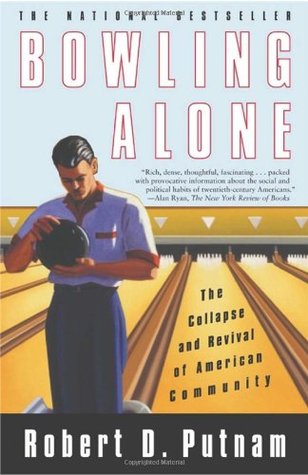
This continued to stick in my mind. In 2002, I read a book called Bowling Alone by Robert D. Putnam. Putnam gathered data from all across America and came to the same conclusions I'd come to after my stint with the Census Bureau:


Most people in America feel alienated, friendless, lonely, alone.


In more recent years I've become deeply disturbed by the climate here in America. During and after the last national election for president, I've been dismayed at the behavior of our leaders, especially our elected president. I was shocked when Donald Trump was elected as our president, and I've been horrified by the words he has spoken to others during his time as president. I don't watch television, but the bits of public life that have filtered down to me fill me with sadness and trepidation.


What is going on in my America?


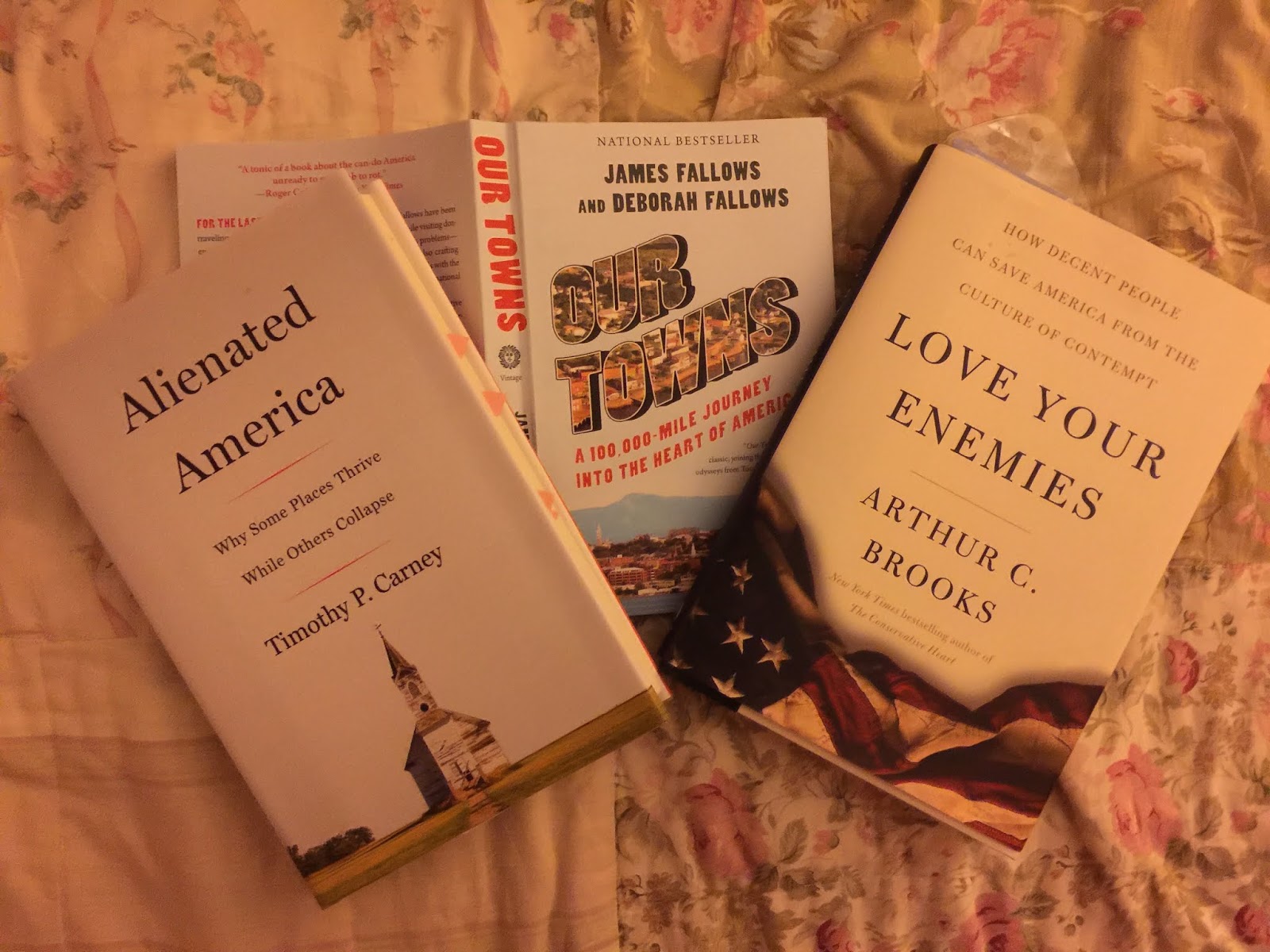
I picked up three books at the recent library conference in Austin that I've been reading in tandem over the past weeks. These books have helped me understand the malaise of the American people. They have helped me think through ways that we can work to change the mood and behavior of the people of our country.  


The three books I read are:


Alienated America: Why Some Places Thrive While Others Collapse by Timothy P. Carney


Our Towns: A 100,000 Journey Into the Heart of America by James M. and Deborah Fallows


Love Your Enemies: How Decent People Can Save America from the Culture of Contempt by Arthur C. Brooks


What have I learned from reading these books? 


Timothy P. Carney looks at the hard, cold facts about America today, especially those who brought Trump into power. The places where Trump scored big are key to understanding why he was elected, Carney tells us. What are those places like?


"Employment is far worse (in these places).... Death rates, especially death by suicide and overdose, correlated with Trump's best counties....Educational attainment is lower in Trump Country. More people are on unemployment. More people are on disability. These economic indicators are devastating, and crucial. But more telling are the social indicators. More men have dropped out of the workforce. Marriage rates are lower. Illegitimacy is higher. Divorce is higher....(Members of this group) said religion was very important to them, but...they were the least likely to go to church."


I found this absolutely fascinating stuff. Trump scores well in places where people are unhappy and communities are weak. 


To add to the problems, the right, Carney tells us, has steadily worked for big businesses over small businesses, deeply weakening community bonds


On the other side, according to Carney, the left has been promoting ideas for years that also build community alienation, stressing overcentralized government programs that provide for the poor at the expense of individuals and local efforts to help the poor, and emphasizing individual freedoms at the expense of the stabilizing effects of marriage and family and church and community on each person.


Arthur C. Brooks, in Love Your Enemies, shares the destructive power of contempt by citing the work of social psychologist and relationship expert John Gottman. Gottman, Brooks tells us, has studied thousands of married couples. After watching a couple interact for just one hour, Gottman can predict with 94 percent accuracy whether a couple will divorce within three years. What is this based on? It isn't the amount of anger a couple expresses, but, instead, it is the amount of contempt one member shows for another. And it is this contempt for one another in political matters that is currently making it impossible for opposing political parties to work together.


So where are we now? Yelling and screaming at each other from positions far to the left or right of our common ground. Cutting off friendships and family connections based on these extreme political positions. 


In short, a mess.


Here is where Arthur C. Brooks takes up the struggle. In his book, Love Your Enemies, Brooks writes: "Deep down, we all know that the polarization we are experiencing in our politics today is toxic. We hate the fighting, the insults, the violence and disrespect."


Brooks shares a powerful story of the rare coming together of political opponents. Black Lives Matter protesters were confronting a group of Trump supporters in Washington, DC. Confrontation was rapidly accelerating into possible violence. 


But then the organizer of the rally unexpectedly offered two minutes of time to the leader of Black Lives Matter. And everything changed. See for yourself what happened: https://youtu.be/xoXwgfYAJFU.


Wow, I thought. Wow. There is hope. 


Brooks shares four rules Gottman offered for bringing people back together. Because we are in such a desperate situation, and because these rules can have a dramatic effect on changing things, I'm sharing them here:


"1. When others are upset about politics, listen to them respectfully. Try to understand their point of view before offering your own. Never listen only to rebut.


 2. In your interactions with others, particularly in areas of disagreement, adopt the 'five-to-one rule,' which he gives couples. Make sure you offer five positive comments for every criticism.


 3. No contempt is ever justified, even if, in the heat of the moment, you think someone deserves it. It is unjustified more often than you know, it is always bad for you, and it will never convince anyone that she is wrong.


 4. Go where people disagree with you and learn from them. That means making new friends and seeing out opinions you know you don't agree with. How to act when you get there? See rules 1 to 3!"


Brooks uses the rest of the book to expand upon these rules and share oodles of great advice for our world, and I'd encourage you to get the book and read it carefully for yourself.


How does Our Towns fit into my study of America? James Fallows and Deborah Fallows spend four years and travel 100,000 miles to visit towns and cities across America to see what is going on in our country. Their book is also a book of hope. In every town and city where they find good things going on, they first see people working together for common goals, both economic and social, building up local businesses, building up local communities, building up schools, rethinking the whats and hows but keeping the whys, and taking pride in what is happening. The two Fallowses offer "10 1/2 Signs of Civic Success" as their takeaway from this adventure. Key to a local community's success is that "people work together on practical local possibilities, rather than allowing bitter disagreements to keep them apart...."


So I've ranted long enough, I think, and it's time for me to start working in my local community to make things better. I feel like I have some solid ideas to work from after reading these three books.


I welcome any thoughts you have about my thoughts here; I'd love to open this into a conversation. Let's move forward, shall we? And can we please move forward together?


Profile Image for Lynn.
3,395 reviews71 followers
April 9, 2019
Conservative Commentator Speaks About White American Alienation

I didn’t realize when I received this book that the author was a Conservative. I read the book but wasn’t swayed by his commentary. He states that the centralization of government and lack of community has caused the communities supporting Trump to be unhappy. I suspect it is lack of economic opportunities and inability to live a life full of the necessities that are harming people. The communities that are most challenged don’t have churches or have ones that are closed are because people have left and the people left have nothing to share. The centralization of the government helped people and allowed more minorities to participate. While the author addresses some of these issues, he clearly sides with a community doing what the choose. The USA has centralization but also decentralized in many ways. Most laws cover minorities that were barred from participating in community government The communities this author mentions are often instates that aren’t we run or as centralized as others.
Profile Image for Trey Grayson.
117 reviews10 followers
March 26, 2019
I’ve been looking forward to reading this book for a long time as Carney is someone who I greatly respect as a writer and political observer. The book met my high expectations.

Carney, citing social scientists, economists and other commentators from all sides of the political spectrum, makes a compelling case for the importance of declining civil society, and the resulting alienation, is the biggest challenge facing an America.

He convincingly finds evidence of the rise of the early support for Trump in this alienation and he shows the important role that churches, synagogues and mosques must play in trying to rebuild our American Dream.

Anyone who is sick of watching people from opposite sides scream at each other on Fox, CNN or MSNBC should read this book for its serious and sober look at the biggest problem facing America.

I highly recommend it.
Profile Image for Simone.
1,753 reviews47 followers
June 24, 2019
So I put this on hold at the library without knowing much more about it than the title. And as someone interested in place and social captial I was interested. So I open up the audiobook, and then like 20 minutes in, I'm like:


And I decide to read the full book description. Whoops. Didn't realize he was a conservative writer. I decided to sally forth and listen to the rest of it. Honestly, that gif of Belle sums up my reaction to the whole book pretty well.

I guess I don't even really know where to start. I agree that there is a decline in civil society, and I also think it has something to do with community, and it certainly improves your feeling of connectedness if you are participating in that civil society. But I think it's more complicated than Carney would have you believe. Let me tell you what Carney thinks will fix this whole problem: attend church. That's it. That's the whole thing.

He can't even conceive of the question--what then might one do if they don't believe in God?--so there's no room for that here. (I think his answer would be: just go to church anyway). Importantly, the idea that religious people should be asked in certain settings to go without their religious beliefs, say in their job or consumer settings, is an anathema to him, the reverse, that people just hang out at churches without religious beliefs is apparently just fine and not imposing on anyone's beliefs. How does he explain people who are very active in their communities but do not attend church? (Spoiler alert, he doesn't seem to have met such a person, and is not interested in understanding why they might feel motivated to help others beyond a framework of religiosity).

But more importantly, there's no close examination here of why exactly these people, especially the poor and working class, for whom apparently the church was such a strong institution stopped attending those same churches. He throws in a chapter about sex and marriage decline, to imply that it's just because of a shift in cultural norms around pre-marital sex and possibly divorce that lead to people not going to church as much, but that makes very little sense. If so many people are turning away from religious institutions, if we have seen a decline in religiosity and civil society over the last 60 years, then something other than free love is afoot.

Carney wants to argue that there's something more happening here than the economy. But as he talks about life in these small towns, ruined by the loss of jobs, industry, and hit hard by opioids, where there are fewer and fewer opportunities, I just found myself thinking it's the economy, stupid. He tries to argue it's not just the economy by looking at a boomtown, which would be like arguing the early Deadwood settlement was a sign that civilization could never take hold in a place dominated by men, gambling and sex. Things did change, but it took time.

He also skirts around the fact that churches are very segregated, sometimes by choice, and sometimes not. There are churches where I might be welcome as a visitor, but not to stay as a member of the community. These segregated churches often belong to and reinforce segregated communities. Carney wants all social help to be provided locally, by people and churches, ignoring that it allows the churches and the people to decide who is worthy of their time and attention and who is not.

It's like this article which I'm going to keep posting until every person on the planet has read it: https://nationalpost.com/opinion/im-b... - certain kinds of giving "feel better" (like giving canned goods) but are actually less helpful in the long run than just giving cash. This feels like this whole book but in microcosm. It's not that people shouldn't give their time and effort, those things are valuable. But they have to be balanced against the greater good, we can't only look for impacts on the local level.
650 reviews10 followers
July 9, 2020
If you’re inclined to be offended by thoughts different than your own, you’ll be offended. If your a rah-rah Trumper, you’ll probably agree. If you’re a critical thinker, open to ideas, you’ll find this an interesting read. There’s a mix of truth, fallacy, facts and oversimplified probabilities. This neither pro nor anti Trump. It paints a picture of a very divided America. And tries hard to explain why.

Most people seem to want to belong, be appreciated, be considered vital, and this alienation gave rise to Trump. This author poses that it’s the decay of social structures, dying industries, secularism, elitist intellectualism, and more.
Profile Image for Drtaxsacto.
703 reviews58 followers
March 1, 2019
William Graham Sumner was a Yale professor in the 1880s who coined the phrase “the forgotten man”. It came from an essay he wrote about the costs of government - the forgotten man was the guy who has to pay for the largesse of politicians; i.e. the taxpayer. When FDR came into office he perverted the meaning by talking about all the people who were suffering during the depression and who he was going to save. Move forward 60 years and Hillary Clinton appropriated an odd meaning of civil society - the support network in the US which DeTocqueville and other marveled at. In the new meaning the “village” that HRC suggested was mostly a series of government programs. A decade later the DNC presented a video of a young woman who from cradle to grave lived off government support and assistance. Timothy Carney’s book examines the costs of declining social capital and its effects on all of us, but most specifically the alienated.

There is no wonder why the topic of restoring civil society is a hot one. Beginning in 2000 (with Robert Putnam’s Bowling Along) and continuing with Charles Murray’s Coming Apart (2012); Yuval Levin’s The Fractured Republic (2016); and J.D. Vance’s Hillbilly Eligy (2016) - a group of writers has explored the decreasing cohesiveness of American society. Timothy Carney’s book would be another on the pile, were it not for a pretty compelling presentation of the numbers around alienation. He starts the story as almost anyone from DC would do - wondering how we got our current president. But his book is a lot more than a postmortem on the 2016 election.

Carney’s book does three things which I think are very useful in this discussion. First, he presents some data on who the Trump voters are and who they are not. It turns out that elite Republicans don’t like Trump (duh!) but Carney does some great dissecting of who these people are. For example, voters of Dutch heritage and Mormons (regardless of economic class) don’t like Trump. Second, he offers a realistic confirmation of the nostrum that when government grows the individual shrinks. He presents evidence that a good part of the decline in civil institutions can be laid on the steps of government. If your local government provides a food kitchen - why bother trying to repeat? He also asserts, I think correctly, that government is either clumsy or malevolent in relation to charities. The Little Sisters of the Poor case, where the Obama Administration argued vociferously for requiring a Catholic Order of Nuns to provide birth control in its health care formulary is but one example. Finally, at the end of the book he offers some credible suggestions about small steps to restore the elements of civil society and thus social cohesion.
Profile Image for Justin.
160 reviews35 followers
August 9, 2020
This is the best book I've read so far this year. People have asked me why I read so much non-fiction. My answer is always, "To gain understanding!" Alienated America certainly succeeds by that measure. I found myself constantly wanting to underline parts, which I never do and can't in this instance because the book belongs to my library! Still, I nearly gave myself over such vandalism because it's just that good. I found it to be incredibly helpful in understanding our times.
Profile Image for Haley Baumeister.
234 reviews302 followers
August 25, 2024
I have heard enough peripheral dialogue about evangelicals and politics for a thousand lifetimes, and I'm amazed that genre is still going. Mercifully, this is not a book about that, but the tie-in to Trump *enthusiasts* (not lukewarm or reluctant voters) was absolutely fascinating. Consider this one more book in the genre chronicling social upheaval, whether that's in the form of changing economics, division, isolation, deaths of despair, the decline in religious affiliation, marriage and children, the crumbling of tight-knit neighborhoods, the loss of free play among children, etc, etc, etc.
These are all facets of similar phenomena, manifesting differently yet exasperating the others.
Carney makes a case for the existence of a very felt experience of the breakdown of social institutions and bonds. Ones which contribute to the rise of many other ills.
Social capital, belonging, trust is necessary for flourishing as we see laid out in Carney's data and investigations. Notably, the most vocal and enthusiastic Trump supporters (when there were other Republicans to choose from) were found to have very low religious involvement, nonexistent institutional or social ties, and felt (are feeling it).
One fascinating finding was the most ardent Trump supporters said religion was very important tot them, yet did not attend or were part of a church. And Carney shows us how religious involvement is truly the last most natural, accessible, and local form on social belonging those of lesser means have, and yet many are not associated with them in any way.
The picture painted for us in grim, and is a reminder that if we don't ever consider our own institutional ties or social capital as being that important to our current well-being... it's probably because those of us fortunate to have them take them for granted.
As with Catherine Pakaluk's book "Hannah's Children" (looking at who is willing to have more children than the cratering birth rates currently show as the norm), Tim Carney ends with an acknowledgment of the importance of religious institutions and church involvement as a starting point to alleviate such grim prospects for a secularizing, isolated, and increasingly desperate country.
Profile Image for Maria.
4,657 reviews116 followers
June 28, 2019
Carney was researching why Trump did well in some Republican primaries and did very poorly in others. His research, and the research that he borrowed from Senator Mike Lee is that places with shrinking or vanishing public services and social cohesion where ripe for the picking. Places where community support and functioning institutions still exist didn't initially vote for Trump.

Why I started this book: Fascinating title and the blurb mentioned my hometown of Salt Lake City.

Why I finished it: This book started out amazingly. It was fresh material and fresh perspectives on who chose Donald Trump and why. But I struggled at the end, because it started to feel like these were different newspaper articles stitched together... repeating themselves because each of them individually had to contain the whole story. Social connects or more importantly the lack of them, make people feel alienated and fearful of the end of America. I didn't agree with his solutions. Carney thinks that more church will make Americans feel like their part of a community again. That problems need to be addressed at the local level. And that all rich parents bring to their schools is volunteer hours. (Schools in America are funded by property taxes. Richer neighborhoods have richer schools.) Other solutions not mentioned, 1. walk-able cities 2. robust library programs and city parks 3. arts and crafts summer programs, 4. federally funded schools that are not dependent on local housing prices, the list can be longer.

Side note: Very interesting that Carney blamed the "elites" for not preaching what they practice, i.e. for not pushing harder for less sexually partners, for waiting to have kids until married and for raising them in a two parent household. However, there was no condemnation of the self-proclaimed Christians who are not practicing what they preach. Blue-color working families are struggling with drug addictions, single parent households and the gig economy.

Read together with: Hillbilly Elegy: A Memoir of a Family and Culture in Crisis, Fantasyland: How America Went Haywire: A 500-Year History, and Going Solo: The Extraordinary Rise and Surprising Appeal of Living Alone.
Profile Image for Tim Elston.
50 reviews1 follower
October 11, 2020
Carney is a devout Catholic, and the premise of his book is fundamentally that America elected Donald Trump because Americans don't go to church enough. Social community and civic society are primarily embodied in church life, and the secularization of American society is the cause of the sense of disconnectedness that triggered the backlash that resulted in Trump's presidency.

Carney questioned the causes of secularization, considering whether it had its foundation in the sexual revolution of the sixties, or post-War economic prosperity or elitist social engineering. What was not considered, however, was the possibility that secularization is a result of a growing awareness of the dubious truth claims of religion and that mythologies grounded in iron age superstitions are gradually losing appeal to a more educated, less anciently moored society.

Carney longs for and advocates a return to church as the antidote to what ails America. Presumably attending one of the many churches whose members passionately support Donald Trump would heal the malady that got him elected.

Carney articulates no vision for secular Americans. He is amply and gratifyingly generous to Christians, Mormons, Catholics, Jews, and Muslims and sees their religious communities as the cure for populist extremism insofar as they give people a sense of wholeness and belonging in civic society. Certainly a society with healthy social connections is to be preferred over one of radical isolation, but a remedy that roots itself in religious adherence without a vision for at least the equal value of forms of secular community is deficient. I and millions like me are not going to go back to church. Any longing for Leave it to Beaver and the white picket fences of middle America cannot outweigh a distaste for tolerating the hollow trappings of religion in barter for a sense of community. What is true need not be purchased by what is seen to be false. Human community, a deep sense of belonging, civic engagement, these all must be attainable without the need to compromise one's secular self to what one sees as false gods, and if this were not the case, in my view, it would be better to die in social isolation than to prostitute oneself in service to a temple of falsehood.

But it doesn't need to be that way. Americans across the country can and do live fulfilling, socially engaged secular lives, and any remedy for the sickness that elevated a narcissistic con man to the highest executive political office needn't require anyone to go back to church. By and large, confessedly secular people didn't vote for him.
Profile Image for Andrew Figueiredo.
351 reviews14 followers
July 18, 2019
“Alienated America” is the kind of book I read as an eBook but am buying a physical copy of because it’s so incredibly good. I’ve spent about the last 4 years reading all sorts of books in an attempt to understand the phenomenon of right-wing populism. Over time, I began to believe that this populist surge arises from a lack of trust in institutions. Carney’s book sums this up in a brilliant way and puts a voice to a lot of what I’ve been thinking for the past few years. He manages to explain so many things in one work that I had wondered about. Frankly, I recommend this to anybody and everybody and I know that I’ll be talking to friends about it in depth.

Carney posits that the rise of Trump is due to alienation, particularly felt by the working class, whose institutions of social capital have been eroded, from unions to the military to bars to churches. Carney focuses especially on the role that social capital plays in social mobility, underlining the importance of religious practice and churches as institutions. Those in the upper class have the means to access social capital and a sense of community through organizations, clubs, etc. However, due to economic and social shifts, these outlets have been closed off to blue-collar America, and churches suffer from both a culture of wholesale secularization and state centralization that crowds out the middle institutions between family and government. The lack of stable jobs, stable marriages, and stable communities causes a turn towards populism and feeling that the American dream is dead. Carney relies heavily on outside research by folks like Raj Chetty, incorporating a number of studies and articles. He also looks at specific communities where Trump did either very well or very poorly in primaries, effectively explaining his base vote. He also overturns both the “economic anxiety” and “racism” arguments that the left spends so much time debating in a nuanced way that acknowledges the legitimacy of some of those arguments. Carney does so by laying out what others propose and then deconstructing these ideas in a pretty non-partisan way.

“Alienated America” worked well in conjunction with many of the other books I’ve read recently. To me, this seems like an argument for upholding it as an important piece of scholarship for understanding populism. Carney builds on Charles Murray’s “Coming Apart” (which I read 3 years ago) and his idea of divergence in things like marriage, divorce, etc between different classes. He also elaborates heavily on J.D. Vance’s Hillbilly Elegy, which is a book I also recommend. Throughout, Carney seems to rebut Lasch’s notion of elites who have given up on traditional stations of life, especially because Carney notes that these elites tend to uphold the old way of living, even if they don’t politicize it. Moreover, his point on factories closing meaning so much more than job losses reminded me of a paragraph from Justin Gest’s “The New Minority: White Working Class Politics in an Age of Immigration and Inequality”. Gest writes on page 10 that “post-traumatic cities were often so wholly dependent on a single company or sector that their sudden closure or downsizing undercut an entire social, political, and economic infrastructure, depriving their vast communities of a sense of stability, power, and certainty”, which dovetails well with Carney’s discussion of economics. Heck, Carney’s argument even reminds me of Dreher’s “Benedict Option” at times. Dreher’s argument for recentering Christian communities around parishes is based on the fundamental notion of the parish as central to community life, a claim Carney explores in some depth. This same claim in fact spurred a research paper I wrote about the Portuguese-American community in Montreal, so it held particular sway with me.

Alienated America stands out to me for its explanatory power. An interesting thing Carney uncovers is why in the GOP primaries it was those who didn’t practice their faith who most backed Donald Trump. This was something I had wondered about for a long time because we saw the same trend in France with Marine Le Pen and lapsed Catholics. Carney's social capital-alienation explanation suggests a common causal node for many nationalistic right-wing populist movements. I’d be interested to see more research on this and if anybody has book suggestions about French populism, I’d love to see them.

Alienated America, pushing back against both unbridled individualism and excessive centralization, is a powerful call for subsidiarity and government recognition of the importance of what Carney refers to as “little platoons”. However, a strength of the work is that it doesn’t just ask for government solutions, and in fact, notes that they may be insufficient. It also calls for those in the upper-middle and upper classes to take part in rebuilding social bonds across classes and in seeding social capital throughout society.
Profile Image for Jack.
104 reviews1 follower
May 24, 2019
This is pop sociology trying to sell an ideology. The author draws a lot of broad, massive conclusions based on extremely limited evidence and vague concepts like "community." The fundamental issue at the center is the sloppy conflation of correlation and causation. Carney is a columnist, not a scientist, and is selling the reemergence of religion as the cure to Trump inclined voters. Good community causes good community causes positive societal health factors causes American Dream causes voting for someone other than Trump. And the author believes that the best "good community" is a religious community because it is easier for poor people to join a church than become an elite and move to Chevy Chase. Every step along this line is extremely complicated yet the author acts as though the undisputed prescription is "build more churches" because he looked at primary Trump supporters and compared Chevy Chase, Maryland to Oostburg, Wisconsin and nulled economic explanations with some guys in North Dakota who just wanted to get laid instead of married. There are real explanations for these questions and obscurantist ideology peddling doesn't help.
Profile Image for Maria Wroblewski.
109 reviews8 followers
March 18, 2019
Some good observations marred by totally debunkable observations. As with many books of this sort there are a lot of repetitions. I gave it 3 stars for the idea that prosperity and the American dream are based in community.
1,053 reviews45 followers
December 22, 2019
There are some interesting points made here, and some ideas I found underwhelming. Carney is a conservative writer who isn't at home with the Trump version of the GOP looking at the appeal of Trump. He wants to look at the appeal of Trump's rhetoric, where he declared the American dream to be dead. He looks at the groups that most strongly supported him in the early primaries - calling them Trump's core supporters. By and large he finds that there is a strong correlation for the most Trump-y places and all kinds of negative indicators on the quality of life: high suicide rates, drug problems, economic problems, closed churches. In these places, the American dream seemed dead, so Trump's words resonated the most. Carney argues that the central problem was the decline of American civic life. We used to have more close-knit communities, but that's gone away. At one point he argues that things like Little League and neighborhood organizations aren't just signs of the American dream - they are the actual dream itself. It isn't just economics, he says. Places that are downtrodden but had a vibrant community life were resistant to Trump in the primaries. This ranged from conservative Dutch towns in the Midwest to Mormon communities out west.

Carney notes studies that show while the most economic studies show that Trump voters weren't worse off than most, geogrphically his support came from places poorly off. Carney argues that it wasn't the opiod addicts who went for Trump, it was their neighbors. People doing OK in places doing poorly were his strongest supporters.

For Carney, the nation needs to revitalize its communities to get better. For him, that means revitalizing its churches. He keeps beating that drum all book long. He argues that rich communities can get by with vibrant secular institutions, but other areas can't. He also dismisses purely economic notions of improvement. Here we run into a serious problem with the book. He dismisses jobs as the way forward by picking one example: Williston, ND. This place is in the middle of an oil boom, but it hasn't created strong local communities. It's just created upheveal. Yeah, that's true of Williston - but Carney is too quick to write it off. How much of Williston's problems are true for all places undergoing an economic boom? For that matter, how much is its problems temporary? California must've had terrible community institutions during the gold rush. Right now, Willison's boom is just a few years old, there isn't much actual housing, and so guys go there temporarily without much family. The longer it lasts, the most roots should get settled, more will settle families, and a community can form from there.

Basically, while a lot of info in this book is well-presented, his conclusions really minimize how central money is to people's lives. (And that's a little odd given how his own book notes that places with more money have less need for religious institutions). Minimizing the importance of economics is a theme in this book. For example, he has one chapter on how increased governmental and economic centralization has crippled local communities. He's got 20 pages on governmental centralization, but then three and a half pages on big business centralization. And frankly, his analysis doesn't really explain why 3 years into his presidency evangelicals are the people most strongly supportive of Trump. Yeah, they weren't his original core supporters and his book is on core supporters - but this shift needs to be explained better.

At times, he'll too quickly assert points without providing enough evidence. He notes the decline of the traditional American family, bringing up all sorts of stats. Then he ponders why. Well, the women's lib movement - and he spends a few pages providing evidence - but he glosses over that too briefly.
Profile Image for Heath.
378 reviews
May 17, 2019
This book ties together much of what I have read in Charles Murray, Yuval Levine, Robert Putnam and others. Indeed, Carney sounds very similar to Putnam in his style of writing. I am fascinated by how much similarity there is between Kuyperean public theology and Roman Catholic. Carney is a big proponent of the Church as an essential component of a functioning civil society, which I appreciate. He also lays out a good framework for how the Church can be a source of immense good in this cultural moment. I highly recommend, this is probably the most impactful volume I will read this year.
286 reviews3 followers
June 2, 2024
Fascinating and Exceptional.

It took me forever to finish, because as a book based on a lot of sociological research, it's not page-turner. Nevertheless, this book put words, data, and nuance to so many of the social phenomena that we can kind of sense in the past 10-15 years, but have trouble describing. A few takeaways:

1.) Not knowing much about this book, I was surprised at how much Donald Trump appeared in the book. What surprised me, was how the author showed how the mass media has interpretted the rise of Trump in overly simplistic terms. He does this in so many ways, but the one that stuck out to me the most was the numerous statistics showing how the most religious communities (measured by people who actually attend church, not just affiliate as 'religious'), were drastically less supportive of Trump in the Republican primaries. Religious, healthy communities, didn't view America as broken, and didn't resonate with Trump's message. When it came to the general election, religious communities (evangelical, Jewish, and Mormon), did vote for Trump when their only other option was Hillary or Biden. The untold story that was interesting was how unsupportive highly religious communities were of Trump when given other conversative options. The highest Trump supporting districts are the most unhealthy communities (economically, unemployment, drug-use, broken families, etc.)

2. The author speaks of the collapse of "third places" in the 21st century that used to bring people together. A third place is somewhere other than home or work, such as church, community organizations, Little Leagues, etc. Even kids sports are not so specialized and travel-oriented, that they don't really bring communities together, but just people who are very similar together.

3. I'm biased here, but the author showed a ton of statistical data about how healthy churches, mosques, synagogues are critical to thriving families and communities.

4. It was really interesting to see the data on some of the most liberal (voting) places in America. They may vote liberal, but they live conservatively when it comes to family. These places have the highest rates of in-tact nuclear families.

5. As I read the book, I was repeatedly grateful for the community I live in. There are so many "third places" and opportunities for community and neighborliness. The author shows how "social capital" (his term) is the essential factor in quality of life. Social capital is having people who care about you and know you. The good life is not capital in a bank account, it's people living in community (and often capital in a bank account correlates).

6. I really appreciated that this guy laid his cards on the table--He's a conservative Catholic--but he really seemed willing to follow where the data led. He was critical of both sides of the aisle when necessary, and also honest about the dark sides of healthy communities.

Again, this book is not a quick read. One of my kids said, "You're still reading that???!!!" But it was excellent.
Profile Image for Abby.
1,648 reviews173 followers
February 7, 2021
“People go to church less and less every year. We belong to fewer organizations than our predecessors did. We know our neighbors less than we did a generation or two ago. We vote less than we did a generation or two ago. Men have fewer jobs than they did a generation or two ago. Men are in the labor force less than they were a generation or two ago. Americans marry less than we did in 1960. We have fewer and fewer children every decade. It all adds up to this: Americans are less attached to society, their neighbors, their communities, other humans. Lacking the environment of a strong community, more Americans lack the scaffolding to climb above their starting point. More Americans lack the support structure that they would need to build a family. More Americans lack role models, and they lack roles. They are displaced persons living in their home country, even in their native state or hometown. They are strangers in their own land.”


3.5 stars, rounded up. Timothy Carney explores the causes of the huge numbers of lonely, isolated, and hopeless Americans who found a strongman in Donald Trump. The paragraph quoted above is the thesis of his book. He makes a compelling case, drawing from a variety of polls, studies, and sources, and I found myself finishing the book with a fuller (and more sympathetic) portrait of the challenging isolation and desperation of many Americans, for whom the “American Dream” really is dead and does not seem to hold any promise of resurrection in their daily lives. Trump’s appeal had long felt like such a mystery to me, and Carney patiently explains that this is because I live in an elite bubble, surrounded by couples with college degrees, strong marriages, and solid social support systems, whether in the form of church or neighborhoods. In other words, I live in a community with strong institutions that undergird almost every facet of my social life. It was hard for me to comprehend that this is not the reality for half the country—and the disappearance of strong social institutions is becoming more common by the day.

Carney is unquestioningly a conservative, but I respected his ability to draw research and insight from both sides of the political spectrum. (It is a shame to me that many of the negative reviews of this book write him off entirely upon discovering that he is conservative, not bothering to actually think about his arguments or acknowledge the fact that he wisely gleans his arguments from Democrats and Republicans alike.) He resists the pull of diving too deep into an ideological hole and is capable of recognizing wisdom from the right and the left (a quality that seems increasingly rare today).

Some points deducted because of the repetitiveness of his arguments; the book could have been half this long. He repeats several anecdotes and lines multiple times, as if the reader must surely suffer from amnesia and would need to hear the exact same example or exact same argument again and again. I confess I am not sure how this ended up on my to-read list, because none of the progressive sources I typically read would have recommended it to me, but I am glad I did read it.
Profile Image for Leslie (PaperAndKindness).
94 reviews6 followers
December 2, 2024
Parts of the book were repetitive, but the core thesis, that Americans are turning towards authoritarianism as a replacement for community, was well explained.
Profile Image for Kyra.
306 reviews
January 19, 2021
I think everyone should read this book. Probably about 20 pages into the book, I was calling people to tell them to read this book. If you've heard from me that you should read this book, I just wanted to confirm that I have now finished it and still think that you should read it. It's so good. And I'm not just saying that because of the heavy emphasis on how wonderful Iowa is (or at least, how wonderful our Dutch people are) (while not Dutch, I also very much appreciate how great the Dutch Iowan people are) (Carney also really liked Evangelicals so I still felt appreciated) (and the Germans. He also gave some shout-outs to the Germans).

Essentially, the solution Carney provides (I won't spoil it) (because I do really want you to read this book) (also his solution(s) are pretty detailed and I probably couldn't give them adequate credit in this blurb) is a compilation of a bunch of concepts that I've been thinking about a lot recently. I'm thrilled that someone is vocalizing the ideas in a coherent way while providing clear and tangible solutions to implement them. Also, I acknowledge that this book emphasized its purpose in "explaining the Trump voter in the Republican primaries," which it did. Yes, it absolutely fleshed through those discussions and put together a coherent case for what caused (or, in some cases, prohibited) Trump's success in the primaries/caucuses. But beyond this, I saw this book as "how to fix American society," because that's what it morphed into at the end - "overcoming alienation." Especially with books like "Why Liberalism Failed," we need solutions to the increasingly individualistic American culture. Plus, I loved his discussion of how there may be policy solutions, but it really starts on the individual level. It prevents the reader from committing the same error that perpetuated this problem and shifting community up to the government. Instead, it starts with us. The ending made me want to run to my church and start up some committees. Carney kept quoting this verse from Jeremiah, which I really liked and will share with you here:

"Also, seek the peace and prosperity of the city to which I have carried you into exile. Pray to the LORD for it, because if it prospers, you too will prosper."

As a side note, I have never actually watched Seinfeld, but I feel as if I have watched it through the proxy of my parents quoting it to me. Throughout this book, the clip of the short one (...George?) asking people for the time and being unable to get a response, then yelling "WE ARE LIVING IN A SOCIETY" ran through my head, almost as if on a loop.

Anyhow, you should read this book. Specifically @ my book club (hello, one of my fav institutions!), please read this and then send me live updates as you go along. Also thanks to the many people who put up with me sending them Snapchats of this book as I went (it's so good!) A final shout-out to Holly Hiemstra, who went to DMCS with me & who was referenced when Carney talked about meeting students at Dordt. That was a cool moment. What a small world.
Profile Image for Michael.
115 reviews11 followers
December 29, 2019
This was recommended by my mom and it has an interesting premise: that the first people to support Trump can be identified by finding those places where the American Dream is dead and that today, the American Dream is only alive if you are either economically well off or, if you're not economically stable, attend church regularly. It's also a premise that, if you've been following the cottage industry of essays that have popped up since Trump became President attempting to explain the Trump voter, isn't that original but is more nuanced and a better supported argument about their motivation than most. Carney examines counties where the American Dream is thriving and what he finds is that these communities are fairly homogeneous, have high incomes, and have a thriving public square, like rec teams, volunteering, community groups, religious institutions, etc. He also presents that the American Dream is more likely to be attainable by those who follow a specific pattern: find a job, get married, have kids. Ultimately, his entire argument hinges on the assertion that attending church and having a strong religious community for support is what keeps a community strong and makes people more hopeful about their future and their place in America. Which is true, but, the other argument he somewhat glosses over in his haste to present his main claim, is that people who make up to 75k a year claim an increase in happiness as well. And since, not everyone can make that much, their next best option for happiness and community is the church. Not to get too Marxist here, but why is it automatically assumed that only those with a certain bank balance are capable of supporting the institutions capable of building and maintaining strong communities? And if that is the case, why is that considered default? What is it about our current economic system that makes it so hostile to building community? Isolation and alienation are a constant theme throughout the book and a reason, Carney claims, for the rise of Trump. I agree with him. What I disagree is with his claim that we can somehow pray the alienation away while not addressing the economic system we are slaves to and that actively works to undermine our humanity and ultimately our ability to create meaningful connections with each other.
Profile Image for Thing Two.
995 reviews48 followers
July 26, 2019
Even though this author is an editor at the—conservative—Washington Examiner, and one of the book blurbs is by—conservative—Jason Chaffetz, author of—eye roll—The Deep State, and the author cannot help from pointing out to the reader which are the liberal and/or leftist publications, I still found this book extremely valuable.

Carney takes studies by contemporary writers like Robert Putnam, William Julius Wilson, Charles Murray, and research from the economists Raj Chetty, who studied social capital, Melissa Kearney, Brad Wilcox, and Andrew Cherkin, who studied the relationships among family structure, community, and social well-being, to try to find out who the early Trump supporters were, and what to do about them.

Carney’s work shows a direct relationship between a lack of connectedness, a lack of community, and an early support of a candidate whose screed is “The American Dream is dead,” which was an original campaign slogan of our current monster-in-chief. Communities with the fewest social clubs, sports teams, and churches also have the fewest two-parent families, the most alienated people (I.e. unemployed men living alone who stay indoors and watch tv all day/night) and were, in 2016, the most likely to support Trump over other Republican candidates in the primaries. Don’t go to the coffee shops in rural communities to interview the Trump supporter—those people have found a “third space” to commune with others. Instead, follow the mail truck to see who is getting monthly disability checks; hang out at the pharmacy to see who’s getting their opioid prescription refilled—that’s who you ask “Why? Why? Why did you do this to us?”

And the answer? Because our current society has alienated them. For a variety of reasons—to be more inclusive, to be less segregated, to have more gender parity, to be more educated—all absolutely necessary!—have had the net effect of leaving behind a segment of white America.

What to do? “You should go to church,” says Carney, because the church (or the mosque or the synagogue) is the cheapest and most accessible place to find community. “Also, you should start a T-ball team. You should create an institution, such as a weekly coffee meeting with other old guys in your town. You should attach yourself to a little platoon and volunteer there. You should spend less time watching cable networks and more time asking after your neighbors.” (Page 285)

It turns out Hillary was right. It does take a village.
Profile Image for Jacob O'connor.
1,652 reviews26 followers
August 27, 2019
Of all the "this is what went wrong with America" books, I like Carney's insight the best. We were made to live in community, but those bedrock institutions are fading. Families, neighborhoods, and churches. The older I get, the more I realize how dependent I am on others. Just as it should be.


Notes:

The book is about how Trump got elected.

Trump did well in areas where "the American Dream" seems out of reach. He bombed where people had a sense it was attainable.

Strong families are the precondition for the good life.

Trump did better among those who didn't go to church

Most actions that require virtue are "inter-actions". Personal note: I like this insight.

Virtue is easier to maintain in a supportive environment.

Good response to "good ol' days". Those days weren't so good for women, blacks, etc

Carney makes a good case that much of what ended "the good ol days" was progress! Inefficient processes replaced by efficient ones (5:34)

Stagnation (6:11)

Cultural resentment (6:21)

The Left and Right agree with the statistics. Marriage is in decline. Progressives just don't think it's a problem (7:5)

Statistically, the women who get married the "traditional" way are more successful (7:11)

Broken families correlate against upward mobility (7:41)

The erosion of community killed marriage (7:45)

"You didn't build that" Is American individualism justified? (11:4)

Secularism gave us Trump (12:50)

The best reason to go to college and get a degree is to get into the networks (13:27)

Elites today lack the courage to preach what they practice (13:8)

What if what the working class need most is not a check from a government but inclusion in community. and what if the most accessible form of community, the church, is under constant assault by both culture and the government, and what if the elites refuse to include them because they're "deplorables"? (13:40)

Utah has the highest upward mobility


Profile Image for Kathryn.
316 reviews
June 12, 2019
I’ve been struggling with how to sum up this book; however, immediately upon finishing it I emailed this to two of my pastors. Perhaps this will suffice as a review:

“...While it might seem like a political book at first because it explores parts of the country that did and didn’t vote for Trump, it is really so much more than that. It explores the critical roles churches have/had in our communities, and as people turn away from churches, they feel more alienated from society.

I got my copy from the library and I’m returning it today. So, so good. I think you’d enjoy it and be encouraged by how important the role of the church is in thriving communities.

My husband let me read it aloud to him on a recent road trip. We had great discussions on the topics presented in the book...”

Seriously though, it’s a great book that put a lot of politics in perspective for me, particularly the 2016 caucuses and election. It most certainly doesn’t hurt that the author references Iowa quite often (we are sure proud of our caucus!) and the Dutch communities here.

I sent a similar text to my social studies teacher friends encouraging them to read this. It truly is a great book with food for thought.
Profile Image for Doni.
666 reviews
August 24, 2019
I had trouble getting into this at first because I disagreed with the author's Libertarian assumptions. But I found that he differentiated liberals and conservatives in ways I hadn't thought about before. One example, is that liberals tend to focus on solidarity while conservatives tend to focus on subsidarity. Subsidarity is the idea that there are specific levels of society that should address different issues. Carney argued that relying on government to heal social ills actually takes away from the more local community organizations that could deals with these ills more effectively. I'm still tossing around that idea. It seems to me like we can use all the help we can get towards treating humans fairly and salvaging our too-long neglected environment. He offered richly-researched analysis of the constituencies that did or did not vote for Trump in the primaries, to avoid falling into partisan generalizations. He found that those people who attended church regularly were the ones who Trump's "death of the American Dream" spiel did not go over well. On the other hand, those who considered themselves religious but did not attend church regularly, did vote for Trump. Overall, I would say it was worth the read.
Profile Image for Russel Henderson.
725 reviews9 followers
March 1, 2019
Important look at our social and political malaise that treats it first and perhaps foremost as the consequence of the decline of civil society. Where Carney shines is his inclusion of church not merely as a spiritual salve (though he certainly highlights that role) but rather as an indispensable element of that civil society. Carney argues provocatively that secularization bears much responsibility for the decline of civil society and civic virtue. Carney wields a great deal of social science data in service of this and other points, and he occasionally wields that data awkwardly or in support of conclusions about which he is perhaps more enthusiastic than is the data. But I see his central insights as sound and important. His book is not expressly about Trumpism but of course no such book can avoid the Orange elephant in the room. But his quest for the alienated and the disaffected, and his insight into common threads both in Trump's appeal and in resistance to him, makes the book well worth the read. If we are to understand deaths of despair, polarization, and the seeming loss of cohesion in America, Carney's volume is a superb starting point.
18 reviews
March 11, 2019
In a slew of books on the sociology behind the 2016 presidential election this one stands out as especially well researched. The author relies on all sorts of evidence, including voting behavior down to the precinct level, well selected empirical academic studies, arguments from a range of other books, and more. And he employs it all to make a convincing argument on the pervasive sense of alienation caused by the systematic hollowing out of the American civil society in the past half a century.

The book does not cover everything. Internet and communication technology likely played a vital role in both alienation and political mobilization of recent years but the author largely ignores them. Also, there are often various iterations of essentially the same argument and even some literal repetition in the book. And, even though the author genuinely tries to be neutral and impartial he comes off as arrogant because, like so many journalists today, he talks of having voted for Trump as a condition that needs explaining. But these are really minor quibbles. If you want to understand what is happening in America today, this book is well worth your time.
1,685 reviews
July 26, 2019
Everyone ought to read this book, seriously. It covers work. It covers marriage. It covers civil society and mediating institutions. It covers immigration. It covers the middle class. It covers the elites. It covers the opioid epidemic. It covers the rise of Trump. It covers the need for strong churches. It covers outsourcing. It covers the American dream. It is full of social science and statistics, but also interviews and travels from around the country. It is optimistic about the potential in this country. It is pessimistic about the choices we have made. It puts faces on those in the basket of deplorables without making excuses for many of their lifestyles. It something like a stethoscope right on the heart of this 330 million-person country.
Profile Image for Anna.
122 reviews42 followers
October 9, 2019
OK, there are some interesting items around the demographics of Trump voters (they’re not uneducated/poor voters, but rather people surrounded by uneducated/poor voters, which is interesting). But by the time you get to the middle of the book, it becomes super obvious that the author has a huge boner for “everyone should go to church” and “actually, birth control is abortion” and I COULD NOT HANDLE ANY MORE.
Profile Image for Lara Ryd.
109 reviews36 followers
July 24, 2019
This book is incredibly insightful and taught me a lot about the community I live in. I've recommended it to many people. Carney is very thorough in his research. Certainly worth reading. I do think the book could be 2/3 of its length... it's hard to be thorough without being repetitive, and I often found Carney repeating himself.
Displaying 1 - 30 of 225 reviews

Can't find what you're looking for?

Get help and learn more about the design.