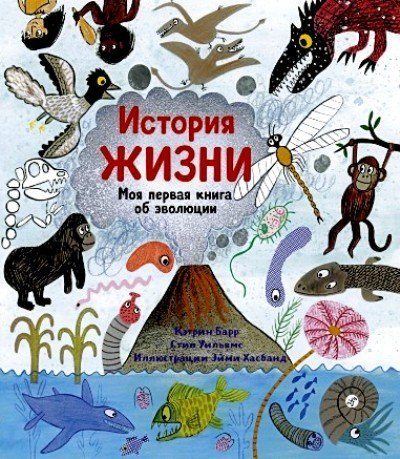
Как возникла жизнь на Земле? Каким образом из клетки - крохотного бесформенного комочка - получились рыбы, птицы, звери и мы сами? Поразительная история жизни на нашей планете рассказана простым языком и отлично проиллюстрирована для детей младшего возраста. Для дошкольного и младшего школьного возраста.
I was inspired to write my first book The Story of Life by my two girls, for whom I searched in vain for the story (rather than a text book) of evolution – in 2015. Previous to unexpectedly becoming a children's author, I worked for Greenpeace International as a campaigner on wildlife issues for many years, before becoming an Editor at the Natural History Museum in London, where I wrote summer exhibitions on Myths, Monsters and Dinosaurs. I now write narrative nonfiction that I hope will spark questions, interest and action.
I am a proud Patron of Reading for a local school and visit schools and festivals with workshops inspired by my books. I love what I do and hope my books inspire curious and challenging conversations, as well as wonder for the natural world.
Reread with the kids and I still love this one. It's great for younger kids (maybe 5-8) providing just enough information, but not overwhelming. From there you could deep dive into some topics from the book with older kids after reading this one as an overview.
The illustrations in this book are stunning, my kids and I adored the playful mixed media nature of the art. It was honestly the illustrations that inspired me to buy this book as well already had several prehistory/evolution books on our shelves. The kids love sitting there and studying the illustrations on each page. :)
Bardzo miła dla oka i przystępna dla młodszego czytelnika książka o tym, jak powstał świat, jak zaczęło się życie na Ziemi i w jakim kierunku zmierzała i nadal zmierza ewolucja.
Catherine Barr i Steve Williams ponownie operują językiem bardzo prostym i przyjemnym w odbiorze, dzięki czemu dziecko jest w stanie zrozumieć (z drobnymi wyjaśnieniami) o co dokładnie chodzi.
Tak jak w "Historii kosmosu" - świetne obrazki ukazujące wszystkie etapy przemian i organizmów żywych na przestrzeni lat. Dziecko widząc obrazki, które samo byłoby w stanie stworzyć własną ręką, wydaje się bardziej chętne i skupione na lekturze.
Tak jak poprzednie dzieło pary autorów - również czytałem z czterolatkiem i zauważyłem takie same zainteresowanie historią kosmosu, jak i historią życia, więc książka jak najbardziej spełnia swoją rolę.
Very handy for answering the difficult questions: 'Who was the first person on earth? and if they were first who were their parents?' my daughter demanded to know, I tried to explain but soon realised that my own understanding of the origins of life and evolution was a bit patchy. This book is a great resourse. I found the rustic illustrations to be simple and charming, and very helpful in explaining and adding colour to the text. The explaination of the story of the origins of life and our evolution is clearly told in language that kids understand. I did feel that some concets were oversimplified - I would have liked more info about what is described as the 'tiny floating bits' that were the origin of life, I find this aspect - the origin of the first cell, quite fascinating and i am sure my kids would too. Overall a very usefull book, fun to read and absolulty accesible. My kids will read and talk about it amongst thereselves and my daughter now considers her questions answered.
First off, I love the illustrations in this book and the fact that the illustrations are labeled with words like volcano, lava, and meteoroids. It provides great, clear explanations for science terms that may come off as intimidating to students. Another fun feature in this book is the time reference points listed on the bottom of the page. At the back of the book is a glossary, which students can refer to throughout the book. One potential drawback is the location of the texts- some of the pages are overwhelming and overloaded with text which can be confusing to follow. I could see this as a supplementary text for students who are looking for more of a challenge, but I am not sure if or how I would use this in a whole group setting.
Un libro sencillo para explicar un tema complejo, con el mérito de no dictar cátedara sino "bajar" de la teoría a una manera de contar cercana a los más chicos. De hecho, las ilustraciones son (o parecen) realizadas por niños, con trazos toscos y esquemáticos, sobre todo a la hora de colorear.
Me parece que está dirigido a lectores de 8-10 años, aunque me imagino que requiere la mediación de parte de un adulto para aclarar dudas o conceptos. Tiene un glosario al final y línea de tiempo (además hay una indicación temporal en cada doble página).
También tiene una cuota de humor y entrega un claro mensaje "Los seres vivos se necesitan unos a otros para sobrevivir, por eso nuestro desafío común es cuidar este planeta azul y verde que es nuestro hogar".
Concise without feeling condescending, Husband provides wonderfully captivating illustrations that will keep kids hooked as the text adds meaning and depth to the first forms of life all the way through to homo sapiens.
Right, first there were some volcanoes and then in the water some small bits came together and the first life appeared on earth. Well, by life I mean a small blob. Then these blobs got bigger and some became animals - let’s call them fish. Some fish with weird fins that looked like legs waddled onto land and creatures started living in swamps and forests. Then there was a big disaster and everything died - no one really knows what happens. When I say everything, I mean everything apart from some lizards who laid some eggs which meant more lizards and the lizards kept getting bigger and they became dinosaurs. There was also the appearance of some furry creatures (these were the first mammals and they are kind of important). A meteorite crashed into earth and everything died again. Well almost everything, this time the furry animals survived (told you they were important). These furry animals evolved into monkeys and apes and then into the first humans. The humans didn’t want to stay in one place so they walked off in search of food and new places to live. And finally there were humans everywhere…phew!
The Story of Life starts off 4.5 billion years ago when nothing lived on earth and the air was filled with the smell and noise of erupting volcanoes. From this opening, readers are then taken on a journey through a further fourteen double page spreads that include the first signs of life on earth, life forming in the oceans, the dinosaurs, an icy darkness, monkeys and apes, and finally to humans.
In 4.5 billion years a lot has happened. The Story of Life does a great job of detailing significant periods of evolution and making a tricky concept understandable and accessible to young readers. Each double page spread is fully illustrated, annotated and labelled. Simple explanations chart the progression of evolution and a timeline charts the moving of time on the bottom of the page. The book is visually appealing and the illustrations are playful and have lots of detail.
The most important double page spread is the last one, and it is the one that depicts today. After journeying through 4.5 billion years readers will learn that humans are the only ones in the whole of history who have and are actively destroying their own planet, killing off plants and animals and having an impact on the climate.
The Story of Life is the perfect book for minds that are curious about Earth and it helps answer some of life’s big questions. It is filled with interesting information and will appeal to a wide age-range of readers.
The book I read this month was The Story of Life: A First Book about Evolution by Catherine Barr and Steve Williams. It is nonfiction and is not part of any series. The book is about how evolution happened on Earth, from cells to fish to lizards to dinosaurs, etc., until we got to where we are today. The main theme of the book is to educate on how evolution happened, and also to shine light on how we are destroying our planet due to climate change, and how we are causing the extinction of many plants and animals. The authors wrote this book in a way that is very educational and informative, but also easy to understand for all ages. It is very accurate, according to science, and goes over tons of the different organisms we've had on earth and how they evolved. Both authors are very qualified on the topic. Barr studied Ecology at Leeds University and worked as a wildlife and forestry campaigner. Williams is a biologist and has a degree in Marine Biology and Applied Zoology from the University of Wales. After reading The Story of Life: A First Book about Evolution, my understanding of evolution and science definitely increased. The strengths of the book for me were the artwork, done by Amy Husband, and how fun it was to read. The weaknesses of the book for me were that it could've been longer, and I wish there was more text on each page, so that I could've learned more. I think this book will leave an impression on me for sure, because it made me think not only about how we came to be as humans, but also about how climate change is ruining the planet. Overall, I really enjoyed this book and I would recommend it to anyone who is interested in the planet and how we evolved into what we are now. I give this book four out of five stars.
I think this book does an excellent job breaking down a complex scientific topic for the 5-8 year old age range. The narrative is organized and easy to follow -- it makes for a great read aloud where a reader and the child(ren) can have further discussions. I think in general the amount of text is spot on but certainly could feel excessive for the young crew in this age group.
That said, the text is so nicely paired with engaging illustrations, there is a lot to hold interest and take in as you flip each page. The illustrations are playful, sometimes includes little quote bubbles. I appreciate that the timelines are made clear on each page in the bottom corner.
I do think there is some oversimplification here of evolutionary concepts and changing life on Earth; but, that's inevitable in ANY attempt to break down these concepts and timeline for young children! Overall I think this book is successful at what it sets out to do.
***Note: I was given a review copy of this book by Quarto Kids. Opinions are my own.
"The Story of Life: A First Book about Evolution" by Catherine Barr, Steve Williams, and Amy Husband was an unexpected but enriching read. The authors' use of approachable language and Husband's vibrant illustrations create a compelling journey through the evolution of life on Earth. Although not really on a college level, the book's educational value is evident, especially for elementary-level readers. The absence of awards does not diminish its role as an important resource, and the inclusion of a timeline demonstrates an effort to enhance the learning experience. Exploring this introductory work served as a reminder of the importance of fostering a love for science in younger generations.
For young readers The Story of Life can become a useful tool for understanding the history of life on our planet and for figuring out what concepts like evolution, extinction, photosynthesis or survival are. The language is accessible and the illustrations do a great job to support the explanations.
Initially, there was no life on Earth, until gas exploded from volcanoes and "oceans of lava bubbled around the globe". The book will then explain what happened from the first forms of life that appeared billions of years ago to complex creatures that now populate the Blue Planet.
If you little one is interested in learning about how animals and humans came to be, this book provides the most recent scientific answers. We liked this book quite a bit - even my 3 year old listened and absorbed intently - as the pictures are just so kid-friendly and beautiful. This book starts 4.5 billion years ago instead of at the Big Bang, like many other evolution books do. But, I kind of liked that since it had a clear focus on the beginnings of life vs. the beginnings of the entire universe and life.
An amazing book which illustrates the beginning of earth, this book covers volcanoes, meteorites, dinosaurs and them going extinct, the first people, the first animals and so on. Alongside the gorgeous illustrations is key words in text boxes all around the images as well as a really useful glossary at the end of the book which then defines all of these key terms.
This is a very good book. I liked reading it because it taught me a lot of history and science. I learned about our earth and the first animals and plants and how they evolved. It told about the ice ages and the big changes to life. It was a very fun book.
Bite sized text and explanations for young readers. A good jumping off point. There isn't a ton of detail, but it was a great conversation starter and isn't overwhelming. My kid loved the pictures.
ATA Wonder Kit -- Beth is going to look at it. -- Science
Note: Children could create a timeline using this book. HCPL Juv Nonfiction 576.8 Bar
At first, nothing lived on Earth. It was a noisy, hot, scary place. Choking gas exploded from volcanoes and oceans of lava bubbled around the globe... Then in the deep, dark ocean, something amazing happened. This is an exciting and dramatic story about how life began and developed on Planet Earth, written especially for younger children.
The authors explain how the first living cell was created, and how the cells multiply and create jellyfish and worms, and then fish with bendy necks, which drag themselves out of the water into swampy forests. They tell the story of the biggest creatures that have ever walked on land - the dinosaurs. Long after that, hairy creatures who have babies, not eggs, take over, stand on two legs and spread around the world, some of them living through cataclysmic events such as ice ages and volcanic eruptions. Everyone living today is related to these survivors. With delightful illustrations including lots of detail and humour, all carefully researched and checked, this book shows the development of life on Earth in a truly accessible and simple way.
Subject: Evolution (Biology) -- Juvenile literature
CATHERINE BARR studied Ecology at Leeds University and trained as a journalist. She worked at Greenpeace International for seven years as a wildlife and forestry campaigner and has a long-running interest in environmental issues. While working as an editor at the Natural History Museum, she researched and wrote two major summer exhibitions: Dinosaurs of the Gobi Desert and Myths and Monsters. She is now a partner in communications company bwa design. She lives on a hill near Hay-on-Wye in Herefordshire with her partner and two daughters.
STEVE WILLIAMS is a biologist with a degree in Marine Biology and Applied Zoology from the University of Wales. His lifelong love of wildlife was further inspired by eight years at sea, after which he trained as a teacher, and now teaches science in a rural comprehensive school in Wales. He is a beekeeper and lives near Hay-on-Wye with his wife and two daughters.
AMY HUSBAND studied Graphic Art at Liverpool School of Art. Her first picture book, Dear Miss, was winner of the Cambridgeshire Children's Picture Book Award in 2010, and she also wrote and illustrated Dear Santa, in the same series. Amy lives in York with her partner, working in a studio with views of York Minster. The Story of Life is her first book for Frances Lincoln.
Starting before there was life on earth, this nonfiction picture book takes readers on a journey from 4.5 billion years ago to today. Volcanoes and black ocean water with some areas that were warm from underwater volcanoes created the tiny bits that formed the basis of life. Cells started growing, some using sunlight, water and oxygen that changed the very earth itself. Over millions of years, cells developed into different forms of life and became the first animals. The seas became full of life and animals and plants started to expand to the land. Then an unknown disaster hit and most of the life on earth was destroyed. It became cold and dark, giving a chance for huge dinosaurs to emerge and take over. Millions of years passed again and insects and mammals appeared. A meteor hit the world though, and then it was time for the mammals to survive. Humans evolved from those mammals and spread across the world, bringing us to the present day.
This basic look at evolution offers a sense of the length of time that it has taken to get us from basic cells to humans today. On each two-page spread there is information on how long ago this scene was taking place. The text on the page has lots of information on the changes happening, the progress towards new life, and also the series of disasters that has caused sudden death on the planet. This is a fascinating look at evolution that is appropriate for even preschool children to begin to understand the science that created life on earth.
The illustrations by Husband are playful and fun. They add a lighthearted touch to the serious scientific information. At the same time, they are have scientific labels for important objects and ideas that let children better understand the progress of evolution that they are learning about.
A strong picture book that explores evolution and will inspire children to learn even more about prehistoric times. Appropriate for ages 4-7.