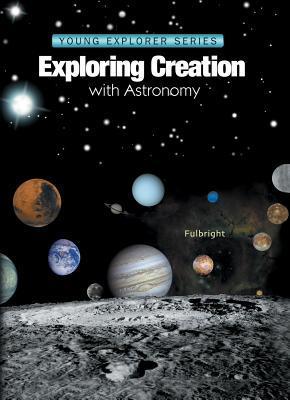
What would living on Venus be like? Are there really black holes? How did God create the cosmos? Curious kids want to know! This book covers the major structures of our solar system, starting with the sun and working towards Pluto. Along the way, the student will also learn about Earth s moon, the asteroid belt, and the Kuiper belt. After that, students will move outside our solar system and learn about the stars and galaxies that make up God's incredible universe. Finally, the student will learn about space travel and what it takes to be an astronaut. The activities and projects use easy-to-find household items to make the lessons come alive! Activities include simulating the use of radar to reveal a hidden landscape, making a telescope, and making an astrometer to measure the brightness of a star.
Jeannie Fulbright, veteran homeschooler of more than 20 years, is the author of the best-selling, multi award-winning Apologia elementary science series: Exploring Creation with Astronomy, Chemistry and Physics, Botany, Zoology, and Anatomy & Physiology. She is also the author of the Charlotte Mason Heirloom Planner, an action-packed historical kid’s time travel book series Rumble Tumbles Through Time, as well as the Mason Jar Manna preschool science books and activity kits, the Charlotte Mason Heirloom Planner, and many Charlotte Mason education necessities. She is also writing The Chronicles of Liberty with Angela O’dell, picture books that teach about the founding of our country, the Constitution, and Government.
Jeannie and her husband Jeff, a practicing lawyer, became empty nesters in 2019. All four of their children went to the University of Georgia on scholarship (Yes! Homeschooling works!) For more than 20 years Jeannie has traveled around the country speaking to homeschoolers at conventions, covering a plethora of topics from Charlotte Mason homeschooling and college prep and teaching science and developing a powerful prayer life.
Jeannie grew up in Austin, Texas and received her Bachelor of Arts from the University of Texas at Austin and her Master of Fine Arts in Creative Writing from Fairfield University. She is also a Certified Christian Life Coach and is dedicated to serving the homeschool community through her books, blog, articles, speaking engagements, and podcasts.
Jeannie loves to connect with fellow homeschoolers. In addition to her website, you can find Jeannie on Instagram, Pinterest, her Facebook page or her Charlotte Mason Christian Homeschoolers Facebook Page and Group, as well as on the Homeschool Solutions Show podcast where she hosts once a month.
Read this to pieces when I was a kid. Needs some updating now since New Horizons reached Pluto a few years ago. (Boy, that was exciting! And yes, I did the whole tracking thing! 😃)
This is our favorite science course of all we have done in homeschooling so far. It’s easy to read and so interesting, keeping all of us well intrigued. We learned SO much! The kids also really loved doing the journals made to go along with this textbook.
Astronomy from a creationist’s perspective. This was our science/nature read-aloud and it was fun, interesting, never dry and held attention of ages 5 to 14! We’re wrapping up this unit with a visit to the planetarium.
Exploring Creation with Astronomy is an excellent text book crammed full of information and it is easy to use. Each chapter is divided into sections that are short enough to cover in even 15 minutes. Depending on the amount of time I had to teach science on a particular day, I could cover as many sections as I wanted and have a good stopping point at the end of each time.
The information packed into this text book is amazing, especially for grade school age children. It is complex and yet my 8 and 10 year old children were able to understand it and later explain what they had learned. Thermonuclear fusion, magnetosphere, meteoroids, asteroids and comets were some of the things that my children were able to discuss in detail even months after having learned about it from this book. There are online sources available with this book where we were able to see more of the things mentioned in the book. The book has a lot of photos and diagrams which really help make the book useable for grade school students.
Throughout the year each of my children kept their own notebook of notes and diagrams on each chapter. I think that really cemented all the facts in their minds.
The one problem I had with the book was the introduction. The student in the introduction, I believe in an effort to be politically correct, kept changing gender. Initially referred to as "he" in the next paragraph would become a "she" and then switch back to "he". I found that distracting but thankfully it did not continue in the chapter text.
The book is thoroughly Christian and so gives God the glory for the creation of the universe and planets and stars and sun and moon and...
Originally posted on Creative Madness Mama.Ever since the very beginning of my homeschooling journey, including the years before my first child was born I knew that I would be pursuing a teacher/book relationship with the Apologia Exploring Creation series from Apologia Educational Ministries ~ (http://www.apologia.com/). As my oldest daughter got closer to the age where I felt she would really comprehend the texts I found myself excited and started collecting the entire series. Last year, we started studying Astronomy with the first edition book from Apologia. My daughter was working at her own pace through the junior notebooking journal and her little sister was always begging to color pages too. When the review slot for Apologia came around I jumped and begged and pleaded to be included in this review, and by the blessing of the crew and Apologia we were sent Exploring Creation with Astronomy, 2nd Edition in all it's glory!
As the title offers exploration, oh boy, did the book take me on a ride throughout our solar system.
My mom bought this book for us (the children) a really long time ago. I was homeschooled, and books like these offer knowledge that is not dumbed down, but instead tailored to fit the vocabulary and tone of children. As a kid, I studied about halfway through the book. 15-18 years later, the adult me read it from start to finish.
The important knowledge that expands one's critical thinking and observation skills is explained with purpose and intention. Yet, the reader does not need to take it so seriously to fully grasp the book's content. Allow me to explain with an example: there is no need to memorise what elements the atmosphere of planets is made of; instead, the book points out observations of how thick, rough or empty the atmosphere of the planets are, then it details the elements and physics that make up these characteristics. This pathway or chain-link in delivering knowledge helps the information stick in my brain. Neptune and Uranus are blue because they have high amounts of Methane!
My two favourite chapters are the comet chapter and the stars chapter. Comets are beautiful, and I grew up fantasising about witnessing comets which I thought were shooting stars, but now I know shooting stars are actually meteors falling into our atmosphere, burning up. Stars are remarkable and such a mystery. The book did not say mankind has been able to send probes near a star (other than our Sun, I'm guessing), so that makes the stars we admire high in the sky, perpetually far (and I mean this scientifically because the universe is expanding infinitely, so the stars are getting even further and further).
One more point I'd like to add for this book: it felt like travelling back to the past. The book was published at a time when there was little information about Pluto, the spacecraft New Horizons heading towards Pluto had just launched, and the best picture of Pluto was very pixelated. Now, about 20 years later, there is an abundance of information on Pluto, the unmanned spacecraft New Horizons flew by Pluto 10 years ago, and true HD pictures of Pluto exist, which are mesmerising.
A last thing I'll add (I'm talking so much about this book because I simply love it) is the teachings of Christianity laced in that don't hinder the learning process, nor does it sway the reader to be biased. I am religious, but I am not a Christian, yet I was able to internalise some of its teachings. Teachings such as the moments where the book tells the reader to appreciate God's work of outer space, and that I did. Regarding the Bible verses the book chipped in here and there, I took it as more of a history lesson and exposure to other religions, which I appreciated too.
5/5 because it is extremely difficult to explain complex theories and advanced science in such a digestible manner. If you cannot explain it well, you don't understand it well, and the author indeed understands Astronomy well.
I thoroughly enjoyed reading this with Kaspar for his science! Aly used a few from the series for a year or two when she was on the older side, maybe Junior High. She did them more independently. After using the Swimming Creatures of the Fifth Day last year with Sam and now this book with Kaspar, I have really come to appreciate just how much information is contained in these books. We tried to move to Christian Kids Explore Earth and Space after finishing Astronomy, but neither Kaspar nor I am liking it because it is just too vague. We learned so many interesting things about the solar system and space travel. What a great resource!
Excellent book, definitely the best science book (and possibly "subject"/textbook) that we've read together for "school". I like the series as a whole and we've gone through a few now (land creatures, sea creatures, human anatomy) but this is my favourite in terms of interest and level of information. The chapters were shorter too which made it easier to read. We read it with a couple of other families and met up each week to discuss/do experiments which added to our enjoyment of the book.
I really love the apologia series of science books for children. They are well written and meant to be read aloud to kids. I often pause reading to check for understanding. We especially loved this volume about space. The chapters were short yet provided a nice first experience into the word of astronomy.
Pretty good. I was very grateful for the constant reminders of scripture and God's handiwork. sometimes certain sections felt far too fact heavy for the age group. A lot of numbers to remember. but overall I thought it was excellent.
My sixth grader has never used a formal science program. We've done other subjects in a more formal matter off-and-on, but science has always been a little haphazard, and since I'm a history and literature oriented person, sometimes I forget about science altogether. This summer, as my oldest child began deciding on some of his pursuits for this year, I was surprised when he requested a formal science to work on. We looked at some different things together, and then we decided to start working through books in the Apologia Young Explorer Series together.
This series is targeted at children in grades K-6, but can easily be stretched higher with differing assignments and extra books. In fact, I originally thought that this would be a subject all four children could do together only to find that my Kindergartener and first grader could not hang with the material. My fourth grader wasn't interested in anything but star gazing, so she was also allowed to drop this science after the first couple of units.
This book is arranged into fourteen lessons, placed in order of where the objects fit into our solar system. We studied the sun, the planets, the moon, stars and constellations, asteroids and meteors, and space travel. We did some of the experiments, a little note booking and supplemented with books from the library, You Tube videos and trips to our local science museum to look at exhibits and attend lectures and planetarium shows. Bennett and I had a great semester studying the planets and the stars and learning together. We're moving on now to spend spring semester with their Zoology 1, Flying Creatures of the Fifth Day, and our current plan is to use Bennett's middle school years go through the Young Explorers Series at the rate of one per semester before deciding which of the Apologia lab sciences to work through for high school. We're happy with Apologia's products.
My only quibble with this book is that the information in this book is great for sixth graders, but the tone of the book is one that is more like something written to my first grader. Having both in the house, I tried this book with both, and that's how I realized how off the tone was in this book. I am hoping that this is because the book is the first one that was written in the series and that it won't be an issue in the other books. Bennett didn't mind it when he was reading or when I was reading to him, but it bothered me, and I don't know if I could even find a concrete example, but it was just a feeling I had that was persistent as we worked through the book.
We used the first edition of the book because I had it on hand already. I had bought it during Bennett's second grade year for us to use as science, only to quickly abandon it due to his disinterest at that point in formal academics. At the point when I bought it, I had thought I was a classical homeschooler, only to realize later that I was more of a partnership educator or unschooler, and that I didn't want a classical or formal atmosphere in our home. So, if I have another child who decides to use this book later on, I will buy the new edition for that child so that we can have the updated science information and better graphics :-) However, for Bennett and I to go through, this still did a great job!
We picked this up, then put it down, then picked it up again, and put it down. I kept hoping I could find something I liked better and I never did so we just went with this. Overall it was a good, thorough study of astronomy, if a little dated. But astronomy changes all the time so any book will be dated.
The photos/illustrations are fantastic. It is well organized and fairly interesting to read aloud. It does a good job covering pretty much everything you'd want to cover in elementary astronomy.
I do have a problem with the "chattiness" of the series, but this one was much less annoying that the Flying Creatures book. Some of the experiments were just too involved for my energy level or abilities. We skipped a lot of them and did others we found elsewhere. While I appreciate the Christian viewpoint of Fulbright's writing, I prefer to teach religion to my children. I skipped over all the "Christian" sections and discussed our own religious beliefs.
We'll hang onto this book for future study, but I will also keep looking for the perfect astronomy book/books.
This is one of my children's favorite studies. We have done it twice in our homeschool,and really enjoyed the text, the projects, and notebooking. My kids were outside at night with their binoculars staring into space looking for meteors, spotting constellations, or just gazing at the stars. During the days, they made a pinhole sunspot viewer, made a newspaper for one chapter, poems for another, short stories about being on Mars, and drew dozens of pictures, and many other projects. They liked to talk about the difference between revolving and rotating and whether Pluto was a planet. My son remembered a lot from the first time he studied it 4 years ago (although he'd been in 2nd grade), so he did extra projects and research and spent time on the NASA websites a lot. This subject really captured their imagination. Fulbright explains advanced concepts in clear and easy ways, and includes many project suggestions. This was our first Fulbright book, and it made me want to get them all!
My daughter loved this book as a first grader. I liked how it was very in depth but simple. I did find myself having to edit some passages that didn't line up with my beliefs, which would not have been so bad if the author's tone were not so preachy. I knew that the book was written from the standpoint of creationism, but I did not know that it was going to teach young earth. Other than that, I liked the format, the graphics and some of the experiments.
This book is so readable and interesting. My 11 year old and 8 year old loved it, and we all learned so much. We went to a planetarium to celebrate finishing the book. Taught from a creationist worldview, the author explains the evidence for a Creator found in the cosmos, and the evidence against long ages of time.
We used this to supplement my son's 2nd grade science. Can be used for a wide range of grades as the olders will understand the more complicated themes. Love that it is christian perspective science!
We loved this book. It is written from a belief in young earth creationist viewpoint. Which, led to some good conversations with the kids as I don't personally agree with that ideology. We loved using this with the notebooking journals.
I really loved this book for half of our science this year.
2023: This is great for elementary. We used the updated edition this time, which was better, and Knowledge Quest’s lapbook (not updated) still worked for most of it.
I thought this was an excellent science book, especially for the home schooling family. Great information, easy to understand, but stretched you a little, good assignments, activities and projects.