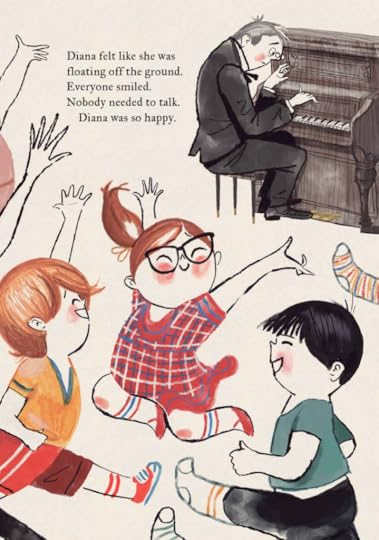
A picture book star is born! Diana is struggling in school. She’s bored. She can’t concentrate. And she really doesn’t like math. Diana visits the doctor after her mother receives a call from a concerned school teacher, but the family doctor finds nothing amiss. It’s only when Diana hears the soft musical notes filling the psychologist’s office that her body begins swaying rhythmically and the correct diagnosis can be Diana is a dancer! This wonderfully illustrated picture book debut showcases Luciano Lozano’s modern yet timeless style, making for a story that readers will want to return to again and again. Elements of diversity woven throughout the story send subtle yet powerful messages of inclusivity and body positivity to young readers. While Diana Dances is sure to resonate with budding dancers, its wonderful tribute to the need for self-expression, the power of movement, and the importance of self-esteem is universal. Diana’s joy at finding her creative outlet is infectious, making Lozano’s fearless heroine a sure-to-be favorite with children. The verdict is Diana is delightful!
In Diana Dances, we follow a young girl as she struggles to pay attention well enough to keep up in school. Concerned, her parents hire a tutor, take her to a doctor, and eventually visit a psychiatrist to try to find a reason why Diana might be so distracted.
The psychiatrist eventually diagnoses her as just needing to dance. From then on, Diana dances while learning and lessons become a bit easier.
I really like the illustrations that have a fun retro feel to them that makes me think of illustrations from the 60s. I also like the idea that the solution to distraction may just be as simple as needing to move around a bit more instead of being stuck in a chair all day.
I can see why this book might raise flags for some for some for various reasons, since the message could be interpreted in different ways depending on how you read it. But, as someone who has a little one close to me who has gone through the ordeal of being labelled by the school as "problematic", I can see how this book could be really helpful to certain kids.
Sometimes adults get very caught up with trying to fit problems into boxes that have perfect off-the-shelf solutions. The kids, though, don't usually fit so neatly into those boxes. Finding the right answers can take months or years filled with appointments with zillions of different specialists. It's not difficult for these kids to get the message that there is something very wrong with them, and that perhaps they are even unfixably broken.
What I like about Diana Dances is that it offers some hope to those kids who are labelled "bad", "disruptive", or "troubled". Although it's not likely most of those kids will get a prescription for "dancing more", maybe some of them will feel a little less alone and "weird" if they can read a book about a kid like them. Who knows, maybe even the parents (or teachers!) reading this book *will* get the message that a distracted/active child is not necessarily a "problem" child who needs "fixing".
Thank you to NetGalley and Annick Press for providing me with a DRC of this book.
Diana hates math and she’s about to fail it. She doesn’t much like school either. She can’t focus so her parents take her to the doctor and then the therapist where they are told to give her dance lessons. There is a reason for it. Diana comes alive dancing.
This is a simple and straight forward story about the joys of dancing. How having something you love and being around people who love it too bring you alive and help your heart to sing. I love the artwork in this story. The joy jumps off the page. I love dancing so this is a great book for me.
The nephew laughed some at the dancing. He thought that was funny. He moves around a lot too and he can dance. He is a funny kid, so his dancing is unique. He ended up giving this 3 stars. The niece enjoyed the story. She liked the message of doing something you love. I think she would love dancing, but she doesn’t want to do anything on a weekly basis. She likes being home. She has a dancer’s body. She gave this 3 stars too.
Diana hates school and hates math. She isn't doing well in either. Her parents take her to a doctor to see if medication can be prescribed. I would say "of course" if you were, like me, a teacher, and you see the number of kids even at an early age on ADHD drugs to counteract what is perceived as disorder. Then they take her to a psychologist, who correctly diagnoses her problem: Diana just would rather dance than do math. Put like this, especially to an English major, this would seem obvious (no disrespect to math types, now. . .).
So mom gets her involved in dancing, yay . . . and Diana is happier, and . . . then even does a little better at school, too.
What is never mentioned, but illustrated, is that Diana is round, not stereotypically dancer-lean. What are our assumptions about a girl who wants to do ballet? She must be a certain body type, right? Well, the question is left open about whether Diana can actually become a professional ballet dancer. Many factors are at play in that career decision. Many may be called, and few are chosen. But not to discourage her on this point. The point for Diana is that she can dance for the rest of her life, whether she makes money at dancing or not.
The point of the book is not about dance, obviously. It is about adults who see children though the lens of what they cannot do--kids seen through their perceived deficits--instead of what they can do--their strengths--and what makes them happy and feeling whole.
One of many dance troupes that have a range of body type dancers:
Thank you NetGalley and Annick Press Ltd for this DRC.
Diana is a sweet and adorable little gal who likes to have fun...school and homework are not fun. Diana has trouble concentrating in school and is failing math.
Instead of talking with Diana her mother immediately gets her a math tutor. When that doesn't work she takes Diana to a family doctor to find out what's "wrong" with Diana. When that doesn't work she takes her kid to a psychologist who decides Diana is a dancer and that's why she doesn't do homework. Ummmmmm. This all seemed really unrealistic to me. I guess for a mother who doesn't notice her kid never does homework and who didn't bother to take an interest in her kid's habits prior to this... that passing her kid off on other people is probably the norm for her.
Great and beautiful story about so many things in such a little book. There is the importance of physical activity in the learning process, there is concentration at school, there is the debate of ADHD (real problem or lack of activity...) and of course, more on the illustration then the story, the importance of loving and accepting our body. Great work! That’s how you do children book!
Diana is having a hard time a school until it is discovered that there is nothing wrong with her.
Diane is a dancer, and needs to move about, and so she in enrolled in a dance class that makers her life so much easier. Easier because she has an outlet for her energy, and she finds like-minded souls.
It is a cute book. And it shows that it doesn't matter that Diane is not tall and thin, she still ejoys dancing and int he future will dance, or not dance as she decides what she wants to do.
Thanks to Netgalley for making this book available for an honest review.
Στη Χαρά δεν αρέσει να μελετάει. Το χειρότερό της μάθημα είναι τα Μαθηματικά. Την επόμενη εβδομάδα θα γράψουν διαγώνισμα στα Μαθηματικά κι εκείνη δεν ξέρει τι να κάνει. Ούτε κι η μαμά της Χαράς ξέρει τι να κάνει όταν λαμβάνει ένα γράμμα από το σχολείο. Και το γράμμα αυτό λέει κάτι πολύ σοβαρό για τη Χαρά: «Η Χαρά θα κοπεί στα Μαθηματικά αν δεν μάθει πολλαπλασιασμό».
Η μαμά προσλαμβάνει ένα δάσκαλο για να της κάνει ιδιαίτερα, όμως η Χαρά δεν συγκεντρώνεται. Η μαμά πηγαίνει τη Χαρά στον γιατρό, όμως εκείνος δεν βρίσκει κάποιο πρόβλημα. Τότε είναι που η μαμά αποφασίζει να την πάει σε Ψυχολόγο.
Η Χαρά δεν αισθάνεται καθόλου χαρά. Μόνο λύπη. Μα εκείνη πιστεύει πως δεν έχει κανένα πρόβλημα, γιατί όλοι οι άλλοι πιστεύουν το αντίθετο;
Στον Ψυχολόγο, όταν η συνάντηση τελειώνει, μένει η Χαρά μόνη στο δωμάτιο ακούγοντας μουσική από το ραδιόφωνο. Μια απαλή μελωδία πλημμυρίζει το δωμάτιο και μια απαλή χαρά πλημμυρίζει τη Χαρά. Σηκώνεται και αρχίζει να χορεύει με τον ρυθμό της μουσικής. Κινείται με χάρη και νιώθει ευτυχισμένη. Έτσι τόσο απλά, ο Ψυχολόγος καταλαβαίνει πως η Χαρά είναι γεννημένη χορεύτρια. Και τότε όλα αλλάζουν.
Είναι από τα βιβλία που τα αγαπάς με την πρώτη ματιά. Αρκεί να κοιτάξεις το εξώφυλλο, που απεικονίζει ένα μικρό εύσωμο κορίτσι να κάνει ασκήσεις μπαλέτου ανάμεσα σε τρεις «κλασικές» μπαλαρίνες.
Η Χαρά είναι η χαρά της ζωής στην κυριολεξία, από τη μέση του βιβλίου και μετά όμως γιατί τότε είναι που βρίσκει τον εαυτό της. Τότε είναι που καταλαβαίνει τι είναι αυτό που αγαπά. Τότε είναι που αν και πηδά ψηλά στον αέρα, πατά καλύτερα στο έδαφος. Το να βρεις τι είναι αυτό που σε εκφράζει, το να έχεις γύρω σου ανθρώπους που σε υποστηρίζουν, το να κάνεις αυτό που αγαπάς σε βοηθά σε όλους τους τομείς της ζωής σου.
Η Χαρά χορεύοντας, καταφέρνει να γίνει καλύτερη ακόμα και στα Μαθηματικά γιατί νιώθει καλύτερα με τον εαυτό της. Γιατί ξεδίνει χορεύοντας, κάτι που τη βοηθά να συγκεντρώνεται πιο εύκολα.
Και δεν έχει σημασία αν η Χαρά και η κάθε Χαρά θα μπορέσει να γίνει επαγγελματίας μπαλαρίνα. Σημασία έχει να κάνεις αυτό που αγαπάς και να εκφράζεσαι με τον τρόπο που εσύ επιλέγεις.
Ένα πολύ τρυφερό βιβλίο που είναι σημαντικό να διαβαστεί προσεκτικά και από τους γονείς. Αν κάποιος κοιτάξει τη Χαρά της ιστορίας ίσως να μην σκεφτεί ποτέ πως ο χορός είναι αυτό που της ταιριάζει. Τα φαινόμενα απατούν λοιπόν. Ας βοηθήσουμε τα παιδιά μας να βρουν τις κλίσεις τους, να ανακαλύψουν τις δυνατότητές τους. Ας τα αποδεχτούμε και ας τα παρατηρήσουμε. Ας τα αφουγκραστούμε κι έπειτα ας τα βοηθήσουμε.
Εξαιρετικές εικόνες, τρυφερές αλλά και αστείες που συνοδεύουν το κείμενο αριστοτεχνικά. Κάτι που είναι λογικό από τη στιγμή που o Luciano Lozano είναι o συγγραφέας αλλά και o εικονογράφος του βιβλίου.
Την αγάπησα αυτή την ιστορία και είμαι σίγουρη πως θα την αγαπήσετε κι εσείς.
This is a cute little book. At first, I was a little bit worried when Diana's mother dragged her to the doctor because she got bad grades and couldn't concentrate; I was afraid that she was going to end up on Ritalin or something. But the prescription was actually far more simple: movement! Instead of drugs, Diana enrolls in a dance class, which she loves. And, to her surprise, the movement helps engage her brain, allowing her to grasp the math concepts she was having trouble with before. (It reminded me a little of a cute scene from 1936's Captain January, in which Shirley Temple's character is practicing her multiplication tables while tap-dancing down the lighthouse steps. Whatever works, right?) Empowering kids to overcome their difficulties in school by exploring some non-traditional activities is a nice thing to see in a picture book.
The illustrations, which look like a mixture of drawing and collage, are sweet. I especially like Diana's little dog. The whole thing has sort of a European feel to me (which I guess isn't surprising, given that the author is based in Spain).
All in all, I was pleasantly surprised. This would be a great book to read with kids who might be struggling with paying attention, and it might give parents some ideas on new ways to help deal with the problem.
Thank you to NetGalley and Annick Press for providing a digital ARC.
This book has a special place in my heart. Being a retired teacher as well as a grandparent, I certainly want to promote individuality, positive self-esteem, various learning styles and developing ways to motivate and stimulate today's children. When Diana is having difficulty concentrating and getting motivated in school, her mother is worried. She takes her to the family doctor and in turn he sends her to a Psychologist. It is only when they realize that Diana needs to move, has natural rhythm and is able to concentrate when she is allowed to move, that she becomes successful. This is a cute little book. Empowering kids to overcome their difficulties in school by exploring some non-traditional activities is a nice thing to see in a picture book and hopefully in real life. The illustrations, are wonderful. They look like pencil drawings and are very sweet. I loved looking for her dog in any of the pictures of her at home or outside playing. He is so cute. All in all, I was pleasantly surprised. This would be a great book to read with kids who might be struggling with paying attention, and it might give parents some ideas on new ways to help deal with the problem. The publisher generously provided me with a copy of this book upon request. The rating, ideas and opinions are my own.
Diana Dances is too cute! Diana is struggling in school. She can’t seem to concentrate long enough to learn her multiplication tables. After trying a tutor and visiting the Dr, a psychologist discovers that what Diana needs is to dance! This is what makes her truly happy and gives her the outlet she needed. After discovering music and dance, her school work seems to come easier to her and she is able to pass her math test! This girl just needed to dance! I really enjoyed this story, We all need to discover that one thing that makes us truly happy. It makes everything else worth doing! Thank you to Annick Press and NetGalley for this advanced copy. My opinions are my own. This will appear on my blog December 10, 2018. www.colecampfireblog.com LanaLCole@yahoo.com
I'm conflicted by this book. When Diane has trouble at school her mom takes her to the doctor and then to a psychiatrist. The psychiatrist decides that all Diane needs is to Dance. She joins a dance school and passes her test. Yes, the addition of dancing helps Diane, but we don't see her studying, she just starts doing well. I'm not sure that there is a good message for kids here.
This is so sweet, and I love the illustrations. Diana is drawn with so much character and personality that she stands out in every panel.
From a simple perspective, this picture book is a story about being yourself, learning your own strengths, and finding your place in the world.
From a teacher perspective, this story is about how unique children are, and how they relate to the world and learn in many different ways. Diana has kinesthetic intelligence (also called body intelligence). People with kinesthetic intelligence are skilled at using their body to convey feelings and ideas. All of the adults in Diana's life thought something was wrong with her, due to her her lack of attention, struggles to learn, and constant case of wiggles. They didn't even consider that her brain works differently, and that focusing on her strengths and interests would make her strong in other areas of her life.
This story highlights how letting people be themselves is so much better than trying to force them to fit society's mold. On that level, this book has a lot to say, and it does it in a simple and charming way.
I'm also a fan of the diversity represented in the illustrations, especially in the different body styles. Healthy body image in picture books is a great place to start.
This picture book will be published on March 12, 2019. For libraries, this would be great for storytime sessions tied to music and movement, and you'll get the bonus of positive body image and the introduction of different learning styles, which is good for both your early learners to see and their parents/caregivers.
I thought this book was really cute! I've taken ballet since I was 7 years old and I love finding books about it because there aren't many that I've seen (*whispers* If you know of any, let me know!). The artwork was really awesome in this book, too!
I'm honestly not sure if I got the age range right, but I figured around 5 because the language is a bit more advanced in this book. I feel like there are a lot of things that would have to be explained by someone older just because of the terminology that's used. At least, I don't think most young kids know what a psychologist is, or would understand why someone would have to go to the doctor because they were bored in school. That being said, I do think this book is a very good opening for discussions about things like this since children will most likely ask questions about different things within this book.
All-in-all, this book had a really cute story and, while it seems like it would be a bit harder for children to understand, I think the intentions behind it are a great way to teach children that it's okay to need help focusing in school and introduce dance to children who may not have had an interest in it before!
I received this book in exchange for my honest review.
I absolutely loved this book. As a child, I was always dancing around the house until my mother finally put me in dance and started a career that would last over forty years of my life in the world of dance, first as performer, then as teacher and choreographer and then finally, as studio owner. This book reflects an understanding of passion for something, be it dancing or writing or reading… for example, that shouldn’t be overlooked by parents. You never know what may come from something a child enjoys.. Little Diana is adorable but she’s not happy until she is dancing. When dancing, everything else in her world falls into place.
The author’s approach to finding the source of Diana’s “problem” is unique. I love the illustrations the most. Together the book is a huge enjoyment and even my daughter loved it.
I would recommend it to anyone who has a child who can’t keep still.
"Diana did not like to study. But above all, she did not like math." "Diana was bored at school, and never got good grades."
She loves her skateboard and being outdoors but her mother is worried about her academics. One Monday afternoon Diana's mother receives the bad news from school that Diana will fail if she does not learn her multiplication tables. It is time for a Mother intervention to help out her struggling daughter. She immediately hires a tutor but quickly discovers it doesn't make much difference in Diana's retention skills which causes Mother to take more drastic steps in finding out why Diana is having problems at school. Mother then seeks out the advice of a medical doctor who diagnoses Diana as completely healthy but suggests that perhaps Diana should see a psychologist.
These findings leave Diana feeling sad and confused about herself. What could possibly be wrong with her? To her great relief the psychologist unleashes her inner dilemmas and together they discover that Diana is a dancer by nature. This eureka moment totally changes Diana's life for the better. Thereafter she expresses herself in lovely beautiful dance movements which enables her to take an interest in her school subjects (even math) and celebrate life with a joyous attitude and happy dancing feet.
Lorenzo's book was originally published in Spain. He touches on themes of self-worth, body image and the freedom to dream. The illustrations are very noteworthy and enrich the text greatly. I particularly love Diana, the main character, who dreams the impossible dream of becoming a ballerina ... but is it really impossible in her reality? She embraces her reality and in so doing discovers a zest and love for life that she never experienced before. I adore this book and highly recommend it. Dance on Diana..........
I read a copy of this through NetGalley. All opinions are my own.
When you look at the cover of this book, it looks like a story about a little girl who loves to dance, even if she doesn't have the stereotypical ballerina look. It turns out, however, that this is a story of a girl with some form of Attention Deficit Disorder. She discovers that she loves to dance (how did she not already know that?) and it turns out that when she practices kinesthetic learning she does much better. An interesting look at various learning styles, but you would never know it from the cover.
I struggled with this book for because first of all, any kid that likes to dance is always moving. How is it that she never tried dance before? Secondly, this book seems aimed at parents instead of children - it is letting parents know that perhaps their child shouldn't sit still all day and might learn better when moving.
“Talvez, um dia, a Bia venha a dançar numa grande companhia de ballet. Ou talvez não. Mas nunca deixará de dançar.” A minha inner child está muito feliz com este livro.
Lozano tells the story of Diana, a little girl who loves to skateboard, be outside, and basically do anything except learn multiplication tables and school, in general. Threatened with repeating her current grade, her mother finds her a private tutor, but even he can't keep her interested in math. The family doctor suggested a psychologist, and the psychologist recommended dance classes. So, Diana found her outlet through dance, and through that outlet she learned her math and passed the grade.
While the story was cute, and the illustrations are wonderful, it really wasn't a story I enjoyed fully. Teachers, in my experience, do not send letters home to inform that failing one task will result in the student's retention. The mother's response was not to talk to her daughter, but rather to take her straight to the doctor as though having energy and a dislike of school means being ill. The first part of the story revolves around there being something wrong with Diana. That her actions are wrong, when they are not. The best thing I liked about the book was the end when Diana thinks its okay if she never gets to "dance in a big theater" because "she would never stop dancing."
Thank you NetGalley and Annick Press for the opportunity to read this ARC.
This children's book is about Diana, a little girl who has trouble in school with Math. She finds it boring, and school in general . She loves to be active, she skateboards, and plays basketball, Her Mom starts to worry and brings her to the doctor and a psychologist to find out if anything is wrong. She finds out that Diana loves to dance and studies math easier when she is active. A little hard for a child to understand the necessity for doctors just because a child is finding Math tough and a child likes to be active, come to think of it, adult's might also have a hard time with this.
Things I appreciate: Diana is active, realistically sized and charmingly illustrated; a schoolmate who uses a wheelchair appears prominently on two spreads (including playing basketball); the kid-friendly demonstration of kinesthetic learning; that the book is world children's literature (originally published in Spain) Missed opportunities: more variation in skin tone, pushing back on stereotype of girls not liking math, pushing back on state of distraction as "wrong"
I fully enjoyed little Diana. As one who loves math and has no dancing ability, I loved reading and living vicariously through Diana who learns how to learn, in her own special way. Thanks to Netgalley for the e-ARC.
This book might have been based on a true story, as I'm pretty sure I've heard something quite similar of a dancer. I like the diversity present in the illustrations (gorgeous, by the way!).
Thanks to Netgalley for the advanced reader's copy.
I have some conflicting feelings on this little book. Diana is struggling in school and that is relatable for kids, but the reaction of her mother is to go to the doctor and then a psychologist to see what is “wrong” with Diana. I feel like this is kind of a strange message to send to children, and seems more aimed at parents because the lesson of the book is that nothing is “wrong” with Diana, she just needs to move and learns best while being allowed to move her body. I did love the parts after Diana started dancing because she learns what works best for her, is more confident, and finds a lifelong love of dancing regardless of if it will bring her fame.
This book is niether bad nor great, but is instead interesting. I do think children would love the illustrations and the second half of the story. It could be useful in a setting where children are learning how to work through their energy with a parent, teacher, or therapist?
Thank you NetGalley for an early copy of this book in exchange for an honest review.
I received this digital ARC picture book from Netgalley to review.
It’s a sweet and simple story about a girl who has difficulty in class and discovers her passion in an unlikely way. The message is great. Most often children that struggle in school need to find an outlet and movement is one that can get stifled in some classrooms.
However, the story line that leads her to discover her passion is odd and I would have a certain level of discomfort sharing with young children.
Diana is having big troubles in school. If she doesn't learn her math tables, she will fail. Her mother takes her to a doctor and then a psychologist, and the psychologist finds a solution: Diana is a dancer. Once she begins to dance, all Diana's problems begin to dissolve away. A story about helping children find their own ways to learn that is helpful and uplifting.
This book was ok for myself and my 4 year old. While the story is completely 100% like my child (even down to the doing better at problems while moving part) and relays a good message in the end, I personally did not like that her mother was so quick to take her to doctors- especially a psychiatrist. While in real life this does happen to many kids, I think it was better off avoided in a young children's book. Maybe that subject would be more suited to older children. I also was not a fan of the artwork, especially when it came to the dancers. My biggest problem with the art was making the Diana character stand out in sharp contrast to everyone else. Yes, it is ok that she is different but I feel that making her so starkly different (especially with the dancers) could be damaging to kids who are slightly fluffy and different looking, it puts a label on them and they may think if they see it in print then it must be true. My 4 year old did not care for the story at all, perhaps older children will. It's a good attempt by the author but I feel it needs some work.
Diana struggles in school, but finds that she has a love of dance. From the cover, I thought this was going to be about body positivity, but it does not mention that in any way.
My highlight from this book is that this book showed a child meeting with a psychologist. I think that is an intimidating experience for children and they often (at least my students have told me) then feel like something is 'wrong' with them. Parents and teachers have given them the message that something isn't working (and that something feels like them!), and that is an overwhelming (and sometimes crushing) feeling. Having psychologist meetings normalized would continue to be helpful in the entire gamut of children's lit and I was glad to see it in this book, albeit brief.
Diana realizes she loves to dance in her meeting with a psychologist after going to a doctor. The psychologist puts on some music and Diana dances her little heart out, the rest is history.
The story is pretty simple, the writing is just ok, and besides Diana loving dance and disliking school you don't get much to know the characters well. That being said, I could see students connecting with this one, and the depiction of going to see a psychologist and finding something that works for them being powerful enough, for now.
*Thanks to publishers and Netgalley for the ARC of this book in exchange for an honest review.