This scarce antiquarian book is a facsimile reprint of the original. Due to its age, it may contain imperfections such as marks, notations, marginalia and flawed pages. Because we believe this work is culturally important, we have made it available as part of our commitment for protecting, preserving, and promoting the world's literature in affordable, high quality, modern editions that are true to the original work.
- What Men Live by - Three Questions - The Coffee-House of Surat - How Much Land Does a Man Need?
Lev Nikolayevich Tolstoy (Russian: Лев Николаевич Толстой; most appropriately used Liev Tolstoy; commonly Leo Tolstoy in Anglophone countries) was a Russian writer who primarily wrote novels and short stories. Later in life, he also wrote plays and essays. His two most famous works, the novels War and Peace and Anna Karenina, are acknowledged as two of the greatest novels of all time and a pinnacle of realist fiction. Many consider Tolstoy to have been one of the world's greatest novelists. Tolstoy is equally known for his complicated and paradoxical persona and for his extreme moralistic and ascetic views, which he adopted after a moral crisis and spiritual awakening in the 1870s, after which he also became noted as a moral thinker and social reformer.
His literal interpretation of the ethical teachings of Jesus, centering on the Sermon on the Mount, caused him in later life to become a fervent Christian anarchist and anarcho-pacifist. His ideas on nonviolent resistance, expressed in such works as The Kingdom of God Is Within You, were to have a profound impact on such pivotal twentieth-century figures as Mohandas Gandhi and Martin Luther King, Jr.
The book is written by Tolstoy so what can one presume except sheer brilliance.
The book comprises of four short stories each having unforgettable lessons and deep meanings of life.
What Men live by "I have learnt that all men live not by care for themselves but by love".
Three Questions "Remember then: there is only one time that is important- Now!"
The coffee-house of Surat "The higher the man's conception of God, the better he will know Him. And the better he knows God, the nearer will he draw to Him, imitating His goodness, His mercy, and His love of man".
How much land does a man need? "Six feet from his head to his heels was all he needed".
Not alot to see here. Four morality tales/parables that teach life lessons. Seems geared towards a younger reading audience. 'How Much Land Does a Man Need?' is the best of the four and worth a read.
The tales "What Men Live by" and "How Much Land Does a Man Need", which I already read earlier in its own book, really got me. Very thoughtful and philosophical as I expected.
A GREAT read. Very simple, yet very deep. You can read it at many levels and get a lot out of it on each level.
Favorite quotes. First, what men live by: "I have now understood that though it seems to men that they live by care for themselves, in truth it is love alone by which they live. He who has love, is in God, and God is in him, for God is love." (Leo Tolstoy, "What Men Live By" in What Men Live By and Other Tales, TARK Classic Fiction: Rockville, MD. 2008, p.35)
"Remember then: there is only one time that is important--Now! It is the most important time because it is the only time when we have any power. The most necessary man is he with whom you are, for no man knows whether he will ever have dealings with any one else: and the most important affair is, to do him good, because for that purpose alone was man sent into this life!" (Leo Tolstoy, "Three Questions" in What Men Live By and Other Tales, TARK Classic Fiction: Rockville, MD. 2008, p.41) THIS ONE IS MY FAVORITE! Ho.ly cow. This quote evokes in me a reverence of the meaning of life. We should plan ahead, we should remember the past, but life only HAPPENS in one moment--RIGHT NOW! Don't squander it with preoccupation with either the past or future. Joy is to be had in the present, now and always.
"The higher a man's conception of God, the better will he know Him. And the better he knows God, the nearer will he draw to Him, imitating His goodness, His mercy, and His love of man. Therefore, let him who sees the sun's whole light filling the world, refrain from blaming or despising the superstitious man, who is his own idol sees one ray of that same light. Let him not despise even the unbeliever who is blind and cannot see the sun at all." (Leo Tolstoy, "The Coffee-house of Surat" in What Men Live By and Other Tales, TARK Classic Fiction: Rockville, MD. 2008, p.51) (On tolerating other's belief systems. A great short story that pitted different religious leaders against each other in a most contentious manner--far from the love that each religion advocates but too quickly forgets when dealing with people who believe differently from themselves)
I find myself falling into reading more and more of the Russian literature. I guess my roots are breaking through the many years I have lived in the US.
I want my intelligence to rise beyond that of "media munchers" (those who read magazines and live through reality tv).
All in all, the stories and points of these raskasi are well written and well thought out.
Teaches of behavior, actions, and greed. People should be satisfied with what they have rather than hopping to and fro. This point may be transferred to real life examples...such as men and women hopping around and "dating" absolutely everyone rather than choosing, being satisfied, and working with the one person their heart tells them is theirs. People give up on what they have to easily and it seems as though it is never enough. Once a person gives up, they launch themselves on an everlasting quest of finding the one person who fits them 100% and that is just...well...improbable which in turn causes one to use another and move on at the first sight of a fault. People are giver uppers. =/
I enjoyed these short stories and believe many people would benefit from reading them carefully to get the full meaning and messages.
Swallow and release your pride, be humble, be moral, and compassionate.
It's a bunch of parables. But if we manage to look past them as just some 'Lord Giveth(s)' , we can find the persistence of human nature, the forgiveness of time and how we manage to live by it.
I really do love the moral tales that Tolstoy offers up in most of his short stories, but these four are particularly wonderful. The fun part for me is that the tales are lined up in the book in my order of preference! Brilliant! One of the things I love best about short stories that they hit you quickly with a punch and make you think. Keep in mind that these stories do tend to have a spiritual element. Each one of these stories does just that and reading them aloud as a family would make for a powerful discussion as each story could easily be understood by most ages. In fact, at least two of these stories have been turned into children's books!
Tolstoy's stories are wonderful teaching tales about the nature of life and about the things that matter, or rather about the things that should matter. In this collection, he is a simple writer, without any heaviness of theology and philosophy. Though these elements are present, they are embedded in the stories and characters, and become lived realities. Three Questions is a particularly compelling story, as is the Coffeehouse.
This book, which I found in Gutenberg, contains the following stories: -What men live by -Three questions -The coffee-house of Surat -How much land does a man need?
The first and last are novellas and I liked them both. What men live by is about a cobbler’s apprentice who needs to learn the answer to the title question, and does so by the end. How much land does a man need? is a moral tale about greed, in the style of the tale of the milk maid.
The other are two-page fables that I had read elsewhere.
Well, it’s LEO TOLSTOY!!! I don’t think I need to explain further.
This volume contains some of my favorite short stories by him- 3 questions, The coffee house in Surat, What men live by and God is where Love Is.
There are some really meaningful quotes I this book:
“Remember then: there is only one time that is important-- Now! It is the most important time because it is the only time when we have any power. The most necessary man is he with whom you are, for no man knows whether he will ever have dealings with any one else: and the most important affair is, to do him good, because for that purpose alone was man sent into this life!”
If only more people interpreted religious scriptures like he did!
At the risk of sounding overdramatic, I would say that, Leo Tolstoy’s books make my heart sing with joy.
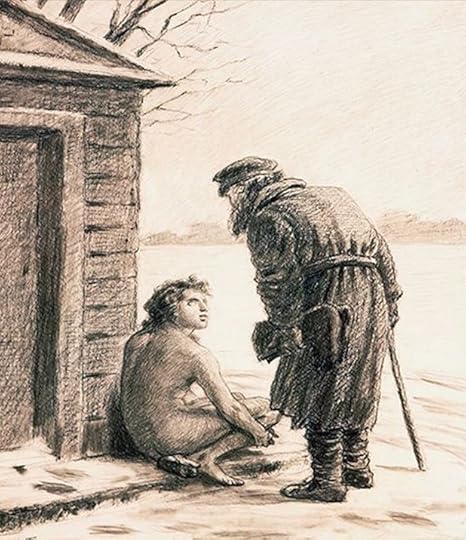
WHAT MEN LIVE BY: A shoemaker named Simon, who had neither house nor land of his own, lived with his wife and children in a peasant's hut, and earned his living by his work. Work was cheap, but bread was dear, and what he earned he spent for food. The man and his wife had but one sheepskin coat between them for winter wear, and even that was torn to tatters, and this was the second year he had been wanting to buy sheep-skins for a new coat. Before winter Simon saved up a little money: a three-rouble note lay hidden in his wife's box, and five roubles and twenty kopeks were owed him by customers in the village.
3.5 rounded down. Four very short, very easy-to-read stories that cover "why" man is here. (With the writer being Tolstoy I was thinking the language would be much harder.)
From the title story--
The most important time is now! The most necessary man is he with whom you are, for no man knows whether he will ever have dealings with any one else. The most important affair is, to do him good, because for that purpose alone was man sent into this life.
This completes my reading challenge of 2022, 112 books, 22190 pages.
really enjoyable short stories! tolstoy never fails to capture readers attention from the very start. also these short stories are very easy to get into and are well written and easily understandable for readers who are just getting into classics.
personally i really enjoyed “what men live by” and “how much land does a man need”
Tolstoy is love. 4 short srories, each is a testimony of Tolstoy's genius.
"Remember then: there is only one time that is important—Now! It is the most important time because it is the only time when we have any power. The most necessary man is he with whom you are, for no man knows whether he will ever have dealings with any one else: and the most important affair is, to do him good, because for that purpose alone was man sent into this life!”
Title: "HOW MUCH LAND DOES A MAN NEED?" Last sentence : "Six feet from his head to his heels was all he needed."
This entire review has been hidden because of spoilers.
This was a very simple read. It has some good lessons. However, reading this book as an adult, it felt like I have already read these lessons over and over again in books and articles and such. Perhaps they were already inspired by this book. So, I wish I read this when I was much younger. These lessons could have been rather fresh for me to form a basis for my understanding of them. Still, a good and simple read.
The book consists of three distinct chapters/ short stories:
1- What men live by: This is a story about Michael, the angel. And here is my favorite quote from this chapter: "Then I remembered the first lesson God had set me:‘Learn what dwells in man.’ And I understood that in man dwells Love!" "What dwells in man I already knew. Now I learned what is not given to him. It is not given to man to know his own needs." "I have learned that all men live not by care for themselves but by love. " "I have now understood that though it seems to men that they live by care for themselves, in truth, it is love alone by which they live."
2- the three questions: This story is about the three questions of which a king tries to find the answers. To me, the climax of this chapter is: "Remember then: there is only one time that is important--Now! It is the most important time because it is the only time when we have any power. The most necessary man is he with whom you are, for no man knows whether he will ever have dealings with anyone else: and the most important affair is, to do him good, because for that purpose alone was man sent into this life!"
3- The coffee house of Surat: This one is a story of a public discussion that takes place in a coffee house amongst the present travelers, ignited by a Persian scholar and his servant. My favorite quote for this part is: "It is pride that causes error and discord among men."
this one was so short but deep. i really loved the concept of three truths, writing them down here to remember them later. first, love is what truly lives in people even when they can't express it. we see this when Matryona despite her usual anger, softens and helps the stranger who was starving. second, what is not given to man is knowledge of his own death. just like the rich man who orders boots for a long year ahead but doesn’t even make it through the day. and third, what men live by is love. not just from family but from anyone willing to give it like the twin girls who lost their mother but lived joyfully because a stranger chose to care. i know we already understand these truths but we forget them too often. :)
This is a solid four for Tolstoy, with stories that surrounded by spiritual evaluations, he succeeded to cover a very complicated theme and design and make it easier to be accepted. That proves how greatly he contemplated his inner narrations then put them into an articulate flow. This book also covers the same thought provoking stories one beside another‘s. My favourite one is still the What Men Live By, and i‘ll put Three Questions on number two.