In an alternative cartoonist’s debut graphic novel, a bee and her friends must save their ecosystem! In expressive black-and-white lines with forays into bold Cubism, Fleener tells the story of Billie the Bee, who is too big, too fast, and has far too much personality to simply collect pollen. So, the Queen Bee (with ulterior motives) sends Billie out to patrol the woodlands and marshes of San Diego for danger. She encounters a heron on hallucinogens, dirty joke-telling turtles, and humans illegally releasing vermin that will unbalance the entire ecosystem. Mixing coming-of-age graphic fiction with facts about bees and the environment, Fleener’s Billie the Bee is both a great reintroduction to a comics talent and ripped from the headlines. Black & white illustrations throughout.
Mary Fleener is an American cartoonist, writer and musician from Los Angeles. After quitting art school in 1976, Fleener pursued a career as both a rock singer and a visual artist. She entered the world of alternative comics in 1984, initially self-publishing mini-comics. Her cartooning style often draws inspiration from cubism and other art traditions. Her first book was Hoodoo (1988), a comic about writer Zora Neale Hurston. Her semi-autobiographical Slutburger series run for five issues from 1990 to 1995, followed by the three issues of Fleener from 1996 to 1997. Other short comics have appeared in magazines and anthologies, like 'Weirdo, 'Twisted Sisters' and 'Wimmen's Comix', to then be collected in books, most notably Life of the Party (1996, Fantagraphics Books).
This is a kind of informational comics story about ecological imbalance (and maybe also about being who you are, as a person/bee) couched as fiction, where Billie the Bee is the main character. The dialogue is kind of stuffy/stilted in the way it actually imparts information (and then there are footnotes, too), so it's hard to fix the intended audience. The title makes it seem like it is for small children, but I'd have to say it is for all ages, because it has a strangely hallucinogenic tone, and the art/story seems more complicated than for kiddies. So this would be maybe two stars for me, really, I think it is all right overall, but I have to give more credit to/highlight the often amazing art. So it's like: Story 1 star, in spite of its important environmental subject, because it alternates from goofy/confusing to stuffy, but art 5 star with its forays into cross-hatched Cubist fantasy.
Here's a review from Daily Grindhouse where you can see some of the cool art I'm talking' about:
Fleener is a kind of classic/cult autobio comics artist from the 1980s Wimmin’s Comix scene, but this is a departure from any of earlier work I have seen.
I've enjoyed Mary Fleener's work in the past, but this book is just silly. She tries to impart real information about bees, but couches it in a work of fiction that just made me constantly cringe with its stilted dialogue, unrealistic characters and heavy-handed moral lessons. I'd say it was aimed at young readers except it includes adult language, so I'm not sure who it is intended for. Definitely not me, anyhow.
This was cute and fun. It's very different from my perception of Mary Fleener’s work though. When I think about all of her stories that I’ve read in the past, what comes most strongly to mind is her cubist style, and her forays into autobiography. But in Billie the Bee, there's very little of the former, and none of the latter.
As you might guess, Billie is a bee. She's not like the other worker bees in her hive. She's larger, for one thing. The Queen charges her with a special duty: be a ranger. Scout out potential new locations for a hive, talk to the other animals in the area, and generally find out whatever needs finding out. Needless to say, Billie has a very special destiny to rise to when the time is right …
It's a very low key story, mostly about Billie making friends and just chillin’. There are assorted Facts About Nature (™) woven into the story, but the purpose of it isn’t to highlight them; they're just there if you want them.
What lingers most with me about this book is how quiet it is. It's not stridently trying to make a point. It's not trying to blow you away with over the top action. It's like a pleasant, warm afternoon in a natural setting. You just listen to the breeze and the birds and the quiet buzz of insects and bask in it all.
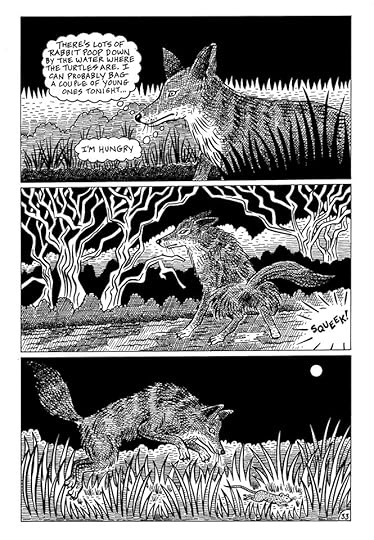
I'm a big fan of Fleener's Slutburger comics, but this volume is somewhat closer to her "Fleener" comics from Zongo Press (less autobiographical and more whimsical). We're following Billie, a strangely large bee (although the mystery of her size isn't that mysterious), who gets recruited as a ranger for her hive, makes friends with others in her ecosystem (specifically, a rattlesnake, coyote, and two turtles), and has lots of adventures. It would feel like a kid's book if it weren't for the profanity, dirty jokes, and occasional animal-on-animal violence. It also has pages in Fleener's trademark cubismo style.
It's a fun read, but it didn't feel like a complete package to me. However, any Fleener is good news!
“The part of the stinger left in the skin can continue to pump the venom, apitoxin, into the victim for up to 10 minutes, or until it is removed.”
This is a strange creature of a book, in one sense this is a riot of selective anthropomorphism, and it is also part animal encyclopaedia, almost part Pixar movie. There are times when this doesn’t seem to know what its purpose is or who it is aimed at.
In the initial stages the dialogue is absolutely terrible and it seems to be aimed at younger kids but then we get into deeper territory which seems to be aimed at people who are a lot older, which presents an overall confusing and uneven feel, but strangely enough in spite of its puzzling flaws I came round to this and learned some genuinely interesting facts about bees, such as,
ROYAL JELLY is a protein/sugar substance secreted from the hypopharyngeal glans located on the heads of “nurse” worker bees.
BEE BALLING: They cluster around an enemy until it dies from overeating *116.6F).
I read this for our visual Book Club, and was wowed by it. The drawings, and especially the pop art, surreal, what did I just take, and jazzy pages are something special. The line art of the animals is engaging, sometimes funny, sometimes jarring and intense, and demonstrates serious art skills. Now the story....starts out kinda cute, then morphs in so much more than talking animals. The footnotes (yes -- footnotes!) are so worth reading. I learned a lot about bees, honey (stock up!), and the other animals featured in the book. Not all are 'nice.' There are people, too, and help show we might fit in the larger story. The description of "dark and complex" is correct. I'll be on the lookout for more by Mary Fleener. This is her first graphic novel.
This graphic novel is both funny and very weird. Occasionally there are facts added about the bees which is quite nice. There is some violence and adult themes so maybe don't read it to your kids.
Fleener's illustrations are always beautiful and evocative of whatever facet of telling a story she wants to emphasize. So many panels in this tale of nature that teaches many facts in narrative and asterisked notes are museum-worthy. She is a master artist of this form. The only reason this isn't five stars is because the plot does not live up to the illustrations.
This is a beautiful, well constructed nature adventure story by the amazing Mary Fleener, better known for her short works, many autobiographical. This is a very different kettle of fish from all of her other work, aimed at kids (I'd guess six to twelve, depending on reading level) instead of the dissolute adults portrayed in most of her other work.
So, parental warnings: there's some talking animal on talking animal violence, a bit of proper talk on insect reproduction that is completely tasteful, and an allusion or two that might make the meekest of us flush a bit, but nothing every kid I knew in grade school wasn't fully aware of by 8 or so. There's some character death, but they're either bad guys presented as such or noble deaths, so nothing as traumatic as an average 80s children's movie.
I'm intentionally leaving this review spoiler free, but this is a great, multifaceted kid's graphic novel with absolutely top notch art, and the story and songs contained within are well done, even if nature adventure usually isn't my thing. At least half of the docked star is probably based on my ignorance of that field, tbh: I have very little to compare this against beyond movies and books I consumed as a kid. For the record, though, the other half star is docked mostly because I wish this were longer. This is a great graphic novel, and for somebody buying for a kid with any interest in nature or animals whatsoever should be an immediate, no-chill buy.
Beautifully drawn, strange story of one odd bee and its adventures. The story is part-ecology lesson, part-moralistic tale, part-mystery. The mystery (which involved the queen bee) is strange and twisty and perhaps the only story-story in here. Some of the interactions among the animals, predators and prey alike, take some moralistic turns at times, some predators chiding others for trying to eat, or eat "wastefully" and so on. The ecology lesson is all about bee colonies and how they propagate and survive disasters to reestablish new colonies/hives. The characters are likable, though somewhat confusing (ecology, zoology and the moralistic story kind of clash at times.) The art is just beautiful: beautiful and detailed crosshatching, lots of wonderful drawings of the habitat and animals. Recommended for those who like larger than life characters, herons, deadly plants, cubism, and raunchy jokes.
The art work is amazing. The story is good. The dialogue is cringe worthy. The art has multiple styles. Cartoonish and friendly bees. Realistic animal life and landscape. Almost grotesque humans. Plus inspired art to show song or violence. All these styles aid in the story telling. This would be a great book for a young reader or an aspiring cartoonist. The story teaches important lessons like, don’t remove wild life, don’t introduce new wild life to a reserve, and keep your dogs on a leash!
What I learned: eucalyptus trees are highly flammable. Bees make a glue called “propolis” Greek for defense of the city. Skunks eat rattle snakes, and are unaffected by the venom. Owls eat skunks, and are unaffected by the smell.
This is a whimsical and really light-hearted story about an over-sized bee and a couple of her wild friends just chilling, telling bad (and dirty) jokes and singing to one another as they encounter events that will bring them closer together as a kind of animal community? The artwork looks organic and spontaneous like something an artist would sketch in a sketchbook, mixed in with a few cartoony elements. The book shares a lot of interesting facts about bees and how to care for nature and our environment in a fun way. Definitely something I'll recommend my nieces and nephews.
This was such a fun short read. I finished this book in one uninterrupted 45 minute sitting. Story about a bee that realises very quickly that she is indeed not like the other bees...she's different. Mary Fleener may not be the first to explore this trope but I think she does so exceptionally well. Seamless story telling, beauuuutifullll drawings (that change art style whenever a character is experiencing intense emotions) and I learnt a lot about bees. I'm giving this a 3.9/5 definitely would recommend.
This one was okay, though I was waiting for some kind of plot twist throughout that never really came. It's a straight-ahead narrative of a bee growing up and making friends with other creatures. If it weren't for some grim animal-related circumstances, one would think this is more of a book for kids given the cheery dialogue and included asides about bee facts. Maybe if one was excited about Fleener's art this book would have more of an impact, but it was a decent enough read regardless of the author's notability.
Black and white illustrations are dull, although well-drawn. Story is a combination of informational and fiction about Billie the Bee who is unusually large so the queen makes Billie into a ranger who goes out and makes friends with all the animals in the surrounding area. Truthfully, I cannot see ANY of my middle school students picking this one up. Also SPL has it catalogued as YA, not JUV but I cannot figure out why because *possibly* a younger student might pick it up...
I enjoyed this charming book - a silly adventure lightly stuffed with facts about the bee ecosystem and a sense of morality and decency. I read it largely because I had never read Mary Fleener and this is what the library had to offer, and I see from other reviews that it's not necessarily all the representative of her work, but I'd read more from her. The artwork is gorgeous and inventive.
I enjoyed this book, although I find some of the criticisms in the other reviews legit. I always appreciate Mary Fleener’s artwork even when the dialogue is a bit silly.