A breathtaking picture book about the relationships we share from New York Times bestselling storytellers Julie Fogliano and Loren Long in the tradition of The Runaway Bunny and Guess How Much I Love You.if i was the sunshine and you were the day i’d call you hello! and you’d call me stay if you were the winter and i was the spring i’d call you whisper and you’d call me sing… Through clever, thought-provoking verse and warmly evocative art, New York Times bestsellers Julie Fogliano and Loren Long explore the awe-inspiring nature of relationships, love, and connection.
Grammarphiles are going to have a tough time with this book. (If the title bothers you, the rest of the book will, too.)
Aside from the avoidance of the subjunctive mood half of the time and the insistence on writing all the letters in lowercase, this is actually a fairly nice rhyming storybook. The verses are clever and make you think. The pictures are appealing and pleasant to look at. And the meter is actually fairly solid, which is always nice to see in a rhyming picture book.
Most kids aren't going to notice the verbs, of course. But their parents might. If it's that bothersome, an adult reader could always change those few words as they're reading aloud to make it more grammatically correct. (I suspect the author did it the way she did because she didn't want too much repetition of certain words. However, it's going to grate on some people's nerves. Just be aware of this.)
I’m having a crisis, one only a grammar nerd would suffer. This is the most GORGEOUS poem with EMOTIONAL illustrations and terribly INCORRECT grammar. I could cry. The title of the book “if i was the sunshine” should be “if i WERE the sunshine”. This error occurs on every page/stanza, mixing was and were often. “Were” encompasses hypothetical situations, “was” connotes something that actually happened in the past. Also the “i” is not capitalized which might fully stab one in the heart, but I don’t mind, because it’s poetic license, and one can get away with a lot in the name of poetry. Man, I love this book but “was” was an egregious error.
Poetically expressive text is paired with gorgeous artwork in If I Was the Sunshine, the new picture-book from author Julie Fogliano and illustrator Loren Long. A series of conditional relationships is described in the narrative - "if i was a flower / and you were a nose / i'd call you sniff / and you'd call me rose" - while the acrylic illustrations depict a variety of creatures in the natural world...
Having greatly enjoyed Julie Fogliano's poetic text in such titles as When Green Becomes Tomatoes: Poems for All Seasons and A House That Once Was, and always an admirer of Loren Long's gorgeous illustrations, I went into If I Was the Sunshine with high expectations. Unfortunately, I wasn't as impressed as I'd expected to be. I'm not really sure why Fogliano chose to use the subjunctive only some of the time - perhaps she felt that the contrast between "was" and "were" was poetically necessary, or somehow helpful in distinguishing between the two things she was comparing, in each verse - but although I definitely noticed the incorrect grammar (it's hard not to, when it's in the title), that wasn't the real problem for me. The text itself just didn't make sense - was it about the relationship between all things? between animals? between mother and child? - and I felt mostly frustrated with that lack of clarity. The artwork was, as expected, gorgeous (and thus my three star rating), but not enough to save this one.
This book is beautifully illustrated but the text is egregiously grammatically incorrect to the point that reading it aloud gives me the same sensation as running my fingernails down a chalkboard. The fact that neither the author nor the editor realized that the title and all other clauses in the book modeled after it should have used "were" rather than "was" is very disappointing. This post from Publisher's Weekly's ShelfTalker blog sums it up quite well.
I am wrestling a little with this rating. This is after all a much maligned genre that suckers caregivers using hollow sentimentality. It’s fair to ask whether even an author of Fogliano’s caliber can mitigate that. I’m not sure, but I think so. Margaret Wise Brown could. Willems can. Not all sentimentality is hollow, and craft matters. Then again, I’ve said that Fogliano isn’t really that well-served by the standard picture book. I still think that.
With breathtaking, dreamlike artwork, this picture book is quite an experience. There’s so much to see and discuss with children about each new stanza. Three lines are always found on one page spread while the fourth is found after turning the page. The pages go through various seasons and weather conditions and also include a variety of locations ranging from a meadow to a mountain to the sea. I very much enjoy looking at the pictures and reading each verse! NOTE: This book bothers some people because of the avoidance of subjective mood (“If I was/were the sunshine…”) and for the fact that it uses all lowercase letters and no punctuation. I guess I can more easily overlook this, especially when it comes to poetic license. Almost 25 years ago, I married a Professor of Rhetoric who diligently studies and teaches linguistics. And if I’ve learned anything from his profession, it’s that language is constantly evolving. For years, the subjective mood has been slowly disappearing from the English language. I refuse to get emotional about it as long as I understand what’s being conveyed in the poem. 🙂 I’m guessing Fogliano and her editor knew precisely what they were doing when they published the poem this way. But it might make an interesting discussion for those willing to debate these choices. 🙂 The illustrations for this book were rendered in acrylic paint.
For more children's literature, middle grade literature, and YA literature reviews, feel free to visit my personal blog at The Miller Memo!
Absolutely beautiful book for children of all ages. An example of a line from this poetic book: "If I was an apple and you were a worm you'd call me lunch and I'd call you squirm." Wonderful!
if i was the sunshine and you were the day i'd call you hello! and you'd call me stay
if you were the winter and i was the spring i'd call you whisper and you'd call me sing
Premise/plot: This picture book is written in verse. From cover to cover it is lyrical and celebrates nature.
My thoughts: What an expressive poem! If you're looking for an example of a poem in picture book format, then you couldn't go wrong selecting this one.
Now and then I am glad that reading picture books is subjective. It reminds me that a) there is a reader for every book and a book for every reader and b) I don't ever "have" to be that reader. OR in other words, I never have to force myself to "like" or "love" a book if I don't. I can take a step--or two or three--back and say there is a right reader for this book. As a reviewer I can say what is it about this book that will appeal to that right reader? Or to come at it from the opposite angle--what is it about this book that does not work for me personally.
Two things kept me from personally loving this one. Can you guess one reason? Those that actually know me could probably guess that the lack of capitalization and punctuation really BOTHERED me. I know it's an artistic choice. I know that writers--authors--have the right, the privilege--to not use capitalization and punctuation in their works. But this drives me crazy.
The second reason this didn't quite work for me was that while it sounded absolutely amazing in terms of lyrical sound...it didn't make much sense. There were exceptions to this rule.
if you were the thunder and i was a cloud you'd call me softly and i'd call you loud
I wanted all the verses to make sense and not just two or three.
The illustrations were beautiful.
Text: 3 out of 5 Illustrations: 5 out of 5 Total: 8 out of 10
With absolutely knockout illustrations, this rhyming picture book pushes readers of all ages to think about relationships and perspective. You know how you think of a sweet-smelling rose, but how does it think of you? If I Was the Sunshine is warm, inventive, and a joy to linger over.
The poetry was evocative and the illustrations were stunning, but the concept is not the most original. Great choice to use in classroom as a model for students to create their own verse.
This a beautiful book of brilliant pictures and a lovely poem. There is more going on in the story than the words and there is lots to talk to a child about as the pages are turned. I enjoyed it very much.
A book with a poetic touch. Some of the lines might be a little abstract for younger kids (ie "if you were the winter and I was the spring, I'd call you whisper and you'd call me sing"). Overall I really enjoyed it, though, and the descriptions weren't over the top. As always, I'm a sucker for a book with lots of nature/forests featured.
This one is the best picture book I've read so far this year, and my kids agree.
Written in verse and reading like a gentle song, the pages not only pull in but make one stop and sigh. It's lovely...from beginning to end. Simple and heart-warming moments are taken from nature and added with clever wording to demonstrate a cute and caring atmosphere. Taken by themselves, the verses can seem a little odd at time, but that's where the amazing illustrations come in. The picture make the point hit home and sink in.
This is a wonderful read for quiet moments, cuddle in a guardians arms or read to groups. Each two page spread carries a little wonder, a dust of humor, amazement and so much love. It's an addicting mixture.
This is one book which will be kept on our shelves and treasured for many years to come.
I received a complimentary copy and enjoyed every moment...as did my children.
Undecided on this ideas/verse vs. proper word usage...
I love the ideas/thoughts presented but I am not sure I understand why it was decided to not use the correct/proper word choice. As Katie Fitzgerald says the following link sums up the problem... http://blogs.publishersweekly.com/blo...
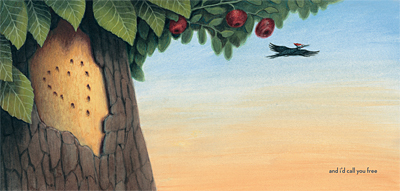
Poetic text meets whimsical illustrations in this hauntingly beautiful book. With imaginative verses like "if you were a bird / and i was a tree / you'd call me home / and i'd call you free", this book explores relationships in nature and relationships between people and nature.
If I Was the Sunshine, written by Julie Fogliano and illustrated by Loren Long, is a beautiful poetic picture book. I discovered this book on the National Council of Teachers of English (NCTE) 2020 Notable Poetry List that was published in the School Library Journal. Since many books contain heavy topics, I chose this book for its light nature. This book explores the relationships between animals, their landscapes, seasons, and various natural phenomena. In this book, the reader will find winter, spring, skunks, flowers, woodpeckers, trees, thunder, and a moose. That’s just to name a few! The appreciation for nature comes through the amazing illustrations and poetic words found on each page.
Each stanza is full of repetition, rhythm, and rhyme. Each stanza is a metaphor of a relationship. “If I was the silence/and you were a sound/i’d call you missing/and you’d call me found.” The illustrations beautifully painted by Long enhance the relationship being poetically written about. With the example given above, the illustration, always on a double-page spread, shows three deer on top of a frozen lake with a lone fish on the water. One can just hear the silence in the forest. When you turn the page, the reader finds the line “and you’d call me found.” Here we see one of the deer looking up at a close-up of five geese flying through the air. One can just hear their loud squawks. The close-ups and details that Long includes in each illustration invites the readers into each setting.
This book is best for younger readers in primary classrooms. There is no Lexile as it is considered non-prose. I would recommend it for preschool through first grade. This book would pair well with The Runaway Bunny as they are both written similarly. Both are about relationships and carry the reader through the book with their repetition and rhythm.
This book works well with many ELA standards. After reading the book more than one time, first grade students can identify words and phrases in the poem that suggest feelings or appeal to the senses. For example, “If I was a flower/and you were a rose/ I’d call you sniff/and you’d call me rose.” Another idea would be for students to use illustrations and details in a story to describe it’s setting and events. One critique of this book would be the decision to print the text in all lowercase. “i” appears many times in its lowercase form. However, even with that, this book is Caldecott worthy and should be added to primary classroom libraries.
If I Was the Sunshine is a poetic book about the relationship between things in nature. It follows the same pattern on every page of "if I was the --- and you were a ---, I'd call you ---, and you'd call me ---." The two things being compared change every time those words repeat. Some of the things compared of concrete such as a bird and a tree. Others are abstract such as silence and sound. The rhyme scheme is good for increasing the child's phonological awareness for better language development. The major theme is the interconnectedness of everything. Even things that seem opposite like night and day or a firefly and the dark, are interconnected. The connections make the two things or concepts even more beautiful. I give this book 3/5 stars because there is not a story line. It is a great book for working on rhyming and phonological awareness, but each set of pages jumps to a different concept. Some of the comparisons and paragraphs are far too abstract and poetic for young readers to understand. I think children would thoroughly enjoy the beautiful illustrations of this book, but they would lack understanding of many of the pages. My favorite connection was the bird and tree. The bird calls the tree home because that is where he is sleeps and rests, but the tree calls the bird free because unlike the tree, the bird can leave whenever. The bird can fly off to any place it desires, but the tree is stuck. I recommend this book for older elementary aged kids because that is the age in which I think children could begin to understand this book on a more significant level. I recommend it for children who are working one reading because the lexicon is simple, but the rhyming will help the child with their reading skills in the long run.
Two master picture book creators collaborate on this lovely book filled with metaphors and using opposites as more than just a concept. On sun-drenched pages, children and animals explore relationships to one another. Using “If I was…” statements, each of the verses delicately explore the inter-connective nature of the world around us. The book moves throughout a day, from morning through to bedtime. It shows various seasons as the book continues too, filling the pages with autumn apples, frozen lakes, and fireflies in the summer.
It is the combination of the art and the words that makes this picture book exceptional. Fogliano’s words are written with such skill. The verses rhyme without any forcing of the meter or the words, made even more difficult by the relationships embedded in each verse. The play of words is so deftly done, each combination is a surprise and a joy as the pages turn.
Long’s paintings are filled with light, whether it is the spark of a firefly or the gold of summer sun. He shows the relationships with various perspectives and cleverly juxtaposes the characters in double-page spreads that one can almost sink into.
A grand picture book that celebrates our world. Appropriate for ages 4-6.
Working with preschoolers and their families, I am frequently encouraging participation in the 1000 books before kindergarten literacy program. After years of encouraging others to participate, I decided to participate as well, despite not having a child under five years of age, and lead by example. In choosing to participate, I decided to use the challenge as a way to become more familiar with the contemporary literary cannon for families with young children, and have begun to immerse myself in both fiction and nonfiction works available for young children today.
This was a unique book, with gorgeous illustrations, that utilized a form of poetic rhyming verse to help children understand opposites and explore relationships. The book itself, while enjoyable, felt to be a bit more than many young children might be able to handle as some of the relationships discussed were very abstract in nature, and with every verse asked children to place themselves in the shoes of someone else. Empathy is a great thing, however it can be difficult for young ones to do. While this is a book I think can be very valuable for children to read through, this is one that might require some explanation or discussion with an adult to allow for the full meaning of the verse to be made clear.
Whoever thought to pair Julie Fogliano and Loren Long, I want to commend you on your brilliance. A stunning marriage of talents tell this story of love, interconnections, and relationships between two things.
Each stanza of Fogliano's rhyming text is spread over two 2-page spreads, with three lines on two pages and the final line following. The sans serif font and limited vocabulary makes this an appropriate beginning reader.
Long's acrylic illustrations are saturated in color, from the bold reds, blues, and yellows of the break of day (opening spread) through to the peek in the bedroom window at night (close of book). So much humor and play can be found here - the bear asleep appears as the hills under inches of snow, the contrast between the smell of the beautiful flowers and the skunk who is smelling the only rose in the garden, the woodpecker leaving behind a heart-shape pecked in the trunk of the tree, and the little boat tossed about in the waves of the ocean is found suspended in the spray from the giant whale's blowhole.
In the story the book goes through a journey of nature's connection with one another and the relationship and connection we have with our loved ones.
The main theme in the book is about love and relationships.
The main genre of the book is poetry.
Through reading this book, we learn through nature the love and connection we have with our loved ones.
This book was a wow book for me because it showed us through nature the beauty of love, connection, and relationships with the ones we love. It’s also a beauty book to teach children about relationships with their parents, family, and friends.
Analysis
Some of the writing craft techniques the author used are metaphor's through almost the entire book. There’s also a lot of grammatically incorrect wording in the book as well. I believe the author did this either because they didn’t want to use too many reaping words or a teaching moment for children to catch.
The author portrayed an anti-bias perspective by exploring all of nature diverse beauty to teach about connections and relationships.
Review originally published on my blog, Nine Pages.
The store received a review copy of this poetic picture book. There’s a definite pattern to the text, stanzas that begin with analogies “if i was A, and you were B” or “if you were C, and i was D” “i’d call you E and you’d called me F” (Fogliano writes all in lowercase). There’s little to the text itself. The book’s meaning emerges through the reader’s reckoning of the relationships between the four varying objects of the stanzas. The text is accompanied by Long’s soothing and brightly colored illustrations, mainly of creatures interacting with nature.
This is a lyrical book with breathtakingly beautiful illustrations! Yes, when I first saw the title I was annoyed by what seemed to be a grammar gaffe and the first few lines in the summary - without the pictures didn’t help me warm to this book. Reading the book, one gets a different feeling when you start to understand the beauty of nature and relationships...and the way words and pictures together can create a whole so much more than the sum of the parts. I especially loved that each text block is about different perspectives - I am definitely reading this with “Mind in the Making” in mind. This is a great example of the principle of perspective taking, which is so important to developing minds.