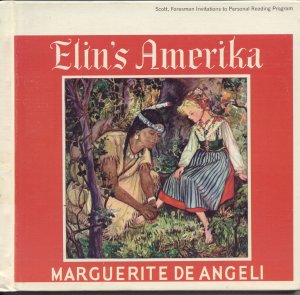
Award-winning children's author Marguerite de Angeli tells the story of Elin, a young girl who has come to live in the New Sweden Colony. She helps us envision how these many different peoples -- Swedes, Finns, Lenape, Minquas (Susquehannock), Dutch and British related to one another. Elin s search for friendship, love of family, and anticipation of celebrations seem familiar. Her isolation from other children, lack of basic things, and the daily routine of chores may seem quite unfamiliar. New Sweden was established in 1638, under the guidance of Peter Minuit, when Swedish colonists were sent to the New World to claim lands in the area around the Delaware River in southeastern PA and south NJ. For ages 8-12. Illustrations.
Marguerite de Angeli was an American writer and illustrator of children's books including the 1950 Newbery Award winning book The Door in the Wall. She wrote and illustrated twenty-eight of her own books, and illustrated more than three dozen books and numerous magazine stories and articles for other authors.
They don’t write stories like this anymore. Nowadays a publisher would presumably insist upon a plot, which is good in some ways but bad in others. Plots are entertaining. Yet there should also be room in the world for stories that portray the beauty, bravery, and significance of ordinary life in different times and places--without the modern caveat that this kind of “literary” tale requires surrounding the main character with a dysfunctional or otherwise unsatisfactory family.
By the author of the more well-known The Door in the Wall, this children’s novel follows Elin, a girl from an eighteenth-century Swedish emigrant family, as she and her community settle into their new homes in America and wait for the next Swedish ship to bring loved ones and needed supplies. Elin is the only girl in the area and feels the loneliness keenly. Her mother tells her that work is good for loneliness, and Elin does her best to hold up her end of the household tasks. She also develops a friendship with an American Indian herb woman. The warmth with which the author portrays her characters makes it believable and a satisfying read.
The glimpses of Swedish culture are quite interesting. Elin’s mother uses the folk belief of a household Tomte to motivate Elin to do her chores properly and to avoid quarreling (“Don’t quarrel! What if the Tomte heard you? He would be angry!”). Young readers may need a certain amount of maturity to recognize what’s going on here, because the author never points out that Elin’s firm belief in the Tomte is based on story instead of fact. The Swedish vocabulary is also a potential source of initial confusion (for instance, Elin’s parents are sometimes called Fader and Moder, and sometimes as Far and Mor) but that also helps build the reader's sense of learning about another culture.
For a vintage book, Elin’s Amerika portrays the Native Americans very positively. One scene states that the Indians and the Swedes worship the same God under different names (another thing to discuss with young readers). The story does feature a single “Indian attack” that feels rather random, but the text connects it to the rum that English traders use for barter.
I wouldn’t call this book great literature, but it’s charming in its own way and I’ll add it to my list of potential future read-alouds. The setting--so filled with details of daily life--is vivid and memorable.
A sweet story of an immigrant girl in pre-revolutionary America. It's a simple story about what life was like for Swedish immigrants, and the challenges and joys they faced. de Angeli illustrated this book herself, and her pictures are quite lovely.
We read this book as part of our history curriculum and throughly enjoyed it! It really brought to life what it would be like to be an early Swedish settler in America. My daughters (6 and 8) both wanted more after it was over; they loved it!
This was a book I read to Julianna for school. It was so good! It was set in the 1680’s in New Sweden near Jersey. I have loved the books chosen by my curriculum A Gentle Feast.
This book holds a special place in my heart. The little girl in the story's name is Elin which is the Swedish version of Eileen. And her middle name is named after the Queen of Sweden at the time, Christina, which is also my middle name. The copy of the book I have is signed by the author and will always be special to me.
This story tells the life of a young girl who is coming to accept the changes in her life as she grown accustom to living in America. She misses her friends, grandfather, and older brother. But she knows that she has much to be thankful for. As the months go past, Elin has different adventures and celebrations which she is thankful for.
The illustrations in this book are beautiful. If you get a chance to read this book you will not be disappointed. I love it!!
I love deAngeli's illustrating style. Her books are specifically written for younger children and she does that well. I was a bit confused as to why it had to be about American life since most of it seemed to be about Swedish culture.
Retro Friday is a weekly meme hosted by Angie over at Angieville and focuses on reviewing books from the past. This can be an old favorite, an under-the-radar book you think deserves more attention, something woefully out of print, etc.
I haven't done a Retro Friday post before, but I read plenty of older books and enjoy talking about them anyway, so I may try to work this into a regular thing. Anyway, I had recently re-read Elin's Amerika by Marguerite De Angeli, so I thought I'd talk about that today.
Marguerite De Angeli is probably best known for her Newbery winning book, A Door in the Wall, but she was a fairly prolific writer/illustrator, and also wrote a loose series of books about young people in America's history. This isn't as daunting as it sounds; one of De Angeli's strengths is her ability to, without making her characters contemporary, create relateable and likeable characters. For the most part, her children work as of their time, while at the same time being sympathetic to De Angeli's audience, and even to us today.
Elin is a young Swedish girl, living somewhere in what will eventually become Pennsylvania and New Jersey. She has three brothers, Peter, Knute, and Axel. Axel is working on one of the ships that brings new settlers and supplies to the area. And, in the midst of all this strangeness and maleness (her neighbors all have boys too) she longs for her friend back in Sweden and wishes for another girl to play with.
I was a little worried about Elin's Amerika, simply because of the fact that I knew these were earlier settlers interacting with the Native Americans and...you know, it's always both annoying and sad when a favorite childhood book turns out to be a problematic. By and large, I think Elin comes out okay in this regard. There is a tribe that attacks the settlers, but there are several others who help them, and De Angeli seems to be trying to depict a sort of cooperative harmony between the Swedish settlers and the neighboring Native Americans (at one point, Fader says, of the others "They just don't know us," which is very simplistic, but better than They are evil). How close that is to the historical reality is probably highly debatable; I simply don't know, so I'm not going to try to get into it, but overall I'd say that this is one I'd feel comfortable reading to children, especially if we were able to discuss a few points afterwards.
One of the strong points of De Angeli's books are her beautiful illustrations. Elin's Amerika is no different--the traditional Swedish embroidery is beautifully rendered, and there's a picture at the very end, which I can't find online, of Elin and her family walking through the woods on their way to the Christmas service that's just gorgeous. The one I was able to find is the family gathered around their fire in the evening.
All in all, I was pleasantly surprised by how much I continue to like poor lonely Elin and the ups and downs of her first year in America. For those who like such things (I do) there are nice descriptions of housekeeping and everyday life, as well as a healthy dose of excitement and potential danger.
Book source: public library Book information: originally published 1941 by Doubleday; reissued by American Swedish History Museum in 2007; children's, illustrated
I received this book from family friends when we moved from Georgia to Washington back in 1981. They gave it to me to remind me of my Swedish heritage. I never get tired of reading it and I enjoy the little insight to New Sweden the book gives me.
From the fly-leaf: ““Only boys, boys, boys everywhere!” Elin Sigstedt sighed. “Boys have all the fun.”
There just weren’t any little girls to play with among the neighbors in New Sweden in 1648. Of course there were Moder and Fader and brothers, Bror and Knjute and Axel, who would be back when the ship from Sweden came in. But if only there were a little girl somewhere to play with!
Elin could pretend that the Tomte, the house elf who surely had come to “Amerika” with them, was near and talk to him. And there was the friendly Indian woman, Lamefoot, who showed her where there wer beautiful flowers growing in the woods. But none of this was like having a little girl. If only the ship would come, bringing supplies and another little girl to the settlers on the banks of the Delaware.
And when Little Christmas and then real Christmas ame around Elin’s longing grew and grew—a little girl to hare her Christmas secrets!
What happened when the ship came at last was a surprise better than any Elin could ever have thought up! She no longer was lonely and had to think of Old Sweden as “home”! This was Elin’s Amerika.
Mrs. De Angeli adds another charming historical picture story with delightful children of the past to her list of HENNER’S LYDIA and THEE, HANNAH! And this new book is one of the finest to chronicle America’s earliest pioneer settlements.”
This is a sweet book about the ordinary life of a Swedish immigrant child. One gets a good picture of Swedish traditions and there is a satisfying solution to the little girl’s longing. I can imagine children incorporating parts of this book into their play. It’s too young for our children now but I will buy it for grandchildren.