I have a shit-ton of thoughts on Bane, so it will be a real challenge to keep this review brief and concise. Be that as it may, I’ll try. No promises, though.
Conceptually speaking, Bane is the most unique romance/erotica novel I’ve read so far. Being the third instalment in the Strain series, it has the unenviable task of ensuring the plotlines of the first and second book dovetail as seamlessly as possible. I suppose that whether it achieves this goal is up to each individual reader. As far as I’m concerned, it both succeeds and fails in different ways.
Whereas Juggernaut focused on the relationship between Zach and Nico and Strain on the one between Rhys and Darius, Bane has the distinction of featuring both pairs. If memory serves, this is something I’ve never encountered, not only in romance and erotica, but fiction in general.
That said, it wouldn’t be fair to claim that Bane is proportionately divided between the two sets of lovers, nor that it gives each pair an equal share of focus. Intentionally or otherwise, the book is partial to Rhys and Darius, and dedicates far more time to them than to Nico and Zach. I’d say the ratio is somewhere around 65:35.
Naturally, I can’t say why that is. Perhaps because Darius and Rhys are a wilder and more popular pairing. Perhaps Gormley found their relationship more interesting to explore. Perhaps it was entirely accidental.
Whatever the case, this meshing of the two, largely separate, storylines is done really well. Both Juggernaut and Strain can be read as standalone novels, but Bane wouldn’t make much sense if read without the appropriate context.
The plotline is full of unexpected twists and turns, and is far more thriller-y and fast-paced than either of the preceding books. I won’t go into detail here, since the narrative is extremely convoluted and everything keeps changing from page to page, so I’ll just stick to some general thoughts.
Bane should’ve been longer. While it’s an exciting thriller that loves throwing one curveball after another at the reader, all that action leaves little time for important character interactions. The conclusion of the trilogy, both as it pertains to the events of this novel and the predicted future happenings, comes across as… I hesitate to use the word convenient here, because using that term would rob the story of its merit.
Perhaps it is somewhat convenient that all the plot threads get resolved in one way or another, but I honestly can’t be mad about that, because it honestly doesn’t feel like a copout. Gormley never strays from the established in-universe rules, nor does she introduce indigestible, farfetched plot mechanisms to arrive at the desired ending.
Everything that happens makes sense. The solution to the problem was introduced in Juggernaut, but treated so offhandedly that no reader in their right mind would’ve ever considered such a minor plot point relevant in the grand scheme of things. It’s been buried deep enough in our minds almost to be forgotten, though not deep enough to feel like it’s coming out of left field.
And, for that, I take my hat off to you, Ms. Gormley. You reeeally had me there for a moment. Or two. Or twenty. You managed to create a suspenseful situation that spanned entire chapters and that genuinely had me worried one of the characters wouldn’t make it.
What’s more, the drama wasn’t contrived, but organically generated. Our lovers’ fates and the fate of their entire world were arrived at and dealt with so superbly, that I honestly don’t know what to say but kudos.
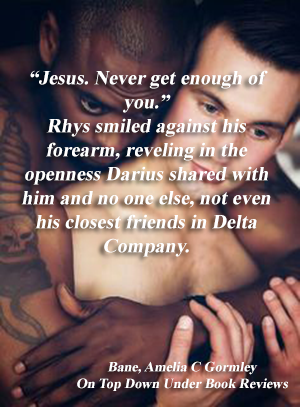
Given that Rhys and Darius, though the former especially, receive most of the spotlight, their development is at the core of the novel. It drives the plot forward. In fact, Bane can justifiably be called a Rhys-driven narrative. Rhys is the one who makes the majority of the decisions, Rhys is the one who moves the plot along, and Rhys is the one who is involved in most of the action—of the thriller and sexual nature alike.
Bane takes place two years after the events of Strain, and two years have done our boy a world of good. Far from the scared, bashful, sheltered creature he used to be, Rhys has now fully come into his own. Even though I loved Strain-Rhys with his quiet bravery and stubborn defiance, I gotta admit I love Bane-Rhys just as much, if not more.
Much like he transformed his undernourished, near-emaciated body into a strong, athletic one, Rhys also underwent a major character development. He now refuses to be seen as a victim, takes charge of his destiny, and is loud and proud about his wants and desires.
Darius doesn’t develop too much. The changes we observe in him come about not so much as a result of his own growth, but as a reaction to Rhys’s. Paradoxically, Darius learns to both hold onto Rhys tighter and let him go and be free and independent. Their power dynamic is much more equal in Bane. Darius’s wonder and amazement at Rhys’s growth perfectly mirror the readers’. We stand back and watch in awe and with pride how far our boy has come.
Zach and Nico are critical to the events that unfold, but aren’t explored all that much. They’re essentially the same characters we met in Juggernaut. Nico is by far the least attended-to character in the quartet, and is conspicuously absent for long stretches.
Conversely, Zach gets more than a few chances to shine. He doesn’t change all that much either, but his steady constancy greatly adds to the plot. And I am still amazed by the fact that his saintlike patience and serenity don’t bother me. Probably because, unlike his father and brother, Zach doesn’t indulge in any sanctimonious bullshit.
Bringing all these different personalities together is an ambitious move, but the author somehow makes it work. There are so many fantastic character interactions here. Pairing up Zach and Rhys is a stroke of genius. Pairing up Rhys and Schuyler is a stroke of genius. Bringing McClosky and Littlewood back is a stroke of genius.
That’s why I feel Bane should have been longer—to allow for more character interactions. I wanted more scenes of Darius and Nico interacting, more of Nico and McClosky, Nico and Littlewood, Joe and Zach, and so on and so forth. Whenever Rhys and Darius went off on their romantic little rendezvous in the woods, I felt like screaming at the pages, “No! What are you doing? Bring them back so they can interact with the other characters some more!”
Bane continues exploring the themes introduced over the preceding books, from religious fundamentalism to othering marginalised groups perceived as threats. It dives into the paranoia the Jugs’ presence causes in this thinly-veiled AIDS allegory. It continues examining what the worth of life is when the things we consider essential become scarce.
But the most prominent theme, and the one heavily explored across all three books, has got to be that of power. Power unchecked. Power without responsibility. Power as a tool of subjugation. In this world, we see some characters keeping their unequal advantage in check and we see others living out the mantra that might makes right, selfishly grabbing for more power on top of the considerable amount they already wield. In short, it’s a joy to read.
I could honestly go on and on, praising Bane and the entire series for their fantastic characters, tight storytelling, relevant themes, and some of the best literary sex I’ve ever had. However, I did kind of promise to keep this review short and sweet (for me, everything under four-thousand words is short and sweet).
Even though Bane isn’t perfect and even though I’ve outlined some of the problems I’ve had with its plot and bemoaned some of the opportunities it missed, I feel no compunction whatsoever about giving it five stars. The issues I have with it pale in comparison to how awesome reading it felt. I was nearly breathless as I ploughed through the chapters, needing and wanting more of the action, more of the feels, the twists, the turns, the interactions, the smut, the social commentary, and all the rest this book provides in oodles.
What’s more, I’m amazed that a series of post-apocalyptic novels that features zombies, a lethal virus, characters mercy-killing their loved ones, and monsters going off the deep end and raping and murdering people managed to make me feel so freaking good and optimistic. I have no idea how that’s even possible, so I’ll just repeat—my hat’s off to you, Ms. Gormley.




 the most. I wasn't as invested in Zachs and Nicos relationship. Rhys and Darius were definitely more readable and Hot!


