Essays by Ernst Benz, Henry Corbin, Jean Daniélou, Mircea Eliade, G. van der Leeuw, Fritz Meier, Adolf Portmann, Daisetz T. Suzuki, Paul Tillich, Lancelot Law Whyte, and Heinrich Zimmer.
O problema desse livro é o fato do primeiro texto ser o do Erich Neumann e, como total BAMF que era, exalou já no inicio deixando os demais textos não tão interessantes.
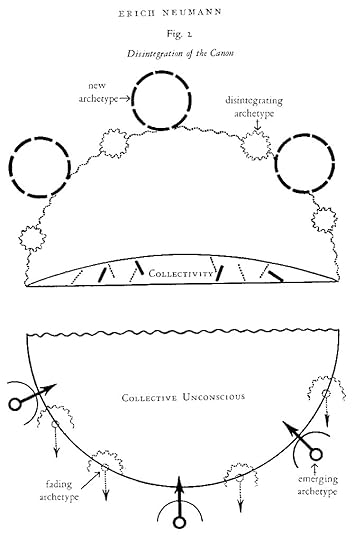
As our daytime world is devoured by the Terrible Mother, torn to pieces in the bloody rituals that are our wars, demonic, magical, and elemental irrationality invades us. The stream of the libido flows inward, from the crumbling canon into the unconscious, and activates its latent images of past and future.
I must quote from Dr. Faustus, with which the tragedy ends: "Often he talked of eternal grace, the poor man, and I don't know if it will be enough. But an understanding heart, believe me, is enough for everything." Let us understand these words correctly. They are not proud or arrogant; on the contrary they are desperately modest. We really do not know any longer whether grace is enough, precisely because we are as we are and are beginning to see ourselves as we are. But at a time of overwhelming crisis, the questionable nature of grace, or rather our knowledge that we are unworthy of grace, compels us to understand and love mankind, the fallible mankind that we ourselves are. Behind this abysmal crisis, the archetype of the Eternal Feminine as earth and as Sophia would seem to be discernible; it is no accident that these words are spoken by Frau Schweigestill, the mother. That is to say, it is precisely in chaos, in hell, that the New makes its appearance. Did not Kwanyin descend into hell rather than spend her time with the serene music makers in heaven?