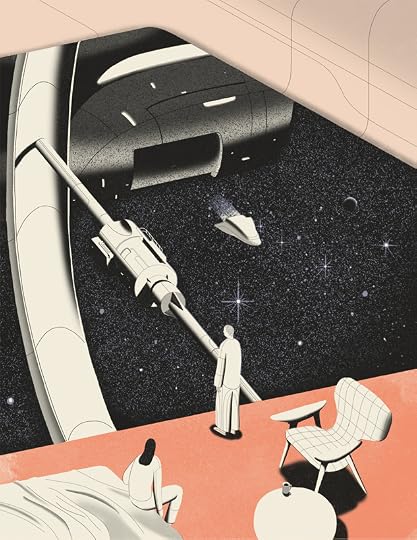
The mission: to survey the galaxy and beyond. An endless stream of probes and starships heading out into the universe, surveying, cataloguing, assaying. Forever. And on board those ships, the intrepid explorers who give it all meaning.
Grace's Family by James Patrick Kelly is a Tor.com Original short story.
At the Publisher's request, this title is being sold without Digital Rights Management Software (DRM) applied.
James Patrick Kelly (please, call him Jim) has had an eclectic writing career. He has written novels, short stories, essays, reviews, poetry, plays and planetarium shows. His short novel Burn won the Science Fiction Writers of America's Nebula Award in 2007. He has won the World Science Fiction Society’s Hugo Award twice: in 1996, for his novelette “Think Like A Dinosaur” and in 2000, for his novelette, “Ten to the Sixteenth to One.” His fiction has been translated into eighteen languages. He produces two podcasts: James Patrick Kelly's StoryPod on Audible and the Free Reads Podcast (Yes, it’s free). His most recent publishing venture is the ezine James Patrick Kelly’s Strangeways. His website is www.jimkelly.net.
Orisa shook her head. “No plan except to keep going. Random choice perfectly acceptable.”
perfectly acceptable.
it’s not often that i have nothing to say about something i’ve read, even something as brief as one of these free tor shorts. but with this one, i got nothing. it’s true that it is outside my usual reading preference - outer space and bots and artificial intelligence, oh my! but beyond that superficial explanation (because i have enjoyed a few stories with those components before, here and there), the story itself didn’t make an impression on me at all. it’s not poorly written - that would have left an impression. it’s not that i didn’t “get” it. it just left me with literally no reaction. last night i was hungry, but it was too hot to go outside and i was too lethargic to be creative with my pantry’s contents, so i ended up shoving some plain bread in my face just to hold up my end of the bargain i have made with my body to keep karen alive. once the hunger pangs were quelled, i had no memory of even eating that bread. that’s how i felt after reading this story; the fulfillment of a self-imposed task: i have read my free tor short for the week. blink. now what??
i read a free tor short every week, and have been doing so for a few years now. they haven’t been posting as many new ones week-to-week as they used to, and some of them have been removed over the years, so there are fewer options from which to choose, since i refuse to read stories that are connected to a series i haven’t read. so i’ve been going outside of my comfort zone on these for a while, and sometimes they pleasantly surprise me, sometimes they confirm what i know about my own tastes, and very rarely, i emerge from my reading like this - flat as distilled water, beige as hotel art, unsullied as teflon &etc.
other readers may love this story. other readers may hate this story. me, i’m as blank as can be.
Grace is a survey ship who travels from system to system looking for life-supporting planets. At the start of James Patrick Kelly’s new novelette “Grace’s Family”, her crew consists of teenage boy Jojin, his bot “sibling” Qory, and their parents Gillian (also a bot) and Dree. We soon learn that they are not an actual nuclear family but are only role playing as one. Human spacefaring culture, it seems, revolves around multi-level immersive storytelling: everyone has their own personal narratives they participate in, plus various narratives they role play as a crew, plus an overarching construct that defines their relationships to each other. Early on in “Grace’s Family”, Dree grows dissatisfied with his role on Grace and he and Gillian end up getting traded to another ship, replaced with a woman named Orisa who introduces Jojin and Qory to different identity constructs, and radical new (but actually old) ideas. “Grace’s Family” is carried in its first half by its captivating premise, and Kelly’s subtly effective characterizations and tension-building. Adding to the intrigue is the idea that humans are “resources” for ships to use in their larger objective of growing the “infosphere” – a term used to describe all the elements contained in the observed universe. It is a hopeful idea, one that harkens back to the more benign aims of classic sci-fi – that our aim as a civilization is not to conquer but to expand our understanding. The injection of Orisa into Jojin and Qory’s lives teases promising new avenues for Kelly’s story to follow, and for a while it almost lives up to that promise. But Kelly undoes everything that was so interesting about the setup, taking the easy way out by giving Orisa and Jojin a traditional romance that eschews their role-playing ways, and jettisoning their constructed narratives in favor of these crazy old things called “books”. I get the (rather obvious) point, but its hard not to look back at “Grace’s Family” in light of where it ends up and feel as though the story's central dramatic question was very tendentious in setting itself up for failure.
A free JP Kelly, and hard-SF to boot. What's not to like? 4.5+ stars. Might make it to a full 5, on reread. Not to be missed. Story link: https://reactormag.com/graces-family-...
Samples: [OK, I got a little carried away. Fanboy Squee! effect.] "Grace was more than a thousand years old, according to Qory. Which was hard to imagine, but then Qory was two hundred and something. I forgot how old Mom was. Old.
Everyone was older than I was. I mean, Dad and I were almost contemporaries and he was what? A hundred and twenty? A hundred forty? But he was wearing out, which was probably why the starships had agreed to trade him. ...
Humans. It wasn’t fair, being us."
A new crew-member comes aboard, a transfer from starship Grace's sister-ship:
“Mercy sends her regards,” said Grace. “We have finished synchronizing our databases and we are processing the new information to grow the infosphere. She will proceed to the mangle and we will resume our survey mission. I am pleased that you’ve joined our family. Would you like to see your rooms now?”
Orisa dropped her satchel and slumped against the bulkhead. “Shit.” . . . The three planets in the Goldilocks Zone of the Kenstraw system were kind of a waste. All were lifeless disappointments. Kenstraw B was a Chthonian, a gas giant that had drifted too close to the red dwarf and had lost its atmosphere, leaving only a rocky core. Kenstraw A was tidally locked to its star. Grace had hoped to find life in the twilight zone between the hot and cold faces ...
.... Grace’s voice perked up.
“Also three continent-like highlands,” she continued. “And I count just one thousand one hundred and sixty-two impact craters ranging in diameter from three kilometers to two hundred and eighty. The atmosphere is so thick that it slows incoming projectiles with less kinetic energy down so that they don’t leave craters.”
She did sound more cheerful. I mouthed the question to Orisa. What the hell?
“It’s a trick I learned on Curiosity,” she said, making no attempt to keep her reply a secret. “Starships like to know we’re paying attention. The infosphere needs an audience. We’re how the universe knows itself.” . . . “How many solar systems are there in the infosphere, Grace?”
“The starship project has made eight hundred forty-three thousand two hundred and eighteen supervised surveys of star systems, including Kenstraw.” The screens lit up with a plot of all the stars in the infosphere. “In addition, unsupervised starship intelligences operating drones have accomplished surveys of approximately eighty-two million star systems.”
“But drone surveys don’t exactly count,” said Orisa. “Do they?”
“Data isn’t information. Information isn’t knowledge.”
“And how many stars are there in our galaxy?”
Grace sounded almost gleeful. “According to current estimates, approximately four hundred billion.”
Grace is an intelligent starship, her family a motley group of humans and robots who have accepted the eternal challenge of mapping the universe. The story of their relationships, how they cope with space travel and the distance between stars - that's the heart of this story, and it provides a lot to think about. I really liked it.
A commentary on how, in a world that increasingly relies on AI, humans still "drive the ship" because we control the narrative. In this way, the story is optimistic about our future in a robot-driven world. However, Kelly's humans are still traded without their consent and the families they create are torn asunder as ships negotiate over them as resources. While this aspect of the story is bleak, the humans (and sentient robots) have the ability to change the plot in a way that benefits them even in circumstances they have been thrown into unwillingly.
Kelly, James Patrick. Grace’s Family. Tor, 2018. The folks at Tor called Grace’s Family a short story, but they published it separately. At 45 pages, it would probably have been the lead novelette in Analog or Asimov’s Science Fiction Magazine. This awkward, between-the-stools length may account for the lackluster ratings it has received on Goodreads. Grace is the AI on a starship that is part of a fleet exploring all the planets in the observable universe. Grace is not a self-directing AI. She requires a human crew to choose the next target, though a random walk is as good as any other plan. Their ultimate goal, in the words of Carl Sagan, is to help “the cosmos know itself,” to convert data into information and information into knowledge. I will leave it there to avoid plot spoilers, but the intriguing premise alone gets James Patrick Kelly four stars from me.
Actually quite grim story about a post scarcity society. The author muses on why people bother to do things - which is either a bit cerebral or a bit scary.
_Grace’s Family_ is the fairly light and easy-going SF story of a young man and the intelligent starship, Grace, which is his home. It seems more like an establishing step towards a much larger mosaic of space exploration, but it’s moderately entertaining on its own.




 come to my blog!