Having already read one collective biography of the Mitford sisters, I was unsure of the value of reading another; however, all the reviews of this one pointed out that it was of value even to fans who had read all the other biographical studies around, so I decided to take them at their word. I think they were right; Thompson does take a fresh approach to the lives of the sisters, giving a better picture of the social world the family inhabited rather than providing one more survey of their romantic exploits and political beliefs.
Goodreads' five-star rating system continues to be a source of frustration--I'd rather give this three and a half out of five stars, or better, six or seven out of ten. I'm a bit ambivalent about Thompson's style of writing; slipping in and out of a narrative voice of someone who was there among the sisters as their private dramas played out is one of the techniques that makes the retelling of these well-known stories feel new, but I always find it jarring when a biographer decides to judge what a subject was or wasn't truly feeling when there is no first-hand evidence to support such conclusions. (She interviewed Diana and Deborah, so in that regard I trust that she is relaying what was told to her; she could not possibly have interviewed Tom, and yet more than once states with authority that he really thought this or that, contradicting what his sisters or close friends reported. Without Tom himself to confirm which of the conflicting impressions of him was accurate and no letters or journal entries to cite as direct evidence, we can't possibly know what he was actually thinking.)
The thing that bothered me most is Thompson's determination to convince us that Unity Mitford remained essentially a teenage fangirl even before her suicide attempt and that Diana Moseley was an admirable person. She makes no excuses for Hitler, the Nazi party, or the atrocities of WWII; she does, however, remind us repeatedly that no one in Britain knew about Buchenwald, Auschwitz, etc., in 1938, and insists that both Oswald and Diana Moseley's Nazi sympathies were born of a desire to see Britain retain its status as an empire and return to a more secure economic footing--preferably one where the aristocracy was restored to its Victorian and Edwardian glory days. After all, we are reminded more than once, Diana had Jewish friends. I would have more patience with this if there was any indication that either Moseley felt any remorse for the millions of people Hitler and his regime murdered, but the best there is is a mild sense of regret that so many died, and the Desert Island Discs interview where Diana's response to the reminder of the Holocaust victims was "Oh, I don't think it was so many as that." Thompson takes pains to remind us that Oswald Moseley may have been a fascist, but he wasn't a Nazi; given his interactions with Hitler, Himmler, and the Nazi high command, this fact seems to me incidental in that he was not a German citizen, not an indication that he would have spoken out, let alone done anything to stop, what the Nazis did. Presuming he and Diana were utterly unaware of what was going on at the time, which strikes me as extremely unlikely, despite Thompson's assurances.
In between all of the making excuses for Diana and, to a lesser extent, Moseley and Unity, she is frequently critical of Jessica, and Esmond Romilly she condemns outright, even as she states herself that Jessica's political intensity was little different in essence from Diana's and Unity's, albeit with a different focus. If Diana and all the other Nazi sympathizers of varying degrees in her family, including her parents, her sister Pam, and Pam's husband Derek Jackson, should be excused to an extent because the general public in Britain was unaware of the concentration camps (the Night of the Long Knives and Kristallnacht were hardly secret, but apparently not enough proof of Hitler's murderous intent for some of the Mitfords), I am entirely confused as to why Jessica's actions as a teenager were so much worse than Unity's or Diana's, or why Esmond Romilly was a worse person than Oswald Moseley. If Thompson (or any other Mitford biographer) has argued that Jessica or Esmond knew or should have known about Stalin's atrocities in the 1940s, I missed it, and yet he is described as "repellent" while Moseley is "a life force". Esmond made some poor choices--to put it mildly--and was by no means a paragon of virtue, but it was jessica herself who recorded some of the incidents and statements upon which Thompson bases her evaluation of him, and one cannot fault his loyalty to Jessica. The excusing and explaining away of Nazi sympathies because Unity was childish and strange and Sydney was an immensely strong person and Diana was just so beautiful and magnetic is frustrating, often maddening. Perhaps they weren't anti-Semitic (although Diana proudly asserted that she was); perhaps they were not aware of what was really going on at the time, although Unity reported back to her family that she had moved into the flat of a "Jewish couple who had gone on holiday". The Mitfords and their respective lovers, spouses, and friends were many things, but none of them were stupid. Diana above all never apologized for her views; strength of mind this may have been, but it is hardly an admirable quality when applied to the denial of mass murder.



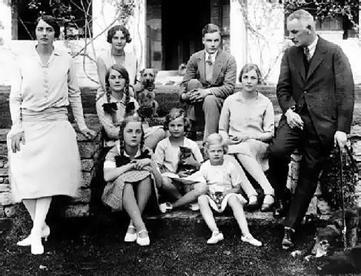
 and it was very much a shock to find my idol had feet of clay. In fact feet???? The clay would go right up to her neck!
 Thompson suggests Unity was mentally ill which would certainly explain her hysterical adoption of the Nazi cause. I find this photo chilling;


