

What do you think?

Rutilius Namatianus' Going Home
Martha Malamud provides the only scholarly English translation of De Reditu Suo with significant notes and commentary that explore historical, literary, cultural, and mythical references, as well as commenting on literary allusions, the structure, diction, and style of the poem, and textual issues. De Reditu Suo provides fascinating insights into travel and communications networks in the rapidly changing, fragmented world of the fifth century. A substantial introductory essay explores Rutilius’ place in several intellectual and literary traditions, as the poem is a sophisticated piece of literature that both draws on the rich tradition of classical Latin poetry and reflects the distinctive formal features of late antique poetry. The poem also conveys the thoughts of a man passionately devoted to Rome and its cultural heritage, enmeshed in the tumultuous political and social upheaval of his day, caught between his hopes for Rome’s restoration and his fear of its disintegration. With line-for-line translation from the Latin and a scholarly introduction, extensive notes, and comprehensive bibliography, Martha Malamud makes this important text accessible and relevant for students and scholars in Classics, Comparative Literature, Religious Studies, Medieval Studies, and Ancient History, as well as independent readers with an interest in the literature of the period.
108 pages, Paperback
Published January 12, 2018
Ratings & Reviews
Friends & Following
Create a free account to discover what your friends think of this book!
Community Reviews
Displaying 1 - 3 of 3 reviews

Read
October 14, 2017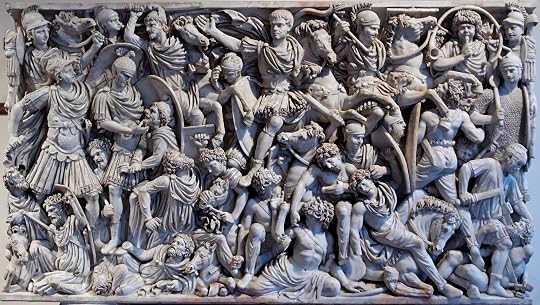
Sarcophagus frieze depicting a battle between Romans and Germans (ca. 251/2)
The north wind turned and we took care to sail when first
the star of dawn gleamed from his crimson steed
and Corsica begins to show her mountains dim.
Same-colored shadow lifts her cloudy head,
just as the puzzling moon with slender horn will fade
and even when found will hide from straining eyes.
Rutilius Claudius Namatianus (ca. 370 - ?) came into this world near what is now Toulouse as the Roman Empire of the West was yet tottering on its last legs and rose to be the magister officiorum (one of the highest posts in the Empire below the Augusti and Caesari) in 412 and praefectus urbi of Rome in 414, four years after its sacking by Alaric. But in 417 he left his posts at the center of power and hurried home to Gaul in order to participate in the attempts to restore the administration and economy of his home province after the latest wave of German barbarians had swept through. He couldn't know that another couple of waves were on the way, followed by a brief resurrection of the western empire during Justinian's reign, an effort that sapped the last of the Empire's strength and was followed by a total collapse of urban life as Europe sank into the Dark Ages and what was left of learning in the West retreated behind monastery walls.(*)
On the way home Rutilius wrote a lengthy poem in an elaborate elegiac meter, De Reditu Suo (On His Return), which Martha Malamud has just translated into English (Rutilius Namatianus' Going Home: De Reditu Suo, 2016) and provided with a useful introduction and commentary. De Reditu Suo originally comprised two books; the first has come down to us nearly intact, but little remains of the second.(**) What we have of the poem consists primarily of vivid descriptions of stations of his journey by sea (from Portus Augusti to, most likely, what is now Marseilles), splendid examples of what the classical rhetoricians called ekphrasis, defined as "speech that brings the subject matter vividly before the eyes," besprinkled with allusions to the Odyssey and the Aeneid. Since, like Odysseus, Rutilius was returning to a home in peril and, like Aeneas, was leaving a sacked city, these allusions were a bit more than literary trimmings. Even more numerous are the allusions to Ovid's texts, particularly his writings from exile, such as Tristia. Indeed, Rutilius' meter is that of Ovid's Black Sea poems.
Though the outgoing Empire produced no Virgils or Ovids, the few yet extant witnesses of a tumultuous and calamitous time (including the sixty year younger Sidonius Apollinaris, whom I have discussed elsewhere) speak to me with sincerity and a certain art that still appeals. And, frankly, I can't help but wonder if we are at the beginnings of a calamitous collapse ourselves.
(*) Here the barbarians are already among us: carrying tiki torches in Charlottesville, firing automatic weapons from hotel rooms, tweeting from the halls of power. (The white supremacist/separatist Richard Spencer has forced my home institution, the University of Florida, to allow him to speak in its Performance Center this coming Thursday. We are all awaiting this event with great anxiety.) But the migration of entire peoples has only just begun this century; as the consequences of climate change continue to grow more extreme, the migrations of the last decade will be as nothing at all.
(**) Hope is not entirely lost, though, as a new fragment of the second book was discovered as recently as 1972. Perhaps more is to come, though most of all I fervently wish someone would find the rest of Petronius' unique and fascinating Satyricon.
bbbbbbbbbbbbbddddddddddddddddddddddddddddhhhhhhhhhhhhhhhhhhhhhhhhkkkkkkkkkkkkkkkkkkkhhhhhhhhhhhhhhhhhhh

February 4, 2018
DE REDITU SUO – Going home
Rutilius Namatianus 417 CE
A modern-day adventurer would be jealous of Rutilius's fantastic life, adventures and journey home to the Southern part of Roman Gaul, a place near modern-day Toulouse from where he was native.
He had spent his young years in Rome for education and succeeded in becoming a high ranking civil servant, up to ‘Praefectus Urbi,' mayor of Rome.
At the time of the invasions of the Goths and the sack of Rome in 410, he must have had to deal with clearing up the mess and restore Roman law and order.
It is likely that in the following years he was asked to return to Gaul to assist in the restoration there after the Gothic invasion, and at the same time restore his family estates after the devastation by barbaric Germanic tribes.
Of this journey, he left an elegant and elaborate poem, De Reditu Suo,
“O Reader, wonder rather at my swift return,
That I’m so quick to leave behind Rome’s charms.
For what is ‘long’ to those who’ve loved Rome all their lives?
What always gives us pleasure is not ‘long.’
…/…
Just so, we trust, within the axis of the heavens,
The council of the highest gods is held.
Fate snatches me away from these beloved shores---
The fields of Gaul are calling for their son.
…/…
In doubtful light of dawn we lift the anchor, then
Colour returns and lets the fields be seen.
In little boats, we move along the nearest shore
So land could always offer us a refuge.
…/…
Near here, we seek the famous port of Hercules;
Soft breezes follow as the day declines.
Amid the traces of his camp, we spin the tale
Of Lepidus’ headlong Sardinian flight,”
These few lines could give the reader an Idea of the style, rhythm, and beauty of Rutilius' poetry, and gives a feeling of the poet’s cultural attachment to Rome and his filial duties to his native Gaul.
He is extremely educated in classical Latin literature and provides numerous cultural and mythical references from works of Ovid, Virgil, and Horace throughout his story.
At the same time, he provides fascinating Information of travel and communication of his time.
The English translation of this edition, by Martha Malamud as well as her extensive scholarly notes, are outstanding in every sense.
In conclusion, I would say that this little book, provides far more history and literature than I would have expected.
Rutilius Namatianus 417 CE
A modern-day adventurer would be jealous of Rutilius's fantastic life, adventures and journey home to the Southern part of Roman Gaul, a place near modern-day Toulouse from where he was native.
He had spent his young years in Rome for education and succeeded in becoming a high ranking civil servant, up to ‘Praefectus Urbi,' mayor of Rome.
At the time of the invasions of the Goths and the sack of Rome in 410, he must have had to deal with clearing up the mess and restore Roman law and order.
It is likely that in the following years he was asked to return to Gaul to assist in the restoration there after the Gothic invasion, and at the same time restore his family estates after the devastation by barbaric Germanic tribes.
Of this journey, he left an elegant and elaborate poem, De Reditu Suo,
“O Reader, wonder rather at my swift return,
That I’m so quick to leave behind Rome’s charms.
For what is ‘long’ to those who’ve loved Rome all their lives?
What always gives us pleasure is not ‘long.’
…/…
Just so, we trust, within the axis of the heavens,
The council of the highest gods is held.
Fate snatches me away from these beloved shores---
The fields of Gaul are calling for their son.
…/…
In doubtful light of dawn we lift the anchor, then
Colour returns and lets the fields be seen.
In little boats, we move along the nearest shore
So land could always offer us a refuge.
…/…
Near here, we seek the famous port of Hercules;
Soft breezes follow as the day declines.
Amid the traces of his camp, we spin the tale
Of Lepidus’ headlong Sardinian flight,”
These few lines could give the reader an Idea of the style, rhythm, and beauty of Rutilius' poetry, and gives a feeling of the poet’s cultural attachment to Rome and his filial duties to his native Gaul.
He is extremely educated in classical Latin literature and provides numerous cultural and mythical references from works of Ovid, Virgil, and Horace throughout his story.
At the same time, he provides fascinating Information of travel and communication of his time.
The English translation of this edition, by Martha Malamud as well as her extensive scholarly notes, are outstanding in every sense.
In conclusion, I would say that this little book, provides far more history and literature than I would have expected.

February 2, 2022
En liten del på latin, resten i översättning.
Displaying 1 - 3 of 3 reviews