David Courtwright is known for his books on drug use and drug policy in American and world history (Dark Paradise, Addicts Who Survived, and Forces of Habit) and for his books on the special problems of frontier environments (Violent Land and Sky as Frontier). His most recent book, No Right Turn, chronicles the tumultuous politics and surprising outcome of the culture war that engulfed America in the four decades after Nixon's 1968 election.
Courtwright lives in Jacksonville, Florida, and teaches history at the University of North Florida, where he is Presidential Professor. He was educated at the University of Kansas and at Rice University.
If nothing else, this book contains these three sentences:
"Bored, miserable creatures are more likely to seek altered consciousness than engaged, contented ones. Animals in captivity, for example, are much more likely to use intoxicants than those in the wild. And one could say that civilization itself represents a state of captivity."
Rarely do I read something that resonates so deeply within my own core set of beliefs.
4.5 stars from me. the book largely succeeds in what it sets out to do, at least as much as any single 200 page book could: describe the advent of the "psychoactive revolution," i.e. the explosion in the global traffic of mind-altering substances, and its effect on the shape taken by the modern world as we know it. i had no idea that taxes on these substances accounted for so much of the revenues of empires, even if i did already have an inkling about how the substances themselves have been used to subjugate and distract populations of the poor, bored, exploited, miserable captive animals of civilization. the whole shitshow definitely could not go on without the nexus of forces described herein.
whether you are averse to drugs or an enthusiast, this was quite competently wrought history with intelligent and fairly light-handed commentary by an author who, notably for me, makes sure at several points to describe which biological and species faculties are being played upon by these substances and by the traffic in them by such powerful entities. Courtwright calls a spade a spade when it comes to colonization and domination, and even seems critical of industrial civilization in ways that i found somewhat surprising for a drug history written for a general readership. this was recommended to me by some anti-civ friends and i can see why. a good adjunct to other histories of the early modern and late modern world.
Courtwright's history of psychoactive substances and their role in shaping the modern world is interesting, filled with tidbits and fascinating stories. At times I found his argument less than convincing, but when he examined the role of drugs in maintaining power relationships, skewing towards a more Marxist analysis of history, he was quite compelling. The problem is that he doesn't seem to stick to one theoretical viewpoint, and his analysis of history seems rather superficial. He often takes the dominant narrative about drugs and drug use at face value, when a more cutting analysis may have complicated his arguments in important ways. He has a tendency toward making sweeping generalizations and taking for granted prevailing theories on the dangers of drugs and how to decrease their use. In one example, he attacks proponents of harm reduction models, though offers no evidence to back the model he supports: that of supply-side reduction strategies. He seems totally unwilling to criticize this model in the slightest, although there's plenty of opportunity and a preponderance of evidence to show that it doesn't work. He casually (and cynically) remarks that the illness and death that can result from drug abuse (a phrasing he rejects) can be beneficial to humanity as a method of population control, extrapolating that without drug-related deaths our population would be essentially out of control, an assertion he doesn't bother to back up in the slightest. And while he manages to work in a Marxist reading of the role of drugs in maintaining late capitalist, he largely adopts a more free market view of drugs. In all, it is difficult to follow exactly what Courtwright's project actually is. Lastly, he completely ignores the role of race in what drugs we consider socially unacceptable, and reproduces a dangerous narrative of the War on Drugs. While these might be beyond his project, I feel that it was a major misstep for Courtwright to not even discuss other possibilities or worse, reject them out of hand.
It is difficult for me to quantify how much I did or didn't enjoy this book. I think it is well-written, clear and accessible and a fairly quick read. It is well-researched, despite my misgivings about the depth of his analysis. Finally, it was a hugely entertaining (if at times maddening!) read. On those grounds, I would recommend it, but with the giant caveat that Courtwright's version of the story is not the only one, and that he misses entirely some incredibly important factors on how we view psychoactive drugs. Some of these are beyond the scope of this book, but others are surprisingly large blindspots that you wouldn't expect in a book such as Forces of Habit. Finally, his insistence on supply-side methods of reduction is actively dangerous. So read this, and enjoy it, but take it with a grain of salt. And maybe pick up a few other books while you're at it, such as Eric Schlosser's Reefer Madness, Doris Marie Provine's Unequal Under Law, and Carl Hart's High Price, all of which both fill in the gaps that Courtwright has left wide open and dispel some of the more harmful assertions that Courtwright makes.
I thought this book made really compelling arguments, and I liked that it was a more economic history than I'm generally used to reading. It was also written in a way that was cogent. That being said, some sections tended to be a barrage of anecdotes from various sources that were crammed together, and some of the anecdotes seemed to have their importance inflated. Courtwright briefly touches on harm reduction in the last chapter in a way that is out of touch with the field. Language that's stigmatizing towards people who use drugs is common in the book, and the biomedical model of so-called addiction is taken for granted without really being wrestled with. I liked it for illustrating how drugs were economic mainstays of different governments throughout history, but I was bored by the relatively underdeveloped way that Courtwright handles topics like injection drug use and chaotic drug use.
Many things attracted me to this book. The fact that it was written by a professor of history, instead of the usual medical doctor who brilliantly explains how the addicted brain works. The idea of understanding a little bit more about the big picture around drug exploitation and the seductive appeal of power over the other, no matter the means, and how this seduction drove so many human beings to inflict such a damage over their fellow men and women, brothers in life.
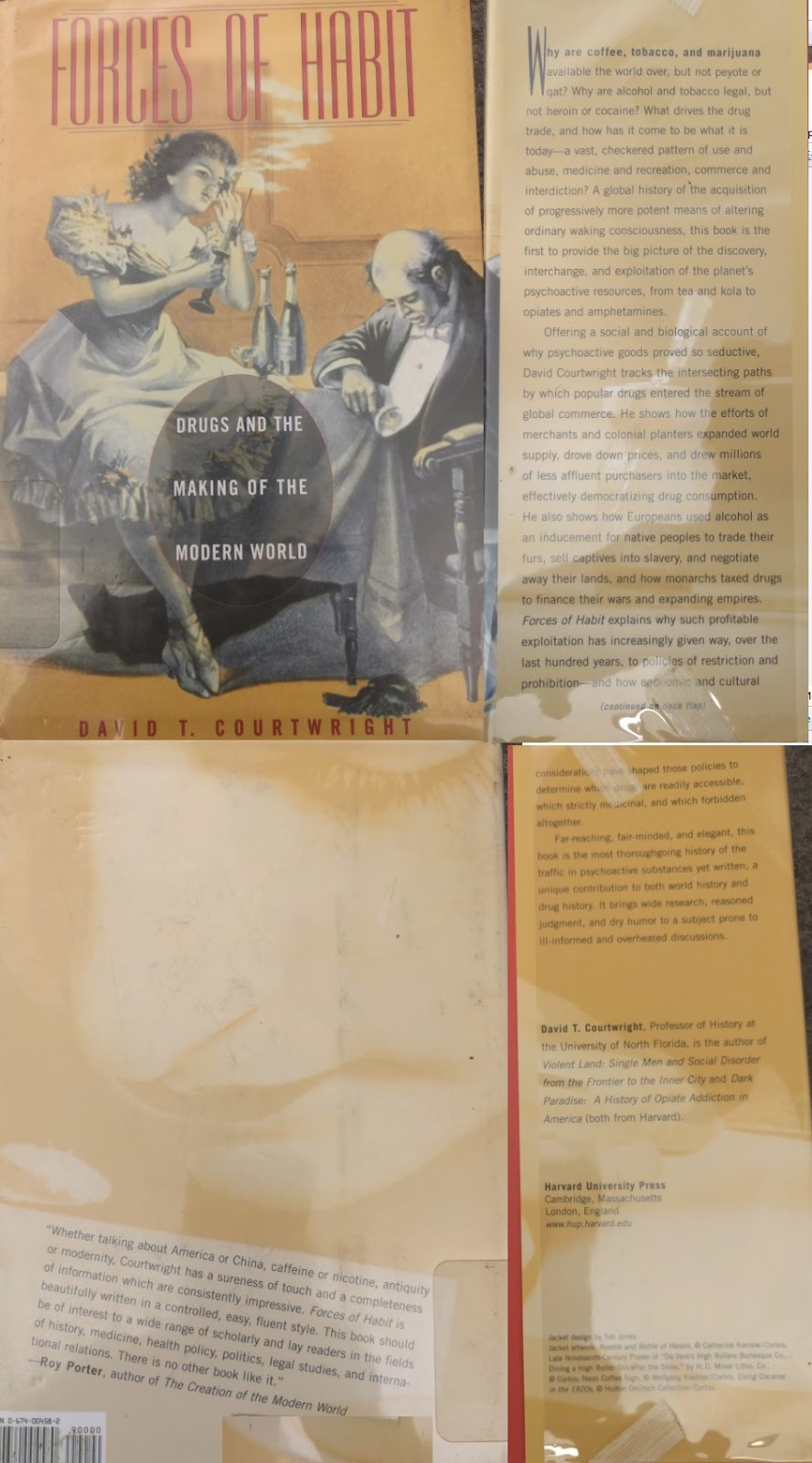
This is an image of the cover information of the book I read:
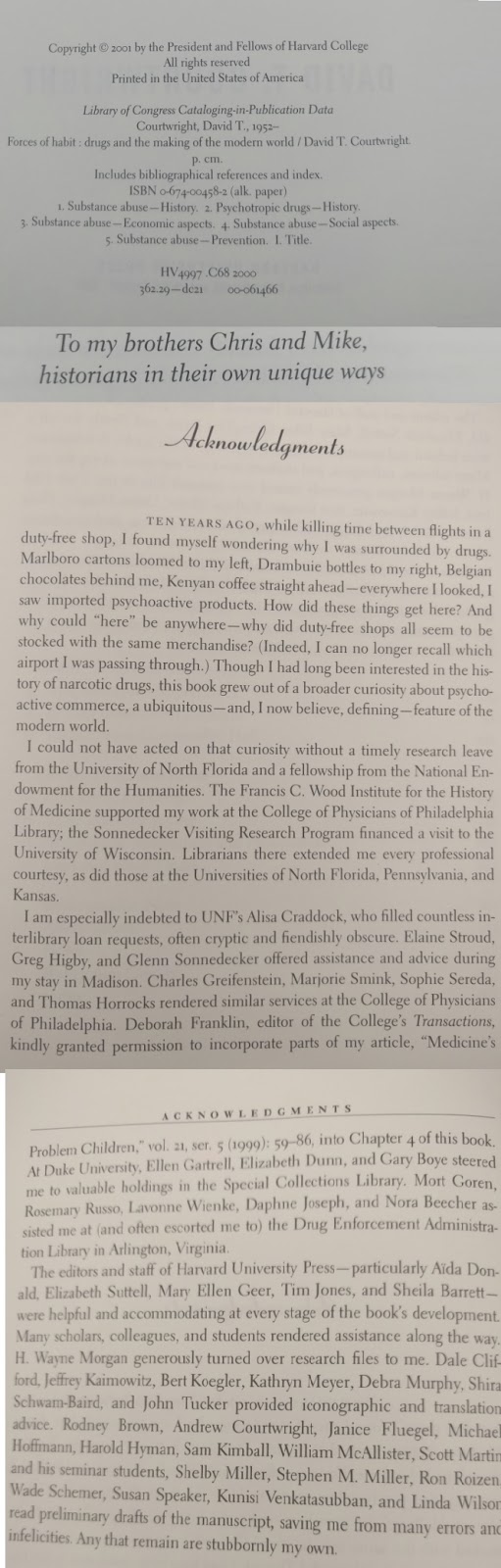
Here are the acknowledgements. What struck me of this writing was that the author was labeling almost everything as a psychotropic agent. Once I read that paragraph, I started to think that maybe the author was doing a little bit overselling of his book. But that did not deter me from reading further.
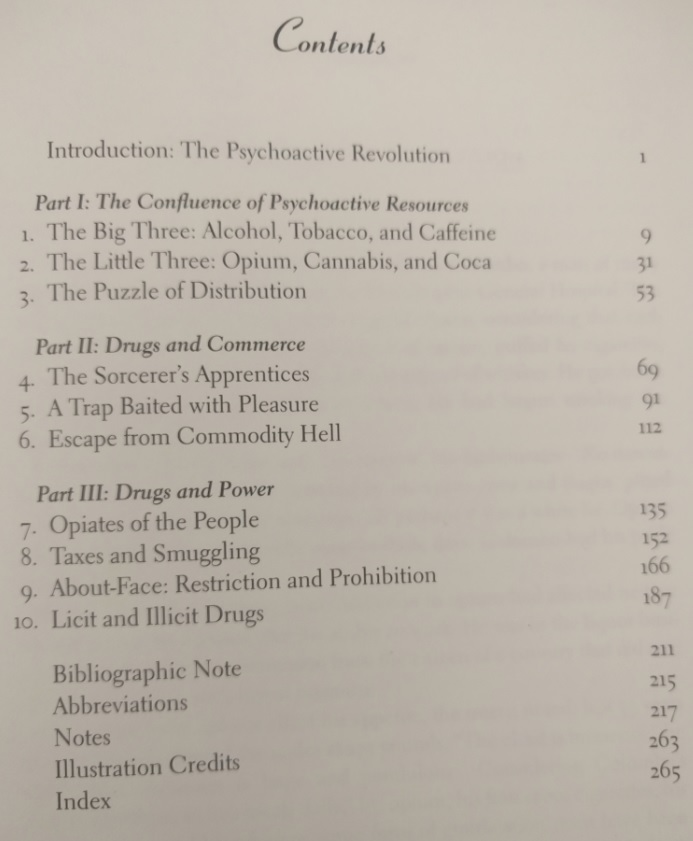
The book is organized in three parts: the first one describes the most popular psychoactive agents: alcohol, caffeine, tobacco,opium, cannabis, cocaine; and gives a glimpse on the distribution strategies. The second part focus a little bit more in the commerce, from the point of view of the power that having and distributing the drug gives to the owner, and the third part dwells a little bit more in the power process behind the drug trade. Here is the table of contents:
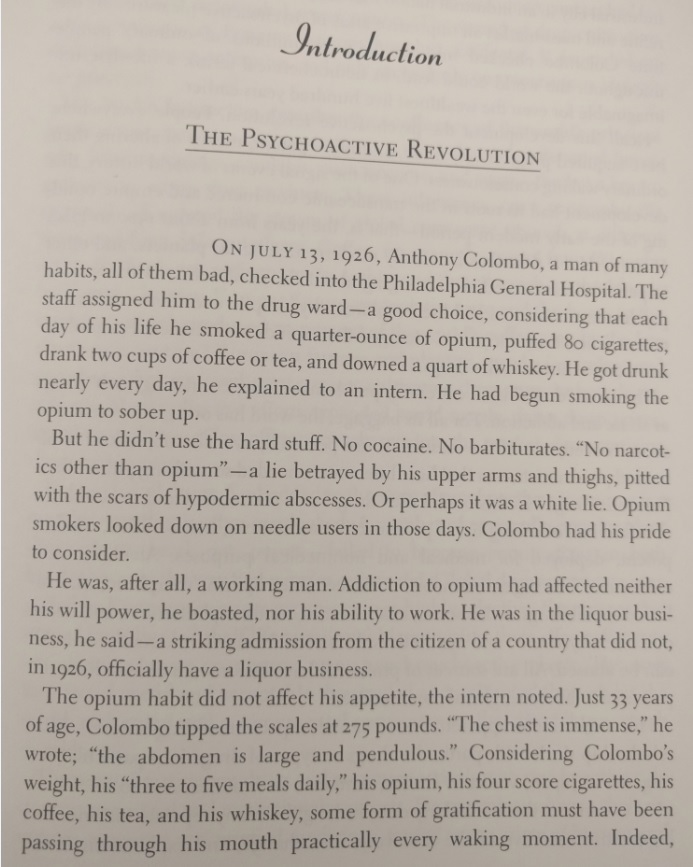
Here is a description of a very interesting drug user: Anthony Colombo. The introduction just get the reader started onto something really juicy.
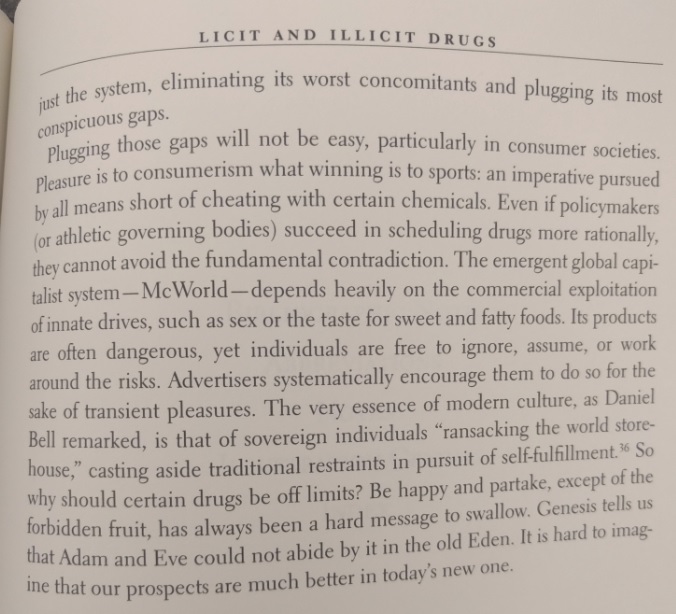
Here is a discussion on questioning why some substances have to be made illegal, assuming that we always are looking for pleasure instead of pain.
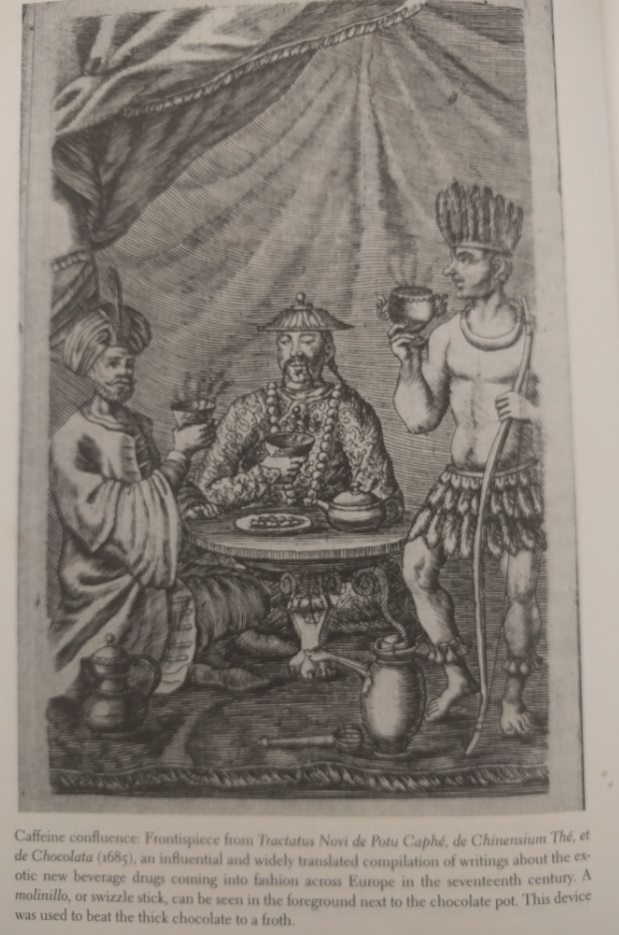
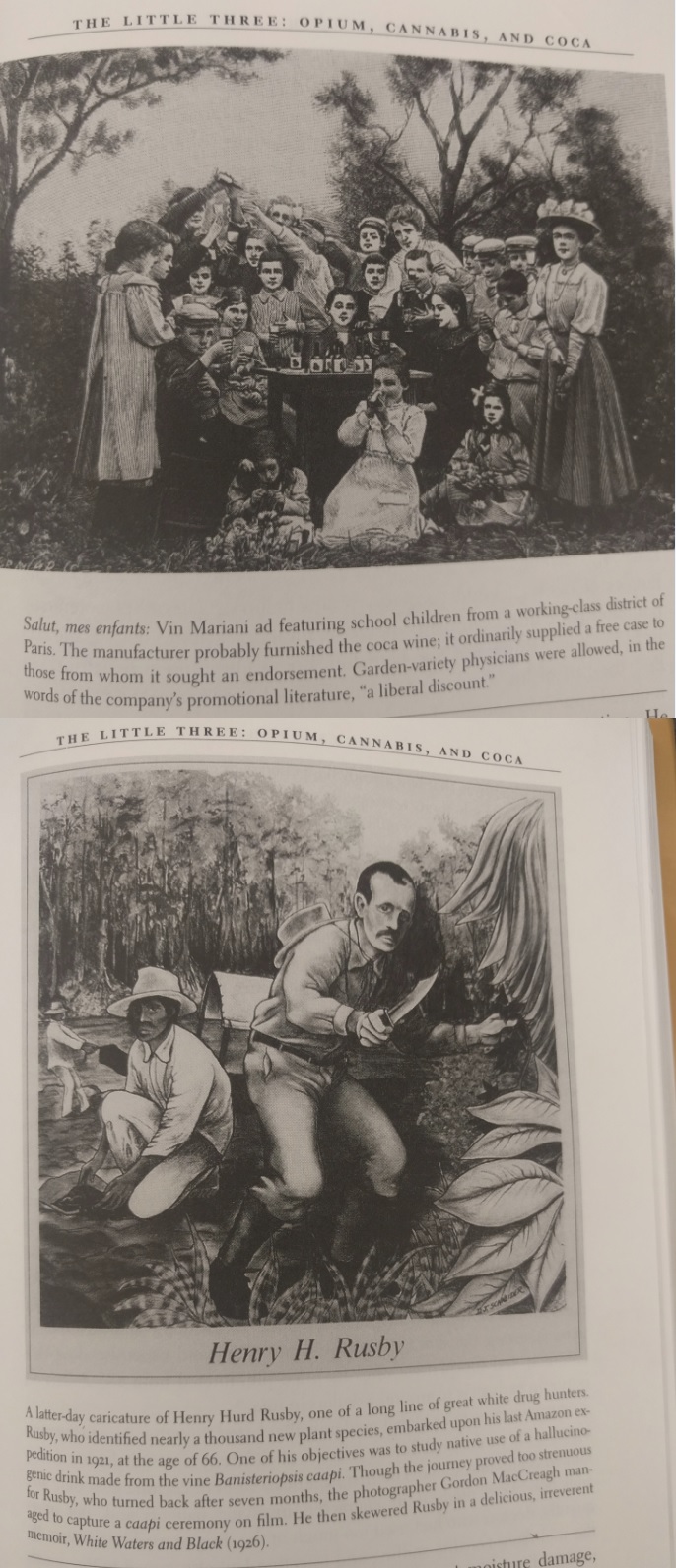
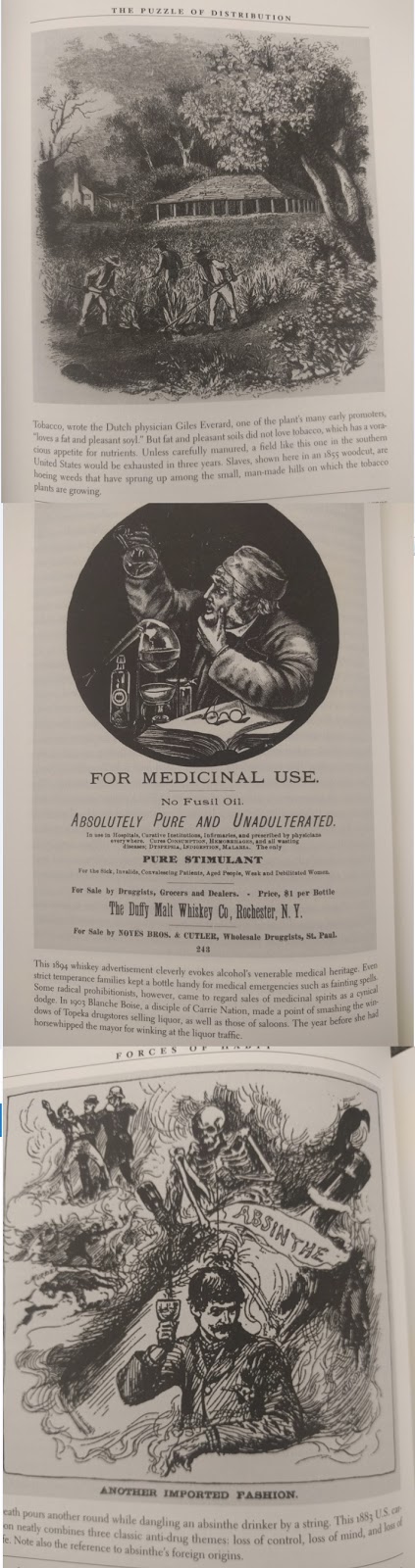
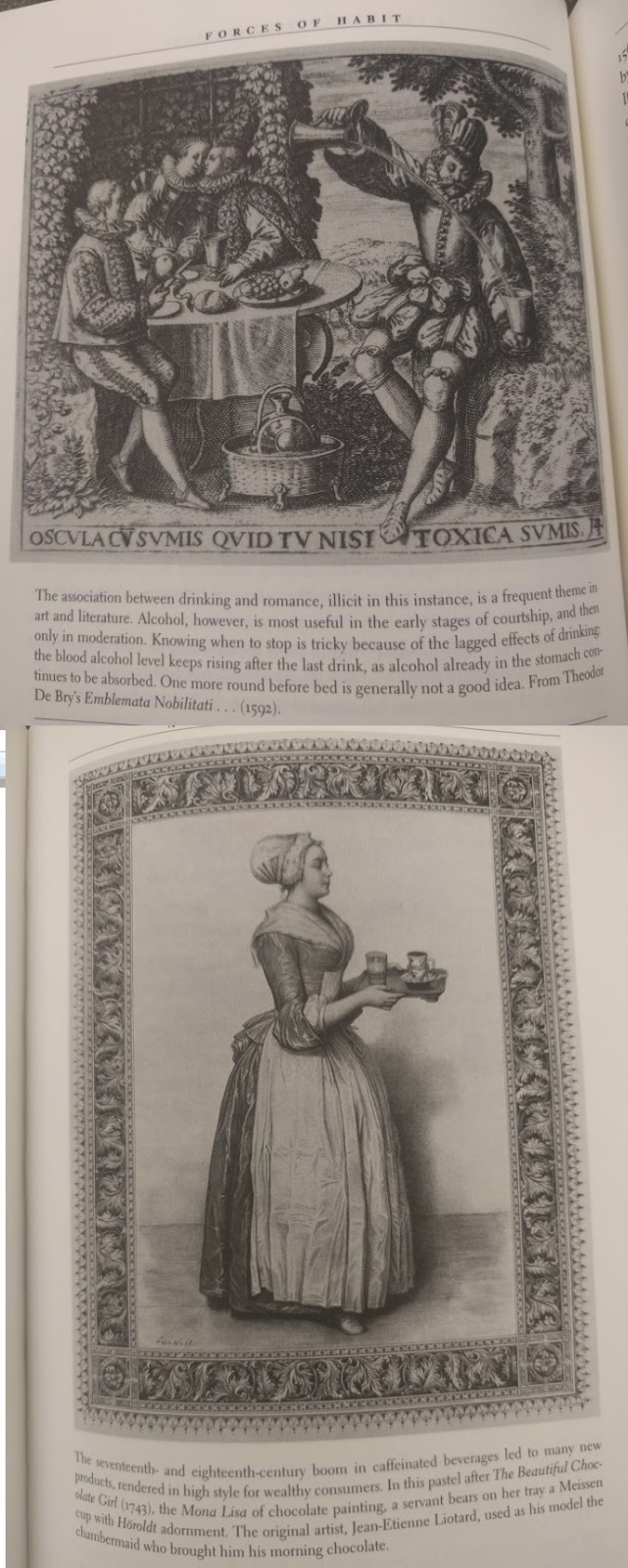
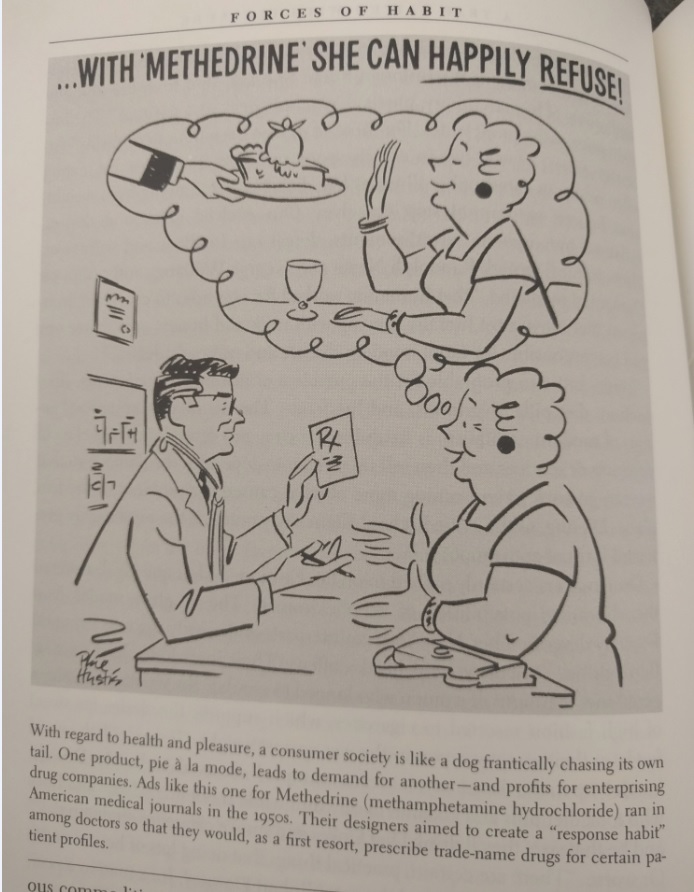
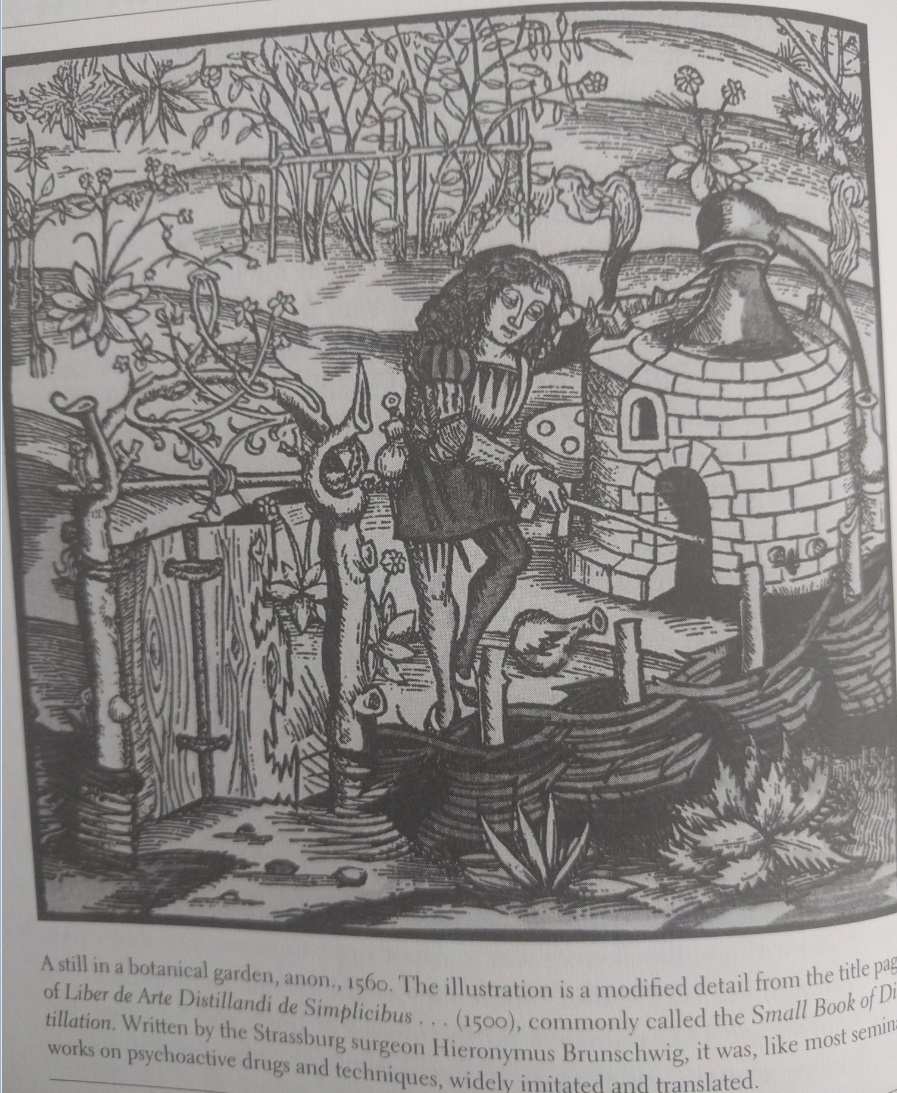
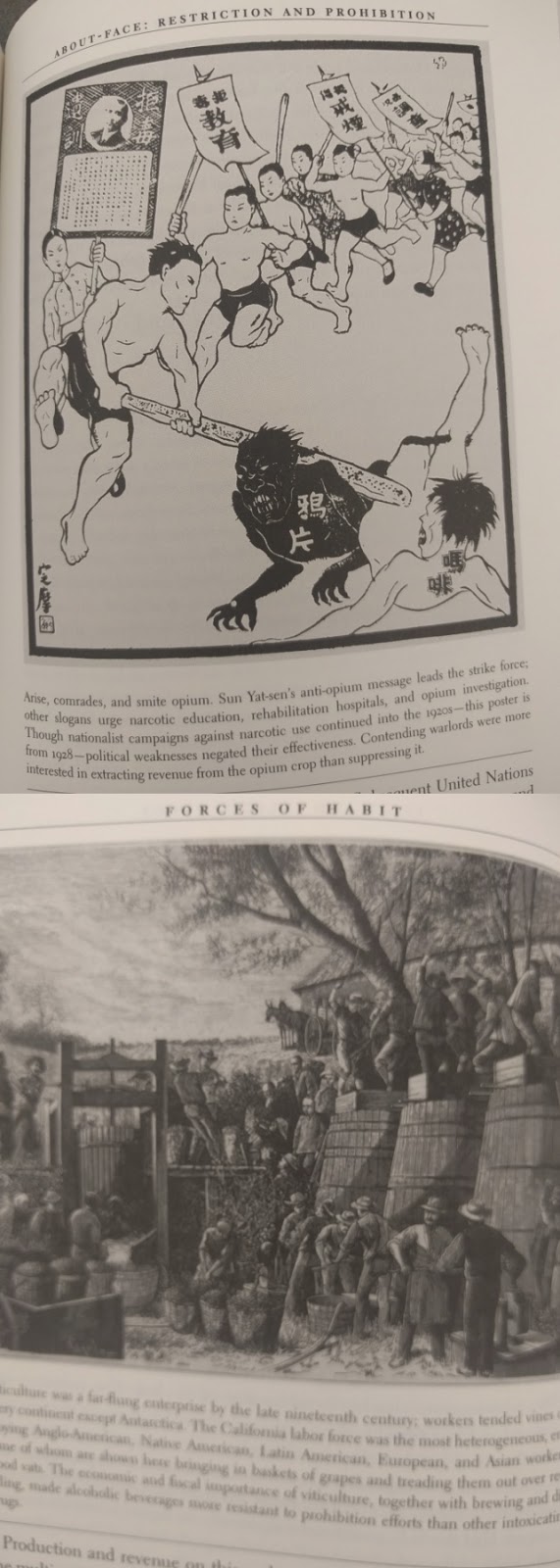
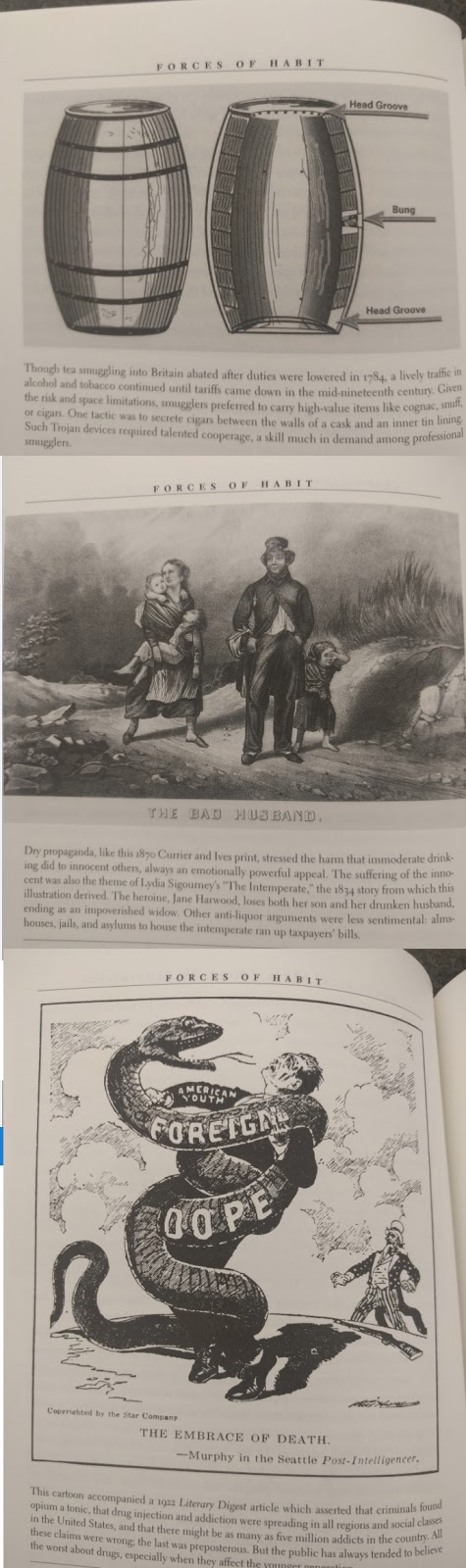
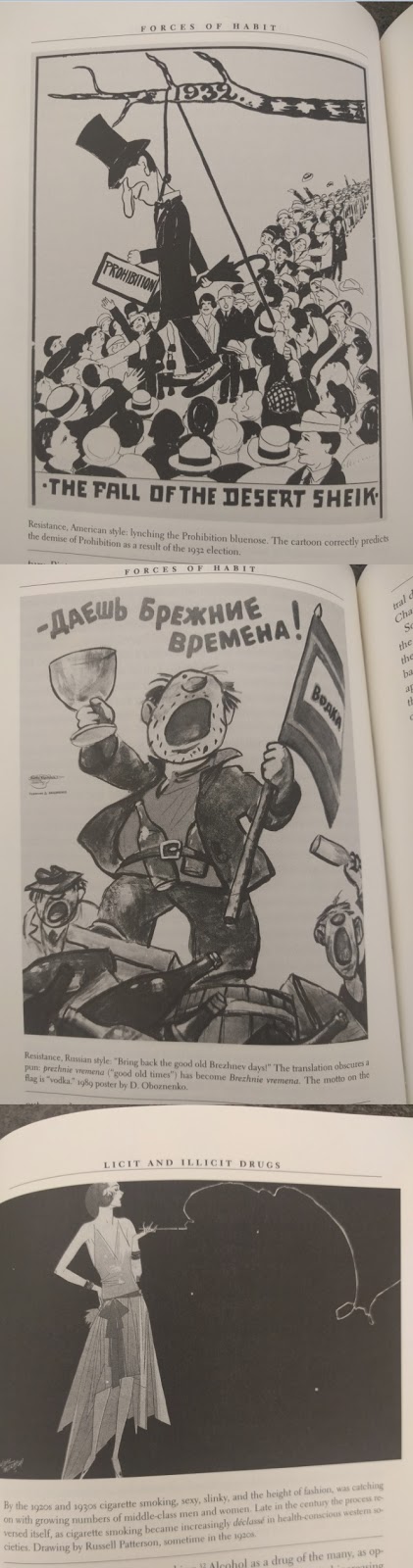
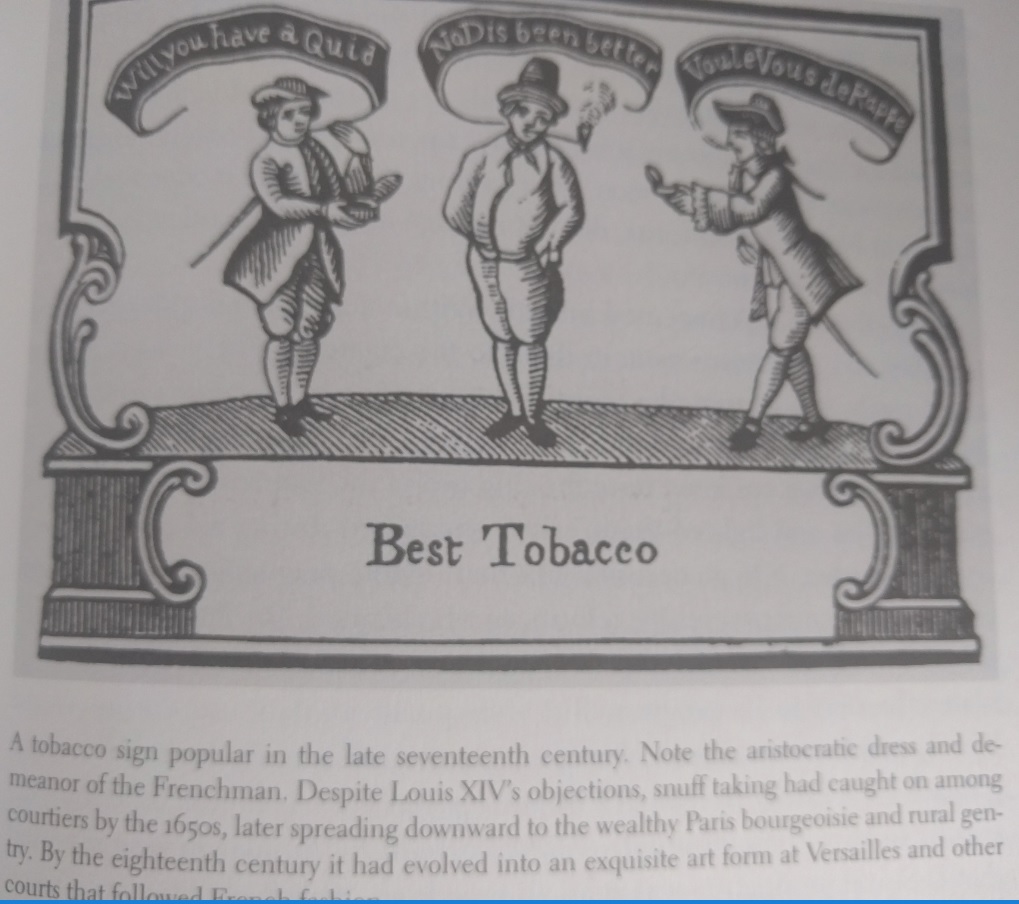
Below are a series of very interesting illustrations contained in this book. From an european "Chocolatada" to methamphetamine prescribed by well-wisher doctors to housekeepers who needed to lose some weight by refusing that tasty piece of cake.
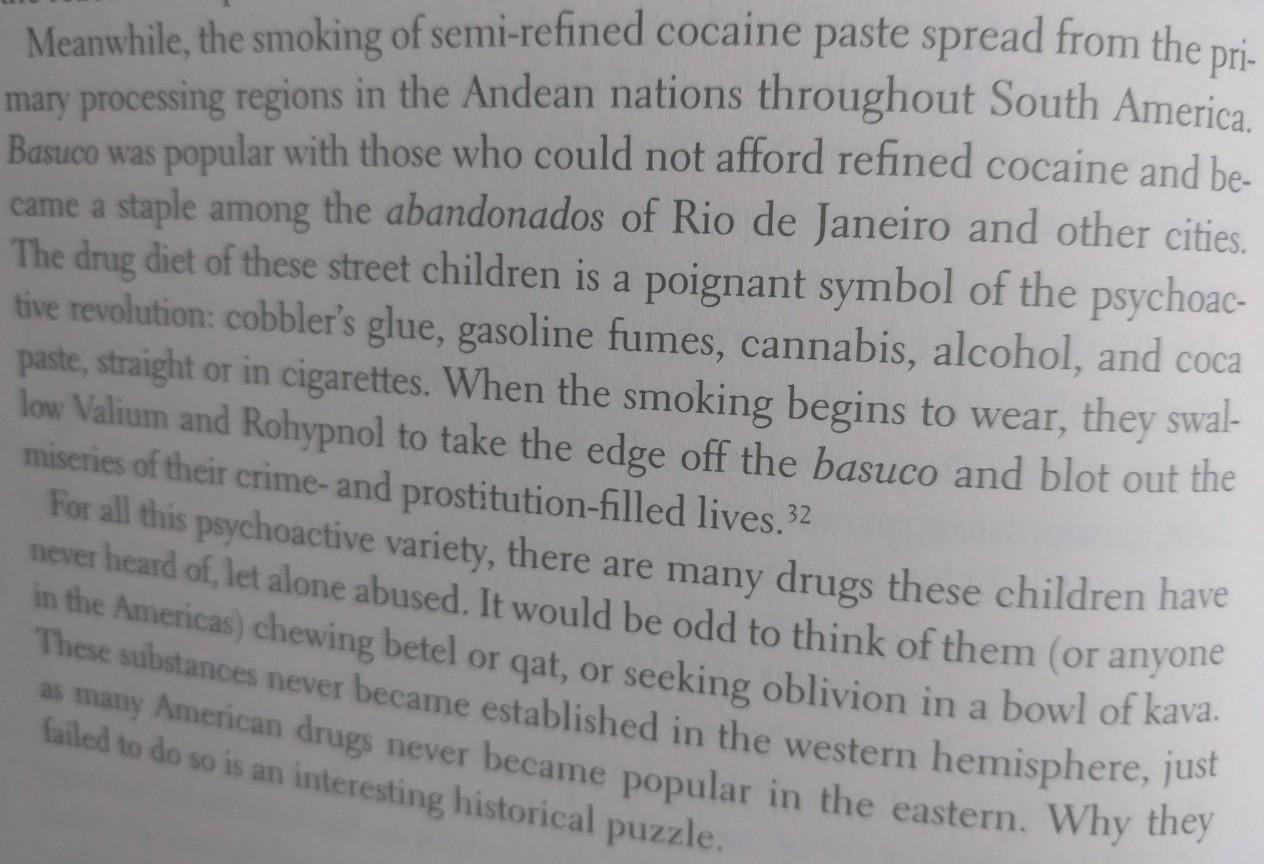
In the following paragraph the author wonders why some substances never made it into the big markets. What kept them from becoming drugs of choice?
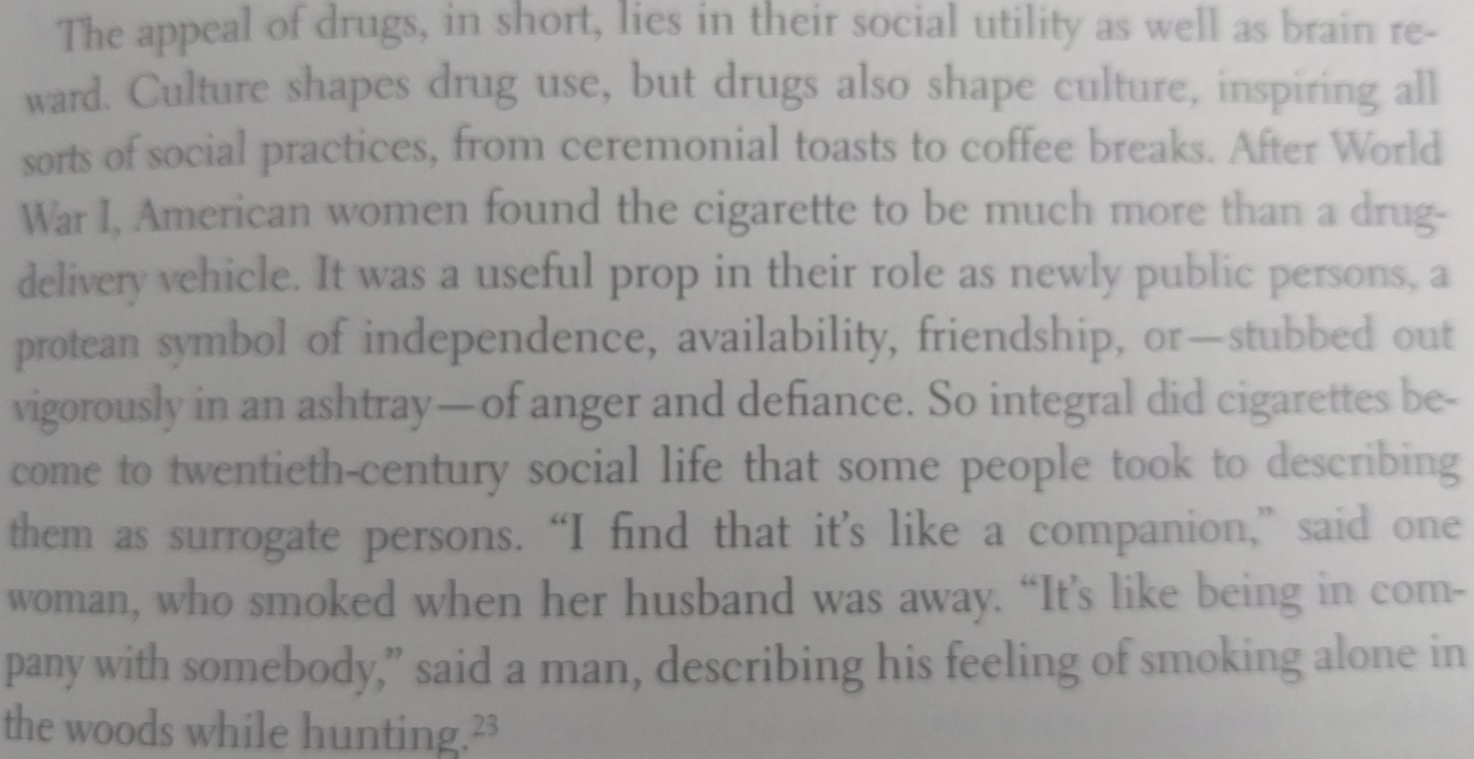
Drugs had other uses, for example social status like in a good cigarette holder.
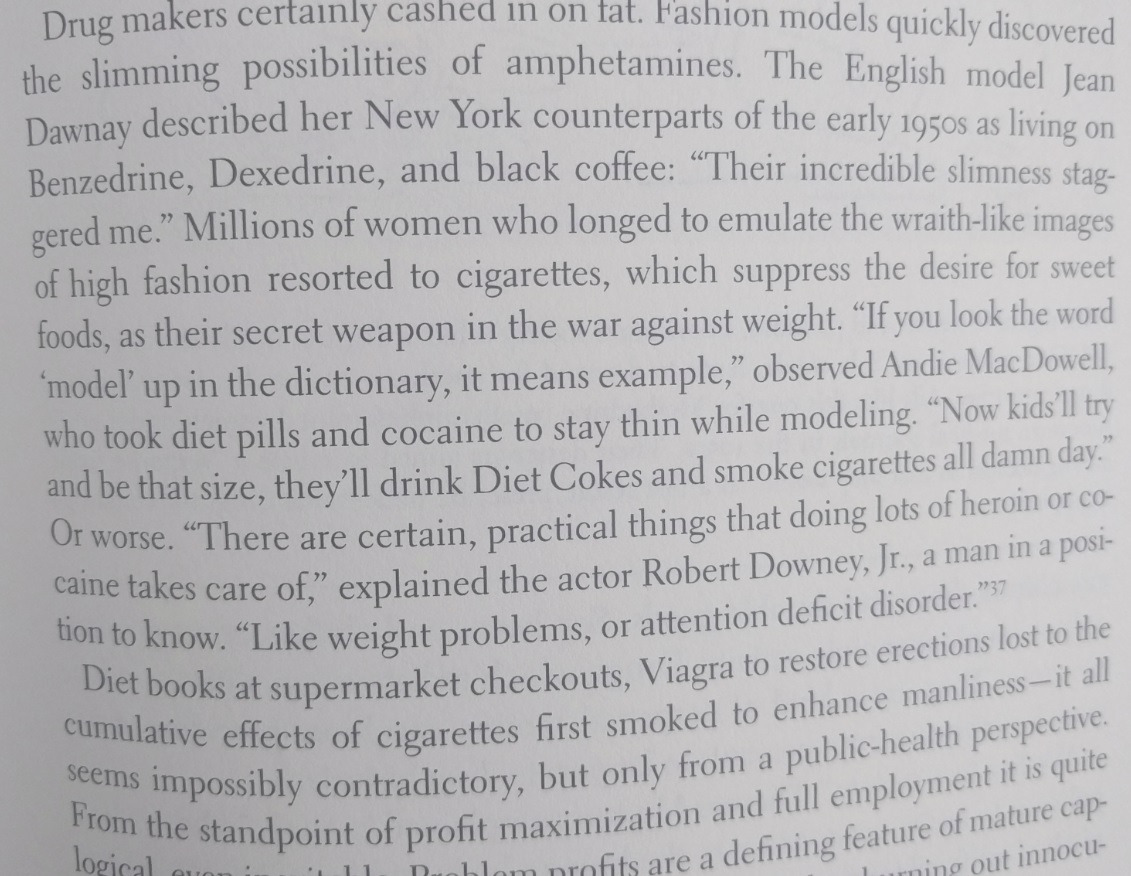
Here a discussion I found very interesting on how the fashion model industry has its little hands in the business of wanting and wishing for perfection, and how drugs go hand in hand with those ideas.
And finally, here is a classification I found really interesting on how the psychoactive drugs are categorized from pure prohibition to universal access
My takeaway from this book is that the most addictive drug is power. And that the real addicts are those who dare to damage the world so much by trading drugs and trying to make other humans addicted. They are addicted to the power it gives to them, from economic to any other kind of power in the world. It was an interesting read, haunting and puzzling at some points, a little bit dry on others, but a good book in general. I will keep it on my shelf for good reference on power and the thirst for it.
Reading this book made me acutely aware of my addiction to caffeine. I cannot imagine a day without it. I'm in a bad mood without it.
Addiction is everywhere. Perhaps not all addictions are created equal, but our differing reactions to addictions to different drugs are not always rational. On some scoring systems, alcohol is one of the most dangerous and addictive drugs in the world, yet there are few restrictions for adults over 21 to purchase effectively unlimited quantities.
While drugs and alcohol are a constant presence during the creation of the modern world, I think the author overstates the role they played. Far from a driving force, alcohol, tobacco and other drugs (ATOD) were at best a catalyst during the evolution of modern life.
This is a great book outlining the history of drugs and how it has shaped the modern world.’ While it is an easy read, it is pretty dense, so a lot of skimming happened.
This book is essentially a loose collections of facts about drugs. To that extent I can recommend it if you’re interested, the only reason I finished it is bc I was learning something and it was an easy read. Other than that it was pretty bad. Their wasn’t really a much more than a surface level analysis. He doesn’t stick to one topic long enough to flesh it out. He’s constantly switching between coffee, alcohol, tobacco etc and it’s a little dizzying. He often phrases others opinions through free indirect speech, which I think is an attempt to be cheeky or entertaining but I think it borders on inappropriate, especially when that opinion is pretty vile. Also, like no racial dimension to the analysis— in a book about drugs. He also just says things some times where I’m just thinking what is the source for this because it is a pretty loaded/general statement. Just not a book where I felt like I trusted the writer, he never explicitly addresses any methodology or theoretical approach to the material. He says something in the bibliographical note along the lines of that the writing was a “writer-in-the-stacks” kind of process, which is pretty evident. In other words you’re probably better off reading the Wikipedia page for drugs— the analysis you’d be missing is relatively common sense if you know that drugs can make people money while at the same time be bad for people.
Forces of Habit is a force in itself, a sweeping overview of the historical trends influencing the global trade in psychoactive substances from the Early Modern Period through today! This book is an excellent, approachable read for physicians like myself as well as psychologists, nurses, social workers, public health advocates, and politicians--basically anybody in the position of caring about these substances or for the people who use them could benefit from reading this book. Courtwright does an excellent job illustrating broader themes with local case studies and presenting a range of perspectives on controversial issues. He manages to check his own biases much more effectively than some other authors I have read on the subject. I highly recommend this book for anyone trying to understand how we got where we are today in terms of the role substances play in our society and our politics!
Interesting read on the history and effects of global interactions through drugs. From coffee to heroin, Courtright dismantles the pharmaceutical industry and the epidemic of addiction that correlates to money and power. Not 5 starts because it was hard to keep moving forward through the book when dates jump from the Industrial Revolution to current in every other chapter. I spent a lot of time re-reading pages to make sure I wasn't lost before moving on to the next page.
This book was interesting, but unremarkable. In trying to discuss every drug in every society ever, it ends up being too broad and not focused enough, although each individual account is very interesting. Still, Courtwright is a great history writer, and I would definitely read another of his books.
"The misery and grinding poverty that were the lot of 90 percent of humanity in the early modern world go far toward explaining why tobacco and other novel drugs became objects of mass consumption. They were unexpected weapons against the human condition, newfound tools of escape from the mean prison of everyday existence."
This is mostly well-written and informative, but how can you write a book about as cool a subject as literally all the drugs in the world and yet come off as such a square?? Not sure this guy has ever tried anything harder than a Budweiser
This book explains the connection between “soft” drugs and the first globalization that led to capitalism, and how capitalism now depends largely on the control and taxation of commodities like coffee and alcohol.
In this book David Courtwright, Professor of History at the University of North Florida, tells "the story of psychoactive commerce." It is Courtwright's theme that psychoactive drugs - both legal and illegal - are commodities, like bread or cloth. They are manufactured, packaged, distributed, marketed and used much like any other commodity. They go in and out of public favor and new and improved products are constantly being introduced. Throughout human history, governments had generally treated drugs like any other commodities. Prior to the Twentieth Century opium, coca, and cannabis were all legally available in the form of patent medicines that were widely and casualty used in both the United States and Britain.
Courtwright divides his book into three sections, with some overlap in content between sections. The first (titled "The Confluence of Psychoactive Resources") describes the way drugs, having originally been geographically confined, entered the stream of global commerce. He compares the history of drugs to the history of infectious diseases in that travel and transport were the variables that influenced the spread of both. Alcohol, tobacco and caffeine (the "big three") and opium, cannabis, and coca ("the little three") all owed their success, he claims, to the expansion of oceangoing commerce.
In the second section ("Drugs and Commerce") Courtwright takes up the issue of drugs as medical and recreational products. Section three ("Drugs and Power") discusses pressures and developments that influenced governments to discard the centuries old policy of a taxed, legal drug commerce in favor of restriction and, in some cases, even prohibition. Not surprisingly, he concludes that this happened "because it served the interests of the wealthy and powerful," but he seems to largely overlook the important role that racism played in motivating prohibition.
Despite the evident failure of drug prohibition in the U.S. and elsewhere, Courtwright endorses the continuation of supply-side strategies. He insists that drugs will be abused wherever they are available, and that efforts must therefore focus on reducing supply. "The task now," he writes, "is to adjust the system." But his optimism about making prohibition work seems perfunctory. Throughout this book, Courtwright paints a gloomy view of the drug problem that is likely to convince the reader that no adjustments to the system will cut off the supply of drugs. There is much to be gained from reading this book whether you accept the author's policy conclusions or not.
This book is great fun not least because of the author's extraordinary skill in the efficient delivery of interesting facts. The opening chapters which detail the origins of the world's major drugs are among the most informative I've read. The second half of the book while still engrossing is a less comprehensive historic analysis of drug use and prohibition. Courtwright concentrates on economics at the expense of culture emphasizing production and commerce rather than demand and moral opposition. Given the enormous social influences in the modern world such as the American cultural war against 60's drug use and the pervasive use of alcohol and tobacco as social tools the emphasis on money and power over cultural forces in the past strikes me as an incomplete analysis. It leads the author to unconvincingly argue that American prohibition and its repeal were primarily the results of economic interests (a "contradiction of capitalism"). Oddly the same events in the Soviet Union are attributed to "popular resistance" without any comparative discussion of the two nations. Finally the value of pleasure and the concept of individual rights are generally neglected. In the end my main problem with is that Courtwright doesn't give culture the excellent and amusing treatment he gives commerce. I can think of worse things to say about a book.
Lots of great information here. (Did you know the Marquis de Sade used cacao suppositories? That FDR's grandfather was an opium smuggler? That Emma Goldman smoked 2 packs a day? That Franco paid his Berber troops partly in hashish? I didn't.) Even more impressive is the way Courtwright uses his many varied sources to present a coherent history of drugs and their impact on society in a relatively short space. I especially liked his discussion of the Third World favorites that have never made it to Western users. But at the end of the day--or rather, the end of the book--it's the same old story, as Courtwright plumps for "harm reduction" and declares that a free, unrestricted market in drugs is not the way to go. Why not? Why hand out clean needles to addicts, then arrest them a block away for buying adulterated street dope? Why conclude that government can influence human behavior for the better, when--even if this were politicians' intention, and even assuming it to be desirable--every page of this mostly excellent book shows the reverse to be the case? (Courtwright is also wrong when he says the "harm reduction" concept predates campaigns for legalization: "harm reduction" goes back to the 1980s, while Gore Vidal was calling for legalization in the NEW YORK TIMES back in 1970. And he wasn't the only one.)
All the stuff you never knew about the histories of drugs, especially alcohol, tobacco, caffeine, marijuana and opium.
How could opium and marijuana be benign in India for centuries before the british arrived, but destroy entire cities afterwards? Why was alcohol pushed by rich and powerful onto the poor and the colonized as a form of wage slavery, but only up to the industrial revolution, when it become the devil's drink? How did the taxing alcohol and tobacco through expensive licensing fees actually increase consumption in industrial Britain?
I love this kind of history book that takes an economic approach, explaining people's actions by determining who wins and who loses in each situation. I feel afterwards that it all makes sense.
Another big insight for me is that, historically, people used drugs in a big way to deal with tedious work and boredom. Field workers had rations of alcohol. Low level workers in India would smoke opium for their only excitement. Recently even I saw a garbage man doing his rounds with a joint in his mouth. I guess I'm just lucky to have an interesting job, although I do still turn to reddit and hacker news.
The only downside of this book is that it stops just as things start to get interesting with the War on Drugs. I guess that'd be a whole other book though.
This is a good, accessible socio-economic study of the history of the global drug trades--a fine background for any informed discussion of drug policy.
As regards the United States, which has effectively set global drug policies since World War II, the ostensible purposes of drug policies are so radically at variance with the actual consequences of these policies that it is fair to turn the equation around. Rather than thinking of the avowed intents of the policy formulators, think of the real effects. Among them are the following: 1. The creation of immense, illegal and untraceable fortunes 2. The record of the utilization of such untraceable funds by various governmental black-operations and intelligence agencies (f.i. both the French & the USA in Indochina, the USA & its client states in Central and South America, the USA in Afghanistan, the British in India and China, etc.). 3. The creation of immense bureaucracies to enforce drug laws. 4. The creation of laws aimed at stemming drug traffic which increase state police powers and decrease individual liberties. --What I don't know is if there is any correlation between increased suppression of drugs and the increased use of these same drugs. I wouldn't be surprised if there were.
Courtwright does an excellent job to cover the history of psychoactive drugs and how they have shaped the modern world. He doesn't advocate for any particular viewpoint, whether political, social, religious, moral. Instead, he explores the history of various ongoing debates and issues relating to drugs, and evenhandedly covers the many sides of each. Perhaps the best thing is that he makes the material interesting. He shows why past issues remain relevant today, and how they shaped modern policy and attitudes.
The format makes it exceptionally easy to read without compromising academic standards. He thoroughly documents his work, using 45 pages of endnotes, without bogging down the reading. Also, he includes a Bibliographic Note at the end, recommending various related texts, and explaining their strong and weak points.
It's not meant as an A to Z history, but more of a balanced primer on psychoactive drugs and their past and present role in society.
Forces of Habit is a social history rather than a neuro-physio-chemical discussion of a range of psychoactive drugs,not limited to legal ones (alcohol and tobacco) or illegal ones (cocaine, marijuna, heroin)that are most commonly problematic. Courtwright appropriately includes coverage of chocolate, cocoa, tea, and sugar as addictive substances. Unlike most social science books on psychoactive drugs that focus on psychological, sociological, and legal aspects, Courtwright places much needed attention on the economic underpinnings of drugs in the history of their usage. The book is nicely written, with fascinating anecdotes (which some readers find distracting), and provides a balanced perspective.
'Forces of habit' focusses on the psychoactive revolution that occured after the discovery of the New World. It's mainly about trafficing and how some drugs are made deviant and others are not. Even though it is an interesting read I hoped it gave more insight on how the general public thought about these drugs, it's legislation and it's deviance. By times I thought it was quite difficult to read because there was no real chronology it Courtwright's writing nor was there a good arrangment of subjects (ie Tabacco, Mariuhana, Alcohol). I didn't get the feeling I was actually learning something by reading this. Having a great interest in the subject I felt like I've allready read most of it.
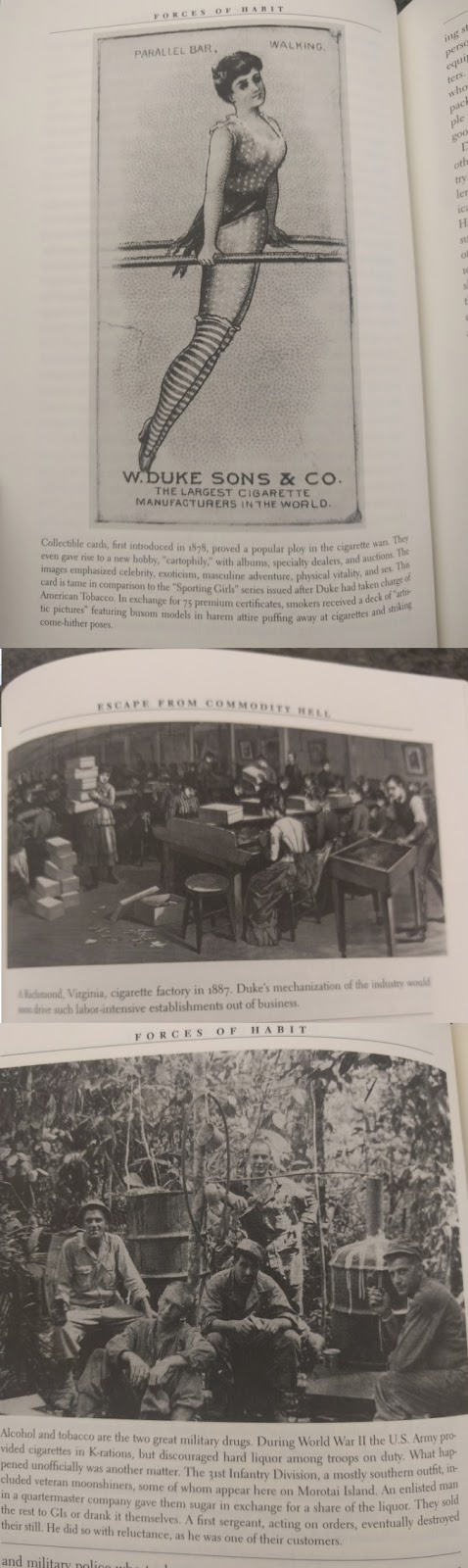
Some nice information on the commodification and subsequent control of substances across the globe (including a wonderful few pages on the summation of the Duke Tobacco Company rise). However, it pales in comparison to the thorough job Pursuit of Oblivion does of tracing drugs in the post WWII era, and suffers in its latter half. Also adopts, for no certain reason, an anti-legalization/decriminalization stance, and believes either of these alternatives with retard some sort of progress. Never the less, it's a nice compliment to Pursuit of Oblivion, though certainly not in the same class. Great for the period of 1890-1920, and very well notated.
While this book has a lot of good information, it doesn't really come together to tell any cohesive story, other than that drugs have spread over the past 500 years, unevenly and in fits and starts. There's no real overarching argument, and the work suffers from a lack of focus. I think the chapters would have been better ordered either chronologically, or by drug, rather than thematically as they are, with no real regard for the timeline.