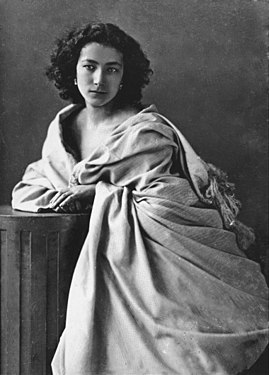
Cornelia Otis Skinner was an American author and actress. Skinner was the daughter of the actor Otis Skinner and his wife Maud (Durbin) Skinner. After attending the all-girls' Ethel Walker School, and Bryn Mawr College (1918-1919) and studying theatre at the Sorbonne in Paris, she began her career on the stage in 1921. She appeared in several plays before embarking on a tour of the United States from 1926 to 1929 in a one-woman performance of short character sketches she herself wrote. She wrote numerous short humorous pieces for publications like The New Yorker. These pieces were eventually compiled into a series of books, including Nuts in May, Dithers and Jitters, Excuse It Please!, and The Ape In Me, among others. With Emily Kimbrough, she wrote Our Hearts Were Young and Gay, a hilarious description of their European tour after college. Kimbrough and Skinner went to Hollywood to act as consultants on the film version of the book, which resulted in We Followed Our Hearts to Hollywood. Skinner was portrayed by Bethel Leslie in the shortlived 1950 television series 'The Girls,' based on Our Hearts Were Young and Gay. In later years Skinner wrote Madame Sarah, a biography of Sarah Bernhardt, and Elegant Wits and Grand Horizontals about the Belle Epoque. She also appeared with Orson Welles on The Campbell Playhouse radio play of The Things We Have on May 26, 1939.
Cornelia Otis Skinner's marvelous biography of "The Divine Sarah" held a prominent place on my mother's shelves as a child, and many were the times that I took it down and rifled through it, looking at the photographs and admiring the cover art. Finally, the summer I was eight years old, I decided to read it, spurred on partly by my admiration for its physical beauty (a book with so lovely a cover could not fail to be interesting, I reasoned), and partly by the fact that my mother liked to call me her "Little Sarah Bernhardt." To the best of my knowledge, it was the first adult book I ever read...
The life story of Sarah Bernhardt, a French actress who first gained acclaim in the 1870s, and whose long, varied career and scandalous personal life made her the celebrity par excellence of her day, makes for fascinating reading, and Skinner does justice to her subject. For a minister's daughter who grew up without the benefit of television, this was heady material, and I tore through Madame Sarah as if it had been a romance, or an adventure story.
This book introduced me, not only to an extraordinary woman, but to the wonders of biography, and for that I am most grateful. I have never read any other books devoted to Bernhardt, and cannot therefore comment on the accuracy of Skinner's portrayal; but having read Madame Sarah many time over, I can say that I always find it well-written and compelling. In this age of celebrity gossip, I sometimes think a little wistfully of "Madame Sarah," who could teach today's superstars to be scandalous with style.
This books is the biography of 19th century French stage actress Sarah Bernhardt. My 2nd time through this book, the first time being mid 80s. I remembered Sarah a bit more favorably than I see her now. Sarah Bernhardt was an amazing woman, in that she accomplished a lot -- acting, playwriting, sculpting, performed nursing duties during wartime, managing her own theatre company, -- during a time when women just didn't do those things. On that basis alone, I consider her an inspiration. She was also flighty, demanding, conceited and inconsiderate, but her acting skills got such raves and worship that those things were likely overlooked by her adoring public.
Sarah started her life as a bastard child to a woman who scarcely cared whether the child lived or died, until Sarah began acting and making money. Sarah was palmed off to various relatives, particularly to a favorite aunt who made sure Sarah was educated and was put on the right road to success. From there she was accepted into more and more prestigious acting companies, where her exceptional skills were developed. Some of her more celebrated roles were in the plays Phedre and Lady of the Camellias. She toured the world several times, always performing in French, no matter what country she was in, and was nonetheless considered to be the most successful actress of her time.
The book itself is not a particularly easy read. Author Cornelia Otis Skinner apparently assumes that her readers will be as fluent in French as herself, and therefore notes untranslated quotations from Sarah and her entourage. Otherwise, an enjoyable informative book.
I had not heard that Cornelia Otis Skinner had written a biography of the tempestuous French actress Sarah Berbhardt until I ran across this book at a thrift store sale. Miss Skinner has an insider's knowledge of and love for the theatre. Her father was one of our greatest actors. She has had several books turned into plays and movies.
A personal story, when my wife, Tepa, sailed from the US in 1960 to join me in Japan, where I was serving in the US Army, she sailed on a US President Lines ship. Sitting at her table was an older lady whom they christened "the Pineapple Princess." Her name was Cornelia Otis Skinner. She was a wonderful story teller and Tepa says she was a joy to travel with.
As a lifelong lover of the theater, I decided I needed to know more about the greatest actress who ever lived, Sarah Bernhardt. There are several books available about the Divine Sarah, but I chose Cornelia Otis Skinner’s Madam Sarah for a specific reason. When it was published in the late 1960s, a dear friend loved the book. I actually bought a copy, never read it, and eventually discarded it. So when this burning desire to know more at Madame churned in me, I decided I should choose Skinner’s book. And I’m very glad I did. I’ve read countless biographies of actors, and this one stands out, for Skinner knows (actually knew, because she is long gone from this world) theater, having been the daughter of a celebrated actor and worked in theater all her life. She, like I, was fascinated by this celebrated, extremely eccentric, complicated Sarah. The Bernhardt, as she was known in America, was a French actor who lived life her way. Her favorite song could have been Frank Sinatra’s hit and Paul Anka’s composition, My Way, if it had existed in the late 1800s. Sarah refused to bow down to anyone. Skinner details Bernhardt’s triumphs and failures, and analyzes much of her repertory (and reports that the plays were mediocre often but made sensational by the delicate, fine-tuned performances of Sarah.) Skinner also treats us to a life that was filled with controversy and choices that many would never have made. In her professional life, Bernhardt left the vaulted Comedie Francaise to strike out and create her own companies, where she was bound to no one’s constricts, values, or traditions. And thus, we find the actor traveling the world for most of her long career, playing in her native French to audiences who had no idea what she might be saying (sometimes, there was a written translation they were given) and yet totally enthralled by her presence and her immense talent. She made fortunes and lost them almost as quickly. She paid off many of her loved ones’ debts, including gambling debts from a profligate husband and a son she doted on. She entertained constantly with lavish meals and parties. And she was loved by thousands, worshipped as if she were the equivalent of a Marilyn Monroe, an Elvis Presley, a Michael Jackson, or a Beatle—to make comparisons to twentieth century celebrities. Fiercely patriotic, she brought Frenchmen to standing ovations with her reciting of her country’s anthem La Marseillaise. And when, in her seventies, a leg was amputated (no spoiler here, for Skinner refers to it almost from the beginning of her book) she kept performing, being carried on a litter by four strong men. She refused to wear a wooden leg, which at that time in 1915 would have been the common recourse, so she designed a highly decorated, very ornate palanquin on which she sat to be carried into a room or onstage. This was a woman who was one of a kind, and as an actress, it is possible she has never been equaled.
I pulled this off the shelf at the library when I was ? 11? 12? for the simple reason that my name is Sarah. I have been a fan of Sarah Bernhardt since that moment, since the book covers her amazing life beautifully. Really, it was a life changing book for me. Nope, I did not become an actress, but I do try to incorporate her attitude into everything I do.
I have this book by my bedside to read a few pages before I go to sleep. It's made for such start-and-stop reading as it is terribly written but full of fun anecdotes. It's as if a time machine was combined with Chatroulette and you found yourself paired with a 19th century Parisian gossip columnist, who launches into stories of the actress Sarah Bernhardt and her milieu. As with all gossip columnists, she assumes a certain familiarity with the celebrities of the day - I've had to google a few to get the full bite of the anecdotes. Want to know how Sarah got into acting? How she accidentally offended the French Emperor with one of her performances? Of her days tending the wounded in Paris during the Franco-Prussian war, one of whom was the later the World War 1 Commander of French forces, Ferdinand Foch? At five pages at a time, this is all very engaging and Skinner's endless cliches and intrusive authorial voice can be borne with philosophy. If I had to read this book in one sitting though, Skinner would drive me mad.
Madame Sarah Bernhardt was a character! The author (who wrote a number of other amusing books, both fiction and non fiction) tells her story with charm and wit. Reading this over 50 years after publication, it highlights the frailty of the human experience, and reminds me that our lives are like dust. Much more important to chase after God!
I think I would have been better off with a more recently published biography of Sarah Bernhardt. Madame Sarah was published in 1966 and it hasn't aged as well as one would hope. There lacks a linear quality and by the end I had gotten a bit sick of reading about the same eccentricities over and over. I know there must be more iteresting things about her.
I just found this on an old shelf. I had forgotten about it. I think I read this in the seventh grade -- the year I finished all the circulating books in my local village library and was given a key (gasp) to the storage unit where all the locked books were. They let me buy this one. It was worth it. Excellent adventure into the life of our most bewitching death-mistress. Amazing.
An interested biography about Sarah Bernhardt, especially since I knew so little regarding her career and life. Certain aspects of her less successful career and romantic ventures were glossed over. All in all, the book covered the pertinent details and was a fairly quick read.
The only thing I knew about Sarah Bernhardt before I read this book was that she was an actress and that she had a fabulous reputation. By the end of the book I was a little tired of her. The author states that "In their zeal to chronicle the eccentric Bernhardt "legend" the biographers are prone to gloss over her human side", but she does the same thing. Hundreds and hundreds of pages chronicle every play she performed in, every tour she made, and the passionate fans that mobbed her everywhere. In her day, she outdid Elvis, The Beatles, Madonna, Sinatra and any other idol one can think of.
The last two chapters were the best because they did describe more of her daily life, her interaction with family, servants and friends, and her undying spirit.
I wish there was a sound recording of her because her voice was said to be mesmerizing. She did make some movies late in her life, but they were silent movies. She was such a legend during her life, there were a lot of exaggerated and just plain false stories. That makes me wonder a little if everything in this book is 100 percent accurate.
Sarah Bernhardt with her exotic pets and lavish spending, famous for being Sarah Bernhardt, brings to mind a Belle Époque TikTok influencer. Skinner is often eager to mythologize her subject: "Guests were given several kinds of wine but Madame Sarah's only alcoholic intake was Veuve Cliquot in minute quantities." (p. 297) While she is willing to call out several of Berndhardt's productions as (critical? popular? Skinner rarely distinguishes) duds, in hindsight, Skinner's assessment of Rostand's Les Romanesques as an "inconsequential but charming little play" (p. 264) is on the wrong side of history. (Jones and Schmidt's adaptation, The Fantasticks, had been running for six years when Skinner's biography was published.)
Biography of Sarah Bernhardt. Born in 1844 in Greece, Netherlands, or France to single mother who worked as a prostitute. After a tumultuous childhood, she finds her way to the theater. Through extremely hard work, her reputation grew. She enjoyed a lifetime of great fame and success in the French theater. She also toured England, Europe, and the United States. All performances were in French and almost all were sold out. Personally, she had a child at 19, enjoyed multiple affairs, and repeated financial ruin. Book is detailed biography of Bernhardt as well as a history of the French theater. Published in 1966 by author who was a writer and actor. Fascinating!!!
This is a fabulous biography of the eccentric and unpredictable Sarah Bernhardt, who became a legendary international superstar. I deduct one star for the author, as with her Our Hearts Were Young and Gay, leaving a multitude of French words and phrases untranslated. Yes, Sarah was French, but the book is written in English! It gets very frustrating to go online continuously for translations!!
This biography covers the life of Sarah Bernhardt, a French actress who lived from 1844 to 1923 and is considered one of the greatest actresses to ever live. Born the illegitimate daughter of a milliner turned courtesan, and saddled with lifelong frail health that resulted in a rail-thin physique, Sarah defied the odds and became an international sensation, beloved both in her home country and abroad. In addition to her legendary acting talent, Sarah was known as a playwright, dabbled in sculpting, was known to be generous with her money, practiced her considerable nursing skills during wartime, courageously fought against stage fright and physical pain to please her audiences, and overcame a childhood largely devoid of love or affection. Yet she was also prone to tantrums and hyperbole, was often inconsiderate with friends and employers, and was known to be impetuous and unpredictable. She was also bold at a time when society was less than kind to women; she openly defied conventions by having a child out of wedlock and openly acknowledging her unmarried status, played men's roles wearing men's costumes when it pleased her, and had numerous lovers, many of which were decades younger than her.
Sarah had a shockingly neglected childhood. Her mother, who seemingly cared little for her, turned her care over to a hired nurse, and would leave the country without informing the nurse or Sarah. Despite stage fright, Sarah found an outlet in acting, although her fame never seems to have impressed her mother. Her eccentric childhood likely contributed to her outlandish and eclectic tastes: "At various times during her restless life she took up sculpture, painting, the piano, writing, pistol shooting, fishing and alligator hunting" (xvii). At various points in her life she was hoisted above the earth in a hot air balloon, went down in a mine, fired a cannon, leapt about on a half-frozen river, attended four executions, and at all times maintained a menagerie of eccentric and at times life threatening animals at her home (including various dogs, tigers, alligators, snakes, and monkeys) - along with a collection of relatives, friends, and servants. Known for her boundless energy, she scarcely slept but worked for hours on end well into her old age, followed by entertaining and socializing late into the night. During her lifetime she was friends with royalty including the Prince of Wales, notables such as Oscar Wilde and Flaubert, and is supposed to have had a fateful interaction with Abraham Lincoln's widow.
The facts of Madame Sarah's life seem difficult to discern, as Sarah was given to hyperbole, as was the press about her. Much of the anecdotes shared about her life in this biography comes from Sarah's granddaughter Lysiane, but there's no way of knowing if the stories she were told about her grandmother's early years are accurate. Skinner does attempt to account for the unreliability of many of the tales of Sarah's life, making sure to include that some may be "spurious" (45) and also including altering accounts when more than one version exist. Yet this quality of the narrative made me question much of its validity, in part because the author seems opinionated rather than strictly in search of the most likely account. Such as her assertion that "it would be senseless to attempt to prove which account is the true one. [...] She told them what she wanted told in turn to posterity. I prefer, in respect for her wishes to stick by [Sarah's version of events]" (51).
In addition, the author seems prone to hyperbole herself in describing Sarah's theatrical performances, She describes the "enchanting wraith" performing by saying her audience "shivered as though with ice on their spines when that voice clarioned in rage or anguish and her acting became the flash of forked lightening" (162). Furthermore, the author sometimes skips over seemingly large events in Sarah's life, such as only briefly referencing the decline and death of Sarah's beloved younger sister and only glossing over major health issues such as "an abdominal operation" that is only referenced as explanation for the loss of Sarah's infamous thinness (285). Finally, the author assumes that her reader will have a working knowledge of French, as she fails to provide translations for several quotes.
Sadly, despite her immense fame, few seem to remember Sarah Bernhardt, who was famous in a world before prolific photography and videography could give her enthralling performances a lasting posterity. The woman who was known as "The Eighth Wonder of the World" and "who had emperors kneeling at her feet, crowned heads showering her with jewels and adoring mobs throwing their jackets on the ground for her to walk on" has largely faded from the public's memory (xi).
A lovely, if slightly old-fashioned biographical approach to a theatrical legend. Madame Sarah appears to have been something of the Amanda Palmer of her day: willing to go out and try something new and not afraid to screw up (or at least not enough to stop her). A woman who lived and played by her own rules at a time when women's rights were a parlour joke, she dressed in men's clothes and played male roles when it suited her, had a child out of wedlock, and numerous affairs with leading men who were her junior, often by quite a few years.
The life of French actress Sarah Bernhardt as recounted by American actress and writer Cornelia Otis Skinner. I was attracted to this biography written in the 1960's because I read and reread Skinner's book, "Our Hearts were Young and Gay" as a child. As a biographer, the author is adequate but does not amuse overmuch. I did get a little bored with the accounts of obscure (to me) French plays but the drama of Sarah's life and passions certainly held my attention.
Sarah Bernhardt has been a familiar name for my entire life, but this book made me realize that I knew almost nothing about her beyond her name and vocation. I had long assumed that she was a stuffy old British actress, but this book quickly informed me that she wasn't stuffy, she wasn't British, and that she had been young before she became old! (In retrospect, I probably should have been able to figure out that last part for myself.) But learning that Sarah Bernhardt was French was almost as shocking to me as when I learned that Joyce Kilmer was a man.
I had a feeling that this was going to be a weird book, and it was, but fortunately not as weird as I feared, and not in an entirely bad way either. Cornelia Otis Skinner isn't a typical biographer; she tells her story in what often seems like a conversational manner. She's often opinionated, in a sniffy and superior tone. But Sarah Bernhardt had a long and colorful life and Skinner tells the story in an entertaining way. One of her sources is Bernhardt's memoir, and as Skinner herself admits, Bernhardt often told tall tales about herself. So it's hard to necessarily believe all of the anecdotes in this book, or where truth ends and fable begins. There's a story of a woman who spontaneously grew a beard and mustache after she died. Bernhardt slipping and sliding atop the carcass of a beached whale, and that same whale being towed up the East Coast of the United States as it followed Bernhardt's tour schedule.
Skinner also fails to do the one thing I think is really important for a biographer, to provide a solid understanding of the time and the place in which the subject lived. The institutions and the historical forces that affected France during Sarah's lifetime are only lightly mentioned, so her life doesn't always get the context that it deserves. Skinner also frequently critiques the skills of the actors and actresses that co-starred with Bernhardt and the quality of her various performances. The author obviously didn't see these performances, but she presents her opinions as if they were her own, without letting the reader know how she came about these opinions or even acknowledging that they're secondhand.
Some day I may decide to read a more scholarly biography of Sarah Bernhardt. There must be some out there that avoid the obvious flaws of this book. But on the other hand, this one was fun to read, so I'm quite satisfied with it, at least for now.