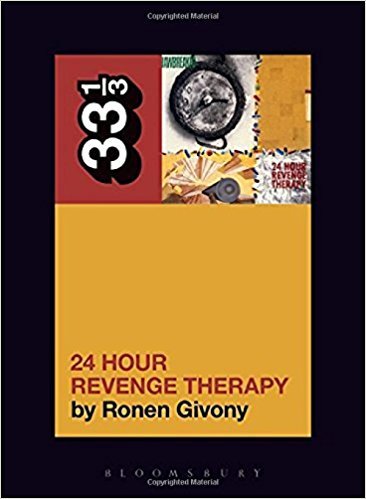
Two and a half decades on, Jawbreaker's 24 Hour Revenge Therapy (1993-94) is the rare album to have lost none of its original loyalty, affection, and reverence. If anything, today, the cult of Jawbreaker-in their own words, "the little band that could but would probably rather not"-is now many times greater than it was when they broke up in 1996. Like the best work of Fugazi, The Clash, and Operation Ivy, the album is now is a rite of passage and a beloved classic among partisans of intelligent, committed, literary punk music and poetry.
Why, when a thousand other artists came and went in that confounding decade of the 90s, did Jawbreaker somehow come to seem like more than just another band? Why do they persist, today, in meaning so much to so many people? And how did it happen that, two years after releasing their masterpiece, the band that was somehow more than just a band to its fans-closer to equipment for living-was no longer?
Ronen Givony's 24 Hour Revenge Therapy is an extended tribute in the spirit of Nicholson Baker's U & I a passionate, highly personal, and occasionally obsessive study of one of the great confessional rock albums of the 90s. At the same time, it offers a quizzical look back to the toxic authenticity battles of the decade, ponders what happened to the question of "selling out," and asks whether we today are enriched or impoverished by that debate becoming obsolete.
This is a good book about an excellent band and one of their best albums.
As a biography about the ten years Adam Pfahler, Blake Schwarzenbach, and Chris Bauermeister spent together as the band Jawbreaker is quite good. For some of his writing about the punk scene of the mid-90’s I feel like it misses the mark, but it’s probably what someone who wasn’t emotionally invested in all that shit at the time would have thought anyway.
I really like this description of the band. It’s from a piece Blake wrote in the 90’s called “How I Spent a Week with Nirvana and Lost All My Punk Rock Credibility” sums up the band fairly well. This is what he reports to be thinking while first talking to the management company in charge of running Nirvana’s tour.
I wanted to interrupt and tell him he had the wrong band, that this was, you know, Jawbreaker—the little band that could but would probably rather not. You know, the three dysfunctional introverts who were scared of no one and everyone simultaneously. You know, like a little punk band comprised of three friends who were really lucky still to be friends, like, you know?
After they recorded and toured for 24 Hour Revenge Therapy they signed to a major label. They released an album and one video that was a flop. They were ostracized from the punk world, were a no-hit casuality of the major label signing spree of ‘punk’ bands in the wake of Green Day and The Offspring. And they broke up very soon after the album came out.
The author hypothesizes that if Dear You had come out in 1998, just two years later it would have been better received. He cites other bands that were making waves then like Wilco and Neutral Milk Hotel.
I disagree with him.
Taken objectively Jawbreaker probably have much more in common with the louder side of indie rock than punk. Their songs are smarter. They look like regular guys. Even the music is almost good to be punk.
That doesn’t matter though. Jawbreaker were a punk band just because of their history. They were a Gilman Street band. They were a band that for some reason Maximum RocknRoll were emotionally invested in. They came up playing with some of the great late 80’s hardcore bands.
After about 2000 I have no idea what happened in the pages of the big zines, but still in 1998 they would have been crucified if they had gone major. And the musical landscape hadn’t changed that much that Jawbreaker would have gotten a pass to the next level of fame. Even if they were similar to those other more indie bands none of those bands were turned into pariahs when they got big. They were from different scenes, or they succeeded in not being accused of selling out because, well, no one gave a shit. Jeff Tweedy's authenticity wasn't connected to being fiercely indie. Neutral Milk Hotel got their mediocre level of late 90's success while still being an Elephant 6 / Merge band. I imagine for the time Jawbreaker sold about as well as Neutral Milk Hotel, and those numbers weren't what major labels considered winning sales that should be supported (Aeroplane has since gone on to sell a lot more copies but according to Wikipedia in 2013 it had still only sold 393,000 which wasn't the sort of number a label with dreams of the next Nirvana / Green Day would be looking for.... and even while this number might sound like a lot, and it is considered a critical masterpiece, it still has only sold half the albums of say NOFX's Punk in Drublic or Rancid's Let's Go... just to put things in to a less rosy prespective.)
I really believe Jawbreaker could have been fucking huge in 1996.
In a move I can completely understand, if not explain to anyone, I believe they intentionally fucked themselves. Maybe not consciously, but I can’t believe they weren’t sabotaging themselves when they got more and more staunch in their ‘punk’ / ‘indie’ stance in the months leading up to them signing to Geffen.
I also can’t believe that if they had seriously wanted to succeed that they would have chosen probably the most mediocre song on the album as their one attempt at a hit single.
If they had released “Save Your Generation” it would have been their “Cherub Rock” or “Smells like Teen Spirit”. Or at worst, it would have made them a one-hit wonder and it would be like that song about sitting on a flagpole from the same period.
I think they didn’t want to be successful. They didn’t want to become a band that would forever be pigeonholed into having to play ‘that song’. Fuck, if you look at what they did live it didn’t take long for them to drop “Want” from their setlists, which was probably their catchiest / popular song from their early days.
A couple of weeks ago I finished the memoir by Scott Ian from Anthrax. Apparently Anthrax had some recent (well recent for when the book came out in 2014) success when they brought back their singer from their hey-day and started to perform those songs with him again.
That to me is somewhat sad. Almost as sad as the farewell letter I saw from 7 Seconds a couple of months ago. Some dude with the last name of “Youth” just can’t keep playing with the band because of back trouble from being old. Jesus, can you imagine still dragging your ass around being a rehash of your 17 year old self when you are in your late 50’s? And still be dragging your ass on tour at that age to play to kids younger than your own kids when the only song most people probably remember you for was a cover of “99 Luftballoons”?
I think somewhere they didn’t want to be trapped into having to be Jawbreaker forever. Or they didn’t want Jawbreaker to become an obligation. Or maybe they were afraid of not living up to the expectations in front of them, and the easiest way to escape the feeling of trying really hard and failing is to just deep-six yourself.
Or maybe I’m just projecting my own feelings of being unable to combine things that I love with things that I can see myself making money doing. As soon as I think of something I could earn a paycheck for I feel in danger of losing my love for it.
Etc;:
1) Four original parts of this review were a lot longer and all went really deep into the concept of 'selling out'.
2) In my personal superstious hyperrealist way of looking at certain things, I found it interesting that the vocals for 24 Hour were recorded on my birthday and three years later on my birthday they played their last show.
3) Their last show is sort of a lie. They have after years of conflicting reports about if they would or wouldn't play together again while the documentary about the band was being filmed, they did reunite last year to play a few shows. They played a few more so far this year. Later this year they will play at least two more, one at Coney Island in September. Thank you creepy phone for figuring out things I'm interested in and giving me alerts to things for telling me the tickets were going on sale yesterday. I can only guess it was because of all the Googling of Jawbreaker lyrics I'd done in the past few days while writing this review.
I'll be seeing Jawbreaker in September!
That pretty much completes getting to see all of my favorite bands ever. My 23-year-old self would be proud of me... well proud of this, disappointed and judgemental about just about everything else.
4) I never talked about the album. I was originally going to shape this review similar the one for the 33 1/3 book about Neutral Milk Hotel. For a lot of reasons that failed. In case you were wondering though, this is my second most favorite Jawbreaker album. I think I have a minority opinion that each Jawbreaker album was better than the one before. Songwise the only two I don't really like on 24 Hour are the first track and Condition Oakland. In Sadding Around has probably consistently been my favorite track from the album.
Thinking their story to be compelling, I was considering writing a Jawbreaker bio when I found out about this 2018 book from the 33 1/3 series, which was purported in reviews to be a true bio of the band with all three members having participated in interviews. Even before I received the book in the mail, I had given up the idea of writing a bio -- because there already was one -- and now having read it, there is no doubt in my mind that their saga, wrought with '90s punk scene drama and politics, is superbly covered in this slim volume.
The generic band bio story is band rises up from nothing, struggles to be noticed, is discovered by and then tangles with the music industry, finds untold success, takes piles of drugs and then breaks up or ODs. But that wasn't exactly it with Jawbreaker. Before signing to Geffen, there was a short period where they emphatically declared their independence and said they would never sign. The punk scene of the '90s, particularly in the Bay Area, where Jawbreaker was based, was supportive of independent music to the degree that a band like Jawbreaker, who were moderately successful, could eke out a living touring in a beat-up van and eating ramen noodles. It wasn't quite sustainable, but at the time, Jawbreaker were beloved for both their sensitive, thoughtful, not-quite-punk music and their allegiance to that community. Even before they signed, there was significant backlash from this scene (some of it silly and well covered in this book) when the band made career decisions (that were not punk) and in the end, it was perhaps one of several reasons that the band split in 1996.
The concept of the 33 1/3 series are books that analyze esteemed albums and I imagine (though this is the first one I've read) that it has to involve picking through the music and lyrics of each song. Though, 24 Hour Revenge Therapy is a masterpiece, which I played over and over on my cassette player as a youngster, I don't think there is any point in poring over the lyrics and quoting similar themes in literature. That sort of analysis may have no relation to the original intention of the songwriter.
So, even if you adore Jawbreaker like I do, you may want to skip through that part. But much of the rest of the book brought me back to a time when some lunkheads like myself believed music might help save the world, or something of the sort. Jawbreaker were at the very heart of the vast independent music scene of the '90s. Even at the time with beliefs that were fairly punk rock, I thought their major label record, Dear You, was an equal if not greater accomplishment than 24 Hour Revenge Therapy. If for any reason you haven't heard them, buy both albums and then Jawbreaker's first two records, but before buying those two, purchase their B-sides collection, Etc., and buy them from Blackball Records, Jawbreaker's label, though they don't currently own the rights to Dear You. And after that, read this book!
As much as I LOVE the subject matter, I wasn’t a fan of the writing. It reminded me of why I never read music magazines or other music writing. It all comes off as pretentious.
Though this book is titled 24 Hour Revenge Therapy, it is essentially a history of Jawbreaker. In Givony’s telling, the eponymous album marks the band’s artistic high point, before the tragic downfall of Dear You. Of course, twenty-five years on, people have caught up to Dear You, Jawbreaker are back together playing those songs to sold out venues, and the backlash over “selling out” seems silly. In telling the story of Jawbreaker, Givony also asks what happened to the concept of “selling out”: How could something that seemed like such a big deal at the time seem so quaint today? And we better or worse off for it?
The Jawbreaker story has been told plenty of times now: besides Pitchfork’s “Oral History of 24 Hour Revenge Therapy,” which is a prominent source here, there’s also now the documentary Don’t Break Down, by the same filmmakers who did the excellent Minutemen doc We Jam Econo. You know the story: Jawbreaker tours with Nirvana, gets shit back home for playing with a major label “arena punk” act, says a million times they will never sign to a major label, sign to a major label, get a bunch more shit, record Dear You for $200,000, it flops and the fans can’t stand it, the band breaks up. Givony is not exactly breaking new ground, then. But he did interview all three band members for the book, plus dug through Maximumrockandroll archives, live videos, and bootlegs to fill in that history. One fun fact: to celebrate the release of Dear You, Geffen rented a cruise ship on which Jawbreaker performed to 250 radio contest winners — to think the boat used to dream from the hill.
There is a long chapter dedicated to a short meditation on each song from 24 Hour, which is an interesting read, if not especially enlightening — but then, one thing these songs aren’t is cryptic. Givony has fun finding literary analogues, citing King Lear, for example, when discussing the line “look like a fool” from “Ache.” He says (and I agree) that “Indictment” and “Boxcar” are the “thinnest” songs on the album, but says, too (and I agree), that they are Jawbreaker’s “My Back Pages” and “Positively 4th Street.” (I might replace the former with “Maggie’s Farm”; I would then say that the rest of the album is Jawbreaker’s Blood on the Tracks and that “rain and road, Egyptian ruins” is a great, Dylanesque line in its surreal yet suggestive juxtaposition of concrete images—but I didn’t write the book.) Givony does make some glaring errors when talking music, though. He claims, for example, that the first three songs on the record begin with a G chord (“The Boat Dreams from the Hill” starts on A), or — when discussing earlier work — that “Bivouac” has a “minor-key bass intro” (it’s a major third). More evidence against music journalists.
Finally Givony considers “the strange death of selling out,” which he attributes in large part to declining record sales and the rise of downloading/streaming. Who cares what label a record is on if no one is actually buying that record? On the one hand, we have moved beyond the “toxic authenticity battles” waged in the pages of MRR; on the other, we have ceded so much agency over what we consume to corporations — he doesn’t even get into algorithms. This is true in many ways beyond music: we all have issues with tech billionaires, but how many of us are willing to walk away from Facebook, Instagram, Amazon, and imagine an alternative way of relating to one another and to the art we enjoy? This was the ethos of punk in the early 90s, and it’s precisely why bands like Green Day and Jawbreaker signing to major corporate labels was seen as such a betrayal.
I think the flip side of this, though, is that the early 90s were a unique moment where there was a sort of alternative rock bubble within the music industry. Major labels were interested in punk bands, and the question of “selling out” naturally becomes a bigger deal when it’s a real possibility. In more obvious and less insidious ways, rock in general has since become a less dominant force in American music and culture.
I never was one — that is, a Jawbreaker fan — not even a casual listener. (Complete honesty: I had never heard of them.) Entering this book, I gave the album a listen. Seemingly generic pop punk melodies, recycled chord progressions, mumbled vocals. Nothing revolutionary but definitely has some hooks. I could see it placed in rotation of my late high school repertoire including Blink-182’s Cheshire Cat, Pennywise, 7 Seconds, NOFX, Screeching Weasel, and such. We grew up on the cusp of mainstream punk. I distinctly remember a neighborhood boy, minor crush, absolutely thinking he was too cool and too punk to socialize in our middle-class suburban neighborhood - a hardcore, JNCO-wearing Green Day fan. Ha, I scoffed to myself, everyone knows Green Day, you fool.
If you grew up a lover in this historical epoch of music, this book is especially for you. Yes, the book is about an album to which I have no special connection and it dives head into its lyrical overanalysis. But it is just as much a biography of the band and the punk scene microcosm that exploded into the mainstream, and the state of the industry to which it has evolved. It is highly personal yet universal. Givony scrutinizes what it meant to be punk — and ultimately of being labeled a sellout. He argues passionately and with a certain nostalgia along this timeline, and transitions to today’s blurred lines between art and consumerism. I am left feeling nostalgic yet wiser.
Overall a really enjoyable history of Jawbreaker, a great band who I was a little late to the party on (eg just after 24 Hour Revenge Therapy came out and I moved in with my friend Howie).
The two things that knock it down a star (at least) are:
1. Goviny’s way too deep analysis of some of the lyrics on 24 Hour, which nearly derailed the book half way through. Some of the early look at lyrics (like on Boat) was interesting but breaking down syllables and such felt too self-congratulatory.
2. The revaluation of the “sell-out” debate (pp 173-185) is unfairly reductionist and I think misses the point of independent culture. Givony clearly believes (and I agree to a point) that Jawbreaker were treated unfairly in the wake of signing to Geffen. But that doesn’t invalidate the betrayal folks felt — nor does it make attempts to draw ethical lines (then or now) wrong; nor invalidate the everyday, ongoing attempts of thousands to live out punk’s ethics and promise. It felt like Givony tried to tie things up too much (eg linking the demise of the record industry to this debate) while also grinding an ax.
In fact, one need go no further than the vitriol directed towards Against Me (c. 2007) over their signing to a major, to see that there are still lots of folks who care about majors vs indie labels (even if they might care too much).
Jawbreaker's third album is a pop punk masterpiece, full of catchy hooks and choruses and yet there's a rough and tumble feel about the songs which adds to the fun.
Givony's book of this seminal album is exhaustive but in the best way possible. Jabreaker were always an interesting band due to the fact that they were literate punks who had strokes of good and bad luck in equal measures. One such example is that they supported Nirvana but then they lost their fanbase after signing to DCG records and then lost more fans when they recorded a polished fourth record. Also the band broke up twice during their ten year career. Givony documents Jaw Breaker's history and how 24 Hour Revenge Therapy plays a part in the group's development as it was the album that helped them become a name in the punk circuit.
24 Hour Revenge Therapy (the book) is thorough study that lovingly details everything, from recording techniques to the LA punk scene in the mid 90's plus there's a couple of photos from that era. This is not simply a love letter to an album but a reading experience in itself.
It's taken me more than a minute to finish this entry into the 33 1/3 series so I want to start by saying, explicitly, that that is not the book's fault at all. It's a good book. Well-researched, easy-to-read, and, most importantly, it has a story wrapped around a thesis guised as the history of a punk record. So why the hell did it take me so long to read it?
Because it hurt. I don't say that lightly. Most of the 33 1/3 books I've read center on albums made well before I was born (Bowie's Low) or ones that I came to well after their establishment in pop-culture cannon (Brudda Iz.) But this one...I was there for this one and the walk down memory lane was not always a happy one.
Author Givony has a point to make: namely, that Jawbreaker should have been much, much bigger. They are the ne plus ultra of right place, wrong time of the indie punk world. He's not wrong. He traces the history of the band as well as the context they found themselves in - late 80s to mid-90s punk - and details how the anti-corporate, DIY, ethos of the time found itself an enemy in the corporate labels that produced most of the world's music. More importantly, he shows how the fans in that scene felt hurt and betrayed by one of their own "selling out" and signing with a major label. It's detailed, accurate, and full of cringe-worthy moments of "oh, God, yeah, we actually said things like that, didn't we?" Which is why it was so hard to read in parts.
It's important to note that the world was different 30 years ago and that what was current and relevant is so different from today as to feel like another universe. But, as Givony shows through interviews and quotes, one of the things we cared about was authenticity. By taking the story all the way through 2017, he shows that had Jawbreaker debuted five years later or even five years earlier, they might have been much, much bigger.
But, in the end, the book is named after, and ostensibly about, Jawbreaker's best (in my opinion) record and the chapters dealing with the song writing and recording are an insight into the mind of the band that helps to put even deeper meaning into the record, which is a very good thing.
LITERATURE in PUNK ROCK - Books #55-56 ------------------------ SONG: Condition Oakland by Jawbreaker ALBUM: 24 Hour Revenge Therapy (1994) BOOKS: - Lonesome Traveler by Jack Kerouac - 24 Hour Revenge Therapy by Ronen Givony ------------------------ “Condition Oakland,” the 6th song on Jawbreaker’s third album, 24 Hour Revenge Therapy, is the albums centerpiece and longest song. At the song’s midpoint (2:45) the vocals disappear, the drums drop to half-time, and narration shifts to the piano of Steve Allen and the voice of Jack Kerouac, reading from his early “spontaneous prose” piece “October in the Railroad Earth.” This piece of “highly experimental speed-writing” (per Kerouac) is from a collection of short essays and narrative sketches published as Lonesome Traveler in 1960. The poem centers on his time living in a San Francisco flophouse while working as a brakeman for the Southern Pacific Railroad. Per Goviny, the audio sample: …was from “Poetry for the Beat Generation,” a Dot Records collection on cassette in Blake’s library, which was played from the band’s low-fidelity boombox while pointed at a Shure SM58 microphone. The near-perfect sample used in the song was a miraculous first-attempt accident as no one knew where the tape was cued; moreover, Steve Allen’s piano part is in the same key! “33 1/3“ by Bloomsbury is a series of short books about popular music, focusing on individual albums by artists. The series title refers to the rotation speed of a vinyl LP, 33+1⁄3 RPM. The series began in 2003 by the publication of “Dusty in Memphis” by Dusty Springfield. 24 Hour Revenge Therapy (1994) by Jawbreaker is the focus of the 130th series publication in 2018.
Adam and Chris are some of the most fantastic people I’ve had the pleasure of spending time with. Fantastically intelligent and witty and I love how this review highlights that about them early on. So much of Jawbreaker is in their charm and it’s important to consider that in their writing. This book misses the point a few times. Like Boxcar, intentionally surface level - designed to be taken literally, as a criticism of gatekeeping punks. That’s all. It was never about their peers, it was about, as mentioned only a few chapters before - about venues like Gilman, shunning major label artists, it was about the concept of sellouts and how that’s not even a thing, it was about “fans” criticising. From my understanding, these pieces are written by fans. People choose to write these, so why is their grasp on the ethos of the band so poor? Reading this, I think the author loves Dear You, and I think they love the themes of “selling out” that came more with Dear You. Why was this not a piece on Dear You? Maybe the creation process of 24 hour was more interesting, maybe it was their peak, I don’t know, but for a look at the themes and the feelings, I would love to see this writer produce a piece on Dear You. It was fine, a few parts were very interesting to me, 24 hour isn’t my favourite record of theirs, but it was my first and will always hold a special place in my heart. A good read, but sometimes a little too much filler.
I loved that this book provided a history of Jawbreaker, as it is surprisingly difficult to simply find information about them and their story. Jawbreaker are often omitted from other books about punk history that either focus on the initial scenes in New York City and London in the late 1970s, or its evolution into New Wave, Hardcore, Grunge and Riot Grrrl in the 1980s and 1990s. For this reason alone, it was a delight to find out information about a band I love that I didn't know previously (the section about recording "24 Hour" with Steve Albini greatly amused me).
However, I felt that for such a sincere band, this book was surprisingly impersonal. The only truly heartfelt moment is the postscript: Givony tells a moving story of how he was introduced to Jawbreaker by the first woman he loved. I really wish that there were more moments like this in the book, and that Givony explored more of why Jawbreaker means so much to their fans instead of using them as a case study for “selling out” in the punk scene.
(And as a side note, I really wish that men who write about music would stop saying that a band “has a high amount of female fans” and is therefore some way more moral or good.)
(Also as a side note, WHO ON EARTH THINKS THAT “CONDITION OAKLAND” IS A BETTER SONG THAN “BOXCAR”???!!!)
Here's the thing...by and large, the book was a success, and I wouldn't turn away from it as a fan of Jawbreaker...but, by and large, one thing that really irked me was that this book has very little to do with 24 Hour Revenge Therapy. It's more like a brief biography of Jawbreaker as a group, from rise to break up and back...but in that, it's also too long. There needed to be loads of editing (which, btw, why does this series always have typos in final print!) as the whole of the book just felt like it dragged. Perhaps Givony tried to force too much on the reader, and got caught in the trap of fandom. Easy to see that, but definitely felt like it held the book's appeal back...for me anyways.
less an in-depth analysis of the record than the story of jawbreaker, with an emphasis on 24 hour revenge therapy. it's 2/3 biography, 1/3 pulling from philosophy, and the literary analysis is intriguing, but it seems more contingent on givony's choices than any basis of what blake himself was reading at the time.
better as a look at a place and time, through the lens of one particular band, rather than a look at an album and how it came to be, along with its legacy. the focus of gavony's book is almost too narrow, in terms of the voices represented and ideas considered, to really work as a band overview, but lacks enough detail to really count as an analysis of the album itself.
Ah, Jawbreaker. Somehow simultaneously one of the smartest and dumbest punk bands of the last 35 years. This is a great album and I always love reading about great albums but I’m not sure it is quite the right subject for one of these books: there’s basically zero story to the recording, and the treatment/analysis of the songs is quite light and very focused on the lyrics (as compared with, for example, Gross’ one on In on the Killtaker).
There’s nothing terribly new or groundbreaking for Jawbreaker fans here, at least not much that isn’t in Sellout or the Jawbreaker documentary. That being said, the author’s stories about his personal connections to the band’s music were beautiful and heartwarming. It was like sitting at the bar (or a coffee shop for my sober homies) enjoying a one-sided conversation about a band you both love. It was a quick, fun read that takes you back to the first time you heard some of these albums.
I love Jawbreaker and this book about their album (also my favorite of theirs) had me beyond excited to start reading. While it had a ton of interesting facts about the songs and the band, it got a little too technical for me. There was just too much diving into what the possible meanings of lines in the song that kind of made it a bit boring. Glad I read it, but left me kind of flat.
Written more like an itemized text book and not as poetically as I would expect from a Jawbreaker super-fan, but still packed with information. This is not so much an analysis of a record as it is an overall bio of a band. Still very provocative and informative, and it's about the greatest band ever, so yeah, obligatory 5 stars.
An absolutely brilliant history of a band that had so much more influence than their commercial success would belie. This book provides so much detail about the structure of the songs, the literary references and the the historical context of the time when the music was released. I can’t wait to put this book back in my queue and read it all again.
You a Jawbreaker fan? Read it. Solid band overview, would’ve loved a little more depth on the creation of the other three albums, but did a fantastic job digging in on the 11 tracks of 24 hour. Still agonizing to read the sections on the absolute rage that followed the release of Dear You. Got to see them a couple years ago in Brooklyn; new religious experience.
A bit long for the series, but it not only covered this seminal album but the decade build towards it and the quick crash following the release. Probably the most thorough release of the series I've read so far.
I once talked extensively with Blake about his softball team in Westfield, NJ - we talked after a Jets to Brazil show in DC. I love Jawbreaker and knew none of this history - I’m glad i didn’t. I think knowing would have stunted my conversation with him. I loved learning this history.
I love the 33 1/3 series because learning about music from someone who loves the band or album is so illuminating - there's something about it that makes me love it even more. I didn't know Jawbreaker super well, but this biography of the band and their third album was really good, if exhausting. Music fans will be super into this book (as well as the rest of the series!)