

What do you think?

Scientist, Scientist, Who Do You See?: A Rhyming Book about Famous Scientists for Kids
Scientist, Scientist, Who do you see? I see Marie Curie in her laboratory!
32 pages, Hardcover
Published April 3, 2018
About the author
Chris Ferrie
141 books407 followersI am Chris Ferrie, father of four and happy husband. My day job is academic research where I follow my curiosity through the word of quantum physics. My passion for communicating science has led from the most esoteric topics of mathematical physics to more recently writing children’s books.
Ratings & Reviews
Friends & Following
Create a free account to discover what your friends think of this book!
Community Reviews
Displaying 1 - 30 of 52 reviews

April 30, 2018
Most people are familiar with the children's book "Brown Bear, Brown Bear, What Do You See?" and this uses that format to introduce readers to several famous scientists. The story is written in the same rhyming way giving a bit of information about what each person did. From Charles Darwin, Marie Currie and George Carver we meet a diverse group of people. They are both male and female as well as various nationalities. The things they are famous for also run the gamut. The illustrations are simple showing the scientist holding something they discovered or used in their discoveries. Of course at the end of the story stands Katherine Johnson seeing a group of young scientists looking at her. At the back of the book is a section "About the Scientists" which shares details about the most notable contribution of each figure mentioned in the book. Then the young child scientists are challenged to find questions to answer to be the next person to change the world. This would be a great book to read to children to tweak their interest in science and scientists. Using this to introduce a unit on biographies or science fair projects would be a great use of this book. The publisher generously provided me with a copy of this book via Netgalley.

May 11, 2018
There are classic books out there that parents try to read their kids. Goodnight Moon, The very Hungry Caterpillar and of course Brown Bear, Brown Bear, What Do You See. It is this final book that this picture book is both making fun of, and not making fun of. It is not really a parody, so much as a n honoring of that classic book.
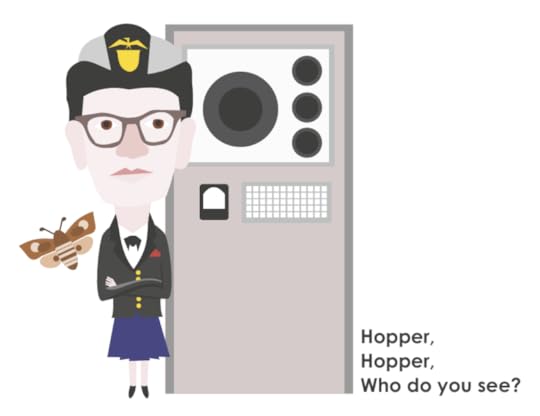
Like the Brown Bear book, the character before is asked who he or se sees. Anywhere from Albert Einstein, to Ada Lovelace to Grace Hooper and her "bug", as you can see below. (Grace Came up with the word for a glitch in the system when she pulled a moth from the computer, and declared that she had found a bug in the device, or so the story goes.)
Good variety of both male and female scientist, as well as a diverse representation. And in the back of the book is a brief explanation of what each is famous for.
The drawings are bright, the text light, and the people chosen are both familiar and new to me.
I think both parents and kids will get a kick out of it, and perhaps they will get interested in being scientists too.
Thanks to Netgalley for making this book available for an honest review.
Like the Brown Bear book, the character before is asked who he or se sees. Anywhere from Albert Einstein, to Ada Lovelace to Grace Hooper and her "bug", as you can see below. (Grace Came up with the word for a glitch in the system when she pulled a moth from the computer, and declared that she had found a bug in the device, or so the story goes.)
Good variety of both male and female scientist, as well as a diverse representation. And in the back of the book is a brief explanation of what each is famous for.
The drawings are bright, the text light, and the people chosen are both familiar and new to me.
I think both parents and kids will get a kick out of it, and perhaps they will get interested in being scientists too.
Thanks to Netgalley for making this book available for an honest review.

May 26, 2018
Cute idea, but it doesn’t cover nearly enough of the scientists. I liked the idea of getting kids used to hearing scientific names, and the kids at story time enjoyed the colorful pictures. But the handful of names isn’t enough to even scratch the surface of the hundreds of people over the centuries who have changed the world of science and made a name for themselves in their chosen fields.

March 4, 2018
Chris Ferrie (author of books such as Goodnight Lab and Quantum Physics for Babies), has created another instant classic. Modeling his book on Brown Bear, Brown Bear, Ferrie takes readers through a roll-call of famous scientists. A dozen distinguished figures from Charles Darwin to Katherine Johnson are shown. Iconic equipment or calculations are placed within the illustrations, such as Einstein's "E=mc2" or George Washington Carver's peanut plant. Science geeks may notice that Curie's page shows two Nobel prize medals, Grace Hopper's computer has a moth fluttering nearby, or that Ada Lovelace is "writing computer code for thee."
A section "About the Scientists" shares details about the most notable contribution of each figure. It is gratifying to note that there is a diverse mix of men and women, as well as racial and ethnic backgrounds represented in the scientists included in the book. The "little scientists" that Katherine Johnson sees looking at her are also included in the back section. Speaking directly to the readers, the text states, "You can be the next person to change the world."
This is a fun book for science-minded parents to read with their youngsters, but also would make a wonderful introduction to a unit on famous scientists. Perhaps with a biography project to research one of the figures mentioned in the book?
I read an e-book provided by the publisher through edelweiss.
A section "About the Scientists" shares details about the most notable contribution of each figure. It is gratifying to note that there is a diverse mix of men and women, as well as racial and ethnic backgrounds represented in the scientists included in the book. The "little scientists" that Katherine Johnson sees looking at her are also included in the back section. Speaking directly to the readers, the text states, "You can be the next person to change the world."
This is a fun book for science-minded parents to read with their youngsters, but also would make a wonderful introduction to a unit on famous scientists. Perhaps with a biography project to research one of the figures mentioned in the book?
I read an e-book provided by the publisher through edelweiss.

Want to Read
March 27, 2018Text-to-Text Connection:
'Scientist, Scientist, What Do You See' is a clear text-to-text comparison and re-write of Eric Carle's 'Brown Bear, Brown Bear, What Do You See'. Both books Are asking the question "What do you see?" to a character. In Carle's book the characters are creatively illustrated animals through most of the book. In 'Scientist, Scientist' the question is being asked of scientists of varying fields of study, and each scientist is described with their major contributions in the scientific world. The end of 'Scientist, Scientist' plays just like the end of 'Brown Bear', with little scientists (or 'children', in 'Brown Bear') looking back, and then a re-telling of the scientists featured. (Just as 'Brown Bear' went back through the animals.) I love that they used the label 'little scientists' for the children, as we know that scientists don't just start as adults in a lab! Children who loved 'Brown Bear' will love the mirroring of the story in this fun introduction to some of our greatest scientific minds!
'Scientist, Scientist, What Do You See' is a clear text-to-text comparison and re-write of Eric Carle's 'Brown Bear, Brown Bear, What Do You See'. Both books Are asking the question "What do you see?" to a character. In Carle's book the characters are creatively illustrated animals through most of the book. In 'Scientist, Scientist' the question is being asked of scientists of varying fields of study, and each scientist is described with their major contributions in the scientific world. The end of 'Scientist, Scientist' plays just like the end of 'Brown Bear', with little scientists (or 'children', in 'Brown Bear') looking back, and then a re-telling of the scientists featured. (Just as 'Brown Bear' went back through the animals.) I love that they used the label 'little scientists' for the children, as we know that scientists don't just start as adults in a lab! Children who loved 'Brown Bear' will love the mirroring of the story in this fun introduction to some of our greatest scientific minds!

September 30, 2019
Probably my favorite Chris Ferrie book. It has the right balance of information and accessibility, which his books struggle with sometimes. The art was my least favorite part, but it is okay, and the text is imaginative enough to still get five stars. It is a take-off on Brown Bear, Brown Bear, but it doesn't feel forced, and it includes some really interesting scientists.
October 20, 2018
The book is really fun for little kids I like still It.the pictures is really funny

November 5, 2020
Enjoyed the wordplay. An interesting book to share.

March 15, 2019
Age: Toddler-Preschool
Twelve diverse scientists are given the Brown Bear Brown Bear treatment in this remarkably good biographical picture book. Although this will sell just fine as a gift book based on the title alone, I was delighted to see that the text flowed and rhymed. Supplementary material includes 1-2 sentences that describe the advancements of each scientist.
Twelve diverse scientists are given the Brown Bear Brown Bear treatment in this remarkably good biographical picture book. Although this will sell just fine as a gift book based on the title alone, I was delighted to see that the text flowed and rhymed. Supplementary material includes 1-2 sentences that describe the advancements of each scientist.

September 1, 2021
This parody of Brown Bear, Brown Bear introduces a range of scientists. I was pleased to see a diverse range of scientists, with women and people of colour reasonably well represented, and I learnt some new scientists along with my daughter. My daughter enjoyed the pictures, which gave clues to what the scientists studied.

April 10, 2018
Ah, I meant to review this book she’s ago and still haven’t gotten to it. I love this science-y related retelling of Brown Bear, Brown Bear. The rhymes don’t always work perfectly, but it’s still a wonderful book.
Full review to come.
Full review to come.
September 1, 2018
Fantastic book that offers a couple of sentences detailing the various scientists and their achievements.

April 24, 2018
Using the classic structure of Brown Bear, Brown Bear, What Do You See? by Bill Martin Jr., Chris Ferrie has created a whole new experience for young scientists. Featuring scientist from past and present, each scientist looks to a picture of another scientist which highlights their notable work such as Grace Hopper making a computer enquiry or George Carver studying botany.
The scientists presented in the story are from all over the world and show both genders equally as well as many ethnicities, creating a wonderful platform for children allowing them to see that anyone can be a scientist. This fact is promoted on the last page, where a diverse group of children are looking back at the scientists. The familiar rhythm of the story along with fun pictures generates a wonderful new way to introduce scientists to young children. Having read this with my two year old as well as several school groups, I believe this book is best enjoyed by ages 2-8.
This book was received for free in return for an honest review.
The scientists presented in the story are from all over the world and show both genders equally as well as many ethnicities, creating a wonderful platform for children allowing them to see that anyone can be a scientist. This fact is promoted on the last page, where a diverse group of children are looking back at the scientists. The familiar rhythm of the story along with fun pictures generates a wonderful new way to introduce scientists to young children. Having read this with my two year old as well as several school groups, I believe this book is best enjoyed by ages 2-8.
This book was received for free in return for an honest review.
June 22, 2018
This adorable book is a scientific spin on the classic book "Brown Bear, Brown Bear What Do You See?". This book is a fun way to introduce kids to important men and women in the science fields. The simple repeating, rhyming text is a lot of fun to read aloud, and the author briefly introduces famous scientists and an overview of their work. The index in the back of the book provides more in depth detail on the life and work of each scientist as well. The scientists in the book represent different time periods, fields of science, backgrounds, and genders, and the ending of the story also shows a diverse group of little scientists, encouraging kids of all backgrounds and genders to pursue a career in science!
November 23, 2021
What do I see? I see a nicely written childrens book about scientists. Chris Ferrie is trying to get young children into learning more about scientists and how they themselves can be scientists and change the world someday. My main gripe is that the child may not pick up on these scientists at first and may have to rely on the person reading to them to tell them who these people are. They have further information about the scientists in the last pages of the book, but the child’s interest may not be there to as much to go to the back and see. Maybe incorporate more about the scientists’ lives and how they became who they were, so maybe the child can relate to them. The scientists Chris talks about is a diverse group, so it appeals to everyone. Nice read overall.

August 16, 2024
This book is most strongly recommended for parents and caregivers who know stories to tell about the famous scientists mentioned here.
If this book isn't a jumping off point, then it's a cute trivia book, with rhymes and scientist name dropping.
And who thinks it is really appropriate to offer children who can barely read: "a scientific parody"?
A PARODY OF WHAT?
Far as I can tell, this is a parody of the English nursery rhyme:
Pussycat Pussycat Where have you been?
Only here the rhymes are more like:
Scientist, Scientist, Who do you see? I see Marie Curie in her laboratory!
FIVE STARS -- for the author's moxie, and evident affection for great scientists.
If this book isn't a jumping off point, then it's a cute trivia book, with rhymes and scientist name dropping.
And who thinks it is really appropriate to offer children who can barely read: "a scientific parody"?
A PARODY OF WHAT?
Far as I can tell, this is a parody of the English nursery rhyme:
Pussycat Pussycat Where have you been?
Only here the rhymes are more like:
Scientist, Scientist, Who do you see? I see Marie Curie in her laboratory!
FIVE STARS -- for the author's moxie, and evident affection for great scientists.

May 18, 2018
A smart and informative spin on the Eric Carle format of animal books, this time detailing a wide variety of scientists. It was succinct and included further details about each scientist at the end. I love continuing stories.
My son and I discovered and read this in the local bookstore and I’ve continued to think about it. He knew who Katherine Johnson was as (thanks to the Hidden Figures movie) but we were both interested in other scientist we’d never heard of. Grace Hopper is my favorite because the woman surprises and inspires me with her work ethic and boldness. Male and female scientist from all races and times make this a great starter book for discussions in any group.
Read it!
My son and I discovered and read this in the local bookstore and I’ve continued to think about it. He knew who Katherine Johnson was as (thanks to the Hidden Figures movie) but we were both interested in other scientist we’d never heard of. Grace Hopper is my favorite because the woman surprises and inspires me with her work ethic and boldness. Male and female scientist from all races and times make this a great starter book for discussions in any group.
Read it!

September 26, 2018
I love the diversity of scientists the author chose so all students can feel inspired to become a scientist. But I do struggle with what grade level to recommend this for. Grades 3-5 could enjoy remembering from when they were younger the Brown Bear Brown Bear book it's parodying and probably better understand the different categories of science represented in it than the younger grades would. But they would probably find the author's line "I see little scientists (referring to themselves) looking at me" as too babyish. Maybe 2nd or 3rd grade would have enough scientific background knowledge to both appreciate it and not feel offended at being referred to as a "little scientist."
April 30, 2018
Scientist, Scientist, Who Do You See? is a great picture book for children of all ages. My young children (ages 2 and 4) would enjoy the book with it's repetition of lines (similar to Brown Bear, Brown Bear), while my older elementary students (ages 9 and 10) would enjoy the book presentation of famous scientists. I liked the section in the back that had descriptions of what each scientist has contributed to the world of science. The illustrations are colorful and captivating. I would definitely recommend this book!
January 7, 2020
Parody of Brown Bear, Brown Bear What Do You See? just scratches the surface of some of the more popular scientists over the last couple hundred years. The author offers a good selection of diversity, with women representing 50% of the scientists, as well as a variety of ethnicities and countries, demonstrating that a scientist can look like anyone.
I love that there's a pretty decent mix of names I am familiar with along with some new to me, along with a brief description at the end for what these scientists are known for.
Better for 5-8 year olds.
I love that there's a pretty decent mix of names I am familiar with along with some new to me, along with a brief description at the end for what these scientists are known for.
Better for 5-8 year olds.

October 12, 2018
Not really a parody but an honoring of Eric Carle’s classic Brown Bear, Brown Bear, the best aspect of this book is the wide range of scientists depicted - women, men, black, European, Asian, physicists, meteorologists, botanists, 19th -21st century... the rhymes give only the most basic of information, and the min-bios in the back barely give anything more, but we used it as a jumping off point to look more information up on the scientists that especially interested us.

May 4, 2020
This is a lovely book. Everybody in my house was interested to discover more about Marie Curie, Grace Hopper, Einstein of course, James Maxwell because we are big photography fans in our house and in particular Katherine Johnson. This book gives great scope for further learning. The kindle copy I got from Netgalley was distorted in parts which did detract from it a little but we enjoyed it none the less. It would be a great addition to any classroom.

January 29, 2024
Not going to lie, I really avoided this book simply because I didn't care for the illustrations on first glance and felt like some of the rhymes were a bit forced. However, I have to credit this book for my toddler recognizing and getting very excited about particular scientists and what they studied. She is really fond of George Washington Carver who studied botany, so I am very thankful for this book to open those doors to scientific discussion!
April 17, 2018
Brown Bear, Brown Bear is a very popular rhyming book by Eric Carle. Chris Ferrie's book, Scientist, Scientist, Who Do You See?, has the same feel. It is a colorful book that introduces kids to twelve scientist--both male and female. The illustrations will appeal to kids because the scientist's pictures have exaggeratedly big heads! As an educator, I really liked this book!

May 11, 2018
This is a cute variation of the classic Brown Bear, Brown Bear. Some of the rhymes are a bit forced and I'm not sure what age to recommend this for as the simplicity would bore older readers but the scientific terms might lose/bore younger ones. However the more stem related picture books we have the better so all in all I liked this book and would recommend it to others.

July 12, 2019
Twelve diverse scientists are given the Brown Bear Brown Bear treatment in this remarkably good biographical picture book. Supplementary material includes 1-2 sentences that describe the advancements of each scientist. Great as a gift purchase or a library checkout.
Reviewed by: Miss Kelsey, Youth and School Services, Vernon Area Public Library
Reviewed by: Miss Kelsey, Youth and School Services, Vernon Area Public Library
September 8, 2023
3.5 it gives a basic introduction to an array of scientists. I like that it's a play on a familiar format but feel that other books are better for their depth. Still...this did introduce me to some names that I hadn't heard of so it was nice that it went somewhat beyond the predictable set of scientists
April 24, 2018
This is a good introduction to some of the many accomplished scientists around the world and throughout history. I especially appreciate the variety of genders and ethnicities represented in the text. However, the rhyme parody gets a little heavy with so many syllables.

August 7, 2019
My name is Josephine. I am eight years old. I really like this book because I like science. It is a parody of Brown Bear Brown Bear What Do You See?. It told a little bit about each scientist. I recommend this book.
December 14, 2017
***I Received an advance copy from Edelweiss***
This can be a fun book to use in STEAM storytime as an introductory to STEAM.
This can be a fun book to use in STEAM storytime as an introductory to STEAM.
Displaying 1 - 30 of 52 reviews