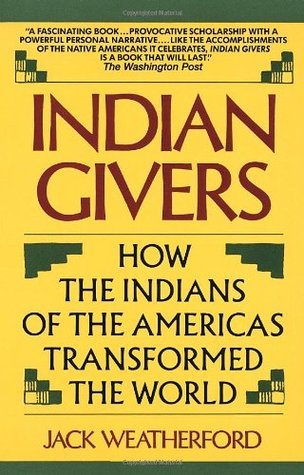
" As entertaining as it is thoughtful....Few contemporary writers have Weatherford's talent for making the deep sweep of history seem vital and immediate." THE WASHINGTON POST After 500 years, the world's huge debt to the wisdom of the Indians of the Americas has finally been explored in all its vivid drama by anthropologist Jack Weatherford. He traces the crucial contributions made by the Indians to our federal system of government, our democratic institutions, modern medicine, agriculture, architecture, and ecology, and in this astonishing, ground-breaking book takes a giant step toward recovering a true American history.
Jack McIver Weatherford is the DeWitt Wallace Professor of anthropology at Macalester College in Minnesota. He is best known for his 2004 book, Genghis Khan and the Making of the Modern World. In 2006, he was awarded the Order of the Polar Star, and the Order of Genghis Khan in 2022, Mongolia’s two highest national honors. Moreover, he was honoured with the Order of the Gran Mariscal de Ayacucho by the Government of Bolivia in 2014. His books in the late 20th century on the influence of Native American cultures have been translated into numerous languages. In addition to publishing chapters and reviews in academic books and journals, Weatherford has published numerous articles in national newspapers to popularize his historic and anthropological coverage of Native American cultures, as well as the American political culture in Congress in the 20th century. In recent years, he has concentrated on the Mongols by looking at their impact since the time that Genghis Khan united the Mongol tribes in 1206.
We used this in teacher training on how to teach accurately about Native Americans in social studies classrooms. Weatherford has so many examples that are interesting for teacher and student alike. So often, teachers don't think to prepare young students before Native Americans come as guests, and kids ask questions like "where's your feathers?" and are disappointed and even disdainful if they're not dressed in traditional garb or talk about Indian affairs instead of doing war whoops.
I learned from this book about the many contributions American Indians have given not onlty the USA but the entuire world..Jack Weatherford is 100% right when he says American Indians have been underrated and mostly ignored when it comes to the contributions they have made to the world economy,food supply and overall culture..This book makes and American Indian even prouder to be an American Indian and I think every American Indian should read this book..
I was very interested in this book and it was a big disappointment. The topics are treated in a very superficial way and the author tries too hard to prove his points. I felt he had an offhand and unbalanced approach to the information.
I also kept coming across blunt references that I questioned. For example, early on (p. 28) he states that the Hudson’s Bay Company is “the oldest company in the world …continuously operating since May 2, 1670.” Since I was aware that the Cambridge University Press has been operating since the 16th century, his assertion made me question his other facts. Of course, if he means oldest in the new world or oldest commercial trading company, he may be correct. Later (p 226-229) he kept referring to the cure of malaria in the world. Malaria is hardly in the cured category and is still one of the major causes of death. Quinine may treat malaria but I don’t think it is a cure. These may be picky on my part, but he is so offhand about his facts, that I was uncomfortable believing what he said about other things.
That said, I did enjoy the two chapters on farming. And, I enjoyed finding out how beaver hats were made. My favorite sentence in the book: According to the Hurons, the Europeans lost their freedom in their incessant use of “thine” and “mine”
I read the 2010 version that includes a preface from the author, which was nice, but none of the original 1988 text was updated, so beware that some of the information is old, incorrect and/or outdated. (As far as incorrect, he at one time mentions that "most Africans have a natural immunity to malaria." This cannot be accurate as Sub-Saharan Africans account for 89% of all malaria cases and 91% of all malaria deaths, according to the CDC.)
However, when Weatherford sticks to the main focus of the book, he provides a lot of very good information that deserves to be known about how native people of the Americas contributed their resources and knowledge to the world (or, most often, had it taken from them). A good primer on the topic, but it really needs a complete update and revision.
A very fine treatment of Native American contributions in the realms of agriculture and pharmacology, and of abuse of native cultures. The other material is rather uneven, and in the case of politics and economy is a reach: reminds me of the old Soviet schtick about the Russians having invented everything. The footnotes are sparing and the bibliography is awfully thin, suggesting that Weatherford may be a little more imaginative than scholarship would demand.
My father is Arawak, indigenous to the Amazonian forests of South America. I fear this book will haunt me for a long time, because of all I didn’t know despite all the things my father has taught me. This book taught me the etymological reasons for the words he uses, the explanations of why he cooks what he does and so much more. It is devastating to learn what we have lost and what we stand to lose with the decimation of Indigenous people and their culture.
The title of the book has two inaccuracies amounting to lies, to begin with.
First and foremost, they are NOT Indian. The European migrants knew this, Columbus knew this, and for sake of keeping a falsehood so Columbus would not risk his reputation or lose his head the sailors working with him who all knew this were sworn to say the opposite. Everyone knew Columbus had not reached India, and everyone nevertheless insists on calling the natives of western continent "Indian", perpetrating a lie, not merely an inaccuracy.
This is doubly racist, since it deprives the said natives of their own identity to begin with, and also no one has asked India if there is any connection whatsoever between the people that lived in a land across the world and India (yes, of ancient trade and exchange of skills, but not populations or identity). The falsehood dumps all non European non African non Oriental non Islamic people into one basket, a huge racism of an assumed hierarchy and separating the high and the low and the others nowhere. It is stupid, racist, ignorant, false, and high time it stopped. High time the natives of the western continent were able to assume their own identity. Unless they wished to claim Indian ancestry and to return to India, that is. Unlikely, since if anything they are connected to Siberia and Mongolia and Pacific islands, which makes far more sense.
Which brings one to another racist imposition of a name, that of the continent. Vespucci Amerigo was one of the sailors who supposedly discovered the continent, and to impose his name on the continent, not even asking a native what they called their land, is supreme racism. America is a racist term by definition.
And then, to belatedly allow that the natives "contributed" to US and "transformed the world" - hellow, they did not massacre all newly arriving migrants, in fact they helped the migrants settle like all good neighbours do, and so they in fact are the founding stone of the edifice in every way! That is only in the north, while in the southern and central parts the migrants were plundering marauders who destroyed everything precious in name of faith. "They had astronomy, architecture, arts, crafts; European migrants had guns and gunpowder" is perhaps a rephrasing of the famous assessing of the encounter, but pretty good to give the idea.
Of course they were givers! They had a superior system in terms of environment as well, which is only recognised now that the fear of global warming and fear about a lack of future for humanity has made some - not all - people do a double take! In addition to what others failed to recognise, they also had potato and tomato and chillies and chocolate, and where in the world can people do without every one of these indeed! Germans post wwi survived on potato as do poor in many a societies even now.
For that matter, the huge (and mostly unnecessary - who ever died or fell sick for lack of face paint?) cosmetic industry of west derived its origin and ideology from an oriental culture of China and Japan where faces of Geishas and upper class women were painted masks, which got copied to Europe for fashion, while the system of administrative examinations and system generally was copied by British and integrated into their own structure of governance.
A good amount of vocabulary in English is borrowed from Arabic, Persian and India, while Latin and Greek are younger siblings if not daughters of Sanskrt (and therefore the ease of India in European languages beginning with English), realised and perforce admitted by Europe long before the present era of denial.
And of course Africa, with her stolen raw materials (like other colonised lands) and kidnapped men and women (unlike other lands) that made US prosper before the civil war dismantled the slavery and dislocated the now free ex-slaves once again, with equality still a faraway goal and animosity of ex-slavers growing to high pitch. Solution? Liberia? Workers work for food and return, much like Germans would like Turks and others to do, is the pleasure of pale colour races?
Gratitude at the very least is way past due. Acknowledgement likewise. Yes, the world gave and Europe received and forgot to say thank you. These belated acknowledgements are better than never, and what next? An equal status? For the givers who received only victimisation in return?
Indian Givers How the Indians of the America Transformed the World By Anthropologist Jack Weatherford.
Ironically the term “Indian giver” is a familiar term is in reference to a person that gives a gift and then takes it back. However, this old adage has nothing to do with the title of this book.
A remarkable read. A groundbreaking book that recovers the fascinating history of the Americas and the crucial contributions that the Indians of the Americas made on a global scale. These include democratic institutions, modern medicine, agriculture, architecture, and ecology. Interestingly, the Indians of the America’s were the first to harvest some sixty percent of foods eaten in the world today. Imagine if you will Italian or Greek food without its tomatoes or the Irish without their potatoes. Chilies, chocolate, corn, beans, squashes, the list goes on. Not to mention the wealth of gold and silver that was taken from the Americas by the Europeans.
My commentary below (apart from the book).
Even though much was given. So much more was taken. Over 500 treaties were made with the Indians of the Americas—and more than 500 broken.
Flash forward to this twenty-first century—the fall of 2016—North Dakota. Tribes of Native Americans from around the country gathering together, protesting an oil pipeline that will run through the heart of the U.S., crossing many waterways with the potential of damaging the largest aquifer in the country.The Native Americans are the heart of this country. They view this land as sacred and are working to protect it. There is no “other” planet. This is it. We all need to appreciate this sacredness before its too late.
Pray for peace, love, and understanding, Zee Huxley www.zeehuxley.com
If you are expecting a book about native Americans, that is not what you are going to find in this book .In my opinion, this book Is just another proof of how hard it is for many white people not to consider themselves the center of the universe. Some information in the book might be interesting, but I found it 25% about resources of the "New world", 60% about how white people used these resources, 5%on how asians & africans used these resources and less than 10% is about actual native Americans "AKA Indians!". Although I believe in the good intentions behind the book and the well of his writer and beside the fact that I agree with most of what is in the closing chapter of the book, I wish it was just written in a way that looks at native Americans as simply just equals to other cultures without putting them in a negative or a positive exotic frame.
I was completely unaware that so many prominent European thinkers and writers (including Karl Marx) were so profoundly influenced by the American Indian form of government and political practices, especially those of the League of the Iroquois. The example of American Indian governance was a true catalyst that helped America's Founding Fathers think outside the box, beyond the Old World monarchies and limited attempts and outlines of democracy by the Greeks. The League of the Iroquois provided a living, well-functioning example of a true democracy in action that our founders were able to study through personal interaction and immersion over several decades leading up to our independence.
Very well written and super eye-opening! Many times reading this book I had one of those “that sounds familiar... that makes sense!” moments. I was able to connect the information in this book with what I know of world (largely European) history. The story of Native Americans as told by Weatherford is both enlightening and sad, and as the book concludes: the Americas were found 500 years ago but have yet to be discovered.
Fun moment reading this: written in the early 90s, Weatherford mentions the American quinoa crop as mostly unknown to Western people. Now, quinoa is ubiquitous!
For some reason this was not an easy read for me, even though I found the subject matter very interesting. The numerous contributions native Americans have given to the world we live in is beyond impressive.
Fascinating book. I learned a lot. Most interested in the way Indians influenced settlers with agriculture such as clearing areas to plant. The author did a great job of interweaving Contributions of the peoples of the Americas with the impact worldwide.
I did reach a point where I wondered if there was any bias since the author is the descendant of an American Indian. I researched the story (a short paragraph of two sentences - almost a throw away section) of Ishi, the last of the Yahi tribe. Weatherford states Ishi, "...went on display at the museum of the University of California .... ...and lived out his last five years at the museum."
It is true that he lived at the museum, but he worked with anthropologists as a research assistant. The author makes it sound like he was in a display case for people to stare at - a circus sideshow! The inflammatory way Ishi was presented makes me wonder about some of the other facts the author presented.
Still, a very interesting read. Just remember that there might be an agenda not easily seen.
La historia la escriben los vencedores. Esa es la que conocemos. Pero esta es la otra. La que explica porqué un descubrimiento como había habido muchos otros, cambió la faz de la Tierra. La ciencia, la tecnología, la medicina, la cultura, los sistemas políticos de los indios americanos y su poderosa fuerza transformadora. Sabías que lejos de ser un centro ceremonial, se estima que Machu Pichu era un laboratorio de agronomía avanzada? Que la actual industria farmacéutica tiene su origen en la medicina india y que la democracia representativa, tal como la entendemos hoy, es mucho más próxima a los sistemas políticos indoamericanos que a los de la antigua Grecia.
A great read - this book really held my attention. I had no idea what incredible agriculturalists Indians were, or that their styles of government had such a profound effect on the political structures of the US. I didn't even know that caucus is an Iroquois word. This was very eyeopening - and totally made me want to know more about these incredible peoples. Full of interesting facts - the Inca's roads through South America are still probably the best roads in many countries, and many of their structures are still the most sturdy. Kind of made me sad though - the Indians of the Americas are so marginalised, and we've lost so much knowledge and culture.
On the one hand, sure, this had some good historical tidbits. On the other hand (like so many others pointed out), there is little reference and little connection throughout. It is just fairly random.
My biggest issue though is that it is so focused on how Native Americans of all different communities affected the rest of the world, which meant that most of the book wasn't about those societies at all! Oh, there were islands where the sweet potato came from? That's cool, heaven forbid discussing that, let's just talk about how other countries now eat it. Basically, this is alright for a skim but not really so great for learning about those societies on their own.
Native Americans (non-European natives who were in North and South America before Columbus) "gave" the world many things: medicine, silver, federal government, etc. Weatherford's book is well-researched and certainly sensitive to the plight of the natives. Strange book in that Weatherford does not provide an introduction - he just jumps right in. The book is disturbing because the natives really did not "give" these things to the world; the things were taken and the natives were treated very poorly. Thought-provoking.
This book made some good points but got bogged down in the minutia. Then it seemed to go off on a Marxist tangent. While I don't disagree that Marx and other revolutionaries that followed were influenced by the Iroquois confederacy, I think the author spent too much time on it and seemed to be promoting it. I did enjoy reading about how the discovery of America changed the world economy. It also never really occurred to me that the riches found in many old European churches and castles were all pillaged from the New World. I'll give it three stars for research alone.
Interesting nonfiction about the ways that Native Americans influenced the world. It is refreshing to read a positive book about Native American culture and history. A good read for November.
Indian Givers turned out to be an educational and at the same time very sobering read. Because while Jack Weatherford makes a very strong point as to why the subtitle of this book "How Native Americans Transformed The World" is totally appropriate. The sad fact is that for the most part, these contributions have gone totally unrecognized. The edition I read is a re issue of the book that originally came out in 1989. Hopefully this edition will go further in getting out the message of just how vital a role Native Americans played in transforming the world.
How did the Indians of the Americas transform the world? They domesticated potatoes and maize that became staple foods of large areas of Eurasia and Africa; they discovered the healing power of the cinchona bark against malaria and of berries against scurvy; their labor mined the silver that financed the commercial revolution in early modern Europe; their political organization influenced European philosophers from Montaigne to Marx and Engels.
Okay I guess and interesting at times, but dry and repetitive. Not much soul. Mostly reads like a list of all the useful things Europeans brought back with them after conquering the Americas.
Time and time again, while reading this book, I read the title of the chapter, thought "Well, this is going to be a stretch", but then was pretty much convinced by the end of the chapter.
Some of the points ended up being a stretch (The Pilgrims didn't go from Leiden to the New World purely for profit, but also because of changes in the Netherlands, the "younger generations" becoming too Dutch, being more rural and not as used to city life, etc. But sure, profit was one of the points). I also found the connection to the industrial revolution, etc. a bit indirect.
Some others I knew in theory, but hadn't wrapped my mind around how pervasive the native american influence actually was, such as with food. From Russian/Irish potatoes, to Italian tomatoes and zucchini, to cashews, peanuts, corn worldwide, etc. etc., these (and a lot more) all came from the Americas. By the way, he asserts that the Sichuan peppercorn originated with peppers in the Americas, but that sounds very odd to me.
And some others actually surprised me. I was sure the chapter on Native American influence on liberty, democracy, and the American constitution would be a complete stretch, but the chapters made a lot of sense. The Iroquois had a league, based on majority votes and caucuses (a Native American word), which Thomas Jefferson and Benjamin Franklin, among others, quoted directly when writing about the American government structure. Everyone mentions Greek democracy, but odd that it didn't influence the world for 2,000 years until people went to the Americas. In fact, even the fact that the Iroquois league could vote new member states in was the only prior example of something similar for admitting new states into the union (rather than colonizing them and absorbing them that way).
Extra plus, I found out this is a signed copy! I had no clue (I ordered it used from Abebooks)!
I really appreciated this book and its approach to Indians of the Americas and all the contributions they have made to our world. I had difficulty reading the book, maybe because I thought it was dated, maybe because is was packed with so much information I often couldn't process it all. He is a good story teller and in parts of the book I was intrigued. In retrospect, having met the author through Zoom with my book group, I appreciated it much more and probably would rate it a 38. Jack Weatherford is an anthropologist who has traveled extensively, lives in Mongolia most of the time since he has retired from teaching and is still writing. A decent human being who is optimistic and charming.
Nice introductory book, the citations/syllabus were a little light but still gave me plenty of follow up material after this whet my appetite. A rare author that successfully balances the human interest narratives with historical scope, i.e. tying in the daily of life of indigenous Bolivians now with the vast changes from the prehispanic, colonial and modern periods. Full of fun little factoids. The chapters on plants (food, medicine, drugs) and their associated technologies (farming, healing, etc) were the strongest, political chapters were the weakest.