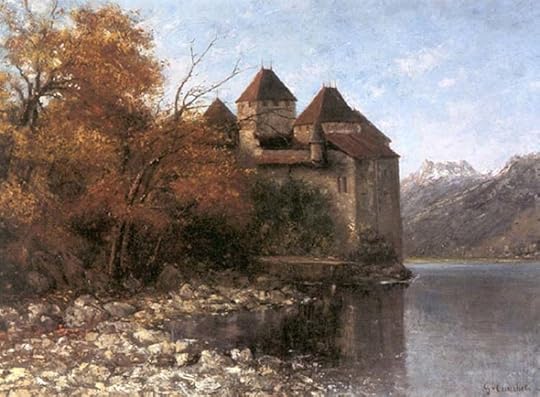
The Prisoner of Chillon is a narrative poem written by the famous English poet, Lord Byron. The poem tells the story of a man named Francois Bonivard, who was imprisoned in the Chateau de Chillon, a castle on the shores of Lake Geneva, Switzerland. Bonivard was a political prisoner who was held captive for six years during the 16th century.Through the poem, Byron explores themes of freedom, isolation, and the power of the human spirit. The poem is divided into stanzas, each of which tells a different part of Bonivard's story. Byron uses vivid imagery and powerful language to describe the castle and its surroundings, as well as the emotions and thoughts of the prisoner.The Prisoner of Chillon is considered one of Byron's most famous works and is often studied in literature classes. It is a powerful and moving poem that explores the depths of human suffering and the resilience of the human spirit in the face of adversity.There are seven pillars of Gothic mould, In Chillon's dungeons deep and old, There are seven columns, massy and gray, Dim with a dull imprison'd ray, A sunbeam which hath lost its way, And through the crevice and the cleft Of the thick wall is fallen and left.This scarce antiquarian book is a facsimile reprint of the old original and may contain some imperfections such as library marks and notations. Because we believe this work is culturally important, we have made it available as part of our commitment for protecting, preserving, and promoting the world's literature in affordable, high quality, modern editions, that are true to their original work.
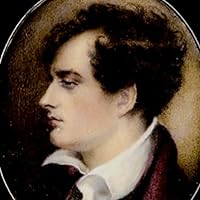
George Gordon Byron (invariably known as Lord Byron), later Noel, 6th Baron Byron of Rochdale FRS was a British poet and a leading figure in Romanticism. Amongst Byron's best-known works are the brief poems She Walks in Beauty, When We Two Parted, and So, we'll go no more a roving, in addition to the narrative poems Childe Harold's Pilgrimage and Don Juan. He is regarded as one of the greatest British poets and remains widely read and influential, both in the English-speaking world and beyond.
Byron's notabilty rests not only on his writings but also on his life, which featured upper-class living, numerous love affairs, debts, and separation. He was notably described by Lady Caroline Lamb as "mad, bad, and dangerous to know". Byron served as a regional leader of Italy's revolutionary organization, the Carbonari, in its struggle against Austria. He later travelled to fight against the Ottoman Empire in the Greek War of Independence, for which Greeks revere him as a national hero. He died from a fever contracted while in Messolonghi in Greece.
I haven't read much Byron over the years, just bits and pieces here and there, so I did not know anything about this poem or the events that inspired it. I was more than a little bit intimidated when I saw that the edition of the poem available at Project Gutenberg was stuffed full of footnotes. I decided to read just the poem itself first, then go back and re-read it with the notes. I also saved any Googling of the topic for after my first run-through. I wanted to experience the pure poem first and foremost.
Narrated by an unnamed man, this poem tells of his years of imprisonment. It was easy to place myself in that damp, mouldy dungeon, with an iron shackle on my leg, fastened to a pillar, unable to see more than just a tiny stream of sunlight. Moving, dramatic, and ultimately victorious in a bittersweet way, the prisoner's story as told by Byron will stay with me for a long time.
As will the real story. Byron was inspired to write his poem after visiting the Chateau de Chillon and touring the very dungeon where Francois Bonivard spent six years in chains for political activism against the Duke of Savoy in 1530. Six years spent pacing back and forth as far as the length of his chain would allow. According to wiki, the rut he created in the floor is still there, as is the chain.
There are of course some details about the poem and the true story that do not match. In the poem our prisoner at first has two of his brothers as companions, each of the three being shackled to a different stone pillar. They cannot see each other, but they can still speak together, even though
"Our voices took a dreary tone, An echo of the dungeon stone, A grating sound, not full and free, As they of yore were wont to be: It might be fancy—but to me They never sounded like our own."
As far as I could tell from my limited exploring, Bonivard was alone during his time in Chillon. But a poet is allowed his dramatic license, right? I would certainly not hold it against Byron for creating a poem that will wrench the heart strings of his readers more than it relates all of the facts. Those facts inspired him to imagine himself chained in that dungeon, and his talent made it possible for the rest of us to experience what he felt, what he imagined The Prisoner himself might have felt.
And those footnotes? They turned out to be digs comparing this line or that phrase to other poets. Did Byron copy Wordsworth's style? Did he lift lines from this poet or that one and change them to fit into his poem? I am not enough of a Byron scholar to weigh in on this debate, if it is even still ongoing. I know that anyone who writes is influenced by many things around them, including what they themselves read. I would assume all such influences would find their way into an author's work one way or another.
But that is no reason to avoid The Prisoner Of Chillon. This poem will make you appreciate your ability to go outside anytime you choose, to feel the sun on your face, the garden grass beneath your bare feet. Read it: you will be grateful for your freedom.
Poetry and I rarely get along, but I loved this. My pleasure derived more than a little from having the eponymous castle only feet away from the bank I was perched on while consuming Lord Byron's verses. Yet while I highly recommend that experience, I think this work stands on its own.
Inspired by the real imprisonment of Francois Bonivard in the sixteenth century, this poem tells of his confinement in the dungeon of Chillon, the untimely death of his brothers only a few feet away (yet just beyond reach to the chained Bonivard), and his eventual and bittersweet liberation. It touches the extremes of human experience and emotion and was simply heartbreaking. If I remember my literature classes correctly, Romantics such as Lord Byron were not known for verisimilitude, but I think the emotion this evokes (if not the actual events) are as raw and real as one could ask for.
Mis cabellos son grises, pero no por la edad, y no se volvieron blancos en una sola noche, como ocurre a veces a causa de un súbito pavor. Mi cuerpo está encorvado, pero no por el trabajo, pues su entumecimiento fue provocado por innoble reposo. Soy el habitante de una fosa.
I have read "The Prisoner of Chillon" 3 times in the past week. I love the historical context behind this work, although you wouldn't need to know about the history to get enjoyment from this poem. I think this works incredibly well as a look into what prolonged captivity does to people's minds, after a number of years, you essentially cease to exist as a person, you grow accustomed to captivity, even being released can seem intimidating. As Byron writes: "I had no thought, no feeling -none- Among the stones I stood a stone, And was, scarce conscious what I wist, As shrubless crags within the mist; For all was blank, and bleak, and grey, It was not night - it was not day, It was not even the dungeon-light, So hateful to my heavy sight, But vacancy absorbing space, And fixedness - without a place; There were no stars - no earth - no time - No check - no change - no good - no crime But silence, and a stirless breath Which neither was of life nor death; A sea of stagnant idleness, Blind, boundless, mute, and motionless!"
I say it everytime, but I just can't believe how good Byron's poetry is, he writes the best kind of melancholy. So good!
Even how prolific Byron was, how mythical but real the Byronic hero is, I could only appreciate much of the poet’s oeuvre: I rank The Prisoner of Chillon next to “Darkness” being his best.
Lord Byron, aj po 200 rokoch som sa zaľúbila! Očaril. Životom, rebéliou, hľadaním, slobodomyšlienkárstvom. Aj v poézii je formálne neviazaný, obrazotvorný, dokonca hlboko citlivý.
I came to Montreux, Switzerland as nothing more than a day stop on my way from Zermatt to Geneva. After days of hiking, ice, beer, chocolate, trying to speak in Deutsch, and the freshest snow flavoured air I'd ever inhaled, Montreux, or as I'd been told - 'The French side' - had its own, cosmo-coastal charm.
Clouds were thick and oppressive that morning and the view muted, however I was there for one reason, my sister and musical colleagues back in Australia insisted on a photo of the famous Freddie Mercury statue. With that goal achieved in less than three minutes, I was at a loss with how else to fill the day.
Then I stumbled upon Chillon Castle, one of the most significant and preserved medieval castles in Europe.
I knew nothing about it, so I traipsed on in, rented the audio tour... and was immediately consumed by its bloody, dark, and beautiful history. When the Savoys were entertaining guests, feasting and dancing in the 12th Century, (on the same timber and stone on which I now stood, a wet-behind-the-ears Australian, imagining the nobles in the 1200's who looked out the same window catchments, perhaps pining for the unattainable love who sips wine across the banquet hall) the dungeon below housed witches and other poor souls, bearing their tormented screams out onto Lake Geneva and deaf ears.
Lord Byron, then still a young poet and increasingly infamous belly-poker of stuffy conservative toffs, had also been moved in the 1800s by what he saw as he played laconic tourist there, so much so that he scratched his name into one of its pillars. His poetic muse, Bonivard, was chained to its fifth pillar for four years... and lived, despite the odds and, no doubt, his inability to kill himself.
'The Prisoner of Chillon' is a very direct narrative poem. Byron's skill is in his ability to write as though he cares only for story and nothing for technique.
But don't be fooled.
There are some considerable gut punches along the way and, by the end, you will be returning to the beginning. The genius here is that the poor protagonist is already waiting for you there. A twisted, neverending cycle of psychological torture.
My enjoyment of this poem is mostly gained from having stood where Byron stood, where Bonivard's shackle still hangs from the stone column nearly 500 years later. To see the narrow strip of light and smell - the cruel suggestion - of water mere metres from him. The hangman's noose still hangs, ready, opposite the very escape route designed for nobles under attack. The water still laps at your feet, like a dog waiting for you to come outside and play. The final torture for the damned.
We stand as gaping tourists with cameras, oohing and aahhing at sites such as these that brought pain and slow death to innocent men and women. We paint them, are compelled into verse for them... but we will never truly know their reality.
Oh, God! it is a fearful thing To see the human soul take wing In any shape, in any mood: I've seen it rushing forth in blood, I've seen it on the breaking ocean Strive with a swoln convulsive motion, I've seen the sick and ghastly bed Of Sin delirious with its dread: But these were horrors—this was woe Unmix'd with such—but sure and slow: He faded, and so calm and meek, So softly worn, so sweetly weak, So tearless, yet so tender—kind, And grieved for those he left behind;
For all was blank, and bleak, and grey; It was not night—it was not day; It was not even the dungeon-light, So hateful to my heavy sight, But vacancy absorbing space, And fixedness—without a place; There were no stars, no earth, no time, No check, no change, no good, no crime But silence, and a stirless breath Which neither was of life nor death; A sea of stagnant idleness, Blind, boundless, mute, and motionless! A light broke in upon my brain,—
No leí este ejemplar, pero el que tengo no está en la plataforma...
En el ejemplar que tengo primero habla del Castillo: de como fue construido, las distintas estancias su uso y los cambios que sufrió a lo largo de los años por las diferentes personas que habitaron en el.
Y la segunda parte es la del poema de Lord Byron; estaba basado en la historia de un personaje real, François Bonivard, el prior de Saint-Víctor en Ginebra. En 1530 fue secuestrado por unos bandidos en las montañas del Jura, que lo entregaron al duque de Saboya, que lo encerró en los sótanos del castillo de Chillon. El poema aunque breve narra como era su encierro y la suerte que tuvieron el y sus dos hermanos encerrados sus dos hermanos.
☆Expoiler☆
Si se sabe algo de historia; se sabe que Bonivard resistió y permaneció allí hasta finales de marzo de 1536, fecha en que las tropas bernesas y ginebrinas sitiaron el castillo y finalmente consiguieron forzar las puertas del castillo para liberar a los prisioneros, incluido Bonivard.
This entire review has been hidden because of spoilers.
Wow, wow, wow. this cant be sadder and more depressing than it already is. the author gives me the “the best way to keep a prisoner from escaping is to make sure he never knows he is in prison.” vibes. for him, the outside is the actual prison. For him, the prison he resides in is not a prison at all, but the home where the souls of his brothers dwell and linger upon the shackles…
Perfect economy of style, never a word unnecessary. The only one to rival Byron is Wordsworth. Something very profound in this, and interesting that an Edward Gibbon style meditation should become the standard way we view historical people through English? So bizarre, yet beautiful.
Summary: This poem is told from the viewpoint of a prisoner. The man’s father was executed for his faith, and the man and his two living brothers were imprisoned for the same thing. The man recounts his many years spent in prison and the suffering he has endured.
Lovely photographs of the castle complement the brief history (written in the 1920s) of the Chateau de Chillon. This includes the beautiful poem by Lord Byron: "The prisoner of Chillon".
Una pequeña obra maestra (por tamaño) de mi amado Lord Byron. Con unas pocas palabras, te transporta literalmente a esa celda del castillo, sufriendo lo mismo que el protagonista. Seguramente así se sentía él, encerrado en una celda, de la que no podía salir.