Jump to ratings and reviews
Rate this book

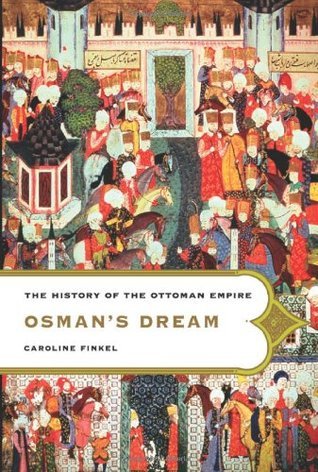
Osman's Dream: The History of the Ottoman Empire

Osman's Dream: The History of the Ottoman Empire

Rate this book
According to the Ottoman chronicles, the first sultan, Osman, had a dream in which a tree emerged fully formed from his navel "and its shade compassed the world"-symbolizing the vast empire he and his descendants were destined to forge. His vision was soon realized: At its height, the Ottoman realm extended from Hungary to the Persian Gulf, from North Africa to the Caucasus. The Ottoman Empire was one of the largest and most influential empires in world history. For centuries, Europe watched with fear as the Ottomans steadily advanced their rule across the Balkans. Yet travelers and merchants were irresistibly drawn toward Ottoman lands by their fascination with the Orient and the lure of profit. Although it survived for over six centuries, the history of the Ottoman Empire is too often colored by the memory of its bloody final throes. In this magisterial work Caroline Finkel lucidly recounts the epic story of the Ottoman Empire from its origins in the thirteenth century through its destruction on the battlefields of World War I.

704 pages, Hardcover

First published January 1, 2005

537 people are currently reading
5854 people want to read

About the author

Caroline Finkel

7 books17 followers
Caroline Finkel is a British historian and writer based in Turkey; she has a doctorate in Ottoman history from the School of Oriental and African Studies, University of London.

Ratings & Reviews

What do you think?
Rate this book

Friends & Following

Create a free account to discover what your friends think of this book!

Community Reviews

5 stars
320 (21%)
4 stars
589 (40%)
3 stars
411 (27%)
2 stars
118 (8%)
1 star
31 (2%)
Displaying 1 - 30 of 180 reviews
Profile Image for Matt.
1,052 reviews31.1k followers
November 23, 2024
“The early Ottomans, struggling to plant their authority, were less concerned with the date of the founding of their state than with the vision that underpinned their right to rule. To them, empire began quite literally with a dream. One night, the first sultan, Osman, was sleeping in the house of a holy man called Edebali when:

He saw that a moon arose from the holy man’s breast and came to sink in his own breast. A tree then sprouted from his navel and its shade compassed the world. Beneath this shade there were mountains, and streams flowed forth from the foot of each mountain. Some people drank from these running waters, others watered gardens, while yet others caused fountains to flow. When Osman awoke he told the story to the holy man, who said ‘Osman, my son, congratulations, for God has given the imperial office to you and your descendants…’


First communicated in this form in the later fifteenth century, a century and a half after Osman’s death in 1323, this dream became one of the most resilient founding myths of the empire, conjuring up a sense of temporal and divine authority and justifying the visible success of Osman and his descendants at the expense of their competitors…”

- Caroline Finkel, Osman’s Dream: The History of the Ottoman Empire

When western historians focus on the Ottoman Empire, they tend to dwell on its decline in the nineteenth century, when it was known as “the sick man of Europe,” the fate of its provinces of growing importance to the circling powers of France, Great Britain, Russia, and Austria-Hungary. At least, that is Caroline Finkel’s contention, which she makes early in Osman’s Dream. Her purpose, with this massive history, is to reframe the Ottoman story by telling it from their perspective. She does not want the Ottoman Empire to be defined entirely by its deterioration and ultimate immolation after the First World War. Rather, Finkel wants it to be remembered as one of the greatest empires the world has ever known.

To be sure, at its height, it rivaled any other imperial force that has ever existed. Founded by Osman I in the fourteenth century, it controlled vast swathes of Southeastern Europe, Northern Africa, and Western Asia, its continent-spanning existence lasting all the way until the 1920s, when its partitioning created many of the geopolitical issues being wrestled with today.

Undoubtedly, the Ottoman Empire is an entity that merits study in its entirety, and not just in its death throes. Whether or not Osman’s Dream is the best vehicle for that study depends on your patience.

***

Osman’s Dream is what I call a this-then-that kind of book. It is strictly chronological, taking events as they happen in time. This is a tried-and-true method of storytelling. Nevertheless, it has some negative consequences.

First, there is little analysis regarding elements of the Ottoman story that might be unfamiliar to readers. Finkel could have separated these elements into thematic chapters, giving them the depth of discussion they deserve. Instead, she explains at the outset that she wanted to integrate all these separate moving pieces into a whole. While her logic is sound, the reality is that aspects of the empire deserving of independent investigation get lost in the stew of more quotidian matters. Moreover, certain fundamental questions are never answered or are swallowed in the sea of unnecessary minutiae.

Second, Finkel’s approach means that it is hard to figure out what is truly important or transformational. She just throws everything at the page. Finkel’s style is to introduce an unfamiliar name; that unfamiliar name goes to an unfamiliar place; and then something happens, whereby the process begins again. Streamlining or highlighting would have done wonders.

***

Thankfully, there is a list of sultans and a timeline at the end of the book, and I found myself turning there repeatedly, to keep from getting entirely lost. Doing so, I realized that there was no difference in tenor between Finkel’s narrative and the bullet-pointed nature of the timeline. They are both written with the same distinct lack of flair, or anything even approaching flair.

***

There are many things an author-historian can do to enliven a book. For instance, they can create set-pieces, scenes in which an incident is described in novelistic fashion, putting you in the moment that history is made. Another tactic is to find the lively personalities, the fascinating characters in the drama, and follow them through their arcs. Finkel does neither of these things. Obviously, in the early days of the Ottoman Empire, there is simply not enough documentary evidence to provide vivid details. But even well-known events – such as the Ottoman siege of Constantinople 1453 – are related tonelessly.

This is a personal preference, but I learn best when I’m engaged. I am engaged when I am entertained. Honestly, I don’t think this is asking a lot, since the Ottoman Empire – packed with hundreds of years of wars, rebellions, and political intrigues – is inherently captivating as a subject. Finkel, though, delivers her information like a textbook, listing dates and events as though it’s all going to be on a test.

Except that there is no test, other than the test of my endurance in getting to the last page.

***

At 554-pages of text, Osman’s Dream is pretty hefty. The amount of research that went into it is extraordinary, and I give Finkel tons of credit for being able to amass this information and present it coherently, if a bit pedantically.

Even given its size, Osman’s Dream cannot cover everything. Thus, Finkel focuses mainly on the political side of things. She occasionally tries to branch out, especially with regard to architecture and the changing role of Islam, but as a whole, non-political happenings get short shrift. This is why I think that interspersing a few thematic chapters would have been so helpful. It would have allowed Finkel to emphasize cultural and societal aspects of the Ottoman Empire – which are lacking – instead of endlessly repeating accounts of janissary revolts.

***

Finkel wants to carve for the Ottoman Empire its proper place in memory. Yet she does not – for the most part – attempt to act as an apologist. Empires, by their very nature, are coercive, subjecting people to an alien authority, often brutally. It was true for the Romans, the British, and for the Ottomans as well.

The one big misstep – in my opinion – is Finkel’s handling of the Armenian Genocide, which skirts dangerously close to outright denial. Devoting roughly three pages to the massacres, Finkel discards the objectively neutral tone she previously employed, and delivers a contradictory, dissembling, and borderline insulting argument that put me in mind of a legal brief written by a lawyer who knows her client is guilty. She engages in moral relativism (“terrible massacres took place on both sides”), mentions the lack of a “smoking gun” (a favorite argument for those who think that Adolf Hitler was just a misunderstood dude), and bemoans the fact that Armenians have coopted the story of their own destruction (writing that the fact that the violence “is told predominantly from one side – the Armenian – certainly demands redress”).

Finkel is an extremely well-respected historian, and I make no accusations about her underlying intent. But imagine her writing about the Holocaust in this way. Imagine her stating that the Germans had no responsibility for the annihilation of millions of people, because there isn’t an extant “smoking gun” order, or that Holocaust studies are incomplete (“demands redress”) because the oppressors haven’t been allowed to express their viewpoint. It boggles the mind. Unspoken is the unsupported notion that the Armenians, along with missionaries, diplomats, and numerous other observers, all conspired to slander the Ottomans, who have been unable to defend themselves.

***

The Armenian Genocide section is a sour note in Osman’s Dream, but not enough to simply toss the book aside. The bigger problem, as noted above, is that Finkel tries to cover too much, with predictably unsatisfactory results.

The Ottoman Empire deserves a chronicler with Finkel’s expertise and devotion. It deserves to be viewed holistically, the highs and the lows, the good and the bad. It also deserves a chronicler that is able to turn that expertise and devotion into something far more vivid and passionate than what is found within these pages.
Profile Image for Caitlin.
306 reviews21 followers
February 17, 2015
Finkel gives a monumental account of the rise and fall of the Ottoman Empire. I will never again feel that they were an obscure or exotic group. Before I read this book the Ottomans seemed so mysterious and distant. I had the pleasure of visiting Bulgaria in December 2014 and I was struck by the notion that for 500 years the Ottomans ruled Bulgaria and the Balkan peninsula. There are still Muslims in the Balkans and their influence is felt in the architecture, art, food and other cultural and political realms. The Ottoman influence inevitably has left lasting influences because it ruled for so long and was so involved in the region (as opposed to the Arabs who had more autonomy in their regions while still being under the umbrella of the Empire, as Finkel describes).

Unfortunately, just like with English history, the majority of the Ottoman Sultans have the same names so while I read the book I understood what was happening in the moment but I do not have the retention skills to remember which Mehmed did what. Finkel jumps right in with Osman I, the founder of the Empire and his legendary dream that led him to militantly make a name and a place in history for his followers. From the start the Ottomans were making a bid for Constantinople with the hopes of recreating a Muslim and Ottoman version of Byzantium. It reached for its realms and ultimately succeeded. At its height the Ottoman Empire stretched from the doors of Iran to the doors of Vienna, going through North Africa, Asia Minor, the Caucasus range and up through South Eastern Europe. Finkel demonstrates how this huge amount of land and the many many different cultures and ethnic groups that comprise it ultimately led to the Ottoman downfall. Just like with the Romans, that many people with geographic and cultural, language and religious differences is too much to maintain. The book is exhausting because it is almost constant battle in several fronts for 700 years worth of time. Fighting the Persians was very different from fighting the Hapsburgs which was different than fighting the Russians, and so on.

Finkel discusses all of this war and the politics and religious aspects in minute detail and it is very interesting. However, I would have loved to hear more about what life under the Ottomans was like. She does touch on clothing, but in light of how some of the Sultans made sumptuary laws for non-Muslims. She mentions the harems and the Chief Black Eunuch but does not elaborate on what life was really like for the women or how the Black Eunuch came about, rather than some other slave eunuch. I felt like Finkel tickled my mind with cultural aspects of the Empire while dousing me in details of the expanding and shrinking of the Empire. Because of this parts of the book seemed to drag and feel repetitive even though it was new wars, new Sultans, etc.

Finkel loses some perspective toward the end of the narrative when she discusses the tragedy of the Armenians and the formation of the Republic of Turkey and its leader Mustafa Kemel Attaturk. It felt like she was in a love affair defending the Ottomans against modern Turkey. I think she lacked empathy in her discussion of the Armenians, that she was trying to be too distant or nuanced. She also is heavily critical against Kemel while begrudgingly admitting good things he did. I do not know much about Turkey or the "Armenian Question" as she calls it, so maybe they are accurate depictions, but I feel that when dealing with things that are still an issue today some empathy is called for.

All in all "Osman's Dream" is filled with drama and information and I am really glad I read it. I recommend it to anyone interested in the Ottomans, it is written for lay people and thankfully there is a Sultan list and a chronology in the appendices.
13 reviews8 followers
November 8, 2010
As dry as the sands of Arabia...

As long as the Silk Road...

As heavy as the walls of Constantinople...

This is....Osman's Dream.


I knew Turkey was supposed to be sleep-inducing, but I thought that was because of the triptophan, not the history (oh he's clever!). Okay, that's being unfair for comedic (?) effect. This book has every single name and date you could want in a comprehensive history of the Ottoman Empire, which is good, particularly since there aren't many modern, detailed studies like this one.

But for this book, excelling at thoroughness means failing at narrative. The question of why and how is answered very infrequently in contrast to the whos whens and wheres which are covered in extreme detail. Not that there isn't value in the whos whens and wheres, obviously those are large components of any historical study, but their worth is diminished without explaining the why and the how. A list of names, dates and places is nothing but an annal; an explanation of why those names, dates and places is important and how they influenced the other names, dates and places is a history.

To summarize, this is not a great book, but it will most likely appear in the bibliography of great books not yet written.
Profile Image for Andrew.
680 reviews247 followers
November 16, 2016
Osman's Dream: The History of the Ottoman Empire, is a blow-by-blow account of the rise and fall of one of the world's most interesting Empires. The Ottoman's started as a tribal group under the leadership of Osman, carving out a space for themselves on the Western coast of Anatolia under the shadow of the waning Roman Empire (in Constantinople). The state grew rapidly, taking territory from fellow Turkic tribes in Anatolia, Greek city states along the coast of Turkey and the Balkans, and Slavic states like Serbia and Bulgaria. These early years saw the Ottoman's shift from a regional player to a world power, and put the fear of God, literally, in most European powers. The Ottoman's also began to takes on the auspices of a religious Empire. They promoted Sunni Islam, and went on to conquer the main route to Mecca for pilgrim's from Asia and India. They invaded the powerful Mamluk Sultanate centered in Egypt, taking their territory in Syria, Palestine, Arabia and Egypt. They moved into the rest of North Africa, creating autonomous states in Algeria and Tunisia which they used as springboards for naval competition with other sea powers, including Spain, France, Venice and The Knights of St. John in Malta. The holy sites is Mecca and Medina soon fell under Ottoman control, as well as Yemen and much of Arabia. The Ottoman's competed with Portugal in India and Africa, and tried to maintain secure shipping routes and tariff controls over the spice, slave and pilgrim trades in the region. They also clashed with the Hapsburgs in Hungary, at times controlling most of the nation, made subjects of the Crimean Tartar's in modern Ukraine, and fought with Poland-Lithuania and Muscovy/Russia in the Steppes. There biggest grudge match was with the Safavid's in Iran, who espoused a Shia Islam, and competed with the Ottoman's over control of modern Iraq, Georgia, Azerbaijan, Armenia and Iran, and dashed Ottoman dreams of conquering Iran.

Even so, the Ottoman's were a multi-ethnic, multi-religious state. They treated Christian's more leniently than most Islamic states at the time (and indeed, most Christian states as well, as Europe became embroiled in Inquisitions, schisms, and violence). The Ottoman Empire became home to many of Europe's Jews, expelled from Spain, England, France, Germany and so on, they found a place to settle in the hinterlands of the Empire, and became key money lenders, bankers and treasurers for the Ottoman government. They faced internal strife from a variety of sources. First, an instituted system of fratricide on succession of a new Sultan meant that the first few months/years of a succession meant strife, civil war, and usually ended with a number of dead brothers and faction leaders. The Janissary corps, groups of soldiers taken from Christian areas as boy-levees, and raised as Ottoman's in law, military tactics and soldiery, had the Empire by the noose for a long time. Wars often ended in defeat because the Janissaries would commit desertion, go back to Istanbul, and riot, execute Ministers, and generally cause trouble. This usually ended with the execution of mob violence against the officers of the corps by wild mobs, or regime change.

Finkel's book is a fantastic look at the Ottoman Empire, from beginning to end. The chapters generally follow the reign of a Sultan (if he was great, such as Suleyman the Magnificent), or a multitude of Sultan's if they were not (the captive Sultans, either by Harem, or controlled by factions such as the Grandees). Ottoman history is a dizzying account of massive growth, sustained existence, and slow crumbling as foreign powers chipped away at the Empire using nationalism, religious fanaticism, or outright Imperialism to take territory. Finkel does a fabulous job looking at history that can be outright confusing to some western readers. Their are a half dozen Mehmet's, Murad's, a few Bayezid's, a couple of Mustafa's, and so on. There are umpteenth Pasha's of various origins, who rebel, fall in and out of favour, control provinces, lead armies and fight for greater power and control. On each succession (at least, during the beginning of the Empire), brothers fight for the right to rule, and many are strangled (the customary execution tactic) and buried in bulging family graveyards.

The Ottoman Empire is a fascinating topic. This is a state that rose to prominence by destroying the last outposts of the Roman Empire, defeated (or in some cases just barely survived) the Mongol hordes of Tamerlane, Jalyarid, and so on. It fought grudge matches in Iran, on the steppes of Russia, and in the hinterlands of Hungary. It ruled territory that was fractious, riven with religious, ethnic and political tensions, and it did so for centuries. This was a state that owned Bosnia and Serbia, Palestine and the Arab lands, Syria, the Armenian heartlands and so on, all at the same time. It was a multi-ethic, multi-religious entity that is unseen of today, and very unique in terms of European history for its longevity. The multi-ethnic Hapsburgs eclipsed the Ottomans in the Balkans, only to see that powder-keg blow up in their face, and bring down their dynasty after WWI. The British Empire barely held on to Pakistan for 50 years. Turkey itself was never balkanized, and remains a state to this day.

Finkel has done a wonderful job with this history. Although as some readers have mentioned, this book can be a bit of a slog due to names unfamiliar to Western readers, and the rapid, blow-by-blow pace it takes, it is nonetheless a rewarding experience. The Ottoman's are an Empire who, in most readers minds, will be synonymous with sickness and decline. The story of their history, however, is one of perseverance, adaptability, and for many centuries, complete and total success. Even the rump state of Turkey beat back army after army in the 1920's under Attaturk, and kept the Italians, Greeks and Brits from divvying it up into colonies. Truly, this is a fascinating, all encompassing history, and not to be missed for those looking for a comprehensive history of the Ottoman Empire.
Profile Image for Marc Lamot.
3,461 reviews1,970 followers
September 4, 2020
More than 550 densely filled pages, followed by numerous annexes: Finkel tells the story of almost 700 years of Ottoman Empire in one sitting, with great attention to detail and adjusting lots of classical Western and Turkish opinions. I have no doubt that this is a very well founded book, the result of thorough research and a lot of reading.

But ... this book is almost unreadable by the accumulation of detail: a neverending succession of sultans, great visors, internal and external wars, treaties and armistices. Finkel has made this rich history into a chronicle, rather than a work of synthesis. The details on military and political evolutions suppress almost all socio-economic and cultural aspects, and that is a pity!
Profile Image for John Farebrother.
115 reviews35 followers
April 22, 2020
A very informative book on another subject I had been meaning to read up on for years.
Divided into chapters that encompass different stages in the life of the Ottoman state from its founding in 1300 to its death in WWI (and beyond to Ataturk's 700-plus page speech read over 36 hours in 1927), the author sets out in incredible detail the lives of the key players and the military, political, economic, social, cultural and other events that simultaneously made and were made by one of the world's great powers. The book covers all the peculiarly Ottoman institutions and their history and roles, from the elite Janjičar infantry and the Derviš orders, while remaining extremely readable. As such, it is a remarkable achievement, obviously written by someone very familiar with and endeared to all things Turkish.
But in its enthusiasm it also inadvertently reveals another, unexpectedly disturbing facet of historiography. I was taken aback by this sentence at the end of the first chapter:

"Such epics fuelled the emotions of the Christian Serbian population of the region in the terrible wars of the late twentieth century: they saw an opportunity to remove from their midst the Muslim population still, even after so many centuries, seen by many as alien".

This readiness to impute to ordinary men and women living today the pseudo-historical rhetoric touted by populist politicians, to cast a whole population into a convenient historiographic mould exposes the superficial nature of historical works. Individuals live their own lives and make their own decisions on their actions. It should be recalled that numerous "historians" in the Balkans sold their services to the various nationalist programmes that destroyed the former Yugoslavia, providing a cryptic legitimacy to what was nothing more than robbery and murder. History is not a game of Risk, and when it clashes with the reality of the present it should always take a back seat; as Nelson Mandela once said, “It is not the kings and generals that make history, but the masses of the people, the workers, the peasants, the doctors, the clergy”.
Profile Image for Marijan Šiško.
Author 1 book74 followers
May 10, 2016
Opsežna i zanimljiva povijest osmanskog carstva, od začetka do pada. napisana za promjenu iz unutarnje perspektive. 2/3 knjige je povijest, ostalo su natuknice, koje se slobodno mogu preskočiti. ali kad kažem opsežna, mislim OPSEŽNA. zavrtilo mi se u glavi od paša, aga i vezira.
Profile Image for Alia Salleh.
59 reviews
April 16, 2017
It took me some time to reach the end of this rather dry narrative of Ottoman history. Then again, it is the story of 600 years in 554 pages; one difficult, perhaps ambitious feat. And the fact that I understood most of it is a cause to thank her - it is readable without prior knowledge of Ottoman history.

Starting at the very beginning, from Osman I of when the Turcomen are gaining power in the region to the fall of the empire, and thus the Caliphate, the book tells of the rise and fall of Sultans and vezirs as the empire progresses, with the peak seemingly during the rule of Suleyman the Magnificient. Yet other than the exchange of powers; the expansion and rebellion suppression efforts; and the many treaties which often follow wars, I don't really leave the book knowing much about the 6 centuries. There were a few peeks of the empire's policy and administration undertakings but they do not give a proper glimpse of how the Ottoman ruled - how the society was. The earlier sultans were also described vaguely in terms of their character, perhaps due to lack of documentation. Tax indeed got some major mentions, which confused me at times by how the concept of jizya imposed on the non-Muslim subjects was not explained properly in balance to the exemption from military conscript and zakat paid by the Muslims - jizya was not mentioned in its proper term, referred instead as poll-tax and zakat was not mentioned at all.

The author's insistence of using English terms for Ottoman jargons was also evident in the youth-levy system, easier understood by me as devşirme. Resulting in the same confusion in my part as the system faced evolving changes, with the line blurred as the term becomes interchangeable with other recruitment efforts. It can be argued as a matter of familiarity, and of calling rose by a different name.

I kinda love how my vocabulary was immensely increased with some cool words - constantly needing the dictionary by my side. And I so need to mention this.

There were of course matters which, looking from the Muslim perspective, peeves me (I restrained from being biased and thus this very short list): one would be the analysis of Mehmed II's motives in conquering Costantinople as firstly economic, then spiritual in relation to the Prophet Muhammad's tradition. That is just too shallow an analysis to digest. Jumping to the end, the next being the changes brought by Mustafa Kemal, where he introduces Swiss-based civil code which supposedly elevated women's position in society, praised by the authoras such:
"It is for this that the women of today's Turkey express their lasting gratitude to Mustafa Kemal." Taking their right for education and work and politics due to their choice of donning the headscarf is hardly elevating. Littered among those two examples were other instances where administration policies are viewed with an undertone of western cynicism, giving the impression that everything is centred around enriching the state above anything else.

Yet such perceived cynicism is fairly moderate - I have read snippets of more suspiciously distorted narratives of the time. The author provided a relatively fair presentation of the Ottoman history, despite the lack of insight into the Muslim psychology, which I find understandable. I do think the supposed self-professed Caliph title is something the subjects and vassals do want, and not merely to justify the empire's legitimacy - the Muslims at that time do want a leader (which does not rob the locals of their autonomy). All in all the Ottomans times were far from ideal and it is important to illustrate that exact fact - she did a good job in this matter.

In the end the fall seems inevitable with enemies from all sides, and a crisis of leadership at the centre of the empire: a string of well-intending yet weak Caliph, internal betrayal flamed by external interests that can hardly be sustainable with all the ever-changing policy forged to solve the complex disintegration of the empire. It is sad.


Profile Image for Eadweard.
604 reviews521 followers
August 30, 2015
I read this mostly for the first 150 years, the wars with the russians during the 18th century, and the dismembering of the empire.
Overall, it's a good book, all the different regions of the empire are given attention, I also enjoyed reading about the Ottoman-Safavid relations and later on, the arabs. Warning: it's really, really dry, even for a history book.
Profile Image for Hadrian.
438 reviews243 followers
June 29, 2021
The title of this book is simple to explain: the narrative starts from the mythical story of Sultan Osman I's (1255?-1323/4) dream about the reach and power of his empire, and concludes with Ataturk's speech in 1927.

To sum up, this is a political history of the Ottoman Empire, with a view 'from the palace' - the motives and disputes of the sultans and the elite echelons of courtly life take precedence here. While obviously a useful overview, this means there are only asides on other institutions such as the military, matters of faith, or other institutions. While I understand the reasoning for presenting the narrative in this way - separate chapters on each institution may leave false impressions on how they have or have not changed - the history of the empire is so vast that it does lead to some unevenness.

That said, the book has its strengths. The author specializes in the 17th century - a period of great institutional changes and the transformation from an expansionist state to a bureaucratic one - and that part of the history is lavished with attention. But in the later chapters of the book, even I noticed there were some groups or people that were not always covered, and I am no expert on Ottoman history at all. Only a few pages on the Young Ottomans and the Young Turks?

I cannot be too harsh in reading this - the only fault is that the history was too vast and so much has changed that a single volume cannot encompass everything.
Profile Image for Amir.
12 reviews16 followers
August 30, 2022
From its humble beginnings, being just one of many Turcoman beyliks in Anatolia, to its rise to the superpower status, to its eventual decline and downfall, this book tells a story of the Ottoman Empire. A good chunk of the book seems to be focused on court intrigues and intra elite fightings, which I personally didn't like, but it's still an excellent book.
Profile Image for Elentarri.
2,065 reviews65 followers
September 13, 2024
Rating: 2.5 stars

This is a political, chronological, history of the rise and fall of the Ottoman Empire: from the first sultan, Osman I, to the abdication of caliph Abdülmecid II and abolition of the sultanate, and the creation of the Turkish nation state. The Ottoman Empire was one of the largest and most influential empires in world history. It survived for more than 600 years, and at its height, the Ottoman realm extended to three continents: from Hungary to the Persian Gulf, from North Africa to the Caucasus. Covering approximately 800 years of history in just under 600 pages, this book is informative, but dense, and reads a lot like an encyclopedic overview of the subject. No particular event is given very much page space, though internal politicking, the Ottoman dynasty, and their relationship with various viziers, gets the lion's share of the narrative. Ottoman culture and society is given short shrift, which I thought was a pity, and would have made more interesting reading than the pages devoted to all the Janissary uprising and all the assassinations of the younger brothers of the Sultan. There was also no analysis of the events outlined in the book. The Ottomans also seem to have a fondness for recycling the same names, repetitively, making it a chore to keep track of who was doing what, where and when. The time line and list of sultans at the end of the book was particularly helpful in this regard. The narrative is plain and straightforward, uninspiring and stodgy, but I still learned things, so I can't completely condemn the book.
157 reviews18 followers
February 6, 2014
I recently started obsessing over the Byzantines and became curious about the empire that eventually defeated and replaced them. Like the Byzantines themselves, the Ottomans don't get a lot of love when it comes to popular, accessible history texts for the layman. It's a shame since they were every bit as impressive and cultured as their contemporaries, and the repercussions of their rule continue to be felt today in the Middle East. This book is a good overview for anyone who wants to fill in the gap between the fall of Constantinople and Lawrence of Arabia.

Finkel's exploration of the remarkable ethnic and religious diversity present in Ottoman territory made a deep impression as I read. While the level of toleration varied depending on the sultan and the century, non-Muslims in Ottoman territory often fared better than non-Christians in western kingdoms. When the Jews were expelled from Spain in 1492, many of them chose to live under the protection of Bayezid II, who warmly received them (and condemned Ferdinand's persecution). The empire wasn't some utopia of modern religious freedom of course--non-Muslims could not hold any political office of influence, and were subject to a special tax--but it illustrates just how complex history, and judging it, can be.

Mehmed the Conqueror. Suleyman the Magnificent. The battles at Kosovo Polje, Vienna, Lepanto, or Belgrade. The bravery, and treachery, of the Janissary corps. The massive 27 foot-long Basilica gun that hammered the Theodosian land walls of Constantinople, or the sumptuous tulip gardens of the 18th century palace grounds. These are the characters and adventures you'll find here, as rich and exciting as those of any other civilization from humanity's past.
Profile Image for Omar Taufik.
240 reviews11 followers
September 20, 2015
Reading this book was a journey I really enjoyed for 5 weeks.
With a very interesting preface the author prepares us for the long and exciting journey starting before 13th century Anatolia with the Turkmen tribe settlement then witnessing the birth of the Ottoman state and the long six century reign of the 36 Ottoman sultans ending 1922 with the abolishment of the sultanate and establishment of the Republic of Turkey in 1923.
The author even takes us further to end the journey in the year 1927 with the famous Mustafa Kemal speech " NUTUK " as a document ending the Ottoman empire history as a memory of the past.
This brilliant book is very rich in interesting details where the author discusses various related subjects from time to time which I really enjoyed with it's great insight.
I do not hesitate here to give the book a straight 5/5 rating as a high recommendation reading to interested readers in the Ottoman empire.
For beginners in the subject, I suggest they read a more brief overview book on the subject before reading this book in order to gain a general idea and avoid easily getting lost in the great amount of historical details and information.
As for myself, I will definatly need to revisit this great book and collect the numerous useful details and information included in its approximate 700 pages.
I would like to really thank the author Caroline Finkel for her passionate objective work.
Profile Image for Daniil.
4 reviews
September 14, 2012
I love Turkey, it's history fascinates me. This book is one of the best works on Ottoman empire ever written in English, so I'm going to read it to the very end. Inside there's many interesting details and illustrations.
3,537 reviews183 followers
May 12, 2025
I read this book nearly a decade ago because it had been mentioned in other histories and I thought it more than good. Clearly a traditional history but so much better than the truly awful 'The Ottomans: Khans, Caesars and Caliphs' by Marc Baer (2021). Perhaps it depends on what you have read about the Ottomans previously. I find that over the years I have read quite a few books and was not put off by Ms. Finkel's way of writing history. If you have read nothing about Ottoman history this may not be the book to start with. I would suggest 'Constantinople: City of the World's Desire, 1453-1924' by Philip Mansel as a very readable introduction to the fascinating history of the Ottoman empire or, despite certain reservations 'Lords of the Horizons: A History of the Ottoman Empire' by Jason Goodwin.

That it fails to cover so much is almost inevitable, the Ottoman empire was diffuse and complex and no one book can encompass it all. What is disgraceful is the account of the Armenian Massacres which, if a similar tone was adopted by author about the Shoah would quite rightly be called 'holocaust denial'. For a historian who can read Turkish and Ottoman and lives in Istanbul this is disgraceful. The proof, and it infuriates me to have to use that word as if there was a doubt, of the Armenia Massacres was placed beyond dispute in 1999 by 'A Shameful Act: The Armenian Genocide and the Question of Turkish Responsibility' by the Turkish author Taner Akçam.
26 reviews
July 9, 2018
A massive narrative history of the Ottoman Empire. From the legendary founder of the Osmanli dynasty, an insignificant Turk warlord from Bursa, Anatolia, to a mighty Empire that stretched from Algeria to Iraq and from Yemen to the gates of Vienna. The initial advantages of the Ottomans that made them invincible were their relative tolerance to different cultures and religions, embrace of technological advancements (the first armies in Europe that made extensive use of firearms and cannons) and a great enthusiasm, a young vigor mixed with a religious fervor. These were also the main reasons behind the Empires downfall; technological stagnation, greater oppresion of the non-muslim population and a general indifference and a hedonistic attitude at courts. The author loves the Ottoman Empire and it shows, while she doesnt like Mustafa Kemal much, who denounced the Ottoman heritage, embraced nationalism and founded the Turkish Republic.


However, the narrative style is the main problem of this book. Literally, the whole book is a gigantic story full of endless names of various pashas, grand vezirs, sultan wifes etc, that in the end you feel overwhelmed. There are no separate parts about society, art, army, bureaucracy in the different time periods of the Ottoman Empire, parallel to the historical events. One huge story , that as pages goes by becomes difficult to keep up.

I think that the book would be easier to read, if better organized. Now its a good reference book about the events that shaped the Ottoman history, but I feel that I missed a lot of stuff about how exactly the Ottoman society and state was structured.
Profile Image for Kartik.
98 reviews
July 8, 2017
Who could have imagined that an errant Central Asian tribe would go on to change the course of history?

Osman's Dream follows the course of the Ottoman Dynasty, as it grew from a local landowning tribe in Anatolia to the leaders of a state that went on to conquer what reminded of the Byzantine Empire and push into the Balkans. The dynasty ruled over a base of highly diverse subjects, from Protestant Hungarians, to Armenians, to Anatolian Turks, to Bedouins, and Sephardic Jews.

The various changes in the fortunes of both the dynasty and the empire (the two were not always in sync) and the various factors that shaped these changes are examined at length in this book, and its overall scope is rather large.

It begins with the origins of the dynasty, which ultimately lie in Central Asian migration to Anatolia and in local power struggles between competing Turkic tribes, and goes on to chronicle Ottoman expansion in Anatolia and the Balkans, the fall of Constantinople, the defeat of the Mamluks, and ends with Mustafa Kemal's establishment of the modern Turkish republic and the banishing of the dynasty.

This book wasn't too dry to read, and maintained a balanced tone (except in the final chapter). It made for an interesting read and was able to impress on me the scope and variety of the factors, events, and actions of people that made the Ottoman state what it was.
Profile Image for Isa.
129 reviews23 followers
November 10, 2022
A monumental rollercoaster of emotions. From cheerleading the janissaries at one point to cursing them a few hundred pages later and celebrating the unstoppable forces of Mehmet, Selim & Sulayman to pulling my hair out in anger towards those hapless Sultans who put the empire in mortal peril. Reading this book has been bittersweet and completing it truly feels like an accomplishment due to its size and mountains of information.

The Muslim Ummah is divided in their opinions of the Ottoman Empire, and after reading this I find myself feeling repulsed at some things that happened but proud and pleased at other things. All I can say is that, they were a long serving empire who mostly did their best for the Muslims, traversing such a hard time against insurmountable odds, I’m just happy I was never put in a leadership position like that.

The one thing that lets it down is that, whilst done in chronological order, there is a fair bit of jumping back and forth by 50 years or so which can often get confusing.
Profile Image for Ambar.
141 reviews14 followers
May 8, 2020
Caroline Finkel's Osman's Dream is exactly the kind of book I wanted on the Ottomans, seeing as it is replete with facts and who did what and when.


But the narrative runs dry fairly often, and explanations regarding why the actors behaved the way they did can be found, but relatively few and far between.

It's still a great book, very informative, but slightly tedious, especially with the constant stream of new names it keeps injecting that can be a bit hard to keep track of.

I will give Finkel full marks for her keen insight in defending the Ottomans from unfair criticisms that have always painted them as evil in the western imagination while at the same time having the wherewithal to criticize ottoman and islamic society, and its treatment of non muslims, "heretics", women and slaves.
Profile Image for Desertblues.
23 reviews
January 19, 2022
(not yet finished with the book)
I am trying to understand the part of the Ottoman empire which this day I know best. I have the impression that the Turkish people are torn between the East and the West. Their sense of history is different than the history as we know in the West. I personally heard a Turk recounting the fate of the Armenians; the genocide ( Armenians, but also the general point of view) in the early 20th century. While hearing this and standing among the ruins of the medieval Ani, the important Armenian city of those days, I saw and sensed the gap (literal while I was standing at the chasm which seperate Armenia from Turkey today). I am getting a better understanding of the events that led to this tragedy.
Profile Image for Brian Griffith.
Author 7 books335 followers
October 27, 2020
Finkel provides a detailed record of all major political events in Ottoman history. This is a highly traditional sort of history – strictly chronological and almost entirely focused on the rulers. Almost equal weight is given to every period, and only in the last 100 pages do the events start to clearly foreshadow the context of modern Turkey. Then we see the slow rise of identity politics, as competing rulers worked to divide or control the ethnic and religious groups of multi-cultural empires, leading to the still-unfolding horrors of ethnic cleansing across Eastern Europe and the Middle East.
Profile Image for Christopher.
Author 3 books131 followers
April 13, 2014
Alot of the reviews on here seem to imply this is dry or boring, but I thought this the best history of the Ottoman Empire I have ever read-yes, including Lord Kinross' epic masterpiece.

By being purely the narrative of the state itself and only engaging with secondary topics as they become relevant, it avoids that obnoxious pitfall so common to contemporary histories of entire narrative-breaking chapters devoted solely to soft social issues like 'religion' or 'home life' and other things I have always found boring when separated from the greater context.

Top of its class.
Profile Image for Ming Wei.
Author 20 books287 followers
March 19, 2019
What a great book, cannot rate this book high enough, excellent writing, centuries of history included, I quickly got submerged in this book and could not put it down, the Ottoman Empie is so interesting, and this book does the Empire proud. What be an excellent book, for any students of history at University or College, no editorial faults, no spelling faults that I could find, excellent from start to finish, this book as made me want to read further books about the Ottoman Empire, it was so good.
Profile Image for Cathal Kenneally.
448 reviews12 followers
December 14, 2017
It took longer than I expected; suffice to say, it covers a lot of detail in 550 odd pages of text for an empire that lasted longer than the Russian empire. How do you cover 6 centuries of history, even if it’s one country or empire? Still for anyone who wishes to study the Ottoman Empire this is a valuable resource. Comes with a list of ruling sultans through the ages and a significant timeline. Definitely one to keep
Profile Image for Mihai.
186 reviews18 followers
April 6, 2020
Following the classical style of writing history, this dry but powerful compendium of Ottoman History is a perfect read for those interested in the subject. Even if the time span is all to big to be arranged in just a book, the author manages to do exactly that. And for such a feat, even if the volume of information needed is huge, that same information is not only about dates and dynasties, but also about the inner workings of such an empire, his political structure, military might and diplomatic endeavors.
On the other hand, the book manages also to be a case study in the rise and fall of a great power, as its dissolution is also greatly studied. Combining those two, the reader is left tired, as a great tome usually does, but also more knowledgeable, sympathetic and informed.
Profile Image for Ali Hassan.
447 reviews27 followers
September 9, 2020
“According to the Ottoman chronicles the first sultan, Osman, had a dream in which a tree emerged fully formed from his navel ‘and its shade encompassed the world’ - symbolizing the vast empire he and his descendants were destined to forge. His vision was soon realized - at its height, the Ottoman realm extended from Hungary to the Persian Gulf, from North Africa to the Caucasus. A multitude of religions flourished within its frontiers.

P.S. I didn't like much because of too many characters and undue lingering. However, it is a detailed work on Ottoman history.
Profile Image for Imran Pasha.
83 reviews41 followers
July 21, 2021
Ahh.. It is so dry and bulky.. it felt like reading Wikipedia pages with so many names and dates!! My brain hurts.. Clearly not worth my time
Profile Image for Jerome Otte.
1,915 reviews
September 1, 2016
In this epic history of the Ottoman empire, Finkel chronicles how the dynamic Ottomans emerged from a group of nomads on the Central Asian steppe to an international empire that eventually met its demise.

Finkel’s narrative is accessible and well-written, even though it jumps around a lot, and she clearly shows how the Ottomans developed a rich culture, a powerful empire, and an atmosphere of relative religious toleration. Finkel eschews the traditional “rise and fall” approach and does a good job stripping away many of the myths and stereotypes of the empire in her nuanced narrative. For example, although the empire’s founders were dubbed ġāzī (“Warrior of the Faith” or “Warrior Against Infidels”), this did not actually have a confrontational, anti-Christian connotation, nor was it a term unique to the Ottomans. Although some in the West still fancy the notion of the Ottomans as keen on spreading jihad, the empire was more what Finkel calls a “predatory confederacy” of both Muslim and Christian warriors whose aim was, more often than not, plunder and booty. And from its beginning, the Ottoman empire often entered into alliances with Christian powers when it suited their purpose.

Most of the book deals with such matters as high politics and international relations. Social and economic issues are given much more general and briefer treatment, but this was not a major issue for me. The book’s approach is straightforward with little real analysis: it deals more with “who, what, when” than “why” or “how.” Issues like culture, art, religion, and ethnicity are given brief treatment. Finkel does not really explain why or how the Ottomans were so successful when it came to empire building. Nor does she devote much attention to the periphery of the empire like North Africa, the Arabian Peninsula, or the Levant. Most of the characters introduced were two-dimensional, wit little real context or motivation explained. Even the treatment of the wars have all the excitement of a telephone directory.

Still, Finkel shows the empire in all of its gory and folly. She gives us a broad picture of the empire’s history, with a good deal of detail on political matters and a readable, if dry, narrative.
Profile Image for Avery.
Author 6 books104 followers
May 7, 2018
The Ottoman Empire was a chiefly agrarian state that for the majority of its lifespan was grounded in a respect for tradition and suspicion of innovation shared between its peasantry and elites. For over 150 years after Gutenberg the printing press was illegal in Ottoman realms in order to preserve the traditional craft and art of calligraphic books. (The law was overlooked to allow Christians to print books but they had a hard time of it too.) Their polity resembled the Roman empire and they had similar political instability and popular uprisings. Like the Russians, the Ottomans were surprised by Western Europe's development of usury, colonialism, and racism in the eighteenth century, and its increasing tendency to break treaties when convenient. In the nineteenth century some sultans tried to adopt European style order, specifically in the army and Navy, but all of this was rolled back by Sultan Abdülhamid's preference for returning to Islam as a source of national unity. Even as the Young Turks tried to push the sultan out of power in 1908, ordinary peasants were rioting on the street calling for bans on photography and movie theaters.

The author includes discussions of the Ottoman approach to minority populations throughout. Rather than uniting all ethnic groups within their nationalism the Ottomans saw the maintenance of non-Muslim populations as key to the upkeep of their empire. Non-Muslims could be taxed, forcibly moved across the empire, expelled, or targeted for conversion depending on what the political situation called for. Even Muslim minorities were seen as possible targets by the Turk majority. This had long-standing implications still visible in Turkey today.

This is a fairly difficult and encyclopedic overview of Ottoman history. It focuses on military history and palace intrigue. Don't expect the author to hold your hand through the many ornate twists and turns. It's generally a good book, but I noticed that the references to Arabic manuscripts and other difficult Ottoman primary sources generally lack contextual value and are offered simply because it's cool to have a primary source witness. If you see something that seems extraneous to the narrative check the footnote and you'll almost certainly see a Turkish manuscript there.
Displaying 1 - 30 of 180 reviews

Can't find what you're looking for?

Get help and learn more about the design.