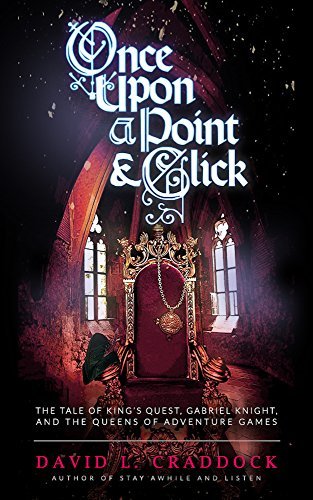
I wrote this book, so I won't cheat by leaving a star-rating or critique. Instead, I'll talk a bit about the process of writing it. (I'm also counting it toward books read in 2017 since I revised and read it several times earlier this year to get it ready for publication by Schiffer Publishing later this summer.) What follows is the introduction to the book, wherein I share my motivation for, and the process of writing ONCE UPON A POINT AND CLICK (OUAPAC).
In 2010, I was commissioned by Good Old Games (now known by its orphan acronym GOG) to write retrospectives for King's Quest 4-6. GOG had just struck a deal to add Activision titles to its service, and rather than offer the first three KQ titles, GOG would roll out the back half of the series. Perhaps because the multimedia trappings of 4-6, which included animated cutscenes and point-and-click interfaces, had aged better than the text parser-driven early entries, although that's just supposition on my part.
While I wanted the job, I had no interest in writing the history of King's Quest by starting in the middle. One can't appreciate the sweeping changes and innovations introduced in KQ4-6, three of the most inventive and important games in the adventure genre, without first appreciating the foundation they built on. I asked my contact at GOG, Tom Ohle, if I could start at the beginning. Earlier than the beginning, actually, since KQ designer Roberta Williams cut her teeth on other games before founding the kingdom of Daventry. Tom gave me the green light, so I commenced writing "From Monochrome to Monarchy," a multi-part series that was well-received by GOG readers. I wrote the articles based on old interviews and articles dug up during research, as Ken and Roberta Williams could not be reached for comment. (A site-wide redesign by GOG broke links to those articles. You might be able to hop in the Internet Wayback Machine and find them somewhere, but a standard Google search isn't likely to bear fruit.)
"From Monochrome to Monarchy" holds a special place in my heart. I wrote it when I was still learning the ins and outs of writing retrospectives about game development and culture. A few years ago, with GOG's blessing, I dusted off the articles and decided to revise them, adding more historical tidbits and details to further illustrate Roberta Williams' efforts. She was a pioneer on several fronts. A confident and intelligent woman in a male-dominated field, Williams raised the bar for interactive storytelling, and not just as the creator of King's Quest. She also directed Phantasmagoria, a breakthrough in FMV (full-motion video) design. GOG had me write an article about "Phantaz" as well, titled "Smoke and Mirrors." I've included it here to add further context to Williams' career and influence.
Although King's Quest VI was my first Sierra adventure, Gabriel Knight 2—aka The Beast Within: A Gabriel Knight Mystery—is my favorite. Jane Jensen, the trilogy's director, got her start as a co-designer on KQ6 alongside Roberta Williams. I'd wanted to pick Jensen's brain about Gabriel for years, so I tracked her down and interviewed her—as well as some of the cast and crew for GK2—for three brand-new articles.
The end result is a book that is in no way intended to be a comprehensive account of Sierra On-Line's history. For that, I would need more time, more interviews, and a much higher page count. Think of Once Upon a Point and Click as a collection of essays, threaded together to explore a set of games made by two women whose contributions to interactive storytelling are still being felt today.