Jump to ratings and reviews
Rate this book

The Martian Obelisk

Rate this book
A story about an architect on Earth commissioned to create (via long distance) a masterwork with materials from the last abandoned Martian colony, a monument that will last thousands of years longer than Earth, which is dying.

24 pages, ebook

First published July 19, 2017

33 people are currently reading
456 people want to read

About the author

Linda Nagata

109 books662 followers
I'm a writer from Hawaii best known for my high-tech science fiction, including the near-future thriller, The Last Good Man , and the far-future adventure series, INVERTED FRONTIER.

Though I don't review books on Goodreads, I do talk about some of my favorite books on my blog and those posts are echoed here. So I invite you to follow me for news of books and many other things. You can also visit my website to learn more about my work, and to sign up for my newsletter.

Ratings & Reviews

What do you think?
Rate this book

Friends & Following

Create a free account to discover what your friends think of this book!

Community Reviews

5 stars
121 (17%)
4 stars
338 (47%)
3 stars
205 (28%)
2 stars
41 (5%)
1 star
5 (<1%)
Displaying 1 - 30 of 133 reviews
Profile Image for Tadiana ✩Night Owl☽.
1,880 reviews23.3k followers
April 16, 2018
This is a 2017 Hugo nominated SF short story, free to read online here at Tor.com. Review first posted on Fantasy Literature:

In another tale that explores human choices in the face of apocalyptic events, Susannah Li-Langford is an eighty year old architect who has spent the last seventeen years working on a master project. While civilization on Earth is in the final stages of collapse due to a combination of global warming, drug-resistant bacteria and other disasters, Susannah ― with the help and funding of an interested tycoon, Nate Sanchez ― is using remote technology to build a huge obelisk on Mars as a monument to humanity.

Using construction equipment and AIs from some failed and abandoned Martian colonies that Nate has purchased, Susannah is very slowly, tile by tile, building an immense, gleaming white obelisk that will reach into the upper atmosphere of Mars. Until, one day, the AI informs her that a vehicle from one of the failed colonies is approaching her obelisk.

“The Martian Obelisk” has an unusual premise with interesting scientific underpinnings, but it’s the human element explored by Linda Nagata that really makes this story successful. In a setting that displays the worst failings of humans, it also shows what is good and noble in us. There are a few welcome notes of hope, perhaps muted, but enough to remind us not to give up, even when life seems darkest.
Profile Image for karen.
4,012 reviews172k followers
June 5, 2020
It was not supposed to happen like this. As a child she’d been promised a swift conclusion: duck and cover and nuclear annihilation. And if not annihilation, at least the nihilistic romance of a gun-toting, leather-clad, fight-to-the-death anarchy.

That hadn’t happened either.

Things had just gotten worse, and worse still, and people gave up. Not everyone, not all at once—there was no single event marking the beginning of the end—but there was a sense of inevitability about the direction history had taken.


i chose this story for my weekly free tor short read more or less at random. it's not one that i ordinarily would've read, nor has it ever caught my attention in my many years of devotion to the free tor short - the "cover" is pretty dull, and i generally scroll past anything that sounds outer-space-y because it's not my thing, but this one is more human-powered than aaaalien, and i enjoyed it very much.

it was supposed to be some kinda tear-jerker, but it takes more than that to jerk my tears.

the story is basically about whether moral responsibility still has a place at the end of the world, when a woman must choose between her art and personal legacy (inflated to the legacy of Earth) and a handful of human lives. ordinarily, not a difficult choice, but in an uncertain world, it's more of a choice between hope and reasonable expectation, where "reasonable expectation" is a downer. if none of that makes much sense, it's because i am doing that thing where i wave my hands about to distract you while i try to avoid spoilers. it's a shortish story, so you can go read it yourself and then we can wave our hands around together.

in other "this won't look like anything to you unless you've read the story," i'm with the exhausted, resigned nate on this matter:

He shook his head. “This all looks like hope, but it’s a trick. It’s fate cheating us, forcing us to fold our hand, level our pride, and go out meekly. And there’s no choice in it, because it’s the right thing to do.”


you do the right thing because it's what you do, but there sure ain't no glory in it. which is kind of how i feel right now - i work really hard and grind myself into dust for no money and then i starve to death in the gutter and no one cares. whee!


read it for yourself here:

https://www.tor.com/2017/07/19/the-ma...

come to my blog!
Profile Image for Francisca.
244 reviews117 followers
December 17, 2023
This is a short story that takes place near the end of the world.

In this future, Earth is slowly dying. Yet our home planet is not about to disappear in a bang of cataclysmic propositions but in a whimper of long planetary neglect, resulting in natural disasters devastating nature and decimating the population, killing humanity’s drive to move forward even before the planet's total doom.

And that's where we (humans) are, still alive but just waiting for the seemingly unavoidable end as Susannah Li-Langford, once a renowned architect, has found solace after the death of everyone she once loved in a project to build an obelisk on the surface of Mars: a monument that will survive humanity, a testament to a species that manage to extinct itself.

All that remains on Mars after a few unsuccessful colonization attempts are automated construction machines, with those and the financing of wealthy Nathaniel Sanchez, Susannah is remotely creating an obelisk-type spire. But one day the remotely-operated machines warn her that there is something unusual happening. A vehicle is approaching the Obelisk's site. . .

I must confess, halfway through I was still unsure what this story was about. But then, the proverbial sh*t hit the fan and it all became clear. Oh, how clear it becomes!

The story is emotional and well paced, and even if the writing is nothing particularly special, it's very much worth the read.
Profile Image for Gary.
442 reviews238 followers
January 11, 2018
Included in my roundup of favorite summer 2017 shorts: https://1000yearplan.com/2018/01/11/l...

The Martian Obelisk is probably my favorite short story of the year from one of SF’s most essential writers. Nagata’s typically pessimistic vision of the future finds human civilization on Earth dying, and attempts to colonize Mars having recently met with insurmountable disaster. Susannah is an artist living on Earth, remotely operating Martian construction equipment to build the titular structure as a final monument to humankind’s existence, even though no one will be around to admire it. But evidence surfaces that a single colonist family may have survived and, though still doomed, would need the resources Susannah is utilizing to survive just a little longer. A stunning philosophical conundrum, thoroughly and heart-wrenchingly examined.
Profile Image for Stephen.
473 reviews67 followers
November 12, 2021
This is my first read of Ngata. If this is typical of her craft, I’ll be reading her a lot more.

The Martian Obelisk has all the elements I love in a story. Grand scale, told concisely, an epic quest, failure, redemption, a bit of philosophy, and mystery. Ngata presents all of this is a scant 30 pages.

Obelisk is set a few decades in the future when the Earth is dying, the result of climate change, conflict, poverty, disease, and a host of other maladies persisting from our time. Ngata expertly conveys the feel of this world on the opening page.
The end of the world required time to accomplish—and time, Susannah reflected, worked at the task with all the leisurely skill of a master torturer, one who could deliver death either quickly or slowly, but always with excruciating pain….

It was not supposed to happen like this. As a child she’d been promised a swift conclusion: duck and cover and nuclear annihilation. And if not annihilation, at least the nihilistic romance of a gun-toting, leather-clad, fight-to-the-death anarchy. That hadn’t happened either.

Things had just gotten worse, and worse still, and people gave up. Not everyone, not all at once—there was no single event marking the beginning of the end—but there was a sense of inevitability about the direction history had taken.
Given this opening one might expect a dour read. Obelisk is not dour. It is ultimately proud, heroic and humane.

Susannah is 80, and a famous architect. Her friend and benefactor, Nathaniel, asks her how she would like to end her career. Susannah envisions a Martian Obelisk, a memorial to Earth to outlive man and our dying planet:
a gleaming, glittering white spire, taking its color from the brilliant white of the fiber tiles she would use to construct it. It would rise from an empty swell of land, growing more slender as it reached into the sparse atmosphere, until it met an engineering limit prescribed by the strength of the fiber tiles, the gravity of the Red Planet, and by the fierce ghost-fingers of Mars’ storm winds. Calculations of the erosional force of the Martian wind led her to conclude that the obelisk would still be standing a hundred thousand years hence and likely far longer. It would outlast all buildings on Earth. It would outlast her bloodline, and all bloodlines. It would still be standing long after the last human had gone the way of the passenger pigeon, the right whale, the dire wolf. In time, the restless Earth would swallow up all evidence of human existence, but the Martian Obelisk would remain—a last monument marking the existence of humankind, excepting only a handful of tiny, robotic spacecraft faring, lost and unrecoverable, in the void between stars.
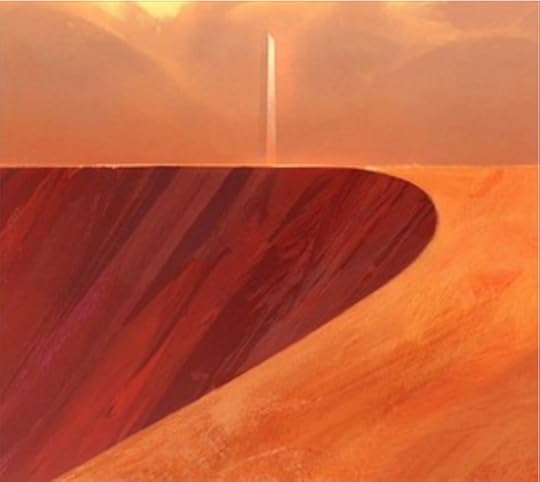
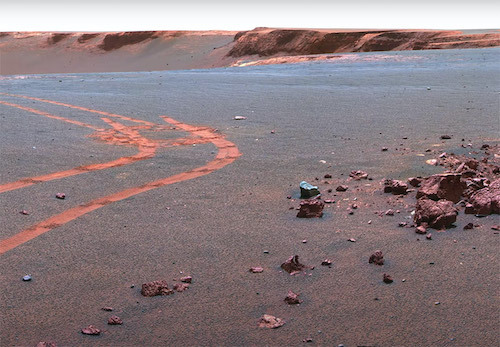

With Nathaniel’s support, Susannah builds her obelisk using equipment stranded on Mars from failed attempts to colonize the planet. It rises to 150 m on a stark hill on the planet’s surface. Unforeseen events then derail the project.

It takes nineteen minutes for communications to reach Mars, and nineteen minutes to return. Ngata uses this fact to build exquisite tension in the middle pages, the camera on Susannah’s equipment only updating her view of the planet every thirty-eight minutes. Imagine watching a drama in thirty-eight minute intervals. A lot can happen and does in the spaces between.


The ending could have used another edit. Susannah’s response reads true to her character. Nathaniel’s not so much.

The following line from the last page perfectly punctuates the story. It also I think captures mankind’s journey to date:
We assume we can see forward to tomorrow, but we can’t. We can’t ever really know what’s to come—and we can’t know what we might do, until we try.
We are a race of try-ers. The results are sometimes good, other times ill. But only in trying do we learn, grow, and advance.

On my buy, borrow, skip scale, The Martian Obelisk is well worth the $2 asking price on Amazon. In a similar vein, I also recommend Equilateral by Ken Kalfus and Tell Them of Battles, Kings, and Elephants by Mathias Énard. Both are like Obelisk about try-ers and their grand designs derailed by forces beyond their control.
Profile Image for Dennis.
663 reviews328 followers
October 4, 2019
Earth is dying. The colonization of Mars has failed. Mankind is coming to an end.
Two 80+ year olds have been spending the better part of the last two decades building (remotely from Earth) an obelisk on Mars. A last monument marking the existence of mankind. And also a purpose for them to keep going when everything else has been falling to pieces.
Then suddenly there’s an anomaly sighted on Mars. And everything changes.

This is a well written and atmospheric short story, that for long stretches had a mysterious feel to it. It promised big things in the beginning, but missed some punch in the end. Its message delivered a little to simplistic for my liking.
Still, reading this was half an hour well spent. A good read.

3.5 stars

2018 Hugo finalist for Best Short Story

You can read it here.

____________________________
2018 Hugo Awards Finalists

Best Novel
The Collapsing Empire by John Scalzi (Tor)
New York 2140 by Kim Stanley Robinson (Orbit)
Provenance by Ann Leckie (Orbit)
Raven Stratagem by Yoon Ha Lee (Solaris)
Six Wakes by Mur Lafferty (Orbit)
The Stone Sky by N.K. Jemisin (Orbit)

Best Novella
All Systems Red by Martha Wells (Tor.com Publishing)
And Then There Were (N-One) by Sarah Pinsker (Uncanny, March/April 2017)
Binti: Home by Nnedi Okorafor (Tor.com Publishing)
The Black Tides of Heaven by JY Yang (Tor.com Publishing)
Down Among the Sticks and Bones by Seanan McGuire (Tor.com Publishing)
River of Teeth by Sarah Gailey (Tor.com Publishing)

Best Novelette
Children of Thorns, Children of Water by Aliette de Bodard (Uncanny, July-August 2017)
Extracurricular Activities by Yoon Ha Lee (Tor.com, February 15, 2017)
The Secret Life of Bots by Suzanne Palmer (Clarkesworld, September 2017)
A Series of Steaks by Vina Jie-Min Prasad (Clarkesworld, January 2017)
Small Changes Over Long Periods of Time by K.M. Szpara (Uncanny, May/June 2017)
Wind Will Rove by Sarah Pinsker (Asimov’s, September/October 2017)

Best Short Story
Carnival Nine by Caroline M. Yoachim (Beneath Ceaseless Skies, May 2017)
Clearly Lettered in a Mostly Steady Hand by Fran Wilde (Uncanny, September 2017)
Fandom for Robots by Vina Jie-Min Prasad (Uncanny, September/October 2017)
The Martian Obelisk by Linda Nagata (Tor.com, July 19, 2017)
Sun, Moon, Dust by Ursula Vernon, (Uncanny, May/June 2017) by Ursula Vernon, (Uncanny, May/June 2017)
Welcome to your Authentic Indian Experience™ by Rebecca Roanhorse (Apex, August 2017)

Best Related Work
Crash Override: How Gamergate (Nearly) Destroyed My Life, and How We Can Win the Fight Against Online Hate by Zoe Quinn (PublicAffairs)
Iain M. Banks (Modern Masters of Science Fiction) by Paul Kincaid (University of Illinois Press)
A Lit Fuse: The Provocative Life of Harlan Ellison by Nat Segaloff (NESFA Press)
Luminescent Threads: Connections to Octavia E. Butler edited by Alexandra Pierce and Mimi Mondal (Twelfth Planet Press)
No Time to Spare: Thinking About What Matters by Ursula K. Le Guin (Houghton Mifflin Harcourt)
Sleeping with Monsters: Readings and Reactions in Science Fiction and Fantasy by Liz Bourke (Aqueduct Press)

Best Graphic Story
Black Bolt, Volume 1: Hard Time written by Saladin Ahmed, illustrated by Christian Ward, lettered by Clayton Cowles (Marvel)
Bitch Planet, Volume 2: President Bitch written by Kelly Sue DeConnick, illustrated by Valentine De Landro and Taki Soma, colored by Kelly Fitzpatrick, lettered by Clayton Cowles (Image Comics)
Monstress, Volume 2: The Blood written by Marjorie M. Liu, illustrated by Sana Takeda (Image Comics)
My Favorite Thing is Monsters written and illustrated by Emil Ferris (Fantagraphics)
Paper Girls, Volume 3 written by Brian K. Vaughan, illustrated by Cliff Chiang, colored by Matthew Wilson, lettered by Jared Fletcher (Image Comics)
Saga, Volume 7 written by Brian K. Vaughan, illustrated by Fiona Staples (Image Comics)

Best Series
• The Books of the Raksura, by Martha Wells (Night Shade)
• The Divine Cities, by Robert Jackson Bennett (Broadway)
• InCryptid, by Seanan McGuire (DAW)
• The Memoirs of Lady Trent, by Marie Brennan (Tor US / Titan UK)
• The Stormlight Archive, by Brandon Sanderson (Tor US / Gollancz UK)
World of the Five Gods, by Lois McMaster Bujold (Harper Voyager / Spectrum Literary Agency)
Profile Image for Claudia.
1,013 reviews786 followers
August 25, 2018
On a dying Earth, an architect builds a monument remotely on Mars to honor the Earth civilization, now dying. But an unexpected event on Mars is forcing her to take a decision: what is more important, the short life of a family or the perennial symbol of the monument?

I failed to grasp the emotion of the choice, therefore it was just an ok read for me.

Can be found here: https://www.tor.com/2017/07/19/the-ma...
Profile Image for Mangrii.
1,145 reviews488 followers
November 29, 2018
3,75 / 5

Ganadora del premio Locus y finalista del premio Hugo a mejor historia corta en 2018, Linda Nagata compone una pequeña historia sobre la capacidad del ser humano para seguir adelante, aunque todo este perdido, a la vez que habla del arte como elemento de grandeza y legado. Conoceremos a Susannah Li-Langford, una arquitecta de 80 años que debe decidir entre perpetuar la huella del hombre en Marte o salvar temporalmente a los supervivientes de la última colonia marciana que ha sido asolada por una enfermedad mortal.

Linda construye una sólida historia sobre la esperanza, recordándonos que nunca debemos bajar los brazos ante lo más terrible de la vida. El obelisco marciano es un cuento corto que promete mucho al principio, pero cuyo dilema moral no me resulta tan poderoso como podría ser, dado que no da tiempo a empatizar del todo con sus protagonistas. Sin embargo, esta muy bien elaborado y ambientado, tiene un ritmo de misterio constante, y su mensaje, aunque simple, te llega directo a la yugular.
Profile Image for Paul  Perry.
415 reviews206 followers
July 9, 2018
This excellent short story is a meditation on art and the deep future viewed from the perspective of a finite existence, of what we can hope to leave to a future that may not exist, yet with a glint of hope and humanity.


It is a wonderfully constructed short story, cramming depth and meaning into so few words. I can't quite give it a higher score, however, as the prose itself is no more than OK, and the dialogue between the two characters rather on the stagey side.
Profile Image for Lata.
4,993 reviews255 followers
June 24, 2018
On a dying earth, architect Susannah Li-Langford designed and is remotely constructing a monument on Mars, using AIs. A towering white spire that will stand for many years after earth dies. Everything is going well till a vehicle from a failed Mars colony approaches the construction site.
There's tension in this story as Susannah tries to figure out what is going on and what she will do about it.
Profile Image for Jen.
3,493 reviews27 followers
August 4, 2017
Very gently flowing, but it kind of had no purpose? Let me attempt to explain. Humanity was doomed, but was slowly dying. The end of the story yields up some hope, but the story tells you it's pretty much false hope, so what's the point of the story? And does a family of three REALLY need EVERY tile used for the obelisk? Can't they just use some and yet still make a shorter obelisk? 3, I liked it, but wasn't that impressed, stars.
Profile Image for Francisco M. Juárez.
330 reviews55 followers
November 12, 2020
3.5 Estrellas

Una hermosa (Aunque por momentos muy frustrante) historia sobre la trascendencia y la empatía.

Sobre unos seres humanos luminosos, de esos que escasean.

Al menos al final, la protagonista hace una declaración de intenciones que era justo idéntica a mis sentimientos desde que se reveló lo que pasaría.

Profile Image for Cathy .
1,942 reviews298 followers
June 16, 2018
A very possible scenario for the end of our world. About loss and acceptance and the need to leave something behind, that proclaims „We were here“. And about hope and never giving up. About doing the right thing.

I liked it and I am tempted to check out her other work.

https://www.tor.com/2017/07/19/the-ma...

Hugo Awards 2018 Short Story Nominee
Profile Image for حسین.
Author 66 books270 followers
July 21, 2017
The beginning of the story had some hackneyed sentences and imageries, like "There were reactor meltdowns, poisoned water supplies, engineered plagues, and a hundred other, smaller horrors." Other than that, the subject was special and could be used to write a novel or novella.
Profile Image for Jon.
838 reviews250 followers
May 27, 2018
2018 Hugo Finalist for Best Short Story

“The Martian Obelisk,” by Linda Nagata (Tor.com, July 19, 2017)
https://www.tor.com/2017/07/19/the-ma...

“There’s a lesson for us in that. We assume we can see forward to tomorrow, but we can’t. We can’t ever really know what’s to come—and we can’t know what we might do, until we try.”

"And then there was Tory Eastman of Mars, who had left a dying colony and driven an impossible distance past doubt and despair, because she knew you have to do everything you can, until you can’t do anymore."


Loved this! 4.5 stars if not 5 ... I have to sleep on it. Excellent short story!
Profile Image for Carolina Mares..
235 reviews17 followers
December 8, 2022
Menudo truco el de la esperanza.

«[...] había conducido una distancia imposible, más allá de la duda y la desesperación, porque sabía que se tenía que hacer todo lo posible hasta que ya no se pudiera hacer nada »
Profile Image for heptagrammaton.
446 reviews53 followers
November 17, 2024
The Martian Obelisk rises, a lone spire to remember humanity's doomed attempts at space colonization, defunct. Its world is at its end, in a whimper. The apocalypse is banal, a textbook escalation of Climate Change; you know it well, but the narrator will recapitulate it anyway. Its heroes, distinctly Randian – the brilliant architect and the last good billionaire – are set on building a monument in the desert of a dead planet, an Ozymandias to sneer, uneroded, forever, over the deathlands – the aforementioned titular Obelisk. Hubris and futility intermingle in a thematically confused mess.

   On a technical level, the prose registered as downright bad to me. Over-expository, functionalistic, amateurish.

   In his Foreverismʳᵉᵃᵈ ⁱᵗ philosopher of nostalgia Grafton Tanner remarks upon tbe the way we speak about natural catastrophes, the irony-poisoned bleakness, the implicit inevitability which accepts things worsenning as a given, the complacent comfortable certaintly of doom:
To utter "not if, but when" is to announce a determined future into existence and to silence any objects. [...] rarely are any alternatives offered to thwart, or at least mitigate, the harm of when. Rather, it promises relative stasis: we must maintain through the harsh season, the endless winter. To the degree change is possible, it is negative: things will change, but the change will be for the worse.
  — (p. 66)

   Thus, the future is consumed, subsumed in and devoured by the present, and we chug forward towards an abyss, with wry ironical acknowledgment. Radical change requires being able to imagine a future. The Martian Obelisk gestures towards such: life endures, a cure to an engineered plague is found, hope nuzzles up warmly against the lid of its jar. Yet it is quick to repudiate itself:
... "This all looks like hope, but it's a trick. It's fate cheating us, forcing us to fold our hand, level our pride, and go out meekly. And there's no choice in it, because it's the right thing to do."

   (Textually, if there is hope, it's the preserve on one exceptional individual. It's unclear how, and for whom else this can be a turning point.)
   Smile wryly, bitterly, for you know the end is near. Endure the long winter.
Profile Image for Denisse.
563 reviews304 followers
January 17, 2019
4.5 It is the deepest feeling of humankind, that of never being forgotten. Everything has failed in this version of the end of the world, except morality.


Este tipo de historias me llegan al alma. Mas que un sci-fi, es un vistazo a nuestro mejor lado como seres humanos. La muestra de que hay que intentar siempre tomar la mejor decisión.

Cada vida cuenta.
Profile Image for Maggie Gordon.
1,914 reviews162 followers
August 11, 2017
The Martian Obelisk is about the human condition and the choices we make when there aren't many choices left. It's about the importance of art, but also survival. It's also a bit derivative of better stories, but an enjoyable short read nevertheless.
Profile Image for Cudeyo.
1,266 reviews66 followers
January 24, 2021
Un relato corto, muy corto, pero que en pocas páginas (apenas 25) cuenta toda una historia, dice mucho de nosotros, de nuestra sociedad, de nuestro mundo.

Y es que aunque es una historia ficticia, ambientada en una realidad ajena a la nuestra, parece que realmente vamos encaminados al mundo que vaticina la protagonista: un mundo sin esperanza, asolado por desastres naturales, por el calentamiento global, por pandemias,... Y aun así, siempre hay un resquicio de esperanza, un posible futuro.

Y es ante esta pequeña llama de esperanza que la protagonista debe decidir: acepta la esperanza, ese pequeño hálito de vida de un posible futuro o se aferra a lo conocido, al presente descorazonador.

Lo dicho: hay mucha historia, mucho trasfondo en estas veinticinco páginas.
Profile Image for Paul Amerigo.
9 reviews1 follower
November 14, 2018
Excellent short story with an ethical dilemma that's practically a Martian trolley problem. One of those short stories that will have you looking for ninja onion cutters around you before you finish it!
Profile Image for Oleksandr Zholud.
1,569 reviews155 followers
April 10, 2018
This short story is short listed for Hugo Awards. For me, this is the best SF story in the selection and 2nd overall. I hope this author gains more popularity because her works are definitely worth it.
The story is set in near future Earth with a very pessimistic outlook at the future and the protagonist is distantly builds the memorial for humanity on Mars.
Profile Image for Jeraviz.
1,020 reviews636 followers
July 12, 2018
La ganadora del Locus a mejor relato corto de este año. Es buen relato, mantiene la tensión hasta el final aunque no me llena del todo completamente.
Profile Image for Katherine.
1,392 reviews17 followers
September 28, 2019
It's really interesting to read this right after the previous novelette I read, The Art of Space Travel. This short story manages to communicate a lot more interesting family drama, and actually have it set in a much more science fiction setting than the other piece, which barely qualified as sci-fi.

This one follows an artist, working on the ultimate piece of doomsday art, an obelisk that will cry to the heavens "we were here!" as the planet around her seems to be falling apart. It's well written, and evocative of the age we're living in now, but there's also a little glimmer of hope.
Displaying 1 - 30 of 133 reviews

Can't find what you're looking for?

Get help and learn more about the design.