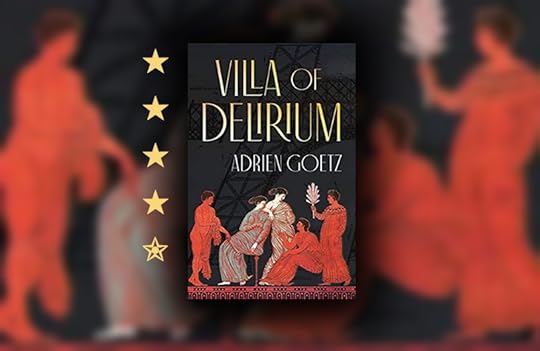
The Villa Kerylos, an architectural homage to Ancient Greece, sits perched above the Mediterranean in the French Riviera. Built over several years at the beginning of the twentieth century by a wealthy scholar and classicist, Theodore Reinach, this marvel serves as the home of a fictional character, Achilles. In the story, this local boy with the name of a Greek hero caught the attention of Reinach, not only for his name, but for the boy’s intellectual abilities, and thirst for knowledge about the ancients.
Reinach practically adopts Achilles and brings him into the Reinach household to be a companion to his nephew Aldophe. Reinach has two brothers who frequently visit, Joseph, and Salomon also known for their classical scholarship. The three brothers form a sort of society along with their neighbor, Gustave Eiffel (who built the famous tower). Achilles learns from their conversations as he plays with Adolphe. Later as an older boy Achilles, travels with the Reinachs to visit ancient sites. On a trip to an inaccessible austere monastery, Achilles steals a priceless artifact that points to the location of an even greater archeological treasure hidden in the monastery. Theodore, learning of the theft, promptly takes the find and Achilles never sees it again.
It is now 1956, the day that Grace Kelly marries the Prince of Monaco. Achilles has become a renowned Cubist painter. He has demons to exorcise. He takes this day to sneak into what remains of the Villa Karylos when he knows all attention will be on the royal nuptials. He goes from room to room in the house taking pictures supposedly for his children and reminiscing. Eventually, through his musings, the reader learns he is looking for the artifact taken from him so long ago. Another motivation drives him, he wants to visit the place once again where he fell in love with the wife of the Villa’s architect.
There are several things that stood out to me about the book. Adrien Goetz, the author, is a professor of Art History at the Sorbonne, so his knowledge and appreciation of ancient art, history, and literature form the backdrop of the story. The novel is written entirely from the perspective of Achilles, which is almost all descriptive musings, no dialogue. As the book takes place inside Achilles’s mind, the narrative skips around in time. He moves around the Villa with his memories jumping from one episode to another.
The end of the book contains a nice surprise, yet it raises all sorts of questions leaving the reader re-evaluating Achille’s story in light of this discovery. At times, the book was extremely melancholy. I found it hard to connect with the Achilles's actions, which was my main criticism. I enjoyed the book because I have always been interested in ancient Greece. It will not appeal to those looking for a faster pace or a straightforward linear story. The book is for lovers of the ancient classics and history.
I have received this ARC from the publisher in exchange for an honest review.