

What do you think?

Εγώ είμαι ο Τζόναθαν Σκρίβενερ
Όταν ο Τζέιμς Ρέξαμ προσλαμβάνεται ως γραμματέας του μυστηριώδους Τζόναθαν Σκρίβενερ, βρίσκεται αντιμέτωπος με έναν γρίφο. Καθώς μπροστά του ξεκινάει μια παρέλαση από φίλους του Σκρίβενερ, ο Ρέξαμ προσπαθεί να συνθέσει τα στοιχεία της προσωπικότητας του αόρατου εργοδότη του μέσα από ιστορίες, υπαινιγμούς και μια σειρά από ανατροπές που οδηγούν στην καθαρτήρια κλιμάκωση.
Σε αυτό το αριστουργηματικό μυθιστόρημα, που η δομή του επηρέασε τον Όρσον Γουέλς στη σύλληψη του "Πολίτη Κέιν", ο Κλοντ Χάουτον υφαίνει με αριστοτεχνικό τρόπο ένα συναρπαστικό φιλοσοφικό και ψυχολογικό παιχνίδι. Γραμμένη ανάμεσα στους δυο μεγάλους πολέμους του 20ού αιώνα, η ιστορία του Τζόναθαν Σκρίβενερ αντικατοπτρίζει την περιπέτεια της συγκρότησης της ανθρώπινης ταυτότητας μέσα σε μια κατακερματισμένη πραγματικότητα.
Σε αυτό το αριστουργηματικό μυθιστόρημα, που η δομή του επηρέασε τον Όρσον Γουέλς στη σύλληψη του "Πολίτη Κέιν", ο Κλοντ Χάουτον υφαίνει με αριστοτεχνικό τρόπο ένα συναρπαστικό φιλοσοφικό και ψυχολογικό παιχνίδι. Γραμμένη ανάμεσα στους δυο μεγάλους πολέμους του 20ού αιώνα, η ιστορία του Τζόναθαν Σκρίβενερ αντικατοπτρίζει την περιπέτεια της συγκρότησης της ανθρώπινης ταυτότητας μέσα σε μια κατακερματισμένη πραγματικότητα.
384 pages, Paperback
First published January 1, 1930
About the author
Claude Houghton
49 books17 followersClaude Houghton Oldfield was born in 1889 in Sevenoaks, Kent and was educated at Dulwich College. He trained as an accountant and worked in the Admiralty in the First World War, rejected for active service by poor eyesight. In 1920 he married a West End actress, Dulcie Benson, and they lived in a cottage in the Chiltern Hills. To a writers’ directory, Houghton gave his hobbies as reading in bed, riding, visiting Devon and abroad, and talking to people different to himself. He added: “I like dawn, and the dead of night, in great cities.” He disliked fuss, noise, crowds, rows, and being misquoted, or being told how much he owed “to some writer I’ve never read”.
Houghton’s earliest writing was poetry and drama before turning to prose fiction with his first novel, Neighbours, in 1926. In the 1930s, Houghton published several well-received novels that met with solid sales and respectable reviews, including I Am Jonathan Scrivener (1930), easily his most popular and best-known work, Chaos Is Come Again (1932), Julian Grant Loses His Way (1933), This Was Ivor Trent (1935), Strangers (1938), and Hudson Rejoins the Herd (1939). Although he published nearly a dozen more novels throughout the 1940s and 1950s, most critics feel his later works are less significant than his novels of the 1930s.
Houghton was a prolific correspondent, generous in devoting his time to answering letters and signing copies for readers who enjoyed his books. One of these was novelist Henry Miller, who never met Houghton but began an impassioned epistolary exchange with him after being profoundly moved by his works. Houghton’s other admirers included his contemporaries P. G. Wodehouse, Clemence Dane, and Hugh Walpole. Houghton died in 1961.
Houghton’s earliest writing was poetry and drama before turning to prose fiction with his first novel, Neighbours, in 1926. In the 1930s, Houghton published several well-received novels that met with solid sales and respectable reviews, including I Am Jonathan Scrivener (1930), easily his most popular and best-known work, Chaos Is Come Again (1932), Julian Grant Loses His Way (1933), This Was Ivor Trent (1935), Strangers (1938), and Hudson Rejoins the Herd (1939). Although he published nearly a dozen more novels throughout the 1940s and 1950s, most critics feel his later works are less significant than his novels of the 1930s.
Houghton was a prolific correspondent, generous in devoting his time to answering letters and signing copies for readers who enjoyed his books. One of these was novelist Henry Miller, who never met Houghton but began an impassioned epistolary exchange with him after being profoundly moved by his works. Houghton’s other admirers included his contemporaries P. G. Wodehouse, Clemence Dane, and Hugh Walpole. Houghton died in 1961.
Ratings & Reviews
Friends & Following
Create a free account to discover what your friends think of this book!
Community Reviews
Displaying 1 - 30 of 46 reviews

July 27, 2022
I Am Jonathan Scrivener is a novel of suspense and mystery… The atmosphere of the book is somewhat similar to that of the stories by Robert Louis Stevenson and Arthur Conan Doyle but with a dash of modernistic spice, however.
Jonathan Scrivener without any preliminary introduction or interview, blindly, employs a secretary and disappears embarking on an indefinite journey… Ostensibly, the secretary, living in his employer’s flat must catalogue his library…
The secretary, endeavouring to find out the real identity of his employer, is a narrator of the tale… Jonathan Scrivener’s friends start visiting the flat… They all are so different… Unfortunately they have become acquainted with Jonathan only recently so for them he is also a mystery…
The visitors consider the secretary as their confidant… They get acquainted with each other… They begin seeing one another independently… They become interrelated… The relations turn complicated… Finally everything turns into a psychological conundrum… Jonathan Scrivener’s personality is still an enigma…
However hard we try to penetrate it, the other person’s soul remains uncharted waters.
Jonathan Scrivener without any preliminary introduction or interview, blindly, employs a secretary and disappears embarking on an indefinite journey… Ostensibly, the secretary, living in his employer’s flat must catalogue his library…
One section of the books might have belonged to a scientist, another to a poet, a third to a philosopher, a fourth to a mystic, a fifth to a psychologist, a sixth to an occultist. And one section might have belonged to a mental sensualist. Yet each volume contained conclusive evidence that it had been studied by Scrivener. If the inscription on the fly-leaf of each volume gave proof of the extent to which Scrivener had travelled, the books themselves established the fact that his intellectual and imaginative journeys had been equally extensive. He had adventured far and wide in two worlds.
The secretary, endeavouring to find out the real identity of his employer, is a narrator of the tale… Jonathan Scrivener’s friends start visiting the flat… They all are so different… Unfortunately they have become acquainted with Jonathan only recently so for them he is also a mystery…
“I must go. But I must give you an impression of Jonathan first. He is tall; he has the head of a composer and the face of an emperor. He is broad, strong, powerful. His eyes are eager, but death has kissed his mouth. He is an adept in arousing your curiosity and a genius in frustrating it. To listen to him is to watch God juggling with the worlds. To be silent with him is to fear him. He is armed at all points, and so is vulnerable everywhere. He is a challenge to your skill; a menace to your pride; an invitation to your vanity.” She threw back her head and laughed long and loud.
The visitors consider the secretary as their confidant… They get acquainted with each other… They begin seeing one another independently… They become interrelated… The relations turn complicated… Finally everything turns into a psychological conundrum… Jonathan Scrivener’s personality is still an enigma…
Two men and two women had given me their intimate impressions of my employer. Each might have been describing a different man. I realized this for the first time and the great significance of this simple discovery overwhelmed me.
However hard we try to penetrate it, the other person’s soul remains uncharted waters.

May 7, 2017
“Raise what battle-cry you will, every echo has only one answer – and the answer of each echo is Change. For the old order has failed and the new order is in the agony of birth…”
British writer Claude Houghton (1889 – 1961) once uttered the pessimistic statement that all his fiction was based on the belief that modern civilization would collapse "because it no longer believes it has a destiny".
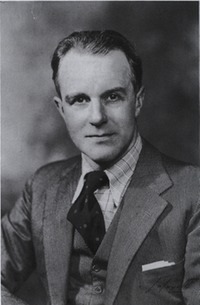
Claude Houghton, circa 1948
By ‘modern civilization’ it is more than reasonable to assume he was referring to his native land of Great Britain, formerly a rather robust empire (these tend to have notions of destiny - however misguided - very much on their minds ) of which he witnessed the piecemeal, inexorable decline. Wracked both economically and psychologically by two world wars, the British Empire ultimately had to cede its former economic and military dominance on the world stage to an upstart in the empire business, a wayward offspring known as the United States of America. The old once more had to give way to the new, as is the nature of things.
The fallout of societal disillusionment, unease and a questioning of tradition which followed World War I permeates the existentialist ‘I Am Jonathan Scrivener’ (1930), generally thought of as Houghton’s masterpiece. Yet the man, despite having enjoyed not an inconsiderable amount of notoriety in his day, now seems to be a largely forgotten voice.
And more’s the pity, for this is a rather stunning, ingeniously constructed and at times utterly mystifying psychological novel, both eerily prescient at time of publication and relevant almost 90 years later. Consider the following passage for its piercing criticism of the complacency and delusion of the English elite at the time as well as for its astonishing foresight:
This just might make some recall– even if only faintly - a rather dramatic political shift to nationalism which occurred last year across the English channel. With some small alterations, it doesn’t take much imagination to ‘update’, if only in the spirit of playful experimentation. The sentiment of longing for renewed national pride and past glory – illusory or real – is lurking right beneath the surface.
Politicizing the novel, however, would be quite the wrong thing to do indeed. Ultimately, it is just a minor detail to point out. As subtext it doesn’t dominate the narrative in any way, shape or form. The fact remains that ‘I am Jonathan Scrivener’ above all is an astonishing, wholly unique feat of psychological study (actually multiple studies, the success of the novel absolutely hinges on the in-depth study of an assortment of widely divergent personalities). Furthermore, it is filled to the brim with drily witty, observant aphorisms and insights into human nature which still very much ring true. As such, it deserves a much wider readership than it currently enjoys.
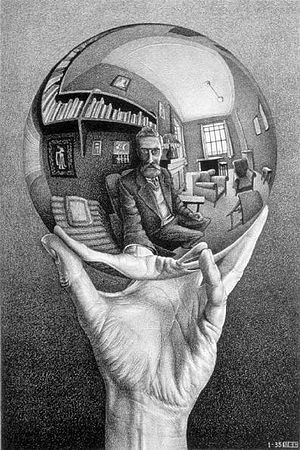
Hand with Reflecting Sphere, M.C. Escher, 1935
Valancourt Books wisely sought to rectify this grave injustice with the republication of some of Houghton’s better novels a couple of years ago, for which we can only be grateful, especially with cover designs this attractive (painfully superficial yes, but what's not to love? It's gorgeous).
For more substantive descriptions of the various characters, a general outline of the plot and quotations of memorable passages I wholeheartedly refer you to a top-notch review by Blair, which provides all these in spades and more. I found it rather futile to retread this already well-explored territory since I didn't have much further to add, so there you go. Blame it on the fact that life is short.
Quite simply enthralling. Houghton's mind is one it would be a travesty not to delve into a bit deeper, as 'I am Jonathan Scrivener' clearly shows. Do not miss it.
British writer Claude Houghton (1889 – 1961) once uttered the pessimistic statement that all his fiction was based on the belief that modern civilization would collapse "because it no longer believes it has a destiny".
Claude Houghton, circa 1948
By ‘modern civilization’ it is more than reasonable to assume he was referring to his native land of Great Britain, formerly a rather robust empire (these tend to have notions of destiny - however misguided - very much on their minds ) of which he witnessed the piecemeal, inexorable decline. Wracked both economically and psychologically by two world wars, the British Empire ultimately had to cede its former economic and military dominance on the world stage to an upstart in the empire business, a wayward offspring known as the United States of America. The old once more had to give way to the new, as is the nature of things.
The fallout of societal disillusionment, unease and a questioning of tradition which followed World War I permeates the existentialist ‘I Am Jonathan Scrivener’ (1930), generally thought of as Houghton’s masterpiece. Yet the man, despite having enjoyed not an inconsiderable amount of notoriety in his day, now seems to be a largely forgotten voice.
And more’s the pity, for this is a rather stunning, ingeniously constructed and at times utterly mystifying psychological novel, both eerily prescient at time of publication and relevant almost 90 years later. Consider the following passage for its piercing criticism of the complacency and delusion of the English elite at the time as well as for its astonishing foresight:
“I told them that there was one difference between the Americans and them and it was this: the Americans are out for money, admit it, and work for it. And my brother’s bunch only want money, won’t admit it, and don’t mean to work for it. The result will be that in a few years we’ll just be a suburb of America. The Americans will not be such fools as the Germans were. They’ll be content with commercial dominion. […] I told them the simple facts that English economic supremacy had gone and that naval supremacy would follow it. We’ve got to get used to not being boss.”
This just might make some recall– even if only faintly - a rather dramatic political shift to nationalism which occurred last year across the English channel. With some small alterations, it doesn’t take much imagination to ‘update’, if only in the spirit of playful experimentation. The sentiment of longing for renewed national pride and past glory – illusory or real – is lurking right beneath the surface.
Politicizing the novel, however, would be quite the wrong thing to do indeed. Ultimately, it is just a minor detail to point out. As subtext it doesn’t dominate the narrative in any way, shape or form. The fact remains that ‘I am Jonathan Scrivener’ above all is an astonishing, wholly unique feat of psychological study (actually multiple studies, the success of the novel absolutely hinges on the in-depth study of an assortment of widely divergent personalities). Furthermore, it is filled to the brim with drily witty, observant aphorisms and insights into human nature which still very much ring true. As such, it deserves a much wider readership than it currently enjoys.
Hand with Reflecting Sphere, M.C. Escher, 1935
Valancourt Books wisely sought to rectify this grave injustice with the republication of some of Houghton’s better novels a couple of years ago, for which we can only be grateful, especially with cover designs this attractive (painfully superficial yes, but what's not to love? It's gorgeous).
For more substantive descriptions of the various characters, a general outline of the plot and quotations of memorable passages I wholeheartedly refer you to a top-notch review by Blair, which provides all these in spades and more. I found it rather futile to retread this already well-explored territory since I didn't have much further to add, so there you go. Blame it on the fact that life is short.
Quite simply enthralling. Houghton's mind is one it would be a travesty not to delve into a bit deeper, as 'I am Jonathan Scrivener' clearly shows. Do not miss it.

September 26, 2015
(Review originally published on my blog, October 2015)
First published in 1930, I Am Jonathan Scrivener concerns the unlikely adventures of James Wrexham, a disillusioned clerk of almost forty who has achieved little in his uneventful life. Wrexham considers himself not only to be a lonely man but to be defined by loneliness, yet - unlike many lonely people - he feels this has enriched his understanding of others.
This turns out to involve meeting and socialising with Scrivener's many friends, who turn up at his doorstep (and in some cases inside the flat itself) expecting Scrivener to be there. They are: Pauline, a young, beautiful woman with great innocence and an inquisitive nature; Middleton, an alcoholic troubled by his experiences in the war and the loss of his fiancée; Mrs. Bellamy (Francesca), a woman made famous by the suicide of her extremely wealthy husband; and Rivers, a flighty young man and something of a social butterfly. These characters, Pauline and Francesca in particular, are each richly imagined in their own right. What binds them all together, Wrexham included, is a desire for something more than the conventional life they have been offered, and rejection of the options they have before them. But each of them is uncommonly obsessed with Scrivener, something made to seem all the more unusual because they are so different in character, age, class, and experience.
I Am Jonathan Scrivener is very much a book of its time, and it's one of a very, very small number of books ( Mrs Dalloway being another) that really made me think about what life and society were actually like during this period. The contrast between the prudish austerity of the Victorian era, so recent in the memories of many, and what is depicted here as the flippancy and flamboyance of 1920s/30s youth; the aftermath of war and the feeling that society was a new, reshaped thing. Wrexham's narrative often involves commentary on London and on society in general, as he observes life in a city much changed from the London of twenty years before. These observations are compelling as a snapshot of this particular period, a world which had seen cataclysmic change and would be upturned again within a decade. They are sometimes amusing because they're still relevant now - and sometimes because they're very much the opposite.
This is also a very funny book, albeit one with a rather dry sense of humour. One of the most amusing scenes occurs when Rivers takes Wrexham to a Japanese restaurant, a place he clearly finds confounding in the extreme.
In the final few chapters, Wrexham's grip on reality loosens; he becomes both paranoid and intensely philosophical, puzzles out the connections between Scrivener's friends, and at the same time imagines they might really have been Scrivener's accomplices, acting out parts, and that Scrivener's servant is spying on him. I Am Jonathan Scrivener is a sort of mystery, making it a compulsive read, but more than that it is simply a story about people, their psychology, their differences and depths of character, what they might be driven to accept or reject given a wealth of opportunities. Through his characters, especially his brilliantly drawn women, Claude Houghton explores the questions any person might ask about their own life, and depicts a search for meaning and purpose that is timeless - but the fact that this is so clearly positioned in the time it was written gives it an extra layer of interest for the modern reader, since it shows how social turbulence and the after-effects of conflict might contribute to such existential interrogation.
First published in 1930, I Am Jonathan Scrivener concerns the unlikely adventures of James Wrexham, a disillusioned clerk of almost forty who has achieved little in his uneventful life. Wrexham considers himself not only to be a lonely man but to be defined by loneliness, yet - unlike many lonely people - he feels this has enriched his understanding of others.
I have known years of loneliness and there is a type of experience which is revealed only to the lonely. During those years I was forced to learn a good deal about myself and that knowledge taught me what to look for in others. If you have been behind the scenes, you never regain the illusion which belongs to a person who has always been simply a member of the audience.Fearing stagnation, Wrexham impulsively decides to apply for the job of secretary to Jonathan Scrivener, a 'gentleman of independent means', via an advertisement in the Times. Much to his surprise, Scrivener employs him without the two of them meeting or even speaking. He's even more baffled when Scrivener, who is abroad, issues instructions that Wrexham should move into his flat immediately, make himself comfortable and fully enjoy the advantages of living in London.
This turns out to involve meeting and socialising with Scrivener's many friends, who turn up at his doorstep (and in some cases inside the flat itself) expecting Scrivener to be there. They are: Pauline, a young, beautiful woman with great innocence and an inquisitive nature; Middleton, an alcoholic troubled by his experiences in the war and the loss of his fiancée; Mrs. Bellamy (Francesca), a woman made famous by the suicide of her extremely wealthy husband; and Rivers, a flighty young man and something of a social butterfly. These characters, Pauline and Francesca in particular, are each richly imagined in their own right. What binds them all together, Wrexham included, is a desire for something more than the conventional life they have been offered, and rejection of the options they have before them. But each of them is uncommonly obsessed with Scrivener, something made to seem all the more unusual because they are so different in character, age, class, and experience.
I Am Jonathan Scrivener is very much a book of its time, and it's one of a very, very small number of books ( Mrs Dalloway being another) that really made me think about what life and society were actually like during this period. The contrast between the prudish austerity of the Victorian era, so recent in the memories of many, and what is depicted here as the flippancy and flamboyance of 1920s/30s youth; the aftermath of war and the feeling that society was a new, reshaped thing. Wrexham's narrative often involves commentary on London and on society in general, as he observes life in a city much changed from the London of twenty years before. These observations are compelling as a snapshot of this particular period, a world which had seen cataclysmic change and would be upturned again within a decade. They are sometimes amusing because they're still relevant now - and sometimes because they're very much the opposite.
Wherever I went, whatever the time, there were hordes of people—restless, irritable, or apathetic people—staring into shops, herding into 'buses, or waiting impatiently to cross streets which were congested with every type of vehicle, capable of every variety of speed. The gloom, particularly in the faces of the men, was remarkably apparent. In a thousand unsuspected places he results of ordeal by battle were unmistakably clear. These people were weary, sceptical, disillusioned. They sought for pleasure with all the feverish activity of the unhappy.
I discovered that modern people never smile. They either shriek with laughter or look as if funerals were the order of the day. The dignity of which we English used to boast had vanished; everyone was slightly hysterical and seemed to be waiting for something to happen—half hoping that it would, yet half terrified that it might. The conversations I heard were always about money... a car of any sort was regarded as the highest pinnacle of human felicity. The garage has become our spiritual home.
... Everyone was exceedingly class conscious when the plain fact of the matter was that classes had ceased to exist and everyone now belonged to one vast undifferentiated mass. Democracy had triumphed at the precise moment when everyone had ceased to believe in it. Politics had become a longer word for chaos. At the time of which I am writing the Conservatives were in power... The Labour Party was far too busy preparing its programme, or dealing with revolution in its own ranks, or explaining that it had not stolen its panaceas from the Liberals, to spare any time for effective criticisms of the Government's proposals. Meanwhile, as ever, the country was run by the Civil Service.At one point, someone makes the remark 'something will turn up - another war or something' - a comment that would have made me roll my eyes had I encountered it in a contemporary novel set in 1930, yet it seems fascinating to find it here.
This is also a very funny book, albeit one with a rather dry sense of humour. One of the most amusing scenes occurs when Rivers takes Wrexham to a Japanese restaurant, a place he clearly finds confounding in the extreme.
It was at this point that the first course appeared. It consisted of odds and ends of dry, very dead-looking things. I tried one which looked like a mushroom of great antiquity, but it turned out to be raw fish.
Although it resembled spaghetti, recent experience had proved that in this restaurant things were not what they seemed. Nor did the fact that one solitary prawn crowned the writhing pyramid inspire me with any confidence.
"Looks like spaghetti," said Rivers, "but it isn't."
I waited, hoping he would say what it was, but he began to eat in the manner of one performing a rite.
As tactfully as possible I inquired whether coffee in this restaurant in any way resembled the beverage usually associated with the word. On being assured that it did, I accepted a cup. It was coffee. I drank it quickly, fearful that its surroundings might pervert it.Other highlights include a soup containing 'long weeds' which resemble 'serpents who had died in youth', and desserts that look like 'small, petrified bats'. In fact, many of the book's funniest moments involve Wrexham's interactions with Rivers. He is the 'light relief' character, the least obvious fit for Scrivener's group of friends, seeming to lack the others' yearning for a unique sense of being, and his cheerful volatility appears to bring out the best of Wrexham's dry wit:
Rivers was an entirely new experience for me. Not only had I never met anyone remotely like him, but I had never imagined such a person as a possibility.
... He paused, studied me with the eyes of a superman, then asked if I could lend him a tenner. The atmosphere was so charged with the philosophy of "live dangerously" that I said "yes".Naturally, given the strange circumstances surrounding Scrivener's character, the plot progresses as a mystery, as Wrexham tries to piece together the reasons for his employer's patronage of such a mismatched group of individuals - not to mention his own mysterious installation in the role of secretary. If this was a modern novel, it would no doubt build to some revelation about Scrivener - he doesn't really exist, or he's several people, or Wrexham himself turns out to be Scrivener, or something. But while the ending holds a small twist, the story is less about this conundrum than the fact that it brings Wrexham into the others' orbit and transforms not only his day-to-day existence, but his whole belief system. Similarly, while it becomes apparent towards the end that Wrexham is an unreliable narrator - something particularly evident when he speaks of a hitherto unmentioned love for Pauline and also alludes to having been affected by an unknown event, years ago, 'which made me content to become a spectator of life' - we never get to know anything more about him than he has disclosed. That event, whatever it was, remains concealed.
In the final few chapters, Wrexham's grip on reality loosens; he becomes both paranoid and intensely philosophical, puzzles out the connections between Scrivener's friends, and at the same time imagines they might really have been Scrivener's accomplices, acting out parts, and that Scrivener's servant is spying on him. I Am Jonathan Scrivener is a sort of mystery, making it a compulsive read, but more than that it is simply a story about people, their psychology, their differences and depths of character, what they might be driven to accept or reject given a wealth of opportunities. Through his characters, especially his brilliantly drawn women, Claude Houghton explores the questions any person might ask about their own life, and depicts a search for meaning and purpose that is timeless - but the fact that this is so clearly positioned in the time it was written gives it an extra layer of interest for the modern reader, since it shows how social turbulence and the after-effects of conflict might contribute to such existential interrogation.

May 22, 2022
Some very short notes on I Am Jonathan Scrivener:
If I had to describe this novel (actually, I don't have to, but I will), I would describe it as a psychological mystery, with the emphasis on psychological.
Michael Dirda, who probably was at least partly responsible for the rediscovery of I Am Jonathan Scrivener, makes a comparison two of Paul Auster's novels. I would agree with that comparison. As with much of Auster's work that I've read, I found myself caught up in the narration while I was reading but, in the end, found that I had little emotional connection with the book or its characters.
A few excerpts I enjoyed:
"She was familiar to me with the elusive familiarity of a person encountered in a dream."
"Information of so many kinds from such different sources was reaching me in regard to Scrivener that to seek to analyse it, or to see it in perspective, was as hopeless as to attempt to assign frontiers to chaos."
"They were examples of the revolt in the world. That revolt shows itself in every sphere of human activity. It is idle to deny it, and it is idle to assign superficial causes in order to explain it. It is not to be suppressed by any of the old methods. It is not a question of class; it is to be found in every class. At its best it is a determination to achieve a new consciousness; at its worst it is a determination to destroy. At its highest, it respects nothing but the true; at its lowest, it respects nothing but the strong. It is present in a thousand forms and, as a result, Certainty has vanished."
"People are usually better than their creeds and more decent than their opinions. If this were not so, civil warfare would be the monotonous characteristic of national life."
And something that read like a British premonition of Raymond Chandler:
"'Who the hell are you?' he asked in a thick unpleasant voice.
I did not reply but studied him closely. He was short, thick-set, and had the smallest eyes I have ever seen in a human being. The face was rather puffy and resembled moist india-rubber. There was cruelty in the thick , rather twisted mouth and brutality in the large misshapen hands. Nevertheless, the dominant impression he produced was of something amazingly mean and sordid. He was probably about forty."
As I wrote earlier, I enjoyed my time with I Am Jonathan Scrivener but, when I had finished reading was left with feelings of emotional disappointment.
If I had to describe this novel (actually, I don't have to, but I will), I would describe it as a psychological mystery, with the emphasis on psychological.
Michael Dirda, who probably was at least partly responsible for the rediscovery of I Am Jonathan Scrivener, makes a comparison two of Paul Auster's novels. I would agree with that comparison. As with much of Auster's work that I've read, I found myself caught up in the narration while I was reading but, in the end, found that I had little emotional connection with the book or its characters.
A few excerpts I enjoyed:
"She was familiar to me with the elusive familiarity of a person encountered in a dream."
"Information of so many kinds from such different sources was reaching me in regard to Scrivener that to seek to analyse it, or to see it in perspective, was as hopeless as to attempt to assign frontiers to chaos."
"They were examples of the revolt in the world. That revolt shows itself in every sphere of human activity. It is idle to deny it, and it is idle to assign superficial causes in order to explain it. It is not to be suppressed by any of the old methods. It is not a question of class; it is to be found in every class. At its best it is a determination to achieve a new consciousness; at its worst it is a determination to destroy. At its highest, it respects nothing but the true; at its lowest, it respects nothing but the strong. It is present in a thousand forms and, as a result, Certainty has vanished."
"People are usually better than their creeds and more decent than their opinions. If this were not so, civil warfare would be the monotonous characteristic of national life."
And something that read like a British premonition of Raymond Chandler:
"'Who the hell are you?' he asked in a thick unpleasant voice.
I did not reply but studied him closely. He was short, thick-set, and had the smallest eyes I have ever seen in a human being. The face was rather puffy and resembled moist india-rubber. There was cruelty in the thick , rather twisted mouth and brutality in the large misshapen hands. Nevertheless, the dominant impression he produced was of something amazingly mean and sordid. He was probably about forty."
As I wrote earlier, I enjoyed my time with I Am Jonathan Scrivener but, when I had finished reading was left with feelings of emotional disappointment.

April 4, 2019
Όσο διάβαζα το βιβλίο, το έβλεπα να εκτυλίσσεται σαν ταινία στο μυαλό μου. Αφότου το τελείωσα, έψαξα να δω μήπως έχει μεταφερθεί όντως στο σινεμά, μιας κι η υπόθεση προσφέρεται για κάτι τέτοιο. Προς μεγάλη μου έκπληξη δεν υπάρχει τέτοια ταινία κι ίσως είναι καλύτερα γιατί έτσι θα μείνει για πάντα άλυτο το μυστήριο του ποιος είναι ο Τζόναθαν Σκρίβενερ.

August 8, 2014
Quite extraordinary. A subtle and complex exploration of a damaged post-war society. A psychological investigation. A mystery that will get its claws in. Highly recommended.

Read
June 8, 2018Νομίζω ότι το χειρότερο πράγμα που έχει συμβεί στο εγχώριο εκδοτικό γίγνεσθαι είναι ότι αυτό είναι το μοναδικό μεταφρασμένο έργο του Κλοντ στα ελληνικά.

April 24, 2016
She thought that he was a straight line — he was a labyrinth.
The best thing about this book is the cover art - accurately capturing the idea of multiple selves/multifaceted self, a self looking inwards-outwards, the white ( the colour is a dirty grey actually) & black areas of tangled human minds — succinctly presented. I dig it!
The second best thing is Part Three of this book where it took a sudden mystical turn. I later learned that it is this writer's speciality – here's how Hugh Walpole described him in the introductory note to the 1935 Doubleday Doran edition: "Houghton is a romantic and a mystic (…) I mean that attitude to life which insists that there are more spiritual worlds than this one in which we live and that it is man's chief business to discover his relation to these worlds. This theme is implicit in every one of Houghton's novels."
Houghton reminds me of Simenon — the same post-war world with its confusion, sense of displacement — the old order crumbling, the new not quite in its place yet, alienated individuals, disillusionment/frustration with the class structure and the limitations and expected social roles that comes with it, etc.
In his very personal Foreword, Michael Dirda compares Houghton to the following writers: "In some ways it resembles a novel by Paul Auster, City of Glass perhaps, or Moon Palace, a blend of the spooky and the philosophical, with a twisty, slightly artificial structure. There are also flashes of Chesterton's The Man Who Was Thursday, early Evelyn Waugh, and the religious supernatural tales of Charles Williams."
Another plus is that he comes highly recommended by Graham Greene.
Claude Houghton is known for his psychological thrillers and I Am Jonathan Scrivener is a psychological narrative where the mystery is played out on a mindscape, but more often than not it reads like a social drama. There's a theatricality to it that would translate well on stage. It doesn't quite fall into a 'typical' thriller slot - that may well turn out to be its usp or not depending on the type of reader it attracts.
The mind games that the titular character supposedly plays with a select group of people recalls the reality shows of our times where disparate characters are thrown together in a tightly controlled environment and then we watch & wait till the situation implodes. The book is a social-psychological experiment of sorts but the final part gives it a curious turn & the smart ending brings us back to square one — the mystery begins all over again!
The best thing about this book is the cover art - accurately capturing the idea of multiple selves/multifaceted self, a self looking inwards-outwards, the white ( the colour is a dirty grey actually) & black areas of tangled human minds — succinctly presented. I dig it!
The second best thing is Part Three of this book where it took a sudden mystical turn. I later learned that it is this writer's speciality – here's how Hugh Walpole described him in the introductory note to the 1935 Doubleday Doran edition: "Houghton is a romantic and a mystic (…) I mean that attitude to life which insists that there are more spiritual worlds than this one in which we live and that it is man's chief business to discover his relation to these worlds. This theme is implicit in every one of Houghton's novels."
Houghton reminds me of Simenon — the same post-war world with its confusion, sense of displacement — the old order crumbling, the new not quite in its place yet, alienated individuals, disillusionment/frustration with the class structure and the limitations and expected social roles that comes with it, etc.
In his very personal Foreword, Michael Dirda compares Houghton to the following writers: "In some ways it resembles a novel by Paul Auster, City of Glass perhaps, or Moon Palace, a blend of the spooky and the philosophical, with a twisty, slightly artificial structure. There are also flashes of Chesterton's The Man Who Was Thursday, early Evelyn Waugh, and the religious supernatural tales of Charles Williams."
Another plus is that he comes highly recommended by Graham Greene.
Claude Houghton is known for his psychological thrillers and I Am Jonathan Scrivener is a psychological narrative where the mystery is played out on a mindscape, but more often than not it reads like a social drama. There's a theatricality to it that would translate well on stage. It doesn't quite fall into a 'typical' thriller slot - that may well turn out to be its usp or not depending on the type of reader it attracts.
The mind games that the titular character supposedly plays with a select group of people recalls the reality shows of our times where disparate characters are thrown together in a tightly controlled environment and then we watch & wait till the situation implodes. The book is a social-psychological experiment of sorts but the final part gives it a curious turn & the smart ending brings us back to square one — the mystery begins all over again!

November 11, 2015
Excellent. I do not know why this author is not better known, but I will definitely be reading him again.
I wonder, also, if Fowles had been reading him; there is the mesmerizing prose, the sense of mystery which is made from nothing at all, the charismatic character who somehow is greater than a regular person. And yet, really, when you think about it, all the man did was to leave town.
But of course his absence is perhaps more useful to his group of "friends" than his presence. Each sees himself reflected in Scrivener, as if he were a mirror instead of a real human being. Many suspect him of machinations, manipulations, experiments when the truth may be very simple: he is just unhappy. Or perhaps even simpler still: he is just who he is.
I wonder, also, if Fowles had been reading him; there is the mesmerizing prose, the sense of mystery which is made from nothing at all, the charismatic character who somehow is greater than a regular person. And yet, really, when you think about it, all the man did was to leave town.
But of course his absence is perhaps more useful to his group of "friends" than his presence. Each sees himself reflected in Scrivener, as if he were a mirror instead of a real human being. Many suspect him of machinations, manipulations, experiments when the truth may be very simple: he is just unhappy. Or perhaps even simpler still: he is just who he is.

May 28, 2020
Ιδιοφυείς διάλογοι, συναρπαστικοί χαρακτήρες. Βαθύ, διεισδυτικό, πολυεπίπεδο φιλοσοφικό και ψυχολογικό δράμα. Η πρόζα του συγγραφέα είναι μαγική. Σε ένα σύνολο 370 σελίδων δεν υπάρχει ούτε μια λέξη περιττή.
Μια βδομάδα μετά το τέλος της ανάγνωσης και ακόμα το σκέφτομαι όλη μέρα. Το προτείνω ανεπιφύλακτα.
Μια βδομάδα μετά το τέλος της ανάγνωσης και ακόμα το σκέφτομαι όλη μέρα. Το προτείνω ανεπιφύλακτα.

November 17, 2021
I Am Jonathan Scrivener [1930] – ★★★★
London, the 1920s. James Wrexham is a lonely thirty-eight year old man just barely bearing his daily job and with no enviable prospects before him. A merely “spectator of life”, he has already resigned to just watch his life go by when he notices an advertisement in The Times. A certain wealthy gentleman, Jonathan Scrivener, seeks a personal secretary for himself and Wrexham applies on a whim. To his delight, he is accepted for an interview with one lawyer and soon given the position despite never having met the man. Scrivener is allegedly abroad and Wrexham starts his duties in his luxurious apartment on a very generous salary. If these circumstances were not odd enough already, a number of Scrivener’s supposed friends then come barging through the door and each has their own incredulous story to tell about Scrivener. Wrexham’s life turns upside down in a matter of weeks as he transforms from a lonely and desperate man to a social butterfly enjoying a life that only the very wealthy can afford. But, questions still remain – who is Jonathan Scrivener, a supposedly brilliant eccentric? Why is he hiding? What purpose may he have in hiring Wrexham? And why do Scrivener’s friends all give contradictory accounts about the man? I am Jonathan Scrivener is a deeply psychological mystery novel, “a hall of broken mirrors”-type of a book whose many elements need careful reassembling.
It sounds like the book has a simple story, but, in fact, there are many layers to it. Much like F. Scott Fitzgerald’s The Great Gatsby [1925], everyone in the novel is talking about a man they have hardly seen, if at all. Like Gatsby, Mr. Scrivener becomes almost this urban legend who is accorded all sorts of powers and brilliance, among which is immense wealth, and all sorts of skills and eccentricities: “A man of brilliant achievements, a man of remarkable possibilities” [Houghton, Thornton Butterworth Publications, 1930: 59]. The characters become obsessed with the unknown and the unreachable. Wrexham, a probable alter ego of Mr. Scrivener, obviously takes the role of Nick Carraway from The Great Gatsby. This unassuming young man becomes everyone’s confidante and each character separately and as a group is trying to penetrate the mystery that is Mr. Scrivener. Is the absent man pulling the strings in the background? Do all of his supposed friends form part of a wicked experiment, a cruel game? Is he perhaps similar to Mr. Owen from Agatha Christie’s And Then There Were None [1939] who prepares a trap for each of the characters?
We guess the character of Mr. Scrivener only through the “effect” that he has on others: on Pauline Mandeville, a beautiful young girl from the upper-class, on Andrew Middleton, a disillusioned alcoholic, on Anthony Rivers, a handsome playboy, and on Francesca Bellamy, a rich and famous widow who may have been responsible for her husband’s death. None of them know Jonathan Scrivener well, but each is considered to be his “friend”, and the secrets of all of them are soon probed as James Wrexham gets acquainted with the unlikely group. Symbolically, the narrator Wrexham represents a clean slate, the Fool from the Tarot deck, who carries almost nothing with him (in terms of experience or knowledge) and expects nothing in return, but who, nevertheless, starts making rounds through the variety of life suddenly on offer for him and because of his newly-found employment. Thus, Wrexham starts attending aristocratic, sophisticated dinners with his wealthy new friends, Pauline Mandeville and Francesca Bellamy, and introduced to a more wild, extravagant and bohemian lifestyles through his relations with Anthony Rivers and Andrew Middleton. In turn, each of these people may also symbolically stand for the four elements in nature: Pauline represents Water, being almost a water nymph who has a “cooling” effect on others, Francesca is all Fire, standing for passion and force, Anthony is Air, being quite whimsical, changeable and irresponsible, and Anthony is definitely Earth, being only too fallible in the eyes of all. The question becomes – is there a “fifth element” to be discovered? Thus, through all of these people, Wrexham has an opportunity to taste life to the fullest in just a matter of weeks, but, paradoxically, the mystery of Scrivener only deepens.
Dotted throughout the novel are astute social observations, especially on the nature of the changing Britain in the early 1920s. Any humane and philanthropic principles of the previous generation give way to materialism and hedonism among the upper-classes fuelled by rising capitalism and prosperity in the early years after the war: “a car of any sort was regarded as the highest pinnacle of human felicity. The garage has become our spiritual home”; “the conversations …were always about money” and “politics had become a longer word for chaos” [Houghton, Thornton Butterworth Publications, 1930: 36]. This shift was seen especially in young people. The character of Pauline Mandeville is a prime example of a young woman from a wealthy class whose standards start to contrast drastically from that of her conservative parents: instead of following any traditions and rules blindly, she rebels, though inwardly, and seemingly lives in her own untouchable world. She is certainly not desperate to land that coveted role of a wife of a rich man, being nothing more than an elegant extension of her husband and all that he represents in society. London and England are described in unflattering terms, too: “London…[Artists] were no longer concerned with its welfare and everywhere the engineer was doing his splendid worst”; “London contains many worlds: there are slums within a short distance of its most aristocratic quarters, and deep solitudes within a few strides of its busiest thoroughfares”; “…life in England is one desperate attempt to find warmth” [Houghton, 1930: 110, 153].
It has been awhile since I read a book with as many interesting insights, too: “the terms we use to describe others usually reveal little concerning them, and much concerning ourselves” [Houghton, Thornton Butterworth Publications, 1930: 69]; “it is what a traveller becomes on his pilgrimage which is important, not where he has lodged on the way”; “you can always tell when you are with your superiors – they give you the illusion that you are their equal. That’s why you like them. Conversely, your inferiors always try to indicate their superiority. That’s why you loathe them” [1930: 252]; “passion…it is what makes people interesting because it reveals them. If you can find out what a person will sacrifice to obtain his or her desire, you know everything about that person. Artist, lover, statesman, fanatic – each is revealed by the extent of the sacrifice he is prepared to make in order to feed the fire on his altar” [1930: 200]; “to know the facts is one thing; to know the truth is another…facts are to the truth what dates are to history – they record certain events but they do not reveal the significance of those events” [1930: 68].
The novel does get quite frustrating, especially in its second half when we want more developments and get endless dialogues instead. Although the “set-up” is deliciously intriguing, half-way through the book it may appear that the plot goes nowhere. The story is “adept in arousing your curiosity and a genius in frustrating it” [Houghton, Thornton Butterworth Publications, 1930: 44], to use one quote from the novel. However, what Claude Houghton did very well is to strike in his novel that delicate balance between the remarkable and the unremarkable. The book seems to be based in realism and follows a perfectly logical course of events, but we also get an occasional feel of a fantasy or a fairy-tale when reading. All the certainty in the novel sometimes gives way to complete unpredictability and, much like in the works of Franz Kafka, characters starts accepting puzzling events without a second thought.
I am Jonathan Scrivener is a psychologically penetrating and highly insightful work of fiction with deep observations on society and people’s minds and beliefs. It is both a top-notch mystery and a journey of self-discovery and from an author who most certainly nowadays deserves more recognition.
London, the 1920s. James Wrexham is a lonely thirty-eight year old man just barely bearing his daily job and with no enviable prospects before him. A merely “spectator of life”, he has already resigned to just watch his life go by when he notices an advertisement in The Times. A certain wealthy gentleman, Jonathan Scrivener, seeks a personal secretary for himself and Wrexham applies on a whim. To his delight, he is accepted for an interview with one lawyer and soon given the position despite never having met the man. Scrivener is allegedly abroad and Wrexham starts his duties in his luxurious apartment on a very generous salary. If these circumstances were not odd enough already, a number of Scrivener’s supposed friends then come barging through the door and each has their own incredulous story to tell about Scrivener. Wrexham’s life turns upside down in a matter of weeks as he transforms from a lonely and desperate man to a social butterfly enjoying a life that only the very wealthy can afford. But, questions still remain – who is Jonathan Scrivener, a supposedly brilliant eccentric? Why is he hiding? What purpose may he have in hiring Wrexham? And why do Scrivener’s friends all give contradictory accounts about the man? I am Jonathan Scrivener is a deeply psychological mystery novel, “a hall of broken mirrors”-type of a book whose many elements need careful reassembling.
It sounds like the book has a simple story, but, in fact, there are many layers to it. Much like F. Scott Fitzgerald’s The Great Gatsby [1925], everyone in the novel is talking about a man they have hardly seen, if at all. Like Gatsby, Mr. Scrivener becomes almost this urban legend who is accorded all sorts of powers and brilliance, among which is immense wealth, and all sorts of skills and eccentricities: “A man of brilliant achievements, a man of remarkable possibilities” [Houghton, Thornton Butterworth Publications, 1930: 59]. The characters become obsessed with the unknown and the unreachable. Wrexham, a probable alter ego of Mr. Scrivener, obviously takes the role of Nick Carraway from The Great Gatsby. This unassuming young man becomes everyone’s confidante and each character separately and as a group is trying to penetrate the mystery that is Mr. Scrivener. Is the absent man pulling the strings in the background? Do all of his supposed friends form part of a wicked experiment, a cruel game? Is he perhaps similar to Mr. Owen from Agatha Christie’s And Then There Were None [1939] who prepares a trap for each of the characters?
We guess the character of Mr. Scrivener only through the “effect” that he has on others: on Pauline Mandeville, a beautiful young girl from the upper-class, on Andrew Middleton, a disillusioned alcoholic, on Anthony Rivers, a handsome playboy, and on Francesca Bellamy, a rich and famous widow who may have been responsible for her husband’s death. None of them know Jonathan Scrivener well, but each is considered to be his “friend”, and the secrets of all of them are soon probed as James Wrexham gets acquainted with the unlikely group. Symbolically, the narrator Wrexham represents a clean slate, the Fool from the Tarot deck, who carries almost nothing with him (in terms of experience or knowledge) and expects nothing in return, but who, nevertheless, starts making rounds through the variety of life suddenly on offer for him and because of his newly-found employment. Thus, Wrexham starts attending aristocratic, sophisticated dinners with his wealthy new friends, Pauline Mandeville and Francesca Bellamy, and introduced to a more wild, extravagant and bohemian lifestyles through his relations with Anthony Rivers and Andrew Middleton. In turn, each of these people may also symbolically stand for the four elements in nature: Pauline represents Water, being almost a water nymph who has a “cooling” effect on others, Francesca is all Fire, standing for passion and force, Anthony is Air, being quite whimsical, changeable and irresponsible, and Anthony is definitely Earth, being only too fallible in the eyes of all. The question becomes – is there a “fifth element” to be discovered? Thus, through all of these people, Wrexham has an opportunity to taste life to the fullest in just a matter of weeks, but, paradoxically, the mystery of Scrivener only deepens.
Dotted throughout the novel are astute social observations, especially on the nature of the changing Britain in the early 1920s. Any humane and philanthropic principles of the previous generation give way to materialism and hedonism among the upper-classes fuelled by rising capitalism and prosperity in the early years after the war: “a car of any sort was regarded as the highest pinnacle of human felicity. The garage has become our spiritual home”; “the conversations …were always about money” and “politics had become a longer word for chaos” [Houghton, Thornton Butterworth Publications, 1930: 36]. This shift was seen especially in young people. The character of Pauline Mandeville is a prime example of a young woman from a wealthy class whose standards start to contrast drastically from that of her conservative parents: instead of following any traditions and rules blindly, she rebels, though inwardly, and seemingly lives in her own untouchable world. She is certainly not desperate to land that coveted role of a wife of a rich man, being nothing more than an elegant extension of her husband and all that he represents in society. London and England are described in unflattering terms, too: “London…[Artists] were no longer concerned with its welfare and everywhere the engineer was doing his splendid worst”; “London contains many worlds: there are slums within a short distance of its most aristocratic quarters, and deep solitudes within a few strides of its busiest thoroughfares”; “…life in England is one desperate attempt to find warmth” [Houghton, 1930: 110, 153].
It has been awhile since I read a book with as many interesting insights, too: “the terms we use to describe others usually reveal little concerning them, and much concerning ourselves” [Houghton, Thornton Butterworth Publications, 1930: 69]; “it is what a traveller becomes on his pilgrimage which is important, not where he has lodged on the way”; “you can always tell when you are with your superiors – they give you the illusion that you are their equal. That’s why you like them. Conversely, your inferiors always try to indicate their superiority. That’s why you loathe them” [1930: 252]; “passion…it is what makes people interesting because it reveals them. If you can find out what a person will sacrifice to obtain his or her desire, you know everything about that person. Artist, lover, statesman, fanatic – each is revealed by the extent of the sacrifice he is prepared to make in order to feed the fire on his altar” [1930: 200]; “to know the facts is one thing; to know the truth is another…facts are to the truth what dates are to history – they record certain events but they do not reveal the significance of those events” [1930: 68].
The novel does get quite frustrating, especially in its second half when we want more developments and get endless dialogues instead. Although the “set-up” is deliciously intriguing, half-way through the book it may appear that the plot goes nowhere. The story is “adept in arousing your curiosity and a genius in frustrating it” [Houghton, Thornton Butterworth Publications, 1930: 44], to use one quote from the novel. However, what Claude Houghton did very well is to strike in his novel that delicate balance between the remarkable and the unremarkable. The book seems to be based in realism and follows a perfectly logical course of events, but we also get an occasional feel of a fantasy or a fairy-tale when reading. All the certainty in the novel sometimes gives way to complete unpredictability and, much like in the works of Franz Kafka, characters starts accepting puzzling events without a second thought.
I am Jonathan Scrivener is a psychologically penetrating and highly insightful work of fiction with deep observations on society and people’s minds and beliefs. It is both a top-notch mystery and a journey of self-discovery and from an author who most certainly nowadays deserves more recognition.

August 1, 2017
Στο φετινό τοπ 10 άνετα... Το προτείνω σε όλους

January 18, 2008
A solitary man with little to distinguish himself answers an advertisement to serve as a personal secretary. He is hired, but never meets his employer, who is abroad; his only duty is to organize an extensive library while living in his employer's flat in London. Soon the callers begin arriving, people with influence and colorful lives, whom our narrator befriends through the common bond of mystery: who exactly is Jonathan Scrivener, and what does he want with each of them?
I'm not sure how this plot couldn't appeal to loner bookworms. The characters are vivid and their psychology studied outright in detail; the writing, like the narrator, is sober and considered but never dull.
As I lost access to the library where I first read this, I hunted down a copy from the 1930 printing; the publisher states that those who intend to keep the book should rebind it, which none of the previous owners bothered to do. But it was well worth the hunt and the subsequent careful handling of the brittle volume and its disintegrating spine. If you find little pieces of it scattered between here and SoCal, it was because I had to keep reading.
I'm not sure how this plot couldn't appeal to loner bookworms. The characters are vivid and their psychology studied outright in detail; the writing, like the narrator, is sober and considered but never dull.
As I lost access to the library where I first read this, I hunted down a copy from the 1930 printing; the publisher states that those who intend to keep the book should rebind it, which none of the previous owners bothered to do. But it was well worth the hunt and the subsequent careful handling of the brittle volume and its disintegrating spine. If you find little pieces of it scattered between here and SoCal, it was because I had to keep reading.

December 1, 2022
Set in London in the 1920s this novel concerns James Wrexham, a lonely thirty-eight year old man bored his job and with little of no prospects. In the newspaper he reads that a certain Jonathan Scrivener, clearly wealthy, seeks a personal secretary and Wrexham applies on a whim.
Having never met his boss, Wrexham is appointed and begins work with Scrivener ‘overseas’.
There’s plenty of mystery to circumstances already, but in his first few days of employment four of Scrivener’s friends call on the office, each with their own dubious story to tell of him. Within a matter of days Wrexham’s life has changed from one of misery and loneliness to city socialite. Any secretarial work is very much second to his partying.
It’s the sort of unhinged and contrived set up typical of Conan-Doyle, but that does it no disservice, in fact the opposite, the many questions posed need answers.. who is the supposedly brilliant Scrivener? why is he absent? why has Wrexham been hired? and what to read into the very different accounts of Scrivener that his friends give?
Clues gradually emerge, but from unlikely sources, while all the time the London of the 1920s provides as much interest, as the upper-class of society grasp at prosperity and rediscovered capitalism.
Anytime that the book veers towards the conventional Houghton is quick to take a tangent. A great example is the lengthy passage when one of Scrivener’s friends, the impulsive playboy Antony Rivers, takes Wrexham to a Japanese restaurant. This section is mainly played for laughs.
Though the finale isn’t quite as grand as what precedes, less sensational as might be expected, it is nonetheless solid, and doesn’t deteriorate from the enjoyment of the whole piece.
This is my second of Houghton’s books, and he has achieved, in my mind at least, something of a cult status. His writing is unpredictable, compelling and zany. It’s a really good example of what Valancourt publishers do well.
This is reputedly his best book, or what he was mainly known for, but I look forward to seeking out the rest.
Having never met his boss, Wrexham is appointed and begins work with Scrivener ‘overseas’.
There’s plenty of mystery to circumstances already, but in his first few days of employment four of Scrivener’s friends call on the office, each with their own dubious story to tell of him. Within a matter of days Wrexham’s life has changed from one of misery and loneliness to city socialite. Any secretarial work is very much second to his partying.
It’s the sort of unhinged and contrived set up typical of Conan-Doyle, but that does it no disservice, in fact the opposite, the many questions posed need answers.. who is the supposedly brilliant Scrivener? why is he absent? why has Wrexham been hired? and what to read into the very different accounts of Scrivener that his friends give?
Clues gradually emerge, but from unlikely sources, while all the time the London of the 1920s provides as much interest, as the upper-class of society grasp at prosperity and rediscovered capitalism.
Anytime that the book veers towards the conventional Houghton is quick to take a tangent. A great example is the lengthy passage when one of Scrivener’s friends, the impulsive playboy Antony Rivers, takes Wrexham to a Japanese restaurant. This section is mainly played for laughs.
Though the finale isn’t quite as grand as what precedes, less sensational as might be expected, it is nonetheless solid, and doesn’t deteriorate from the enjoyment of the whole piece.
This is my second of Houghton’s books, and he has achieved, in my mind at least, something of a cult status. His writing is unpredictable, compelling and zany. It’s a really good example of what Valancourt publishers do well.
This is reputedly his best book, or what he was mainly known for, but I look forward to seeking out the rest.

June 20, 2016
A fascinating book, although I confessed I liked the first part better than the second.
I hate re-hashing plot, so I'll summarize as briefly as possible. Wrexham, through whom the story is told, responds for a position as secretary to a London gentleman (Scrivner as it turns out), and is hired by that man's lawyer, without meeting the client. Scrivner has decamped, correspondence forwarded via his bankers, leaving Wrexham alone in the flat to catalogue the books, officially. That turns out to have been a bit of a ruse, as we find out midway through. Wrexham's "duty" seems to be to deal with four other people who had met Scrivner briefly, and were now in a sort of "thrall" to him.
Part One goes from Wrexham's application through the appearance of all four Scrivner devotees. For the most part here, there's some sort of action involved with comings and goings, and new characters introduced. Part Two I found a bit harder going as the later chapters seemed to highlight bickering among the group, with a fair amount of ... I dunno ... psychological guesswork on their parts as to why Scrivner brought them all together via Wrexham (the four had been unknown to each other). The lawyer comes into play as a fifth "Scriv guy" towards the end as well. All I'll say about the conclusion is that my reaction was "Okay ... that's one way of handling things!"
What I liked about this the most was that Wrexham was able to handle the situation he was essentially dumped into as well as he did, juggling: a morose, belligerent fellow who's drunk (almost) the entire time; a calm young woman from a solid, though not upper class, background; another fellow who dashes about from pillar to post in search of excitement and being "seen"; and finally, a notorious rich widow whose relationship with Wrexham gave me whiplash as she would alternately find him terrific and frustratingly insufferable, depending on her mood. Unlike modern day, there weren't sushi bars on every block in 1920's London, so I'd say my favorite scene was Wrexham's description of the dishes presented to him and the frenetic fellow at a Japanese restaurant, where he'd been dragged.
Several of my Goodreads friends would really like this one, and a shout out to the one who brought it to my attention - thanks, Larry!
I hate re-hashing plot, so I'll summarize as briefly as possible. Wrexham, through whom the story is told, responds for a position as secretary to a London gentleman (Scrivner as it turns out), and is hired by that man's lawyer, without meeting the client. Scrivner has decamped, correspondence forwarded via his bankers, leaving Wrexham alone in the flat to catalogue the books, officially. That turns out to have been a bit of a ruse, as we find out midway through. Wrexham's "duty" seems to be to deal with four other people who had met Scrivner briefly, and were now in a sort of "thrall" to him.
Part One goes from Wrexham's application through the appearance of all four Scrivner devotees. For the most part here, there's some sort of action involved with comings and goings, and new characters introduced. Part Two I found a bit harder going as the later chapters seemed to highlight bickering among the group, with a fair amount of ... I dunno ... psychological guesswork on their parts as to why Scrivner brought them all together via Wrexham (the four had been unknown to each other). The lawyer comes into play as a fifth "Scriv guy" towards the end as well. All I'll say about the conclusion is that my reaction was "Okay ... that's one way of handling things!"
What I liked about this the most was that Wrexham was able to handle the situation he was essentially dumped into as well as he did, juggling: a morose, belligerent fellow who's drunk (almost) the entire time; a calm young woman from a solid, though not upper class, background; another fellow who dashes about from pillar to post in search of excitement and being "seen"; and finally, a notorious rich widow whose relationship with Wrexham gave me whiplash as she would alternately find him terrific and frustratingly insufferable, depending on her mood. Unlike modern day, there weren't sushi bars on every block in 1920's London, so I'd say my favorite scene was Wrexham's description of the dishes presented to him and the frenetic fellow at a Japanese restaurant, where he'd been dragged.
Several of my Goodreads friends would really like this one, and a shout out to the one who brought it to my attention - thanks, Larry!

January 10, 2020
A lost masterpiece by a forgotten author.
Although it was written in the 30s it's still relevant, maybe more than ever.
Highly recommended.
Although it was written in the 30s it's still relevant, maybe more than ever.
Highly recommended.

December 1, 2015
Romanzo strano e paranoico che fonde indagine psicologica, mistero e paradosso.
Buono a tratti ma pure gli intermezzi noiosi non scherzano.
Finale ad orologeria che non spiega niente.
Non so, forse mi sono perso qualcosa ma mi è sembrato sotto le aspettative. [69/100]
Buono a tratti ma pure gli intermezzi noiosi non scherzano.
Finale ad orologeria che non spiega niente.
Non so, forse mi sono perso qualcosa ma mi è sembrato sotto le aspettative. [69/100]

March 24, 2012
An entertaining novel in which the main character does not appear until the last line...
February 1, 2014
I stumbled across this quite by accident and regard the incident as one of those happy accidents that now and then occur. The protagonist is not the eponymous Scrivener but the man employed to be his secretary, James Wrexham. The book was released in 1930 and its author, Claude Houghton, should now, if justice be served, enjoy a richly deserved renaissance in the minds of the reading public.
After living a humdrum existence into his thirties having been left little or no money in his recently deceased father’s will, the public school educated Wrexham goes to work in the offices of a small provincial town’s solicitor’s partnership. His life is one of self-selected solitude. Although he occupies a single room in the home of the senior partner, Petersham, he finds he has nothing in common with the older man and keeps very much to himself preferring to live a ‘life of the mind’. However, after existing some years in this condition he happens to notice an ad in the Times, for a private secretary, to which he eagerly responds although with little hope of success. The job is to catalogue the library of a certain Jonathan Scrivener. To his great surprize he receives a favourable response to his application and goes to live in his new employer’s fashionable London apartment. What is odd and constitutes the central plot device is that Scrivener leaves the country without ever meeting the man who is going to occupy his flat. What is more, the salary he offers is more than generous for the time and, on top of this, Scrivener provides Wrexham with the name of his tailor with instructions to visit him whenever he feels it appropriate to do so with Scrivener covering all costs.
Soon after taking up residence, Wrexham begins to receive visits from several of Scrivener’s friends and through them endeavours to find out something about his enigmatic employer. Throughout the remainder of the book the question cannot help forming in the minds of both the protagonist and the reader with increasing insistence: who is Jonathan Scrivener? Although their accounts differ significantly in certain respects each of Scrivener’s friends provide snippets of information about him that allow Wrexham to gradually form a picture. He is left in no doubt that each of them, in their own way; believe that Scrivener is a remarkable man, with extraordinary qualities.
The book provides an evocative portrait of London between the wars, and the preoccupations of the middle classes, in the lead up to a second ‘Armageddon’. The prose is exquisite and, although vastly different in tone and accomplishment, there are echoes of a significantly inferior work published almost thirty years later: Atlas Shrugged, by Ayn Rand, in which a similar question to that posed above, is continuously asked throughout; ‘who is John Galt?’ Likewise, Jeffrey Ford’s excellent ‘The Portrait of Mrs Charbuque’, is also brought to mind, in which an artist is asked to paint a portrait without ever seeing the face of his subject; merely relying on the image formed within him based upon their conversations during sittings.
If you want to give yourself a treat buy and read this book: once taken up you will find it hard to put down.
After living a humdrum existence into his thirties having been left little or no money in his recently deceased father’s will, the public school educated Wrexham goes to work in the offices of a small provincial town’s solicitor’s partnership. His life is one of self-selected solitude. Although he occupies a single room in the home of the senior partner, Petersham, he finds he has nothing in common with the older man and keeps very much to himself preferring to live a ‘life of the mind’. However, after existing some years in this condition he happens to notice an ad in the Times, for a private secretary, to which he eagerly responds although with little hope of success. The job is to catalogue the library of a certain Jonathan Scrivener. To his great surprize he receives a favourable response to his application and goes to live in his new employer’s fashionable London apartment. What is odd and constitutes the central plot device is that Scrivener leaves the country without ever meeting the man who is going to occupy his flat. What is more, the salary he offers is more than generous for the time and, on top of this, Scrivener provides Wrexham with the name of his tailor with instructions to visit him whenever he feels it appropriate to do so with Scrivener covering all costs.
Soon after taking up residence, Wrexham begins to receive visits from several of Scrivener’s friends and through them endeavours to find out something about his enigmatic employer. Throughout the remainder of the book the question cannot help forming in the minds of both the protagonist and the reader with increasing insistence: who is Jonathan Scrivener? Although their accounts differ significantly in certain respects each of Scrivener’s friends provide snippets of information about him that allow Wrexham to gradually form a picture. He is left in no doubt that each of them, in their own way; believe that Scrivener is a remarkable man, with extraordinary qualities.
The book provides an evocative portrait of London between the wars, and the preoccupations of the middle classes, in the lead up to a second ‘Armageddon’. The prose is exquisite and, although vastly different in tone and accomplishment, there are echoes of a significantly inferior work published almost thirty years later: Atlas Shrugged, by Ayn Rand, in which a similar question to that posed above, is continuously asked throughout; ‘who is John Galt?’ Likewise, Jeffrey Ford’s excellent ‘The Portrait of Mrs Charbuque’, is also brought to mind, in which an artist is asked to paint a portrait without ever seeing the face of his subject; merely relying on the image formed within him based upon their conversations during sittings.
If you want to give yourself a treat buy and read this book: once taken up you will find it hard to put down.

November 2, 2024
Ο Τζέιμς Ρέξαμ που προσλαμβάνεται, κατόπιν αιτήσεως του, ως γραμματέας του χαρισματικού, πλούσιου και μυστηριώδους Τζόναθαν Σκρίβενερ, βρίσκεται αντιμέτωπος με τον γρίφο της ταυτότητας του εργοδότη του, αφού δεν έχουν συναντηθεί ποτέ. Διαμένοντας στο διαμέρισμα του εργοδότη του στο Λονδίνο, με ουσιαστική απασχόληση της ταξινόμηση της βιβλιοθήκης του, μπροστά του ξεκινάει μια παρέλαση από φίλους του Σκρίβενερ [ο δικηγόρος Γουίνκγουώρθ, η αιθέρια Πολίν Μάντλιν που είναι κόρη στρατηγού, η χήρα Φραντσέσκα Μπέλαμι που ο σύζυγος της αυτοκτόνησε, ο απογοητευμένος ερωτικά Άντριου Μίντλτον και ο ενθουσιώδης και παρορμητικός Άντονι Ρίβερς] και ο Ρέξαμ προσπαθεί να συνθέσει τα στοιχεία της προσωπικότητας του αόρατου εργοδότη του μέσα από τις ιστορίες και τους υπαινιγμούς αυτών των φίλων.
Στην τελευταία σελίδα εμφανίζεται ο ίδιος ο Σκρίβενερ.
"Δεν ξέρω τι θα μου είχε συμβεί αν δεν υπήρχαν τα βιβλία, αλλά τα βιβλία είναι ένα φτωχό υποκατάστατο της ζωής."
"Δεν έχω μεγάλη εμπειρία, με την ευρεία σημασία της λέξης. Έχω ταξιδέψει ελάχιστα και δεν έχω γνωρίσει πολλούς ανθρώπους. Όμως έχω γνωρίσει χρόνια μοναξιάς και υπάρχει ένα είδος εμπειρίας που αποκαλύπτεται μόνο στους μοναχικούς. Στη διάρκεια αυτών των χρόνων αναγκάστηκα να μάθω πολλά για τον εαυτό μου και αυτή η γνώση με δίδαξε τι να αναζητώ στους άλλους."
"Το προσωπείο που συνήθως παρουσιάζουν στον κόσμο ή άνθρωποι σου λέει μόνο αυτό που επιθυμούν να πιστέψεις για αυτούς."
"Μπορεί να γνωρίσει κανείς πιο βαθιά μοναξιά ανάμεσα στα κινούμενα πλήθη παρά στην απομόνωση της εξοχής.
"Όταν όλα είναι ένα μυστήριο, τίποτα δεν είναι μυστηριώδες."
"Αυτό που θεωρείται ευρέως αμαρτία είναι απλώς άγνοια."
"Υπάρχει μέσα σε όλους μας ένα πνεύμα της δυσπιστίας που δεν μας εγκαταλείπει ποτέ. Οι πιο πολύτιμες πεποιθήσεις μας ζουν στη σκιά του... αυτό το πνεύμα της δυσπιστίας επιμένει, άσχετα με το πόσο πειστικά μπορούν να είναι τα στοιχεία που αποδεικνύουν ότι αμφιβολίες μας δεν έχουν βάση."
"Η γνώση δεν παύει να υφίσταται ως γνώση επειδή αγνοείται."
"Αναζητούσαν την ηδονή με όλη την πυρετώδη ζωντάνια του δυστυχισμένου."
"Όλες οι ανθρώπινες σχέσεις βασίζονται σε μία λανθασμένη παραδοχή."
"Άλλο πράγμα είναι να γνωρίζεις τα γεγονότα και άλλο είναι να γνωρίζεις την αλήθεια. Τα γεγονότα είναι για την αλήθεια ότι οι ημερομηνίες για την ιστορία, καταγράφουν συγκεκριμένα συμβάντα, αλλά δεν αποκαλύπτουν τη σημασία τους."
"Συχνά λέμε αστόχαστα ότι 'ξέρουμε' κάποιον, παρόλο που στην πραγματικότητα δεν γνωρίζουμε τίποτα για την ουσία της ζωής αυτού του ατόμου. Συνήθως, ξέρουμε μόνο τη συνθήκες της ζωής του."
"Οι όροι που χρησιμοποιούμε για να περιγράψουμε τους άλλους συνήθως δεν αποκαλύπτουν πολλά σχετικά με αυτούς, αλλά αποκαλύπτουν πολλά για μας τους ίδιους."
"Ποιος από μας μπορεί να πει όλη την αλήθεια για τον εαυτό του; Είναι η προσπάθεια ενός προσώπου να πει την αλήθεια για τον εαυτό του σε κάποιον άλλο αυτό που τους δένει για πάντα. Η ευθύνη της ακρόασης είναι εξίσου σπουδαία με αυτή του λόγου, γιατί, όταν δέχεσαι μία εξομολόγηση μοιράζεσαι ένα βάρος."
"Οι περισσότεροι από μας ενδιαφέρονται περισσότερο για την ποσότητα του δραστηριοτήτων τους παρά για την ποιότητά τους."
"Ξέρουμε πολύ καλά ότι οι καλύτερες ιδέες μας δεν είναι ποτέ αποτέλεσμα συνειδητής σκέψης και ότι η μόνη μας ευκαιρία σε μία ξαφνική κρίση είναι να δράσουμε όπως μας προτρέπει το ένστικτό μας εκείνο το κρίσιμο δευτερόλεπτο."
"Έχω συναντήσει πολλούς ανθρώπους που υπέφεραν απίστευτα δεινά εξαιτίας της απόφασης τους να μην υποφέρουν."
"Όλοι γνωρίζουμε περισσότερα από αυτά που τολμάμε να παραδεχτούμε. Στους πιο ασήμαντους από μας υπάρχει μία γνώση που οι πιο σπουδαίοι ανάμεσά μας φοβούνται."
"Είναι αδύνατον να κάνεις παραχωρήσεις σε κάτι που δεν καταλαβαίνεις, για τον απλό λόγο ότι ίσως παραχωρείς κάτι που δεν χρειάζεται."
"Οι γυναίκες μπήκαν στην αγορά επιδιώκοντας την ελευθερία των ανδρών, και αντί γι' αυτή μοιράζονται την σκλαβιά των ανδρών."
"Αυτό που αποκαλύπτει τους ανθρώπους είναι αυτό που κάνουν στον ελεύθερο χρόνο τους."
"Αυτό που με ενδιαφέρει είναι το πάθος καθαυτό. Είναι το μόνο πράγμα στο οποίο ανταποκρίνομαι. Είναι αυτό που κάνει τους ανθρώπους ενδιαφέροντες, γιατί τους αποκαλύπτει. Αν μπορείς να ανακαλύψεις τι θα θυσίαζε ένα άτομο για να υλοποιήσει την επιθυμία του, τότε ξέρεις τα πάντα για αυτό.
"Το να σκέφτεσαι είναι σαν να αποδέχεσαι τη δύναμη αυτών των εμποδίων που σε κρατάνε μακριά από τον αντικειμενικό σου σκοπό. Η ιδιοφυία τα αγνοεί, η κοινή λογική τα υπολογίζει, τα αποδέχεται και έπειτα ζει μιά άθλια μικρή ζωή στη σκιά τους."
"Το κριτήριο για την ψήφο δεν είναι η ηλικία. Όχι, δεν είναι η ηλικία ούτε το φύλο. Το ουσιώδες κριτήριο είναι το συμφέρον της χώρας. Φρονώ ότι μία ψήφος δεν είναι τίποτα άλλο παρά ευθύνη. Και εφόσον είναι ευθύνη, θα πρέπει να παραχωρείται μόνο σε υπεύθυνα άτομα."
"Σχεδόν όλοι μας έχουμε μία πρόχειρη και προκατασκευασμένη θεωρία ότι υπάρχουν δύο πλευρές στον χαρακτήρα μας. Ο 'Δοκτωρ Τζέκυλ και Μίστερ Χάιντ' έχει γραφτεί για να απεικονίσει αυτή την πεποίθηση. Είναι μία ξεκάθαρη και βολική σύλληψη, αλλά είναι εντελώς ανεπαρκής. Είμαστε τόσα πρόσωπα όσα είναι οι φίλοι μας."
"Όλοι περιμένουν από έναν άνδρα να κάνει αυτό ακριβώς που κάνει η αγέλη της οποίας είναι μέλος. Αν δεν το κάνεις, κάτι δεν πάει καλά με σένα. Και όχι μόνο αυτό. Η άρνησή σου θεωρείται από τα μέλη της οικογένειας σου σαν κριτική προς αυτά."
"Ποιος από μας δεν το έχει βιώσει αυτό σε κάποιον βαθμό; Η επιθυμία μας, σαν μία πεταλούδα, είναι όμορφη μόνο όταν είναι άπιαστη. Αιχμάλωτη, είναι ένα νεκρό πράγμα το οποίο τρυπάμε με μία καρφίτσα. Πολλαπλασιάζουμε τα θέλω μας γιατί κάθε αντικείμενο που έχουμε στην κατοχή μας μας απογοητεύει με τη σειρά του, ωστόσο μας λείπει το κουράγιο να παραδεχτούμε την ματαιότητα της καταδίωξης."
"Η πιο γόνιμη επαφή ανάμεσα σε δύο ανθρώπινα πλάσματα πηγάζει από την απόκριση του ενός στον ενθουσιασμό του άλλου. Πρώτα σε γνωρίζω, και σταδιακά γινόμαστε φίλοι. Μου λες τις ελπίδες, τους φόβους, τα μυστικά σου. Αν ανταποκριθώ σε αυτά, μπορώ να είμαι ξένους απέναντι τους;"
"Μόνο οι φιγουρατζήδες, οι λειψοί, οι αδύναμοι, οι αβέβαιοι και οι τυφλοί έχουν ανάγκη τον θαυμασμό. Μπορούν να πιστέψουν στον εαυτό σου μόνο αν οι χαζοί πιστέψουν σε αυτούς. Και δεν θα υπήρχε ίχνος αλαζονείας σε αυτή την πεποίθηση. Μπορείς να καταλάβεις πάντα πού βρίσκεσαι με τους ανώτερους σου - σου δίνουν την ψευδαίσθηση ότι είσαι ίσος τους. Για αυτό σου αρέσουν. Αντίθετα οι κατώτεροι σου πάντα προσπαθούν να επιδείξουν την ανωτερότητα τους."
"Η διάρκεια δεν σημαίνει τίποτα από μόνη της. Είναι ένα ρολόι που δουλεύει χωρίς δείκτες. Μόνο ηλικία δεν φτάνει ποτέ για να κάνει έναν άνδρα σοφό."
Στην τελευταία σελίδα εμφανίζεται ο ίδιος ο Σκρίβενερ.
"Δεν ξέρω τι θα μου είχε συμβεί αν δεν υπήρχαν τα βιβλία, αλλά τα βιβλία είναι ένα φτωχό υποκατάστατο της ζωής."
"Δεν έχω μεγάλη εμπειρία, με την ευρεία σημασία της λέξης. Έχω ταξιδέψει ελάχιστα και δεν έχω γνωρίσει πολλούς ανθρώπους. Όμως έχω γνωρίσει χρόνια μοναξιάς και υπάρχει ένα είδος εμπειρίας που αποκαλύπτεται μόνο στους μοναχικούς. Στη διάρκεια αυτών των χρόνων αναγκάστηκα να μάθω πολλά για τον εαυτό μου και αυτή η γνώση με δίδαξε τι να αναζητώ στους άλλους."
"Το προσωπείο που συνήθως παρουσιάζουν στον κόσμο ή άνθρωποι σου λέει μόνο αυτό που επιθυμούν να πιστέψεις για αυτούς."
"Μπορεί να γνωρίσει κανείς πιο βαθιά μοναξιά ανάμεσα στα κινούμενα πλήθη παρά στην απομόνωση της εξοχής.
"Όταν όλα είναι ένα μυστήριο, τίποτα δεν είναι μυστηριώδες."
"Αυτό που θεωρείται ευρέως αμαρτία είναι απλώς άγνοια."
"Υπάρχει μέσα σε όλους μας ένα πνεύμα της δυσπιστίας που δεν μας εγκαταλείπει ποτέ. Οι πιο πολύτιμες πεποιθήσεις μας ζουν στη σκιά του... αυτό το πνεύμα της δυσπιστίας επιμένει, άσχετα με το πόσο πειστικά μπορούν να είναι τα στοιχεία που αποδεικνύουν ότι αμφιβολίες μας δεν έχουν βάση."
"Η γνώση δεν παύει να υφίσταται ως γνώση επειδή αγνοείται."
"Αναζητούσαν την ηδονή με όλη την πυρετώδη ζωντάνια του δυστυχισμένου."
"Όλες οι ανθρώπινες σχέσεις βασίζονται σε μία λανθασμένη παραδοχή."
"Άλλο πράγμα είναι να γνωρίζεις τα γεγονότα και άλλο είναι να γνωρίζεις την αλήθεια. Τα γεγονότα είναι για την αλήθεια ότι οι ημερομηνίες για την ιστορία, καταγράφουν συγκεκριμένα συμβάντα, αλλά δεν αποκαλύπτουν τη σημασία τους."
"Συχνά λέμε αστόχαστα ότι 'ξέρουμε' κάποιον, παρόλο που στην πραγματικότητα δεν γνωρίζουμε τίποτα για την ουσία της ζωής αυτού του ατόμου. Συνήθως, ξέρουμε μόνο τη συνθήκες της ζωής του."
"Οι όροι που χρησιμοποιούμε για να περιγράψουμε τους άλλους συνήθως δεν αποκαλύπτουν πολλά σχετικά με αυτούς, αλλά αποκαλύπτουν πολλά για μας τους ίδιους."
"Ποιος από μας μπορεί να πει όλη την αλήθεια για τον εαυτό του; Είναι η προσπάθεια ενός προσώπου να πει την αλήθεια για τον εαυτό του σε κάποιον άλλο αυτό που τους δένει για πάντα. Η ευθύνη της ακρόασης είναι εξίσου σπουδαία με αυτή του λόγου, γιατί, όταν δέχεσαι μία εξομολόγηση μοιράζεσαι ένα βάρος."
"Οι περισσότεροι από μας ενδιαφέρονται περισσότερο για την ποσότητα του δραστηριοτήτων τους παρά για την ποιότητά τους."
"Ξέρουμε πολύ καλά ότι οι καλύτερες ιδέες μας δεν είναι ποτέ αποτέλεσμα συνειδητής σκέψης και ότι η μόνη μας ευκαιρία σε μία ξαφνική κρίση είναι να δράσουμε όπως μας προτρέπει το ένστικτό μας εκείνο το κρίσιμο δευτερόλεπτο."
"Έχω συναντήσει πολλούς ανθρώπους που υπέφεραν απίστευτα δεινά εξαιτίας της απόφασης τους να μην υποφέρουν."
"Όλοι γνωρίζουμε περισσότερα από αυτά που τολμάμε να παραδεχτούμε. Στους πιο ασήμαντους από μας υπάρχει μία γνώση που οι πιο σπουδαίοι ανάμεσά μας φοβούνται."
"Είναι αδύνατον να κάνεις παραχωρήσεις σε κάτι που δεν καταλαβαίνεις, για τον απλό λόγο ότι ίσως παραχωρείς κάτι που δεν χρειάζεται."
"Οι γυναίκες μπήκαν στην αγορά επιδιώκοντας την ελευθερία των ανδρών, και αντί γι' αυτή μοιράζονται την σκλαβιά των ανδρών."
"Αυτό που αποκαλύπτει τους ανθρώπους είναι αυτό που κάνουν στον ελεύθερο χρόνο τους."
"Αυτό που με ενδιαφέρει είναι το πάθος καθαυτό. Είναι το μόνο πράγμα στο οποίο ανταποκρίνομαι. Είναι αυτό που κάνει τους ανθρώπους ενδιαφέροντες, γιατί τους αποκαλύπτει. Αν μπορείς να ανακαλύψεις τι θα θυσίαζε ένα άτομο για να υλοποιήσει την επιθυμία του, τότε ξέρεις τα πάντα για αυτό.
"Το να σκέφτεσαι είναι σαν να αποδέχεσαι τη δύναμη αυτών των εμποδίων που σε κρατάνε μακριά από τον αντικειμενικό σου σκοπό. Η ιδιοφυία τα αγνοεί, η κοινή λογική τα υπολογίζει, τα αποδέχεται και έπειτα ζει μιά άθλια μικρή ζωή στη σκιά τους."
"Το κριτήριο για την ψήφο δεν είναι η ηλικία. Όχι, δεν είναι η ηλικία ούτε το φύλο. Το ουσιώδες κριτήριο είναι το συμφέρον της χώρας. Φρονώ ότι μία ψήφος δεν είναι τίποτα άλλο παρά ευθύνη. Και εφόσον είναι ευθύνη, θα πρέπει να παραχωρείται μόνο σε υπεύθυνα άτομα."
"Σχεδόν όλοι μας έχουμε μία πρόχειρη και προκατασκευασμένη θεωρία ότι υπάρχουν δύο πλευρές στον χαρακτήρα μας. Ο 'Δοκτωρ Τζέκυλ και Μίστερ Χάιντ' έχει γραφτεί για να απεικονίσει αυτή την πεποίθηση. Είναι μία ξεκάθαρη και βολική σύλληψη, αλλά είναι εντελώς ανεπαρκής. Είμαστε τόσα πρόσωπα όσα είναι οι φίλοι μας."
"Όλοι περιμένουν από έναν άνδρα να κάνει αυτό ακριβώς που κάνει η αγέλη της οποίας είναι μέλος. Αν δεν το κάνεις, κάτι δεν πάει καλά με σένα. Και όχι μόνο αυτό. Η άρνησή σου θεωρείται από τα μέλη της οικογένειας σου σαν κριτική προς αυτά."
"Ποιος από μας δεν το έχει βιώσει αυτό σε κάποιον βαθμό; Η επιθυμία μας, σαν μία πεταλούδα, είναι όμορφη μόνο όταν είναι άπιαστη. Αιχμάλωτη, είναι ένα νεκρό πράγμα το οποίο τρυπάμε με μία καρφίτσα. Πολλαπλασιάζουμε τα θέλω μας γιατί κάθε αντικείμενο που έχουμε στην κατοχή μας μας απογοητεύει με τη σειρά του, ωστόσο μας λείπει το κουράγιο να παραδεχτούμε την ματαιότητα της καταδίωξης."
"Η πιο γόνιμη επαφή ανάμεσα σε δύο ανθρώπινα πλάσματα πηγάζει από την απόκριση του ενός στον ενθουσιασμό του άλλου. Πρώτα σε γνωρίζω, και σταδιακά γινόμαστε φίλοι. Μου λες τις ελπίδες, τους φόβους, τα μυστικά σου. Αν ανταποκριθώ σε αυτά, μπορώ να είμαι ξένους απέναντι τους;"
"Μόνο οι φιγουρατζήδες, οι λειψοί, οι αδύναμοι, οι αβέβαιοι και οι τυφλοί έχουν ανάγκη τον θαυμασμό. Μπορούν να πιστέψουν στον εαυτό σου μόνο αν οι χαζοί πιστέψουν σε αυτούς. Και δεν θα υπήρχε ίχνος αλαζονείας σε αυτή την πεποίθηση. Μπορείς να καταλάβεις πάντα πού βρίσκεσαι με τους ανώτερους σου - σου δίνουν την ψευδαίσθηση ότι είσαι ίσος τους. Για αυτό σου αρέσουν. Αντίθετα οι κατώτεροι σου πάντα προσπαθούν να επιδείξουν την ανωτερότητα τους."
"Η διάρκεια δεν σημαίνει τίποτα από μόνη της. Είναι ένα ρολόι που δουλεύει χωρίς δείκτες. Μόνο ηλικία δεν φτάνει ποτέ για να κάνει έναν άνδρα σοφό."

June 20, 2013
Imagine the inverse of Bartelby the Scrivener: a handsome, talented, rich young man who is partly the eponymous hero. The clerk though tells the story. The clerk James Wrexham, a nameless nobody, has been leading a miserable and lonely life until he reads an ad from Scrivener and becomes oddly Scrivener's secretary, obliged to catalogue Scrivener's maddenly various library whilst ensconced in his employer's luxurious Pall Mall (pell-mell?) flat, without ever meeting him. The philosophical and gothic first-person narrative details Wrexham's entry into London's post World War I's beau monde and his self-discoveries. Peopling Wrexham's tale are Scrivener's friends, contrasting witty types: femme fatale and ethereal beauty, drunk and man of fashion, stuffy lawyer and crook. The dialogue is first-rate, and the mystery of who Scrivener and Wrexham are is finally solved amidst echoes of the Secret Sharer.

February 26, 2017
I really enjoyed it at first - just so different and intriguing. The narrator leaves a lonely and humdrum existence to become secretary to Jonathan Scrivener, the mysterious character who has gone away and left his flat and library for his secretary. The mystery of who or what Jonathan Scrivener is occupies the lives of several of Scrivener's friends and the narrator himself. I just thought that it was a bit long and I did not always find the ideas about how we live convincing.
April 23, 2013
An odd, fascinating book which vividly paints a expressionistic portrait of several characters, and London, in the 1930s. An existential study of interwar society.

February 3, 2026
2.5
I would love to know if Claude Houghton came up with the storyline for this book first or if he just tacked it on at the end of the collection of musings about English society and the individual that make up a large part of this novel. Whilst some of these are genuinely interesting and insightful you can’t hang an extended piece of fiction on some nice aphorisms alone.
Houghton does initially create a sense of tension and intrigue about the central mystery of Jonathan Scrivener here, but as I reached the second half of the book I wondered if its resolution was actually going to stand up against the stream of the narrator’s analysis of other characters that preceded it which for me it did not. We are given numerous scenes of dialogue either set in the London flat where most of the book takes place or at various pubs and restaurants throughout the city which whilst initially diverting do become tiresome and I definitely hit a wall with them at around the 200 page mark (and to be honest at points even earlier than that). At this point of I am Jonathan Scrivener the ‘solving [of] his secret’ started to seem even more necessary to me in order to put an end to the book and provide some kind of reward for making it through which made the final chapter even more disappointing. The final section of the book reads as rushed as our central character expounds a lengthy theory about Scrivener that has ‘solved the riddle’ of his personality. To me this smacked of an author reaching for a conclusion to a story that was only there in the first place to provide character studies and reflections on the post-war English citizen. Whilst there’s nothing wrong with this in theory I think that to categorise this as a psychological thriller (as is the implication on the back of my copy) is somewhat disingenuous as the mechanics of the plot appeared to me to be of secondary interest to the author. Not an unenjoyable experience to read but it did become repetitive and I was frustrated with the pages of amateur psychological musings I was given in lieu of an actual payoff. Some readers more intelligent and less plot dependent than me will probably love this.
PS. I’ll include this quote just because it made me laugh and reminds me that I did at least get something out of reading this:
“He was one of those people - a modern type - who, during a first meeting, tell you everything about themselves. So much so that you cannot decide whether you will ever really know them or whether there is anything really to know.”
I would love to know if Claude Houghton came up with the storyline for this book first or if he just tacked it on at the end of the collection of musings about English society and the individual that make up a large part of this novel. Whilst some of these are genuinely interesting and insightful you can’t hang an extended piece of fiction on some nice aphorisms alone.
Houghton does initially create a sense of tension and intrigue about the central mystery of Jonathan Scrivener here, but as I reached the second half of the book I wondered if its resolution was actually going to stand up against the stream of the narrator’s analysis of other characters that preceded it which for me it did not. We are given numerous scenes of dialogue either set in the London flat where most of the book takes place or at various pubs and restaurants throughout the city which whilst initially diverting do become tiresome and I definitely hit a wall with them at around the 200 page mark (and to be honest at points even earlier than that). At this point of I am Jonathan Scrivener the ‘solving [of] his secret’ started to seem even more necessary to me in order to put an end to the book and provide some kind of reward for making it through which made the final chapter even more disappointing. The final section of the book reads as rushed as our central character expounds a lengthy theory about Scrivener that has ‘solved the riddle’ of his personality. To me this smacked of an author reaching for a conclusion to a story that was only there in the first place to provide character studies and reflections on the post-war English citizen. Whilst there’s nothing wrong with this in theory I think that to categorise this as a psychological thriller (as is the implication on the back of my copy) is somewhat disingenuous as the mechanics of the plot appeared to me to be of secondary interest to the author. Not an unenjoyable experience to read but it did become repetitive and I was frustrated with the pages of amateur psychological musings I was given in lieu of an actual payoff. Some readers more intelligent and less plot dependent than me will probably love this.
PS. I’ll include this quote just because it made me laugh and reminds me that I did at least get something out of reading this:
“He was one of those people - a modern type - who, during a first meeting, tell you everything about themselves. So much so that you cannot decide whether you will ever really know them or whether there is anything really to know.”
October 28, 2022
Εγώ είμαι ο Τζόναθαν Σκριβενερ του Χαουτον Κλοντ. Πρόκειται για ένα φιλοσοφικό μυθιστόρημα που προβληματίζει τον αναγνώστη με τα θέματα με τα οποία τον φέρνει αντιμέτωπο, με βασικότερο αυτό της μοναξιάς.
Η βασική ιστορία ξετυλίγεται γύρω από τον αφηγητή, ο οποίος προσλαμβανεται ως γραμματέας από έναν εκκεντρικό Λονδρεζο επιχειρηματία ,τον οποίον ομως δεν έχει συναντήσει ποτέ. Ο γραμματέας προσπαθεί να λύσει το μυστήριο του αόρατου εργοδότη του ζώντας στο σπίτι του και συναντώντας ανθρώπους που τον γνωρίζουν. Η ιδέα δε μπορώ να πω πως ήταν ικανή να στηρίξει τη ροή του βιβλίου και σε πολλά σημεία γινόταν μάλλον ανιαρή, ιδίως ως προς την ανάπτυξη. Πέρα από αυτό όμως οι συνεχείς ψυχολογικές αναλύσεις των ηρώων του βιβλίου και η εμβάθυνση στους χαρακτήρες τους είναι που κρατάνε το ενδιαφέρον.
Ο συγγραφέας προωθεί την ιστορία του και το ψυχογραφημα των πρωταγωνιστων του κυρίως μέσα από συνεχόμενους διαλόγους. Η αφήγηση σε πρώτο πρόσωπο υπάρχει αφενός για να προετοιμάζει τον αναγνώστη για τον επικείμενο διάλογο, αφετέρου για να αναπτύξει φιλοσοφικά ερωτήματα. Μικρες δόσεις από αγγλικό χιούμορ βρίσκονται αναπάντεχα διάσπαρτες μέσα στο κείμενο, πράγμα που προσδίδει σε αυτό μια γοητεία. Συχνά ο λογος γίνεται ποιητικός, ενώ το ύφος που προσομοιάζει με μυθιστορηματα του 19ου αιώνα, μεταφέρει τον αναγνώστη σε μια εποχή πιο ευγενική. Μια εποχή με τύπους, κοινωνικό πρωτόκολλο... Αναμφίβολα το "εγώ είμαι ο Τζόναθαν Σκριβενερ" δεν είναι εύκολο βιβλίο καθώς χρειάζεται στενή παρακολούθηση των ηρώων ωστε να γίνει κατανοητή η εξέλιξη των συναισθημάτων και των χαρακτήρων τους. Δε θα ισχυριστώ ότι με κέρδισε όσο περίμενα, όμως με κράτησε με τα πολλά νοήματα που εξετάζει και τους προβληματισμούς που θέτει προς εξέταση. Γραμμένο στο μεταίχμιο δύο πολέμων, σε μια κοινωνία που ολισθαινει προς μια αβέβαιη πραγματικότητα, παρουσιάζει τους ανθρώπους τη στιγμή που αυτοί χάνουν τις σταθερές τους. Ο κόσμος προχώρα, οι αδύναμοι κι όσοι δεν ακολουθούν ας βρουν το δρόμο μόνοι τους. Ο κεντρικός ήρωας πρέπει να παλέψει ταυτόχρονα με το μυστήριο, με τον εαυτό του, με τους ανθρώπους που τον πλαισιώνουν, με τους δικούς του δαίμονες
Η βασική ιστορία ξετυλίγεται γύρω από τον αφηγητή, ο οποίος προσλαμβανεται ως γραμματέας από έναν εκκεντρικό Λονδρεζο επιχειρηματία ,τον οποίον ομως δεν έχει συναντήσει ποτέ. Ο γραμματέας προσπαθεί να λύσει το μυστήριο του αόρατου εργοδότη του ζώντας στο σπίτι του και συναντώντας ανθρώπους που τον γνωρίζουν. Η ιδέα δε μπορώ να πω πως ήταν ικανή να στηρίξει τη ροή του βιβλίου και σε πολλά σημεία γινόταν μάλλον ανιαρή, ιδίως ως προς την ανάπτυξη. Πέρα από αυτό όμως οι συνεχείς ψυχολογικές αναλύσεις των ηρώων του βιβλίου και η εμβάθυνση στους χαρακτήρες τους είναι που κρατάνε το ενδιαφέρον.
Ο συγγραφέας προωθεί την ιστορία του και το ψυχογραφημα των πρωταγωνιστων του κυρίως μέσα από συνεχόμενους διαλόγους. Η αφήγηση σε πρώτο πρόσωπο υπάρχει αφενός για να προετοιμάζει τον αναγνώστη για τον επικείμενο διάλογο, αφετέρου για να αναπτύξει φιλοσοφικά ερωτήματα. Μικρες δόσεις από αγγλικό χιούμορ βρίσκονται αναπάντεχα διάσπαρτες μέσα στο κείμενο, πράγμα που προσδίδει σε αυτό μια γοητεία. Συχνά ο λογος γίνεται ποιητικός, ενώ το ύφος που προσομοιάζει με μυθιστορηματα του 19ου αιώνα, μεταφέρει τον αναγνώστη σε μια εποχή πιο ευγενική. Μια εποχή με τύπους, κοινωνικό πρωτόκολλο... Αναμφίβολα το "εγώ είμαι ο Τζόναθαν Σκριβενερ" δεν είναι εύκολο βιβλίο καθώς χρειάζεται στενή παρακολούθηση των ηρώων ωστε να γίνει κατανοητή η εξέλιξη των συναισθημάτων και των χαρακτήρων τους. Δε θα ισχυριστώ ότι με κέρδισε όσο περίμενα, όμως με κράτησε με τα πολλά νοήματα που εξετάζει και τους προβληματισμούς που θέτει προς εξέταση. Γραμμένο στο μεταίχμιο δύο πολέμων, σε μια κοινωνία που ολισθαινει προς μια αβέβαιη πραγματικότητα, παρουσιάζει τους ανθρώπους τη στιγμή που αυτοί χάνουν τις σταθερές τους. Ο κόσμος προχώρα, οι αδύναμοι κι όσοι δεν ακολουθούν ας βρουν το δρόμο μόνοι τους. Ο κεντρικός ήρωας πρέπει να παλέψει ταυτόχρονα με το μυστήριο, με τον εαυτό του, με τους ανθρώπους που τον πλαισιώνουν, με τους δικούς του δαίμονες
July 25, 2024
[Cedric Chivers] (1978). HB/DJ. 314 Pages. Purchased from lufibooks.
An early (1930), philosophical novel from the prolific, brilliant and underrated Claude Houghton (1889-1961). Probably his best-known work.
A strange, intriguing and thought-provoking tale.
The narrative revolves around James Wrexham’s interactions with a bizarre cast of characters - some of whom are quite monstrous - and his allied pursuit of transparency concerning his employer and employment.
There are comedic gems thrown in; the account of JW’s visit to a Japanese restaurant, in the abysmal company of Rivers, being a real highlight.
“If I die to-night, I have realized one thing, if only one, about life in this world: its significance is unrelated to time… Mere duration signifies nothing. It is a ticking clock without a dial hand. A man is never wise because he is old.” (p. 73)
“There was something much more repulsive in this puffy unhealthy man in his respectable clothes than in the traditional underworld types - something especially mean, flabby, and inert… He moved slowly and there was something in his gait which gave me the fantastic impression that it was not normal for him to walk upright.” (p. 223)
“‘Tell me this: why is Scrivener interested in these people?’
‘It is a mystery,’ she replied, ‘because he is a mystery. I believe he will return soon. Things are rapidly approaching a crisis between all of us and I feel that he has plotted that crisis and when it emerges, he will appear.’
:
‘You’ve no definition to cover Scrivener, then?’ I asked.
‘None,’ she answered, ‘unless he’s the pilgrim of an inward Odyssey.’” (p. 264)
“Our desire, like a butterfly, is alluring only while it eludes. Captured, it is a dead thing through which we stick a pin. We multiply our wants because each possession in turn disappoints us, yet we lack the courage to admit the futility of the chase. The Failure becomes bankrupt in that he loses his hope; and the Successful knows the bankruptcy involved in the attainment of his desire. Neither will admit it and so the frenzied farce goes on.” (p. 302)
An early (1930), philosophical novel from the prolific, brilliant and underrated Claude Houghton (1889-1961). Probably his best-known work.
A strange, intriguing and thought-provoking tale.
The narrative revolves around James Wrexham’s interactions with a bizarre cast of characters - some of whom are quite monstrous - and his allied pursuit of transparency concerning his employer and employment.
There are comedic gems thrown in; the account of JW’s visit to a Japanese restaurant, in the abysmal company of Rivers, being a real highlight.
“If I die to-night, I have realized one thing, if only one, about life in this world: its significance is unrelated to time… Mere duration signifies nothing. It is a ticking clock without a dial hand. A man is never wise because he is old.” (p. 73)
“There was something much more repulsive in this puffy unhealthy man in his respectable clothes than in the traditional underworld types - something especially mean, flabby, and inert… He moved slowly and there was something in his gait which gave me the fantastic impression that it was not normal for him to walk upright.” (p. 223)
“‘Tell me this: why is Scrivener interested in these people?’
‘It is a mystery,’ she replied, ‘because he is a mystery. I believe he will return soon. Things are rapidly approaching a crisis between all of us and I feel that he has plotted that crisis and when it emerges, he will appear.’
:
‘You’ve no definition to cover Scrivener, then?’ I asked.
‘None,’ she answered, ‘unless he’s the pilgrim of an inward Odyssey.’” (p. 264)
“Our desire, like a butterfly, is alluring only while it eludes. Captured, it is a dead thing through which we stick a pin. We multiply our wants because each possession in turn disappoints us, yet we lack the courage to admit the futility of the chase. The Failure becomes bankrupt in that he loses his hope; and the Successful knows the bankruptcy involved in the attainment of his desire. Neither will admit it and so the frenzied farce goes on.” (p. 302)
This entire review has been hidden because of spoilers.
July 7, 2018
I read this book because I am a keen reader of crime & mystery classics and also I had heard it was a lost or little read masterpiece. I have absolutely enjoyed reading this book but please do not be fooled by the other reviews - this book is almost totally dedicated to discussing philosophical questions relating to societal norms and conformity and/or non-conformity to our type that we are born and raised into. Although the book has a mystery as it's basis (trying to find out who Jonathan Scrivener is and why he has befriended and employed various people) - this basis is only used as a frame in which to discuss various personality types and to get the reader to self reflect upon him/herself - the entire middle section and much of the later part of the book is taken up with this quest. Yes the book is interesting and I found myself reflecting upon my own personality - however the mystery part is at best just a device in which to present a book that would normally be a dry and difficult to read factual book - so a crafty idea to write it as a novel but one that works well. If you are thinking of reading this book because you enjoy mysteries, you might be very disappointed - especially after the first third of the book as this book is as much about yourself as it about the characters you find within it. I would give this book 8 out of 10.

January 4, 2020
Anche se lo scrittore mi era completamente ignoto, avevo sentito ben parlare di questo libro. Pare che questo Houghton abbia scritto molto e con successo, ma sostanzialmente sia rimasto un po' "confinato" in area anglo-americana. Per quanto ne so questo è l'unico suo titolo tradotto in italiano, ed è preceduto da una prefazione di Henry Miller (al solito, col suo stile un po' da spaccone).
Me ne sono fatto un opinione un po' oscillante.. Il motivo del successo non tardo ad immaginarlo: la trama del romanzo è accattivante come una sciarada, ma i personaggi pongono riflessioni che esulano dal mero giallo poliziesco. Tuttavia, per com'è congegnato il romanzo, qualcosa in più me lo sarei aspettato. Un finale del genere c'era da aspettarselo, e mi sento di condividere con chi ha scritto prima di me che ad un certo punto c'è una sorta di impasse nella vicenda.
Però, durante la lettura, ogni tanto ci si imbatte in alcune osservazioni, fossero pure brevi frasi, davvero meritevoli d'attenzione. Verso la fine del romanzo, poi, c'è una bella pagina sulle disillusioni della vita, la paura del confronto e il conseguente ritrarsi dalla lotta che tanto spesso è pura auto-giustificazione per mascherare la propria pavidità.
Me ne sono fatto un opinione un po' oscillante.. Il motivo del successo non tardo ad immaginarlo: la trama del romanzo è accattivante come una sciarada, ma i personaggi pongono riflessioni che esulano dal mero giallo poliziesco. Tuttavia, per com'è congegnato il romanzo, qualcosa in più me lo sarei aspettato. Un finale del genere c'era da aspettarselo, e mi sento di condividere con chi ha scritto prima di me che ad un certo punto c'è una sorta di impasse nella vicenda.
Però, durante la lettura, ogni tanto ci si imbatte in alcune osservazioni, fossero pure brevi frasi, davvero meritevoli d'attenzione. Verso la fine del romanzo, poi, c'è una bella pagina sulle disillusioni della vita, la paura del confronto e il conseguente ritrarsi dalla lotta che tanto spesso è pura auto-giustificazione per mascherare la propria pavidità.

August 9, 2025
9 / 10
Pretty remarkable that this went out of print and under the radar for years until the good people at Valancourt Books brought it back. Genre labels can sometimes feel overly reductive or focused on putting things into neat slots that they don't always fit into, but this may be the thing that pops into my head for the rest of time when I think about psychological books.
There's a lot going on here, with this feeling both like a mystery novel and a borderline modernist piece of writing in its utter detachment from recognizable reality. But I Am Jonathan Scrivener ultimately has a razor focus on the psychology of its damaged and broken characters, breaking them down piecemeal, and revealing elements that feel recognizable in ourselves and others, even if the situations presented here hardly feel familiar. There were times when the repetition of the Holmesian "How could you possibly have known that???" of these conversations gets a bit excessive, but I accept that as a necessary evil to get these set-pieces moving as efficiently as possible.
This is the type of read where you want to pick it up again the second you've finished. Really rewarding, really strange, and despite Valancourt's best efforts, still seemingly quite under-read.
Pretty remarkable that this went out of print and under the radar for years until the good people at Valancourt Books brought it back. Genre labels can sometimes feel overly reductive or focused on putting things into neat slots that they don't always fit into, but this may be the thing that pops into my head for the rest of time when I think about psychological books.
There's a lot going on here, with this feeling both like a mystery novel and a borderline modernist piece of writing in its utter detachment from recognizable reality. But I Am Jonathan Scrivener ultimately has a razor focus on the psychology of its damaged and broken characters, breaking them down piecemeal, and revealing elements that feel recognizable in ourselves and others, even if the situations presented here hardly feel familiar. There were times when the repetition of the Holmesian "How could you possibly have known that???" of these conversations gets a bit excessive, but I accept that as a necessary evil to get these set-pieces moving as efficiently as possible.
This is the type of read where you want to pick it up again the second you've finished. Really rewarding, really strange, and despite Valancourt's best efforts, still seemingly quite under-read.
July 14, 2019
An author who creates characters and knows what they do and think is considered to remain outside the story. But what will happen if the author, a transcendental being like a god, exists among the characters? This is what is happening in this novel. The eponymous character is actually an author as his name suggests, and the narrator Wrexham and all the other people are fictional characters created by him. No wonder Scrivener knows what they do and think. No wonder Scrivener can beat anyone at their own game. No wonder each character finds in him his/her self image magnified, because s/he is a representative of a part of the author's mind.
The most interesting thing about the novel is that the author makes one of his characters try to solve the mystery of author. Wrexham does a wonderful job near the end of the story and approaches the truth, but he gets nearer and nearer like an asymptotic line to the truth without ever reaching it. How can he imagine he is just a fictional character? It is only us, readers of this novel, who can "think again the thoughts of gods."
This is an experimental novel, a metafiction, though no one has recognized it as such.
The most interesting thing about the novel is that the author makes one of his characters try to solve the mystery of author. Wrexham does a wonderful job near the end of the story and approaches the truth, but he gets nearer and nearer like an asymptotic line to the truth without ever reaching it. How can he imagine he is just a fictional character? It is only us, readers of this novel, who can "think again the thoughts of gods."
This is an experimental novel, a metafiction, though no one has recognized it as such.
Displaying 1 - 30 of 46 reviews