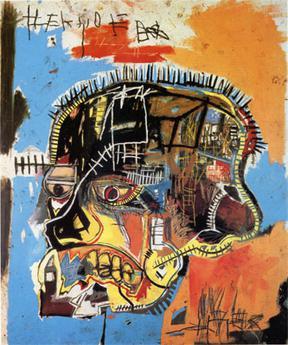
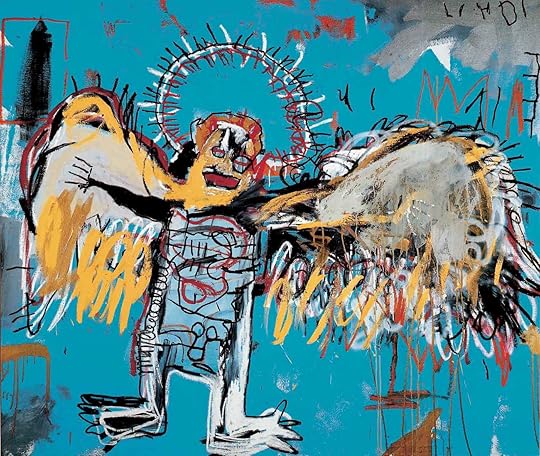
In many ways, Javaka Steptoe's Radiant Child is simply and gracefully a beautifully told account, presenting not only how and even why Jean-Michel Basquiat becomes an artist but also that art is for one in the eye of the beholder (and that what some might consider beautiful, others might not, although this could and should have been a bit more specifically and clearly demonstrated and pointed out by the author, as there exists in my opinion some potential areas of and for confusion) and for two that art and artistic expression can often also be a source of healing, of actual therapy (but also, alas, how individuals with an artistic mindset and temperament will unfortunately at times experience life both more intensely and more difficultly, such as Jean-Michel Basquiat's mother, who seemingly ends up institutionalised, breaking her son's heart, as Jean-Michel Basquiat and his mother Matilde are described as having been very close, as kindred spirits of the soul).
Now I have read a number of intensely negative reviews of Radiant Child that seem to take great umbrage at the fact that as a teenager and young adult Jean-Michel Basquiat goes out alone at night and draws, paints his art as graffiti on city walls, buildings, structures. And while I can to a point understand that some if not even many people might well regard graffiti as not really art but as vandalism, in my own humble opinion, art is art. And sometimes, public displays of artistic expression uncommissioned and perhaps even unwanted on buildings, walls and other public structures are actually what it takes, are necessary to make gallery goers, art aficionados, art dealers etc. (and the general public) take notice and become aware of a young or an emerging artist (and some artists do in fact both have the desire and often an intense personal requirement and need to produce, to create art anywhere and everywhere, that they are complelled, that they cannot resist the urge to engage in public displays of their artistic soul and talents).
Furthermore, and as someone who always tends to require both solitude and often silence when I am writing (or engaging in) anything even remotely creative, I do appreciate oh so very much that Javaka Steptoe has shown in his presented narrative of Radiant Child that art is often (and perhaps even mostly) very much a solitary action, that while the end result, the end product of artistic expression might well be public (and will even need to be public if an artist wants to be recognised and have his or her works displayed in art galleries and museums), the actual creation of art is often intensely private and that many, if not actually the majority of artists do indeed much prefer to work alone, without distractions, and often much require this for their creative processes to adequately come to fruition (and that too much social contact even prevents or at least can significantly hinder creativity).
But while I guess part of me does understand why the most troubling aspects of Jean-Michel Basquiat's short life have not been mentioned by Javaka Steptoe within the text of Radiant Child and just relegated to the back and his author's notes, another part of me does wish that even within the narrative itself, Basquiat's struggles with especially substance abuse had at least been alluded to, as for me, and after researching Jean-Michel Basquiat a bit online, it truly and sadly does in fact appear as though he possesed a rather fragile and easily shatterable soul and was probaly using drugs to self medicate when expressing his thoughts, his feelings, his fears and innermost self via his artwork was clearly no longer sufficient (and in my opinion, and although this is all troubling and sadly so, Jean-Michel Basquiat's ultimately unsuccessful struggles against addiction are as much, were as much part of his life as his paintings, his collages, his sculptures, and I strongly feel that this does need to be presented, warts and all, within the text proper of Radiant Child, and quite frankly, having this information only appear in the author's notes leaves me both rather disappointed and even a tiny bit insulted).
Now with regard to the accompanying illustrations that won Javaka Steptoe the 2017 Caldecott Medal, they are glowing, colourful, full of expressive emotion and indeed do a simply wonderful job illustrating, presenting not only Jean-Michel Basquiat as an artist but as a person (his life, his artistic oeuvre, his legacy), how he lived and how he worked, produced, created. However, as much as I have indeed and in fact liked and even loved Javaka Steptoe's pictorial offerings, I do have to admit that I am finding it supremely annoying that there are none of Jean-Michel Basquiat's actual works of art reproduced in Radiant Child (and while this might well be due to legal and copyright reasons, it is still a most lamentable shortcoming and frustration that has also at least somewhat lessened my reading pleasure, as what is a book about the life and times of an artist, without pictures of his or her actual work).
And finally, while I read Radiant Child as a download on my Kindle, I would NOT really tend to all that much recommend this book in an electronic format, as while the illustrations are indeed lovely and expressive even on the Kindle, the text is so small that reading it has proven very annoying and eye-strain producing, even with zooming in, even whilst wearing reading glasses.