Jump to ratings and reviews
Rate this book

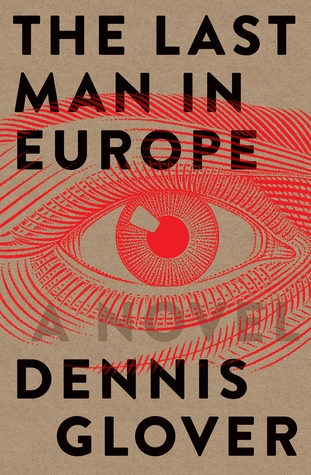
The Last Man in Europe

Rate this book
April, 1947. In a run-down farmhouse on a remote Scottish island, George Orwell begins his last and greatest work: Nineteen Eighty-Four.

Forty-three years old and suffering from the tuberculosis that within three winters will take his life, Orwell comes to see the book as his legacy – the culmination of a career spent fighting to preserve the freedoms which the wars and upheavals of the twentieth century have threatened. Completing the book is an urgent challenge, a race against death.

In this illuminating novel, Dennis Glover masterfully explores the creation of Orwell’s classic work, which for millions of readers worldwide defined the twentieth century. Simultaneously a captivating drama, a unique literary excavation and an unflinching portrait of a beloved British writer, The Last Man in Europe will change the way you understand Nineteen Eighty-Four.

288 pages, Paperback

First published July 3, 2017

52 people are currently reading
813 people want to read

About the author

Dennis Glover

17 books23 followers
Dennis Glover was educated at Monash and Cambridge universities and he has made a career as one of Australia's leading speechwriters and political commentators. His first novel, The Last Man in Europe, was published around the world in multiple editions and was nominated for several literary prizes, including the Walter Scott Prize for Historical Fiction. His second novel, Factory 19, was published in 2020, and his newest novel, Thaw, is forthcoming.

Ratings & Reviews

What do you think?
Rate this book

Friends & Following

Create a free account to discover what your friends think of this book!

Community Reviews

5 stars
199 (27%)
4 stars
319 (44%)
3 stars
146 (20%)
2 stars
47 (6%)
1 star
12 (1%)
Displaying 1 - 30 of 119 reviews
Profile Image for Michael Perkins.
Author 6 books471 followers
June 21, 2019
Compelling biographical novel about one of the greatest modern authors, George Orwell.

I had read and re-read his two most famous books, Animal Farm and 1984 (and, later, Homage to Catalonia) but did not know before how brave, heroic really, he was in his dogged pursuit of the truth, which he so brilliantly and fluidly captured in his work. I have tremendous admiration for him as both a writer and a person of courageous perseverance, even in the midst of serious health problems in his later years. He barely completed a fully revised and edited version of 1984 before he died of TB at age 46.

My favorite novel of 2017.

-----

"Orwell was one of those upon whom nothing was lost. (This included, as Orwell himself said: “the power of facing unpleasant facts”). By declining to lie, even as far as possible to himself, and by his determination to seek elusive but verifiable truth, he showed how much can be accomplished by an individual who unites the qualities of intellectual honesty and moral courage."

-Christopher Hitchens
Profile Image for Susan.
3,023 reviews570 followers
February 17, 2018
This fictional biography looks at George Orwell’s life from 1935, until his death in 1950, at the tragically young age of forty six. The central theme of the novel is the writing of, “1984,” on the island of Jura, when he is suffering from tuberculosis.

I have never read a biography of George Orwell, but this novel has left me keen to find out more about his life, as well as explore those books I have not yet read. “1984,” has long been one of my favourite novels and I enjoyed reading about the background and influences on the author; from his time in the Spanish Civil War, his work in the Second World War, where so much of his time was spent writing a round-up of the news to be broadcast to the Indian sub-continent, his time on Jura, his illness and his personal life.

Despite all the obstacles he faced, it was obvious that Orwell was driven to write, “1984,” and that the struggle he had completing the novel makes you marvel that it was ever published. “The Last Man in Europe,” was the working title and Dennis Glover offers up little snippets that you may recognise from Orwell’s books, or that really make you think (Sonia Orwell not visiting him in hospital after his will was finalised shocked me to the core…). If you are an expert on George Orwell you may not get much from this, but, as someone whose knowledge is very basic, it will hopefully encourage you to explore Orwell’s work, and life, in greater depth.
Profile Image for Roger Brunyate.
946 reviews745 followers
February 2, 2018
The Problem with Bio-Fiction
Jura, April 1947. It was his third day back on the island but the first he had managed to get out of bed. He knew what he had to do; transfer to paper the ceaseless, grinding monologue that had been working through his mind since… when? His days at the BBC? The betrayal in Barcelona? The discovery of the proles in Wigan? Those glorious summers of his youth? Prep school and HG Wells? He couldn't remember; perhaps the obsession had always been with him.
The opening paragraph of Dennis Glover's novel about Eric Blair, the man known to the world as George Orwell. It is virtually an index of what will follow. There will be chapters on his schooldays at Eton, his first struggles as a writer, the miners he befriended writing The Road to Wigan Pier, his volunteer service in the Spanish Civil War, the famous names he would meet as his own fame increased, and the onset of the TB that would eventually kill him. The last third of the novel takes him to that lonely farmhouse on the Scottish island of Jura where he completed his last novel, Nineteen Eighty-Four. "The Last Man in Europe" was apparently his working title, until he was persuaded by his publisher to change it.
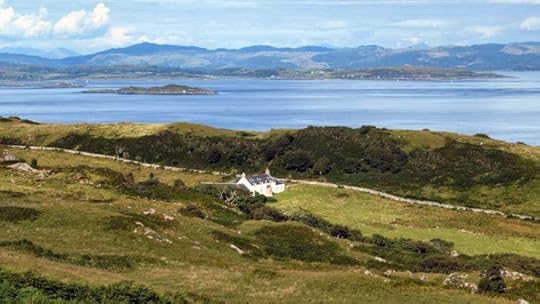

Orwell's house on Jura

I was drawn to the book by the poetry latent in that final phase, the dying writer in one of the least accessible but most beautiful parts of Britain. I have seen Orwell's house, Barnhill, only in photographs, but I know other Scottish islands and their special magic—also their utter bleakness when the weather isn't right. I learned a good deal of facts from this book by Dennis Glover, who has written only non-fiction up to now, but looked in vain for poetry, magic, or even some bleak pathos. If we know Nineteen Eighty-Four or other Orwell works, there is some amusement at seeing how this phrase or that plot idea might have taken shape. And Glover is good at explaining how an upper-class Englishman could first turn Socialist, and then end up writing two magnificent polemics against Communism and Totalitarianism respectively. But it is all facts. We are let into Orwell's mind only to be told what he is thinking; we seldom get to feel it for ourselves.

Here is an example where Glover at least comes close. But the mechanism is creaky—Orwell in 1941 looking through a diary from the year before—and just as it approaches some kind of inner revelation, he fritters it away in prosaic interrogation:
He could see now, though, it had all been wishful folly. The revolution has ended before it has even begun, and English socialism has been stillborn. He thought it rather a good thing; better for the revolution never to have happened than for it to have been betrayed, as it inevitably would have been. As his eyes drifted down the page, an underlined sentence stood our: 'Thinking always of my island in the Hebrides.' What could it mean? The Hebrides? Some idea of escape? Somewhere safe from the bombs? A last redoubt against Nazi terror? Somewhere, maybe, he could write in peace? He tried to recall scribbling these words in the diary, but couldn't.
======

This will be the 44th book on my Goodreads shelf I call "biography-fiction." It seems I am a sucker for the genre, even though it almost always disappoints me; there are many three-star ratings and very few fives. I think it has to do almost entirely with this question of inner life, and the problem is most acute when the subject is a writer. For what does a novelist or poet do but expose his inner thoughts through his published words, and what can a fiction-biographer add that is halfway relevant? Little or nothing.

As I look through my list of novels about authors, the few successful ones seem to be books in which the later novelist makes no attempt to explain the literary achievement of his model, let alone match it, but finds some other way to talk about an interesting figure who just happens to be a writer. Here are a few of the better examples, in my personal ranking; the links are to my reviews:

5* David Malouf: An Imaginary Life. Ovid. Malouf's success is that he takes one of the great myth-makers and in turn mythologizes him, enlivening his lonely exile with beautiful fantasy. In doing so, he absolutely captures the spirit of Ovid's work, by paralleling one kind of imagination with another that complements it without ever coming into conflict.

5* Damon Galgut: Arctic Summer. EM Forster. Although the central part of this novel shows Forster around the time of his last great novel, A Passage to India, Galgut is less concerned with explaining what Forster did write than what he didn't: his homosexuality that ultimately stopped him writing fiction altogether. His novel opens out the life of the notoriously shy author with daring, respect, and close empathy.

5* Helen Dunmore: Zennor in Darkness. DH Lawrence. Dunmore's debut novel makes no attempt at offering an analysis of Lawrence, or even painting a picture of him as a writer. Instead, she takes one specific period in his life, when he moved with his wife Frieda to the Cornish village of Zennor. But this was WW1, when there were U-boats off the coast; Lawrence was a writer with odd habits, and Frieda was German-born. Lawrence did not write about it himself, but there is no need for much invention; the plot is there for the taking.

4* Michael Cunningham: The Hours. Virginia Woolf. There have been other bio-fictions about Virginia Woolf, but Cunningham's is the most successful, since he parallels her story with those of two other women from later periods. Woolf is thus allowed her independence and privacy, yet the novel is nonetheless a multi-layered picture of her, partly though the sidelights shone on her by the other characters, and partly from the book's structure which closely follows that of some of Woolf's own works.

4* Jay Parini: The Last Station. Tolstoy. One secret of Parini's success is that he focuses on Tolstoy's final year, when he was no longer writing fiction, but was living a live of rustic simplicity as the head of an utopian community. The novel is thus about the tensions inherent in that situation and between the people around Tolstoy, and hardly about the great writer himself.

4* Christopher Nicholson: Winter. Thomas Hardy. Another writer in his final years (though still with some poetry left in him), his life in suspended animation like (in Coleridge's words) "silent icicles, quietly shining to the quiet moon." Nicholson's strength is that he explores every aspect of this setting, including Hardy's problem communicating with his much younger wife, but wisely does not attempt to go beyond it, either back to the past, sideways into the literature, or forwards to Hardy's death.
Profile Image for Nigeyb.
1,478 reviews407 followers
March 8, 2018
Well researched, however where do factual events end and fictional interpretation begin?

Dennis Glover takes a high risk approach to exploring George Orwell's life, rather than adopt the straight biographical approach of, for example, D.J. Taylor's 'Orwell', he chose to write a novel about the key moments in Orwell's life.

Initially I was very impressed by 'The Last Man in Europe' however, as I worked through the book, I started to find the novelisation technique intrusive. How did Dennis Glover know how Orwell was thinking or feeling?

Having read D.J. Taylor's 'Orwell' one thing that became clear was the extent to which Orwell constructed his own myth, and there are differences between that and the real person. Despite living in the twentieth century Orwell is a remarkably opaque individual. D.J. Taylor did a marvellous job of sifting through the evidence, such as it is, to allow the reader to make up her or his own mind. 'Orwell' is a nuanced and balanced assessment of a frustrating and complex man.

'The Last Man in Europe' allows no room for D.J. Taylor's nuance, something Dennis Glover acknowledges at the end of his book. He explains how he had to imagine the scenes and make best guess approximations of what Orwell was experiencing. The book is obviously well researched however the reader is often left wondering where factual events end and fictional interpretation begin.

'The Last Man in Europe' covers George Orwell's life from 1936 through to his death in 1950. During this period, Orwell wrote Keep the Aspidistra Flying, The Road to Wigan Pier, Homage to Catalonia, Coming Up for Air, Animal Farm, and 1984. The final two made him famous. Orwell’s determination to finish 1984 was probably what shortened his life.

The extent to which you enjoy it will probably depend upon your willingness to go along with Dennis Glover’s novelisation technique. It was not wholly successful for me however I would say, with confidence, anyone with an interest in Orwell will find plenty to appreciate in it.

3/5

Profile Image for Kim.
426 reviews541 followers
October 26, 2017

I love George Orwell's writing with a passion. I've read all but one of his novels, I'm slowly working my way through his collected non-fiction, I've read a biography and I have his collected letters on my to-read list. So when I heard about this novel, based in particular on Orwell's last years as he struggled to finish writing Nineteen Eighty-Four, I knew I had to read it.

I found it engaging, but it may be enjoyed more by a reader who knows less about Orwell's life. Dennis Glover is an Orwell scholar, so there's no real doubt about his passion for his subject or the accuracy of his research. I learned a bit, although not a great deal, about Orwell that I didn't already know and generally I liked the connections made between his life and his writing. However, at times I found the links between pretty much every scene in Nineteen Eighty-Four and some incident in Orwell's life a bit tenuous. Orwell may have been a better essayist than he was a novelist, but I'm prepared to credit him with at least some imagination.

That said, the account of Orwell's last months was deeply moving and I found the novel worth reading for that reason alone. I don't mean to imply that this isn't worth reading, though. It's a solid effort, well-written, well-researched and engaging. Definitely a worthwhile read for anyone who appreciates Orwell's work and wants to know more about him. Three and a half stars.
Profile Image for Lisa.
3,792 reviews493 followers
August 22, 2017
As I wrote in my previous post about the launch of Dennis Glover’s The Last Man in Europe at The Bookshop at Queenscliff, this novel is a fictionalised account of George Orwell’s life when he was writing 1984, (which was originally going to be called The Last Man in Europe). It’s an unusual kind of historical fiction, sticking closely to the historical record, exploring influences on Orwell’s writing, and supplemented with Glover’s imaginative reconstructions. It’s a book to appeal to Orwell enthusiasts and those familiar with his works especially 1984, but as to how it might work for people who haven’t read Orwell, I can’t say.

I think, however, that it’s actually quite courageous to write a book like this about such a famous author. Amongst his other accomplishments (see my previous post) Glover is a scholar of Orwell, but so are countless others, and there will be experts who read this looking for flaws rather than enjoying the ride. The advantage for the everyday reader like me is that pressure like that means we can assume that the facts are not in contention.

Written in serviceable prose without any authorial flourishes other than frequent flashbacks to illustrate the sources of Orwell’s ideas, Glover’s novel begins in 1937 with Eric Blair’s doubts about his future as a writer. Like many an author before and since, he was finding that apart from changing his name to Orwell, nothing much had changed since the publication of his first book. An old Etonian without financial resources to match, he yearned to be successful both from a personal and political point-of-view. Orwell was an intensely political creature, and like many intellectuals in Britain, he was a socialist because he believed that socialism would redress the inequality that he witnessed and wrote about in his books.

Today, when everything Orwell wrote is devoured by readers all over the world, it is hard to believe that his books were mostly ignored until the success of Animal Farm. Those books were fueled by his idealism and his disillusionment. In his all too brief life he had worked in the Indian Civil Service under imperialism; he had fought against fascism in in the Spanish Civil War. He had witnessed two world wars and a depression, and he had seen terrible poverty and shocking violence. By the time he came to write 1984 he was convinced that communism under Stalin was a terrible distortion of an ideal and he was appalled by what he knew of show trials and oppression. He also knew from having worked in the propaganda office during WW2 that even in a democracy truth was being warped in order to manipulate behaviour.

To read the rest of my review please visit https://anzlitlovers.com/2017/08/22/t...
Profile Image for Emma Monfries .
156 reviews6 followers
August 10, 2017
I am a huge fan of Orwell, and am a high school English teacher who has studied 1984 with many classes, and so my judgement is harsher than that of others. Above all, I found this novel disappointingly dull. The writing is nice, but not exciting, and the story didn't reveal anything new. Each scattered line from 1984 stood out starkly to me, but didn't mesh with the character of Orwell, because he is not Winton Smith and never needed to be, so I felt like that was clumsy. Eileen was supposed to be Julia too? No, it just didn't work for me. Good idea though. Recommended as an introduction to Orwell and/or 1984.
Profile Image for Melanie.
560 reviews276 followers
April 23, 2018
Interesting as I did not know much about Orwell as a person, despite having read quite a few of his books/essays. However, I would argue that this book mainly fails because it is neither a novel (but meant to be a novel) but it's also not non-fiction (and alas, it was meant to be a novel). I was quite sad as I had high expectations of this book and I can't but feel that the author missed the opportunity to be braver and give Orwell a real personality in the book. So ok, readable, certainly a quick read, but just neither here nor there.
Profile Image for Jennifer.
479 reviews7 followers
January 18, 2018
This is more than a fictionalised biographical novel. It delves into the writing process, political history, medical treatment. Of course, it traces parallels between Orwell’s experiences and those of Winston in 1984. I don’t think I am up to re-reading the horror that is 1984; this novel acts enough as a warning of the need to peoctect individual freedoms. I hope this novel raises some consciousness in its readers.
10 reviews
July 30, 2017
A heavy-handed, novelised, biography of Orwell's writing 1984. At great pains to show how each vignette directly informs a passage either from 1984 or Animal Farm and the poorer for it. Very readable but left me wanting a regular bio.
4,131 reviews29 followers
October 27, 2018
A fictional account of George Orwell focusing on his writing of animal farm and 1984, this book brings him to life. The author evokes Orwell's thoughts, ideas and beliefs so well, it often reads as an autobiography.
Profile Image for Margaret.
904 reviews36 followers
May 31, 2021
Focusing on the last years of his rather brief life, while occasionally diving back to earlier times - Orwell's part in the Spanish Civil War for instance - this fictional-though-based-on-fact account mainly has as its subject Orwell's last years on the Scottish island of Jura. This is a bleak and wholly unsuitable place for a man already dying from tuberculosis. Orwell was there to write his last novel, at first called The Last Man in Europe. We know it by the title he soon gave it - Nineteen Eighty Four.

The book is assured in painting a picture of Orwell's life in shabby-genteel poverty, of his somewhat cavalier attitude towards his colleagues and the women he bedded, and his wives, and most particularly of his changing political thought processes which would come to fruition in his last and probably greatest book. Now I need to go back and read the lot again.
Profile Image for Kate.
965 reviews16 followers
January 20, 2018
If you are interested in the life of writers, this is worth the read. I loved Animal Farm and 1984 but had no idea about George Orwell (Eric Blair)'s personal life. This book is kind of dragged out---not super interesting, but it does have tidbits and insights that make it worthwhile. The ending was a shocker for me---spoiler here----I never knew about the 1984 misprint, which of course, changes the whole meaning of the book.
Profile Image for Radiantflux.
468 reviews504 followers
March 20, 2018
26th book for 2018.

A imagining of George Orwell's life though his books. I found the book got annoying quite quickly. Orwell is presented in a very flat way – as if he was Winston in 1984 – with little complexity and little sense of his hopes or joys.

A major problem for a biography that sticks so close to his books is that Glover's own writing doesn't measure up to Orwell's. I have, for instance, just read Homage to Catalonia and Orwell's description of his experiences in Spain are markedly better in both tone and depth to Glover's own description of these events.

If you want an overview of Orwell's writing this is a good quick read, but I'd recommend either reading Orwell's books themselves, or a good traditional biography.

2-stars.
Profile Image for George.
235 reviews
June 18, 2019
A great book to give you some fictional insight into the time in Orwell's life leading up to the writing of 1984. The first third felt a bit forced with seemingly every moment being fodder for what ended up in the great book. Thankfully the other thirds moved more into the success of Animal Farm and slowly building up to the writing of the book.

Really enjoyable read and added so much to my recent re-reading of 1984. Problem is now I want to read a biography of Orwell to see what was true.
Profile Image for Kristin Vlasto.
7 reviews
June 19, 2018
I recently read ‘The Last Man in Europe’ by Dennis Glover; a fictionalisation of Orwell’s life, culminating in his finishing of ‘Nineteen Eight Four’. I devoured this book as it was about Orwell, but also cleverly mimicked his writing style (wow). Orwell had TB and knew he was dying, and was self-aware that this was impacting on his conception of the world, resulting in a work of grim dystopian fiction. Even on his deathbed he thought the novel was too bleak, that somehow Winston should be left with a glimmer of hope, but I know from my own reading of the novel that the lack of hope was the only natural ending for the novel. But it’s not all dark; Glover returns to the glorious scenes of ‘the Golden Country’ and captures how one idyllic memory can nourish a lifetime of fictional inspiration. But it is the following quote from Orwell that I keep coming back to, in all my anguish around the human race, and I’m not sure there will ever be a more enduring prompt about the human condition.

“If you want a vision of the future, imagine a boot stamping on a human face - forever.” George Orwell.
This entire review has been hidden because of spoilers.
Profile Image for Mark Dunn.
216 reviews7 followers
January 13, 2018
A good book to read for the times we’re in now...

I REALLY enjoyed reading this. Firstly, I wouldn’t recommend reading it if you haven’t read 1984. If you have, and you enjoyed it then I’d be very surprised if you don’t enjoy this book and I’d wholly recommend reading it.

In the writer, Dennis Glover’s own words, The Last Man in Europe is “a work of fiction, but one that attempts to keep as close to the historical facts as is possible without sacrificing the dramatic requirements of the novel form”.

The book covers the life of George Orwell, mostly from the mid-1930s all the way to the completion of 1984 and his death. It very nicely pulls highlights from that timeline that help to put 1984 in the context of his own experiences.

Despite having read 1984 a few times myself (plus “Down and Out��� and “Animal Farm”) I didn’t realise both the rich life experience Orwell had, especially in such a short lifetime (dying at 46). It also opened my eyes to the ravage and poor living conditions of the Second World War in Europe, and how much better we have it today.

A great read. This being his first novel, I’d also look out for any future books by Glover. Really well written.
Profile Image for Candace.
395 reviews
March 30, 2018
4.5 stars - The Last Man in Europe is Dennis Glover’s historical story of Eric Blair aka George Orwell and Orwell’s creation of 1984. You can tell much research has gone into the book and the narration follows Orwell as his health deteriorates from TB but then jumps back in time to show how and why Orwell wrote 1984. The novel is just under 250 pages and I feel as if I learned so much about Orwell the man and also about his vision for 1984. Thought provoking and interesting to the last page, I really enjoyed this book and plan on revisiting both 1984 and Animal Farm in the very near future.

I will definitely pick up the next book Glover writes, I enjoyed his writing style and found it very easy to read.


👁 🐀
Profile Image for Paulo Reimann.
379 reviews1 follower
February 17, 2019
Orwell rules

As an Orwell fan, this book isn't necessarily great. The writing style is slow, confusing and sometimes too speculative. I would stick with his original essays and books. Orwell himself is the greatest.
843 reviews5 followers
January 29, 2018
I enjoyed this biographical novel which enlightened me about Orwell and his writing. It shows his movement away from the far left, for which he fought in Spain, leaving him still a socialist though, despite what the right would have us believe. His belief that the power at both extremes of politics corrupts has proved true in so many circumstances. The account of his last illness and the struggle to complete 1984 is portrayed brilliantly and reading this has provoked the desire to reread both it and Animal Farm.
Profile Image for Niki Rowland.
322 reviews5 followers
June 4, 2023
My admiration and appreciation for George Orwell as a literary genius increases every time I learn more about him and his endless courage and perseverance to write.
Profile Image for Jonathan Gill.
58 reviews1 follower
May 21, 2020
Interesting dramatisation of George Orwell life and final works.
Profile Image for Gavan.
704 reviews21 followers
February 9, 2025
Interesting - but it felt more like a biographical description of Orwell's life than a novel. Hence a little "remote".
Profile Image for Sandra.
1,235 reviews26 followers
April 17, 2020
'Every book was the product of its time - not just its era, but the days and the circumstances in which it was physically created; it had to reflect that or not get written at all. Afterwards, a writer always looked back, thinking what could have been done better, but always knowing that once the book was set in type and cast in metal, it was unalterable.'

But is it???

I did enjoy this read about the writer George Orwell and the political preferences and climate that he lived in, further consolidated by his personal experience that inspired him writing the majority of his literary work but highlighting Animal Farm and 1984.

This book does outline the succinct moments of Orwell's life without being too heavy in detail. It is mainly focused on why he wrote and the circumstances he endured to finish his work. It has motivated me to re-read Orwell's work with fresh insight.
Profile Image for Malcolm.
263 reviews5 followers
July 25, 2017
Great writing, really captures the times in which Orwell lived and draws / extends on his life as captured in other source materials. Some reviewers have commented that links to his fiction (eg Room 101) aren't handled subtly but I didn't find that an issue. Enjoyed reading such clear evocative writing such that I flew through this one without wanting more, it is all in there. Other than I now need to go back and read 1984 again ...
Profile Image for Luke Johnson.
591 reviews3 followers
March 25, 2018
I think I may of gotten a little ahead of myself with this book. Basically, when I picked this book up from the shelf at my local library I opened the inside flap and read, "April, 1974. In a run-down farmhouse on a remote Scottish island, George Orwell begins his last and greatest work: Nineteen Eighty-Four." As soon as I read I thought to myself - Awesome! Here's a book about Orwell's time on Jura!! To be honest, I find this island located off the southwest coast of Scotland to be fascinating. Here's an island that is basically twice the size of Manhattan, and yet has a total population of 186 people. Compared to Islay, a very lush island further to the southwest (and island known as The Queen of the Hebrides), Jura has nothing. It's got one road, one hotel, one distillery (priorities people!), and not much more. This is an island known more for its red deer (the Norse term for which the island takes its name) and the rounded mountains that resembles breasts (the Paps of Jura). After having read the fictious "Burning Down George Orwells House" by Andrew Ervin a few years back I was excited for more.

Sadly, only a small portion of the book's contents actually deal with Orwell's time on the island that he described as "an extremely ungetable place". Though disappointing to me, it's not necessarily a bad thing as we get an account of Orwell's early life and career and his role in both WWI and II. The book is divided into four sections, section three being about his time on Jura writing 1984. I didn't feel like the author did a thorough enough job describing the bleakness of the island, the bleakness that does come through IMHO in 1984. Yes, the author does recount the well known tale of Orwell and his nieces and nephews getting caught in the Corryvrekan whirlpool and how far Orwell is from a doctor or even just neighbors. But to me it's no such much that he's rather cut off at Barnhill, it's that he's cut off on the ENTIRE ISLAND.

However, that's all just my own preferances and obviously not Mr Glover's. I guess my main complaint about the work itself is the sequence of events, namely the way the book does bounce at odd times between events in Orwell's rather short life. One minute it's 1949 and Orwell is slowly dying from TB complicated by the pneumonia, which he got from his dip in the Corryvrekan and never fully recovered from, on page 218 and then on page 222 it's 1920 and he's a schoolboy with an ill-fated crush. To once again go back to the boating accident, one page Orwell is cold and wet waiting three hours on some rocks before being rescued and then in the next section (same page I might add) Orwell is discussing with a friend who among their acquaintances is a communist or homosexual. The flow of the work just seemed so incredibly choppy to me in this section it just felt weird and very negatively played down the drama. The author does also, and perhaps rightfully so, make Orwell out to be a bit of a womanizer. Again, that's probably true but I didn't feel like it added anything to story. Yes, I did enjoy the sexual playfulness of Orwell's first wife but his other conquests failed to interest me.

So if I wasn't clear enough already this book is interesting especially in the way it shows Orwell's development of ideas and opinions that he would then put down on paper on 1984. Still, even though it is a short work (237 pages), I could of done without all the pages of complaints about pens and typewriters, the slamming of H.G. Wells, the random women Orwell does or at least tries to bed, and the way the book just ends flatly with his death. Would still recommend picking up if you are an Orwell fan though.
Profile Image for Blake Wilson.
16 reviews
January 31, 2018
I’m debating on whether to write my thoughts on totalitarianism or my thoughts on this barely fictionalized account of George Orwell’s life. Let’s dabble in both!

There’s a lot of discussion about what political ideology creates a truest form of utopia (if a utopia is even what these thoughts are striving for.) The flashback blurb to Eric’s (George Orwell) time in Eton (with Aldous Huxley (“Brave New World”) as his professor no less?!?) stuck out to me the most. There was only three total flashbacks, but the conversation, the ultimate goal of these wars and revolutionary efforts was laid bare in the conversation between the two literary giants.

“What if, instead of mandating communism, we gave the people what they wanted?” -Aldous
“You mean equality, sir” -George (Eric)
“No. What they’re actually asking for. I mean happiness - peace, nice clothes, an annual holiday at the seaside, an ice every day, free beer, oriental mistresses, everyone with their own motorcar and aeroplane. No work, no need to think or worry.”
“A society based on the principle of hedonism?”
“Yes, Blair. Shallow, gutless hedonism. Happiness! With little to complain about or agitate for, people will be easily governed don’t you think?”

It appears to foreshadow the coming totalitarianism (whether it’s that of the right or the left), that which promises an end to hardship only to turn into something much worse. A formula for pulling people into the shadow of a bloated government. People are lulled with the promise of the free and easy, to be cuffed and chained to a life of powerlessness over themselves. The author debates (internally it seems) about whether freedom inevitably wins out over totalitarianism, but the back and forth between young Orwell and Huxley ultimately answers the question. Without a struggle, freedom can not overcome. Without a struggle, happiness, all day every day, isn’t worth having. In other words, it’s not the triumph, but the struggle.

Also, worth noting is Orwell’s day at the park at the end of Part II. He realizes that the happiness he sees of the young and the old on a random sunny day, can’t be prescribed by the Marx’s of the world. Their happiness is within their own hands.

In terms of the story line, the history weaves into a seamlessly written biographical piece that’s sadly listed beyond the parameters of non-fiction. While reading it myself, I figured the non-written correspondence between two characters probably covered the majority of the fabricated (if only slightly) parts of the story. Well-written indeed, and it gives me a new perspective on the man behind the threats of an unpromised future of free men and women.

Side note: Pretty ironic that a self-proclaimed socialist for most of his life ends of becoming a wildly rich and famous author by the end. Mixed in with the atrocities of Stalin’s Soviet takeover and the turn of communists in Spain, no wonder Orwell seems pretty bitter and low on the lefty ideas of redistribution and economic “brotherhood”
Profile Image for TBV (on hiatus).
307 reviews70 followers
July 5, 2019
The Last Man in Europe is a biographical novel of Eric Arthur Blair (1903-1950), better known to us as the author George Orwell. Known initially primarily for his essays and reviews, George Orwell achieved great fame as a novelist with his later novels: Animal Farm and Nineteen Eighty-Four. The Last Man in Europe was his original title for Nineteen Eighty-Four which was written when he was already very ill from tuberculosis.

The Last Man in Europe traces Orwell’s political life as well as his writing and broadcasting career, staying as closely as possible to the facts with some small deviations for dramatic impact. These changes are mentioned in the Author’s Notes. This novel picks up Orwell’s life when Orwell had just finished writing Keep the Aspidistra Flying which was published in 1936, the Aspidistra being a metaphor for the middle class. Research into social conditions in northern England took him to Wigan, where he went down a mine and was appalled by what he saw. In 1937 his novel The Road to Wigan Pier was published.

Orwell was dismayed at the news from Spain and promptly set out for Spain at the end of 1936 where he joined the POUM (Partido Obrero de Unificación Marxista/Workers’ Party of Marxist Unification). Orwell was wounded in Spain, and later he had to flee with his wife Eileen. This is all historical fact, but as I do not wish to spoil the novel for you, I leave you to read the details. His memoir Homage to Catalonia (1938) was a result of his experiences in Spain during the Spanish Civil War.

Orwell had many interesting connections, and several of these people appear in this novel or are mentioned. A famous encounter with author H.G. Wells is recounted and amusingly fleshed out in this novel.

Orwell’s novels were frequently misunderstood, but Orwell made sure that his message came across. There is an amusing scene where he finds Animal Farm in the children’s section of a bookstore, and a poignant scene where he clarifies his intentions in writing Nineteen Eighty-Four. I loved some of Orwell’s observations in Dennis Glover’s novel, including when he comments on Nineteen Eighty-Four that it is “Positively gloomy”.

###
Extract from the Author’s Note:
“Every reader will have his or her own interpretation of the meaning of Nineteen Eighty-Four. My story attempts to demonstrate my view that Orwell’s nightmare future was not an imaginative work of science fiction (a genre he often criticised) but an amplification of dangerous political and intellectual trends he witnessed in his own time. The fact that something similar had happened already – in the forms of fascism and communism – gives even more force to Orwell’s warning that they can happen again, if we let them.”
527 reviews33 followers
January 27, 2018
This biography of George Orwell is presented as a novel, a life being lived, rather than the usual stand aside to observe and report mode of biography. It works quite well. In a jacket blurb , Thomas Ricks, author of the excellent 2017 book, "Churchill and Orwell," calls it "the biography--even though it is a novel--that Orwell deserves." It is a book heavily tinged with sadness, I thought. This bright man who eventually left an outstanding literary legacy, "Animal Farm" and "Nineteen Eighty-Four," spent most of his life grubbing for enough money to get by while suffering from debilitating TB, a disease that eventually killed him at age 46.. Glover's description of the surgeries undertaken to cure him is quite graphic, but Orwell's struggle to complete
"Nineteen Eighty-Four" while recovering is heroic.

A socialist, he became a target of the communist forces in Spain, his supposed ally, during the Civil War, fleeing with his wife Eileen while being hunted by Soviet agents. While leftist, he was not leftist enough for his communist combatants. He tells the story of his fighting against General Franco's forces and the Soviets in his book, "Homage to Catalonia." He went to war, in part, to make money from his war reporting.

He had earlier written a sociological study of poor coal miners in Scotland in his book, "The Road to Wigan Pier." Glover's book takes the reader into combat in Spain with Orwell and into the mines and lives of the miners in Scotland. Orwell's focused hatred of the Soviet state and his love of the workers lasted through Orwell's too short life.

Orwell pieced together many jobs and assignments, serving with the wartime BBC, serving on the editorial staff of a number of literary magazines, well known, and less so, and writing reviews and essays. All this work barely kept him solvent. With the publishing success of "Animal Farm" he finally had financial security, but his health was so compromised that he had little opportunity or time to enjoy it. His final years were dedicated to finishing what became "Nineteen Eighty-Four."
The title of "The Last Man in Europe" was taken from Orwell's title for the notes and ideas he began writing in his notebook, the origin of "Nineteen Eighty-Four." Both the latter book and "Animal Farm" remain in print and both are still read and studied widely for their depiction of totalitarian control and governance.

"The Last Man in Europe" provides an insight into both the man, George Orwell, and his times, the Thirties and Forties.


822 reviews40 followers
March 11, 2019
Because this is about Orwell, about his life-long inquiry into freedom and truth, this book is a compelling read.

This is biographical-fiction and Glover stays as close to the record as possible, taking us into Eric Blair's life as he fights on the side of the Communists in the Spanish Civil War, getting shot int he throat, as he descends into the mines of Northern England, as he works at the BBC, gets bombed in London during WW2 and as he writes, writes, writes. But mostly we accompany him in his awakening to the dangers of any extreme ideology. The fallacy of believing politics to be other than "power for its own sake...the essential philosophy of all rulers was the same: control, manipulation, coordination-the crushing flat of whatever joy life promised, under the guise of efficiency."

The focus point of the book is the last years of Blair's life as he struggles to complete 1984 (his original title was The Last Man in Europe.) Suffering from acute TB, Blair fights to stay alive long enough to finish his book. This is heart- in-the-mouth prose as the effect of the drugs he is taking to stabilize his breathing give him hallucinations, where he falls asleep midsentence, where he types out the manuscripts to send to his publishers himself as he barely can keep his head up. Truly, herculean. He dies one year after it is published, knowing it was a success but feeling also that he failed to convey his exact message. His message was that totalitarianism was not the rule of either communists or fascist exclusively, but shows up as a perversion to which any centralized economy is liable. And that it is up to each person to not let that happen.

As completely as Winston is taken over by Big Brother, Glover writes an Orwell who wanted to be wrong and still held out hope for some other outcome. Maybe. For sure, if Orwell was here in 2019, he would be distressed to see that he was right about people all along.

Dennis Glover does a solid job with this. Recommended for Orwell fans.
Displaying 1 - 30 of 119 reviews

Join the discussion

Can't find what you're looking for?

Get help and learn more about the design.