

What do you think?

Lonely Planet Melbourne & Victoria
Lonely Planet: The world's leading travel guide publisher
Lonely Planet Melbourne Victoria is your passport to the most relevant, up-to-date advice on what to see and skip, and what hidden discoveries await you. Get lost in Melbourne's laneways, drive the Great Ocean Road or hear the roar of the fans at the Melbourne Cricket Ground; all with your trusted travel companion. Get to the heart of Melbourne Victoria and begin your journey now!
Inside Lonely Planet Melbourne Victoria:
Colour maps and images throughout
Highlights and itineraries help you tailor your trip to your personal needs and interests
Insider tips to save time and money and get around like a local, avoiding crowds and trouble spots
Essential info at your fingertips - hours of operation, phone numbers, websites, transit tips, prices
Honest reviews for all budgets - eating, sleeping, sight-seeing, going out, shopping, hidden gems that most guidebooks miss
Cultural insights give you a richer, more rewarding travel experience - history, art, literature, cinema, music, architecture, politics, sports, cuisine, wine
Free, convenient pull-out Melbourne map (included in print version), plus over 50 maps
Covers City Centre, Fitzroy, Carlton, St Kilda, Richmond, Great Ocean Road, the Grampians, the Mornington Peninsula and more
The Perfect Choice: Lonely Planet Melbourne Victoria , our most comprehensive guide to Melbourne Victoria, is perfect for both exploring top sights and taking roads less travelled.
Looking for just the highlights of Melbourne? Check out Pocket Melbourne, a handy-sized guide focused on the can't-miss sights for a quick trip.
About Lonely Planet: Lonely Planet is a leading travel media company and the world's number one travel guidebook brand, providing both inspiring and trustworthy information for every kind of traveller since 1973. Over the past four decades, we've printed over 145 million guidebooks and phrasebooks for 120 languages, and grown a dedicated, passionate global community of travellers. You'll also find our content online, and in mobile apps, video, 14 languages, 12 international magazines, armchair and lifestyle books, ebooks, and more, enabling you to explore every day. Lonely Planet enables the curious to experience the world fully and to truly get to the heart of the places they find themselves, near or far from home.
TripAdvisor Travelers' Choice Awards 2012, 2013, 2014, 2015 and 2016 winner in Favorite Travel Guide category
'Lonely Planet guides are, quite simply, like no other.' - New York Times
'Lonely Planet. It's on everyone's bookshelves; it's in every traveller's hands. It's on mobile phones. It's on the Internet. It's everywhere, and it's telling entire generations of people how to travel the world.' - Fairfax Media (Australia)
0207Lonely Planet Melbourne Victoria is your passport to the most relevant, up-to-date advice on what to see and skip, and what hidden discoveries await you. Get lost in Melbourne's laneways, drive the Great Ocean Road or hear the roar of the fans at the Melbourne Cricket Ground; all with your trusted travel companion.0401http://media.lonelyplanet.com/onix-fe... Planet0101GOODREPRUSLonely Planet Global Limitedhttp://www.lonelyplanet.comIE04201711... AE AF AG AI AL AM AO AQ AR AS AT AU AW AX AZ BA BB BD BE BF BG BH BI BJ BL BM BN BO BQ BR BS BT BV BW BY BZ CA CC CD CF CG CH CI CK CL CM CN CO CR CU CV CW CX CY CZ DE DJ DK DM DO DZ EC EE EG EH ER ES ET FI FJ FK FM FO FR GA GB GD GE GF GG GH GI GL GM GN GP GQ GR GS GT GU GW GY HK HM HN HR HT HU ID IE IL IM IN IO IQ IR IS IT JE JM JO JP KE KG KH KI KM KN KP KR KW KY KZ LA LB LC LI LK LR LS LT LU LV LY MA MC MD ME MF MG MH MK ML MM MN MO MP MQ MR MS MT MU MV MW MX MY MZ NA NC NE NF NG NI NL NO NP NR NU NZ OM PA PE PF PG PH PK PL PM PN PR PS PT PW PY QA RE RO RS RU RW SA SB SC SD SE SG SH SI SJ SK SL SM SN SO SR SS ST SV SX SY SZ TC TD TF TG TH TJ TK TL TM TN TO TR TT TV TW TZ UA UG UM US UY UZ VA VC VE VG VI VN VU WF WS YE YT ZA ZM ZW017.76in025.04in030.71in08.904lb01197mm02128mm0318mm08.378kg03159781742202150BCLONELY PLANET (AMERICAS)US20320102Lonely PlanetTrade21.99USDUSZ
Lonely Planet Melbourne Victoria is your passport to the most relevant, up-to-date advice on what to see and skip, and what hidden discoveries await you. Get lost in Melbourne's laneways, drive the Great Ocean Road or hear the roar of the fans at the Melbourne Cricket Ground; all with your trusted travel companion. Get to the heart of Melbourne Victoria and begin your journey now!
Inside Lonely Planet Melbourne Victoria:
Colour maps and images throughout
Highlights and itineraries help you tailor your trip to your personal needs and interests
Insider tips to save time and money and get around like a local, avoiding crowds and trouble spots
Essential info at your fingertips - hours of operation, phone numbers, websites, transit tips, prices
Honest reviews for all budgets - eating, sleeping, sight-seeing, going out, shopping, hidden gems that most guidebooks miss
Cultural insights give you a richer, more rewarding travel experience - history, art, literature, cinema, music, architecture, politics, sports, cuisine, wine
Free, convenient pull-out Melbourne map (included in print version), plus over 50 maps
Covers City Centre, Fitzroy, Carlton, St Kilda, Richmond, Great Ocean Road, the Grampians, the Mornington Peninsula and more
The Perfect Choice: Lonely Planet Melbourne Victoria , our most comprehensive guide to Melbourne Victoria, is perfect for both exploring top sights and taking roads less travelled.
Looking for just the highlights of Melbourne? Check out Pocket Melbourne, a handy-sized guide focused on the can't-miss sights for a quick trip.
About Lonely Planet: Lonely Planet is a leading travel media company and the world's number one travel guidebook brand, providing both inspiring and trustworthy information for every kind of traveller since 1973. Over the past four decades, we've printed over 145 million guidebooks and phrasebooks for 120 languages, and grown a dedicated, passionate global community of travellers. You'll also find our content online, and in mobile apps, video, 14 languages, 12 international magazines, armchair and lifestyle books, ebooks, and more, enabling you to explore every day. Lonely Planet enables the curious to experience the world fully and to truly get to the heart of the places they find themselves, near or far from home.
TripAdvisor Travelers' Choice Awards 2012, 2013, 2014, 2015 and 2016 winner in Favorite Travel Guide category
'Lonely Planet guides are, quite simply, like no other.' - New York Times
'Lonely Planet. It's on everyone's bookshelves; it's in every traveller's hands. It's on mobile phones. It's on the Internet. It's everywhere, and it's telling entire generations of people how to travel the world.' - Fairfax Media (Australia)
0207Lonely Planet Melbourne Victoria is your passport to the most relevant, up-to-date advice on what to see and skip, and what hidden discoveries await you. Get lost in Melbourne's laneways, drive the Great Ocean Road or hear the roar of the fans at the Melbourne Cricket Ground; all with your trusted travel companion.0401http://media.lonelyplanet.com/onix-fe... Planet0101GOODREPRUSLonely Planet Global Limitedhttp://www.lonelyplanet.comIE04201711... AE AF AG AI AL AM AO AQ AR AS AT AU AW AX AZ BA BB BD BE BF BG BH BI BJ BL BM BN BO BQ BR BS BT BV BW BY BZ CA CC CD CF CG CH CI CK CL CM CN CO CR CU CV CW CX CY CZ DE DJ DK DM DO DZ EC EE EG EH ER ES ET FI FJ FK FM FO FR GA GB GD GE GF GG GH GI GL GM GN GP GQ GR GS GT GU GW GY HK HM HN HR HT HU ID IE IL IM IN IO IQ IR IS IT JE JM JO JP KE KG KH KI KM KN KP KR KW KY KZ LA LB LC LI LK LR LS LT LU LV LY MA MC MD ME MF MG MH MK ML MM MN MO MP MQ MR MS MT MU MV MW MX MY MZ NA NC NE NF NG NI NL NO NP NR NU NZ OM PA PE PF PG PH PK PL PM PN PR PS PT PW PY QA RE RO RS RU RW SA SB SC SD SE SG SH SI SJ SK SL SM SN SO SR SS ST SV SX SY SZ TC TD TF TG TH TJ TK TL TM TN TO TR TT TV TW TZ UA UG UM US UY UZ VA VC VE VG VI VN VU WF WS YE YT ZA ZM ZW017.76in025.04in030.71in08.904lb01197mm02128mm0318mm08.378kg03159781742202150BCLONELY PLANET (AMERICAS)US20320102Lonely PlanetTrade21.99USDUSZ
384 pages, Paperback
First published July 1, 2011
Ratings & Reviews
Friends & Following
Create a free account to discover what your friends think of this book!
Community Reviews
Displaying 1 - 5 of 5 reviews

Read
June 6, 2020During lockdown I started posting on Facebook some strange facts about Melbourne – I’m not even totally sure why I started doing this – all the same, here are the first dozen. This is not really a review of this Travel Guide
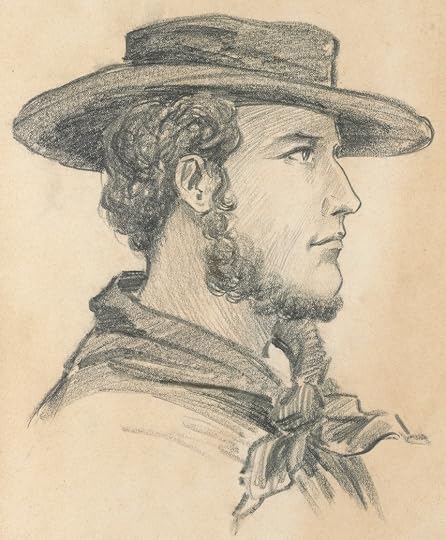
John Batman is often depicted wearing a scarf. This is symbolic, since in the last years of his life he developed nasal syphilis and lost his nose. He used the scarf to cover the open wound in the middle of his face. After he died his wife was kicked to death working as a prostitute in Geelong.
****
The motto for the coat of arms of Melbourne was given to the son of the first mayor by the first judge. It translates as ‘it gathers strength as it goes’. It is from Virgil’s The Aeneid. It is from where Aeneid and Dido start up their sexual relationship and rumours of it start to spread, and rumour being the swiftest of evils gathers strength as it goes. This was also the start of the great enmity between Rome and Carthage - and ultimately somewhat bad for Carthage. Sydney had better watch out, is all I’m saying.
****
Some of the streets in the west side of the grid run King, William, Queen, Elizabeth. People often think they were named after two people, when they were named after four. Governor King, King William IV, Queen Adelaide (Missus of said king), and Elizabeth Bourke, wife of Governor Bourke. Elizabeth had died a couple of years before this. Bourke and Elizabeth streets dissect the grid and there was talk of their intersection becoming known as ‘lovers’ corner’ - except most people just assume Elizabeth Street was named after a queen who died 300 years before.
****
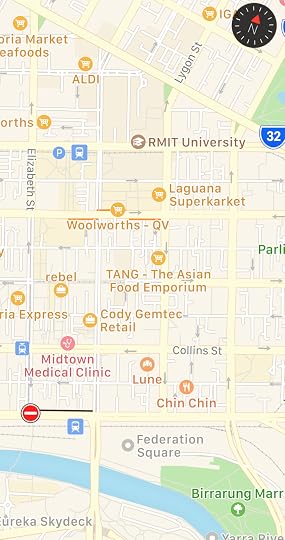
The Hoddle grid was set so that the streets would run north-south and east-west. But as you can see from the compass direction in the image below, the streets don't actually do that now. The reason why is that in 1835 the streets aligned with magnetic north and magnetic north shifts over time. As you can see, it shifts a lot. Lygon St now almost runs along magnetic north.
****
Batman wrote in his journal that ‘this will be the site for a village’. The problem is that all the things that make for a good village – close access to fresh water and fertile farming land – are destroyed once a city is built over the top of it. Part of the reason for choosing the site was the falls, depicted here with people of the Kulin Nation walking over them. Above the falls the water was fresh, below it was brackish. Some believe the falls may have been created by the Kulin. they were removed (by dynamite) in 1883.
****
In 1888, just before the crash of the land boom, the Anglican Church were encouraged to sell St Paul’s cathedral to a consortium who wanted to demolish the beginnings of works on the site and to build a multi-storey office building – parishioners decided against the sale by a single vote.
****
When government secondary schools were being introduced in Victoria, principals of private schools said governments had no right to compete in the ‘general business of education’ and wanted compensation for the potential of lost revenue. They lobbied to ensure that no government high school would be located in an area already adequately served by private schools. By 1921 there were 24 non-selective high schools in Victoria, but only one south of the Yarra. This ensured that virtually the only access to university was via a private education. In fact, it was not until the mid-1950s that Box Hill Boys’ High School became the first such school with a matriculation class.
****
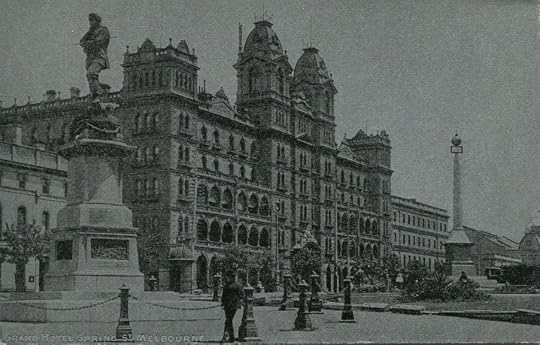
Melbourne was one of the first places in the world to win an 8 hour working day with no loss of pay. Given some people had been working 12 or 14 hours a day, six days a week, this was a significant improvement. The photo shows the 8 hour day monument when it used to live in Spring Street.
****
The car park at Queen Victoria Market was once the Old Melbourne Cemetery. Some of the graves were removed to Fawkner Cemetery in 1936. However, the register of burials was lost in a fire in 1864, that is, after most burials had occurred, and so many graves could not be identified or removed. In fact, of the approximately 9000 people likely to have been buried there, less than 1000 ever made it to Fawkner. Those buried in the Old Melbourne Cemetery believed they were going to paradise, but they ended up in a parking lot.
****
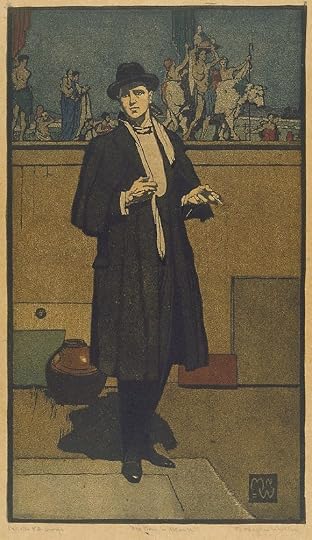
The linocut self-portrait below is of Mervyn Napier Waller from 1925. It is called The Man in Black. The recently reopened section of the State Library at the top of the marble stairs has the artwork depicted behind him in this portrait. You can see one of his murals in Collins Street on the front of Newspaper House. He also did the paintings on the walls of the Melbourne Town Hall. He lost his right arm in France in 1917 and had to learn to paint and write again using his left. It is believed he learnt to do linocuts while convalescing in France and England. Despite this self-portrait being completed 8 years after he lost his arm, as you can see, he has his right arm. Although, one of those behind him might not.
****
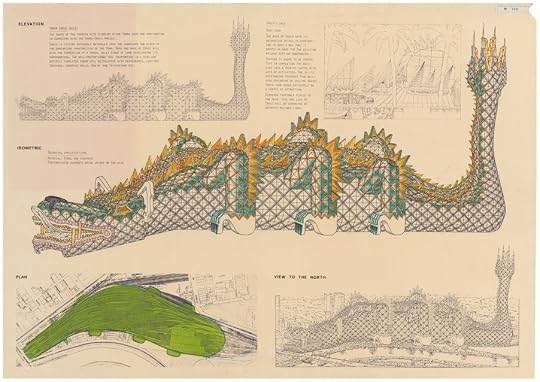
For a long time, Melbourne was very keen to have a landmark. In 1978, a $100,000 landmark competition sought a design to both cover the Jolimont rail yards and create a landmark that would draw tourists. 2000 entries were received. No single entry ‘won’ – not even, it turns out, this one.
****
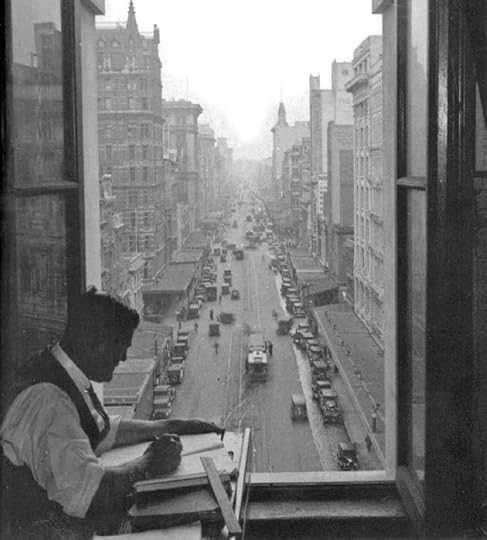
A photo looking up Elizabeth Street from Flinders Street Station. The tall building behind the man on the corner of Flinders Lane was, for 40 years from the 1880s, the tallest building in Australia. People even believed it was the tallest building in the world at one time – but this wasn’t true – others believed it had been the second tallest building in the world at one time. That wasn’t true either, but obviously harder to check. Despite it being listed with the National Trust, it was demolished in the 1980s.
John Batman is often depicted wearing a scarf. This is symbolic, since in the last years of his life he developed nasal syphilis and lost his nose. He used the scarf to cover the open wound in the middle of his face. After he died his wife was kicked to death working as a prostitute in Geelong.
****
The motto for the coat of arms of Melbourne was given to the son of the first mayor by the first judge. It translates as ‘it gathers strength as it goes’. It is from Virgil’s The Aeneid. It is from where Aeneid and Dido start up their sexual relationship and rumours of it start to spread, and rumour being the swiftest of evils gathers strength as it goes. This was also the start of the great enmity between Rome and Carthage - and ultimately somewhat bad for Carthage. Sydney had better watch out, is all I’m saying.
****
Some of the streets in the west side of the grid run King, William, Queen, Elizabeth. People often think they were named after two people, when they were named after four. Governor King, King William IV, Queen Adelaide (Missus of said king), and Elizabeth Bourke, wife of Governor Bourke. Elizabeth had died a couple of years before this. Bourke and Elizabeth streets dissect the grid and there was talk of their intersection becoming known as ‘lovers’ corner’ - except most people just assume Elizabeth Street was named after a queen who died 300 years before.
****
The Hoddle grid was set so that the streets would run north-south and east-west. But as you can see from the compass direction in the image below, the streets don't actually do that now. The reason why is that in 1835 the streets aligned with magnetic north and magnetic north shifts over time. As you can see, it shifts a lot. Lygon St now almost runs along magnetic north.
****
Batman wrote in his journal that ‘this will be the site for a village’. The problem is that all the things that make for a good village – close access to fresh water and fertile farming land – are destroyed once a city is built over the top of it. Part of the reason for choosing the site was the falls, depicted here with people of the Kulin Nation walking over them. Above the falls the water was fresh, below it was brackish. Some believe the falls may have been created by the Kulin. they were removed (by dynamite) in 1883.
****
In 1888, just before the crash of the land boom, the Anglican Church were encouraged to sell St Paul’s cathedral to a consortium who wanted to demolish the beginnings of works on the site and to build a multi-storey office building – parishioners decided against the sale by a single vote.
****
When government secondary schools were being introduced in Victoria, principals of private schools said governments had no right to compete in the ‘general business of education’ and wanted compensation for the potential of lost revenue. They lobbied to ensure that no government high school would be located in an area already adequately served by private schools. By 1921 there were 24 non-selective high schools in Victoria, but only one south of the Yarra. This ensured that virtually the only access to university was via a private education. In fact, it was not until the mid-1950s that Box Hill Boys’ High School became the first such school with a matriculation class.
****
Melbourne was one of the first places in the world to win an 8 hour working day with no loss of pay. Given some people had been working 12 or 14 hours a day, six days a week, this was a significant improvement. The photo shows the 8 hour day monument when it used to live in Spring Street.
****
The car park at Queen Victoria Market was once the Old Melbourne Cemetery. Some of the graves were removed to Fawkner Cemetery in 1936. However, the register of burials was lost in a fire in 1864, that is, after most burials had occurred, and so many graves could not be identified or removed. In fact, of the approximately 9000 people likely to have been buried there, less than 1000 ever made it to Fawkner. Those buried in the Old Melbourne Cemetery believed they were going to paradise, but they ended up in a parking lot.
****
The linocut self-portrait below is of Mervyn Napier Waller from 1925. It is called The Man in Black. The recently reopened section of the State Library at the top of the marble stairs has the artwork depicted behind him in this portrait. You can see one of his murals in Collins Street on the front of Newspaper House. He also did the paintings on the walls of the Melbourne Town Hall. He lost his right arm in France in 1917 and had to learn to paint and write again using his left. It is believed he learnt to do linocuts while convalescing in France and England. Despite this self-portrait being completed 8 years after he lost his arm, as you can see, he has his right arm. Although, one of those behind him might not.
****
For a long time, Melbourne was very keen to have a landmark. In 1978, a $100,000 landmark competition sought a design to both cover the Jolimont rail yards and create a landmark that would draw tourists. 2000 entries were received. No single entry ‘won’ – not even, it turns out, this one.
****
A photo looking up Elizabeth Street from Flinders Street Station. The tall building behind the man on the corner of Flinders Lane was, for 40 years from the 1880s, the tallest building in Australia. People even believed it was the tallest building in the world at one time – but this wasn’t true – others believed it had been the second tallest building in the world at one time. That wasn’t true either, but obviously harder to check. Despite it being listed with the National Trust, it was demolished in the 1980s.

January 4, 2019
3 - 3 ½ stars
May 9, 2021
external reviews say not very accurate

July 21, 2022
More in-depth guide for planning itinerary for Melbourne and Victoria region. 👍🏻👍🏻👍🏻
August 25, 2012
we used it on our travels and had to discover that it had quite a few mistakes. for some places it is highly exaggerating the touristic attractivity and therefore sometimes misleading.
Displaying 1 - 5 of 5 reviews