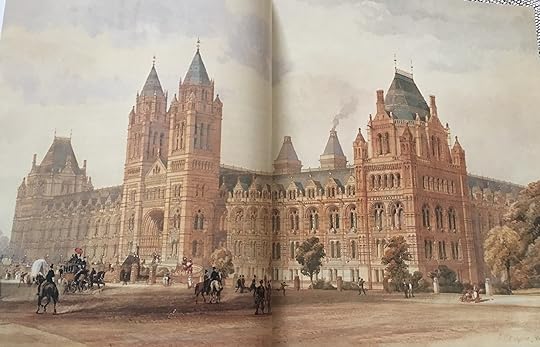
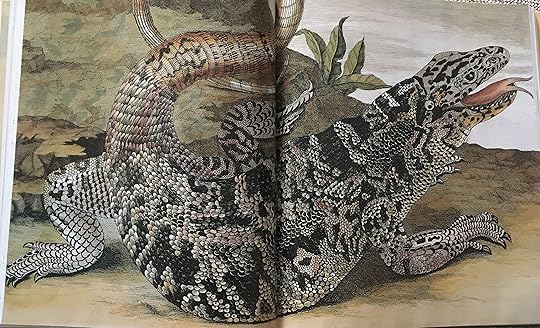
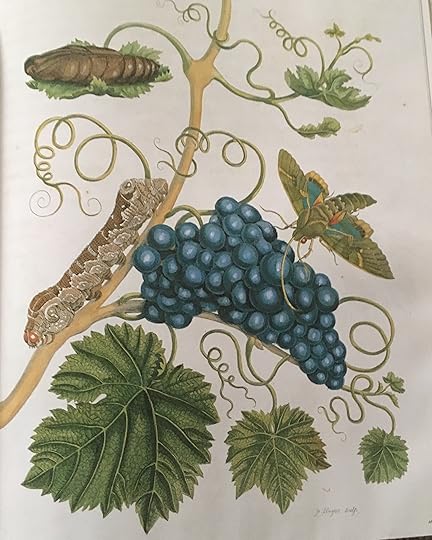
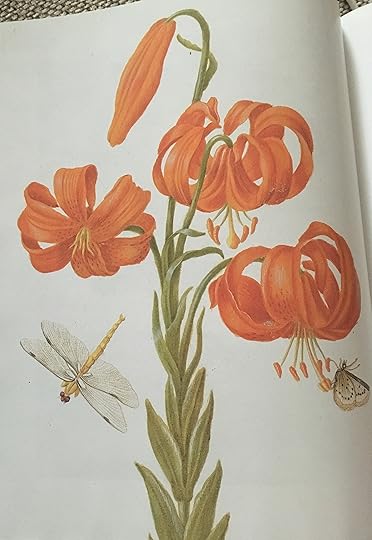
This is another one of the books I grabbed when I was in London's Natural History Museum and though it's quite heavy and not exactly small, I don't regret it in the slightest.
In 10 chapters it tells of journeys around the world that became significant to the scientific community. We thus go to Jamaica, Ceylon, Surinam (this one was especially interesting because the journey was undertaken by a woman), cross the Pacific with James Cook, return to the South Sea with him in the following chapter, chart Australia, sail on board the Beagle, accompany Alfred Russel Wallace to Amazonie and experience the Challenger Expedition to the depths of the ocean - exploring about 3 centuries of natural history (from the 1600s to the late 1800s).
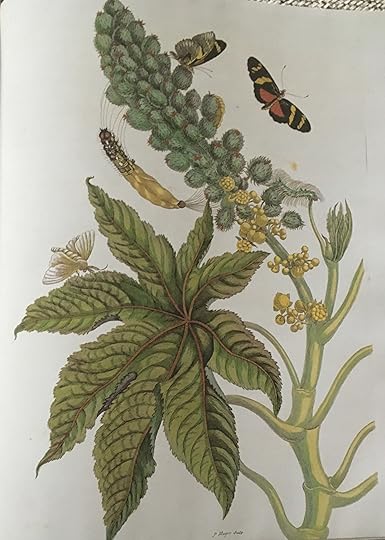
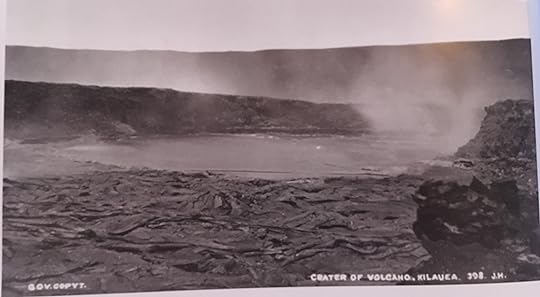
The book is interspersed with the respective naturalist's sketches, drawings and paintings or, in case of the more recent voyages, some photographs even.
I preferred the chapters about the really old expeditions and thus also the artwork from way back when, but it was an interesting look at the progression of the field and the travels themselves. It also illustrates the progression of technology helping with exploring our world.
The writing style was not as captivating as in other books, sadly, but the topic itself was interesting enough to still make me read through this. And I have to admit that the most important part was the scientists and to see their way of cataloging plants and animals and drawing conclusions from their observations - to say nothing of all of them having apparently been quite talented artists.
Brief overviews of (mostly british) exploring with large format drawings of beautiful plants and some animals and maps. Subtitle says it all:" a visual celebration of ten of the greatest natural history expeditions" has some William Bartram in se USA area, Hans Sloane in Jamaica, Maria sibylla merian in Surinam etc. Has a selected biographies, brief bibliography, brief index. All pictures mostly from libraries of natural history museum London
Can't go wrong with a collection of old natural history illustrations. This one sampled Sir Hans Sloane and his Jamaica collection; Paul Hermann, Johan Gideon Loten and Pieter de Bevere and their Ceylon survey; Maria Sibylla Merian and her Surinam collection; William Bartram and his North American collection; James Cook, Sir Joseph Banks and Sydney Parkinson and their Pacific samples; James Cook, and Johann and George Forster and their South Pacific collections; Matthew Flinders and Ferdinand Bauer and their Australian survey; Carles Darwin and his Beagle journey illustrations; Alfred Russel Wallace and Henry Walter Bates and their Amazonian adventure samples; and samples from the Challenger expedition, which was one of the first of its kind in the 1870s, in that it had a scientific agenda and used new technology to investigate the ocean depths.
Science illustrations are one of my favorite parts of studying the history of science. This book is a beautifully assembled collection of some of the greatest hits of natural history.
This book was more pictures than words, as it rightly should be, being a showcase of illustrations from the natural history museum. The introductory write ups for each chapter were proficiently done, going into just sufficient details on the personalities of each historical voyage, the logistics and travel itinerary, without getting overly bogged down. This is useful for those who want a primer on the more famous naturalists like Darwin, Bates, and Wallace, before heading for the enormous and more thorough literature about them.
Artists were truly the unsung heroes of the Age of Discovery leading up to the late 19th century, without which visual representations of fauna and flora (and for that matter landscapes and peoples of new places) would not be available to the rest of the world, and saved for posterity, in the era before the advent of photography. Indeed, they were just as critical to the mission as the sailors and scientists on these epic voyages.
A collection of singing praises to the massive and rather impressive collection of the Natural History Museum in London. It details the early expeditions taken by daring voyagers centuries prior to current day. This gigantic coffee table book focuses down on not only those that spearheaded the voyages themselves, but the artists that were hired to paint landscapes, botany specimens, and animal life as they were found.
Though the age of exploration was truly remarkable, I wouldn’t treat this as an accurate historical representation of such. Very few words dictate this tome and they say incredibly little about the trials, tribulations, and encounters that systematically spurred the demand for the slaughter, collection, and objectification of animals, plants, and humans alike. It simply sings the praises of discovery and its artistic contributions to the museum.
Sure, that’s a pretty remarkable accomplishment, but as far as historical accuracy goes this book falls short. It’s to be taken as an art book, nothing more. Perhaps an inspiration to visit the museum, but not much more.
Before I read this, I never really thought much about people cataloging new species when they ventured to the "New World". Very interesting, and the pictures are great...what the scientists and artist accomplished, especially before modern classification systems, is remarkable.