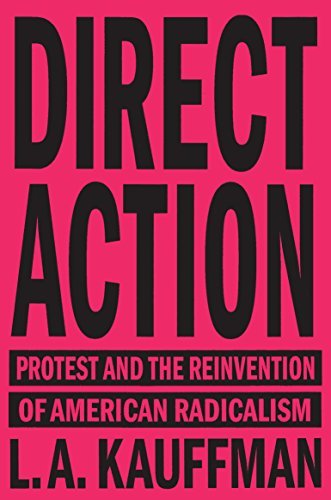
A longtime insider explores the origins of modern protest movements like Black Lives Matter and Occupy Wall Street, offering a groundbreaking history of disruptive protest and American radicalism since the Sixties As Americans take to the streets in record numbers, L.A. Kauffman’s timely, trenchant history of protest offers unique insights into how past movements have won victories in times of crisis and backlash and how they can be most effective today. This deeply researched account, twenty-five years in the making, traces the evolution of disruptive protest since the Sixties to tell a larger story about the reshaping of the American left. Kauffman, a longtime grassroots organizer, examines how movements from ACT UP to Occupy Wall Street to Black Lives Matter have used disruptive tactics to catalyze change despite long odds. Kauffman’s lively and elegant history is propelled by hundreds of candid interviews conducted over a span of decades. Direct Action showcases the voices of key players in an array of movements—environmentalist, anti-nuclear, anti-apartheid, feminist, LGBTQ, anti-globalization, racial-justice, anti-war, and more—across an era when American politics shifted to the right, and a constellation of decentralized issue- and identity-based movements supplanted the older ideal of a single, unified left. Now, as protest movements again take on a central and urgent political role, Kauffman’s history offers both striking lessons for the current moment and an unparalleled overview of the landscape of recent activism. Written with nuance and humor, Direct Action is essential reading for anyone interested in understanding the protest movements of our time.“The best overview of how protest works—when it does—and what it’s achieved over the past 50 years.”—Rebecca Solnit, The New York Times
My rating is rounded up from 2.5 stars. There have to be better books on this subject... Details various organizations and their direct actions from 1970's to Ferguson but not much of a political perspective from the author besides broad definition of "left". It mostly focuses on white-led groups, noting how much trouble they had uniting with people of color but doesn't offer much valuable insight on the problem before moving on to the next thing. Like reading a long wikipedia article. The pic of the book is neon pink but mine is neon green.
In 2014, I participated in my first direct action: a die-in at the university mall where I went to school, in solidarity with Ferguson activists facing the knife edge of militarized police brutality. It was a little surreal to read a book which ends on Ferguson and the burgeoning Black Lives Matter movement, when that's (arguably) where my activism began.
Direct Action by L.A. Kauffman is essentially a crash course on the American direct action landscape since the 1970s, which wasn't exactly what I was expecting. Rather, I had hoped for a little more focus on the specifics of tactics, training processes, and evolving attitudes towards direct action. As someone who has participated in quite a bit of front line activism at this point, I'm always interested to learn more about innovative strategies, because I always come away with something from them that I want to bring into our planning today. We have a wealth of knowledge and tactical know-how to inherit if we know where to look. I am still trying to amass that experiential knowledge.
To be clear, the book does cover these things, but relatively cursorily. Kauffman acknowledges that this work has severe holes in its coverage; for example, indigenous activism is only lightly touched upon in relation to environmental organizing. The book primarily follows the trajectory of white-led and PoC-led activism, marking the differences in issue focus and in tactics throughout the end of the 20th century. There is an unfortunate recurring failure of white-led groups to identify and meaningfully dismantle implicit racism from their movements, and while the book charts the slow improvements on this front, it is still not resolved. Especially in the sphere of arrestable action, I have personally witnessed the breakdown in communication between activists of color and their supposed white allies around the level of risk we are willing to take on. It's a balancing act I continue to work in, and I appreciated being able to foreground that work in a decades-long process.
Additionally, the extremely creative breakthroughs in action developed by feminist and queer activism are given their flowers, much to my appreciation. I had no idea some of the central tactics we continue to use in activist circles were developed in these movements, and I'm glad to pay respect where it is due.
In sum, I share with other reviewers a desire for a little more detail in places. The Combahee River Collective, for example, was only lightly mentioned despite the incredible amount we owe it for pushing intersectional work forward. But for what this book is, I found it very readable and very helpful as an introductory text. The footnotes in the back and the various speeches, interviews, pamphlets and movement literature referenced in it further supplies ample avenues for continued research. 4 stars!
This book was invigorating in a way I did not expect. As a person that has participated in direct action on and off for the last 20 years, it was great to see myself and my peers reflected in this story as part of a legacy of global resistance.
More importantly, it helped me understand the roots of the movements and tactics that I inherited. While I lived the tension between the Bay Area and NYC hip-hop inspired (mostly socialist) POC organizers and the overwhelmingly white anarchists, I didn't know the history and wasn't informed of the efforts my predecessors (like the sisters from Combahee) had made to intervene and confront the white, straight, and male complexion of the many campaigns employing direct action. SO many of the concerns that had long swirled in my mind were validated on the pages of this book.
Direct Action ends on a promising note. With the emergence of the Black Lives Matter movement, those who have long been pushed to the margins in direct action work are again at the center. However, as we all know, after BLM came Standing Rock and then The Women's March and then antifa and now we are looking at the re-emergence of a global climate justice movement with Extinction Rebellion. Will we just backslide into the old ways or will the new formations be truly intersectional? Only time and struggle will tell. But one thing is evident both from the book and my lived experience: much of the work of transforming the world lies in more rigorous and self-reflective prefiguration. See adrienne maree brown's Emergent Strategy for that ;)
"Kauffman does not hesitate to address the flaws and weaknesses of some of the groups she studies. She points out that direct-action enthusiasts who advocate voluntary arrest will often alienate people of color and others who routinely face violence from the police.
Prefigurative movements can incubate useful ideas and methods that affect wider society, changing the frame of what's seen as possible, but at their worst, they become a way to retreat from the pursuit of concrete victories in the outside world."
–Sarah Jaffe on L.A. Kauffman's Direct Action: Protest and the Reinvention of American Radicalism in the Feb/Mar 2017 issue of Bookforum
read this last summer - found it to be a super compelling history of protest movements in the united states. so many of the challenges organisers faced in the second half of the last century are apparent today. it ends with black lives matter. would love for a similar history to be written about lefty groups in the netherlands.
This was extremely interesting to me, it’s really a history about radical direct action in US after the 60s told by an activist. The author makes it a very readable and somewhat hopeful (though often depressing) story.
There was definitely a lot of “ultimately they did not achieve their goals or get their demands…but their tactics were influential to people that came after them.” I still don’t know how I feel about those parts because, I mean, who cares if it’s influential for future activists who also don’t achieve their goals? But the author also doesn’t try to make it out to be an arc that inevitably bends toward justice. I think the reality is just that obviously, from a leftist activist perspective, a lot of this history is simultaneously hopeful, energizing, and profoundly depressing. Gotta keep on keeping on though.
great, to the point, pictures were useful - a maybe too rosy assessment of what can be done with this type of politics though even with all the asterisks.
That was nice and easy read. I liked it. But I do feel a bit annoyed that I read these things that are solely focused on North-America. I'm not just less interested in the US, but also annoyed by its cultural dominance and my decision to consume it. The links and inspiration that many of these movements had with European movements also seems to be a bit underplayed. I would love to read a European version of this. I am reminded of the Subversion of Politics and Geronimo's Fire and Flames, but they are of a different and lesser quality.
It starts with the mostly forgotten big 1971 Mayday action, that I loved reading about, and goes on until Ferguson protests of late 2014. For a book that covers 40 years of radical actions and organizing in less than 200 pages most of what is covered understandably lacks detail. Because of that it is sometimes not that easy to see how all these different campaigns and groups are connected. But I like how it was quite reflexive, trying to gauge strategic merits of all these different groups, their successes and failures. A red line throughout the book is also its reflection on race. How the direct action has always been very white and how they dealt with that.
The author, L.A. Kaufman has spent three decades as an organizer. This is her attempt to distill the past fifty years of protest history.
Ugh, alright. This book is a pile of unanalyzed evidence. It’s testimony in the name of testimony. While there’s value in preserving these stories, that isn’t what I wanted from this book. I wanted some guidelines for moving forward. It seems a little foolish to trace the genealogy of direct action when the left is so splintered. The perspective of each group is so fundamental to their actions, that an analysis like this is bound to be incoherent. (The author needs a better editor). I wanted a guide for action, but this is a storybook. You could viciously rebuke me, claiming that direct actions are inherently creative acts which reflect too many variables for them to be elucidated in any book (or whatever tactics will probably change soon anyway). Anyway, I would rather have read something besides this book.
Since the 60’s we’ve seen a profusion of leftist political identities, alongside a massive decrease in the left’s influence Direct action has many definitions. Martin Luther King used, “Nonviolent direct action seeks to create such a crisis and foster such a tension… that a community which has constantly refused to negotiate is forced to confront the issue”
One: Mayday Largest ever direct action. As a response to the vietnam war, on may 3rd, 1971, 25,000 people attempted to shut down the government. The government anticipated the action, and arrested 7000 people in one day. While the protest failed, it still managed to spook Nixon. Wow, inspired by police murders of protesters at Kent State and Jackson State, by May 1970 “it’s estimated that half the country’s student population-- perhaps several million youth--took part in antiwar activities” They even burned + bombed almost one hundred campus buildings with military ties. Many organizers were beginning to burn out. The antiwar movement fractured into a Socialist section who marched (lame), a pacifist section who did sit-ins (better), and an alliance of the most politicized hippies with the hippest radicals. The final group is the one which sought to shut down the govt.. Their plan was to strategically obstruct traffic with bodies and vehicles, a tactic adopted from earlier civil rights organizers. (for the civil rights group there was a massive backlash of public opinion, tho their tactic worked). Mayday action established the precedent for affinity groups. The groups of 5-15 people plan their role for the action, allowing the event to be more decentralized (which helped accommodate the diversity of identity groups involved). Wow, the New Left had groups which were so much more militant than anyone today. Affinity groups can be criticized as allowing “the tyranny of structurelessness”. While apparently democratic, the lack of structure in affinity groups enabled informal and unaccountable power dynamics to flourish. The movement’s true leadership was hidden by this and allowed to be completely unaccountable to the affinity groups. The author quickly profiles a gay contingent of the Mayday protest. They pioneered the zap, “a unique tactic of confrontation politics, combining the somber principles of realpolitik with the theatrics of high camp” … “At a time when government surveillance and disruption of radical movements were both routine and highly damaging, the exuberant eroticism of the Gay Mayday Tribe doubled as a form of protection.”
Two: Small Changes The 70’s were a dispiriting time for leftist organizers. They grew increasingly cynical about the possibilities for change. The groups working most actively were also the most violent groups. Their bombings and kidnappings alienated the mainstream public. A massive economic crisis lead many to refocus their efforts away from activism. Similarly, the end of the vietnam war lead many to quit protesting. The left began to organize around a plethora of identity groups. Whoa: the guy who first supplied guns to the Black Panthers was a longtime FBI informant New inspiration for protesting came from the clamshell alliance, a group of anti-nuclear activists. Their tactic was basically the same as Occupy: they occupied. In their case that meant planting trees and corn at the site of a proposed new nuclear plant. Their tactic delayed the construction of the plant by a decade. Many other groups subsequently adopted it. Another interesting aspect of the Clamshell alliance is that they organized themselves like quakers; using “voteless decision-making”. Instead of taking votes, they would come together to assess the spirit of the group. The practice is based around the religious conviction that the disparate perspectives will eventually converge on god’s truth. If the group doesn’t reach agreement then they take no action (at least in the quaker model). In part this served as a sort of ‘pre-figurative politics,’ which means treating the movement as a rough model for what society will look like; a.k.a prefiguring. (the author notes that prefiguring became popular at a time when it was becoming increasingly difficult to achieve external change, which made the internal soul-searching of these pre-figurative actions more appealing). Consensus-based decision-making is beneficial in that it helps empower marginalized voices. The process can be amazingly convoluted and sluggish though. The process could also be undermined. For instance, one anti-nuclear group was divided when a politician offered them a better protesting location so long as they agree to leave after several days. The decision had to be made rapidly, and so some people accepted the terms on behalf of the whole protest, without ever consulting the protesters. After the lengthy, painful planning process, this sudden unconsulted shift felt like betrayal. The group was also divided on a key decision of whether or not to physically shut down the nuclear plant. 2500 people attacked the fences, only to be repelled by tear gas and fire hoses. One organizer later acknowledged, “we made a big mistake, partly just out of political immaturity. We elevated direct action to a politics instead of just a tactical choice.” The author describes various racist practices within direct action groups. There’s an overview of direct action against apartheid. First, several prominent leaders arrive at the South African embassy to present a list of demands to the ambassador. Unexpectedly, they’re arrested. The next day they bring more people with them. They’re arrested again. The number of people coming to be arrested at the embassy swells rapidly, bringing critical attention to apartheid. Success! There was a similar sort of action on college campuses. Students began to build shanty towns in prominent places as a way of demonstrating the squalor of blacks in South Africa, while forcing confrontation with administration…. There was tension between black activists and white ones. They disagreed on tactics. Blacks were more cautious because they were treated worse by the police. Whites, on the other hand, had a romantic image of being arrested.
Three: In Your Face The left got into the real bad habit of protesting party conventions during election years; the democratic one especially. These were aimless, ineffectual actions aimed against a confused political party. Ugh. One of the key innovations during this time was that punks began to go to protests. They were rowdy and vaguely nihilistic, but at least their rage was focused outward onto mainstream society (as compared to the more introspective culture of the progressive protesters). During this time various conservative groups began to use direct action tactics. There’s an account of a protest aimed against the CIA for intervening in Central America. An uneasy coalition of labor, religious people, and progressives protested. Meanwhile 1000 people worked to block access to the CIA. OK, it seems like the work of organizing people is based around the idea of convincing them to do media-savvy actions. They need to force confrontation in a way that presents their complaint as ‘common sense’. The challenge is not only defining the right message, but also convincing activists to buy-in to actions that will have a broad appeal. A lesson: “they took a white-defined and white-led movement and tried to diversify it through subsequent outreach, an approach that was doomed to fail” A conference intended to initiate a new national movement faces an old divide. One group, inspired by the Social Democrats of the New Left, wants to use the time to find the most appropriate issues to engage. Another group, more anarchist in its character, wants to follow a prefigurative program; supporting the notion that their activism should be more about “how we want to live” than about tackling whatever issue. One black group nearly boycotting the entire conference because of the low number of students of color involved in deliberation. Though it was discovered that many black student groups decided not to participate because of their distaste for direct action. “Environmental Action, the fairly moderate group behind te first Earth Day, openly and actively encouraged ‘ecotage,’ with little concern that the tactics would be viewed as extremist. The group even held a contest for the best sabotage tips” “Daniel and Phillip Berrigan-- militant catholic brothers… undertook a series of “Plowshares” actions, in which they used hammers to damages actual nuclear weapons, generating huge amounts of publicity for their cause.” “What most distinguished this crop of activists was how the viewed themselves in relationship to mainstream America. Where both Greenpeace and Plowshares opted for a prophetic role, undertaking actions that they hoped would appeal to the consciences of millions, the new wave of radicals had little expectation of gaining widespread sympathy for their positions… Their basic strategy was… ‘Make it more costly for those in power to resist than to give in” There’s a profile of HIV medication group ACT UP. They were incredibly successful. Many members quit all other activity after discovering their HIV infection in order to organize. They did risky activities, like disrupt news, and barricade governors in their homes. They cleaned up each others’ shit, and attended each others’ funerals. The movement brought gays and lesbians together in palpable way (earlier they had been suspicious of each other). “The political grounding that the lesbians gave to ACT UP was complimented by the sensibility and skills of the movement’s most notable neophytes: affluent white gay professionals with considerable cultural and financial capital at their disposal” … ACT UP fostered a splinter group, The Lesbian Avengers, which emerged as many gay activists were burning out. The avengers substituted sweetness for anger, handing out balloons and lollipops to kids… “Just three years after their first ACT UP direct action, members were already seeing a declining rate of return from their dramatic tactics” Earth First! Is profiled. Many of the early members of the group were misanthropes, who wanted to see nature left alone. When the 90’s rolled around, those members were outnumbered by more socially-minded people who were willing to build coalitions with loggers and other interest groups.
FOUR: TURNED UP In 1995, a coalition of activists supporting gay rights, affordable housing, cheaper tuition and opposing police brutality, blocked all four manhattan bridges in response to mayor Giuliani's major budget cuts. Also in 1995, President Clinton approved a large amount of logging on public land. To counter that, Earth First environmentalists devised numerous new ways of constructing human shields to block roads. The principle was to attach someone to something that would be difficult to remove without injuring the person. Also around this time, more groups addressing ecological racism began to emerge (former environmentalism had been mainly white, and focused on the preservation of wilderness rather than the welfare of people). The WTO protest happens. Police respond to blockade tactics by using pain-compliance. They rub pepper spray in people’s eyes, a dangerous thing to do. The action featured prominent “carnivals in the street”. 9/11 happened, and activism died way down. Ugh. Largest world protest ever happened against the Iraq War. A million people protested in NYC alone. While the groups were large, they weren’t militant. This raises the question of whether the most important part of a protest is numbers or tactics. At around this time police began to become more aggressive. Occupy Wall Street is detailed. It’s all real familiar. Black Lives Matter comes next. It, too, is real familiar. And that’s Direct Action
This entire review has been hidden because of spoilers.
I came to Direct Action after listening to Kelly Hayes’s interview of L.A. Kauffman on the Movement Memos podcast. The interview, performed in the post-Trump-presidency but pre-pandemic world of the 2019, was about the efficacy of protests, and I very much enjoyed listening to Kauffman’s learned and generous take on protesting. For the past 4 months or so, my wife and I have been actively learning about the intertwined histories of fascism and antifascism along with the political history of the 20th century. Direct Action arrived at our house at about the same time as Howard Zinn’s memoir You Can’t Be Neutral on a Moving Train and Mark Bray’s Antifa: The Anti-Fascist Handbook. All three books are about the same length, and wanting to read all at once, I did just that, rotating between books after each chapter. Since all three books are history books dealing with similar time frames, there was a neat crossover between them. But for now, I’ll stick to the topic, Kauffman’s excellent history of protest in America after the 1960s.
The book is divided into 4 chapters, with each chapter being about 50 pages. The first chapter focuses on the last major protest in America over the U.S.’s involvement in Vietnam—the Mayday protest in Washington, D.C. on May 3rd of 1971. She uses the organizing and tactics of the protest to discuss the historical approaches the protest both inherited and worked against. The second chapter looks at the period after the end of the Vietnam War to the early 80s. It was a time, as she characterizes it, of cynicism and small group work. Kauffman looks at the various collectives that formed around various identities, fighting for specific issues rather than for “universal” causes. She looks at the Combahee River Collective, among other organizations. She also looks at the bigger single-issue causes that became big with influential protesting techniques, specifically the Clamshell Alliance’s protesting of the building of the Seabrook Nuclear plant in New Hampshire, and the anti-apartheid protests that appeared on college campuses and students tried to get their various universities to divest in companies that supported apartheid regimes. In the third chapter, Kauffman covers the ‘80s and ‘90s, starting with the protests at the 1984 Democratic National Convention, moving on to ACT UP and the protests surrounding the American government’s failed policies to address the AIDS/HIV epidemic, as well as the queer and lesbian movements for visibility and acceptance. The final chapter looks at the late ‘90s and the 21st century, from Earth First! Protests, the WTO blockade in Seattle, the Occupy movement, and finally coming to Black Lives Matter and the sustained uprising in Ferguson over the murder of Michael Brown.
Kauffman is interested in tracing the historical movements as well as the ever changing and growing ways of protesting. Approaches and techniques were borrowed from the most successful protests, and as the media and the world got used to (and bored of) those techniques, they would change and grow again. The book is not only educational but inspiring. She is interested in what makes a protest a successful protest as much as she is in the history of protesting, and in her estimation, judging success is not an easy thing to do. Sometimes what looks like a failure has a long-lasting impact and a far-reaching influence. And it is fascinating to see how those influences reach across movements and ideologies as protestors learn from each other. Because Kauffman is as much an activist herself as she in an historian, she knows all the planning and organizing it takes to sustain any movements, and she looks not only at the public-facing side of events but at the behind-the-scenes actions as well.
I really enjoyed this book and have filled my copy with marginalia and underlining. I find myself needing to re-learn a lot of history that I have lived through because you can only see so much from where you stand. This is the history of the last 53 years from the lens of protests and it’s a compelling picture of our modern era.
**Direct Action: Protest and the Reinvention of American Radicalism** by L.A. Kauffman is a historical and analytical account of grassroots protest movements in the United States from the 1970s through the early 2000s. The book examines how activists have used direct action tactics to challenge power, resist oppression, and build new political cultures, with a focus on creativity, decentralization, and community-based organizing.
Key concepts and actionable ideas:
* Defines direct action as a strategy of disruption:
* Rather than working through formal political channels, direct action seeks to exert immediate pressure or draw attention through physical, visible, and often confrontational tactics. * Examples include sit-ins, blockades, banner drops, and street theater.
* Traces lineage from civil rights and antiwar movements to new radical forms:
* Post-1960s activism evolved to emphasize horizontal structures, collective decision-making, and anti-authoritarian values. * Movements like ACT UP, Earth First!, and anti-globalization protests pioneered new organizational models.
* Emphasizes affinity group organizing:
* Small, autonomous groups operate with high trust and flexibility, allowing for quick decisions and tight coordination. * Encourages building networks based on solidarity rather than hierarchy.
* Champions creative resistance:
* Art, music, costumes, and satire are not peripheral but central tools in reframing issues and energizing participation. * Culture jamming and theatrical protest make complex messages more accessible and engaging.
* Highlights the role of consensus decision-making:
* Activists reject top-down leadership in favor of participatory processes. * Emphasizes patience, trust, and facilitation skills as necessary for effective collaboration.
* Connects protest to broader movement-building:
* Direct action is most effective when it is linked to sustained organizing, education, and alternative institution-building. * Tactics should not be ends in themselves but part of long-term strategy.
* Addresses challenges of burnout, repression, and internal conflict:
* Encourages care practices, conflict resolution, and awareness of activist sustainability. * Recognizes the emotional labor of organizing and the need for collective resilience.
* Frames radicalism as reinvention:
* Contemporary radical movements are not simply continuations of old ideologies but active re-creations based on present-day conditions. * Innovating tactics and structures is key to remaining relevant and effective.
* Argues that direct action reshapes not just politics, but participants:
* Engaging in protest transforms how people relate to power, community, and themselves. * Activism fosters agency, connection, and alternative visions of how society could function.
This book is both a history and a practical reflection on protest as a transformative force. It calls for bold, imaginative, and participatory approaches to change, offering lessons for current and future movements striving for justice and systemic reform.
There are numerous books, which delve into the rise of the New Left movements of the 1960s. They chart their struggles, how the government targeted them, and their eventual fall and disintegration. The legacy of the Left in the Sixties looms large over left-wing activism. Yet, while it may not have the same folklore, movements have pressed on in the past decades.
L.A. Kauffman's book fills that void of knowledge by piecing together a history of the left from the early 1970s to the Black Lives Matter movement. She astutely chooses to focus on the tactic of direct action to explore the combination of identity politics or intersectionality issues, which organizers have had to confront to grow movements. She recounts the ways in which direct action failed to appeal to poor and working class people of color because they were vulnerable.
From Earth First! to ACT UP to Catholic anti-nuclear activists, Kauffman offers concise portraits of the genesis of key groups. She sharply interrogates the history, unpacking what worked and what failed, so that those organizing and resisting oppression now can draw inspiration.
Each era, activists will put their own spin or mark on the tactic of direct action. Organizers cannot mimic history. They have to figure out what variation or innovation they can employ to solidarity activism and do what will work best for their efforts to build power or achieve demands.
Edifying, impressive recounting of the coalitions on the left that formed, fought, broke up since 60s thru BLM. Appreciated the details on the ethos informing different movements, motivating groups, and how they adjusted (or didn’t).
I gained a huge appreciation for organizers trying to both change the world - whether it’s getting more resources poured into hiv drugs or fighting against mass incarceration- and bring along a range of characters motivated by different ethos.
I learned a lot about the reality that each movement requires bringing together different people with different outlooks and perspectives on how to make decisions, what to fight for, what tactics to use, what training to require, etc etc and that is HARD to do. And at the same time that it’s so worth it for the victories that can only be achieved by rolling up our sleeves.
And I appreciated more that some people are motivated by such different things from myself, and they’re not dumb but they’re just working towards different aims. This book made me understand that in the context of organizing goals (eg some care that whatever movement they’re in adopts principles and sort of creates an alternative reality more than they focus on changing our larger systems).
Recommend to anyone interested in how we can make a change in our political and economic systems.
A surprisingly good book that weaves the long line of direct action from the 1971 May Day protest to the present. Kauffman is an insider to many of these movements, which shows from her diverse amount of materials she has about them as well as the interviews she conducted. Perhaps best of all, she doesn't shy away from the racial and class limits that subsumed many of these movements. She also makes a fairly convincing case that women of color, women in general, and queer, lesbian, gay, etc. communities had a leading role in many of them. Although this claim doesn't hold true for all that she says, it nonetheless punctuates the book enough to validate her point.
Perhaps most interesting is the way she gets at the complexities of the various movements investigated. She explores how they succeeded but also where they have failed or the potentialities that they held but never released. The books shows a nuance that reveals how long she has been working on the book (around 25 years) as well as her involvement and intimacy with such struggles. Probably the best thing written as of lately addressing a long historical trajectory of social movements for the past 50 years.
Main takeaways: The US government is built to resist change. They have been infiltrating groups of protesters across all political and human rights groups for a century to sow distrust and spark internal failures of the organizations before they become too effective at affecting change. Also, white people are more likely to initiate violent/highly disruptive direction action because they are less likely to be as targeted/severely brutalized by police. When white men dominated protest/radical culture, BIPOC individuals were consistently not heard or not even considered/left out, and women were constantly being sexually harassed and assaulted at protest events. The intersectional feminist movements led by BIPOC and queer women that have been growing and organizing since the mid 20th century are the most democratic (all voices heard before plans are made) and relationship-building of the radical movements.
We have to Stan. I’m for once not adding this to the must read list, but it’s really interesting. This is a history book, and I for one and I think most people (at least younger people who didn’t live through all this) don’t know about many of the direct actions that have gotten us where we are now. I consider myself pretty up on AIDS protesting, but I didn’t know very much about women’s lib, anti nukes, WTO, and other influential movements since the 60’s, and how all their successes and failures introduced intersectionality and new protest methods that are more common now. It was published in 2017 and of course this is a topic that will always be changing, but I feel like that’s especially true right now with the movement for black lives. It’s not so old that it doesn’t touch on BLM but I’ll have to put a more up to date and specific BLM book on the lefty list.
at times, crafts a carefully articulated narrative of direct action rippling with emotion that makes me want to drop everything and go (depending on... the movement in question lol). certain movements are detailed in a rush (glaringly: the combahee river collective), and the selection of movements is narrow. i understand that if this is an overview of "direct action" radicalism as opposed to other forms of activism, that may be intentional. but i wonder about the title of this book-- does this tell a story of the "reinvention of american radicalism? are direct action and radicalism analogous and if not (...they aren't) why not?
Really interesting history of direct action and protest from the late 1960s through the 2010s. It would have been interesting to hear Kauffman's take on what has happened since 2017. I appreciated how human her storytelling is and her use of direct quotes. She interviewed tons of people for this book, which was being formed for 25 years. Her detailing of the specific failures of movements and actions has helped me think through my own organizing. This includes whiteness and racism and which decision-making processes work the best. Even the organizing itself - from affinity groups to hub-and-spokes to leaderless actions - makes me think about how best to achieve victory.
A clear well written history of major direct action events within American history since May Day 1971. Kauffman spends a lot of time highlighting the changes movements underwent as they were presented with critiques, and how often racial issues became central to coalition building. While not comprehensive probably in many respects, it does a good job highlighting the most present actions and how they were carried out. Well worth the read if you're unsure of how protests and tactics have changed since the vietnam anti-war protests and why.
(From my notebook) The book ended more suddenly than I expected; for some reason I thought there would be writing on the 2020 uprisings (probably because I saw that the book ended with BLM, not realizing it meant its earlier history). Overall, this book has a lot of information for someone interested in the topic, and it clearly took a lot of time, effort, and love to create. I personally found "Midnight in Chernobyl" to be a more captivating read of a history, but the important part is that I learned a lot of practical information. This is why I don't like rating things...
very informative, if a bit dry (especially considering the author herself was involved with many of the actions discussed). nonetheless required reading for anyone who considers themselves a leftist or progressive, as their is wisdom to be gleaned from past actions, whether they were successes or failures - and in fact this book invites us to question what it is that makes a direct action successful, as even something that doesn't directly affect policy can still have an impact.
She examines the protests movements from the later part of the twentieth century and their use of direct action practices, as well as how those practices have changed and evolved over the years. She particularly emphasizes the influence of civil rights and feminism on these movements. Anyone interested in progressive movements today should read this book to find out our history, our successes and failures and the theories behind direct action.
giving up on this one. I generally have a hard time with history, so this may be my own fault, but the narrative is super rambly and goes in weird loops and I'm just having a hard time following. I'd love to know all about these groups, but maybe I just need a different format to consume this information.
Kauffman adds a critical but often-ignored layer to movement history as she traces identity politics, and especially race, through leftist organizing beginning in the 70s. I found this extremely useful, even though there were times I would have liked more detail, especially more direct sources rather than her reflection.
This is a survey of major direct action campaigns since 1971. Loved it. I learned a lot as I have been involved in the Ferguson movement as a resident of Ferguson. Kauffman shows how we got here in terms of various social movements and why the #BlackLivesMatter movement is the way it is. Easily read.
Provided an incredibly informative perspective on how direct-action has evolved to how we recognize it today (including the legacy of whiteness in post-civil rights activist circles). Highlights the essential rolls of women and BIPOC in providing the framework for successful activism today, even though many of the largest movements were grounded in white-male identity. The main absence is indigenous activism which I would have loved to hear more about. It's a bit dense, but I felt the flow picked up as I got more into the interwoven stories of the different movements.
Really fascinating look at the last 5 decades of direct action in the US—there is so much context and history I had no idea about. I love that the author connects the struggles and advances of all sorts of direct action movements over the years. It was also interesting how culture, from hippies to punks, influenced the philosophy of organizing tactics.
This book is all about the American left. Which is written in the title. But I didn't want to read any more, because there's more to the world than USA, and I don't want to get used to seeing everything through the lens of the USA.
This is a great, if somewhat brief, history of radical action in America from the late 60’s to (almost) the present day. It does a great job of explaining exactly why radical politics lost so much steam after 1968, and gives a good deal of hope that all may bot be entirely lost.
Relevant overview of the history of direct action and the wider development of the US protest movement starting with the anti-war movement around Vietnam. A bit academic but filled with useful insights sure to give the reader hope about the slow but steady progress of resistance.