Written for ages seven to ten, The Shakespeare Collection is an irresistible retelling of Shakespeare's most popular plays in storybook form. Written by experienced children's authors, the stories have been reviewed by Kathy Elgin of the Royal Shakespeare Company and contain extracts from the original texts. Illustrated with full-color and black-and-white drawings throughout, these lively books make Shakespeare accessible to a young audience, sparking a lifelong interest in the Bard and his world.
Anthony Masters was a writer, educator and humanitarian of exceptional gifts and prodigious energy. He was, in the parlance of his spiritual ancestors, the ancient mariners, that rare voyager "as gracious as a trade wind and as dependable as an anchor".
He leaves 11 works of adult fiction – notably, Conquering Heroes (1969), Red Ice (1986, with Nicholas Barker), The Men (1997), The Good and Faithful Servant (1999) and Lifers (2001) – and was in the process of completing another, Dark Bridges, which he thought would be his best. Many of these works carry deep insights into social problems that he gained, over four decades, by helping the socially excluded, be it by running soup kitchens for drug addicts or by campaigning for the civic rights of gypsies and other ethnic minorities.
His non-fiction output was typically eclectic. It ranged from the biographies of such diverse personalities as Hannah Senesh (The Summer that Bled, 1972), Mikhail Bakunin (Bakunin: the father of anarchism, 1974), Nancy Astor (Nancy Astor: a life, 1981) and the British secret service chief immortalised by Ian Fleming in his James Bond books (The Man Who Was M: the life of Maxwell Knight, 1984), to a history of the notorious asylum Bedlam (Bedlam, 1977).
My game plan for revisiting Shakespeare was to stream video of a staging of the play, listening and watching, while reading along to as much of the original text as was incorporated by the staging. Later, I read the entire play in the modern English version.
The staging I found for Macbeth was the 1971 film adaptation directed by Roman Polanski, adapted by Polanski & Kenneth Tynan and shot by Gilbert Taylor, the legendary director of photography on Dr. Strangelove, Repulsion and Star Wars. Starring Jon Finch as Macbeth and Francesca Annis as Lady Macbeth, the production is handsomely mounted, enthralling and spooky, no surprise since this was Polanski's follow-up to Rosemary's Baby.
Historians believe Shakespeare wrote Macbeth in 1606 for the King of Denmark on a visit to his brother-in-law King James I in London. Shakespeare may have drawn inspiration from Ralph Holinshed's Chronicles of England, Scotland and Ireland, which the Bard consulted often in his research. Macbeth ruled Scotland from 1040-1057 A.D. and per Holinshed, conspired with his wife, his aide Banquo and several others to murder Duncan, a rival chief with whom Macbeth held a grievance. Macbeth may have also consulted with "three women in evil apparel" who spun certain prophecies. Macbeth engaged in a series of murders to protect his rule and was eventually revenged by Duncan's son, Malcolm.
A reigning superstition in the theater is that Macbeth is so unlucky that to even utter the title or quote from it on stage will invite disaster. Among theater groups, referring to it as "The Scottish Play", "The Scottish Business" or simply "that play" are preferable to tempting fate by saying the name Macbeth. Constantine Stanislavski, Orson Welles and Charlton Heston all suffered some woe after a performance. Abraham Lincoln apparently read the play the night before his assassination. The bad luck is said to originate from the Witches Song in Act IV, Scene 1, which if the rumors are to be believed, has the power to literally raise hell. Or, the fact that the play is performed in dim lightning with heavy swordplay and stuntwork might account for the freak accidents associated with it.
The play lives up to its sinister reputation. It's one of the darkest and most potent dramas I've read.
Macbeth opens with three witches, the Weird Sisters, commiserating on a Scottish heath as a storm brews. King Duncan arrives on a battlefield with his sons Malcolm and Donalbain to be notified that a rebellion backed by the King of Norway has been repulsed by Macbeth, thane of Glamis. Macbeth and his fellow nobleman Banquo are stopped by the three witches after their great victory and issued a pair of prophecies: that Macbeth will assume the title of Thane of Cawdor and eventually, King of Scoland. A messenger then notifies Macbeth that due to his capture of the traitorous Thane of Cawdor, Duncan has bestowed upon him the villain's title.
In spite of his battlefield honors and favor of the king, Macbeth is none too pleased when Duncan announces that his son Malcolm will inherit the throne. Macbeth returns to his castle at Inverness, sharing with his wife Lady Macbeth that three witches have predicted his rise to power. The little missus doubts that her husband has the mettle to take what is his. When the king arrives to spend the night, Lady Macbeth hatches a plot to disable the king's bodyguards with drink, allowing her husband to slip into the king's room to murder him, laying the blame on the king's men.
Uncertain of his ability to commit regicide, Macbeth is pushed by his wife and manages to carry out the crime. He catches a break when the king's sons flee Scotland for their own protection, sewing suspicion that they may have killed their father. Macbeth is crowned king, but his celebration is short lived. Fearing that Banquo and his boy Fleance will ferret out Macbeth's guilt, he hires murderers to ambush father and son. Banquo is vanquished protecting his son, but during a banquet, Macbeth sees the ghost of his old friend at the table and makes a spectacle of himself, much to Lady Macbeth's displeasure.
Another nobleman, Macduff, distances himself from Macbeth, fleeing to England rather than risk attack. The king responds by sending murderers to slaughter Macduff's wife, children and servants. As forces gather against Macbeth, he pays another visit to the witches. They conjure three apparitions, which tell Macbeth to beware Macduff, that no one born of woman will harm Macbeth and that no harm will come to him until the forest of Birnam Wood advances on his castle. In spite of these predictions, Macbeth and his wife discover it's lonely at the top, and that fate works in mysterious ways.
Macbeth is a gangster movie. Unwilling to pay their dues, the thane of Glamis and his wife resort to violence to rise to the top in a fashion that Tony Montana would approve of. And in gangster movie style, the couple's unchecked ambition gets them exactly what's coming to them. The play is drenched in highland atmosphere, with witches, superstitions, skullduggery, hallucinations and duels. It's eerie, bloody and contains some of most powerful dialogue to be found in Shakespeare. Act V, Scene 5 is particularly memorable, with Macbeth realizing a little too late that "All our yesterdays have lighted fools the way to dusty death".
The dilemma faced by Macbeth and his wife -- whether to play the game or grab what's coming to them by any means necessary -- is more relevant to the human condition today than it was in 1040 A.D. The appearance of the witches and their cryptic predictions lend the play a dark and unsettling mood, as if Macbeth's plot had been seen from a hundred miles away and is going to end badly in spite of what his conscience is telling him. It's a quickly paced play with terrific inner monologue by Macbeth and Lady Macbeth as they debate their course of action and thrills as their plot meets its ends. The characters may not be the most complicated in Shakespeare, but they may be the most cursed.
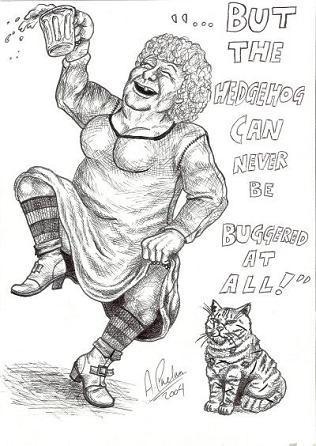
MACBETH - Pussy-whipped Thane of Glamis, then Thane of Cawdor, and later, King of Scotland
Lay Macbeth - Scold of Glamis
King Dunkin - King of Scotland (played by Sheerluck in a crown)
Ban-quo, affectionately known as StatusQuo to his mates
Malcolm Donalbain Fleance MacDuff's son Young Siward ------------------------all played by What-son!?
A Baboon
And
Nanny Ogg and her two Weird Sisters ::[image error]::
~~~~~~~~~~~~~~~~~~~~~~~~~~~~~~~~~~~~~~~~
NB - IN THIS STREAM OF CONCIOUSNESS-ESQUE RENDITION OF THE SCOTTISH PLAY, PLEASE TAKE IT AS FACT THAT ANY CHARACTER MENTIONED IS LOOKING STRAIGHT INTO THE CAMERA LENS, THEREFORE COMING EYEBALL TO EYBALL WITH YOUR GOOD SELF.
Mists and belching, dig-dip, digging. Thunder, lightening, dripping firs And a bevy or three. And singing.....
Nanny Ogg: How now brown cow, who comes this way? 'tis the Pussy-Whipped One And His side-kick Just as we foresaw, forsooth. And here the tale is told.
I watched the Joel Coen Macbeth movie with Denzel Washington, and since I was a bit dissatisfied by that adaptation, I thought I'd try another one right away to compare, and boy is this one so much worse.
I felt the Coen flick was too dominated by a director who wanted to let you know he was directing dammit!!! from the use of black-and-white stock to the super elongated shadows to the bizarre elevation of Macbeth's cousin Ross from minor messenger in the play to major character in the film. Meanwhile, Denzel's Macbeth was too withdrawn, reserved, and monotone for me.
But at least they didn't dumb down the material to the degree this adaptation does. Of course, the plot and language are simplified for an audience of children, but sheesh. I suppose it will serve to at least familiarize kids with the story so they are better prepared to tackle the original later in life, unless the pure cheesiness puts them off ever attempting that.
At least it made me feel a little better about the Coen film.
Reading the No Fear version is the next best thing to having a teacher guide the way through a story that I’m certain I would have missed a good deal of.
I definitely liked it, but not as much as Shakespeare's other plays. I loved how wicked and manipulative Lady Macbeth was. I hated Macbeth for his greed and being naive. Some lines in this play really spoke to me, like Macbeth's soliloquy about the dagger - I know it's not anything special, but he's talking about seeing something that you think is real but it is not in reality. I guess you can just see that speech from another perspective when taken out of context.
Update (2021): I always think of Macbeth as my favorite play by Shakespeare. My initial reaction is always different than the lingering effect.
As an adult reader, I am reading Shakespeare's play for the first time. About four scenes in, I started to feel frustrated with how much time it is taking me to grasp the language. I thought it might be a good idea to read a general, engaging overview before diving back into the original text. Enter: Coville's Macbeth picture book adaptation. This was an excellent introduction to the storyline of Macbeth, and I feel a lot more inspired to return to the play with these stunning visuals (by Gary Kelley) in mind.
3.5/5 i think cause i am reading this for school i just cant like it more than 4 stars sorry but this was actually fun to read still i was entertained but there was still quite a bit to unpack so yeah not bad lady macbeth is highkey a baddie
From Goodreads: In its concentration of interest upon the protagonists, Macbeth can be seen as Shakespeare's experiment in unity of focus, whose chief appeal arises from the struggles of the central characters with each other and with the infernal powers that inspire or govern them. Ok, whatever. It’s freakin’ MacBeth. By that dude Shakespeare.
I will admit that I am not a fan of Shakespeare. He’s so damn hard to read! For fuck’s sake! I remember reading Romeo & Juliet in school, but that’s about it. I’d read more, but I get so bored and frustrated that I decided I was going to be someone who never reads his shit anymore. But then I spotted this graphic novel at the library and thought, Well, hell. Maybe I can finally get the gist of this without the headache. And I was right! The basic story is here without all the fancy language and wow, is MacBeth an asshole. And don’t get me started on his power hungry wife. Bonus that a couple of famous quotes were included and now I know where the hell they came from. I could never remember when I heard them, so maybe I will now. Anyway, the footnotes were a bit annoying only because I’ve read historical romances for more years than I care to admit to, so I knew a lot of what was being noted. However, I can understand, this being an educational series, the need for definitions. The illustrations aren’t too bad considering they’re small panels, but they don’t particularly float my boat. Plus, the historical facts and such at the end were very interesting. Overall, a good telling of an old classic.
2.5 stars I remember reading Macbeth in high school and not enjoying it as much as other Shakespeare works – mainly due to the harsh sounding Scottish language (or Scotch as the ‘pres’ says). Plus, I was not very literate in high school either, refusing to read anything.
But, I have been enjoying all the other Bruce Coville retellings of Shakespeare stories, so why stop! In any case, it’s good to hear these stories from a kid-point-of-view for people like me to understand them better. I did not enjoy Macbeth as much as I have enjoyed the other stories but it was ok. The next one we’re going to do is Midsummer Night’s Dream, I think.
Olsen, my eight-year-old son, will write a short review.
Olsen's rating 2 stars Olsen's review In giving this book 2 stars since Macbeth turned into a murderer and a bad guy.
I love Macbeth and I have this book as a reference within my classroom. While I will pull bits and pieces from it to show my students, as a whole, this book is not well done. The characters look very similar and the drawings don't seem to match with the emotions all the time. Also, while I understand that No Fear Shakespeare is supposed to make it easier to understand, they are also getting rid of the actual beauty of so much of the play. There's a healthy balance of Shakespearean and modern English and they did not strike it.
Also, there is just so much text... I understand that there are soliloquies, but holy cow this is on a new level for the amount of text in a speech bubble.
An entertaining retelling of Shakespeare's Macbeth. The graphics are top-notch.
This GN includes a cast of the major characters at the beginning, history of the authors and the play as well as explanation of some of the more difficult lines in the story.
This would make a great introduction and/or companion piece to the play Macbeth.
I’ve been thinking about reading Shakespeares’ Macbeth soon, so when I saw this I thought it would be the perfect introduction to the story. And it was, it was concise and the art style was great. I especially liked how it pulled actual quotes from the play and gave food-for-thought questions at the end.
it was pretty good. i'm sorry, i know shakespeare did not do everything he did in his career for me to sit under my covers at 1 in the morning and say "yeah it was pretty alright" but here we are. lots of interesting themes about guilt and masculinity. macduff almost got it right realizing emotions are a part of manhood, but then said he wasn't going to sit around and weep like a woman.
A nice refresher on Macbeth, who went from "no, absolutely no murder" to "yeah, alright, fine, murder" in, like, 24 hours, and yet people still choose to bemoan Romeo and Juliet.
This is a first-rate adaptation as far as the text goes; it was very well done.
The illustrations, with their shadowy, muted, reddish tones, went well with the somber, blood-stained storyline. The pictures of the witches, though, were ghastly to a nightmarish degree. 😱 I hated them!
Adam McKeown's adaptation ("The Young Reader's Shakespeare: Macbeth") is longer and more detailed, with illustrations less horrid, but this retelling by Coville is also a good place to start with mature students if you are studying Macbeth. (Macbeth is definitely not for young kids! 🙈) If, that is, you think they will be okay with the illustrations. I strongly recommend previewing this yourself before deciding.
Generally speaking, the Coville adaptations are great first picture books on the Bard's plays, if the students are old enough to tackle the difficult topics. McKeown's may be better for slightly older audiences or for those that prefer a chapter-format to a picture book. I do believe that well-written picture books can have great value for older students, and these aforementioned Shakespeare retellings make great introductions even for high school and adult audiences. Moving on to the full plays after getting to know the stories through adaptations can be immensely helpful.
I recommend both the Coville and McKeown books for intermediate Shakespeare studies, though it's probably overkill to use both for each play. I have enjoyed comparing and contrasting them! Still have a pair or two left to do. 🙂
Very good picture book adaptation of my favorite of Shakespeare’s plays. The story is simplified while keeping most of the intricacies of the plot intact, and much of the dialogue is straight or lightly changed Shakespeare. The narration also explains some of the stuff that, onstage, is worked out in asides or soliloquies. It’s well done.
The pictures are brilliant: moody and evocative of a gloomy medieval Scotland, and the eerie and uncanny elements—the witches, Banquo’s ghost, the three spirit messengers who prophesy Macbeth’s doom—are creepy without being outright scary. I think that’s the right way to do it, especially since this is geared toward introducing kids to the Bard.
As for my own kids, I think introducing is the right word. The eldest (age seven) got most of it but was fuzzy on some of the side characters, especially once Macduff, whose name was very similar to Macbeth to her, was intrigued. All of them liked the pictures and what they got of the story. It was a good bedtime read, and a good first taste of Shakespeare.
This version of Shakespeare’s tale of ambition, betrayal, war and witchcraft is splendidly redone. The author throws out most of the Bard’s language, keeping just enough to maintain its Shakespearean credit without making it too strange for children to grasp.
The illustrations are superb, the mainly sepia tones capturing the somber Scottish countryside. The backgrounds are simple with solid, plain geometric shapes to suggest a cavernous hallway, a king’s bedroom, a blasted heath, among other things. Mr. Kelley has a sure grasp of composition, form and color, as when we see curtains draping the tousled bedsheets of a dead, recumbent monarch, with pinkish hues gradually resolving into drips of blood down one arm and pooling on the floor.
This is a masterfully crafted version of the Scottish play, one good enough for children and adults.
I normally love Bruce Coville’s adaptations of the bard’s famous plays, however this one didn’t make me excited to read the original. Maybe once I have read Macbeth I will rethink my view on this rendition since I don’t yet know what was there for him to work from. The illustrations were however amazing.
This book was dark, and I mean that in a literal way. It is of course a darker, more intense story. But the artwork was gray and dark, and almost a little upsetting at some points. I don't think there was gore, but the witches were quite creepy! I wouldn't want younger kids reading this, even if it is a very simplified version with pictures.
interesante leer a shakespeare en inglés, no creo que esté preparada para hacerlo de nuevo en un tiempo JAJAJ pero esta edición 20/10, y todo el material extra igual. me gustó leerlo en inglés antiguo, aunque se sintió más estudio que una lectura por hobby… pd, te quiero shakespeare, adoro tus dramas :p






 ::? T'riffick!