A fascinating history of the intricate web of trade routes connecting ancient Rome to Eastern civilizations, including its powerful rival, the Han Empire. The Roman Empire and the Silk Routes investigates the trade routes between Rome and the powerful empires of inner Asia, including the Parthian Empire of ancient Persia, and the Kushan Empire which seized power in Bactria (Afghanistan), laying claim to the Indus Kingdoms. Further chapters examine the development of Palmyra as a leading caravan city on the edge of Roman Syria. Raoul McLaughlin also delves deeply into Rome’s trade ventures through the Tarim territories, which led its merchants to the Han Empire of ancient China. Having established a system of Central Asian trade routes known as the Silk Road, the Han carried eastern products as far as Persia and the frontiers of the Roman Empire. Though they were matched in scale, the Han surpassed its European rival in military technology. The first book to address these subjects in a single comprehensive study, The Roman Empire and the Silk Routes explores Rome’s impact on the ancient world economy and reveals what the Chinese and Romans knew about their rival Empires.
This basically a follow-on to McLaughlin's study of trade across the Indian Ocean. Despite being almost the same size, it feels like an appendix to it.
Whereas his former book spent a lot of time giving specifics of particular trade goods and where Romans were going to get them and trying to get an idea of the overall Roman budget, this is more of a jumbled history of some of the land area between Rome and China. He starts off with a discussion of what Rome had to get from China, which is interesting.
The obvious part is silk, and he goes into the difference between 'domesticated' silk, and 'wild' silk, where the latter uses threads from cocoons where the larvae ate it's way out, cutting the strands. Chinese 'domesticated' silk is so good because it has extremely long single strands to work with. At any rate, the lesser version was produced in many places, including the Greek island of Cos. More surprising is the assertion that Chinese steel was superior to what Rome could produce, so high-quality steel was an import. I'd like to see some sort of study of the history of metallurgy to check that. The most surprising part is indications that Rome was exporting silk to China. It wouldn't have been much, but the Roman world had access to some brilliant dyes that China did not, so dyed silks left the Empire again.
Most of the rest of the book takes a look at various areas and regimes along the northern trade routes that made up the Silk Road(s). He starts with China's troubles with the Xiongnu (Huns!), which started China exploring to the south of their territory looking for potential allies against them. This eventually gets them to Bactria... but just as the post-Alexandrian nation there is dissolving into fragmented city-states.
There is some look at the Chinese economy, but it's not nearly as well developed, and most of the book he seems to try to avoid discussing their currency. ("Han revenues: 12,300 million cash", without saying cash what.) At one point near the end he does define the wushu, which seems to be the currency base for his calculations. He spends some time discussing the differences between revenue collection between the two, which could probably stand to be more in depth, though I'd have to spend a fair amount of time thinking about it to make sense of everything he does have there.
All that is basically the ends of the book. In between, there's a discussion of various regions in between, their contacts with other areas, trade routes through, but mostly little on the actual trade itself. It makes for a good history of central Asia from ~200 BC to ~100 AD, also with some helpful notes on the geography involved, but it doesn't integrate them with each other very much except for a time line given in the front. So, it's nowhere near as useful as The Roman Empire in the Indian Ocean, though it is interesting, and good books on this region are rare.
History of the trade between the Roman and Han (Chinese) Empires during Classical and Late Antiquity.
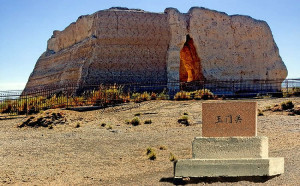
The Jade Gate Ruin at the Han Imperial Entry and Exit Porte for Caravans on the Silk Routes. This fort marked the northern frontier of the Han Empire.
My dead pixels, format, ebook was a moderate 388-pages which included: maps, footnotes, appendices and a bibliography. It had a UK 2016 copyright.
Raoul McLaughlin is a British historian and author of ancient history, in particular Roman trade. He is the author of three (3) non-fiction books on the period. This was the first book I’ve read by the author.
Firstly, this is an intermediate-level text on a particular aspect of Roman history. It would be very helpful for a reader to have a firm background on the history of Classical and Late Antiquity to fully appreciate it. In addition, I recommend having an atlas available; preferably one showing satellite imagery, to relate the geographical locations and conditions found in the narrative.
TL:DR Summary
McLaughlin’s narrative was a traditional chronological account: stretching from about 200 BC to about 400 AD. It describes the trade, primarily in the fabric silk, between the ancient Han Chinese and Roman Mediteranean empires. In particular it describes: the goods, the routes between the two powers, the trade’s economics, and the cultural, military and political conditions of the two powers and those of the intervening geography. When the book sticks to its knitting on the topic of the silk trade, it’s very good. However, the author too frequently drifts-off topic. As a conclusion he tries to write an abbreviated Fall of the Roman Empire, which fails to bring the primary trade narrative to a solid conclusion. It also gives short shrift to diminished trade’s effects on the political entities of Central Asia. Finally, the geography of Central Asia is not supported by adequate maps, illustrations or photographs.
The Review
McLaughlin is a fair writer. I found very few writing errors. The narrative was very clear and factual in an academic fashion. Descriptions and explanations were well-enough done. Only in a few places was his narrative evocative. For example:
Travelers using these routes had to carry water and food supplies along courses marked by the droppings of camels and the bones of dead animals.
There were maps. However, the maps were childishly rendered. In addition, in my edition they were mislabeled. I realize that maps and illustrations add to the cost of printing an ebook or otherwise. However, the included maps did not contain the detail needed to support the detailed narrative. The author is a historian, but there was a vast geography involved in the silk trade that he skims over. To his credit he describes the caravans down to a thumbnail description of Bactrian (two humped) camels which carried the loads over the longest, hardest stretches. However, I had GoogleMaps open to satellite view to get a feel for the distances and topography. I was forced to use this and interpolate between the: book’s maps, the narrative and the atlas to gain a necessary appreciation of the geography.
Central Asian Silk Routes Geography. The silk routes started at the far right in China and stretched to the eastern Mediterranean. The route starts in Northern China. It goes across the northern edge of the Himalayas to what is now Tajikistan. It then split to go due west, across the Aral and Caspian seas, through the Caucasus to the Black Sea; a route to Roman territory that avoided the Parthian Empire. The other arm went south into what is now Afghanistan. In Afghanistan it split again. One arm going south into India and the other west through the now Iran (then the Parthian Empire) to the Eastern Mediterranean. From India, silk could travel to Egypt by sea, when The Monsoon allowed. This route also avoided the Parthian Empire.
There were illustrations and two (2) photographs included. The illustrations were line drawings of coins and reliefs. I would have preferred there to be architectural diagrams. I didn't understand why the photographs included were chosen. (The pic I included above would have been a better choice.) There was no use of tables and charts in the narrative. Information that should have been arranged in a tabular fashion appeared in the appendices.
The narrative was mostly from the Roman perspective. A good portion of the remainder was Chinese. These were the entities with the largest trove of surviving historical records. There was a much smaller amount from the intermediary: Parthian and Kushan empires and the Indian and Central Asian steppe kingdoms. Since these political entities were the crucial middlemen in the trade between Rome and China, they would have added a valuable perspective. Note that the Parthian Empire and its successors were a rival power to the Roman, and eventually Byzantine Empires.
I found the discussion of the silk trade of antiquity to be an education on silk. Silk was a fungible commodity in ancient China. Peasant farmers could pay their taxes with a quantity of silk thread produced by their women folk in a cottage industry. Silk fabric in standardized rolls was used by the Chinese Imperial government to pay wages, and debts. Silk was both money and could be made into clothing with the addition of some labor. As the Chinese pushed north to fortify their frontier against steppe nomads they started buying the nomads off with silk. That silk eventually worked its way west as trade goods. Silk transported well. It being: non-perishable, light and non-fragile. Eventually the standardized Chinese rolls of silk reached western markets, where they were unwoven and rewoven, then dyed into a more desirable cloth than the available: linen, wool, hemp and cotton (only available in India). The weight in silk thread that would make-up a mean, Han peasant farmer's smock in China, in the form of a more colorful, artfully crafted, diaphanous garment could only be afforded by an Empress in Rome. Silver was the major trade good that drained east to China to pay for silk. A one-way trip for a roll of silk between northern China and the Eastern Mediterranean was about 5000 kilometers (about 3000 kilometers as the crow flies by the land routes. It took about a year. In addition there were partial sea routes. One went from Ptolemaic (later Roman) Egypt, through the Red Sea, and across the Indian Ocean to the Indian sub-continent. The other from the Black Sea to Asia Minor, across the Caucasus to the Caspian, and Aral seas (both larger then) then to the Central Asian steppe.
Note that in addition to silk, Chinese high-carbon steel moved east to west. This was a high tech material not available in the west at the time. In addition to gold and silver, small, light, high-value objects like fine glass and precious and semi-precious gems moved west to east. Roman glass was a high tech material not available in the east at the time.
I thought the author did a very good job on the qualitative aspects of the narrative. To a certain extent he did well with the quantitative. However, that was generally from a monetary perspective. I fault him for not using a proper macroeconomic analysis. For example, not noting that silk was uniquely, a fungible commodity in the Chinese empire. Also, there was no real discussion of the spatial interaction with silk. That is, the complementary relationship with it and the impetus for interaction between the distant, Mediterranean region with its precious metal. However, the author displayed himself to be a historian at heart and not an economist or a geographer.
Finally, narrative-wise there was still a lot of story after the fall of the Roman Empire and the impoverishment of the Byzantine Empire. The book’s narrative abandons its trade emphasis with the steppe Hun’s precipitating the fall of the Roman Empire. (Pages are spent on a thumbnail Fall of the Roman Empire.) The Huns were certainly a disruptive influence on Central Asia and Europe. However, they likely did not end the silk trade, like the book abruptly ended in about 400 AD. Historically, the trade was just diminished in the west, until silk production started in the Byzantine Empire in about the 6th Century. Technically, Byzantium was the Eastern Roman Empire and successor state of the Roman Empire? I was also disappointed not to be reading more about the silk trade and the Sassanid dynasty, the successor state to the Parthian Empire. I thought the book ended two (2) centuries too early.
This is a good read for an interested and prepared student. The Roman legions and gladiatorial combats get popular attention. The trade of luxury commodity goods and import taxation in the Roman Empire is little discussed. I have read little on the Han Empire of antiquity, which was as important as the Roman Empire in world history. The Parthians always get a bad rap, in western-oriented ancient history. (Iran may have inherited some of this?) The book gives you a focus on the historical importance of central Asia (which includes the present Afghanistan), currently a backwater. However, the author wanders from the book's central consideration of ancient Roman/Chinese trade. He squanders pages on well-known Roman History, peripherally related to the silk trade. He also neglects the less well-known history of the middlemen political trading entities, and the Chinese in late antiquity. This could have either been a shorter book, or a more informative larger one, if the author had maintained its focus.
Readers may want to read Justinian’s Flea: Plague, Empire, and the Birth of Europe by William Rosen (my review) before reading this. The books are very similarly written, although McLaughlin only mentions one plague (smallpox) in his narrative. Historically, there were several. Rosen does mention Asian trade, but only as a source of infection.
A good, somewhat factual introduction to the Silk Routes and the various empires that acted as an intermediary between the Roman and Chinese empires. Although both empires were aware of each others existence, there was no direct contact, not in the last place because intermediate empires such as the Parthians and Kushans, seeking to maintain lucrative control over the silk trade, inhibited direct contact between these two powers.
Raoul McLaughlin sticks to the facts: he sums up the rise and fall of the various buffer empires, the goods that were exchanged (mainly Chinese silk and Roman glassware), where which coins were found and the few stragglers that managed to end up in China. It was depressing to read that a Chinese envoy, sent out to make contact with the Roman empire, was dissuaded by the Partians to venture further, where only a mere 40 days distanced him from the Roman border, leaving me to wonder how history could have turned out if he actually had succeeded.
I really wanted to like this book. It started out so well: the first two chapters are composed of interesting stories compellingly told. Sadly, things go downhill from there, and the book suffers from a lack of any narrative from that point on, and, worse, jumps around incomprehensibly from one unfamiliar ancient nation to another, with no maps to assist with following where the world the author is rambling about, no reproductions of inscriptions, tapestries, or manuscript illustrations to help with picturing one nation distinctly from another, and little coherent link between one section and the next. When I gradually realized in chapter 10 that we were no longer even following events that took place on the Silk Road, but had somehow wandered into Roman holdings along the Danube in modern Germany, France, and Hungary (I think: lack of maps make it impossible to be sure), I gave it up. It's a shame; its clear that there is ample material for a fascinating book --but perhaps it is the inability to focus the work narrowly enough that has excluded narratives such as the one of the Chinese princess smuggling silk worms out in her hair that made the early chapters so compelling: the focus in later chapters is so "zoomed out" that the individuals who lived the stories are wholly indistinguishable. I do not plan to finish the book, and it's terribly disappointing. It started so well.
The concept of the book exploring commercial ties between China and Rome was sufficient for me to give it a read. The book was full of interesting information much that was new or in a new context. What I appreciate most about this book is the alternative points of view to which I now have access, especially when thinking about these regions.
What I didn't gain was clarity on the players in between the great empires. It was a bit rough to read some of it, not for the content but for maintaining context. Maybe that was just me but it took away from an otherwise interesting book on an underappreciated topic.
An overview of the political situations and other factors playing into the trade between China and Rome.
Chinese techniques for steel were superior, for instance, but because Rome was used to different places having better or worse steel according to their ore, Romans assumed it was just better material. Romans unpicked silk and rewove it into lighter waves, and dyed it as well; this got re-imported as far as India and led the Chinese to believe that Rome had sericulture.
There's also chapters on the regions between and their effects on trade. These are less good but still have some interesting stuff.
Read this while researching my next book, Ends of the Earth. Covers a lot of the early history of central Asia that few people know about and does it in a very readable way.
A difficult read. I suspect if you did not have a strong command of geography and history already this book would be almost meaningless. No obvious narrative thread. The pattern of jumping around in time means that it is difficult to track where each of the described groups was in relative development.
If, like me, you have a reasonable grasp of ancient Roman history, but were curious about the world to the east of the Empire, the Roman Empire and the Silk Routes will help you fill in the gap. It traces the history of the regions between Rome and China during the era concurrent with the Roman and Han Empires, with a particular emphasis on the commercial ties that brought goods between the two greatest empires of the epoch.
A book like this is inevitably a survey, but it’s a bit more than a random assortment. Chapters examine the Xiongnu and Han, the Yuezhi, the Kushan and Parthian Empires, and the Sogdians and Sarmatians. Other chapters are focused on individual topics, like the extent of the silk trade between China and Rome, a comparison between the two empires, and the geography and character of the Black Sea region. There are many anecdotal interludes, but I found each of them interesting and enlightening.
Sometimes the book makes leaps that aren’t clearly supported by the evidence, and sometimes complex issues are rendered a bit too simple. I also found the lack of analysis of Pontus under Mithridates VI a curious omission. I did, however, appreciate how the author closely analyzed several unusual primary sources (such as a curious set of confiscated Sogdian letters) to support his conclusions. Overall, I really enjoyed my journey through these overlooked regions and departed with a deeper understanding of the ancient world.
The book added to my knowledge of the ancient world. It was very detailed covering a multiplicity of names for empires, tribes, emperors, kings, leaders. The author covers almost 400 years, 200 BCE to 200 CE, therefore power struggles changed the outlines of the territory covered.
The strength of the book is political geography not economics. It could have benefited from many more maps—there are only four in the e-book. However, the author conveys both the physical topography of the Silk Roads and the multitude of peoples who sought power along the routes. Another positive aspect is combined discussion of East and West—from China and all of the political powers between them to the Roman Empire. It is a scholarly book that uses as its sources the works of the historians and geographers of antiquity. Trade does not seem to be a major topic for these writers, which explains the plethora of information about warfare, the rise and fall of empires, and the physical environment.
There are many fascinating nuggets of information to supplement other reading on the ancient world.
An interesting look into the confluence of Rome and China, but though it touches upon many interesting periods of history it tends to come across as a 'list of things said by sources' in many ways, resisting too much in the way of analysis or captivating history-telling. There's a great tendency for speculation – ancient history of course is difficult from a historiographical perspective, but it doesn't necessarily make for great reading when nothing seems particularly solid. Though the title promises the silk road as a sort of throughline, more often the book sort of falls into a 'history of these parts of the world in between Rome and China', which – while interesting – only occasionally veers back to the silk road, and then not often in a particularly interesting way. Those complaints aside, I learned some new information here and there and it wasn't necessarily an unreadable book, just a little dull.
The basics of the subject are interesting and well researched. The style can be pretty dry and sometimes redundant. The title and description make it seem the focus will be on Roman understanding and attitudes toward the Silk Road, but a lot of time is spent on the Parthians. While this focus eventually makes sense, it is confusing at first. Reading the digital version was also problematic, as I could not reference the maps as much as I needed to when grappling with geography that is unfamiliar to me, especially in an ancient context.
Organized badly. Or not at all. Random facts given in great detail, but boings around from Rome to China to places in between with no pattern. Maps not detailed enough, places seldom given their modern name so we know where they are. Meh.
An informative and wide-ranging look at a little-known and little-studied but very significant part of ancient history.
This book transforms the romantic "Silk Road" or "Silk Routes" into a definite geography and history of many different interacting nations and cultures, with an underlying emphasis of looking at the relationship between the world's two largest empires of the Roman period: Rome and China. Between them lay a number of diverse nations, including large prosperous ones such as India and Parthia, and formidable and elusive ones such as the Xiongnu and the other peoples of the northern steppes. All of these players played roles in the commerce that gradually developed between China and the West, a commerce that was always only one element in a complex and shifting mix of geography, politics, war, and technical innovation.
The writing is a bit dry and sometimes repetitive, and seems to head off on tangents here and there--all of which are interesting, but maybe not always completely germane. But the author does communicate his fascination with this exotic world, and this reader learned lots of new things. Right now, this is probably the book on the Silk Routes. If you're interested in them, you need to read it.
An excellent and informative book about Sino-Roman relations and the world between them primarily during the Imperial/Han periods. This was very informative and I learned a lot with this book, especially about Central Asia and the closeness between Rome and China, with oftentimes only the Parthians separating the two empires.
Very informative and easy to understand and though it requires a fair bit of knowledge about Rome and focuses more on Rome’s relationship with China rather than the other way round, much of this is likely because of the surviving sources, or lack thereof.
Diving into a period of time in a region of the world that hasn’t been studied much in educational institutes of Western Europe. It was amazing learning new stuff about the vast steppes of Asia and how the nomads affected Parthia and their rivalry with the Roman Empire.
The book is available through kindle, for free, if you have Prime subscription. Definitely recommending it
Began this year with a pivot once again to history, and within history reads to the history of Rome, which is how I believe I began my current reading stint (with Rubicon as the first one if I am not). I had two expectations from this book – one a narrative-ish history of Rome and the silk route empire(s) and a second an economic history or a history of trade. The first, I think I subconsciously wanted in the flavor of something written by Tom Holland or Everritt or even Mike Duncan. The second, I wanted something along the lines of works by Adam Tooze, Daniel Yergin or even Niall Ferguson. Worst case, I expected something similar to Anarchy by Dalrymple (a narrative historian who frankly does not get economics).
It is safe to say none of those expectations were met. This book was decently saturated with factoids (one extremely fascinating learning was that Chinese steel was superior to Roman steel); yet it does not flow very well nor have any apparent cohesive argument or theme. Maybe I got a little bored (a rarity for any economic history and a history of Rome) but I did not feel like the book even went through with a timeline or a history of trade between the empires, across the years. It simply talked about trade existing, presenting histories of the intermediary empires as well as of china, and coupled it with documenting trade in goods and artefacts
I guess my greatest disappointment stems from the fact that I focused a little too much on the title which set expectations for a detailing of ‘The Ancient World Economy’, yet this was at best a cataloguing of the trade existing at random points between the Roman and Chinese worlds. There is more to an economy than that for sure.
Rating: sigh with a heavy heart I have to give a Roman and economic history read a 3 out 5, best. This book is just meh. Not so bad as to be left incomplete, not amazing enough to continue racing through it nonstop.
One of the most important trade routes in history is commonly known as the “Silk Road”. However, it was not 1 road but a series of known trade routes that connected multiple empires in the ancient world. One of the biggest beneficiaries of the goods were the Romans & it's love for silk. And this book gives lots of information in the backdrop of this vast trade network.
Despite not having official links, the routes allowed the Roman to acquire silk via the thousands of miles from the Han Empire to the upper classes in Rome. Seen more as a way to pay subject for their work in the Han Empire, the Romans paid vast amounts of bullion for this good.
Along the way, we learn about many others that were in conflict with Romans like the Parthians & the steppe peoples who resided along the Black Sea, lands further east around the Caspian. These conflicts would hamper trade. But it wasn't only there, as the Han empire had to deal with the Xiongnu in the Mongolian steppe, the Tarim kingdoms to the west, the Sogdians, & their trade relations with the peoples beyond.
This book has loads of information that is squeezed into this one volume. The political & social information is crucial in understanding this era. The author does well in trying to provide a good rounded understanding of each main player without getting into too much detail on each as those can be addressed in their own separate works.
Overall, if you are a fan of antiquity & wish to get a much better understanding of the Roman & Han empires, this is a very good place to start.
The author is clearly passionate about the subject, but makes a lot of tenuous leaps in his analysis of source material that would not be supported by the majority of academics (see e.g. his attempt to link Pliny's description of the Seres with archaeological finds in the Tarim Basin from thousands of years earlier). As another reviewer points out, sources are too often taken at face value. The author states in his introduction that he "examines the ancient evidence without the agendas or limitations of ongoing academic disputes," yet many of the connections he is trying to make - across such vast distances in a time period so far removed from our own - are inherently controversial. My advice to others would be to read this with a grain of salt, as it is far from an authoritative account.
I debated finishing this book because usually give up on books I don’t love. But the stories of the various empires were interesting enough to keep reading. It is perhaps better thought of as a series of vignettes, with no real thesis. In fact, great portions of the book are simply restated facts from contemporary works like the Han Shu and Natural History.
Worth a read if you’re really interested in this era or the various Eurasian empires that came and went. But don’t expect anything deep.
A nitpick: the author couldn’t decide how to refer to different empires and constantly writes things like “XYZ happened in Da Xin (the Roman Empire)” even when not quoting.
I have read over 30 books about Greco-Roman history and dozens more about Middle Eastern, Central Asian and East Asian history, and this book is one of the most boring I have read. The various chapters lack a cohesive structure. Most chapters have little to do with the Roman Empire's relation with the silk road. The book mostly consists of background information about the geography and basic history of each region between China, India and the Mediterranean. There are occasionally interesting tidbits, but they are few and far between.
Academic book on the ancient world economy and the Silk routes that connected the Roman empire with the Han Chinese empire. It also covered the empires of central Asia and the Parthians. Interesting read for those versed in economics. Recommended.
A fine researcher...but as dry as the Gobi, McLaughlin needs a ghost writer to communicate his fascinating facts. Sadly, my high school students were better, more poised and erudite writers. Lots to learn if you can survive the arid prose!
More of a history of how the Roman world's economy interacted with central Asia than commerce across the Silk World. Jumped around between various empires between Rome and China. Could have used more maps.
In our age of the Internet, where the differences of time and distances of lands collapse via wireless communication and aero vehicles, we are easily apt to presume that what we can do was an impossibility for those of different eras and places. Yet, what is happening now has happened before, although in various modes of Operandi. Global trade was also part of the ancient world's economy that affected civilization's fortune just as it is today in our time. This book shows the reader how ancient commerce happened thousands of years ago across a great distance of continents from the Far East to the West to propagate the prospects and prosperity of Europe and Asia's far-flung regimes via silk routes through Central Asia.
The book is a fine organization of routes, resources, and regimes involved in the ancient business world that surprise the modern reader that without airplanes, cars, and computers even, our forefathers of humankind found ways to travel a great distance for profits with flares for adventure. First, the term "Silk Roads" became famous by the 19th Century German geographer/explorer Baron Ferdinand von Richthofen, who surveyed the land routes crossing Central Asia from Afghanistan to China as used in the ancient Chinese and Roman texts. His ambitious plan was to construct a railway line across Central Asia that would have linked the German economy to Chinese markets. In ancient times, the Romans imported Chinese silk that came to Roman Syria from Iranian caravan routes crossing the Parthian Empire from Uzbekistan to Mesopotamia. The Romans' Eastern business also included Indian valuables via the Persian Gulf that reached Parthian markets in Babylonia. An ancient text reveals that one Indian sailor from the wreckage of a trade ship from India around the Red Sea rescued by a Greek patrol ship from the Ptolemaic kingdom of Egypt around the Arabian Peninsula told the Greeks how to sail from India via season Monsoon winds.
The Romans had already known about India but not the Far East until 1 B.C., when silk began to reach the Mediterranean Sea through the Parthian Empire ruling in ancient Iran via caravan routes, aka the silk roads. It appears that commerce contacts and cultural interactions indeed existed. Modern archeologists discovered the graves of slave workers of textile production during the first century A.D. at Vagnari in southern Italy; one of them had a DNA of Far Eastern ancestry inherited from his mother. From Julius Caesar to Caligula, silk both ornamental and devotional in the panoply of magnificent Roman authority. The Romans made ceremonial silk curtains dyed in royal Tyrian purple as awnings in public ceremonies to protect spectators' eyes from the glare of the fiery Mediterranean Sun. Silk also made beautiful garments and garlands presented to classical gods' images and offered to the protective household deities. The reader would be pretty surprised to learn that the end of Cleopatra VIII and her paramour Mark Anthony was a purple augury of lucrative Roman trade from the eastern world. The accumulated Roman economy from Ptolemaic Egypt's annexation and control over the eastern legions made the distribution of the Roman citizens' funds possible. The empire gained direct sovereignty over the Red Sea shipping lanes into the Indian Ocean.
Reading this book confirmed my conviction that people would find the way to do what they needed. However, the younger generations of our time often make the anachronistic mistake of judging the previous generations as culturally retrogressed and hemmed in insular thoughts. It is only a different way of doing business, however slow or primitive it may seem. The ancient commerce contacts show that a country cannot stand alone and survive alone in the world if it refuses to measure the truth with the desire based on ethnocentrism growing into xenophobia. Human cultural progress is a collective enterprise. We live not in isolated islands but a global village.
This is the third book this year on the “Silk Roads”, along with some others that have been tangentially related to it. I am not sure what is so intriguing to me about it - whether to find an historical basis for China’s current infrastructure projects in Central Asia or the geopolitical ideas that Putin is using to justify his rule, or else the intriguing idea of some set of pathways, however sparsely travelled across some of the more barren stretches, or even an insight into when Central Asia was an actual driving force in the world’s politics and economics. All of these lines of thought are worthwhile and attention grabbing. The more that is known about the Silk Roads, the more reduced my expectations have become for big discoveries. For example: 1) There wasn’t really one Silk Road but a variety of roads that were determined by the geography, the interests of traders and travelers, and the political state of play at any given time. 2) The state of the roads varied widely across different time periods. Who was ruling what? What forces were there to secure order? Who were the prominent participants in different periods? 3) The road, such as it was, did not serve as a thruway but more as an occasion of linked shorter works that individuals and states participated in on various stretches. The analogy with the US would be how the Interstate highway system grew up out of a number of preexisting roads and shorter local initiatives and was only linked together later in its history (the 1950sl and 1960s). 4) It is amazing that any of this persisted, given the sparse volume of travel and the rudimentary technology for keeping track of transactions over very long periods of time. 5) While it is tempting to think of contacts between Europe and China over the Silk Roads, this really this not occur on a regular basis. There is a whole historiography of Marco Polo, of course, but the most fascinating linkage - between the Roman Empire and Han China - did not really develop much at all. The Chinese knew fairly little about Rome and the Romans seem to have known even less about the Chinese Empire. Too bad!
This is the point behind Raoul McLaughlin’s book on the Roman Empire and the Silk Routes. There wasn’t really much of a direct linkage, whatever the trade routes there were from China to the West. These linkages, such as they are, get covered well, but other books on the Silk Road, such as Hansen’s, are more informative.
What McLaughlin provides that makes his book valuable is the historical context for the Silk Routes in both China and the Roman world. What was the political state of affairs? How were the different empires administered? What factors drove their ecocnomies? What were the states between Rome and China and how did they influence the extent of trade that occurred? What about oceanic travel? These points are covered in detail and the book is valuable for providing good context. For example, the Romans obtained silk from China on a regular basis. They did not, however, obtain much related to the technology of steel making or advance weapons that the Chinese possessed. The suggestion in the book is that the Parthians wanted this technology for themselves and impeded the transfer of this knowledge to the Romans, which allowed them to maintain an advantage in weaponry.
If a readers interest is in one book on the Silk Roads, this is not as good as some others. For telling the story of how Rome fit into the world of the Silk Routes, the book is very effective.
Attorno al 300 a.C. l'Occidente greco e l'oriente cinese non avevano alcuna idea l'uno della conoscenza dell'altro. Poi, le conquiste di Alessandro portarono l'ellenismo fin nell'attuale Tagikistan, insomma alle porte della Cina; ma la Cina interna era separata dal cuore dell'Asia dagli impenetrabili deserti del Taklamakan a nord e dalla altissime montagne himalayane a sud; nel mezzo, c'erano le popolazioni nomadiche degli Xiongnu che tormentarono la Cina per decenni. Un vero peccato, perché la Cina aveva due prodotti di cui l'Occidente era allora privo: la seta e il ferro lavorato (nettamente superiore alla lavorazione greco-romano). Tutto cambia quando la dinastia Han manda in esplorazione un dignitario che, dopo disavventure epiche (prigioniero degli Xiong nu per un decennio eccetera), raggiunge i regni greci più orientali e "scopre" l'occidente. Dopo questo evento, ci vorranno ancora anni prima che la Cina stabiisca il controllo su lande così desolate ed entri stabilmente in contatto con l'Occidente greco d'Oriente (perdonate il gioco di parole). Altra scoperta fondamentale sarà quella del cammello battriano (che può resistere un mese senza acqua!) La via della seta, cioè il più antico vettore di commerci e conoscenze del mondo antico, era nata.
Nella prima metà l'ottimo libro di McLaughilin racconta in dettaglio questa storia e spiega anche perché e da quando la seta divenne importante per il mondo romano. L'autore, con ricchezza di dettagli e una narrazione sobria e precisa, spazia da resoconti greci a cronache cinesi con assoluta dimistichezza. Il libro però perde quota nella seconda metà, quando ci sono delle divagazioni di troppo. Il capitolo sui popoli del Mar Nero (la via settentrionale della seta) è assolutamente un riempitivo, per quanto un riempitivo interessante (l'autore analizza il viaggio di Arriano attorno al Mar Nero). I capitoli sui Parti, poi, mi hanno lasciato insoddisfatto. Il resoconto delle prime campagne militari romane (Crasso, Antonio e le trattative diplomatiche di Augusto) è, anch'esso, sostanzialmente inutile nei dettagli. Tra l'altro per qualche motivo l'autore salta a piè pari le campagne militari di Publio Ventidio (subito dopo quelle di Marcon Antonio).
La conclusione torna tuttavia su eccellenti livelli. L'autore paragona direttamente la Cina e Roma cogliendone le differenze: stato burocratico il primo con un piccolo esercito, stato "liberista" il secondo con un grande esercito professionale. Il finale è beffardo: Roma e la Cina entrarono ufficialmente in contatto con l'ambasciata romana del 166, che raggiunse la capitale Luyoang, ma circonstanze varie impedirono il proseguimento dei contatti: la peste antonina era scoppiata nell'impero. Mi è dispiaciuta l'assenza di un paragone economico con il regno partico che, facendo da intermediario tra romani e cinesi, non è meno importante di questi.
Consigliatissimo, comunque, il libro è pieno di storia.