

What do you think?

War and the Iliad
War and the Iliad is a perfect introduction to the range of Homer’s art as well as a provocative and rewarding demonstration of the links between literature, philosophy, and questions of life and death.
Simone Weil’s The Iliad, or the Poem of Force is one of her most celebrated works—an inspired analysis of Homer’s epic that presents a nightmare vision of combat as a machine in which all humanity is lost. First published on the eve of war in 1939, the essay has often been read as a pacifist manifesto. Rachel Bespaloff was a French contemporary of Weil’s whose work similarly explored the complex relations between literature, religion, and philosophy. She composed her own distinctive discussion of the Iliad in the midst of World War II—calling it “her method of facing the war”—and, as Christopher Benfey argues in his introduction, the essay was very probably written in response to Weil. Bespaloff’s account of the Iliad brings out Homer’s novelistic approach to character and the existential drama of his characters’ choices; it is marked, too, by a tragic awareness of how the Iliad speaks to times and places where there is no hope apart from war.
This edition brings together these two influential essays for the first time, accompanied by Benfey’s scholarly introduction and an afterword by the great Austrian novelist Hermann Broch.
Simone Weil’s The Iliad, or the Poem of Force is one of her most celebrated works—an inspired analysis of Homer’s epic that presents a nightmare vision of combat as a machine in which all humanity is lost. First published on the eve of war in 1939, the essay has often been read as a pacifist manifesto. Rachel Bespaloff was a French contemporary of Weil’s whose work similarly explored the complex relations between literature, religion, and philosophy. She composed her own distinctive discussion of the Iliad in the midst of World War II—calling it “her method of facing the war”—and, as Christopher Benfey argues in his introduction, the essay was very probably written in response to Weil. Bespaloff’s account of the Iliad brings out Homer’s novelistic approach to character and the existential drama of his characters’ choices; it is marked, too, by a tragic awareness of how the Iliad speaks to times and places where there is no hope apart from war.
This edition brings together these two influential essays for the first time, accompanied by Benfey’s scholarly introduction and an afterword by the great Austrian novelist Hermann Broch.
121 pages, Paperback
First published December 1, 1940
About the author
Simone Weil
286 books2,137 followersSimone Weil was a French philosopher, Christian mystic, and social activist. Weil was born in Paris to Alsatian agnostic Jewish parents who fled the annexation of Alsace-Lorraine to Germany. Her brilliance, ascetic lifestyle, introversion, and eccentricity limited her ability to mix with others, but not to teach and participate in political movements of her time. She wrote extensively with both insight and breadth about political movements of which she was a part and later about spiritual mysticism. Weil biographer Gabriella Fiori writes that Weil was "a moral genius in the orbit of ethics, a genius of immense revolutionary range".
Ratings & Reviews
Friends & Following
Create a free account to discover what your friends think of this book!
Community Reviews
Displaying 1 - 30 of 160 reviews

January 14, 2022
i voted, re-read this book and did some research about history and politics (i basically got lost on wikipedia, as per usual), i feel like a proper citizen today 😌
───────────────────────────
absolutely brilliant, i have nothing else to say
───────────────────────────
absolutely brilliant, i have nothing else to say

Read
May 13, 2018 -I : introduction
I found this collection on the shelves of the library, technically I don't think it should have been there at all - it seemed to belong to the collection of another library, when I attempted to borrow it using one of the self-service machines (which are not librarian shaped), the machine rebuffed me and directed me to one of it's human co-workers, the non- robotic woman - despite (apparently) lacking the capacious spring loaded book holding shelf of her electronic counter part or inbuilt light pen, was able to explain that some varlet had already reserved the book and that person had the right (and hopefully the legal duty) to read it before me, however in the lawful exercise of her librarian functionality she then reserved it for me, I wasn't so certain that I wanted to read it that much, but occasionally even I can recognise the hammer blows of FATE, some god or goddess, hostile or even friendly thrusts a volume upon you that in the unending war of classics versus moderns one is doomed to read...
0: general bit
I assume that if I was to tell you that there was a collection of essays written during the second World War about the Iliad, that you'd form a certain impression of what those essays would be about, however I'm moderately certain that what one imagines - unless you already know of the authors would not give you a good idea of what these essays actually contain - they don't point to the reality of living through a war and reading a poem about war at the same time.
The key feature instead that all three writers were of Jewish heritage, Broch converted to Catholicism, Weil's family had become Catholic, Bespaloff by contrast had moved geographically rather than spiritually from Ukraine to France. There is a sense of them as singular figures from the margins looking for a centre and for the universal and general, my feeling is that these essays are not great or particularly helpful insights into the Iliad, rather the Iliad is an introduction to the philosophies and intellectual struggles of these writers. For Weil -her singular saintly self-destructive Catholicism who finds in the relentless violence of the Iliad - pacifism, Bespaloff finds a unity of spirit between the ancient Hebrews and their nearish neighbours, the ancient Greeks, while Brock finds in the Iliad an escape from Max Weber's steel cage of the disenchanted existence of modernity. Perhaps that just goes to show that a really creative misreading of a book is a perfect mirror for the essayists well established pre-occupations and hobby-horses.
I : War & the Iliad Simone Weil
Surprisingly short, such a little essay. The introduction points to Weil's creative misreading of the Iliad, which the editor holds owed more to Goya's the Horrors of war series than to any edition of Homer.
That emphasises the feeling that to read this essay is not to be brought into dialogue with Homer but with Simone Weil's spirituality. Her's was a Catholicism which seems particularly curious, asserting a link of genius between the Iliad and the Gospels , throwing out with distinct vigour the Odyssey, the Aeneid and the Old Testament. One wonders quite what see liked about the Iliad.
She has an absolute clarity about the Iliad as a poem about force and violence, which leads in her view inescapably to pacifism and equality between people. This, I feel, is an amazing reading, the Iliad seems to assume a connoisseurship of single combat from it's readers, an appreciation of the use of broad bladed spear and of the sharp edged sword. I don't think she was entirely crazy in her reading in that, the balance in the Iliad is near perfect, there is heroism everywhere, and as she points out it has a relentless clarity about violence, he who lives by the sword, dies by the sword (or spear as appropriate).
II : on the Iliad Rachel Bespaloff
This was a much wider ranging essay, according to the introduction, Bespaloff had read the Iliad and had started writing some notes when she was shown Weil's essay and indeed Bespaloff picks up on Weil's idea of 'force' though she specifically says that the Iliad is more than only a poem of force - contradicting Weil's dark vision, but rather like Weil, she finds inspiration in it and draws links- in very vague terms - between the Hebrew Bible and ancient Greek writings, I felt here that there was a certain feeling of inferiority on her part and an assertion of cultural equality and worth between the Greek heritage - generally acknowledged to be great and of world-wide significance and Jewish tradition - Bespaloff was writing during WWII after a period in which Judaism had been coming under criticism from various quarters, about which you may have heard.
She linked the Iliad to Anna Karenina and Moscow to Troy, reading, I remember this made some kind of sense, but twenty or so hours after reading it seems an entirely crazy parallel that makes little sense - in this scheme Tolstoy is a new Homer, both in her view transcending mere literature and creating some kind of new cultural paradigm and new cultural values. Perhaps you find the notion inspiring, or merely puzzling, I find it burdened with heavy assumptions about Homer - a creature about whom we know nothing.
In passing I noticed that for her the Occident was masculine and the Orient feminine, and although she was, I believe, a woman herself, she doesn't seem to intend this in a complimentary way. Maybe an example of how conventional and non-thoughtful our use of language can be.
That war is always a conflict over Helen seemed a pregnant thought considering how often the nation is portrayed in female form - though one observes the homo-erotic tendency demonstrated by John Bull and Uncle Sam in that case.
III : The Style of the Mythical Age Hermann Brock
Brock's tiny twenty page piece is in direct response to Bespaloff. I liked it best of the three, although it too was joyfully insane in it's own way. I forget already if Brock cites Gramsci directly or simply channels his spirit (knowingly or otherwise): The crisis consists precisely in the fact that the old is dying and the new cannot be born; in this interregnum a great variety of morbid symptoms appear, but that is the central point I feel of what Brock says, for him cultural paradigms are closed systems which at a certain point beyond maturity collapse and die. Homer is both for him the late product of a mature civilisation but also holds the potential to be the basis myth for a new cultural paradigm, the Force of Bespaloff, which was Weil's way of talking about violence, I think suggests for Brock all the abstract forces in the modern world, a modern Hector or Ajax for him fights not fate but the power of gender roles or social hierarchy or structural inequalities, it suggests the nobility and dignity in fighting even in the face of death and acceptance that if one day you are the killer, the next you too will be killed. Victor becomes victim, it's all in the game. Perhaps on the other hand I feel personally that quite enough people already wake up every morning like Achilles - ' I am angry, I must kill - Mum, get me armour' - perhaps this shows that Brock was prescient.
I found this collection on the shelves of the library, technically I don't think it should have been there at all - it seemed to belong to the collection of another library, when I attempted to borrow it using one of the self-service machines (which are not librarian shaped), the machine rebuffed me and directed me to one of it's human co-workers, the non- robotic woman - despite (apparently) lacking the capacious spring loaded book holding shelf of her electronic counter part or inbuilt light pen, was able to explain that some varlet had already reserved the book and that person had the right (and hopefully the legal duty) to read it before me, however in the lawful exercise of her librarian functionality she then reserved it for me, I wasn't so certain that I wanted to read it that much, but occasionally even I can recognise the hammer blows of FATE, some god or goddess, hostile or even friendly thrusts a volume upon you that in the unending war of classics versus moderns one is doomed to read...
0: general bit
I assume that if I was to tell you that there was a collection of essays written during the second World War about the Iliad, that you'd form a certain impression of what those essays would be about, however I'm moderately certain that what one imagines - unless you already know of the authors would not give you a good idea of what these essays actually contain - they don't point to the reality of living through a war and reading a poem about war at the same time.
The key feature instead that all three writers were of Jewish heritage, Broch converted to Catholicism, Weil's family had become Catholic, Bespaloff by contrast had moved geographically rather than spiritually from Ukraine to France. There is a sense of them as singular figures from the margins looking for a centre and for the universal and general, my feeling is that these essays are not great or particularly helpful insights into the Iliad, rather the Iliad is an introduction to the philosophies and intellectual struggles of these writers. For Weil -her singular saintly self-destructive Catholicism who finds in the relentless violence of the Iliad - pacifism, Bespaloff finds a unity of spirit between the ancient Hebrews and their nearish neighbours, the ancient Greeks, while Brock finds in the Iliad an escape from Max Weber's steel cage of the disenchanted existence of modernity. Perhaps that just goes to show that a really creative misreading of a book is a perfect mirror for the essayists well established pre-occupations and hobby-horses.
I : War & the Iliad Simone Weil
Surprisingly short, such a little essay. The introduction points to Weil's creative misreading of the Iliad, which the editor holds owed more to Goya's the Horrors of war series than to any edition of Homer.
That emphasises the feeling that to read this essay is not to be brought into dialogue with Homer but with Simone Weil's spirituality. Her's was a Catholicism which seems particularly curious, asserting a link of genius between the Iliad and the Gospels , throwing out with distinct vigour the Odyssey, the Aeneid and the Old Testament. One wonders quite what see liked about the Iliad.
She has an absolute clarity about the Iliad as a poem about force and violence, which leads in her view inescapably to pacifism and equality between people. This, I feel, is an amazing reading, the Iliad seems to assume a connoisseurship of single combat from it's readers, an appreciation of the use of broad bladed spear and of the sharp edged sword. I don't think she was entirely crazy in her reading in that, the balance in the Iliad is near perfect, there is heroism everywhere, and as she points out it has a relentless clarity about violence, he who lives by the sword, dies by the sword (or spear as appropriate).
II : on the Iliad Rachel Bespaloff
This was a much wider ranging essay, according to the introduction, Bespaloff had read the Iliad and had started writing some notes when she was shown Weil's essay and indeed Bespaloff picks up on Weil's idea of 'force' though she specifically says that the Iliad is more than only a poem of force - contradicting Weil's dark vision, but rather like Weil, she finds inspiration in it and draws links- in very vague terms - between the Hebrew Bible and ancient Greek writings, I felt here that there was a certain feeling of inferiority on her part and an assertion of cultural equality and worth between the Greek heritage - generally acknowledged to be great and of world-wide significance and Jewish tradition - Bespaloff was writing during WWII after a period in which Judaism had been coming under criticism from various quarters, about which you may have heard.
She linked the Iliad to Anna Karenina and Moscow to Troy, reading, I remember this made some kind of sense, but twenty or so hours after reading it seems an entirely crazy parallel that makes little sense - in this scheme Tolstoy is a new Homer, both in her view transcending mere literature and creating some kind of new cultural paradigm and new cultural values. Perhaps you find the notion inspiring, or merely puzzling, I find it burdened with heavy assumptions about Homer - a creature about whom we know nothing.
In passing I noticed that for her the Occident was masculine and the Orient feminine, and although she was, I believe, a woman herself, she doesn't seem to intend this in a complimentary way. Maybe an example of how conventional and non-thoughtful our use of language can be.
That war is always a conflict over Helen seemed a pregnant thought considering how often the nation is portrayed in female form - though one observes the homo-erotic tendency demonstrated by John Bull and Uncle Sam in that case.
III : The Style of the Mythical Age Hermann Brock
Brock's tiny twenty page piece is in direct response to Bespaloff. I liked it best of the three, although it too was joyfully insane in it's own way. I forget already if Brock cites Gramsci directly or simply channels his spirit (knowingly or otherwise): The crisis consists precisely in the fact that the old is dying and the new cannot be born; in this interregnum a great variety of morbid symptoms appear, but that is the central point I feel of what Brock says, for him cultural paradigms are closed systems which at a certain point beyond maturity collapse and die. Homer is both for him the late product of a mature civilisation but also holds the potential to be the basis myth for a new cultural paradigm, the Force of Bespaloff, which was Weil's way of talking about violence, I think suggests for Brock all the abstract forces in the modern world, a modern Hector or Ajax for him fights not fate but the power of gender roles or social hierarchy or structural inequalities, it suggests the nobility and dignity in fighting even in the face of death and acceptance that if one day you are the killer, the next you too will be killed. Victor becomes victim, it's all in the game. Perhaps on the other hand I feel personally that quite enough people already wake up every morning like Achilles - ' I am angry, I must kill - Mum, get me armour' - perhaps this shows that Brock was prescient.

January 13, 2012
An inexhaustible little collection, in which three heavyweights, all war refugees – Simone Weil, Rachel Bespaloff, and Hermann Broch – seek the meaning of their own “dark times” in the verses of Homer.
The three essays are coincident or directly responsive: Bespaloff knew of Weil’s, and Broch’s begins as an appreciation of Bespaloff’s. (The introduction also notes that Weil and Bespaloff rested in the same Swiss clinic, at different times, and that both were powerfully affected by an exhibition of Goya’s “Horrors of War” in Geneva in 1939.) If you have a taste for such mingling of intensities – and why would you not? – NYRB Classics also reprinted a collection of the letters Rilke, Tsvetaeva, and Pasternak exchanged in the summer of 1926.
Weil’s “essay” is barely prose; it’s an infinitely resonant philosophic poem – smithed and honed – to be read in a single rapt sitting, or not at all – on the spiritual deformations of war and slavery.
After the pointed perfection of Weil’s “The Iliad, or The Poem of Force,” Bespaloff’s “On the Iliad” at first felt meandering, merely literary criticism; but then she meanders through the ethical systems of the West, considering Homer alongside the Old Testament prophets, Plato, and War and Peace:
At last there is Hermann Broch’s “The Style of the Mythical Age.” Broch intimidates me, certainly more than the other Central European philosophical fabulists – Kafka, Gombrowicz – I intend to tackle in the coming year, and who seem clever clowns next to Broch’s agon, what Hannah Arendt in Men in Dark Times called his “wearisome and unwearied search for an absolute,” a search whose synthetic seriousness made him scorn the “merely literary,” rue “the fate of being a poet in spite of oneself,” and demand that contemporary literature “pass through all the hells of l’art pour l’art” before it could aspire to the truly “ethical.” I don’t think I’m terminally belletristic, incorrigibly arrested in the hells of l’art pour l’art, or trivially enamored of bien ecrit, but Bespaloff’s and Broch’s philosophical vocabulary and effortless abstraction daunt me.
----
* The vast testimonial eloquence of the American Civil War is summed up in the Homeric remark of Union veteran and Supreme Court justice Oliver Wendell Holmes Jr. : "But I do think that at present man is a predatory animal. I think that the sacredness of human life is a purely municipal ideal of no validity outside the jurisdiction. I believe that force…is the ultima ratio, and between two groups that want to make inconsistent kinds of world I see no remedy except force. I may add what I no doubt have said often enough, that it seems to me that every society rests on the death of men."
For those dreamers who considered that force, thanks to progress, would soon be a thing of the past, the Iliad could appear as a historical document; for others, whose powers of recognition are more acute and who perceive force, today as yesterday, at the very center of human history, the Iliad is the purest and loveliest of mirrors.*
The three essays are coincident or directly responsive: Bespaloff knew of Weil’s, and Broch’s begins as an appreciation of Bespaloff’s. (The introduction also notes that Weil and Bespaloff rested in the same Swiss clinic, at different times, and that both were powerfully affected by an exhibition of Goya’s “Horrors of War” in Geneva in 1939.) If you have a taste for such mingling of intensities – and why would you not? – NYRB Classics also reprinted a collection of the letters Rilke, Tsvetaeva, and Pasternak exchanged in the summer of 1926.
Weil’s “essay” is barely prose; it’s an infinitely resonant philosophic poem – smithed and honed – to be read in a single rapt sitting, or not at all – on the spiritual deformations of war and slavery.
It is not the planning man, the man of strategy, the man acting on the resolution taken, who wins or loses battle; battles are fought and decided by men deprived of these faculties, men who have undergone a transformation, who have dropped either to the level of inert matter, which is pure passivity, or to the level of blind force, which is pure momentum.
After the pointed perfection of Weil’s “The Iliad, or The Poem of Force,” Bespaloff’s “On the Iliad” at first felt meandering, merely literary criticism; but then she meanders through the ethical systems of the West, considering Homer alongside the Old Testament prophets, Plato, and War and Peace:
Homer and Tolstoy have in common a virile love of war and a virile horror of it…
When Homer and Tolstoy want to illuminate the fatality inherent in force – the inevitable glide of the creative will into the automatism of violence, of conquest into terror, of courage into cruelty – they do not fall into invective and moral indignation. An image suffices them, a contrast that remains forever present in our memories.
At last there is Hermann Broch’s “The Style of the Mythical Age.” Broch intimidates me, certainly more than the other Central European philosophical fabulists – Kafka, Gombrowicz – I intend to tackle in the coming year, and who seem clever clowns next to Broch’s agon, what Hannah Arendt in Men in Dark Times called his “wearisome and unwearied search for an absolute,” a search whose synthetic seriousness made him scorn the “merely literary,” rue “the fate of being a poet in spite of oneself,” and demand that contemporary literature “pass through all the hells of l’art pour l’art” before it could aspire to the truly “ethical.” I don’t think I’m terminally belletristic, incorrigibly arrested in the hells of l’art pour l’art, or trivially enamored of bien ecrit, but Bespaloff’s and Broch’s philosophical vocabulary and effortless abstraction daunt me.
----
* The vast testimonial eloquence of the American Civil War is summed up in the Homeric remark of Union veteran and Supreme Court justice Oliver Wendell Holmes Jr. : "But I do think that at present man is a predatory animal. I think that the sacredness of human life is a purely municipal ideal of no validity outside the jurisdiction. I believe that force…is the ultima ratio, and between two groups that want to make inconsistent kinds of world I see no remedy except force. I may add what I no doubt have said often enough, that it seems to me that every society rests on the death of men."

December 4, 2018
This soaring and glorious meditation on the Iliad made me feel I’d learned something that only Simone Weil could teach me. In a way though it made me sad to read this essay, because I realized once again how few women write like this, absolutely sure of their superior intellect and expertise, and with absolute authority, and without a hint of apology for taking command of their thesis and telling the reader what’s what. No throat clearing clauses like “I’m not sure but” or “It’s possible that…”. Just a rush of knowledge written without doubt or equivocation.
Susan Sontag wrote this way. So did Gertrude Stein. Camille Paglia writes this way. In her case I disagree with most of what she writes but I still love what I would call her …a word comes to mind…see, here is the problem, the word that comes to mind is “I love her ballsy-ness.” My language for the act of writing with unapologetic authority is corrupted by a learned cultural sense that to write this way is inherently male. That's bad.
Susan Sontag wrote this way. So did Gertrude Stein. Camille Paglia writes this way. In her case I disagree with most of what she writes but I still love what I would call her …a word comes to mind…see, here is the problem, the word that comes to mind is “I love her ballsy-ness.” My language for the act of writing with unapologetic authority is corrupted by a learned cultural sense that to write this way is inherently male. That's bad.

May 28, 2017
"Sing, goddess, the anger of Peleus’ son Achilleus
and its devastation, which put pains thousandfold upon the Achaians,
hurled in their multitudes to the house of Hades strong souls
of heroes, but gave their bodies to be the delicate feasting
of dogs, of all birds, and the will of Zeus was accomplished
since that time when first there stood in division of conflict
Atreus’ son the lord of men and brilliant Achilleus."
Three vastly different essayistic approaches to The Iliad are united in this collection.
Through Homer’s epic poem, its authors – Weil, Bespaloff and Broch - try and make sense of the disconcerting threat of militaristic Nazism they perceived in Continental Europe, which they all eventually left behind for the United States. There they would remain, never to return to native soil.
Weil, in solidarity with her people in occupied France, went on a hunger strike, thus exacerbating her tuberculosis, from which she died in 1943. Six years later Bespaloff, sporadically suffering from fits of clinical depression, suffocated herself by sealing her kitchen doors with towels and turning on the gas. Broch met his end in considerably more peaceful circumstances in 1951.
While Weil and Bespaloff never met each other, and had no knowledge of the fact each was writing on The Iliad, both their essays were written roughly at the same time, if not published simultaneously. It is clearly established Weil’s appeared at the eve of war in 1939, and Bespaloff’s just a few years later in the midst of the occupation, yet there is still some doubt of whether Bespaloff had read Weil’s attempt – often considered a pacifist manifesto - and modified her own text, turning it into a subtly stated call to resistance. Broch on the other hand used Bespaloff’s essay as a springboard for expounding his own theory of the “mythical style”.
More prose poem than essay, Weil’s The Iliad, or the Poem of Force concisely sets up the theme of her sweeping piece in the first couple of lines:
This theme indeed is woven through the entire fabric, and is eloquently portrayed as a near unavoidable corrupter of the human spirit, if wielded callously and with little understanding:
Consider this for its warning to those who momentarily hold yet abuse their power:
And there can be few better passages in existence that explain what makes The Iliad still so poignant, so exceedingly relevant to us than this:
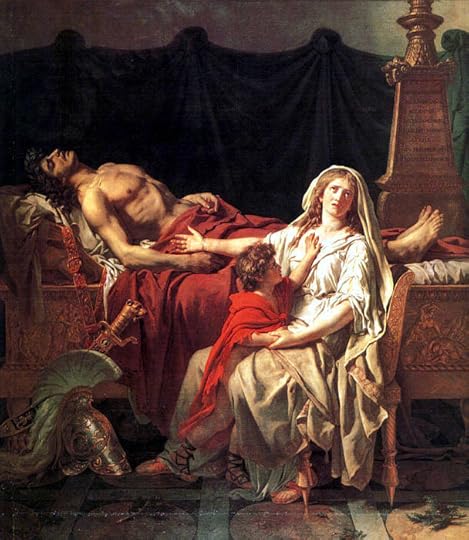
Andromache Mourning Hector, Jacques-Louis David (1783)
The splendour and importance of Simone Weil’s essay cannot be overstated. Quite indispensable, while also serving as a commandment, as an impetus to seek out more of her work by me.
As Weil’s punch to the gut is a rather tough act to follow, Rachel Bespaloff’s perhaps more traditionally academic On the Iliad doesn’t quite reach the same heights. However, her dedicated analyses of principal actors and interpersonal dynamics are invariably interesting, and did add some more texture to my understanding of the poem. The one on Helen in particular was highly illuminating. Furthermore, she draws some interesting comparisons between Homer, the Bible, Plato and Tolstoy, though I’d need to read more of those to decide whether I agree with her points or not.
This passage rung especially true to me:
With Hermann Broch’s The Style of the Mythical Age, a decidedly more dense, philosophical angle is adopted, as one enters into the realm of abstraction, which I doubt The Iliad is the right vehicle for. Employing an overly analytical mindset when coming to grips with it would detract from its visceral nature. Perhaps it makes more sense to someone with actual academic knowledge of modernist criticism, but I didn’t quite connect with it. With some more theory under my belt, I might one day decide to return to it though.
If The Iliad touches you on a deep human level, this collection will surely further enrich that experience. My re-read is scheduled for the very near future already. If only every essay on a book could achieve such a feat.
and its devastation, which put pains thousandfold upon the Achaians,
hurled in their multitudes to the house of Hades strong souls
of heroes, but gave their bodies to be the delicate feasting
of dogs, of all birds, and the will of Zeus was accomplished
since that time when first there stood in division of conflict
Atreus’ son the lord of men and brilliant Achilleus."
Three vastly different essayistic approaches to The Iliad are united in this collection.
Through Homer’s epic poem, its authors – Weil, Bespaloff and Broch - try and make sense of the disconcerting threat of militaristic Nazism they perceived in Continental Europe, which they all eventually left behind for the United States. There they would remain, never to return to native soil.
Weil, in solidarity with her people in occupied France, went on a hunger strike, thus exacerbating her tuberculosis, from which she died in 1943. Six years later Bespaloff, sporadically suffering from fits of clinical depression, suffocated herself by sealing her kitchen doors with towels and turning on the gas. Broch met his end in considerably more peaceful circumstances in 1951.
While Weil and Bespaloff never met each other, and had no knowledge of the fact each was writing on The Iliad, both their essays were written roughly at the same time, if not published simultaneously. It is clearly established Weil’s appeared at the eve of war in 1939, and Bespaloff’s just a few years later in the midst of the occupation, yet there is still some doubt of whether Bespaloff had read Weil’s attempt – often considered a pacifist manifesto - and modified her own text, turning it into a subtly stated call to resistance. Broch on the other hand used Bespaloff’s essay as a springboard for expounding his own theory of the “mythical style”.
More prose poem than essay, Weil’s The Iliad, or the Poem of Force concisely sets up the theme of her sweeping piece in the first couple of lines:
"The true hero, the true subject, the centre of the Iliad, is force. Force employed by man, force that enslaves man, force before which man's flesh shrinks away. In this work at all times, the human spirit is shown as modified by its relation to force, as swept away, blinded, by the very force it imagined it could handle, as deformed by the weight of the force it submits to."
This theme indeed is woven through the entire fabric, and is eloquently portrayed as a near unavoidable corrupter of the human spirit, if wielded callously and with little understanding:
“Force is as pitiless to the man who possesses it, or thinks he does, as it is to its victims; the second it crushes, the first it intoxicates. The truth is, nobody really possesses it.”
Consider this for its warning to those who momentarily hold yet abuse their power:
“But at the time their own destruction seems impossible to them. For they do not see that the force in their possession is only a limited quantity; nor do they see their relations with other human beings as a kind of balance between unequal amounts of force. Since other people do not impose on their movements that halt, that interval of hesitation, wherein lies all our consideration for our brothers in humanity, they conclude that destiny has given complete licence to them, and none at all to their inferiors. And at this point they exceed the measure of the force that is actually at their disposal. Inevitably they exceed it, since they are not aware that it is limited. And now we see them committed irretrievably to chance; suddenly things cease to obey them. Sometimes chance is kind to them, sometimes cruel. But in any case there they are, exposed, open to misfortune; gone is the armor of power that formerly protected their naked souls; nothing, no shield, stands between them and tears. This retribution, which has a geometrical rigor, which operates automatically to penalize the abuse of force, was the main subject of Greek thought. It is the soul of the epic.”
And there can be few better passages in existence that explain what makes The Iliad still so poignant, so exceedingly relevant to us than this:
“The wantonness of the conqueror that knows no respect for any creature or thing that is at its mercy or is imagined to be so, the despair of the soldier that drives him on to destruction, the obliteration of the slave or the conquered man, the wholesale slaughter – all these elements combine in the Iliad to make a picture of uniform horror, of which force is the sole hero. A monotonous desolation would result were it not for those few luminous moments, scattered here and there throughout the poem, those brief, celestial moments in which man possesses his soul. The soul that awakes then, to live for an instant only and be lost almost at once in force’s vast kingdom, awakes pure and whole; it contains no ambiguities, nothing complicated or turbid; It has no room for anything but courage and love. Sometimes it is in the course of inner deliberations that a man finds his soul: he meets it, like Hector before Troy, as he tries to face destiny on his own terms, without the help of gods or men.”
Andromache Mourning Hector, Jacques-Louis David (1783)
The splendour and importance of Simone Weil’s essay cannot be overstated. Quite indispensable, while also serving as a commandment, as an impetus to seek out more of her work by me.
As Weil’s punch to the gut is a rather tough act to follow, Rachel Bespaloff’s perhaps more traditionally academic On the Iliad doesn’t quite reach the same heights. However, her dedicated analyses of principal actors and interpersonal dynamics are invariably interesting, and did add some more texture to my understanding of the poem. The one on Helen in particular was highly illuminating. Furthermore, she draws some interesting comparisons between Homer, the Bible, Plato and Tolstoy, though I’d need to read more of those to decide whether I agree with her points or not.
This passage rung especially true to me:
“Nietzsche is wrong when he says that Homer is the poet of apotheoses. What he exalts and sanctifies is not the triumph of victorious force but man’s energy in misfortune, the dead warrior’s beauty, the glory of the sacrificed hero, the song of the poet in times to come – whatever defies fatality and rises superior to it, even in defeat.”
With Hermann Broch’s The Style of the Mythical Age, a decidedly more dense, philosophical angle is adopted, as one enters into the realm of abstraction, which I doubt The Iliad is the right vehicle for. Employing an overly analytical mindset when coming to grips with it would detract from its visceral nature. Perhaps it makes more sense to someone with actual academic knowledge of modernist criticism, but I didn’t quite connect with it. With some more theory under my belt, I might one day decide to return to it though.
If The Iliad touches you on a deep human level, this collection will surely further enrich that experience. My re-read is scheduled for the very near future already. If only every essay on a book could achieve such a feat.

September 11, 2016
Simone Weil’s essay in this collection is brief and impassioned. She argues that force turns people into objects in various ways; most obviously by killing, but also through the threat of force apparent in relations of domination. Weil does not argue that this destroys the “soul”, but that the soul must be in agony when forced to “live inside” an object. To me this seems quite descriptive, preventing the argument from falling totally into abstraction (“[the slave’s] situation keeps tears on tap for him”). The arbiter of force is also its object, intoxicated by the illusion of invulnerability. In The Iliad, she points out, everyone is at some point forced to “bow his neck to force”. The power of the classic lies, I think she is saying, in making us “feel with sharp regret what it is that violence has killed and will kill again”. Weil admires in the Greeks the “spiritual force” that allows them to avoid self-deception, and mourns that this spirit was not transmitted to the Romans or to Christianity. She concludes:
Both writers are impressed by the lack of partiality in The Iliad, the absence of race-ism or nationalism (of course, in a way it is aboutnationalism, but the author position is free from it – everyone is equal and equally human in Homer), and Bespaloff elaborates this in her interpretation: All [people] live in affliction: there is no basis for true equality. This seems to me an accurate reflection of The Iliad’s world, but not necessarily a helpful position. While Weil’s essay sometimes inspired me, Bespaloff’s was only interesting, probably because I couldn’t always follow the links she was making between such broad topics. I agree with her statement that “the ethical experience lives only in the acts that embody it” and argument that poetry is important because it offers a way to reprise that experience, but I lose the trail somewhere in the comparisons between classical fatalism and the Bible, Homer and Tolstoy. Trying to hold on to Being and Becoming in such texts is still a struggle for me; I hope I will become more proficient.
At the end of the edition is an essay called ‘The Style of the Mythical Age: on Rachel Bespaloff’ by Hermann Broch, but it is hardly about Rachel Bespaloff at all as far as I can tell, apart from some off-handed head-patting, but about the genius of certain white, male artists in their old age. It defines a “style of old age” which is characterised by a loss of vocabulary and reliance on syntax, whatever that means. Broch is clearly really keen on this style, and sees Homer as a great exemplar of it. You may enjoy skipping…
… nothing the peoples of Europe have produced is worth the first known poem that appeared among them. Perhaps they will yet rediscover the epic genius, when they learn that there is no refuge from fate, learn not to admire force, not to hate the enemy, nor to scorn the unfortunate. How soon this will happen is another questionSimone’s lucid blaze of rage is partly echoed by the calmer, longer, wider ranging essay of Rachel Bespaloff, but possibly I prefer the former, which represents a radical view, a refusal of violence, whose purity I want to hold onto. Bespaloff is perhaps more practical; for example in naming Hector the “resistance hero” she suggests that violence might be needed to defend “the perishable joys” that Weil also finds under threat in The Iliad. She is also less insistent on the dehumanising power of violence, I think, when she points out that the gods preserve Hector’s body – if he is a “thing”, then he is a thing divine or at least adored.
Both writers are impressed by the lack of partiality in The Iliad, the absence of race-ism or nationalism (of course, in a way it is aboutnationalism, but the author position is free from it – everyone is equal and equally human in Homer), and Bespaloff elaborates this in her interpretation: All [people] live in affliction: there is no basis for true equality. This seems to me an accurate reflection of The Iliad’s world, but not necessarily a helpful position. While Weil’s essay sometimes inspired me, Bespaloff’s was only interesting, probably because I couldn’t always follow the links she was making between such broad topics. I agree with her statement that “the ethical experience lives only in the acts that embody it” and argument that poetry is important because it offers a way to reprise that experience, but I lose the trail somewhere in the comparisons between classical fatalism and the Bible, Homer and Tolstoy. Trying to hold on to Being and Becoming in such texts is still a struggle for me; I hope I will become more proficient.
At the end of the edition is an essay called ‘The Style of the Mythical Age: on Rachel Bespaloff’ by Hermann Broch, but it is hardly about Rachel Bespaloff at all as far as I can tell, apart from some off-handed head-patting, but about the genius of certain white, male artists in their old age. It defines a “style of old age” which is characterised by a loss of vocabulary and reliance on syntax, whatever that means. Broch is clearly really keen on this style, and sees Homer as a great exemplar of it. You may enjoy skipping…

July 14, 2019
I don’t own a copy of this book, and so I was able to read only Simone Weil’s essay (available online as a PDF), not Rachel Bespaloff’s. Weil’s essay, however, is beautiful and thought-provoking, as well as something I probably shouldn’t attempt to comment on at 7 in the morning, not having slept much. For now, all that comes to mind is a quote from Goebbels: ‘even if we lose we shall win, for our ideals will have penetrated the hearts of our enemies.’
The listing is a bit confusing- or it was to me, anyway. The title of Weil's essay is not War and the Iliad but rather The Iliad, or the Poem of Force:
http://biblio3.url.edu.gt/SinParedes/...

August 10, 2020
Os primeiros 2/3 são absolutamente imprescindíveis para quem haja apreciado esse épico ímpar que é a Ilíada. O restante consistiu num pequeno calvário que oscilou entre o meu desinteresse leitor (os temas pareceram-me forçados e até aborrecidos), com muito mais-do-mesmo no texto do Benfey (perfeitamente dispensável).

January 8, 2020
This book is actually a collection of three essays: Simone Weil's War and the Iliad, Rachel Bespaloff's On the Iliad (published after Weil's essay but probably at least partly influenced by it), and Hermann Broch's The Style of the Mythical Age: On Rachel Bespaloff. Weil's essay was especially good; Bespaloff's was slightly less focused but still interesting, especially her discussion of Tolstoy in relation to Homer, and Broch's essay was brilliant—what struck me in particular was how similar it is to Edward Said's On Late Style (published much later than Broch's essay). I don't remember if Said refers to Broch, but if he didn't, that's a problem. There was also a comment in Broch's essay about Savonarola, which I'm pretty sure Isaiah Berlin takes up in his essay on Tolstoy, The Hedgehog and the Fox. All in all then, Broch's essay seems to have been influential—more so, perhaps, than has been recognized (or admitted).

May 29, 2016
Mary McCarthy's translation of Weil's "Iliad, or the Poem of Force" I first read in a house McCarthy had visited, as had Elizabeth Bishop; it was the house of their Vassar '33 classmate, and my departmental colleague Rhoda Sheehan on River Road, Westport Harbor. I noted that even the quotations of the Iliad (trans. from French) are the best I'd read. McCarthy enlightened with her expert French, as did Rhoda with her German major (she had seen Hitler in his car as she walked in Berlin after curfew).
For forty years I depended on Weil's provocation here when I taught Homer with my small Latin (well, maybe 12oz.) and less Greek. (I also depended on the distinguished fellow AmColl graduate, and fellow student of T Baird, R Fagles.) The Odyssey is a breeze in a classroom; just aloudread either Fagles or the narrative genius of R Fitzgerald. The Iliad, I never got, because I never served as did my cousin martyred in Viet Nam, or my room-mate hero, surgeon at Da Nang; nor did I grow in neighborhoods where gangs, competing for death and beauty of graffiti, ruled.
Weil wrote just after the fall of France; she directs toward acute anti-dreamers, "who perceive force, today as yesterday, at the very center of human history, [with] the Iliad the purest and loveliest mirror." She writes with a novelist's insight about behavior in the presence of those who have power of life and death, "In their presence, people move about as if they were not there."
"He that takes the sword, will perish by the sword. The Iliad formulated the principle long before the Gospels did, and in almost the same terms: 'Ares is just, and kills those who kill.'" My Andrew Marvell put this principle best in his Horatian Ode on Cromwell's Return: "Those same Arts that did gain/ A Pow'r must it maintain."
Weill finds mostly no time in battle for reflection, and: "Where there is no room for reflection, there is none either for justice or prudence." The main subject of Greek thought is "This retribution, which has a geometrical rigor, which operates automatically to penalize the abuse of force…" It is the soul of the epic, Aeschylus's Nemesis, etc.
The Iliad battles, a continual see-saw which the personae do not recognize, overpress advantage, etc: "The auditors of the Iliad knew that the death of Hector would be but a brief joy to Achilles, the death of Achilles but a brief joy to the Trojans, and the destruction of Troy but a brief joy to the Achaeans." This picture of uniform horror would result in"Monotonous desolation were it not for those few luminous moments, scattered here and there throughout the poem, those brief, celestial moments in which man possesses his soul" moments of love, or hospitality, etc.
Buddhists seem to have the Greek idea of virtue and limit, but the Occident "no longer even has a word to express it in any of its languages: concepts of limit, measure, equilibrium, which ought to determine the conduct of life are, in the West, restricted to a servile function in the vocabulary of technics." Someone I know, a rarity, values "balance."
[My/Rhoda's '75 edition: Pendle Hill: Wallingford, PA, 1956]
For forty years I depended on Weil's provocation here when I taught Homer with my small Latin (well, maybe 12oz.) and less Greek. (I also depended on the distinguished fellow AmColl graduate, and fellow student of T Baird, R Fagles.) The Odyssey is a breeze in a classroom; just aloudread either Fagles or the narrative genius of R Fitzgerald. The Iliad, I never got, because I never served as did my cousin martyred in Viet Nam, or my room-mate hero, surgeon at Da Nang; nor did I grow in neighborhoods where gangs, competing for death and beauty of graffiti, ruled.
Weil wrote just after the fall of France; she directs toward acute anti-dreamers, "who perceive force, today as yesterday, at the very center of human history, [with] the Iliad the purest and loveliest mirror." She writes with a novelist's insight about behavior in the presence of those who have power of life and death, "In their presence, people move about as if they were not there."
"He that takes the sword, will perish by the sword. The Iliad formulated the principle long before the Gospels did, and in almost the same terms: 'Ares is just, and kills those who kill.'" My Andrew Marvell put this principle best in his Horatian Ode on Cromwell's Return: "Those same Arts that did gain/ A Pow'r must it maintain."
Weill finds mostly no time in battle for reflection, and: "Where there is no room for reflection, there is none either for justice or prudence." The main subject of Greek thought is "This retribution, which has a geometrical rigor, which operates automatically to penalize the abuse of force…" It is the soul of the epic, Aeschylus's Nemesis, etc.
The Iliad battles, a continual see-saw which the personae do not recognize, overpress advantage, etc: "The auditors of the Iliad knew that the death of Hector would be but a brief joy to Achilles, the death of Achilles but a brief joy to the Trojans, and the destruction of Troy but a brief joy to the Achaeans." This picture of uniform horror would result in"Monotonous desolation were it not for those few luminous moments, scattered here and there throughout the poem, those brief, celestial moments in which man possesses his soul" moments of love, or hospitality, etc.
Buddhists seem to have the Greek idea of virtue and limit, but the Occident "no longer even has a word to express it in any of its languages: concepts of limit, measure, equilibrium, which ought to determine the conduct of life are, in the West, restricted to a servile function in the vocabulary of technics." Someone I know, a rarity, values "balance."
[My/Rhoda's '75 edition: Pendle Hill: Wallingford, PA, 1956]

May 3, 2024
This book comprises two essays, one by Simone Weil called "The Iliad, or the Poem of Force" and the other by Rachel Bespaloff called "On the Iliad".
Both these essays are academic.
According to Weil, the Iliad is a nightmare vision of combat as a machine where all humanity is lost, which probably wouldn't come as much of a surprise.
Bespaloff brings out Homer's novelistic approach to character and the drama that transpires from the character's choices, but the conclusion she draws is that at times such as the Trojan War there is no hope apart from war.
Both these essays are academic.
According to Weil, the Iliad is a nightmare vision of combat as a machine where all humanity is lost, which probably wouldn't come as much of a surprise.
Bespaloff brings out Homer's novelistic approach to character and the drama that transpires from the character's choices, but the conclusion she draws is that at times such as the Trojan War there is no hope apart from war.

February 5, 2013
Just prior to World War II and in the early years of the war, as the world tipped into chaos, two remarkable writers, Simone Weil and Rachel Bespaloff, wrote independently and brilliantly about the Iliad. Their insights were similar and yet looked at the poem from completely different angles.
Simone Weil was concerned with force and the Iliad as a story of war. The hero is force, she says, the ways in which men oppress other men. The Iliad is about power but the truth is no one in the poem really possesses it because every character, mortal or god, and therefore everyone in history, has to submit to it. Everyone is victim. Force creates things, and things are corpses. He who uses force does so in only a limited quantity which is exhausted and then the seesaw, Weil's great analogy, will totter the other way into victimhood. What was vitality, success, and a time of boast becomes a time of facing the death contained in all of us. In this way war, force, victory, loss, slavery, and victimhood can be seen as the same thing. The conquering soldier and hero is a slave because he's possessed by his need for war. The force he exerts reduces him to a thing, and that is the end result of war. Human suffering is seen as present in both conditions and is the way, Weil writes, how Greek tragedy morphed into the Gospels. The great segue was Greek tragedy to the Roman gladiators and eventually to the Hebrews, who saw it as sin. All this Weil sees as at odds with the poet.
Rachel Bespaloff's concern is with the difference between poetry and history. The poet is the creator of heroes greater than gods and more human than men. She has some things to say about force, too, describing it as divine in that it arises from a contempt for death and a willingness to sacrifice oneself. She transmits her ideas through the actions of the Iliad's characters--Hector, Thetis, Achilles, Helen, and Priam. The heart of her essay, though, compares Homer (poetry) with Tolstoy (history) and therefore Helen with Anna, Troy with Moscow. Both Homer and Tolstoy loved war. War represents all the epics of nature and all cosmic upheaval. Just as it does Patroclus and Hector, war places Prince Andrey between heaven and time, actors and managers of the drama locked together so that glory is created for the Greek and faith for the Christian, both true. By becoming nothing they become as holy as Troy and Moscow.
In the final essay the Great German novelist Hermann Broch, commenting on Bespaloff's essay sums it up as Homer being at the point where myth is refined into poetry, Tolstoy at the point where poetry moves back into myth.
This is sketchy, doesn't begin to address the web of ideas Weil, Bespaloff, and Broch have spun. I doubt it's possible in one or two readings to grasp every nuance of their rich examinations of the Iliad, let alone do justice to them in the space allotted here. But if you love the Iliad as I do, and if you love intelligent writing encompassing history, myth, philosophy, literature, and religion, then this will be essential reading. For me it was a reread, but I know I have more reading to do here and know I'll never reach the bottom of it.
Simone Weil was concerned with force and the Iliad as a story of war. The hero is force, she says, the ways in which men oppress other men. The Iliad is about power but the truth is no one in the poem really possesses it because every character, mortal or god, and therefore everyone in history, has to submit to it. Everyone is victim. Force creates things, and things are corpses. He who uses force does so in only a limited quantity which is exhausted and then the seesaw, Weil's great analogy, will totter the other way into victimhood. What was vitality, success, and a time of boast becomes a time of facing the death contained in all of us. In this way war, force, victory, loss, slavery, and victimhood can be seen as the same thing. The conquering soldier and hero is a slave because he's possessed by his need for war. The force he exerts reduces him to a thing, and that is the end result of war. Human suffering is seen as present in both conditions and is the way, Weil writes, how Greek tragedy morphed into the Gospels. The great segue was Greek tragedy to the Roman gladiators and eventually to the Hebrews, who saw it as sin. All this Weil sees as at odds with the poet.
Rachel Bespaloff's concern is with the difference between poetry and history. The poet is the creator of heroes greater than gods and more human than men. She has some things to say about force, too, describing it as divine in that it arises from a contempt for death and a willingness to sacrifice oneself. She transmits her ideas through the actions of the Iliad's characters--Hector, Thetis, Achilles, Helen, and Priam. The heart of her essay, though, compares Homer (poetry) with Tolstoy (history) and therefore Helen with Anna, Troy with Moscow. Both Homer and Tolstoy loved war. War represents all the epics of nature and all cosmic upheaval. Just as it does Patroclus and Hector, war places Prince Andrey between heaven and time, actors and managers of the drama locked together so that glory is created for the Greek and faith for the Christian, both true. By becoming nothing they become as holy as Troy and Moscow.
In the final essay the Great German novelist Hermann Broch, commenting on Bespaloff's essay sums it up as Homer being at the point where myth is refined into poetry, Tolstoy at the point where poetry moves back into myth.
This is sketchy, doesn't begin to address the web of ideas Weil, Bespaloff, and Broch have spun. I doubt it's possible in one or two readings to grasp every nuance of their rich examinations of the Iliad, let alone do justice to them in the space allotted here. But if you love the Iliad as I do, and if you love intelligent writing encompassing history, myth, philosophy, literature, and religion, then this will be essential reading. For me it was a reread, but I know I have more reading to do here and know I'll never reach the bottom of it.

November 25, 2025
This read I just did the slice of it that is the Simone Weil essay. Her work had been recommended to me by a friend the other night and since I have been making my way through Greek epics and tragedies. Weil is brilliant. Will re-visit and read the opening remarks and the other essay in this edition, coupled with a re-read of the Illiad. A great companion to that epic, this slim NYRB. Pick it up.

October 27, 2024
O kadar güzel bir kitap ki, İlyada'yı yeniden okumak, sevdiğin birine uzun uzun anlatmak gibi bir deneyim.
"Yaşamda gördüğü hiçbir şey ona göre korkunç değildir, çünkü yaşamın bütünü korkunçtur. İnsanın ıstıraplarının hesaplanabileceği bir terazi, tartı veya ölçü yoktur."
"Yaşamda gördüğü hiçbir şey ona göre korkunç değildir, çünkü yaşamın bütünü korkunçtur. İnsanın ıstıraplarının hesaplanabileceği bir terazi, tartı veya ölçü yoktur."

January 14, 2013
Can I do that thing where I give this book three stars but now tell you that I would much rather give it 3.5? I suspect my judgement will settle down towards a more comfortable 3 as times passes, though.
In this short collection of three essays, two of which mostly focus on The Iliad and one of which attempts to explain one of the essays, there are about two great essays.
One is spectacular - Simone Weil's is wonderful, and adds substantially to my appreciation and understanding of the great epic. Indeed, it makes me anxious to read it again (this time, surely, I'll read it in a new translation though). Her ideas about Force, about war, and the constant intrigue of human self-destruction are worth the price of this book. This is a five-star document. An essay whose form is exciting, whose writing is incisive and clear, whose argument and topic is utterly convincing.
One is merely passably good - Rachel Bespaloff's work. It also adds substantially to my appreciation and understanding of the great epic, The Iliad. But it does so with a great deal more effort, and with a great deal more confusion - and it will require a second, more careful reading if I can find the patience for it. Broken up into smaller examinations of characters and narrative technique, this essay brings some of the humanity into Homer's work. And it also talks about Tolstoy, too (which makes me want to read that man's work all the more). These are the good aspects of the essay. Her understanding of Hector is wonderful - a pleasant, complimentary foil to Weil's. But the essay ends with a section that, oddly, somehow, and in a very poor manner, discusses the role of the poet in society, and the prophet too, and relates the two to a discussion of how Homer's work and The Bible are similar and dissimilar. This last section comes across as mostly nonsensical, mostly unsure of itself, mostly incapable of speaking with an ounce of clarity. Perhaps her mentor should have told her that depending on "it" instead of defining "it" is one of the great sins in writing an essay. Perhaps, though, her mentor was far more intelligent than I.
The third essay - by Hermann Broch - is good, without being great. And it is at its best when it is discussing the role of art in society, and the ways in which art changes and, as a result, changes society. This is lovely, actually, if somewhat romantic. It is exciting, though, to see an explanation for the innovation which has been essential to art - the effort to explain art and mythology in new languages and new methods. Perhaps a little excessively romantic, a bit too general of an argument, but still a pleasant one. As an effort, though, it fails to explain the Bespaloff - particularly the last section.
I'm glad that the NYRB printed these essays, and that they printed them together. Two of them added to my love of a great poem, and one of them made me wonder about art as a reflection and factor in society. Nothing to complain about in there.
In this short collection of three essays, two of which mostly focus on The Iliad and one of which attempts to explain one of the essays, there are about two great essays.
One is spectacular - Simone Weil's is wonderful, and adds substantially to my appreciation and understanding of the great epic. Indeed, it makes me anxious to read it again (this time, surely, I'll read it in a new translation though). Her ideas about Force, about war, and the constant intrigue of human self-destruction are worth the price of this book. This is a five-star document. An essay whose form is exciting, whose writing is incisive and clear, whose argument and topic is utterly convincing.
One is merely passably good - Rachel Bespaloff's work. It also adds substantially to my appreciation and understanding of the great epic, The Iliad. But it does so with a great deal more effort, and with a great deal more confusion - and it will require a second, more careful reading if I can find the patience for it. Broken up into smaller examinations of characters and narrative technique, this essay brings some of the humanity into Homer's work. And it also talks about Tolstoy, too (which makes me want to read that man's work all the more). These are the good aspects of the essay. Her understanding of Hector is wonderful - a pleasant, complimentary foil to Weil's. But the essay ends with a section that, oddly, somehow, and in a very poor manner, discusses the role of the poet in society, and the prophet too, and relates the two to a discussion of how Homer's work and The Bible are similar and dissimilar. This last section comes across as mostly nonsensical, mostly unsure of itself, mostly incapable of speaking with an ounce of clarity. Perhaps her mentor should have told her that depending on "it" instead of defining "it" is one of the great sins in writing an essay. Perhaps, though, her mentor was far more intelligent than I.
The third essay - by Hermann Broch - is good, without being great. And it is at its best when it is discussing the role of art in society, and the ways in which art changes and, as a result, changes society. This is lovely, actually, if somewhat romantic. It is exciting, though, to see an explanation for the innovation which has been essential to art - the effort to explain art and mythology in new languages and new methods. Perhaps a little excessively romantic, a bit too general of an argument, but still a pleasant one. As an effort, though, it fails to explain the Bespaloff - particularly the last section.
I'm glad that the NYRB printed these essays, and that they printed them together. Two of them added to my love of a great poem, and one of them made me wonder about art as a reflection and factor in society. Nothing to complain about in there.

February 18, 2010
This book consists of two essays: Simone Weill's "The Iliad, or the Poem of Force" and Rachel Bespaloff's "On the Iliad," together with a shorter essay by the Austrian novelist Hermann Broch entitled "The Style of the Mythical Age: On Rachel Bespaloff." While I found the Broch essay misfiring at times, the Weil and Bespaloff essays -- written around the same time -- complement each other beautifully.
In Homer's The Iliad, Weil sees an image of the violence that Europe was falling into before and during World War II. She is not above twisting the words of the epic to prove her point, but her point is a valid one. War creates its own reality: "Thus war effaces all conceptions of purpose or goal, including even its own 'war aims.' It effaces the very notion of war's being brought to an end."
Less of a philosopher and more a great literary critic, Bespaloff examines selected characters and scenes from the epic, and brings her own thoughts to bear on the relationship between Homer's world of Fatum or Fate, and the world view of Christianity. I find her argument convincing that "Homer's characters are infinitely more complex than we suspect if we let the concentration and voluntary abbreviation of the classical style lead us astray."
In Homer's The Iliad, Weil sees an image of the violence that Europe was falling into before and during World War II. She is not above twisting the words of the epic to prove her point, but her point is a valid one. War creates its own reality: "Thus war effaces all conceptions of purpose or goal, including even its own 'war aims.' It effaces the very notion of war's being brought to an end."
Less of a philosopher and more a great literary critic, Bespaloff examines selected characters and scenes from the epic, and brings her own thoughts to bear on the relationship between Homer's world of Fatum or Fate, and the world view of Christianity. I find her argument convincing that "Homer's characters are infinitely more complex than we suspect if we let the concentration and voluntary abbreviation of the classical style lead us astray."

December 24, 2021
Much as I’d like to write something about these works that sounds fine and high-minded, I don’t think I’m going to try. When Simone Weil’s prose is in the picture, evaluative concepts such as “fine” and “high-minded” move to a whole new plane, and saying anything at all is apt to seem inadequate. This turns out to be true of Rachel Bespaloff’s writing too, at least where her Iliad commentary is concerned (I’ve read nothing else of hers). I’ll limit myself to one quotation from each and leave it at that.
From Weil, page 30 in this volume: “[The Iliad] is absolutely unique, in this bitterness that proceeds from tenderness and that spreads over the whole human race, impartial as sunlight.… Nothing precious is scorned…; no man is set above or below the condition common to all men; whatever is destroyed is regretted.”
From Bespaloff, pages 54–55: “Achilles’ heroism is not so breathtaking as his discontent, his marvelous ingratitude.… Without Achilles, men would have peace; without Achilles, they would sleep on, frozen with boredom, till the planet itself grew cold.”
From Weil, page 30 in this volume: “[The Iliad] is absolutely unique, in this bitterness that proceeds from tenderness and that spreads over the whole human race, impartial as sunlight.… Nothing precious is scorned…; no man is set above or below the condition common to all men; whatever is destroyed is regretted.”
From Bespaloff, pages 54–55: “Achilles’ heroism is not so breathtaking as his discontent, his marvelous ingratitude.… Without Achilles, men would have peace; without Achilles, they would sleep on, frozen with boredom, till the planet itself grew cold.”

Read
June 20, 2024The Simone Weil essay is among the best I’ve ever read. Coming to it immediately after having finished the Iliad, I found it almost an extension of the poem itself, like she was completely locked into its essence (or at least the same aspects of the poem that had resonated with me). Rachel Bespaloff’s essay was alternately fatiguing and brilliant. I loved the sections on Helen and Priam meeting with Achilles, but at times - particularly in the last chapter - found it difficult to follow her train of thought. I often felt like I was missing very necessary context, and she seems to make assumptions about her reader’s familiarity with certain texts or even their interpretations of the Iliad itself. See, for example, this sentence where she universalizes what is clearly her own reading experience: “We do not realize that Priam dominates the poem until we have finished reading it.” (Still waiting for that realization to hit, I guess.) Still, the parts where I was on its wavelength were excellent, and the essay feels generative to me, as evidenced by Hermann Broch’s afterword, where he takes up a few ideas of Bespaloff’s and creates his own argument about myth’s relationship to artistic movements.

January 22, 2025
Three fascinating essays. I liked Weil's essay the most, she explores the idea of force reducing human beings to mere objects - an interesting perspective to read the Iliad.
Bespaloff's essay had a lot of illuminating sections but was sometimes quite complex.
Broch's afterword (rather an essay) is a reflection of the evolution of the style of myth from antiquity to modernity.
What striked me the most was that Bespaloff and Broch emphasized the similarity of Homer and Tolstoy which I never really thought about but now seems obvious looking into Tolstoy.
Highly recommend!
Bespaloff's essay had a lot of illuminating sections but was sometimes quite complex.
Broch's afterword (rather an essay) is a reflection of the evolution of the style of myth from antiquity to modernity.
What striked me the most was that Bespaloff and Broch emphasized the similarity of Homer and Tolstoy which I never really thought about but now seems obvious looking into Tolstoy.
Highly recommend!

July 22, 2022
2.5 stars (between ok and good)
There’s some interesting stuff here, but I didn’t get as much out of this as I was hoping. Probably mostly my fault. But not entirely.
I’m going to attach Larry’s review which approximates some of the thoughts I had while reading this book:
https://www.goodreads.com/review/show...
There’s some interesting stuff here, but I didn’t get as much out of this as I was hoping. Probably mostly my fault. But not entirely.
I’m going to attach Larry’s review which approximates some of the thoughts I had while reading this book:
https://www.goodreads.com/review/show...
September 30, 2026
Özellikle Simone Weil'in makalesi Ilyada'ya bakışımı bambaşka bir boyuta çevirdi. Peşine gelen diğer iki makale ise her şeyi daha da doyurucu yaptı.
April 8, 2018
Liked this one. Love books that give you angles on things and this one gave a few interesting, well more than a few interesting angles on the Iliad which I haven’t read but seen films and documentaries about. The freaky / really interesting thing about the book was that it comprises 2 essays that were written at about the same time with approximately the same message just around the start of WW2 by 2 super intellectual female writers; but neither of them knew that the other one was writing the same type of essay. It was as though history was being hacked to pieces by Hitler and his muppet crew and these 2 ladies gave voice, simultaneously, to what was clearly in the air around the chthonic madness that was taking place in Europe then! Even more interestingly was the fact that they both drew parallels from Achilles’ attack on Troy. They both likened Achilles to Hitler in that they both had a thirst for the destiny they saw themselves to be a part of! At times a bit too intellectual for me but here were some of my best bits straight from the book:
• The critic Kenneth Burke once suggested that literary works could serve as “equipment for living” by revealing familiar narrative patterns that would make sense of new and chaotic situations.
• It need not be stressed again that owing to its loss of religious centrality, the present world, at least of the West has entered a state of complete disintegration of values, a state in which each single value is in conflict with every other one, trying to dominate them all. The apocalyptic events of the last decades are nothing but the unavoidable outcome of such dissolution
• And how can it be said that we brought culture to the Arabs when it was they who preserved the traditions of Greece for us through the middle ages?
• It is not the planning man, the man of strategy, the man acting on the resolution taken, who wins or loses a battle. Battles are fought and decided by men deprived of these faculties, men who have undergone a transformation, who have dropped either to the level of inert matter, which is pure passivity or to the level of blind force, which is pure momentum.
• Thus violence obliterates anybody who feels its touch
• Perhaps they will yet rediscover the epic genius when they learn that there is no refuge from fate, learn not to admire force, not to hate the enemy, nor to scorn the unfortunate. How soon this will happen is another question.
• The sport of war, the joys of pillage, the luxury of rage, when it swells in a human breast, sweeter than honey on a human tongue, the glitter of empty triumphs and mad enterprise – all these things are Achilles. Without Achilles men would have peace, without Achilles they would sleep on, frozen with boredom, till the planet itself grew cold.
• The Japanese painter Hokusai reaching the peak of his mastery at about ninety had only this to say: “now at last I begin to learn how one draws a line”.
• For the myth is the first emanation of the logos in the human mind, in the human language, and never could he human mind or its language have conceived the Logos had not the conception been already formed in the myth. Myth is the archetype of every phenomenal cognition of which the human mind is capable.
• The critic Kenneth Burke once suggested that literary works could serve as “equipment for living” by revealing familiar narrative patterns that would make sense of new and chaotic situations.
• It need not be stressed again that owing to its loss of religious centrality, the present world, at least of the West has entered a state of complete disintegration of values, a state in which each single value is in conflict with every other one, trying to dominate them all. The apocalyptic events of the last decades are nothing but the unavoidable outcome of such dissolution
• And how can it be said that we brought culture to the Arabs when it was they who preserved the traditions of Greece for us through the middle ages?
• It is not the planning man, the man of strategy, the man acting on the resolution taken, who wins or loses a battle. Battles are fought and decided by men deprived of these faculties, men who have undergone a transformation, who have dropped either to the level of inert matter, which is pure passivity or to the level of blind force, which is pure momentum.
• Thus violence obliterates anybody who feels its touch
• Perhaps they will yet rediscover the epic genius when they learn that there is no refuge from fate, learn not to admire force, not to hate the enemy, nor to scorn the unfortunate. How soon this will happen is another question.
• The sport of war, the joys of pillage, the luxury of rage, when it swells in a human breast, sweeter than honey on a human tongue, the glitter of empty triumphs and mad enterprise – all these things are Achilles. Without Achilles men would have peace, without Achilles they would sleep on, frozen with boredom, till the planet itself grew cold.
• The Japanese painter Hokusai reaching the peak of his mastery at about ninety had only this to say: “now at last I begin to learn how one draws a line”.
• For the myth is the first emanation of the logos in the human mind, in the human language, and never could he human mind or its language have conceived the Logos had not the conception been already formed in the myth. Myth is the archetype of every phenomenal cognition of which the human mind is capable.

January 8, 2025
These parallel essays, written during the outbreak of war in 20th-century Europe, are excellent and timely supplements to The Iliad. It's perhaps fair to say that Weil's essay is more focused, taking us deep into its central thesis of force as the Iliad's "hero", while Bespaloff covers more ground, applying the idea of force on occasion, linking Homer's epic to biblical prophecy, and additionally, arguing for Priam as the main focus of the story. Not convinced! All the same, it's an interesting take, and the essay in general, insightful. The response to Bespaloff's essay by Hermann Broch in the afterword is equally worthwhile for anyone wishing to further broaden their perspective. Funnily enough, I probably found Weil's essay the least interesting (including Brochs' contribution), but I'm also not too proud to say that some of it very likely went over my head. Something I'll return to in the future for sure.

October 3, 2008
By bringing together Weil's impassioned exploration of violence and Bespaloff's celebration of the domestic heroism of the Hospitality code, Christopher Benfey creates one of the most satisfying and beautiful works of criticism I've ever read. Both of these essays are a joy to read; Though Weil's essay may not be convincing criticism, it is a powerful example of the way in which a critic's personal experience and cultural location influence the way we read a text. This book offers me a model of faithful, Christian criticism, if only we can find what Bespaloff calls "a certain way of telling the truth, proclaiming the just, of seeking God and honoring man, that was first taught us and is taught us afresh every day by the Bible and by Homer."

June 28, 2023
It's difficult to explain how well-written these essays by Simone Weil, Rachel Bespaloff, and Hermann Broch are.
Weil and Bespaloff give emphatic, passionate analyses of the Iliad and its importance to world literature and the human condition. Broch gives a pleasant layer of depth to Bespaloff's essay, and, in general, all three deepen one's understanding of one of the most important works of literature in world history. They lend a greater insight to the ethics and the emotions of the Iliad, beyond simply the war and the sublime one-on-one interactions in the epic.
I think you'll just have to read these.
(This was purchased during the NYRB summer sale).
8/10.
Weil and Bespaloff give emphatic, passionate analyses of the Iliad and its importance to world literature and the human condition. Broch gives a pleasant layer of depth to Bespaloff's essay, and, in general, all three deepen one's understanding of one of the most important works of literature in world history. They lend a greater insight to the ethics and the emotions of the Iliad, beyond simply the war and the sublime one-on-one interactions in the epic.
I think you'll just have to read these.
(This was purchased during the NYRB summer sale).
8/10.

February 13, 2013
Weil's essay is utterly brilliant, and it also caused me to appreciate the Iliad much more so than I did as a child. Bespaloff's essay is good, but it really can't compare to Weil's strong philosophical take on mankind and force. I thought about buttering up this review with more flowery language, but there is no need. It's simply brilliant. I wish Weil's work was not so difficult to get a hold of (financially speaking).

Read
December 8, 2021Dense prose masking some life-changing insights. Now I really gotta revisit The Iliad

June 1, 2021
This little volume, published by New York Review Books under the title War and the Iliad, packages three related essays inspired by The Iliad and written during or immediately after World War II: Simone Weil's “The Iliad, or the Poem of Force,” 1939, and Rachel Bespaloff's “On the Iliad,” 1943, both translated from the French by Mary McCarthy; and Hermann Broch's “The Style of the Mythical Age,” 1947.
Simone Weil's brilliant, short, deservedly famous essay was written at the beginning of World War II. It begins rather abstractly and, I thought, off-puttingly, promoting the thesis that The Iliad is a depiction of force, or power, that turns people into things. This reading at first seemed cold to me, ignoring so much of the humanity and sympathy in the epic that define its perennial appeal after more than two and a half millennia. To Weil, war is a machine and people are cogs in that machine whether they’re victors or vanquished. People in war lose their souls and become objects, consumed either by the necessity of terror or by the alternative necessity of blind, drunk momentum. So, one wonders, is this essay about war per se or about The Iliad? It’s true that Homer’s gruesomely specific battle descriptions and similes revel in showing us the human body as a collection of vulnerable parts that can be crushed, spilled, and skewered. The Iliad is filled with brains, teeth, eyes, intestines being knocked or spilled out, with arms and heads lopped off, and with corpses—dropped face-down in the dust, trampled by horses, fought over, rolled over by chariot wheels, or dragged by the feet behind chariots. So yes, The Iliad does show war turning people into objects.
Within this context, Weil details the mindlessness, or the temporary blindness or insanity, of aggressors—or, if that’s not the right word, of those feeling ascendant, feeling strong, with force’s momentum at their backs. I’m going to quote two of her paragraphs at length, which I reread a number of times, thinking—I couldn’t help myself—of George Floyd and Derek Chauvin, not to mention of all of the other incidents of police brutality that we’ve learned about recently:
Perhaps all men, by the very act of being born, are destined to suffer violence; yet this is a truth to which circumstance shuts men's eyes. The strong are, as a matter of fact, never absolutely strong, nor are the weak absolutely weak, but neither is aware of this. They have in common a refusal to believe that they both belong to the same species: the weak see no relation between themselves and the strong, and vice versa. The man who is the possessor of force seems to walk through a non-resistant element; in the human substance that surrounds him nothing has the power to interpose, between the impulse and the act, the tiny interval that is reflection. Where there is no room for reflection, there is none either for justice or prudence. Hence we see men in arms behaving harshly and madly. We see their sword bury itself in the breast of a disarmed enemy who is in the very act of pleading at their knees. We see them triumph over a dying man by describing to him the outrages his corpse will endure. We see Achilles cut the throats of twelve Trojan boys on the funeral pyre of Patroclus as naturally as we cut flowers for a grave. These men, wielding power, have no suspicion of the fact that the consequences of their deeds will at length come home to them—they too will bow the neck in their turn. . . .
But at the time their own destruction seems impossible to them. For they do not see that the force in their possession is only a limited quantity; nor do they see their relations with other human beings as a kind of balance between unequal amounts of force. Since other people do not impose on their movements that halt, that interval of hesitation, wherein lies all our consideration for our brothers in humanity, they conclude that destiny has given complete license to them, and none at all to their inferiors. And at this point they exceed the measure of the force that is actually at their disposal. Inevitably, they exceed it, since they are not aware that it is limited. And now we see them committed irretrievably to chance; suddenly things cease to obey them. Sometimes chance is kind to them, sometimes cruel. But in any case, there they are, exposed, open to misfortune; gone is the armor of power that formerly protected their naked souls; nothing, no shield, stands between them and tears.
One of Weil’s great observations about The Iliad is its sense of balance and narrative fairness:
The progress of the war in the Iliad is simply a continual game of seesaw. The victor of the moment feels himself invincible, even though, only a few hours before, he may have experienced defeat; he forgets to treat victory as a transitory thing.
Indeed, so much of The Iliad’s plot is a depiction of the Greeks feeling flush with confidence in their own strength and righteousness, certain of imminent victory, with the Trojans in desperate rout—after which, perhaps because of some intervention from a god, the Trojans get newly inspired with courage and strength and overrun the Greeks, who in turn despair, curse their fates, and consider escaping back home in their black ships. This happens over and over and over again. Each time either the Greeks or the Trojans feel ascendant, the reader knows that they’re merely deluded. Delusion about one’s prospects in battle is an explicit theme in The Iliad; the word itself is used repeatedly. Remember that Zeus deliberately sends a dream to Agamemnon to make him believe, mistakenly, that his victory is imminent. Remember that Hector vigorously rejects negative omens and prudent counsel urging retreat. Remember that it’s Zeus’s explicit aim to give the Trojans temporary aid and temporary ascendency only to make the Greeks regret Achilles’s withdrawal from the war more bitterly. The poet will often interject—about Hector, say, or Agamemnon—“Fool!” Weil is right. All the combatants, including the briefly victorious, are pawns, lambs led to slaughter. Ephemeral feelings of invincibility or divine favor are just madness.
In the second half of her essay, after her abstract opening exposition, Weil acknowledges, perceptively and beautifully, that there’s more going on in The Iliad than the mere depiction of abstract mechanistic force acting on people as objects. Every reader of the epic knows that there are many moments sprinkled throughout the horrific battlefield scenes when the characters open up, clearly have souls, react with awareness and wonder at their own fates, question the very premise of war, express pity and compassion and love: Hector and Andromache with their infant son, for example, or Priam begging Achilles for the body of Hector. Weil writes that “there is hardly any form of pure love known to humanity of which the Iliad does not treat,” and she goes on to cite a number of the touching depictions in the poem of filial, parental, and brotherly love, of the friendship between comrades-at-arms, and of conjugal love, including the sorrowful words a widow expresses to her dead husband.
And Weil wants us to notice the accent of “incurable bitterness” that permeates the whole epic: “It is in this that the Iliad is absolutely unique, in this bitterness that proceeds from tenderness and that spreads over the whole human race, impartial as sunlight. . . . Nothing precious is scorned, whether or not death is its destiny; everyone’s unhappiness is laid bare without dissimulation or disdain; no man is set above or below the condition common to all men; whatever is destroyed is regretted.” The impartiality of Homer’s regret is indeed the most remarkable aspect of The Iliad, considering that it is a Greek poem, composed for a Greek audience, about a Greek war. There is nothing triumphal about it, nothing apologetic, nothing that portrays the Greek warriors as justified or virtuous or the Trojans as wicked and deserving of their fate. If anything, Weil points out, the enemy’s misfortunes are more sharply depicted than those of the Greeks and their fate more bitterly regretted. The Iliad is a poem about how war brings unhappiness to mankind, and it doesn’t take sides. “One is barely aware that the poet is a Greek and not a Trojan.” The epic’s final, heartbreaking scenes are of the Trojans mourning Hector.
Finally, Weil sees this clear-eyed, impartial sense of justice and equity in The Iliad, rooted in an awareness of universal human suffering, as a key element of the Greek genius and of our “Occidental”—her word—inheritance, found also in the tragedies of Aeschylus and Sophocles and in the Gospels, but not found in Roman literature, in the Old Testament, or in other Western epics such as the Song of Roland or other chansons de geste, wherein the suffering and sacrifices of our people are always keenly felt and the suffering and sacrifices of other people are always trivial or justified. Weil concludes with a provocative dismissal of most of Western literature as shallow, absent that original Greek “spiritual force that allowed them to avoid self-deception”:. . . nothing the peoples of Europe have produced is worth the first known poem that appeared among them. Perhaps they will yet rediscover the epic genius, when they learn that there is no refuge from fate, learn not to admire force, not to hate the enemy, nor to scorn the unfortunate. How soon this will happen is another question.
Rachel Bespaloff’s essay in this volume is actually a series of sketches on characters and themes in The Iliad: for example, “Hector,” “Thetis and Achilles,” “Helen,” “The Comedy of the Gods,” etc. I confess that I found much of it unforgivably abstract and unreadable. The exception is “Priam and Achilles Break Bread,” Bespaloff’s sketch on The Iliad’s final book. It is less abstract than the rest of the essay, recognizably grounded in the poem, and revelatory and deeply moving because the epic’s Book 24 is itself revelatory and deeply moving. Bespaloff calls the scene between Priam and Achilles one of “ecstatic lucidity,” in which “the haggard world recomposes its features,” and she comments (in a footnote) that “We do not realize that he [Priam] dominates the poem until we have finished reading it.” It’s a surprising but true observation. Homer’s long narrative of so much violence, cruelty, and suffering ends on a note of remarkable grace and gentility. Priam transcends the role that fate has assigned him and forces Achilles to do the same, and in this final scene shifts the meaning of the entire poem.
Bespaloff’s concluding sketch, “Poets and Prophets,” forces—not very convincingly, I think—a comparison between Homer and the Old Testament prophets, in that both represent a thirst for justice and unvarnished truth. After “Priam and Achilles Break Bread,” this sketch felt like a relapse, a falling back to unreadable abstraction. Take, for example, this passage:
The climate of the Iliad is no more favorable than that of the Bible to the diffuse eroticism that sustains the workings of magic. A new energy has come along to collect the scattered Eros of nature divinities into one powerful love. Yet the attraction of the perishable, the spell of sensation remains. A grand anthropomorphic imagination forges a new bond between the individual and the universe, sanctifying the relationship of man to the elemental forces.
Translation, please!! This is a kind of writing for which I have little patience. No reader should have to work this hard.
The third and final essay in this volume, by Austrian novelist Hermann Broch, takes Bespaloff’s essay as its jumping-off point—though it’s actually more lucid and interesting than most of Bespaloff’s. It is still, however, highly abstract and only tangentially about The Iliad. Broch’s subject is something that he calls “the style of old age,” which he finds in Homer and Tolstoy, as well as in Rembrandt, Goya, Beethoven’s late quartets, Bach’s Art of the Fugue, Goethe’s Faust, and perhaps in a few other great works. This “style of old age” has something to do with myth, and with “abstractism” (which I didn’t realize was a word), and with “expressing the essential and nothing but the essential.”
Broch’s brief essay is wide ranging cultural history, and rather sweeping in its generalizations. It seems to say (and this is me interpreting and paraphrasing) that the greatest art is only possible when the artist (1) is thoroughly a part of his own epoch or civilization and has completely absorbed its myths and conventions, but (2) is just beginning to challenge them, just beginning to ask essential questions about human life underneath those myths and conventions. Conversely, the greatest art isn’t possible when the artist is either (a) totally captured by and engaged in his epoch and culture, or (b) mostly disengaged from it. So, for example, medieval art is too complacent to be great, too comfortable in its Catholic civilization and worldview, to achieve the abstract essentialism demanded of the greatest art. Modern art, on the other hand—as a matter of fact, all Western civilization since the Reformation and, after that, Romanticism—is too deracinated to achieve greatness. Modern civilization is so focused on the individual that it has lost its connection to any prevailing mythology. Kafka tried to invent his own mythology but failed and despaired. Only a few artists, typically in old age, seem to take the forms or styles or conventions of their times and to pare them down to essentials. This is not about brevity: Broch isn’t saying that War and Peace and Art of the Fugue are great because they’re brief, which would be patently untrue; he’s saying that Tolstoy and Bach, like Homer, took the received conventions of their times and their genres and explored them for something true and infinite and universal.
I’m not sure how much of this I buy, and I’m not even sure that I’ve interpreted Broch’s essay correctly.

November 30, 2018
Perhaps all men, by the very act of being born, are destined to suffer violence; yet this is a truth to which circumstance shuts men's eyes. The strong are, as a matter of fact, never absolutely strong, nor are the weak absolutely weak, but neither is aware of this. They have in common a refusal to believe that they both belong to the same species: the weak see no relation between themselves and the strong, and vice versa. The man who is the possessor of force seems to walk through a non-resistant element; in the human substance that surrounds him nothing has the power to impose, between the impulse and the act, the tiny interval that is reflection. Where there is no room for reflection, there is none either for justice or prudence. Hence we see men in arms behaving harshly and madly. We see their sword bury itself in the breast of a disarmed enemy who is in the very act of pleading at their knees. We see them triumph over a dying man by describing to him the outrages his corpse will endure. We see Achilles cut the throats of twelve Trojan boys on the funeral pyre of Patroclus as naturally as we cut flowers for a grave. These men, wielding power, have no suspicion of the fact that the consequences of their deeds will at length come home to them -- they too will bow the neck in their turn. If you can make an old man fall silent, tremble, obey, with a single word of your own, why would it occur to you that the curses of this old man, who is after all a priest, will have their own importance in the gods' eyes? Why should you refrain from taking Achilles' girl away from him if you know that neither he nor she can do anything but obey you? Achilles rejoices over the sight of the Greeks fleeing in misery and confusion. What could possibly suggest to him that this rout, which will last exactly as long as he wants it to and end when his mood indicates it, that this very rout will be the cause of his friend's death, and, for that matter, of his own? Thus it happens that those who have force on loan from fate count on it too much and are destroyed.
January 13, 2022
So good, especially on how to properly situate the Iliad, the Bible, and Anna Karenina
Displaying 1 - 30 of 160 reviews