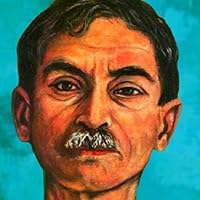
Munshi Premchand (Hindi: मुंशी प्रेमचंद) was an Indian writer famous for his modern Hindustani literature. He is one of the most celebrated writers of the Indian subcontinent,and is regarded as one of the foremost Hindustani writers of the early twentieth century.
Born Dhanpat Rai, he began writing under the pen name "Nawab Rai", but subsequently switched to "Premchand", while he is also known as "Munshi Premchand", Munshi being an honorary prefix. A novel writer, story writer and dramatist, he has been referred to as the "Upanyas Samrat" ("Emperor among Novelists") by some Hindi writers. His works include more than a dozen novels, around 250 short stories, several essays and translations of a number of foreign literary works into Hindi.
Premchand is considered the first Hindi author whose writings prominently featured realism. His novels describe the problems of the poor and the urban middle-class. His works depict a rationalistic outlook, which views religious values as something that allows the powerful hypocrites to exploit the weak. He used literature for the purpose of arousing public awareness about national and social issues and often wrote about topics related to corruption, child widowhood, prostitution, feudal system, poverty, colonialism and on the India's freedom movement.
Several of his early works, such as A Little Trick and A Moral Victory, satirised the Indians who cooperated with the British colonial government.
In the 1920s, he was influenced by Mahatma Gandhi's non-cooperation movement and the accompanying struggle for social reform. During this period, his works dealt with the social issues such as poverty, zamindari exploitation (Premashram, 1922), dowry system (Nirmala, 1925), educational reform and political oppression (Karmabhumi, 1931).
In his last days, he focused on village life as a stage for complex drama, as seen in his most famous work Godan as well as the short-story collection Kafan (1936).Premchand believed that social realism was the way for Hindi literature, as opposed to the "feminine quality", tenderness and emotion of the contemporary Bengali literature.
My father gifted me all the volumes(probably 8 volumes) of Mansarovar when I was a kid. Though I could not understand many stories at that age but few of them like eidgaah, poos ki raat, shatranj ke khiladi etc made an everlasting impact which later compelled me to revisit the whole set. If one is in doubt that whether he should read Mansarovar or not the following sentence may help "Premchand is the Gorky of India".
My salute to the great writer for the simplicity of his writing, the brilliance of his characters and the realistic and engrossing portrayal of the life, people and culture of India in pre-independence years.
There are no words to describe Premchand's works, as far as short stories are concerned. I guess even Premchand himself would fail to do so. Brilliant would be an under-statement. I strictly recommend.
I felt nostalgia while reading these short stories because some of these I read in school. At that time these stories gave amazing feeling. But now when my mind got exposed to nuances and complexities these stories seem simplistic and one can see through the woven pattern. Still there are many stories which engaged me. It took me 33 months to read it at leisurely pace. After reading 30-40 stories, plots become predictable. I think -this may seem controversial- Premchand has larger image in our mind than he deserves or may be he is more famous and accessible. There are some other Hindi authors who can portray realism in far better way. The one most intrigued me is Yashpal.
Premchand is at its best. I have read both mansarovar 1 and 2. These book are collections of short stories. All stories are work of fiction but gives great insight in the village life of contemporary india in which premchand lived. Some stories shows good side of the village setup whiles others shows dark side of the village life. Stories takes into account various problems faced by the people on those days. Most stories gives moral message at the end. Premchand has very well thought style of writing where he raises many important social issues of his time in humorous and some time in sad way. Every story has different way of writing. In these two books reader may find 8-9 different style of writing as it may seem as stories are from different writer. Premchand gives minute details of main character and other minor characters are left to the imagination of reader. Many stories are ended in a such way that it gives reader much food for thought. Mansarovar can be best enjoyed if reader pauses for sometime after each story and tries to think about character and the message story gives. I started with casual reading but after few stories I realise stories have much deeper meaning in them.
love the author and his writings ... all the short stories teaches a lesson .. tells us about the past time ... its a splendid book and a must must must read by everyone ..
Relevant as ever... the stories are socio-depictions which are still very fresh and wonderful. Premchand was one of the foremost writers who began exploring India in the truest sense.
Premchand is certainly the best Hindi author I have read till now. He is as good with short stories (in this book) as novels. I feel Premchand wanted to highlight the plight of women, showcase some progressive thoughts regarding women, children and downtrodden people in the society through the stories in this book. This is because, most of the stories have a woman as the central character. It is quite a long collection of short stories, I read just the part 1 till now. There are apparently 3 or 4 more parts (maybe it is the version of the book that I might be reading)
These are all great stories which cover different aspects of INDIA at the time of British rule. Many of the stories show the problems of caste, religion, traditions, family etc. Premchand was a master story teller who observed the life of the people from a very minute lense and put it on paper. You gonna love it.
No words to describe the work of this great writer. These stories shaped my childhood. It seems that he lived his stories. Love all parts of Mansarovar.
Premchand is like Gorky who spent too much time in Uttar Pradesh. An acquired taste, but worth a read if you want to acquaint yourself with the culture and problems of that time.