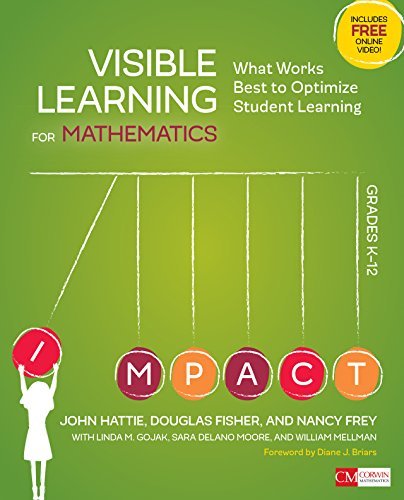
Selected as the Michigan Council of Teachers of Mathematics winter book club book! Rich tasks, collaborative work, number talks, problem-based learning, direct instruction…with so many possible approaches, how do we know which ones work the best? In Visible Learning for Mathematics, six acclaimed educators assert it’s not about which one—it’s about when—and show you how to design high-impact instruction so all students demonstrate more than a year’s worth of mathematics learning for a year spent in school. That’s a high bar, but with the amazing K-12 framework here, you choose the right approach at the right time, depending upon where learners are within three phases of surface, deep, and transfer. This results in "visible" learning because the effect is tangible. The framework is forged out of current research in mathematics combined with John Hattie’s synthesis of more than 15 years of education research involving 300 million students. Chapter by chapter, and equipped with video clips, planning tools, rubrics, and templates, you get the inside track on which instructional strategies to use at each phase of the learning Surface learning When—through carefully constructed experiences—students explore new concepts and make connections to procedural skills and vocabulary that give shape to developing conceptual understandings. Deep learning When—through the solving of rich high-cognitive tasks and rigorous discussion—students make connections among conceptual ideas, form mathematical generalizations, and apply and practice procedural skills with fluency. Transfer When students can independently think through more complex mathematics, and can plan, investigate, and elaborate as they apply what they know to new mathematical situations. To equip students for higher-level mathematics learning, we have to be clear about where students are, where they need to go, and what it looks like when they get there. Visible Learning for Math brings about powerful, precision teaching for K-12 through intentionally designed guided, collaborative, and independent learning.
John Allan Clinton Hattie ONZM (born 1950) was born in Timaru, New Zealand, and has been a professor of education and director of the Melbourne Education Research Institute at the University of Melbourne, Australia, since March 2011. He was previously professor of education at the University of Auckland.
This book answered all the questions my grad school professors could not, especially when is best to use specific teaching practices. It does a nice job of synthesizing relevant math ed literature with Hattie's own research on learning. Video supplements, which provided concrete application of the text with insights by real teachers and implementation in real classrooms, gave me many ideas for my own practice.
If you only have time to read one math related book, I wouldn’t suggest this one. Although the book makes some good points that teachers should implement in their classrooms, I felt as though the book was too research focused and didn’t have enough examples of use in the actual classroom. There were also some points that I flagged as disagreeing with because of other research and practice I have read/experienced. For example, the book suggests to group students based on academic diversity, however current research suggests that this is not the best way, but rather visibility random grouping is best. There was some other points as well. I think if reading this, it would be best served in conjunction with other resources rather than a stand alone resource.
I have the feeling this is a book I should read again in another year, just to reinforce ideas of things I want to implement but maybe don't have the bandwidth for right now. Like the single highest effect size is self-reported grades. I'm thinking it would be a small change for me to add a learning target with a place to self-report onto my assignments (e.g. I can find features of rational functions without graphing, with a scale 1-5 or something) for next year, plus maybe try a couple other things. Then revisit the book and see what else I can do for the year after.
I particularly love the idea of grouping kids by splitting the class in the middle and pairing them up like #1/14, #2/15, #3/16... #13/26. That was really helpful for me to think about, in terms of heterogeneous grouping. I really wish I had tables instead of individual desks!
Below is a quote I wanted to record for myself. I think if I ever feel frustrated that students aren't learning as much as I want them to as quickly/easily as I hoped they would, I should just take a breath and reread this passage.
"There are times when you will want students to build automaticity on certain types of procedures. Instant retrieval of basic number facts is foundational for being able to think conceptually about more complex mathematical tasks. [These] retrievals are the product of a combination of exposure to others, working it out for yourself, playing with concrete materials, experimenting with different forms of representation, and then rehearing the acquired knowledge unit within your immediate memory, transferring it into long-term memory, and having it validated thousands of times."
Amazing book on teaching math with Hattie checks embedded. What an incredible, rich resource. I have notes all over this book and found myself thinking, ‘I need to do more of this.’ and ‘What a great way of explaining this idea.’. If you teach math, this should be a resource in your classroom.
Chapter 1 - Visible Learning "Learning is not linear; it's recursive." This is emphasized several times. Plato erroneously said that education should be reserved for those that were "naturally skilled in calculation." Rigor - a balance among conceptual understanding, procedural skills and fluency, and application with EQUAL intensity. Classroom discourse - facilitates meaningful conversation, constructs viable arguments, critiques the reasoning of others, allows for communication and interpretation. Likely to result in 2 YEARS of learning gains for a year of schooling.
Chapter 2 - Teacher Clarity Learning Intentions (objective statements) must be stated in a way that students can use it to gauge their progress. In other words, it MUST include a criteria for measuring success. (Success Criteria). AFter John Hattie compiled all this data, he found THE SINGLE MOST IMPORTANT THING TEACHERS CAN DO IS TO KNOW THEIR IMPACT ON STUDENT LEARNING. Teacher clarity 1. clarity of organization - lessons, links to objectives 2. clarity of explanation - explanations are accurate and comprehensible to students. 3. clarity of examples and guided practice - examples are illustrative and illuminating. 4. Clarity of assessment of student learning. Regular acting on feedback he or she receives from students The expert blind spot is where the teacher knows the content well, but fails to recognize the problems of students learning these concepts. This happens when students learn a procedure, but don't know the meaning of the calculation they have done. writing objectives - Expert teachers start with a standard, break them into lesson-sized chunks and phrase these chunks so students understand them. embed previous content in the new content. Framed as "Students have a right to know what they are supposed to learn and why they are supposed to learn it" cause people to take it more seriously. After all, they are being tested on it and given transcripts that last a lifetime. Pre-assessments
Chapter 3 - Tasks and Discourse
Chapter 4 - Surface Mathematics Surface Learning is conceptual exploration and learning vocabulary and procedural skills that give structure to ideas. Basically it is the first approach at a concept that gives understanding and some procedural skills. Talk that guides students in the surface phase of math: (classroom discussion = 0.82 effect size) - Number talks. Needs to be done daily to be effective - Guided questions. Instead of giving an answer, pause and instead ask a better question that helps guide thinking. - Worked examples. My Favorite No - Direct instruction. This is not a monologue from the teacher. This is scaffolded, demonstration, checking for understanding, recaps when they have done with closure Best Teaching methods for surface learning in Math: - Vocabulary instruction (p.67 effect size). introduced after students have struggled with coming up with appropriate words for a while. - Manipulatives for surface learning - Spaced practice with feedback - Mnemonics "...students who confront and fail a challenging problem and then are provided further clarifying instruction out perform traditionally taught students." Productive struggle or productive failure - Kapur, 2008. Ask more "why" questions and fewer "what" questions. "My Favorite No" Use this to ask more questions. rewrite the problem yourself so no one can recognize handwriting of student, then ask "I wonder why..." questions. This questioning helps students justify why we take steps and clears misconceptions they may have had. "Big difference between teaching and telling"!! Direct Instruction should NOT: - be the sole means for teaching mathematics - consume a significant portion of instructional minutes. The majority should be on students doing the math. - DI can follow student exploration, begin a unit or solve problems. - DI is a chance to model mathematical practices, thus a way to teach them. Design lessons with these math practices in mind. - Getting students to use "I" statements in reflection helps in self-verbalization and self-questioning, which has an effect size of 0.64. Helps students realize they are the force acting upon and understanding the mathematical ideas and employing math practices. Metacognitive strategies (effect size of 0.69) is thinking about our own thinking. i.e. when students must explain why. Making the students use the word "because" grows students profoundly. Teachers must use this too to explain our thinking, so students will not wonder why we did something.
Book suggests breaking my Units into three phases: Surface learning phase: When—through carefully constructed experiences—students explore new concepts and make connections to procedural skills and vocabulary that give shape to developing conceptual understandings. Deep learning phase: When—through the solving of rich high-cognitive tasks and rigorous discussion—students make connections among conceptual ideas, form mathematical generalizations, and apply and practice procedural skills with fluency. Transfer phase: When students can independently think through more complex mathematics, and can plan, investigate, and elaborate as they apply what they know to new mathematical situations. To equip students for higher-level mathematics learning, we have to be clear about where students are, where they need to go, and what it looks like when they get there. Finally, hearing my voice every day is grating and difficult for students who have a verbal and body language style that conveys to their peers better than I can, the procedural and logical methods that work for them. So I need to make sure collaborate and peer interactive work like partner work approaches 50% of our time together.
This book has outlined, in a direct way, exactly what great teachers do. We all know that students deserve the best teachers, but how do teachers become the best teachers they can be? Answer: help the students learn how to teach themselves.
There are about 24 points that I want to implement in my classroom this upcoming year that I gleaned from this book, and so many video QR codes and resources and anecdotes and effect sizes that I am left wondering how anyone can go so far nowadays and not know, in an itemized way, the best things that they can do to improve their practice in the classroom.
This is not a "quick-fix" book for everyone, but it does tell mathematics teachers ranging from K-12 levels how to fix persistent problems given time and effort. The good thing is that the teacher does not need to do all of the lifting -- students can (and should) learn to carry their own learning as well. Definitely recommend this to anyone teaching math in a K-12 context.
A lot of this book focused specifically on deep learning, surface learning, and transfer learning. This book also listed specific strategies in terms of their effect size; the higher the effect size, the more helpful the strategy. This book had a closing chapter on assessment which included information on what works for assessment based on the most current research. The best thing about this book was the sheer amount of research that went into it. The practices that were mentioned as effective came from numerous studies featuring thousands of students all over the world. I thought the authors did a very nice job of condensing this into chapters that were easy to read and direct in terms of the specific advice. I would recommend this to elementary school math teachers as the content seemed predominantly geared towards this audience.
Still in the middle of this book but it is amazing. It has completely changed the way I think about teaching mathematics. Will update this review once I've finished the book and begun putting it into practice in my 4th grade classroom.
Amazing book. I wasn't sure about it before reading, seemed like it could be a little dry... I was surprised to love this book as much as I did-- and it's really about teaching and learning at the end of the day, framed in a math context. So much to think about! And a mic drop at the end.
This book is definitely a text book. It is not very easy to read, but it is important! It takes all the new research on best practice and teaches teachers what it takes to have students succeed in math.
DNF. Right before I started this book, I learned more information about Hattie’s research methods and how flawed his data is. So I went into the book with a bad taste in my mouth. After reading 2 chapters and skimming the rest of the book, there is pretty much no new information.