

What do you think?

Achewood Dark Horse collections #1
The Great Outdoor Fight
Rare book
104 pages, Hardcover
First published September 1, 2008
Ratings & Reviews
Friends & Following
Create a free account to discover what your friends think of this book!
Community Reviews
Displaying 1 - 30 of 89 reviews

August 4, 2015
Well, I loved the concept of this book. . .
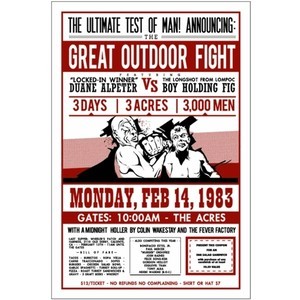
I mean - GEEZ! Right?
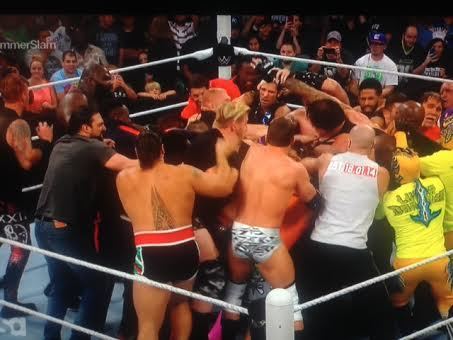
Thousands of men duking it out until the one still standing is declared the winner. It sounds kind of like when the WWE boys snap their collective caps and start whaling on each other and for once the whole thing doesn't look completely rehearsed.
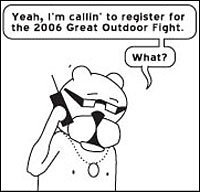
Unfortunately, the concept was the best thing about this book. Most of the pages are taken up with the adventures of this critter -
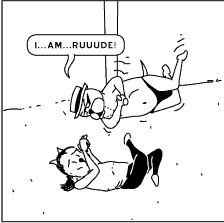
- who only fights one dude at a time, only wins by cheating and worst of all, fights in some sort of sumo-thong-thing.
And about that artwork, eh? I'm sorry, but I have better cartoons in my high school notebooks that I drew when I should have been taking notes.
It's a shame, because I really liked the "historical" parts of this book - the origin story, the profiles of champions through the years, and especially the two pages reprinted from the cookbook - Recipes of The Great Outdoor Fight: Hearty Food For Your Strong-Hearted Man. Here are manly, meat-saturated recipes where even the salad consists, not of "dainty leafy greens," but two cups of minced ham. My favorite was the one and only veggie dish which features 3 carrots and 1 stick of butter cooked in a pastry shell with some strips of bacon, of course!
This attention to detail is the only reason I gave the book 3 and not 2 stars.
I mean - GEEZ! Right?
Thousands of men duking it out until the one still standing is declared the winner. It sounds kind of like when the WWE boys snap their collective caps and start whaling on each other and for once the whole thing doesn't look completely rehearsed.
Unfortunately, the concept was the best thing about this book. Most of the pages are taken up with the adventures of this critter -
- who only fights one dude at a time, only wins by cheating and worst of all, fights in some sort of sumo-thong-thing.
And about that artwork, eh? I'm sorry, but I have better cartoons in my high school notebooks that I drew when I should have been taking notes.
It's a shame, because I really liked the "historical" parts of this book - the origin story, the profiles of champions through the years, and especially the two pages reprinted from the cookbook - Recipes of The Great Outdoor Fight: Hearty Food For Your Strong-Hearted Man. Here are manly, meat-saturated recipes where even the salad consists, not of "dainty leafy greens," but two cups of minced ham. My favorite was the one and only veggie dish which features 3 carrots and 1 stick of butter cooked in a pastry shell with some strips of bacon, of course!
This attention to detail is the only reason I gave the book 3 and not 2 stars.

February 4, 2013
Ray Smuckles, a bear wearing sunglasses with lotsa cash who lives in a mansion, hears about The Great Outdoor Fight from his mother when she visits him randomly at the start of the book. The Fight takes place outdoors and is a kind of Royal Rumble melee of 3000 men beating on each other for 3 days and the last man standing is the victor. Also much turkey and brandy is consumed on the second day. Ray hears that his long-lost father was a champion of the Fight in the early 70s and decides that he will enter the Great Outdoor Fight in 2006 and reclaim his father’s title. So he sets off with his best friend, Roast Beef (they’re all talking bears), to win the Fight.
On the face of it, “Achewood” is the kind of comic book I would usually completely fall for. It’s got anthropomorphic animal characters, most of whom talk a kind of Southern hick vernacular sometimes verging into Latino gangsta territory, and they’re concerned with winning a large fisticuffs fight in a field - the setup is brilliant. Ray and Roast Beef are great characters, Ray being a bear-like Kenny Powers - who doesn’t enjoy “Eastbound and Down”? But... maybe it’s because I had high expectations after many “Achewood” fans told me it’d be hilarious, but I didn’t think it was that funny a story.
The dialogue isn’t particularly witty, there are no memorable moments, and I like the two lead characters but they’re not so fantastic that they became comedic legends. The story of a fight is a bit weak and Chris Onstad’s art is very, very amateurish - I know the effect is meant to make the book funnier but it just didn’t work for me.
I hear “Achewood” gets really good in later books and I’m not totally put off the series that I would never return to it but this first book hasn’t gotten me fired up to seek out the next one in a hurry. “The Great Outdoor Fight” is a somewhat interesting indie comic but maybe not the best entry point for new readers coming to the series.
On the face of it, “Achewood” is the kind of comic book I would usually completely fall for. It’s got anthropomorphic animal characters, most of whom talk a kind of Southern hick vernacular sometimes verging into Latino gangsta territory, and they’re concerned with winning a large fisticuffs fight in a field - the setup is brilliant. Ray and Roast Beef are great characters, Ray being a bear-like Kenny Powers - who doesn’t enjoy “Eastbound and Down”? But... maybe it’s because I had high expectations after many “Achewood” fans told me it’d be hilarious, but I didn’t think it was that funny a story.
The dialogue isn’t particularly witty, there are no memorable moments, and I like the two lead characters but they’re not so fantastic that they became comedic legends. The story of a fight is a bit weak and Chris Onstad’s art is very, very amateurish - I know the effect is meant to make the book funnier but it just didn’t work for me.
I hear “Achewood” gets really good in later books and I’m not totally put off the series that I would never return to it but this first book hasn’t gotten me fired up to seek out the next one in a hurry. “The Great Outdoor Fight” is a somewhat interesting indie comic but maybe not the best entry point for new readers coming to the series.

March 16, 2012
"Dude, you didn't fugue, you were just berserk. That's like comparing a lunatic to a pissed guy with goals."
The Great Outdoor Fight tells the story of a long-running toughest-guy-around tournament, and a pair of friends who weasel their way into it. The animation reminds me of South Park, not so much in the look of it but in the way it's simultaneously awful and amazingly expressive. A lot of information is conveyed in every inexpertly drawn panel.
It surprised me how much I enjoyed this book. I actually laughed out loud at least a dozen times. Totally worthwhile.
----------------------------------
2ND READ ten years later
Onstad seeds the story with an impressive history--indeed, a mythos--for his Great Outdoor Fight event, really brings it to life.
I'll never not enjoy this book, but a bit of the magic leaks out after that first read-through.
----------------------------------
3RD READ
I picked up my first case of covid this week. With my brain fizzing I was finding my mind skipping off of Steinbeck and I needed something lighter and funner to chew on. The GOF fit the bill perfectly.
The Great Outdoor Fight tells the story of a long-running toughest-guy-around tournament, and a pair of friends who weasel their way into it. The animation reminds me of South Park, not so much in the look of it but in the way it's simultaneously awful and amazingly expressive. A lot of information is conveyed in every inexpertly drawn panel.
It surprised me how much I enjoyed this book. I actually laughed out loud at least a dozen times. Totally worthwhile.
----------------------------------
2ND READ ten years later
Onstad seeds the story with an impressive history--indeed, a mythos--for his Great Outdoor Fight event, really brings it to life.
I'll never not enjoy this book, but a bit of the magic leaks out after that first read-through.
----------------------------------
3RD READ
I picked up my first case of covid this week. With my brain fizzing I was finding my mind skipping off of Steinbeck and I needed something lighter and funner to chew on. The GOF fit the bill perfectly.

February 16, 2009
Chris Onstad is my wife. Today is our wedding.
February 20, 2009
Three Days, Three Acres, Three Thousand men. Onstad at his best, and full of amazing supplemental information. This is probably the closes you'll get to providing a good starting point for someone wanting to read Achewood, "in context" enough for long time readers, but separate from the main story to not require prior knowledge of every character's history.
Read
February 2, 2026perfect book to read in one sitting in the bath tub sam got me this forever ago and ive only ever read it in the bath

April 26, 2011
Chris Onstad's Achewood internet comic was at one time one of the most important parts of my weekday, and I've spent countless hours hitting the "random" button to read his genius comics. This is a book version of his most successful plot thread with extra 'lore' and shit like that. It's amazing and breaks my heart even more that Achewood has gone on indefinite hiatus.

December 20, 2012
Completely original. Collection of online strips, now in hardcover.... a story about participation in this year's Great Outdoor Fight, and both front and end matter document this long history, with recipes from local restaurants. Some reviewers didn't find it funny. I get that. That is sort of the point, or beside the point, as this feels almost like a cult phenomenon, where people are just doubled over laughing at the lame violence and graphic jokes... and the fact that it IS so lame is the point... it's another version of outsider art. I liked it a lot, did find it unique and funny and oddly interesting.

September 29, 2008
One of the most perfect graphic narratives ever. Man. This reasonably-priced, gorgeously designed hardcover is a perfect introduction to the wonderfully-written world of Achewood. The characters are perfect, the humor sublime, and the minimalist art has a simple elegance that only gets richer as you read more. While almost all of the content is available for free online, having in in a portable edition is a joy. Buy this, buy one for you friends, and hell, buy one to give to a stranger. Our sad, fucked-up world needs more joy.
April 1, 2015
I just don't see the appeal. Is it the over the top violence? The author puts in the work to create a detailed history for the Great Outdoor Fight, but the strips themselves don't create a compelling story.

December 14, 2025
I was too poor in my 20s to have the internet at home, so I missed the golden age of the webcomic.
I think it is fair to say that Onstad's Achewood would be part of that. It was a webcomic, right?
All I really know of it is the various panels that people post online. So I decided to read it as God intended, and put a copy of the first book on reserve.
The Great Outdoor Fight is an annual event that our hero signs up for once he learns he is the heir to a past champion. (I'm fairly certain the fight is fictional, as are the characters; I need to verify this.)
What surprised me about the book was that it was pretty much one coherent story, including front parts and back parts to frame the story and place it in the fictional universe. It was funny and clever, and I am disappointed that The Great Outdoor Fight was the only Achewood text available through my library. I need to find the other collections.
I think it is fair to say that Onstad's Achewood would be part of that. It was a webcomic, right?
All I really know of it is the various panels that people post online. So I decided to read it as God intended, and put a copy of the first book on reserve.
The Great Outdoor Fight is an annual event that our hero signs up for once he learns he is the heir to a past champion. (I'm fairly certain the fight is fictional, as are the characters; I need to verify this.)
What surprised me about the book was that it was pretty much one coherent story, including front parts and back parts to frame the story and place it in the fictional universe. It was funny and clever, and I am disappointed that The Great Outdoor Fight was the only Achewood text available through my library. I need to find the other collections.
July 9, 2020
Loved it. Been obsessed with Achewood since a co-worker showed it to me about a year ago. Somehow Chris Onstad makes one strip laugh out loud funny and the next one sentimental and poignant. "Our every move is the new tradition," is a line that's said and I keep reciting it in my head. I think RollingStone put out a list of Top 50 graphic novels that aren't about superheros. They put this one at #14 and although it's hardly a graphic novel (as much as a collection of strips is one) I'd still put it higher on that last. It's born from a time in like 2001-2005 when Onstad was probably one of the first cartoonists putting comics on the internet. It has such a specific and niche sense of humor that it's aged miraculously well. I'll be re-reading it and sending it to friends forever.
March 26, 2019
I think achewood as a whole is the best piece of art to come from the internet, and the great outdoor fight is the most coherent continuing plotline; this book is a collection of those original achewood strips with additional content to fill out the mythology of the event that the plot goes through. the great outdoor fight is the a 3,000 man melee that takes part over the course of three days, with only one winner. that sounds serious. but achewood is a comedy strip, and most of the pleasure that comes from this collection is in the absurdist humor, including idiosyncratic phrasing and minimalist drawing that makes his world completely his own. man, achewood was so good.

October 24, 2017
I borrowed this from the library on a whim and dove into reading it without knowing anything about the story or its characters. At first I couldn't tell if I liked the art style or the characters or even the story, but all three wound up growing on me. I even went back to read the Introduction, something I never read, and was totally fascinated with the history of the Great Outdoor Fight, which seems oddly plausible.

April 12, 2018
Less a collection of strips than a concept book that continues to use Onstad's strip structure, this features all the same characters in an ongoing storyline that has a concrete beginning middle and end. Hilariously inappropriate as always, the fighting take down techniques are offbeat and tricky.

January 4, 2025
Oh my god. This book was hilarious. I don’t think I’ve laughed out loud this many times during a read since A Walk in the Woods.
I’ve never taken on any Achewood until now and I finally get it.
Roast Beef the cat is decidedly the prototype of social media speak, I’ve concluded.
I’ve never taken on any Achewood until now and I finally get it.
Roast Beef the cat is decidedly the prototype of social media speak, I’ve concluded.

March 29, 2018
I only read about 25 pages of this one. Not my thing.

January 13, 2021
An impressive balancing act between stupid and transcendent.

March 12, 2023
Walks an uneven line between absurd and relevant, but the prologue story was the most enjoyable part.

June 13, 2023
Hilarious parody of toxic masculinity and action-hero stories. Well worth the quick read.
December 6, 2023
Extremely funny! Hard to recommend!
March 21, 2025
A transcendent work of literature. The great American novel for the 2000's.

December 3, 2020
[UPDATE 08-23-2021] Hello. It has become clear to me that my ratings system is flawed beyond repair. Due to a lack of standardization, I have rated many books more highly than they deserve, resulting in an inability to rate newly read books accurately without creating an incorrect impression of quality compared to books previously read. As a result, I am re-rating all of the books I have read in 2020 and 2021. For each book, I will append this little explanation, my new rating for this book using Storygraph’s scale (which allows for quarter-star ratings), my reasoning for the change (if necessary), and finally a guide to my new rating scale. Thank you.
Old Rating: 5
New Storygraph Rating: 4.25
My Reasoning: okay, this one goes pretty hard
Guide to my New Rating Scale:
* 5 Stars: This book was more or less flawless. One of the best things I’ve ever read.
* 4.75 through 4.25 Stars: This book had slight flaws, but I REALLY loved it. Marked as 4 stars on Goodreads.
* 4 Stars: This book had slight flaws, but I loved it.
* 3.75 through 3.25 Stars: This book had significant flaws, but I REALLY liked it. Marked as 3 stars on Goodreads.
* 3 Stars: This book had significant flaws, but I liked it just fine.
* 2.75 through 2.25 Stars: This book was extremely flawed, but I thought it had some merit. Marked as 2 stars on Goodreads.
* 2 Stars: This book was extremely flawed, but I didn’t actively dislike it. It was a waste of my time but not odious.
* 1.75 through 1.25 Stars: This book was irreparably flawed, and I actively disliked it. Marked as 1 star on Goodreads.
* 1 Star: This book was irreparably flawed. I actively hated this book and am worse off for having read it.
————————————————————————-
hell yeah
Old Rating: 5
New Storygraph Rating: 4.25
My Reasoning: okay, this one goes pretty hard
Guide to my New Rating Scale:
* 5 Stars: This book was more or less flawless. One of the best things I’ve ever read.
* 4.75 through 4.25 Stars: This book had slight flaws, but I REALLY loved it. Marked as 4 stars on Goodreads.
* 4 Stars: This book had slight flaws, but I loved it.
* 3.75 through 3.25 Stars: This book had significant flaws, but I REALLY liked it. Marked as 3 stars on Goodreads.
* 3 Stars: This book had significant flaws, but I liked it just fine.
* 2.75 through 2.25 Stars: This book was extremely flawed, but I thought it had some merit. Marked as 2 stars on Goodreads.
* 2 Stars: This book was extremely flawed, but I didn’t actively dislike it. It was a waste of my time but not odious.
* 1.75 through 1.25 Stars: This book was irreparably flawed, and I actively disliked it. Marked as 1 star on Goodreads.
* 1 Star: This book was irreparably flawed. I actively hated this book and am worse off for having read it.
————————————————————————-
hell yeah

February 2, 2016
What an odd world, this world of Achewood. I came into The Great Outdoor Fight blind, and was thus convinced by excellent writing and a state of confusion that I was even more confused when, following the documentary-style history of The Great Fight in question, I was presented with wise-ass, street-talking animals living in a mansion somewhere. This led me to look up what the heck Achewood was.
After learning a bit of background I was able to finish the story, laughing at the section with the main character, Raymond Smuckles' mother -- which brilliantly parodied certain mother types, and chuckling here and there at the absurdity of it all and various jokes, situations and bits. I did find the whole thing a bit too absurd, inconsistent (Smuckles' character was super-confident and wily, ghetto, sophisticated, southern redneck, scaredy-cat, ass-kicker -- all over the place for example), and ridiculous, but a good time was had overall.
True Rating: 3.4 Stars
February 14, 2009
Now that Chris Onstad is too busy to update Achewood with new strips, I finally picked up a copy of the book causing all the trouble... The Great Outdoor Fight. I've been waiting to see a fully fleshed-out Achewood ever since the excellent Ray goes to hell story arc and this book, for the most part, satiates. Onstad does well by keeping the focus on Ray and Roast Beef, a fascinating Brothers Karamozov-style dynamic if there ever was one. Maybe it's just because I read
Watchmen
recently, but I wanted more "primary sources," and not just tacked on at the end. Almost feels like a missed opportunity to give more history of the G.O.F. with articles and flashbacks. Otherwise, a good first "full-length" showing for Achewood... can't wait for the next.

February 7, 2012
I picked up this book recently because the reviews I'd read made it sound like a minor work of genius. But, I have to admit to being a bit underwhelmed. All three of the stars I'm giving this are for the presentation and the front and back matter which book-end a fairly charmless comic book. To be fair, I haven't really read Achewood before this, so I could be missing some of the appeal which comes from reading long-followed characters in a more long-form tale (though I believe all of this originally appeared in serial format). Still, Onstad's art is rough in a fairly non-charismatic sort of way, and only the rare shots of wit elevate a fairly pedestrian story.
That said, I thought the previously mentioned back and front matter, which largely details history of the Great Outdoor Fight was pretty entertaining and well done. If the main strip had the same level of quality and attention to detail, I probably would be raving about the book.
Sadly, that isn't the case.
That said, I thought the previously mentioned back and front matter, which largely details history of the Great Outdoor Fight was pretty entertaining and well done. If the main strip had the same level of quality and attention to detail, I probably would be raving about the book.
Sadly, that isn't the case.

October 14, 2012
Catching up on reviews!
I haven't exactly made any secret of my love for Chris Onstad and Achewood (people who are actually Facebook friends with me, which is everyone on here, I guess, will note he's my only "inspirational person"), so giving this five stars shouldn't come as any surprise. You can make all of the accusations about Achewood dropping off quality-wise and I won't make a peep (I think it's peaked, too), but this is a shining example of the strip (is it a strip?) at its best. Onstad has his character voices down so tight, the art is spare but somehow perfect, and the jokes are magnificently executed. There's some fun back-matter type stuff to be had in the added bios of GOF champions of yesteryear, but the recipes section falls surprisingly flat for an Onstad production. My biggest quibble is that Dark Horse put a big 1 on the spine, which I think is bound to throw people as time goes on.
I haven't exactly made any secret of my love for Chris Onstad and Achewood (people who are actually Facebook friends with me, which is everyone on here, I guess, will note he's my only "inspirational person"), so giving this five stars shouldn't come as any surprise. You can make all of the accusations about Achewood dropping off quality-wise and I won't make a peep (I think it's peaked, too), but this is a shining example of the strip (is it a strip?) at its best. Onstad has his character voices down so tight, the art is spare but somehow perfect, and the jokes are magnificently executed. There's some fun back-matter type stuff to be had in the added bios of GOF champions of yesteryear, but the recipes section falls surprisingly flat for an Onstad production. My biggest quibble is that Dark Horse put a big 1 on the spine, which I think is bound to throw people as time goes on.
December 11, 2008
Combining an astoundingly sparse drawing style with rich background writing and development, it's hard to take in Achewood:The Great Outdoor Fight in one sitting.
The actual plot is a violent and somewhat disturbing riff on the Clint Eastwood movie Any Which Way You Can where there's no interference, but the fight has its own rich history and etiquette.
Indeed, this history and etiquette is where Chris Onstad really shines, providing creative color to an otherwise very simple plot.
As it's my first exposure to Achewood, I definitely feel I'm missing something. It's not the best place for jumping on, but one can see the depth and thought that Onstad puts into his work.
The actual plot is a violent and somewhat disturbing riff on the Clint Eastwood movie Any Which Way You Can where there's no interference, but the fight has its own rich history and etiquette.
Indeed, this history and etiquette is where Chris Onstad really shines, providing creative color to an otherwise very simple plot.
As it's my first exposure to Achewood, I definitely feel I'm missing something. It's not the best place for jumping on, but one can see the depth and thought that Onstad puts into his work.

August 29, 2008
Achewood being the quintisential hipster webcomic, I would expect nothing less from the book. It was nice to read a full story arc in a larger format and all together (and on paper no less!), not to mention the sheer amount of extra material the author has put in (almost half the book), including a history of the Great Outdoor Fight as well as select biographies of past years' winners. Though previous knowledge of Achewood would help one understand the characters, I'm pretty sure you'll get by (and still be amused) without it.
October 11, 2008
Chris Onstad is a fabulous putter-together-er of words. The characters are rich and exquisitely laid out. Onstand's world is detailed, relying on tropes you didn't realize you knew in order to create a world just bizarre enough to be plausible as a real place.
Taken from a long-running webcomic, this is a standalone story arc. There's plenty of added content (the glossary! the bios! the recipes!) for those who've read the plotline via the web. Plus, the book is a goddamn gem to touch. It makes my hands feel good.
Taken from a long-running webcomic, this is a standalone story arc. There's plenty of added content (the glossary! the bios! the recipes!) for those who've read the plotline via the web. Plus, the book is a goddamn gem to touch. It makes my hands feel good.
Displaying 1 - 30 of 89 reviews