

What do you think?

The Grandmothers: A Family Portrait
Glenway Wescott’s poignant story of nineteenth-century Wisconsin was first published in 1927 as the winner of the prestigious Harper Prize. Like F. Scott Fitzgerald and Ernest Hemingway, Wescott left the Midwest behind to live as a writer in 1920s Paris. In this novel, based on Wescott’s own life and family, the young Alwyn Tower leaves Wisconsin to travel in Europe, but finds himself haunted by a family of long-dead spirits—his grandparents and great-uncles and aunts, a generation whose young adulthood was shattered by the Civil War. Their images were preserved in fading family albums of daguerreotypes and in his own fragmented memories of stories told to him by his strong and enduring grandmothers. To disinter and finally lay to rest the family secrets that lingered insistently in his mind, Wescott writes, Alwyn was “obliged to live in imagination many lives already at an end.”
The Grandmothers is the chronicle of Alwyn’s the bitter Henry Tower, who returned from Civil War battlefields to find his beautiful wife Serena lost in a fatal fever; Rose Hamilton, robust and eager, who yearned to leave the cabin of her bearded, squirrel-hunting brothers for the company of courteous Leander Tower; the boy-soldier Hilary Tower, whose worship of his brother made him desperate; fastidious Nancy Tower, whose love for her husband Jesse Davis could not overcome her disgust with the dirt under his fingernails; Ursula Duff, proud and silent, maligned among her neighbors by her venal husband; Alwyn’s parents, Ralph Tower and Marianne Duff, whose happiness is brought about only by the intervention of a determined spinster.
The Grandmothers is the chronicle of Alwyn’s the bitter Henry Tower, who returned from Civil War battlefields to find his beautiful wife Serena lost in a fatal fever; Rose Hamilton, robust and eager, who yearned to leave the cabin of her bearded, squirrel-hunting brothers for the company of courteous Leander Tower; the boy-soldier Hilary Tower, whose worship of his brother made him desperate; fastidious Nancy Tower, whose love for her husband Jesse Davis could not overcome her disgust with the dirt under his fingernails; Ursula Duff, proud and silent, maligned among her neighbors by her venal husband; Alwyn’s parents, Ralph Tower and Marianne Duff, whose happiness is brought about only by the intervention of a determined spinster.
408 pages, Paperback
First published January 1, 1927
About the author
Glenway Wescott
42 books34 followersGlenway Wescott grew up in Wisconsin and briefly attended the University of Chicago where he met in 1919 his longtime partner Monroe Wheeler.
In 1925 he and Wheeler moved to France, where they mingled with Gertrude Stein and other American expatriates, notably Ernest Hemingway, who created an unflattering portrait of Wescott in the character of Robert Prentiss in The Sun Also Rises.
Eventually, Wescott and Wheeler returned to America and lived in New York City, and later on a large farm in Rosemont, New Jersey owned by his brother, the philanthropist Lloyd Wescott, along with other family members.
Wescott's early fiction, the novels The Apple of the Eye (1924) and the Harper Prize winning The Grandmothers (1927) and the story collection Goodbye, Wisconsin (1928) were set in his native Midwest.
Later work included essays on political, literary, and spiritual subjects, as well as the novels The Pilgrim Hawk (1940), which shared a narrator in Alwyn Towers with The Grandmothers, and Apartment in Athens (1945). Wescott's journals, recording his many literary and artistic friendships, offering an intimate view of his life as a gay man, were published posthumously under the title Continual Lessons.
In 1925 he and Wheeler moved to France, where they mingled with Gertrude Stein and other American expatriates, notably Ernest Hemingway, who created an unflattering portrait of Wescott in the character of Robert Prentiss in The Sun Also Rises.
Eventually, Wescott and Wheeler returned to America and lived in New York City, and later on a large farm in Rosemont, New Jersey owned by his brother, the philanthropist Lloyd Wescott, along with other family members.
Wescott's early fiction, the novels The Apple of the Eye (1924) and the Harper Prize winning The Grandmothers (1927) and the story collection Goodbye, Wisconsin (1928) were set in his native Midwest.
Later work included essays on political, literary, and spiritual subjects, as well as the novels The Pilgrim Hawk (1940), which shared a narrator in Alwyn Towers with The Grandmothers, and Apartment in Athens (1945). Wescott's journals, recording his many literary and artistic friendships, offering an intimate view of his life as a gay man, were published posthumously under the title Continual Lessons.
Ratings & Reviews
Friends & Following
Create a free account to discover what your friends think of this book!
Community Reviews
Displaying 1 - 18 of 18 reviews

June 11, 2010
In many ways The Grandmothers reminded me of another wonderful book published in 1927, Willa Cather's Death Comes for the Archbishop, and perhaps it would remind me too of Cather's more midwestern pioneer writings, if I had read them. (It bears more resemblance to this than it does to Wescott's novella The Pilgrim Hawk.) Wescott would become urbane and cosmopolitan (he was already gay), move to Europe and hang with Gertrude Stein's crowd, and become Hemingway's model for Robert Prentiss in The Sun Also Rises, but you get no inkling of that in the world he creates here, based on the lives of his family and ancestors in hardscrabble Wisconsin. The Wescott-based character Alwyn Tower of The Pilgrim Hawk appears here as a young boy surrounded by older relatives, listening to their stories or being puzzled by their mysterious reticence, and thumbing through their daguerrotype albums:
As he remembered his childhood, it seemed that much of it had been spent in the center of a carpeted floor; and all about in a circle of rocking-chairs there had been women and men - grandparents, and their friends, and old cousins, and great-aunts, and uncles; and behind each one a life had extended into the past like a corridor - poorly lighted, long corridors winding away in every direction, through reticence and forgetfulness, to their youth; and in the ring of rocking-chairs, the child for whose existence all the corridors had come together, had shivered in the gusts of emotion which blew vaguely down them, and tried to understand the strange syllables which echoed from one life to another.
In language that is strange and morose, and both elegant and plain, Wescott describes the pioneer life which is often harsh for the Towers and the Duffs, the families who will combine to produce little Alwyn. A 16-year old son disappears fighting the Civil War; a husband is shot to death by Rebels; young wives, babies, toddlers die. Loves and hopes are thwarted. Marriages of convenience are consummated. Lonely people settle for emptiness. Neuroses bloom. Melancholics brood. Love always seems to be tinged with alienation. When a son goes off to war, the light in his father's eyes "had resembled, but had been too shining to be, that of affection." His mother's "air of pride and resignation had made him feel the impersonality of maternal love - he was only one of her sons, doing what she had given him birth to do."
A description of Ira Duff, the pompous grandfather:
For Alwyn's grandfather, who was known as "the greatest talker in the country," used words which no one else understood, words which he did not understand, and words which do not exist, to swell a passionate theme, to confound his neighbors in an argument, and for their own sake. He would say, for example, "My farm was the very apocalypse of fertility, but the renter has rested on his oars till it is good for nothing," or "Manifest the bounty to pass the salt shaker in my direction." Something of the Bible, something of an Irish inheritance, something of a liar's anxiety, made of his most ordinary remark a strange and wearisome oratory.
The book ends with Alwyn, a college student on summer vacation, keeping vigil by his dying grandmother's bedside, pondering not only his ancestry, but all of America and his place in it - city and soil, prosperity and poverty, the successes and failures of religion, the end of the pioneers, the future, and in whose hands it lies.
July 17, 2023
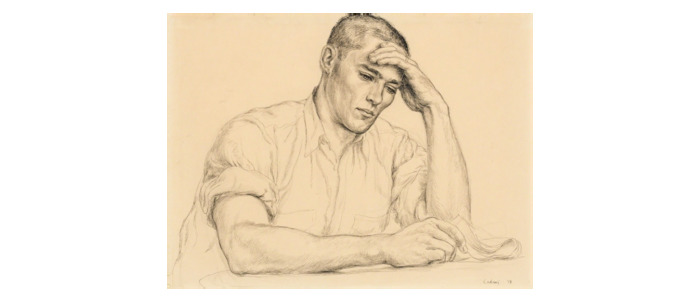
Portrait by Paul Cadmus
Glenway Westcott is best remembered as one third of the intellectual group that included Monroe Wheeler and George Platt Lynes. Wheeler and Westcott were partners, a partnership that welcomed Lynes when he and Wheeler fell in love. It was Westcott and Wheeler that furthered Lynes's fashion and photographic career. The three are celebrated in a triptych by Jared French. Wheeler is painted nude against a surreal background, Lynes against a Cocteau-style mural, and Westcott against a traditional Renaissance red background. The conformist background used for Westcott suggests exactly what French thought of the three men. Wheeler became the Director of Publications at MOMA and Westcott was President of the American Academy of Arts and Letters.
The Grandmothers, published in 1927, and written from February 1925-November 1926, precedes this famous period. It is an author in European exile, looking back (like many) on the nature of America, an author writing traditionally away from the stream of Modernism. Nothing of Westcott's private sexual concerns flows into the novel, though he does allow himself one moment of indulgence as he describes the perfectly youthful body of Timothy Davis. There are some fine moments in the novel, invariably where Westcott trusts himself to narrate a story, but the novel collapses through the weight of its earnestness. Too often, the novel shifts from character portraits to wieldy sections on religion and the aridity at the heart of America. The further Westcott drifts from his narrator into his own voice the more the novel becomes a diatribe against love and Protestant values. Westcott is at his finest when he stops moralising and describes the natural world of Wisconsin. The Grandmothers becomes an attempt to anatomise American history, from the Civil War to the American-Spanish War, and write the great Frontier novel. Less ambition would have created a finer novel.
P.S, The Winslow Homer illustrations give a nice touch to the novel.

February 8, 2019
Early Wescott; his greatest commercial success, and certainly his most immediately accessible. The coldly gleaming, crystalline prose that characterizes his mature style is present here only in brilliant coruscating flecks, as if this is the inherited debris—ancestral, artistic—he had to dutifully pan to find his specific authorial voice. Even, perhaps, himself.
But the question of whether this ended up constituting a beginning or an end (a collection of the fiction he published over the remaining 50+ years of his life wouldn't run much longer than the several hundred pages of The Grandmothers) silently hangs over this sprawling, multi-generational portrait of suspended, often blunted lives. Placing Wescott's own biography next to this text, one is tempted to retrospectively perceive something of a hereditary curse.
But the question of whether this ended up constituting a beginning or an end (a collection of the fiction he published over the remaining 50+ years of his life wouldn't run much longer than the several hundred pages of The Grandmothers) silently hangs over this sprawling, multi-generational portrait of suspended, often blunted lives. Placing Wescott's own biography next to this text, one is tempted to retrospectively perceive something of a hereditary curse.

October 19, 2007
I read this book after my own grandmother died in 1967 and felt as though Wescott was really writing about my family. His "great, gaunt grandmother" was mine, the daguerrotypes, the possibly apocryphal stories, the bitter residual of disappointed hopes and blighted love, unprofitable love of beautiful land.
I am not blind to its flaws, but it is my story too.
I am not blind to its flaws, but it is my story too.

June 1, 2014
I loved "The Apartment" about the Nazi occupation of Athens; but this was dull and was more about his personal inability to un-distort distortions about himself.

July 3, 2012
It begins beautifully, a plain and honest look at pioneer life in Wisconsin. Westcott's family happens to have settled very near the area my family is from, about 50 miles north of Milwaukee, around Lake Winnebago. Even so, my interest began to lag when he begins to tell the individual tales of his ancestral settlers (heavily imagined because he never met them), which is unrelentingly gloomy. I don't doubt the hardships, but there was also happiness and discovery, of which we get only glimpses. One grandmother in particular, whose life was full of travels, is described at length during her most miserable years, with her liberated ending consigned to a few unsatisfying paragraphs at the end. I wanted to like the book, but ultimately it does not measure up to works of Westcott's contemporaries (and friends) from the Lost Generation.

Want to Read
March 29, 2014Recommended, after a fashion, by Wisconsin Death Trip.

April 12, 2018
Would love to give this book five stars but an overly long, muddled "Conclusion" forced me to give it four. The actual edition that I read was similar to the edition of Wescott's 'Goodbye Wisconsin' which I finished April 25, 2018.
THE GRANDMOTHERS by Glenway Wescott
New York: Harper & Brothers Publishers, 1927. Limited Signed Edition (with sleeve) – 388 pages. The book is like new, the sleeve is in rough condition though the labels are both intact and clean.
No. 31 of 250 numbered copies – unread as the pages were unopened. Before modern printing techniques, that was not atypical. I used a playing card to carefully open the pages along the fold or folds. All these years and I didn’t even know that such a thing as unopened pages existed. I will be seventy-one in May. I consider myself reasonably well read. Odd bit of synchronicity, I just finished ‘War and Peace’ and a brand new, unopened book is mentioned! Along with the use of a page-knife (or paper-knife) which the better sort would always carry with them. I bought the unopened, as new, book for only $44.00 with shipping. Happy, happy, joy, joy!
As for the novel, the writing is superb, at times poetical. The writing feels so modern that I would forget that the wars being referenced are the Civil War and the Spanish American War and not the Great War and WWII. To think I had never even heard of Glenway Wescott. Hamlin Garland yes, Glenway Wescott no. Hamlin is OK, his ‘Son of the Middle Border’ being my favorite, but his writing is dated, over-wrought and entirely too flowery. Wescott is easily the superior writer. But he was an ex-pat and led an openly gay life-style. Horrors!
As a lifelong resident of Western Wisconsin, I found the book of great interest. The Westcott surname is thought to pre-date the Norman invasion of Great Britain. I am fourth generation American-Norwegian (both sides). Also, his family’s journey to Wisconsin goes back at least one additional generation. However, in the story, as a young boy, Alwyn’s search for the foundation of the original family log cabin was exactly like my own experience. As a young lad I would stay for a week at my mom’s uncle’s farm. Elmer Flaten was her dad’s brother and he had assumed ownership of the original homestead in NE Iowa. It was pointed out to me where the original log cabin had stood. Hardly any evidence of its one-time existence remained. There were also the ruins of a two-story stone house nearby that I found fascinating. Their current house was a large two-story wooden structure that itself went back many years. The yard contained a stand of huge pine trees. Upstairs, on the attic wall hung an old photo of the house taken during a large gathering of kin. In that old photo, the pines were little trees, waist high. Long hours of exhausting work for little financial gain was understood. Elmer and his daughter, my cousin Artis, worked at Mansfield Industries in Spring Grove, Minnesota. A far more lucrative occupation than farming. The dairy cows were long gone, replaced by a small herd of beef cows and a large herd of pinto horses. The family loved their horses. They even had a team that performed an equine version of square dancing for local festivities and parades.
Wescott’s family stories were so bleak, no comic relief at all. They were, in their own oppressive way, excellent but unrelenting in their grief and disappointment.
This quote from page 27 explains so much of why we are in such a mess politically. “Nevertheless, millions remained poor. Before their eyes lay the feast—they could not eat; and though there were millions of them, each felt alone in his poverty. They grieved, but stifled their grief, being ashamed of it; for if they worked harder, if they had led purer lives, if they still worked harder. . .. Those who did not give up hated life secretly; those who did, despised themselves.” Sadly, I am in accord with this thinking. There are times when I think I should be punished for my failure to achieve the American dream.
My favorite chapter was on Alwyn’s Aunt Mary; of her travels and travails. When his stories were good they were very good. When they faltered, it was because Glenway got lost in over analyzing his deep thoughts. The syntax became strained. Maybe I’m just not bright enough. Regardless, I found this book challenging reading.
Perhaps I will come to appreciate Glenway Wescott more after I read his ‘Goodbye, Wisconsin’.
THE GRANDMOTHERS by Glenway Wescott
New York: Harper & Brothers Publishers, 1927. Limited Signed Edition (with sleeve) – 388 pages. The book is like new, the sleeve is in rough condition though the labels are both intact and clean.
No. 31 of 250 numbered copies – unread as the pages were unopened. Before modern printing techniques, that was not atypical. I used a playing card to carefully open the pages along the fold or folds. All these years and I didn’t even know that such a thing as unopened pages existed. I will be seventy-one in May. I consider myself reasonably well read. Odd bit of synchronicity, I just finished ‘War and Peace’ and a brand new, unopened book is mentioned! Along with the use of a page-knife (or paper-knife) which the better sort would always carry with them. I bought the unopened, as new, book for only $44.00 with shipping. Happy, happy, joy, joy!
As for the novel, the writing is superb, at times poetical. The writing feels so modern that I would forget that the wars being referenced are the Civil War and the Spanish American War and not the Great War and WWII. To think I had never even heard of Glenway Wescott. Hamlin Garland yes, Glenway Wescott no. Hamlin is OK, his ‘Son of the Middle Border’ being my favorite, but his writing is dated, over-wrought and entirely too flowery. Wescott is easily the superior writer. But he was an ex-pat and led an openly gay life-style. Horrors!
As a lifelong resident of Western Wisconsin, I found the book of great interest. The Westcott surname is thought to pre-date the Norman invasion of Great Britain. I am fourth generation American-Norwegian (both sides). Also, his family’s journey to Wisconsin goes back at least one additional generation. However, in the story, as a young boy, Alwyn’s search for the foundation of the original family log cabin was exactly like my own experience. As a young lad I would stay for a week at my mom’s uncle’s farm. Elmer Flaten was her dad’s brother and he had assumed ownership of the original homestead in NE Iowa. It was pointed out to me where the original log cabin had stood. Hardly any evidence of its one-time existence remained. There were also the ruins of a two-story stone house nearby that I found fascinating. Their current house was a large two-story wooden structure that itself went back many years. The yard contained a stand of huge pine trees. Upstairs, on the attic wall hung an old photo of the house taken during a large gathering of kin. In that old photo, the pines were little trees, waist high. Long hours of exhausting work for little financial gain was understood. Elmer and his daughter, my cousin Artis, worked at Mansfield Industries in Spring Grove, Minnesota. A far more lucrative occupation than farming. The dairy cows were long gone, replaced by a small herd of beef cows and a large herd of pinto horses. The family loved their horses. They even had a team that performed an equine version of square dancing for local festivities and parades.
Wescott’s family stories were so bleak, no comic relief at all. They were, in their own oppressive way, excellent but unrelenting in their grief and disappointment.
This quote from page 27 explains so much of why we are in such a mess politically. “Nevertheless, millions remained poor. Before their eyes lay the feast—they could not eat; and though there were millions of them, each felt alone in his poverty. They grieved, but stifled their grief, being ashamed of it; for if they worked harder, if they had led purer lives, if they still worked harder. . .. Those who did not give up hated life secretly; those who did, despised themselves.” Sadly, I am in accord with this thinking. There are times when I think I should be punished for my failure to achieve the American dream.
My favorite chapter was on Alwyn’s Aunt Mary; of her travels and travails. When his stories were good they were very good. When they faltered, it was because Glenway got lost in over analyzing his deep thoughts. The syntax became strained. Maybe I’m just not bright enough. Regardless, I found this book challenging reading.
Perhaps I will come to appreciate Glenway Wescott more after I read his ‘Goodbye, Wisconsin’.

May 18, 2021
An All-American story of two linked pioneer families in Wisconsin stretching from the Civil War to the 1920s, The Grandmothers is an epic that touches on love, war, memory, loss, bitterness, desertion, and religion. Wescott, who was gay, also manages to slip in subtle gay themes mainly focused on desire not acted upon. Wescott's prose is occasionally dense, particularly in the last section dealing with the grandmothers' deaths, where he gets lost in memory and religion and family inheritance, in sentences of great length and many clauses, that are overburdened by paradoxes and ironies. The stronger 90% that makes up the first section is positively brisk, but also lovely; he creates a history of America in under 300 pp. A bit of a lost classic.

April 18, 2023
This book was published in the 1920's when the author lived in Paris. The story reflects on the origins of his family post Civil-War as they came to the midwest. The author has lyrical quality to his writing that is beautiful AND full of insights into his family. However, the book reads like lots of short stories laced together...I would have liked more connections/ common themes throughout the narrative.
November 22, 2020
Once again I wanna thank the Neglected Book Page for introducing me to an unknown author and his work . Written in 1927 about a family’s history in Wisconsin the book is beautifully written almost over written but beautifully written nevertheless. Why his name has gone unnoticed when other writers of his day are well known is a mystery.

Read
April 23, 2020A family portrait well-written and dotted with charming phrases, even if a bit dry or long-winded in places.

February 14, 2022
A beautiful and completely original book, one of the best ever written about the American Midwest.
September 25, 2009
This book, an epic of a Wisconsin pioneer family, is written so very well. One is memorable..."During his grandfather's lifetime, the alpaca jacket which he put on when he came in for supper swung from a hook on the door of the...room. It held the shape of his body and soul: the sharp angle of the sleeves at the elbow meant irascible vitality; the empty pockets, poverty and indifference; the imprint of the stooped shoulders, fatigue; and the contradictory flare of the collar at the back, pride."

August 22, 2012
Una novela americana de esas que, aún no siendo tan conocidas como otras contemporáneas, sin duda forma parte de la gran literatura del país y la época; bastante al estilo de "El Gran Gatsby" en términos de estilo narrativo, pero poco que ver en cuanto a argumento y cualidad apasionante del mismo.
Frescos de una época a través de distintas fotografías de personajes, bastante aburrido en su mayor parte, quizá excesivamente lírico en su narración.
Frescos de una época a través de distintas fotografías de personajes, bastante aburrido en su mayor parte, quizá excesivamente lírico en su narración.

April 2, 2009
In Micheners HAWAII, a character said that this book was one of the three best books ever written. It was about Wisconsin and by a Wisconsin author. I got through three chapters and gave up. Did not like it!
June 5, 2011
I am surprised that this book has not enjoyed a wider audience. Masterful family story of Wisconsin pioneers.

November 8, 2012
Interesting images, but no narrative- just goes on and on
Displaying 1 - 18 of 18 reviews