The Mermaid’s Tale is a thought-provoking book. But before I get into those thoughts, a few disclosures. I share a publisher with Den, Five River’s Publishing, and I’m a tiny bit acquainted with him, virtually at least. We’re both members of SF Canada, Canada’s National Association of SF professionals. And editor Robert Runte edited both our books when he was Senior Editor of Five Rivers. I don’t believe any of those factors has influenced my opinion of The Mermaid’s Tale.
I’ve been curious about this book for a while because there is some buzz about it. People are talking about it, writing about it. After The Mermaid’s Tale came out, I read comments by others that suggested this book was a cut above. On Goodreads and in emails. So I went into this book with high hopes. I wanted to like it. I wasn’t disappointed.
Sometimes when I give a book a five star rating it’s not because I think it’s the best book ever written. Sometimes I’m employing other criteria. Maybe I think it’s a five star book for that author, or there’s some other quality about the book that elevates it to five star status. You may not agree with this approach. I don’t care—it’s my approach, refined over time. Why am I telling you this? Because I want you to know that in this case I’m giving The Mermaid’s Tale five stars because I think it actually deserves five stars. I think it’s a five star book.
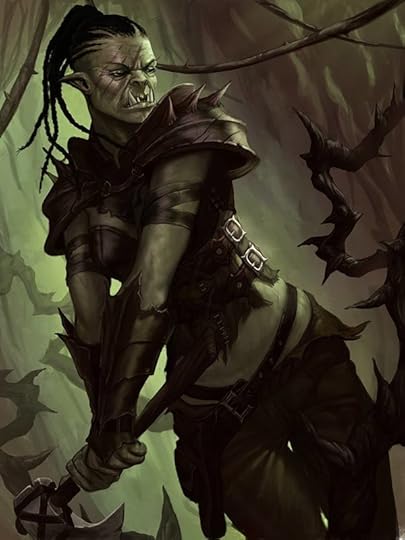
The Mermaid’s Tale is about orcs and dwarves and goblins and hobgoblins and vampires and giants and trolls. I already knew this wasn’t going to be your usual mermaid, orc, troll story because it’s Den and because of the buzz around the book. This book contains these sorts of fantasy/horror characters, and that might make it sound juvenile, but I assure you it’s not. One of the many strengths of the book is the spin it puts on all of that. These aren’t the mermaids, orcs and trolls we grew up with. They serve a purpose. They have much more depth. We feel for them. Boy do we feel for them.
The book is from a small independent publisher. Like I said earlier, it's one that I share with Den. It’s print-on-demand so individual print copies might be a bit more expensive than you’re used to, but I considered it worth it. I actually bought this book twice: first the inexpensive e-book version, then, because I realized I don’t like reading e-books, the print version. I’m glad I did. The print copy looks and feels great and was a pleasure to read.
You might be asking yourself: who is Den Valdron? This is a bit of a problem for Den and authors like him. When you're not a name author, few are going out of their way to find books by you. So who is Den? He’s an aboriginal rights lawyer originally from the Maritimes in Canada. A man who’d probably rather spend most of his time writing but can’t because you can’t make a living writing these days, with rare exceptions. So he can’t pump out as much material as required to make an impression. He could be a Stephen King but he’s not as prolific and hasn’t pulled off a Carrie yet. But he might—just give him time.
Den won’t break out with this book, I expect. It’s special, all right, but it’s got a jaw-dropping act of violence near the beginning that I suspect some people won’t be able to get past. I can imagine it would be pretty triggering for some. It reminded me of a scene in one of Stephen R. Donaldson’s books, Lord Foul’s Bane, that I first read when I was about seventeen, and that almost made me stop reading that book, I was so outraged. The scene in Den’s book did not make me stop reading it, but I wondered about it. I wanted to understand its place in the book. It’s not random, it’s not gratuitous, it’s ugly and horrible. It’s integral to the plot, to the characters, to the theme. It would not be the same book without it. It’s referenced later in the book. It speaks directly to the characters’ pain. It’s tragic and awful and something that happens in the real world and therefore merits inclusion. How do we deal with such violence if we simply bury it, refuse to acknowledge its existence, and don't talk about it in our art?
The Mermaid’s Tale deals directly with such violence. This is a story about characters who live in a violent world. It’s a story about the impact of that violence on them. It’s a story about characters who must live with the knowledge that they are reviled by everyone around them. Everyone, even themselves. It’s a story about the corrosive impact of that terrible knowledge upon them. But this isn't just fantasy; all of that violence and hatred exists in our own world too. This is a reflection of that, and forces us to reflect upon that fact.
I should probably also mention that it’s a murder mystery, but, although important and well executed, and it’s the mystery that provides the scaffolding, that aspect is almost incidental. It’s the story, but not what the story’s actually about. The Mermaid’s Tale is greater than the sum of its parts.
We live in a world saturated with art and entertainment. It’s a golden age for television. A century's worth of films to choose from. Hundreds of thousands of books published every single year. Much of this art and entertainment is very good, some of it sublime, created by gifted people know what they’re doing. We can’t possibly sample even a fraction of it. Like the unnamed protagonist in The Mermaid’s Tale who doesn’t stand much of a chance in her world, a violent book about an orc by an unknown author from a small publisher may not stand much a chance in this world.
And that's a shame, because a book of this calibre deserves to be much more widely read.