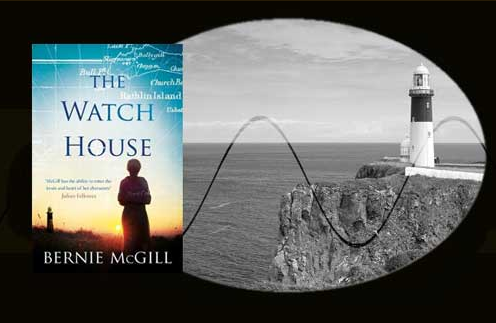
In the vein of Hannah Kent's Burial Rites, THE WATCH HOUSE by Bernie McGill is the story of the small community of Rathlin, an exposed island off the north coast of the Irish mainland, which is thrown into turmoil by the arrival of a group of Italian engineers, sent there by Marconi in 1899.
Her latest publication is This Train is For, a collection of short stories published by No Alibis Press, Belfast (June 2022). Sleepwalkers, Bernie's first collection of short stories, was published in May 2013 by Whittrick Press and shortlisted for the Edge Hill Short Story Prize 2014. The title story was first prizewinner in the Zoetrope: All-Story Short Fiction Contest (US) and the collection includes 'Home', a supplementary prizewinner in the 2010 Bridport Short Story Prize and 'No Angel', Second Prizewinner in the Seán Ó Faoláin and the Michael McLaverty Short Story Prizes. Her work has been anthologised in Belfast Stories, Reading the Future and in the award-winning The Long Gaze Back, The Glass Shore, and in Female Lines. She is the recipient of a number of Arts Council Awards as well as a Research Award from the Society of Authors. She is a former Writing Fellow with the Royal Literary Fund at the Seamus Heaney Centre at Queen's University, Belfast.
Reviews ‘McGill writes about life, love and telegraphy with a poet’s clarity’ Sunday Times ‘Totally absorbing and full of unexpected twists’ Sunday Business Post ‘A lyrical, wonderfully atmospheric novel’ Sunday Express ‘McGill proves once again she is a masterful storyteller . . . historical fiction at its absolute best’ The Lady ‘The Watch House, set on Rathlin Island at the turn of the 20th century, [is] awash in old rituals and impending transformations, in loyalties and enmities and all manner of local witchery.’ Patricia Craig in the Irish Times Books of the Year. ‘Hard to put down, this atmospheric book will stay with you long after the final heart-rending denouement, setting McGill firmly into the panoply of modern Irish writers’ Irish Independent 'McGill has the ability to enter into the brain and heart of her characters.' (Julian Fellowes, creator of Downton Abbey writing in The Guardian
Opening in April 1899, on Rathlin Island, off the coast of Ireland, the book begins with the birth of a child. The story then goes back in time to February 1898.
Fionnula (Nuala) Bryne, was brought up by her grandparents, after her family moved to Canada. Nuala has a special ability to be able to see and hear voices that no-one else can.
After the death of her grandparents, Ned (The Tailor) McQuaid, asks Nuala to be his wife. Not wanting to be left alone and poverty-stricken, Nuala accepts this offer from a man twice her age, and one she doesn’t know very well.
Once married it turns out that there will be three people in her marriage, her, Ned and Ginny, Ned’s sister. Ginny has no intention of leaving her brother’s side, and doesn’t like, nor trust Nuala.
A life alone may have left her poverty-stricken, but her marriage has left her full of sadness and regret. Will Nuala ever find happiness in a place where everyone knows everyone else’s business?
I found The Watch House quite a hard read, in that I had to read it slowly. I needed every little piece of information to be absorbed thoroughly, or I would lose track and have to go back over previous pages again.
The story is heartbreaking and poignant, yet fully captivating. The information regarding Marconi’s Men, and the work they did was all based on true facts about Marconi using the small island off the coast of Ireland to test his wireless link between Rathlin Island and Ballycastle.
The book has a wonderful cast of characters, from those that you will have pure empathy for, to those who seem like they are filled with evil.
I was full absorbed by the writing, and the immense research that McGill has put into her work to make this a book that you want to take your time with. This is not a novel to rush, but one to be savour.
It’s books like this one, that bring to the forefront what the past generations were like, and how hard they had it. This is an extraordinary story, both immensely tragic and heartening at the same time.
In brief - Dark, lilting, poetic, satisfying... 4.5/5.
In full The start of this book is wonderfully dark and bleak. It caught my interest immediately. Set mainly in 1898 & 1899 on Rathlin island in Ireland I found this book rather special. After the dark start the narrative goes back a year and we begin to learn about Nuala Byrne's life. The story weaves the fact that Marconi used the island to test his wireless transmission in Morse from there with Nuala's. Nuala's family have left Ireland for the new world and she is to join them later. However that falls through and she is left with few choices. When she has a proposal of marriage from "The Tailor" of the island she decides to accept.
I did find this quite a slow burn book to start with. The writing has a poetic lilt to it and the language and tone is unquestionably Irish and from an earlier time. There is quite a lot of descriptive writing here; it is great for giving a fullness to the setting and the people but maybe slows things down more than I would have really liked. It is not a book to be read fast nor can it be; it is one to savour. Once I understood that I settled back to enjoy the tale.
Now married Nuala spends some time at the Watch House where the test transmissions are taking place. She begins to understand something of the far wider world. I really did find her one of the better characters I've read in quite some time. I was completely engaged with her and her story. Her life and feelings became clear to me and I understood and empathised. I really liked the ending of this book - something I rarely say. All in all this is a powerful and moving story. I found it deeply satisfying as a read in some way I find hard to explain.
Note - I received an advance digital copy of this book from the publisher in exchange for a fair review
Separated from her family who have emigrated to Newfoundland, Nuala thinks marriage will give her, if nothing else, security and a house of her own. Instead she finds herself saddled with a husband – the Tailor – many years her senior and unfulfilled both physically and emotionally: ‘I’m as trapped on this island, in this house, as I ever was before.’ Not to mention the Tailor’s malevolent sister, Ginny, who treats Nuala like a skivvy.
Intelligent, resourceful and relatively well-educated, Nuala finds herself constrained by her situation, social expectations and the customs of the islands. With her knowledge of healing and herbal remedies, handed down from her grandparents, she also has a sort of otherworldly quality being sensitive to the echoes, whether real or imagined, of those who have gone before on the island. I loved the distinctive voice the author created for Nuala, capturing the rhythm of island dialect.
I found the juxtaposition of past and present in the book really fascinating. The Marconi engineers are bringing cutting edge wireless communication technology to the island yet this is an island that can be cut off for days by bad weather. It’s the turn of the century and there is a sense of change, of a new era on the horizon but there is an equally strong sense of the islanders resisting this change, questioning the need for it.
The history of the island is also evident in the ancient place names, the stories etched into its caves and stones, and the unchanging rhythm of island life.
‘I stand on Crocknascreidlin and watch the boat come in. It’s a good place to stand, on the hill of the screaming women, above the dark hollow of Lagavistevoir. They’re as loud as they were when Drake’s men came and slaughtered all the men of the island. I am silent. I let them scream for me. They’re keening for my heart.’
Everything changes for Nuala when chance brings her into daily contact with the engineers installing the new technology: ‘They are Marconi’s men, come to catapult their words out over the sea.’ Nuala feels an immediate connection with one of the engineers, an Italian called Gabriel, who recognises Nuala’s potential and teaches her to use the telegraphy equipment. The development of their friendship brings with it consequences that create a wonderfully intense and dramatic story that will also surprise you as events take an unexpected turn. I was strongly reminded of the film Ryan’s Daughter, with its passionate love story and breathtaking scenery.
As well as a wonderfully involving story, I loved the way the author explored themes of communication and translation. Nuala and the other islanders struggle to understand and are suspicious of the concept of wireless communication.
‘Ginny says it’s not right to separate a person from their words, to put that much sea between the two. A body could say anything then and feel no responsibility for it. Who’s to say, she says, that at that remove, those words belonged to a person at all? […] A word is a thing to keep close, always, she says.’
Gabriel, as a native Italian speaker but almost fluent in English, is fascinated by the Gaelic language and the meaning of words. ‘He’s thinking about translation. He’s thinking about the dots and dashes and the chart of the [Morse] code that hangs on the watch house wall.’ Morse code comes to form an important role in Gabriel’s and Nuala’s relationship.
In her fascinating afterword, Bernie McGill writes, ‘As a fiction writer, I am always looking for the gaps between recorded events, the spaces in between’. In this novel, I think she has definitely succeeded in filling those ‘gaps’ and ‘spaces’ with a really involving, compelling story. The Watch House is beautifully written with an atmospheric setting, characters I cared about, and an underlying sense of mystery. For me, it’s the epitome of a good read.
I received an advance reader copy courtesy of NetGalley and publishers, Tinder Press, in return for an honest review.
This book is really something special and reading it has proved total addiction as the author plays expertly with my emotions often leading me down the path of utter shock. What at first glance might seem a pleasant tale about the inhabitants of Rathlin island welcoming Mr Marconi and is magical wireless telegraphy soon turns into an altogether sinister affair.
Nuala Byrne living alone on the island (having been deserted by her family when they moved to Newfoundland) is content to wed Ned McQuaid, the Tailor even though he is 30 years her senior. She is however attracted to the fact that he is a man of some means and living in a well built house. When Gabriele Donati arrives on Rathlin to help oversee and utilise this new technology Nuala finds herself strangely attracted to him and now has time to reflect that maybe her marriage to the Tailor was a mistake. To say much more about the plot would spoil the hidden surprises, and the decisions that Nuala Byrne is about to make will alter her life and have a lasting impact on many of the inhabitants.
After a truly exceptional opening prologue the first part of the book shows an island slowly acknowledging and accepting the genius that is Marconi. This idyll is soon to be shattered by an evil act and the unravelling of the mind of a pretty young girl. Bernie McGill has the ability to retain a strong hold on the reader and there is no doubt that she is in total control, at times offering false security only to have this eroded by the evil that men do. There is some wonderful prose...."I was to lie quietly in the dark on my wedding night, it advised, and await my husband's arrival. I was to desist from moving around too much until the act of consummation was complete."...."It'll double as a christening robe when the time comes, she said winking at me. That's if the Tailor has any juice left in him."....."The tremble that grows and passes between us is like the first test notes of the fiddle, the song warming in the singer's throat, the drumming on the skin of the bodhran, till we find a rhythm that suits us both"......"He looks like a painted wooden puppet whose strings have all been cut. He looks like all the movement have left him."
Many thanks to good people of netgalley for a gratis copy in exchange for an honest review and that is what I have written. Highly recommended.
Set in 1898/1899, this is a love story with technology. An unlikely combination. There are love triangles all over the place. Lust and desire, regret and resolve, wicked manipulators, retribution; its all in there!
Highlights
The location, Rathlin Island, off the north coast of Ireland is interesting. Like other small islands off the UK mainland (the Scottish Islands, the Channel islands, the Scilly Islands) there’s something fascinating about small communities in self contained settings
Lowlights
This is a character driven novel, and unfortunately (for me) the leading characters (Fion)Nuala Byrne, Gabriele Donati, Ginny McQuaid) did not resonate through either dialogue or their interaction and I felt I knew everything about each one after their introductory paragraphs. I assume that McGill set our to write a page turning, plot driven, novel with huge twists that confounded the reader. I was surprised, but not in a good way, given the flaws in the underlying reveals that underpin the ending.
Historical context
Marconi, the company that took the name of the eponymous Guglielmo Marconi, developed the Wireless technology based around wavelengths and Morse code. This was an evolving technology that became an alternative to the early fixed line telecommunications. There’s a significant amount of technical explanation breaking up the human connection in the storyline.
Questions
(172) Having followed the dishevelled Ginny into sweathouse, with her bum in the air and in just her ‘smalls’ , the image is described by Nuala as 'A sight for sore eyes'. Is this right? The dictionary describes the phrase as meaning a welcome sight; someone or something you are glad to see.
Author background & Reviews
Bernie McGill is best known for her short story collections. Sleepwalkers, was short listed in 2014 for the Edge Hill Short Story Prize. Julian Fellowes (of Downton Abbey renown) is a strong champion of McGill’s writing
Recommend
A book I came to as a choice in my monthly physical book club. When I reached the end I felt I had been reading a love story written in the mould of the extremely popular BBC TV series “Line of Duty". You have to completely suspend disbelief. This book wasn’t for me, but the combination of the Rathlin Island setting and the Marconi story does make it of some interest as a factual background to the ridiculous plot.
1898: The story of Marconi and the advent of the radio …from a small Irish island…
Booktrail the locations in the novel here Rathlin Island
How much I enjoyed this novel. There’s something magical about stepping back in time, via a novel and seeing the world at a specific time in history. The birth of radio is not really something we think about nowadays given how fast communications seem to be developing now but the advent of wireless has led to what we had now. Imagine what it would have been like to be alive where radio first started to be heard? Those magical words floating across oceans and continents.
The premise and background of this novel is amazing and I was fully immersed in the excitement of the time. The isolation of the island is claustrophobic but there is a tingle of excitement which builds throughout and I was captivate into finding out how such an invention would affect a small unconnected island and people.
The writing is fresh and light but the subject quite serious and of course based on true fact – this mix really works as this is a novel with easy reach which will allow its words to linger in the air long after you’ve finished reading. Marconi would be proud.
The Watch House brings history to life in a very unique way and it’s a fascinating read. And I have to go to Rathlin island – what a remarkable setting and backstory which the author has spun into literary gold.
"The Watch House" by Bernie McGill is an intriguing novel.
Set on Rathlin island, just off the coast of Ireland, it tells the story of Nuala Byrne and her search for love and family. Her parents emigrate to Newfoundland, leaving her with her grandparents, but with the promise that they will send for her. However, the promise is not fulfilled and Nuala finds herself with the possibility of having no home. She accepts the proposal of the Tailor, a man much older than she is, and moves in with him and his sister, Ginny.
Nuala's dull, loveless life is changed when several men, including Italian Gabriel Donati, arrive on the island at the behest of Marconi. They are there to experiment with wireless communication and Nuala is employed to cook for them. From this time onwards, Nuala's life takes a different course.
I found this novel to be very interesting. The author had obviously researched the subject of Marconi's experiments thoroughly and her love of the landscape of the island is plain to see from her descriptions. However, this isn't a novel that is merely a vehicle for explaining facts. It tells a very moving story of a young woman finding and losing love; of deep friendship and of loyalty. Well worth reading!
I am grateful to NetGalley for the opportunity to read and review this novel.
With thanks to Headline/Tinder Press for the opportunity to read this.
A terrifically emotive first chapter sets the tone of foreboding that continues right through to the end. The action settles down after that first burst and we see the dull, impoverished grind Nuala is born into, with few opportunities for change. She is trapped on a small island, is married to a much older man and shares her house with his waspish, malevolent sister. But no sooner has she resigned herself to her limited circumstances than the most exciting thing happens. Marconi’s wireless men are setting up a station in the Watch House and Nuala becomes involved, first as cook and later as assistant to the exotic Italian running the show on Rathlin island. She is entranced, by both Gabriel and the whole process of the wireless telegraph, and sees how constricted her little world is. The omens for a happy outcome are not good, but Nuala thinks she has little to lose, until the time comes when she does have something to lose, and there lies the tragedy foreshadowed at the beginning of the book. There is a nice twist at the end which I won’t spoil, but it goes some way to relieve the bleakness of Nuala’s story.
A very descriptive novel in terms of landscape, strong on atmosphere, and with some memorable characters, all of which I enjoyed. Masses of detail about the early days of wireless I loved rather less but it served to highlight how new and magical-seeming the technology was for the people of late 19th century Ireland and how far removed from modern society Rathlin was. Historical fiction with a twist of romance, perhaps I’d recommend more for a winter fireside than a beach read.
This book sings with poetry, I enjoyed it immensely. As a moderately fluent speaker of the Irish language, I adored the way the author weaves the beauty of the language and the place names in particular into the narrative. I also had no idea that there were people in Antrim at the turn of the twentieth century who did not speak English as their first language...I was only barely aware of thr pivotal event of the novel, the construction of a Marconi commercial radio system on Rathlin Island, and I found the detail fascinating. I hoped for a braver and more resilient ending for our magnificent heroine, but that is of course, purely a matter of choice. I also very much enjoyed this author's first novel The Butterfly Cabinet, and I look forward to reading her future works
At the centre of The Watch House is the true story of experiments in telegraphic communication undertaken by Marconi in 1898 for Lloyds of London. The work was carried out between Ballycastle and Rathlin Island, the northernmost point of Northern Ireland, and in those days, an area of busy shipping lanes. If this is the first novel based on these events, then the wait has been worthwhile. This is a fascinating and entertaining book. Bernie McGill combines a skilful presentation of the development of wireless communication with as good a set of fictional characters as you will come across. Nuala Byrne’s family has emigrated to Newfoundland and she waits at home to look after her grandparents for their lifetime. Fallen on hard times in the new continent, her parents cannot afford to send Nuala her passage as planned, so her only choice, now alone, is to find a suitable husband. Options are limited, so she marries Ned McQuaid , thirty years her senior, and finds she has also acquired his older toothless, scheming sister Ginny, for whom she becomes maid of all work. When work starts on the island, the locals are curious and worried about all these words now flying through the airwaves. Nuala is offered work cooking for the engineers, and gradually show herself to be a good student at learning and transmitting Morse code. The pace of this read is faultless. When Nuala returns home each day from her work at the Watch House, Ginny enquires about the day’s events up there as a refrain to each set of events as they unfold. The dialogue is calm and elegant, (although there will be readers who might prefer a glossary of terms), sometimes darkly amusing but more often just dark and bleak. This is a wonderfully researched historical snapshot and as good a read as you will find. Thanks to Netgalley and Headline Tinder Press
I enjoyed how the author combined actual events, fiction, and the folklore, beliefs and history of Rathlin Island - an island i've visited numerous times.
Rathlin Island lies off the northern coast of Northern Ireland. It is 1898, and men working with Marconi, the Italian inventor of a wireless radio that could send waves over long distances, arrive on the island to build an experimental station. Rathlin Island is close to both Scotland and Northern Ireland, and so was an ideal location for this work. At the turn of the 19th century, the Irish language was still spoken, although young islanders were also fluent in English. The protagonist is Nuala Byrne, who was left behind with her grandparents by her family when they immigrated to Newfoundland. Nuala was a sickly child and her parents promised to send for her when she got older. This never happened as her family did not prosper in their new homeland and couldn't afford the fare. Nuala is close to 30 and both her grandparents have passed away. An island man known as "the Tailor" asks her to marry. She had no options, and no money, so she agrees.
She discovers that his elderly sister, Ginny, will be living with them. She begins a life in which she is essentially their servant. When Marconi's men arrive, she is intrigued. Nuala is intelligent, and she is also blessed with the gift of healing. She has to do such healing out of the sight of her husband and sister-in-law who disapprove. Nuala soon meets the men working on Marconi's radio in the "watch house". When their cook leaves for a few weeks, Nuala is asked if she will cook their midday meals. She has to ask permission but her husband and Ginny need the income. They are constantly on the verge of going hungry, living on the edge of poverty.
McGill provides detailed descriptions of the islands geology, and nature. It is a place that is often isolated by violent weather. The people are not modern, being isolated from so many developments on the mainland. They are suspicious of Marconi's invention, unable to understand how "words" can travel through air without being overheard by everyone. McGill has done a great deal of research to make this an authentic portrayal of the people and island of the time. Nuala is a compelling character that kept me reading
This exceptional novel never made it to the U.S. market, something I don't understand. Instead, the U.S. market is flooded with "Irish" novels written by Irish Americans who sometimes obscure that they are American and not Irish. I read novels set in other places, and times hoping to get insights into people and ways of life outside of my experience. I would recommend this book to readers interested in powerful female characters, Irish island life, and want to read a story that is gripping and doesn't disappoint. I read this book of the Linen Hall Library book club in Belfast (meeting tomorrow). A benefit of online meetings is that I can participate in events happening far from me (as long as I am able to get up early in the morning for some).
I have been wanting to get my teeth into this book since it joined the towering pile of ‘to reads’ last summer. It was worth the wait!!! I have to confess to also buying it on my kindle and lending my copy to a friend. I find I read more in the evening so my kindle suits me best although I buy paper copies as I can’t resist books and bookstores. The standard of writing is what I had anticipated, extremely high. Bernie Magill is the mistress of storytellers; the story flows effortlessly but I am confident that the geographical detail, all historical content and every local/island tradition were extensively researched to make this story feel so authentic. The language is rich and lyrical at all times and even though the story has lots of historical and local references it didn’t jar or spoil my enjoyment, indeed the opposite was so. I found it hard to set aside once I got started and I really didn’t know how it was going to conclude- which I love in a novel. I plan to visit Rathlin Island very soon armed with my returned paper copy in search of all the mentioned place names and indulge all my senses on what the island has to offer.
This is what I said about The Watch House on Amazon: What I ask of a book is that it should be beautifully written, say something about the human condition, be well plotted and immerse me in its world for as long as it takes to read it. The Watch House did all of these things. The reader's only dilemma is the speed with which he or she turns the pages - rush to discover the resolution of the story or linger and savour the language and imagery? Whatever your preference, the characters and the island will stay with you long after you have closed the covers of this wonderful novel.
Rathlin Island lies off the cost of Country Antrim and is the northernmost point in Northern Island. In 1898 the East Lighthouse on Rathlin was used by Gulielmo Marconi to successfully transmit the first commercial radio signals across water from the lighthouse to Ballycastle on the Northern Irish mainland.
Rathlin Island is also an island full of myth and folklore, an island that in 1898 was still somehow stuck in a time warp, many unwilling to embrace the new fashions and ways that were slowly creeping in from the mainland.
It was also a time of great hardship as islanders struggled to scrape a living, many leaving for the mainland or emigrating to America to seek their fortune.
Set against this backdrop we meet Nuala, alone in her family home barely earning enough to keep herself clothed and fed. Her parents, brother and sisters long since gone to Newfoundland and her grandparents now dead, Nuala is waiting for her parents to send money for the passage to join them. When word from her family arrives that life is not much better and funds are not available Nuala is forced into accepting a marriage proposal from the Tailor. Moving into to his newly renovated house she is unprepared for the wrath of his sister Ginnie, who treats her pretty much as the housemaid and with obvious contempt.
When engineers from the mainland arrive to carry out experiments with wireless telegraphy on behalf of Marconi she is sent by Ginnie, always eager to make money, to cook their evening meal. What Nuala doesn't expect is her friendship with the engineer Gabriel, a man who recognises Nuala's intelligence and to the annoyance of local lighthouse keeper Tam Casey, teaches her the rudiments of morse code and telegraphy. As their friendship turns to love Nuala's marriage to the tailor, and life with his sister becomes a prison from which there is no escape and events slowly spiral out of control changing Nuala's life forever.
From the heartrending first chapter this novel drew me in and didn't let me go until i read the last page and closed the book.
First of all we had the island setting. An island that could be beautiful one minute, and wild and desolate, cut off from the mainland next. An island where the community is tight knit, where everyone knows everyone's business, where secrets are hard to keep.
Then you have the characters. Nuala, alone, slightly apart from the rest of her community, willing to accept her lot in life, yet willing to take risks realising her love for Gabriel may be the only chance she has of happiness no matter how shortlived.
Gabriel, Italian, full of new ideas, patient teacher, drawing Nuala in, promising nothing, yet always the perfect gentleman, always honest about his feelings for Nuala and their relationship.
The Tailor is portrayed as a pathetic, weak man, forever under the influence of sister Ginnie. Ginnie, herself is bitter and twisted, jealous of Nuala's intrusion in the life she shares with her brother. Her actions are those of an unhappy woman, a woman who thinks nothing of inflicting the cruelest thing imaginable on Nuala, never once thinking of the consequences.
This fantastic combination of setting and characterisation are wonderfully done by McGill. The island's weather perfectly matches the mood of the characters, creating wonderful imagery and drama. I had vivid images of Nuala battling the wind and the rain as she roamed the island in despair.
McGill cleverly weaved in the story of Marconi and the development of telegraphy and communications, using it to highlight the slow disintegration of island life, of the diminishing belief in the old ways and folklore, so prevalent on the island. You could clearly see the future for those island folk who resented and feared the new ways.
McGill has written a novel that will have you feeling a full range of emotions, from despair and anger to sheer joy. I have to admit to shedding a tear at the end, a sign of a novel that has held me in its clutches and not let me go until the very end.
I was delighted to be invited on the blogtour for The Watch House and would like to thank @Phoebe_Swinburn and @TinderPress for a proof copy to read and review.
Set on the small and isolated Island of Rathlin, not too far from where I type, the story centres around the real life use of the Island by the Italian inventor Marconi and his new wireless morse code technology. The main character, Nuala Byrne, is our guide for the island along with its suspicious and superstitious residents, who finds herself falling for the Italian engineer Gabriel, sent to set the equipment up on the Island.
This wouldn’t normally be the type of book I would pick up…I’m not a huge historical fiction fan, nor am I big into romance, but I’m very glad I did. Bernie is an incredible writer. She is a word smith, a poet who has such an artful way with language, giving every sentence an almost lyrical quality. There wasn’t a chapter without some beautiful or profound quote you would happily have embroidered on a pillow. She is the type of writer which makes me very jealous due to her uncanny ability with the written word.
The book is incredibly well researched, with every historical detail accurately depicted and every square inch of the island and its caves brought to life. I found myself genuinely interested in the Italian inventor Marconi and his Morse code technology to the point that I lost an hour googling him online. It even made me want to visit Rathin island, somewhere which despite its closeness, I have never had reason to visit. It is obvious to the reader, the time and effort Bernie put into writing this book and it is very much appreciated.
The characters themselves are incredibly real and believable. From the curious, adventure seeking Nuala to her vile, spinster sister in law Ginny, I found myself genuinely engrossed in their lives and individual stories. I enjoyed the switching of perspectives between these narrators, to see the world through their eyes and from their own perspectives- it really helps the reader connect with Nuala and to root for her happiness, no matter how futile our hopes for a happy ending appear.
The central themes of this book are well explored and carry as much importance and relevance now as they did a century ago. The theme of communication is explored deeply in the book and is just as relevant today in our world of ever evolving communication technology. The clash between the old and the new, the struggles of some to come to terms with sudden modernity is something else which we still see today, as many struggle to keep up with this constant evolution. Indeed, even the idea of the corruption and interception of communication is explored, with devastating consequences for the lead character. Whilst this book involves wireless morse code rather than the super computer I call my smart phone, the implications of messages being intercepted and corrupted, the power of communication and the benefits it can bring, reaches across time and raises the same questions and issues now as it did then.
Whilst I had some issues with the ending and the decisions made by certain characters, albeit with the best of intentions, I recommend this book to any fan of historical fiction. I would give it four stars out of five!
It’s the summer of 1898 on the small island of Rathlin, off the coast of Northern Ireland, and the small local community is abuzz with the fact that strangers have arrived with mysterious new technology that will allow people to send messages through the airwaves. While most of the villagers are suspicious, Nuala Byrne, recently married to a man 30 years her senior, is more curious than scared of this new technology. She soon becomes a helper for the Italian engineer, Gabriel, by first cooking his daily dinners and then by learning Morse code and eventually sending and receiving messages to and from the mainland. As her friendship with Gabriel deepens, she realizes the huge mistake she made by marrying the town’s elderly tailor and decides that Gabriel could be her one shot at happiness… an opportunity that will likely have to sustain her for the rest of her life on the small rural island.
Although Nuala’s story is fictional, the novel is based on the facts surrounding Marconi’s experiments in telegraphy, which really did include the tiny Irish island.
McGill has written a beautiful, sad story of the life of a young woman who yearns for more, but realizes her prospects of experiencing anything more than the island can offer are very slim. Treated no better than a servant by her husband and his sister, Nuala simply soldiers on until she grabs her one chance at happiness. McGill’s words are powerful and lyrical, and she intertwines the fables of the island into Nuala’s story. Because both of my parents are of Scots-Irish ancestry and were born and raised about 25 miles from where this story takes place, I was able to relate very strongly to the dialects and expressions used in the book (many of which, unfortunately, will be lost on the average reader but trust me, I could hear my relatives’ voices in these characters).
In a couple of places there was just a tad too much description of the mechanics of telegraphy for my liking, but that would be my only quibble and that’s just my personal taste. Others might well find it fascinating.
This is a book that you have to read slowly in order to absorb the descriptive passages and dialogues, but it’s well worth it. For lovers of character-driven historical fiction, it’s the perfect book to curl up with under a warm blanket on a cold night.
Beginning in 1898, the Watch House is set on the small Irish island of Rathlin. There is not much for the islanders to do, so gossip is rife. Onto the island arrive two men, eager to set up a radio station, the villagers are intrigued. Central character Nuala Byrne is a young woman, trapped in a loveless marriage to the island’s elderly tailor. It is a relationship that is staid, and ripe for gossip by all of the islanders, particularly the Tailor’s unwelcoming Sister. The men are from Marconi, their radio equipment is important for communications between islands, but the islanders, set in their old ways, customs and rituals do not welcome the change. Nuala Byrne is offered the chance to cook for the Marconi men at the watch tower, before becoming an apprentice operator, and finding a new way of looking at the world. A romance develops between her and Italian engineer Gabriel, before a tragedy unfolds, changing life on the island. A tragic tale unfolds, involving murder, and a mother robbed of the chance to raise her child by herself. The book is rich in character, evocative of both time and place, with all of the characters having a deep bond with each other, formed over time and space. The intervention of a new world into their old lives changes things, it gives the islanders, cut off from the rest of the world, the chance to learn of the world outside of their own experience. The ending follows in a way that makes sense, but it seems rushed, whilst the events that unfolded between Gabrielle and Nuala with a sense of euphoria in their well-drawn physical relationship, which lets some love and affection into Nuala’s otherwise platonic and staid life with the Tailor is particularly well drawn. The book has elements of romantic, and historical fiction, as well as describing well the lives of the islanders during a year which proved to have repercussions on their lives for years to come.
I read this for a book group. Never in 100 years would I pick this book. The back of the book makes it sound like the worst book ever. I like that it's a local author of course, but my heart sank when I opened it and it was 1899 Rathlin Island. It took me two tries to get into it. The worse bit of writing in it, is when it's the Ginny chapter and she is describing how to get rid of the baby with the string.
It is written well, but not spectacularly well. I got into the love story, although I could see it was obviously going to be the Italian's baby by the way the chapters were arranged. I assume Nualla's monthly was spotting and that she was actually pregnant with the tailor's baby? That wasn't believable to me. I also found it hard to believe that she would be surprised about Ginny moving in with them after she married the tailor. Surely she knew about Ginny when she agreed to marry the tailor? Where else would she go?
I liked the relationship between Nualla and the Italian. I needed more motivation from the rapist that killed the Italian. I knew he was a creepy man, but not someone capable of that.
The ending is a little disappointing. It would have been more surprising if the girl Nualla kept seeing was actually hers but dead, serving as a warning for Nualla to be more careful of Ginny. Or, if Nualla had been more unhinged and her cure was all in her head. I felt like the author really could have used that to have something more interesting happen, instead of just a quick chapter on Dorothy and what really happened. And the last chapter is just tying things up with a neat little bow.
I like how they keep dropping stones on the rapist's head. And it was, for the most part, an indulgent, easy read. I wouldn't necessarily want to read anything more by this author, but it was for the most part an enjoyable ride.
This entire review has been hidden because of spoilers.
I hate to admit this, especially now that I've finished the book, but I was not looking forward to reading this book. I don't know if it's the fact that I'll be studying it in English Literature or the fact that it's set in Ireland (even though I'm from Ireland) that put me off reading it, but for some reason I was dreading it.
*Fast forward three days* I kind of wish I never read it...I can barley think straight! I mean this in the best way possible though. McGill's writing is so hauntingly beautiful and poetic that I had trouble putting the book down. The setting on Rathlin Island was atmospheric and I really enjoyed finding out more about the history of the island and radio history itself.
The plot was honestly gut wrenching. I have no words. I had to put the book down numerous times to try and either work up the courage to read the dark parts or to calm myself down. The events that Nuala endured were painful to read at times, but I guess that's Victorian society for you.
The characters were enthralling and intriguing and even though I hated some, I did love others. I just want more Gabriel and Nuala content *cries over what could've been*. McGill definitely has a knack for creating lovable and loatheable (if that's a word) characters.
This book is such a suffocatingly tragic tale yet the end did have a happy note to it, but that still doesn't make me feel any better. I could really feel Nuala's pain throughout the novel and going through each experience with her was something very special.
I was honestly not expecting much of this book, nevermind to love it. It's definitely one of the most poignant books I've ever read and I enjoyed every second of it.
The Watch House begins with the birth of a child, a sick mother, and an unknown woman involving herself in a way that you suspect she shouldn't be.
Fionnuala (Nuala) Bryne is about to make a life changing move to Canada, to be with the parents who abandoned her when she was young, when the local Tailor makes his own life changing proposal of Marriage.
Nuala had given up hope of finding someone, knowing realistically that her parents would eventually send for her. But then the news arrives that they don't have the money for her passage and so she accepts the Tailor's offer.
The Tailor is decades older than her and lives with his interfering sister, Ginny. Nuala expected her to be gone when she married and moved in with the Tailor (Ned, but everyone calls him the Tailor) but has no such luck.
Not far from the Tailor's house is a place known as the Watch House, a place where Marconi has sent one of his engineers to carry out some test transmissions with the wireless telegraphy he has developed. Nuala is drawn there by a stranger asking for food in exchange for payment.
Nuala is a good cook, and the Tailor and Ginny are grateful for the extra money. Soon Nuala is swept into a world of codes and secrets, and she realises that there is more to life than a roof over your head and a makeshift family.
The Watch House is a very poetic novel in the language used, and this only makes it all the more captivating. Whilst there's plenty more I could say about it, I won't for fear of giving anything away. Just know that you need to discover this novel for yourself.
As a reader I struggle with books that use dialect text..
I would much rather the author tell me where the character hails from, then my head can 'voice' the character for me. I just find that if I don't know the area or the lingo used I find it difficult to read and understand.... having said that,
The Watch House is a truly good tale.
Having accepted Ned..the Tailor offer of marriage, Nuala soon finds she has made a mistake. With her family gone she thought that this was the only life on offer, but when she finds she is interested in the new way of communication brought by none other than the Great Marconi, who comes to the island of Raithlin, she forms a close relationship with The Italian Gabriel Donati.
The Watch House has wonderful characters, some likable some not, it is atmospheric and life his hard for Nuala. McGill captures her bleak start and the lifestyle of the time perfectly.
This is story which captures your heart quickly, I soon became involved with all that happens with Nuala, she is treated poorly by Ginny, the crony sister of Ned the Tailor.
There is a lot of story in this book, and watching the real history unfold within it's pages is quite amazing. You can tell this book has been well researched.
Until I read The Watch House by Bernie Magill, I thought that Rathlin Island was made up of a lighthouse at one end, a bird sanctuary at the other and a small town and harbour in the middle. Now I know that over one hundred years ago Rathlin was an almost self-sufficient island nation with myriad hamlets dotted around the island where home-based craftsmen provided most of the islanders basic needs. That this same island is haunted by black deeds of the past, of men granted safe passage, then slaughtered, of Viking raids and pillage. An island where the dead lie uneasy and the spirit world is but a gap in the curtain to someone like Nuala Byrne who has the gift of second sight and who has the ‘cure’ for many ills. Even so Nuala cannot avoid the consequences of her own mistakes: a sterile marriage, the love of Gabriel, an Italian who is helping Marconi to develop his telegraph system and the begrudging hate of her sister in law. This is a beautiful and sensitively written book, way outside my usual sphere of thrillers and crime, but it held me gripped to the last.
It’s been years since I read an entire book in one sitting but that is what I have just done with The Watch House. It is deeply satisfying and convincing. Magill has an enviable way of describing her characters in a word or a phrase, soapy as a peeled parsnip, or Mr. Corcoran assembling a mosaic of the Virgin Mary whose face bears the features of his wife. She robs no one of their power or their dignity and manages to carry a complicated plot whilst avoiding the clichéd portrayals that seem to characterise so much of Ireland/island dramas. She has captured Rathlin in all its seasons and landscapes. With its late 19th century setting sometimes it felt like I was ready Thomas Hardy but with a strong undertow of a womans poetic voice, and here’s why it’s so satisfying-an angry voice seeking out justice.
This book takes place on an island just off the coast of the Northern Ireland. A steady rhythm of the life of Nuala, who was left behind by her parents who had left for the New World, is disrupted by the arrival of Marconi's men, who are testing the new invention of the telegraphy. Suddenly, Nuala sees a whole new world of possibilities and opportunities, which might never appear in her life (again). I loved the language and rhythm of the book and also the many musings on the way humans communicate, the value of information and on time, sounds, waves and even possibly the people who are present in our life even though we cannot see them. The last third of the book got somehow overly dramatic, especially in comparison to the slow pace of Nuala's almost inner world of the first parts. But I still think the book was lovely, beautifully written and told.
Historical fiction, by which I am positively surprised. It draws you in from the very beginning with a slightly dark narrative, but a very exciting start. It is set at the end of the 19th century, and I would describe as story about love, about technological progress, as well as about the fear and taboos that it brings. Nuala is the main character in the story, described as a very strong and willful person, who also has unusual powers to notice dead people. Throughout the book there is a lot of detail about the island where the book is set on, the watch house, the lighthouse etc, as well as the geography of the island, which adds to that sense of mystique. Only the end I did not fully understand and it remained a question for me.
The Watch House was not what I expected, but so much better than I'd anticipated. I read and enjoyed McGill's previous novel, but found The Watch House to be so much better, and worth the wait. I knew that the story centred around Marconi's experiments/work on Rathlin island, but didn't expect the human drama which played out alongside the technological advances.
This is really a book about language, things said and unsaid, the ways we translate others' words, and the ways language shapes experiences. As a semi-local reader I found the depiction of nineteenth century Rathlin fascinating, and I loved all the local names, though I do wonder whether other readers would need a glossary!
This is such a beautiful read. Set on Rathlin island off the Irish coast in the lat 1900's, it tells of Nuala Byrne whose plans to join her family in Newfoundland fall through. She chooses to marry the local tailor who is 30 years her senior. Then some men arrive on the island to carry out experiments for Marconi and Nuala meets Gabriel and finally discovers what it's like to love and be loved and comes to realise the bad deal she made with the tailor. The images and discriptions are so vivid I felt like I was there. Beautiful.
Set on a remote Irish island [Rathlin] at the end of the nineteenth century, this is an unsettling and heart-breaking novel. With an incredible sense of place, and a raw wildness too, it's one of the best books I've ever read - and it's one of those books that lingers long after the last page. It's dark, beautiful and compelling. At times, it's literally breathtaking.