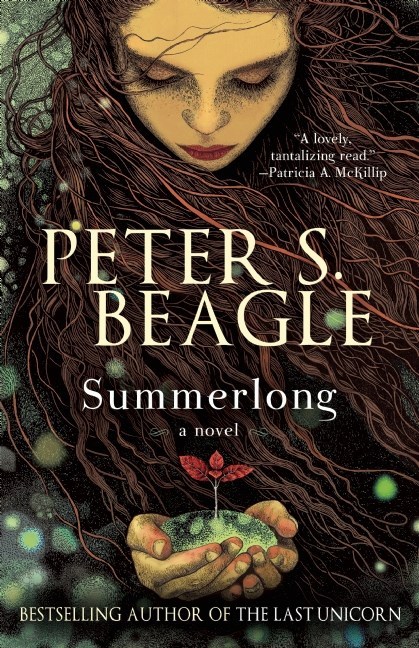
Retired history professor Abe Aronson is a cranky, solitary man living out his autumn years on Gardner Island, a ferry ride away from the hustle and bustle of nearby Seattle. One rainy February night, while dining at a favorite local haunt, Abe and his girlfriend Joanna meet an engaging enigmatic waitress, new in town and without a place of her own. Fascinated and moved by the girl's plight, Joanna invites her to stay in Abe's garage. It seems everyone falls for the charming and invigorating the waitress, but she is much more than she appears, and an ancient covenant made a millennium ago threatens to disrupt the spring and alter the lives of Abe, Joanna, and all those around them forever...
Peter Soyer Beagle (born April 20, 1939) is an American fantasist and author of novels, nonfiction, and screenplays. He is also a talented guitarist and folk singer. He wrote his first novel, A Fine and Private Place , when he was only 19 years old. Today he is best known as the author of The Last Unicorn, which routinely polls as one of the top ten fantasy novels of all time, and at least two of his other books (A Fine and Private Place and I See By My Outfit) are considered modern classics.
Peter S. Beagle has long been one of my favorite authors. It is not that I love everything he writes as much as I adore his word-smithing and his ability to evoke emotion. His strength, in other words, is not consistently in plotting. I love his short stories, and the novel The Folk of the Air remains my first–and possibly favorite–experience with urban fantasy (1986–take that, Ms. Anita Blake!). When reading Summerlong, I heard echoes from Folk of the Air, and of the two, I wholeheartedly prefer Folk. It’s funny though, because in many ways it feels similar, with Summerlong representing the perspective of a much older author--more sadness, more solitude, less playful. It is possible I might appreciate it more as I grow even older. The smile chilled Joanna, not because it was evil or mocking; to the contrary, it was almost heartbreaking in its remoteness, its unhuman attempt at a human signal. It was the moon’s midnight smile, shadows shaping a grimace across endless emptiness.
It should be clear that as always, the emotion of the book is true. Alas that the dialogue doesn’t always follow; Abe the professor and his long-time lover Joanna talk mostly like people at a Renaissance Faire, aping something that seems almost archaic in structure and naked emotion, but completely unsuitable for daily dialogue. Would that we have more true moments like those, however. (See what I mean?) Aside from the tendency to speak like half-baked Shakespeare, the characters feel real and multi-dimensional. I had the sense of each as a relatively complete personality, struggling with hope, deflecting with humor, living with longing. My only hesitation would be what seemed to be a sudden appearance of Joanna’s restless spirit. “She also understood just as clearly that she had no business on Puget Sound even in the Yandells’ rowboat, let alone in a skin soap-bubble, and that her fancy of drifting silently over bright shadow, in and out of time and dream, leaving no trail, was one of the dangerous ones, the ones that took people with them when they left.
The setting is beautiful with a love for the northwest and the ocean. I loved it, from the rickety staircase by Abe’s house playing picnic table/bathroom for the raccoons to the local diner. Ah, if only Beagle could move it along. It’s one of the reasons he excels at shorter stories/novellas which seem to force him to be more concise. When the waitress Lioness (again with the melodrama) appears, it’s clear she has the spring of magic behind her, but it takes almost a third of the book to move it along to the inevitable. The conflict that eventually develops–or fails to really develop, as in the case of long-married almost-dissatisfaction–between Abe and Joanna feels too developed, where it no longer is about Lioness at all, but about two people, one with both an itch and a grudge. I’d rather the proportions were reversed in this case; a quick exposition and rise to the conflict, and a longer resolution. “The Market had been Joanna’s private comfort ever since she had arrived in Seattle as a college student. Cocooned by crowds, insulated by noise, she moved easily in her own warm silence, deliciously alone, perfectly content to wander aimlessly between the iron-columned arcades above ground and the subterranean dress and antique stores, nibbling on a Chinese pork bun or a chunk of frybread as she studied the boat traffic…”
Despite the indolent pace, it feels remarkably tense at times with the anguish and indecision of the characters. Its one of the perfect blending of myths for Beagle’s evocative melancholy. It is one of the reasons I both love and fear him as an author, because it is likely I’ll run into feelings I’d rather left undisturbed. Overall, it is an apt and appropriate novel for a man in the autumn of his career, but I confess I much prefer spring.
Three and a half seeds, rounding up because Beagle.
Many thanks to Tachyon Publications and NetGalley for the advance reader copy. They are the best!
This is a gentle and thoughtful book about the dissolution and formation of friendships, relationships, and the fascination of gods.
What? Well, honestly, it's about a middle-aged couple and their mild and complicated relationship in a comfortable middle-class household, where she becomes disillusioned and he discovers a new love, and such things are mirrored interestingly with the inclusion and complicated immersion into a particularly well-beloved Greek Myth, walking the earth.
The whole book is rather introspective in effect, if not always in action, diving heavier into interpersonal reactions and how easy it is to be lost in ideas, in gut-reactions, and the misery of not knowing what you want, or in taking what you think you want, learning that it was all a mistake.
Of course, this is a rather deep exploration of both points of view in the grand myth of Persephone and Hades, too, so it's actually rather rich in contemplation.
If what you're looking for is straight magical realism in comfortable middle-class topes, you'll find a mild tale with deep and fascinating characters that pop with detail, but don't expect much in the way of plot. Expect thematic exploration, interpersonal angst, and an attempt to discover some sort of balance with summer and winter. Growing older doesn't always mean growing wiser, after all.
3.5 stars. Summerlong is Peter Beagle's first published novel in about a decade, and it has some wonderful aspects to it. Beagle writes so well that even when the pace was a bit too languid, I still enjoyed it. I loved the mix of mundane life in the Seattle area, which he describes so well that I could almost feel myself there, and the way that mythic fantasy (think ancient Greek gods) subtly sneaks into the story, just a mystifying detail here and there at first, then more and more until myth crashes into reality and people are never quite the same. It's bittersweet and a bit bleak.
There were some aspects of it that didn't work for me: the name Lioness, which passes up randomness and jumps right into weird territory for me; I don't really see how the normal meaning of that name fit the character, but maybe I just need to mull it over a little more. The ending of the Lily-Lioness subplot felt too inconclusive.
Full review to come, after it posts on Fantasy Literature.
Both the feel and particulars of this book reminded me quite a lot of Patricia McKillip's more recent stories, where she explores a contemporary setting impinged upon by mythic elements. (If you liked 'Kingfisher,' or 'Mer,' don't miss this one!)
It's also really a fantasy for older people. I feel like it probably would've resonated with me far more strongly if I were 20 years later in life, and I fear that younger readers probably won't enjoy it at all.
Joanna and Abe are an older, long-term couple whose relationship has been loving but has also depended on a certain amount of distance. Joanna's job as a flight attendant means she's frequently away, and Abe has his own house, and takes plenty of time for his writing and academic research. The setting also feels distant - an island on the outskirts of Seattle. The sense of foggy isolation that the location lends the narrative feels very appropriate to the story.
At their local diner, the couple meet a new waitress - a young and alluring woman. By the end of their meal, they've discovered that she doesn't have a real place to live, and Joanna is urging Abe to let the quirkily-named Lioness (Lyonesse?) stay in his garage. This over-the-top act of generosity seems a bit out-of-character - but soon we realize that people just seem to be compelled to do whatever they can for Lioness. Who is she, really? Just a free-spirited hippie wanderer, as she seems to be - or something more rich and strange? Her presence seems to spark something in those she encounters - a certain reaching out, a breaking of routines, an unfamiliar desire. But along with this blooming comes a loss of comfort, of contentment.
Ancient gods and myth (particularly that of Demeter and Persephone) weave a skein of the otherworldly into a contemplative exploration into the dynamics of mature relationships. And even when the gods mean no harm, it's hard to survive the aftermath of their touch.
Also inspired by this painting:
Many thanks to Tachyon and NetGalley for the opportunity to read. As always, my opinions are solely my own.
2.5 out of 5 stars, rounded up for nostalgia's sake.
Has there ever been an author that you loved, who just disappeared off the map for decades? If you’re a fantasy fan, the answer is probably yes. When that author reappears, as though revived from the dead, and releases a new novel after said silent decades, have you ever ran screaming to the store to buy it only to be disappointed? I have. Unfortunately, I feel like Peter S. Beagle let me down with Summerlong.
Beagle never disappeared completely off the fantasy scene, but this was his first highly publicized work since The Last Unicorn in 1995. It’s a tiny thing, coming in at 240 pages, and yet it took me 9 days to read it. I just couldn’t make myself care about the characters, though they were well fleshed out. Lioness, the hub around which the story spins, was less a character than a lovely idea. The big revelation that doesn’t come about until the last 50 or so pages of the book isn’t that big of a revelation for a mythology fan, which I feel many fantasy readers are. The best part of the book was the gorgeous cover, which also gives some of the story away if you know your mythology. (Side note: I generally care little about what a book looks like; it's what's inside that matters, right? But man, that cover is gorgeous.)
This tale brought the mythic into our reality. The story took place on Gardner Island, a fictitious island huddled inside Washington’s Puget Sound, where life was pretty ordinary until Lioness came on the scene. Abe and Joanna, a happily unmarried couple of twenty years, take Lioness in, and their lives and the life of Jo’s daughter Lily change, for better or for worse. There was no new ground covered here. If you want mythological deities in modern America, I heartily suggest American Gods by Neil Gaiman. But this story was lackluster. Not terrible, but far from amazing. The writing was still lovely, as Beagle’s writing always is. The small scale of the story should have made it emotional and moving, but it’s hard to be moved by what you fail to connect with.
Beagle gave fantasy fans something special with The Last Unicorn. It was breathtaking, and I still remember reading it for the first time when I was twelve. I had found it in a used bookstore, hiding among The Boxcar Children and Nancy Drew. It was a sparkling jewel in a tattered jacket, and I treasure it still. Summerlong was missing that magic and felt almost crude in comparison. And I mourn what it could have been. But there were a few lines here and there that shined brightly, which gives me hope that whatever special spark Beagle had, he has it still.
You can find this review on Booknest, where I'm now a reviewer!
And, though this review is not on Celestial Musings, you can still find my other reviews, short stories, and thoughts on life there.
I only just read The Last Unicorn this past year, a book that enchanted me and my imagination. I was excited about this novel because the description and cover caught my attention. This was definitely a summer read because the season is central to the story.
I don't want to give a lot away but this is an interesting blend of mythology and real-life, present-day settings and characters. This was a difficult combination, and the characters are just as bewildered as I was as a reader (this isn't a criticism, please read on). The flight attendant and her longtime partner have had a routine for decades; he has helped be a father figure to her daughter, a woman who struggles to maintain relationships. They live on an isolated island in the Puget Sound, near Seattle. When a beautiful, enchanting, alluring woman appears they find themselves thrown off guard, offering her a place to stay for free, professing love, and even the island acts unusually with a longer summer, music and plants producing unusually well. This seems all positive at first but of course there is an underworld to it, starting with the man who seems to never get off the ferry.
Thanks to the publisher for the chance to read this book early!
Beagle is one of those authors that just speaks to me. I enjoy fantasy, which is his primary genre, but more than that, I love his writing. This is a short book (nearly a novella), and it might be too quirky or slow for some people, but I absolutely loved this little parable of a strange woman who shows up on an island in the Pacific Northwest.
Beagle is so good at description and mood. And his characters practically jump off the page.
I received this review copy from the publisher on NetGalley. Thanks for the opportunity to read and review; I appreciate it!
Gardner Island is just a ferry ride away from Seattle, but it feels like another world altogether, especially during the Spring that retired professor, Abe, and girlfriend of too-many-to-count years, Joanna, decide to dine at a local eating spot. They’re sitting in this small room, checking out the other patrons and assorted people working there, including the musicians. Their waitress is new, they’ve never seen her before, and she seems more than out of place because she’s an unknown on an island of people who see each other day-to-type, typically. She even looks as through she’s stepped out of another place and time. Joanna notices that one of the guys in the band is sweet on her, and she seems potentially interested in pursuing some matchmaking skills to further this along. Abe and Joanna invite the waitress to join them as the evening winds down, and share her story. As it turns out, she is staying in one of the back rooms courtesy of the restaurant owner, and Joanna offers Abe’s garage (she has the ulterior motive of wanting Abe’s junk out of there) for her to stay. And so, their friendship begins.
What happens after the lovely, young Lioness Lazos gratefully moves into Abe’s garage is change. At first it’s a little, the garage gets cleaned out, Joanna’s happy, Abe’s happy, and Lioness is mostly happy, if guarded. Then strange things begin to occur, and when they do, Lioness always seems to be nearby. Always looking over her shoulder, but, who, or what is she looking for?
Pub Date: 30 September 2016
Many thanks to Tachyon Publications, NetGalley and to author Peter S. Beagle for providing me with an advanced copy for reading and review.
I am a fan of Peter S. Beagle and I think he can do no wrong, as far as writing fantasy stories go. I’ve read all his novels and most of his short stories, and he never disappointed me. I don’t even mind his curious decision here to name his character Lioness, something I would normally label silly and an affectation, especially for a waitress who works in a family restaurant on Gardner Island, in Puget Sound. Abe Aronson, a retired scholar of sixty-five, and his partner Joanna Delvecchio, are put under a spell by the presence of this red-headed, seductive waitress who reminds Abe of a famous painting by Boticelli. Abe is quick to find another, more likely explanation for her unusual name:
“That was an enchanted country, Lyonesse. Did you ever hear of it?”
I have, of course, heard of it myself. Jack Vance’s trilogy of the same name is one of my all time favorites. For Abe, the name brings back the lines of a poem by Thomas Hardy. In the economy of the book, this meeting between the elderly couple and the young waitress is an incursion of the magical into the real. With the arrival of Lioness Lazos, Gardner Island becomes an enchanted place where nature seems to forget it is supposed to follow the long established succession of seasons, and summer days come in the middle of winter. Beasts of the sea and of the land respond to the songs and the calls of the waitress ( “Well, hey there, sweet thing. Hey there, brown-eyes.” ), flowers bloom, beer ferments and people start having strange dreams and impossible yearnings.
Abe and Joanna invite Lioness to come live in their garage, long in need of a spring cleaning and of a human presence. Joanna’s daughter Lily comes to visit and to recover from her latest break-up only to fall instantly in love with Lioness. While Abe Aronson rediscovers his passion for playing the harmonica and singing the blues, Joanna becomes interested in canoe-riding between the islands, even as she knows she cannot swim. The abnormal weather patterns, the emotional upheavals in people who have built for themselves a comfortable and quiet existence far from the bustle of modern life, the mystery of the enchanted woman and of the couple of strange newcomers who might be the very persons Lioness is running from and trying to hide on Gardner Island – all of it unsettle Abe and Joanna and Lily, especially after the spell of good weather is followed by a terrible storm. Reality has a way of reasserting its supremacy, and old myths are stubborn and resistant to revisions. Lioness and the hunters on her trail may be older than history... ... and even immortals get the blues, especially in a Peter S. Beagle story.
‘Come on, you know the legend!
I guessed the true identity of the magical woman pretty easily, but I do have the advantage of reading and re-reading the old mythologies and the old legends as a child. The real appeal of this novel is not for me in the puzzle created by the enchantments on Gardner Island, but in the details of the ordinary life Abe and Joanna are trying to live, comforting each other with gentle irony and warm embraces, with a good dinner or an evening of music at the local pub, meeting with friends or puttering around the house, learning how to craft artisan beer or how to cook exotic food. Lioness is herself a gentle and mostly sad person, haunted by her secret past, full of good intentions and of kindness, especially for the wounded-in-love Lily:
“She told me, Lily, never be afraid of sadness. Sadness is your friend, Remember. I heard her say that.”
But Lioness cannot help who she really is , she cannot escape her own mythology. Summer and flowers follow her every footstep, but chaos and strife are never far behind.
The novel itself requires patience and even a little familiarity with the style of the author, because the bittersweet tonality, the apparent lack of focus and the avalanche of domestic details create a slow, downbeat rhythm that is reflected often in the old blue tunes Abe is playing on his harmonica. I was even starting to think Beagle is turning self-indulgent and sentimental, even as his way with words is as enchanting as in earlier books. ‘Summerlong’ reads like an elegy about old age, about regrets and slowing down and trying to make the best of the restrictions imposed on the elderly by financial, health and social loss. It’s a book written under the shadow of the Covid years, but it is also a book that rewards patience and eventually strikes gold when the mythical and the real are finally put in the right context. I’ll take kindness and strong characters any day.
“Truthfully, there is no point, my dear Delvecchio. There will be one, as there must be – tomorrow, the next day – but just today ... just today, you find me happily pointless, drifting between destinies, as we pointless folks do, never alighting anywhere, never settling, never choosing. Only savoring, savoring.”
Tomorrow comes to Gardner Island, tossing Abe and Joanna apart in a violent destruction of their delicate balance . Out of the ashes there might arise a new lease on life, in a pattern that is older than time itself:
... light, dark, spring, autumn, life, death, rebirth ... they go on together. They’re how things are.
This book was beautifully-written, but I don't think it was for me. Expectations come heavily into play here and I'd been under the impression that this was a far more magical fantasy novel than it actually was. For the most part, it reads like a character-driven contemporary about an old couple. When the fantasy aspects do arrive, they felt somewhat out of place. Kirkus calls the characters "compellingly ordinary" and they are indeed ordinary, and perhaps compellingly so for those who didn't expect to be whisked out of this world and into another. I just wanted more from it.
It's been a few days since I finished this story, and in that moment, I gave it a three star rating. The beginning was really good; if you like beautiful writing, but in the second part the story doesn't exactly evolve. There were situations that should have been more developed, namely the ones related with the magical realism aspect. Things that happened that felt strangely out of place and that left me with a sour taste in my mouth.
Thing is, this is a quiet story that follows the lives of a couple that has been together for more than twenty years. They're quirky, intelligent, and after all those years they still like to keep their personal space. After more than two decades together they still keep their own houses. They have their own lives with their very different interests: Del, a flight attendant, is always on the move, her non stop rhythm finding a pause in Abe's quieter way of life.
Abe is a reformed professor who is in the process of writing a book. His hobbies involve brewing domestic beer and messing with his neighbour's peace and quiet: Abe likes to play the harmonica. My enthusiasm for the story rested heavily on their relationship. And then Lioness appears... Lioness is beautiful with a presence that would make her right at home in times of old... and strangely both Abe and Del end up entranced by her.
Why? I have absolutely no idea, since I found her extremely dull.
And that's when things started unravelling. Lily's, Del's daughter from her only marriage also falls head over heals over Lioness. Everyone falls for Lioness. Strange things start happening, but they are mostly told in a dispassionate format.
I start reading only one or two pages per day: let's face it, my enthusiasm had disappeared with Lioness's dull character.
And then Abe goes and
Then the explanation for why Abe behaved the way he did was so lame. And so weak.
I've read about compulsion... maybe in the last book that I truly enjoyed of the Mercy Thompson series. Well, until that scene :/ Abe didn't act under a compulsion!!
So, yeah, after that I was like "what the hell am I reading?"
Now, a couple of days after having finishing it, I feel that reading "Summerlong" was akin to a dream: you may remember a couple of things, but mostly, the story it is already forgotten.
My full review of this book is going up at Wired soon, but suffice to say that it's a marvelous look at what happens when people who have been just going through the motions for years suddenly wake up and start living their lives again. The supernatural stuff is brilliant, but the real strength is the characterization and the brilliant depiction of an older couple who have gotten used to each other but haven't ever really committed to each other.
{{Digital arc gently provided by Netgalley and Tachyon Publications}}
Primera impresión: Con visos de realismo mágico. De amores, veranitos de San Juan, y blues.
----------------------------------------------
A medium age couple in a going relationship for 22 years, he is a 66 y.o. retired historian living in Gardner Island (across Seattle) , she is a 55 y.o. flying attendant; both divorced, have their own homes but virtually rise together her daughter. Friends. Lovers. On a everyday laughts and fights. Content, I said.
Until one day in her usual restaurant a young waitress, Lioness, catch their attention. Abe gets a guest in his garage, and some things starting slowly to change.
The languaje is evocative and melancholic. Some dreams let be in the road. Some Gaiman's strokes /the theme mostly/
How difficult are relationships. Man/Woman. Mother/Daughter. Exploring and failing , old and new ways.
I think that we suppose be in simpathy with Lily, but sorry no. Too obsessived to me. Joanna had my simpathies all along. And well .
Una cosa que llama mi atención:
Esto me hizo googlear a la Primavera de Boticelli, porque eso le parece Lionesse a Abe. Y luego, por defecto, O primavera de Monteverdi que es uno de mis madrigales favoritos.
Tu ben sei quella ch’eri pur dianzi, sì vezzosa e bella; ma non son io quel che già un tempo fui, sì caro a gli occhi altrui.
(You are as you were before, so charming and beautiful, but I am not as I was in past times, so dear in the eyes of others.)
Summerlong asks one of my favorite questions for fiction to explore: What happens when the mythic intersects with the mundane?
It changes everything, or course.
Abe is a retired professor working on a book of medieval history and Joanna is a stewardess nearing retirement. They have their relationship exactly how they want it—dating but not married, separate homes but Joanna practically lives at Abe’s, and a comfortably bickering dialog with one another but still a solid sex-life. While everything is as they want it, nothing adventurous ever happens.
Until they meet Lioness, a new waitress at their regular restaurant Sky-liner. Abe coins her ‘primavera’ because she looks like Botticelli’s Primavera. They’re both immediately enraptured by her, and by the end of their dinner she’s agreed to live in Abe’s garage, for she longs to be warm again and has nowhere to stay. Both Joanna and Abe believe she must be hiding from someone.
Neither Abe nor Joanna notice the magic at first, but bit by bit strange things start happening: orcas come to greet Lioness, and leave after she speaks to them in her own language, which Abe and Joanna mistakenly think is Greek; Abe’s beer turns out perfect for the first time ever; one day Abe sees the little boy that lives next door pull flowers from beneath the ground to show Lioness. And summer stays on Gardner Island, even as the months pass.
Joanna’s daughter Lily also becomes enraptured by Lioness, and falls in love with her, a love that Lioness kindly and gently does not return. Unlike Joanna and Abe, Lily’s character is not as well developed and nuanced, which is problematic as she is essential to the novel’s climax.
While the magic slowly builds, both Abe and Joanna find talents they were never brave enough to explore. Abe begins playing harmonica for a band, and Joanna learns how to kayak. When Mr. Mardikian, a strange man Joanna has met on the ferry, goes to Sky-liner restaurant with the couple, everything changes. When Lioness sees him, she runs, and Abe runs after her.
This is a simple, character-driven novel, a modern look at the well-known Persephone and Hades myth. Most people know Peter S. Beagle from his famous novel The Last Unicorn, but Summerlong is not the same kind of fantasy. It reminds me more of Beagle’s first novel, A Fine and Private Place, about ghosts trying to remember the past in the cemetery they’ve been buried in. Both are quiet novels.
There’s a lot to like in Summerlong. Abe and Joanna have a rich and realistic relationship, and the changes Lioness brings to their characters is gradual and well-done. I love the bits of magic that gradually build up, but at key moments in the novel Beagle fails to show the magic. This undermined the gradual buildup, and I’m not sure why these scenes are missing and only thought of in retrospect.
Okay, this is a weird review to write. Peter S. Beagle is one of my favorite authors. The Innkeeper's Song and The Last Unicorn are two of my very favorite books. But this book...it's just not good. The characters aren't very well-developed, and they're stereotypes/cliches of a Jewish old man, a middle-aged Sicilian woman, and a tormented lesbian. The plot is not really a plot. Nothing really happens through most of the book, and what does happen is just stupid. I'm sorry. I wish there was a better way I could say that, but as others on GR have noted, the "mystery" is easily discernible on page 5 or so, and when Beagle does "reveal" everything, it sounds so silly and childish that I can't even take it seriously or empathize with any of the characters. I sense a deeper undertone in this story, a man coming closer to his last years, wondering about life and God's interaction with mortals. I feel like Beagle was working things out here; there are moments of philosophizing that come close to a really strong theme, but they are only moments, and the theme, which has real potential, is never fully developed. I can highly recommend Beagle's work, but I can't recommend this book at all. The only thing I can say about it or for it is that Beagle's prose is beautiful as always. Not beautiful enough, though--it took me way too long to read this short book because I just didn't care.
I fell right in love with this book straight away, for the unconventional romance between Abe and Joanna. I loved that they didn’t seem to be possessive, that they didn’t live together 100% of the time, that they had differing interests. I loved the way Abe knew Joanna. I really wanted the story to be about the strength of their bond, unshaken because deep-rooted. I really did.
Spoiler: it’s not. It’s about the two of them being changed, deeply and irrevocably, by a man and a woman who might just be Hades and Persephone. (It’s not much of a mystery, really, given how quickly the clues are given. I mean, as the reader you work it out quickly because you know Beagle’s a fantasy writer; it wouldn’t be obvious to the characters, by any means.) And that change includes their separation, seemingly also irrevocable. And I hated it. I’ve read that story with the young pretty girl who turns an old guy’s head time and time again, and I didn’t want to read it again. I wanted to read about two people who wouldn’t let life shake them apart — even when life or even a goddess tries to come between them.
So it’s not really the book; it’s definitely a matter of preference. And the strength of my reaction to the bond between Abe and Joanna shows how beautifully Beagle can write and observe his characters. It’s all wonderfully written, I just wanted a different story.
A copy of this book was provided to me by the publisher via NetGalley in exchange for an honest review. No external considerations went into this review.
In college, I flew to and from Portland, Oregon several times a year. I love flying, but I particularly love flying in over the Cascades and the Columbia River, seeing volcanoes out either window and the pine forest below, and looking west down the river as the plane turns for the final approach, knowing that the ocean is out there somewhere. There’s a feeling… it’s hard to describe. A lightness in my heart, a nerve-tingling energy, a feeling of rightness at returning to the Northwest.
That’s what I got from Summerlong.
It’s a rare book that strikes me this way. I read a lot of things I enjoy, and a lot of things I love, but far fewer that feel like puzzle pieces fitting into a space I didn’t know existed. Summerlong resonated deeply with me - its setting, its subtle unconventional magic, its complicated and idiosyncratic characters. Absolutely everything about it was lovely and absorbing, and I don’t just say that because Beagle’s rich, loving descriptions made me homesick for Seattle and Puget Sound. (Though that’s definitely a plus; there’s a deep sense of place running through this book that really brings it alive.)
Tachyon Press describes Summerlong as ‘literary speculative fiction’, which I find apt in the way it suggests a slowness of plot and a meditative quality not found in most fantasy novels. It’s about ordinary people, who are nonetheless marvelous in their quirks and variations, whose lives are disrupted by something subtly extraordinary. In particular there are three players: Abe, a retired history professor; his sort-of girlfriend Joanna, an aging Sicilian flight attendant; and Joanna’s daughter Lily, a young journalist with consistent bad luck in the women she dates. They’re a family unit without all the usual trappings: Abe and Joanna’s relationship is committed and caring, but not formalized; Joanna and Lily struggle to get along, but are deeply loyal to one another; Abe is something of a fond uncle to Lily. They all feel incredibly real, and I found myself getting drawn into and invested in their lives almost before I noticed.
And then there’s Lioness, she who disrupts the status quo:
Thick and heavy and desert-colored, her hair caught the candlelight and gave it back with the added rawness of a living thing when she turned her head.
Ohh, that description. Having read the synopsis, I was actively trying to figure out who or what Lioness was, and it took me less than a fifth of the book to be certain. However, it didn’t feel like Beagle was trying to keep this a secret from the reader, who’s primed to expect something of the fantastical in this novel; in fact, I enjoyed picking out all of his subtle hints and references after I knew the secret more than figuring it out in the first place. There was another interesting side effect, too: knowing that Lioness herself was extraordinary, I found myself guessing at every side character. Were they supernatural as well, or just unusual humans? It made me question the value of making such a distinction at all.
Lioness is… not a non-entity, but by necessity not as vividly characterized as Abe, Joanna, and Lily either. Her role in the story is to be a disturbance; she is a stone thrown into calm water, disturbing the status quo for better or worse by introducing ineffable magic to this small corner of the world. It’s not dramatic, but neither could it be prevented. From the moment of her arrival, the lives of humans around her change course, and much of the book is just watching those new courses play out. Change necessarily brings loss, though, and there is an eventual… collapse at the end of the book that took me by surprise.
One of the themes that many fantasy novels have explored is the idea that darkness and light must exist in a kind of symbiotic balance. “To light a candle is to cast a shadow,” writes Ursula K. LeGuin in A Wizard of Earthsea - a book which, at its heart, affirms that darkness is just as natural and as necessary as light. Summerlong presents similar dualities - courage and fear; love and rejection; growth and loss. The question it seemed to be asking is this: knowing what it may cost, would it be better not to experience magical things at all?
I’m still not sure what my answer is.
((Aside: I admit that I particularly appreciated the part of this book in which there were whales. However, I felt there could have been more whales. There are never enough whales.))
**This is a fair and honest review written in exchange for a Netgalley advanced reader copy** **Warning: spoilers**
I'm not going to mince words on this one. I hated this book. To give it one star means I wouldn't recommend it to anyone and the only reason it received one star was because he does a great job writing about the beautiful island. The rest of the story is trash. Don't waste your time.
Peter S. Beagle's new book, Summerlong, is set on a fictional (if not familiar) island just a ferry ride away from Seattle, with the Puget Sound as it's alluring backdrop. Joanna, a 50 year old flight attendant and Abe, a 65 year old author, have spent 20 years living in separate dwellings (Abe on the island, Joanne a ferry ride away in Seattle) while enjoying a happy, seemingly committed relationship. On an outing to a local eatery one evening, a new server causes them both to catch their breath. She has desert-sand colored hair and deep green eyes. Her name is Lioness Lazzos, daughter of a single-mother from the east coast, a Greek businessman father who abandoned them. She's new in town and looking for a place to stay. Before Joanna can stop herself, she offers Abe's cluttered garage, with Abe reluctantly seconding the offer (that reluctance will be short lived). As Lioness moves in, Joanna's gay daughter, Lily, spots Lioness, and she too, is swiftly enamored and smitten with Lioness.
The story moves on to many fantastical events, (Lioness disappearing into a frigid storm, then knocking on Abe's door, so stone-cold that Joanna and Abe have to force her to lie between them in bed to save her; Lioness teaching the neighbor children to magically pull flowers from the dirt; Lioness seemingly speaking a foreign language to killer whales on the beach). Abe, Joanna and Lily begin to wonder who Lioness really is and why she seems to be hiding her real identity. Lily has now become very infatuated with Lioness and drops in to visit Abe in hopes of spending time with Lioness (although we have no confirmation that Lioness is gay).
Abe and Joanna's relationship begins to show signs of trouble, when Joanna decides she wants to follow an interest in kayaking and Abe picks up an old desire to play harmonica with a local band, causing Joanna to become jealous. The mystery of who Lioness really is and why she seems to have some mystical abilities, comes to a head when Lioness'es mother shows up at a party at Abe's home on the island. We now see that Lioness is hiding from both her mother and a husband (much too Lily's dismay).
We quickly move to a point in the book where I almost put the book down and walked away. After Lioness'es husband shows up to confront her at the local eatery, where Abe is performing, she runs off, horrific fear on her face, with 65 yr. old Abe racing after her, to protect her. What happens next is so ridiculous, such an old trope, I could hardly believe I was reading it. Abe (who is likely 40 years older than Lioness) is consoling her in her new living quarters, the converted garage, when Lioness opens her arms and insists that Abe make love to her, hard and fast, please give me more. I nearly spit my coffee on my screen. It is apparent that aging Beagle is playing out his own ridiculous fantasies in this mess of a scene.
The book dissolves in to one of the worst mish-mashes of bad plot, questionable prose and unbelievable characters. I wasn’t only disappointed in this book but pretty disgusted. Who is the audience for this book? Teenage girls? Young women? Old men? Because this certainly wasn’t attractive to me, someone who is of the same age as Joanna. I’m sorry but this book was just ridiculous after a point.
This is my first Beagle book and I liked it. The writing is very smooth and endearing. And I adore the main characters, which I think are quite unique since both are elderly, a 50something senior flight attendant and a 60something historian. Just the stories on their daily life is quite enchanting, supported by a great narrative about the location that feel alive. I normally hate long and frequent mention on the surrounding environment - river, sea, plants, soil, weather - but in this book, it becomes part of the story. The characters, Joanna and Abe, are definitely people you'd like to call your friends. They are nice people but with depths.
The plot is very simple. The main leads met a mysterious charismatic beautiful young woman who apparently running away from something. Halfway through the book my enjoyment was rather diminished since I guessed who she really was - many clues here and there - so, one possible (rating) star dropped. Sorry, I just love when author can surprise me. But then another star dropped when two lead characters did something that I think was quite out of the blue and out of character. And then the climactic ending felt a bit off as well - the scale and stake of the conflict should have given more impact and not too localized.
Thank you Netgalley and Tachyon Publications for the opportunity to read this book. I think three stars - all for the writing - is enough. I will definitely read his other works. Any suggestion?
Thanks to Netgalley for the opportunity to read this book in exchange for an honest review!
Love this stunning cover...and the story inside was just as beautiful! Nothing is quite the same for Abe and Joanna when Lioness enters their lives. Up until that point, middle-aged Abe & Joanna had been living a predictable and unremarkable existence as a comfortably unmarried couple, until the day that they met Lioness, a young waitress at a local diner. They are immediately drawn to the young woman and impulsively invite her to live in Abe's garage. From there, inexplicable things begin to happen and Abe & Joanna begin to wonder who this mysterious young woman is.
Beagle's writing is smooth and magical, and I was immediately drawn in. The characters are flawed and down-to-earth, in striking contrast to the ethereal and magical qualities of Lioness. You don't learn until the end of the book why Lioness possesses these otherworldly characteristics, so it is quite surprising to learn who/what she truly is at the end of the book.
I would recommend this to anyone who appreciates stories of magical realism with endearingly realistic characters.
Bittersweet and lovely, though I disagree with the suggestion that the ending was especially "realistic" - and I'm certainly not referring to the magical aspects!
The story takes its time to move along, but I found this made the reading ever more mesmerising.
This book was so different for eveything I have read so far.
So I could either hate it or love it and luckily I loved it...
The first thing that stand out for me was how the characters represented. They were human, with worries and flaws that I have, or my parents. It was so realistic that it was impossible to stay away from them, unattached.
I loved the relationship of Abe and Joanna.
And then everything stoped being ordinary and become extradinary instead. Liolness brought the change and with her came magic and mystery.
The last chapters of the story made me sad but for me there couldn't be any other ending...
Overall I would recommend but not to people reading only YA.
*My thanks to Tachyon Publications and Netgaley for the e-arc*
https://lynns-books.com/2016/10/17/su... Summerlong is a book that I was greatly looking forward to. I’ve heard so many good things about Peter Beagle that I didn’t even think twice before requesting this one. It was just a no-brainer for me. However, I have come away from this one with slightly mixed feelings and in fact even now I’m still trying to figure out just how I feel about it. What I can’t deny is the power of the writing which is really excellent. I may not have read Beagle before Summerlong but that’s something that I intend to rectify.
This is a difficult book to give a traditional review for. The plot is very mild, and in fact the pace is a little ponderous – in fact this is a book that will make you ponder! This is a book of summer and one summer in particular that becomes extended for one couple who make the acquaintance of an enigmatic character called Lioness. Joanna Delvecchio and Abe Aronson have been in a relationship for many years. They’re both very independent characters who enjoy their own separate space as much as they enjoy being together. As a blustery winter sets in over Gardner Island the two of them meet a young woman called Lioness. Lioness is a waitress who seems to be running away from something and Joanna and Abe feel an immediate draw to her, a protective urge that sees them offering her a room in their garage space. To be honest there’s not much more that I can really tell you about the plot. Lioness is a mystery character and one that will have a profound effect on the lives of those she comes into touch with.
So, to the writing. Very evocative and really quite beautifully executed. The scene is set easily and the characters are all very well drawn, well, okay, more on that in a moment. The pacing of this is definitely quite slow and the fantasy elements very mild – its not a book that you will race towards the end, definitely a slow burner, although the action does pick up more in the latter chapters.
This is definitely a character driven story and this is something that I usually love. Great characters, well drawn. And this is where my mixed feelings come into play. I think the characters are well done. Abe and Joanna – on the face of it, yes, they appear to have a good and solid relationship. But, if you scratch beneath the surface do they really, are they together simply because that’s always been the case? They don’t really commit to each other, each keeping their own homes and I think that in itself says a little something about their relationship – which, to be clear, isn’t to say that people can’t live separately and have good relationships – more that with the two of them it feels like a statement, as if they hold something back and never really act true to their own natures when in each other’s company – in fact you could say that in the light of events they were indeed holding each other back to a certain extent. It’s difficult to explain because on the face of it they appear to be a loving and intelligent couple, Both maybe on the cusp of a little bit of disenchantment but that could simply be because they’re a little tired of getting older. Then we have Lioness. Our mystery character. It’s difficult to say too much about her – I’m pretty sure that other readers will have pretty quickly realised what was going on with her – there are clues sprinkled like breadcrumbs. Yes, she’s an enigma and I guess that makes it difficult for her to be written in a way that makes you feel an attachment to her. She’s aloof, withdrawn, even maybe a little cold. She is a character that will make you feel intrigued, she may also make you feel a little bit concerned about what impact she’s really going to have. You’ll want more from her but she keeps herself very much at arms length, and there is, of course, a very good reason for that but it does make you feel a little bit frustrated. I wanted to get closer and in fact wanted more of a story from her but that isn’t really forthcoming. And then of course there is the impact that she, so casually, has upon our couple.
So, without giving too much away I hope this is not a story of happy skipping bunnies. It becomes a little sad as the story unfolds and for me I felt like the characters actually didn’t act like themselves. However, on reflection I’m not entirely sure that’s true (and the rest of this paragraph may have slight spoilers). There was always something of an attraction going on here. It never felt completely innocent and so the events in the latter half didn’t really come completely out of the blue. But, that being said, and even though I had the niggles at the back of my brain, I confess that the turn of events disappointed me. So, I’m conflicted really – I don’t tend to think of myself as someone who only likes happy endings with rainbows and fairy dust. And, even though I felt like the characters acted not in a way that I expected – again, on reflection – I did expect them to act in this way so in actual fact ALL of them acted completely in character. I think, put simply, I wanted more for the two of them – and I guess I wanted a little bit more from our mystery guest.
I certainly didn’t dislike this story. It’s not a traditional fantasy read but one with characters based in the land of myth. It’s a very gentle read, sombre, reflective even and maybe not uplifting in the way that I hoped but definitely a book that will make you think.
I received a copy of Summerlong from the publisher through Netgalley, for which my thanks. The above is my own opinion.
This is a quiet, dreamy sort of book, set on the Puget Sound, and very familiar to anyone who's been to the area. Almost from the get go, the style and prose of Summerlong reminded me of Guy Gavriel Kay, though the only book of his I could say this is similar to is Ysabel. However, the similarity persisted for the whole story.
It's hard to say much about the story without giving away the plot, and the plot of this book, distilled down to its essence, is the very, very old "a stranger comes to town" trope. In doing so, the lives of our two no-longer-young protagonists are upended. It makes for a very bittersweet story, with a lot of character growth and musings about the nature of love thrown in.
When so much about Beagle has recently been focused on legal issues, this is a triumphant return to his peak fiction form.
The reality is: middle-aged couple becomes fascinated with eerie young woman for no reason at all. Characters feel forced. Writing tries too hard at being witty. Inconsequential dialogue. Cringy cringe everywhere (I meet you for the first time and say you're like Boticcelli's Primavera, then recite poems. Wut?). Everything about Greece screams CRINGE (I'm Greek, it was torture). I guessed the nature of the 'fantastic' within 10 pages of Lioness' (this name went from quirky to effortful real quick) appearance. Wasn't impressed. Cherry on top: 65-year-old guy hooks up with
PLEASE.
I hate giving reviews like this, but there wasn't anything I liked :(
After all these years Beagle still writes some of the most beautifully heartrending tales filled with mystery, myth, the intersection between fantasy and reality. This new tale is set in modern times, but with a few characters steeped in such 'otherness' they can't help but fascinate anyone who crosses their path (reader included). Even after I pieced together most of the twists, I still wasn't sure where it would end.
What a refreshing read! A true piece of mythic fiction, this book did not disappoint. At once slice of life and part of a more epic and timeless tale, this story left me with a touch of melancholy. As always with Beagle, the prose did not disappoint, I liken it to smooth jazz. I loved that the protagonists were an older couple, that was such a nice change in a genre filled with tales of the young.
A retired professor and a near-retirement stewardess invited a waitress to live in their garage. She is, of course, more than she seems.
As with most people, I first heard of Peter S. Beagle via his book The Last Unicorn. Not that I read it; I heard about it, in the over-hyped way that always makes me suspicious. I didn't get around to actually reading it until a quarter century or so after it was published. It was in a nice compendium along with A Fine and Private Place, "Lila the Werewolf", and "Come, Lady Death". None of them made much impact on me. Still, The Last Unicorn has had an undeniable impact on SFF readers over the years, so when Summerlong came available, I thought I'd give it a try. I'm glad I did.
Despite the brevity of the book, Beagle takes his time with the narrative, establishing credible, engaging characters, an effective mood, and a story that's appealing in itself, without any fantasy elements. In many ways, it's good that he does, because he's tackling a very old story indeed, and one that's been told many, many times. Telling you what exactly it is would be something of a spoiler, but it's a story of a kind that I don't much care for. It's a tribute to Beagle that he pulls it off. The writing is strong and well balanced, and even some of the mystical events come through a practical, mundane perspective that sets a firm foundation for the story. I'd say it reminds me a bit of John Irving, but Beagle started writing earlier.
There are a few places where Beagle steps past his carefully drawn lines, but they're forgivable. The relationship between Lily, the stewardess' daughter, and the waitress, Lioness (the name itself is a misstep) is insufficiently founded, even by implication, and that weakens the ending. At lease one of the supporting cast is a fairly red herring, and Beagle doesn't do enough to admit it at the end. There's a fantasy sequence at the end that's poorly supported. Another element becomes surprisingly mawkish, and it's a poor fit. These are quibbles, though, and otherwise, though, the book is strong. The ending is particularly appealing; for all the flaws I note here, Beagle hasn't chosen the obvious, Hollywood ending, and the book is better for it.
I'm glad I tried this book. While unimpressed by Beagle previously, Summerlong goes a ways toward establishing him in my mind as a strong, competent, and thoughtful writer. I may have to go back to those older stories and books and try them again. In itself, though, Summerlong is solid, well written, and moving.