Jump to ratings and reviews
Rate this book
Rate this book
Brian Staveley’s new standalone, Skullsworn, returns to the critically acclaimed Chronicle of the Unhewn Throne universe, following a priestess-assassin for the God of Death.

“Brilliant.” ―V. E. Schwab, New York Times bestselling author

From the award-winning epic fantasy world of The Emperor’s Blades

Pyrre Lakatur is not, to her mind, an assassin, not a murderer―she is a priestess. At least, she will be once she passes her final trial.

The problem isn’t the killing. The problem, rather, is love. For to complete her trial, Pyrre has ten days to kill the seven people enumerated in an ancient song, including “the one who made your mind and body sing with love / who will not come again.”

Pyrre isn’t sure she’s ever been in love. And if she fails to find someone who can draw such passion from her, or fails to kill that someone, her order will give her to their god, the God of Death. Pyrre’s not afraid to die, but she hates to fail, and so, as her trial is set to begin, she returns to the city of her birth in the hope of finding love . . . and ending it on the edge of her sword.

"A complex and richly detailed world filled with elite soldier-assassins, mystic warrior monks, serpentine politics, and ancient secrets." ―Library Journal, starred review, on The Emperor's Blades

320 pages, Hardcover

First published April 25, 2017

322 people are currently reading
11559 people want to read

About the author

Brian Staveley

24 books4,272 followers
I live on a long dirt road in rural Vermont where I divide my time between mountain biking with my son, trying to play piano music that is far too difficult for me, running trails, doing laundry, splitting wood, thinking I really ought to wash the kitchen floor and then not, cursing at the pie crust for sticking to the surface, drinking beers with friends out by the firepit, and sometimes trying to write books.

Ratings & Reviews

What do you think?
Rate this book

Friends & Following

Create a free account to discover what your friends think of this book!

Community Reviews

5 stars
1,999 (36%)
4 stars
2,228 (41%)
3 stars
922 (16%)
2 stars
220 (4%)
1 star
58 (1%)
Displaying 1 - 30 of 566 reviews
Profile Image for Petrik.
771 reviews62.1k followers
July 19, 2020
Absolutely marvelous. Not only Skullsworn is Staveley’s best work so far, it’s also one of the most well-written books I’ve ever had the pleasure of reading.

Skullsworn is a standalone prequel to Staveley’s Chronicle of the Unhewn Throne trilogy; focusing on Pyrre Lakatur—one of my favorite characters from the main trilogy—as she faces her final trial to become the Priestess of Ananshael, the god of death. To pass her trial, Pyrre has fourteen days to kill the seven people depicted in an ancient song, including the one she loves / someone who will not come again. The main problem in this trial for Pyrre isn’t the killing itself, but love; she isn’t sure if she’s ever been in love or whether she knows what love is. If she fails to find someone to love—and then kill—she will fail the trial and die in the hands of the Priests of Ananshael. Pyrre isn’t afraid of death but she hates failing, and hence, she returns to the city of her birth, Dombang, in the hope of finding love and ending it with her blade.

“Love is not some eternal state, but a delight in the paradise of the imperfect. The holding of a thing is inextricable from the letting go, and to love, you must learn both.”


The book wasn’t as epic in scope in comparison to the main trilogy, but in my opinion it was even more compelling and incredible to read. Skullsworn is a story about life, death, devotion, and love; it’s a heavily character-driven book that serves as the origin story of Pyrre. As I mentioned before, Pyrre was one of my favorite characters from the main trilogy, and I’m very happy to say that her prequel standalone story strengthened that notion. Her devotion to her god, her past, her nuanced personality, and the emotional difficulties she faced were all immensely believable. Staveley breathes life into the name ‘Pyrre’ with his graceful and lush prose; which I’ll get into in details later. Beneath the trials, secrets, and bloodshed, Skullsworn can also be considered a love story. Now, if you’re not a stranger to my reviews, you should know by now that romance very rarely works for me. I emphasize on the word rarely because this is one of the few cases where the romance actually didn’t bother me. Pyrre’s character was gradually and superbly developed. Plus, even though the story was told solely through Pyrre’s perspective in the first person, the side characters, Ruc, Ela, and Kossal were so well fleshed-out that they helped to create dynamic and engaging interactions.

Even in this relatively small book, the partly Asian-inspired city of Dombang was brimming with history, cultures, and vivid setting under Staveley’s masterful pen. The fish-scale lanterns, the claustrophobic alleys, the deadly atmosphere of the city which accompanied the characters like a haunting melody, the city truly bursts into life with intricate descriptions. Every moment Pyrre spent in this city made me feel like I was really there. While this book can be read without reading the main series, reading them will be helpful in familiarising yourself to some important in-world terminologies; Kettral and Csestriim, to name a couple. Besides, if you haven’t read the main trilogy, you should really give it a go as it’s a great series anyway.

“It takes work to keep the world whole. A simple thing like a cup needs to be cleaned each day, placed carefully back on the shelf, not dropped. A city, in its own way, is every bit as delicate. People move over the causeways, ply the canals with their oars, go between their markets and their homes, buy and barter, swindle and sell, and all the while, mostly unknowingly, they are holding that city together. Each civil word is a stitch knitting it tight. Every law observed, willingly or grudgingly, helps to bind the whole. Every tradition, every social more, every act of neighborly goodwill is a stay against chaos. So many souls, so much effort, so difficult to create and so simple to shatter.”


Each book in the Chronicle of the Unhewn Throne has ended with amazing battle sequences. This was especially true in The Last Mortal Bond, and Skullsworn is not an exception. The last chapter of the book—the climax sequences—was absolutely breathtaking and brilliantly written. The tension in the orchestra of death and joy were palpable - the clashing of glimmering steels was heard, the flurry of attacks was seen, the scent of relentless bloodshed; it was a deadly and emotional battle that heightened my senses to its peak. Staveley has undoubtedly delivered a satisfying and fantastic conclusion with a maelstrom of blood, violence, and tragedy. One of the many things I really loved about the action was how Staveley composed a thrilling tempo and rhythm to correlate music with the art of killing that resulted in bloody gorgeous cinematic scenes; which brings me to his prose.

“Our human flesh is better than most things at keeping pace with its own decay, and yet it takes so little—a tiny knife dragged across the windpipe, a dropped roof tile, a puddle three inches deep—to unmake a man or woman. It’s amazing, given everything’s fragility, that we don’t live in a smashed world, all order and structure utterly undone, the whole land heaped with bone, charred wood, carelessly shattered glass. It amazes me sometimes that anything is still standing.”


There’s no way I’m closing this review without any mention about the writing because I am completely stunned by Staveley’s prose in this novel, which struck me with a staggering blow. From the very first page, I was seduced by the writing and that seduction lasted until I closed the last page of the book. Every page, paragraph, sentence, and word left me in awe. It was simply astounding how Staveley chose his words and composed the most exquisite phrases/expressions. I honestly think that Staveley is one of the rare authors who can make grimdark feel elegant and graceful. The book was extremely well-polished and meticulously written; it has by far his best prose and that’s saying a lot considering how incredibly well-written the main trilogy already was. Words dissolved into vivid imagery, and the resplendent prose was used as an emotive tool that undeniably earned my reverence. In a different way, it reminded me a bit of the prose in Lancelot by Giles Kristian and The Kingkiller Chronicle by Patrick Rothfuss; not in that they have similar prose, but the way their writing allured and enchanted me was of equal gravitas.

My words aren’t enough to explain just how extraordinary the writing was. Staveley’s prose in Skullsworn is exemplary to me; when I write a book, I’ll consider my prose great if I’m able to achieve a fraction of the writing skill evident here. Skullsworn is an outstanding book enhanced by superlative prose that exceeded my expectations in every possible way. If you’re a character-driven fantasy enthusiast like me, with temerity I recommend you to treat yourself by giving this magnificent standalone a read.

Sidenote:
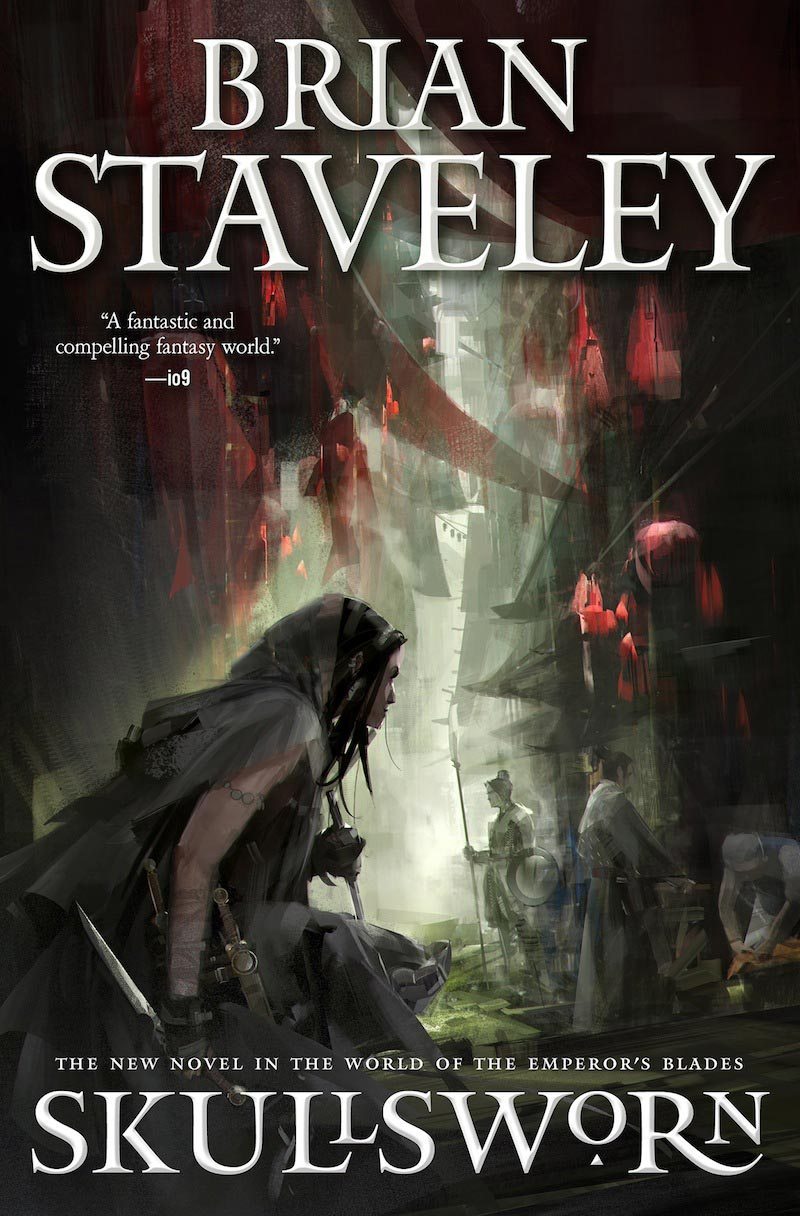
Special thanks to my girlfriend for gifting me this absolutely gorgeous book. Once again, Richard Anderson’s (flaptraps) cover artwork didn’t fail to reflect the greatness of the content; in reverse, the content did the cover justice.


You can order the book from: Book Depository (Free shipping)

You can find this and the rest of my reviews at Novel Notions

Special thanks to my Patrons on Patreon for giving me extra support towards my passion for reading and reviewing!

My Patrons: Alfred, Alya, Annabeth, Devin, Hamad, Jimmy Nutts, Joie, Mike, Miracle, Nicholas, Zoe.
Profile Image for James Tivendale.
339 reviews1,444 followers
February 12, 2017
To begin I would like to thank Brain Staveley and Tor for giving me the opportunity to read an advanced copy of the highly anticipated Skullsworn, in exchange for an honest review.

The narrative is set in the same world as Staveley's previously released Chronicle of the Unhewn Throne trilogy and it follows Pyrre, a character from those stories, however, it is being marketed as being a standalone adventure in the same environment. I, unfortunately, have to admit that this is the first book of Staveleys' that I have read so, whilst some of my Goodreads' friends will not be overly pleased that I, new to the world he has fabricated, have been given the opportunity to read and review an advanced version, I honestly hope that I do it justice and influence people unfamiliar with the author, as I was, that they can start here and truly enjoy what happens within these pages. I will post this to fantasybookreview.co.uk and I know that other reviewers and friends there have already read all of, and found Staveley's previous works highly enjoyable and I envisage, going forwards that they will post reviews from their points of view and then we would have covered the opinions of new and seasoned readers alike. I am intrigued to see how the statements differ.

As briefly mentioned, the story follows Pyrre, who is Skullsworn - meaning she is a priestess, who just so happens to be a double knife whirling assassin in the service of the God Ananshael (this empires' Death) and the tale revolves around her traveling back to her homeland of Dombang, the destination chosen by her where she could complete her initiation trial to prove her credentials and worth to her sect, and to her God. She is shadowed by two experienced practitioners of their Lord, one being the charming, deadly sex addict Ela and another being the seasoned, sometimes blunt but undeniably devoted elder priest Kossal. They are her witnesses, judges, and jury with reference to how they perceive her trial transpires, and assessing whether she has ticked the metaphorical boxes presented. Her trial is as follows - she is destined to kill seven specific individuals in fourteen days as depicted by a composed song and to conclude, she has to fall in love within the designated timeframe and then, kill that person as one of her seven offerings.

I approached this novel with an open mind, however; I had the view that, if I couldn't follow what was happening in this narrative, did not understand the characters' actions and was essentially lost in an abyss of an ununderstood art after fifteen percent, I wouldn't have carried on and would have engulfed the trilogy first. I wouldn't have wasted my time, or the authors time posting a review that wasn't fair if the premise was that I needed to know the world already to appreciate it. After ten percent and taking a few notes, I was easily able to analyse the characters, the Gods they revered and the world that was frequented. I am glad my reading experience here did not end as the previous outcome suggested it may and that was half predicted, as I would have missed an entrancing tale.

Skullsworn is written in the first person perspective following Pyrre and her narrative bounces from current endeavours, to recollections of her colourful youth which ultimately has caused her to traverse back to her origin town and in addition; her descriptions of the world incorporating but not restricted to the Gods, religions, alliances and depicting her relationships and emotions with reference to each of the aforementioned and how they affect her world at this important time in her life. It is presented, I analysed, as either being a presentation of an internal monologue or a diary-esque autobiography and the writing showcases Pyrre's personality, highlighting the darker aspects a disciple of a macabre Lord would feel within themselves, as well as her acknowledging the beauty in the world showcased by some of her heightened and poetic descriptions of the environment and events. It is a pleasant juxtaposition. (Every university students favourite essay word).

It is intriguing that I, as a new reader, am not aware if this happened before or after the trilogy of Staveleys'. This didn't affect my enjoyment but may add extra layers when approaching Skullsworn, to a seasoned reader of this gentleman's' works.

This is not a very long book. Perhaps 350-400 pages and it has about 5 or 6 main characters always presented through Pyrre's mind and the views of hers acknowledging the looming pressure of her trials deadline ever lurking. Kossal and Ela, the two shadowing priests from the white sandstone fortress of Rassambur, where the Skullsworn prepare, train, and worship are a great duo. So different in personalities but their respect and "relationship" is intriguing. One of the major players in this story is not one of Pyrre's Ananshael respecting colleagues but is a gentleman named Run Lan Lac. Bare-knuckle boxer, leader of the cities alliance the Greenshirts and Pyrre's ex "lover" from an age long ago. The conversations between Pyrre and Run are integral to the story and together they discuss the past occasionally but are more interested in the potential rebellion and uprising which people say are revering three ancient God's whose names have been banned from being spoken for many generations.

If so far, Skullsworn does not sound enticing, then I imagine you have internet fallen on to my review page by mistake. It is a concise narrative of the highest order. The politics and underground rebellions and factions reminded me of Scott Lynch's work to a degree. There are many breathtaking scenes. Collapsed bridges leaving 100's of people drowning in miasma of sludgy nothingness, naked alliance battles against Croc's to prove their worth to a mythical age old faction and, in addition showcasing loyalty to a deadly macabre Lord that will set his priests against potentially undefeatable mythical races of old.

About 30 pages from the finale of the book, I had no idea how it could come to closure in that short timeframe. It did, and it was highly unpredictable. Quite tragic too. In fantasy these days, most of the stories present a relevant level of grimness and this overcame the acquired amount. If you do not like swear words or depictions of a sexual nature, then you may be too young to truly appreciate this. The word cunt is used here occasionally. The sexual nature bizarrely sums up the corruption and ill-advised happenings of the world but also the beauty in certain segments. Hopefully, you will see what I mean. I am happy to admit that this is a highly engrossing fantasy world even in this slightly streamlined presentation limited to few, albeit, amazing characters. This is a great entry point for this gentleman's' work and truly I wish to check out the rest of his stories.

Your friend,
James x >>> www.youandibooks.wordpress.com
Profile Image for Melanie (meltotheany).
1,196 reviews102k followers
November 8, 2017


Chronicle of the Unhewn Throne:
1.) The Emperor's Blades ★★★★★
2.) The Providence of Fire ★★★★★
3.) The Last Mortal Bond ★★★★★

“From the first offering to the last, the would-be priestess is allowed fourteen days. Fourteen days for seven offerings. Not such a daunting task—not for one raised and trained in Rassambur—but an impossible one for someone, like me, who had never been in love.”

This book is a prequel in the Chronicle of the Unhewn Throne series, where we are met again with a very predominant side character, Pyrre Lakatur. Pyrre is cutthroat, badass, and a completely ruthless killer. Pyrre is also a follower of Ananshael, the God of Death, and this story is all about her trial that will or will not make her one of Ananshael's Priestess.

But obviously the God of Death himself wouldn't make a trial like this easy. Pyrre has fourteen days to kill seven people that fit the part of an ancient song, or she will meet her God much sooner than expected. Pyrre feels confident until she hears the line “Give to the god the one who makes your mind and body sing with love.”

Pyrre then begins to question whether she has ever truly been in love before and even if fourteen days is ever enough time to prove that she is. She can complete her trial anywhere, but she chooses to go back to the first place she ever called home, so that she can be reunited with the first and only boy she had ever felt something like love for.

“Love is like killing,” she said. “You do it with every part of you, or not at all.”

On this mission she has two companions as well; who will watch over her and make sure she accomplishes everything in order to become a Priestess. One is Ela, who is one of the most amazing characters Brian Staveley has ever created! Her confidence, her acceptance, her bisexuality, her views on sex, her sense of humor, literally everything! Ela is beyond words amazing and I couldn't help but fall in love with her. The second companion, Kossal, is a stern older man, who hates anything that denies his God by never dying. He is a fantastic fighter, and also has a very big soft spot for Ela, too. These two characters made one of the best duos I've ever read about, and I'd actually love a pre-pre-story about them and some of their adventures together.

Pyrre has made Ananshael her life's work from a very young age. She had a very hard and unfair childhood that no child should have to endure, so when she returns to her hometown, Dombâng, she doesn't feel the slightest bit bad about causing a little trouble by recreating an ancient prophecy. It seems harmless enough, well, at least for a worshiper of the God of Death, until someone else picks up where Pyrre leaves off with her reenactment.

From there the city takes a turn for the worse, where we have the maybe only love of Pyrre's life leading the military against many devoted worshipers and fanatics of three mysterious Gods said to be living in the delta. The worshipers of these three Gods give human sacrifice in hopes of pleasing them, but no one is really sure that they even exist.

Oh, and the delta? That place was so frightening. Snakes, spiders, crocodiles, you name it and it is in there. Whenever the characters would be on a boat floating around, I felt so much anxiety! It was almost like I was living in the Anaconda movie! And let's not forget the three beautiful Gods that love hunting people, too.

“I realized something about life then: it’s not always good”

This story is truly amazing, with both parts terrifying and beautiful. The topics of love and how many different ways there are to love someone are just exceptional. I also loved how this book kept proving over and over how actions truly do scream in comparison to mere words. And, not to go all Incubus on you guys here, but how love truly is a verb and it's the most beautiful action any of us can ever do in this life.

“It is an error of grammar to make love a noun. It is not a thing you can have. Love—like doubt or hate—is a verb.”

And the writing in this, God, the writing in this. Brian Staveley's writing is so eloquent and beautiful. The amount of tabs I placed in this book is honestly unreal. This book is filled with beautiful quote after beautiful quote, and when you pair that with an already magnificent story, this book becomes something of magic.

“Love is not something you can keep. It is something you do, every day, every moment, regardless of who is dying.”

I also praised Brian Staveley for this throughout the entirety of the Chronicle of the Unhewn Throne series, but he truly does write strong female characters so very well. It never feels forced, or like fan-service, or have any hints of misogyny. He truly is just an amazing writer, and he never disappoints with his female (or male) leads.

I totally recommend reading this after you read the other three books in the Chronicle of the Unhewn Throne, because even though this is a standalone and you will understand what's going on, you will have such a better appreciation of this world, and the races in this world, if you read the original trilogy first. Again, you can totally read this on its own, but you will just miss out on a few things and one particular beautiful epilogue that left me sobbing in my bed, which I literally then cried myself to sleep.

I was so enthralled while reading about Pyrre's journey, and this will easily be one of my favorite books of 2017. I am completely captivated by this world, and I can't wait to see what is next. And if you've read the Chronicle of the Unhewn Throne, please give this a try. It's short, and beautiful, and so very powerful.

Blog | Twitter | Tumblr | Instagram | Youtube | Twitch
Profile Image for Navessa.
449 reviews876 followers
April 15, 2018
"I grew up in a place where women wear vests ribbed with stilettos, where each priest has a dozen knives, steel traps, needles so fine you can slide them beside the eye into the brain and out again without leaving a mark."
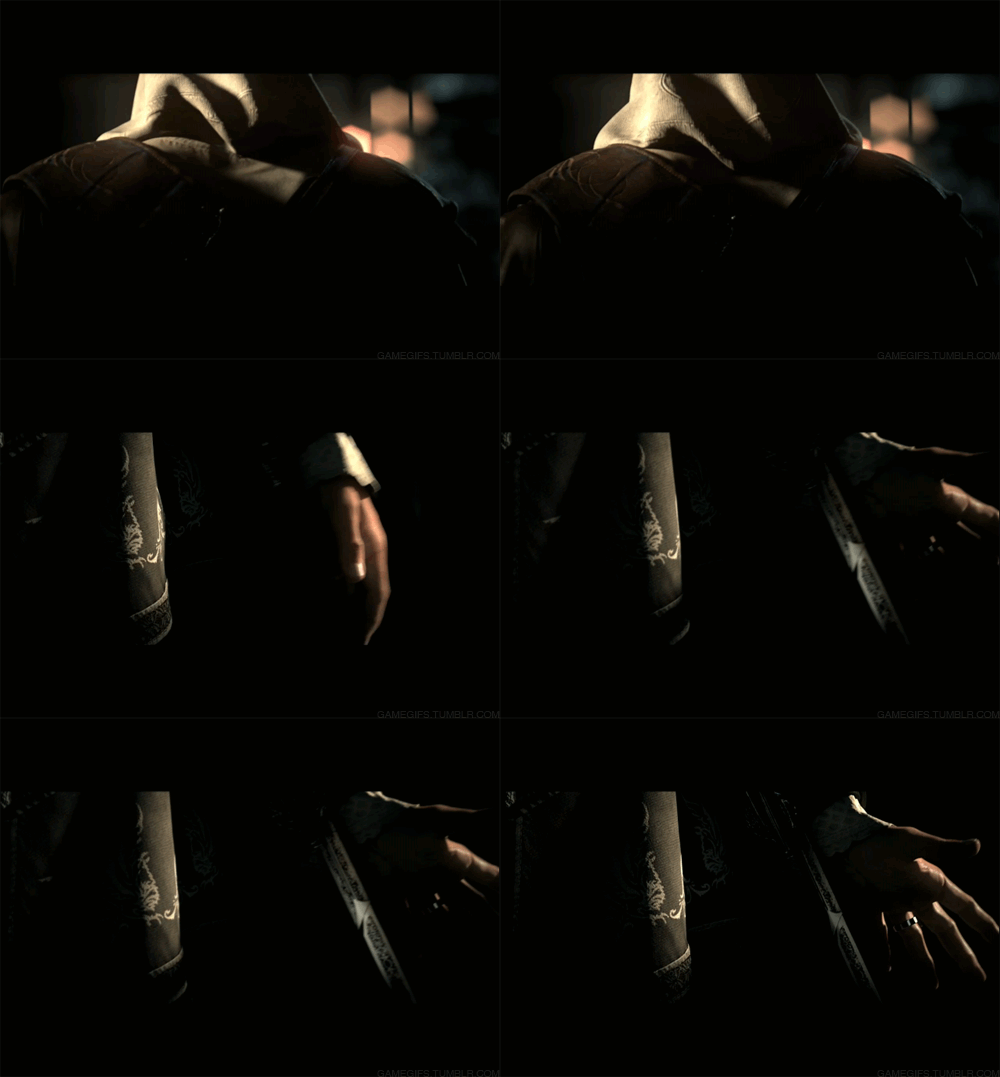


Pyrre Lakatur. If you've read the Chronicle of the Unhewn Throne series, this woman needs no introduction. For those of you who haven't, please allow me to summarize: the cast of characters from that trilogy featured a slew of badasses so well-versed in battle and bloodshed that by the end of it, each of them became a myth unto themselves.

All of them were wary and more than a little in awe of Pyrre.

This is her origin story. And it's everything I hoped it would be. In Skullsworn, she's not yet a priestess of Ananshael, the god of death, but an acolyte, attempting her final and most difficult challenge: to kill the one she loves above all others.

She has just fourteen days to do it. Trouble is, she's never been in love. And so, hoping to rekindle an old spark with a man she once felt something for, she and the priest and priestess serving as witnesses to her ordeal return to Dombâng, the city of her birth.

This barely-civilized backwater bayou brimming with distrust for the empire that conquered it is more than just a backdrop. Staveley's powerful, poetic prose turns it into a character unto itself.

"Two hundred years earlier, Annurian trebuchets had pounded the northern quarter of the city into flaming oblivion...Dombâng was still burning, although the flames had been long since contained, tamed, caged in ten thousand stoves, torches, lanterns, the fire a servant once more. From atop the mountain, the whole labyrinthine expanse sprawled before us like a muddier, nearer echo of the stars."


It is here that we learn of Pyrre's humble beginnings. We're shown the squat hovel where she was born. We meet the man, Ruc, son of a once great household, guardian of Dombâng, traitor to his people, that she intends to fall in love with.

Speaking of love, how do you define it? How does someone else? How do you know if you're in it? Who can fairly judge that you are? You? Or another person? This book takes a really interesting, philosophical approach to the subject. The priest and priestess, Kossal and Ela, who accompany Pyrre aren't just there to bear witness. They're to act as judge and jury when her fourteen days are up. Only if they determine that she is in love when and if she manages to kill Ruc does she pass. If not, she'll be found unfit to serve as priestess to Ananshael, and they'll give her to their god.

No pressure.

I just...loved this book. Loved every damn thing about it, really. The take on love, the subtle, satirical jabs at fantasy genre cliches, the inclusiveness, the diversity, the feminist themes, the age, body, and sex-positivity, the macabe sense of humor that permeated the pages:

"How much could a man love a woman, after all, if he wasn't a little worried she might kill him?"


Skullsworn is just as intricately plotted and masterfully told as Staveley's other works. Having read him before, I knew better than to try and guess the outcome, or anticipate the twists, because I've learned through experience that I'll never be right.

Though this book comes to a neat ending, it still left me desperately hungry for more. Unlike The Chronicle of the Unhewn Throne, this is told in first person perspective. I got so caught up in Pyrre's mind that I'm suffering some serious book withdrawal now that I'm finished. Her origin story is not enough.

I NEED HER WHOLE GODDAMN LIFE.

The good news for those of you unacquainted with the other books set in this world is that this can function as a standalone. I highly recommend it for anyone fed up with the repetitive themes in the fantasy genre. And especially for those fed up with the portrayal of women in the fantasy genre. This book and those few of its ilk are the future, and I cannot fucking wait for the day when more men and women write as progressively as Staveley.

For this and everything else I've mentioned, it goes on the "will re-read until I die" shelf.

Blog | Facebook | Twitter | Instagram | Pinterest
Profile Image for Sean Barrs .
1,121 reviews47.9k followers
January 21, 2019
Skullsworn is an impressive standalone fantasy that delivers a sweeping tale of love, treachery and murder. It’s super cool.

I recommend it to all fantasy fans because it’s a great way of seeing exactly what the author can do without being bogged down by a trilogy. It’s quite short too, but despite it’s 300 pages it packs a hefty punch (or a stab- should I say?) I’ve not read the Unhewn Throne trilogy, but after this I want to. It’s given me a glimpse into a fantasy realm I want to see much more of.

The tale begins with death and it ends with death. In order to enter the elite ranks of master assassins (The Skullsworn) Pyree must kill the one she loves most in the world. It’s a high entry price, and she’s more than willing to pay it. The problem is she doesn’t love anyone. Worshiping the god of death has taught her to contain her emotions, to remain unattached from other people and to kill with unflinching mercilessness. There’s no time for sentiment. There’s no time for friends and there’s no time for love.

So, it’s a rather hefty task, one that sends her back to her roots to try and spark some feelings into her cold dead her. She seeks out her adolescent fling with the hope of falling for him once more. And they are now both very different people, grown wise by the ways of the world and reluctant to trust one another again. Pyree must manipulate, conspire and start a revolution in order to usher in the circumstances that could push the two together once more. And it’s all very clever except she can’t make herself love anymore.

An interesting dynamic develops, told against a backdrop of a decaying city surrounded by dangerous swamps. They’re infected with giant crocs, snakes and spiders that can kill a man instantly. It’s a treacherous place and the wildlife is absolutely cut-throat, but the people, the people are even worse. The city is ready to tip over the edge and the revolutionaries don’t care who they kill (or sacrifice) in order to achieve their goals, namely the restoration of their independence.

So it’s a real strong book told with energy and layered with hidden depths and powerful entities that are much more (or less) than they seem. There’s plenty of mystery to be found in the swamps as the story churns and delivers several surprising reveals that took the book to an entirely new level of storytelling. The fantasy elements are centred more on gods and myths rather than magic and sorcery. As such, there were some real tense moments in here and the action as electric.

Brian Stavely is certainly an author I will be revisiting – a solid 8.75/10.
Profile Image for Samir.
116 reviews231 followers
March 25, 2018
Actual rating 2.5 stars.
Profile Image for Dannii Elle.
2,331 reviews1,830 followers
April 9, 2017
I received a copy of this book in exchange for an honest review from NetGalley. Thank you to the author, Brian Staveley, and the publisher, Tor, for this opportunity.

Do you ever finish reading a book, and just think to yourself... wow! I honestly have no idea how I am going to do this rich setting, the evocative language, the compelling plot, and the unforgettable characters justice!

This is a stand-alone fantasy, which is a rare thing in itself and that, combined with the author's good name, is what hastened me to read this. This is a continuation of one of Staveley's original series, of which I have not read. I don't think this impacted my reading, in any way. Perhaps I missed out on subtle clues that connected the two, or a continuation of a character's journey, but I could follow this story with no trouble.

This is the story of Pyrre, who is on a mission to prove her status as a fully-fledged Skullsworn. As a Skullsworn, she will serve Ananshael, the God of death. Her journey is both a geographical one as well as a mental one. She journeys, along with those who will test her worth, across this rich, fantastical land, learning both about herself and the path she has chosen in life.

I can not fully explain how opulent and palatial the writing is. As well as being a master story teller, Staveley could write of the most mundane or smallest of detail and make it rich with texture and full of life. His writing is what drew me in, but it was his immense world that made me stay.

For this world was a broad one. The characters traversed many corners of this realm and yet the reader, it felt, was only shown a small portion of it. With many places still yet to discover, I am planning to follow this by reading the original series, and I ardently hope for further continuations in one of my new favourite fantasy worlds.
Profile Image for Mayim de Vries.
590 reviews1,169 followers
April 12, 2018
“I came here to find you. I came here to fall in love with you. I came here to kill you.”

Skullsworn is a very unorthodox romantasy. Firstly, the romance does not dominate the novel. Secondly, the main aim is not a ‘happily ever after’ but rather a ‘dead ever after’. You are going to enjoy it very much provided that you don’t mind the minor fact that the main protagonist is an absolute psychopath.

“If we can’t have a decent storytelling, at least we can enjoy the violence and fornication.”

The book is set in an Asian style city on water, but do not think of Venice, rather something that is as wild as it is lethal. Think serpent, dark storm and river death. The death should be very unpleasant. The city of Dombâng is hidden in the delta swarming with all sorts of deadly creatures imaginable and has a long history of independence that was not forgotten during the 200 years of occupation. It is inhabited by people who are accustomed to facing daily danger and who remember that they once were more than they are now. This is a dangerous combination and so “the city is balanced on a blade.” To complicate matters more, our main protagonist, a native of Dombâng, returns to her birthplace in order to pass a final trial required by her religious order, the worshippers of Ananshael, the god of death. She needs to kill 7 people in 14 days. The last victim should be someone she loves. Her idea of setting her heart on fire is to set her hometown on fire by the means of inciting a revolution.

“Insurrection.” Ela blinked. “Is that a sexual position?”

You do not need to be familiar with the trilogy proper in order to enjoy the Skullsworn. Skullsworn is a prequel and Pyrre is the only link here. Since the events in the book happen before those unfolding in the Emperors Blades and have no impact on them whatsoever, lack of this knowledge will not hinder your reading experience. On the other hand, I have read the Unhewn Throne dozens of books ago and so certain details regarding background information and world building (like the differences between he Cestriim and the Nevariim) were kind of blurry for me. Often, when reading, I wished I had remembered more, especially that there is no glossary attached and you need to absorb a lot of data to understand the wider context of what is going on.

In short, the main motifs of the books are two: love and death. Both are linked and explored within this interconnectedness. Both proved to be very problematic for me.

“Love is hurling yourself onto a deadly creature, then realising once you get hold there is no way to let go. Either you die, or it does.”

With some strain but in the end I was able to accept the premise that the only way for two people to fall in love with each other is to bring a civil war into the city. The main problem I had was the fact that even though the whole point of the kerfuffle was to incite romance, from the very beginning Pyrre thinks and talks about Ruc as if she’s already fallen for him, just does not know it yet. Aside from the main plot line and action scenes, the novel is ripe with her quasi-philosophical pondering and reflections on the nature of things. While the former is top notch quality, I have barely pushed through the latter.

It starts with the “Love is like killing. you do it with every part of you or not at all.” wisdom (which is about the most perverted and absurd I encountered) and continues throughout the book to culminate in the final scene that I have no words to comment on. The lessons are given by Pyrre’s two tutors and simultaneously witnesses for her trial: Ela and Kossal. While Kossal is a pure psycho killer (who plays the flute in order to keep himself from killing people at large), Ela is all this plus a wanton nymphomaniac. To spice things up, they are in love with each other, and it is a great romance because Ela sleeps with whomever she wants to and Kossal kills people she sleeps with. They are, what is frequently underlined, Rassambur legends and the very best of what the Anashael priesthood has to offer.

It is so unreal that in the end, the whole thing borders on funny (a creepy sort of fun). All three of them are killing machines. They excel beyond and above what the normal human being is capable of like a jaguar suprasses the pussycat. Pyrre pretends being Kettral. But, I thought, at least the Kettral have something to account for their prowess. Here, we get nothing so you will just have to accept at face value that the Skullsworn can do normal people cannot merely because of a healthy regimen, training and good air. Also, the fact that they kill is perfectly normal.

Don’t get me wrong. I know that death is inevitable and it constitutes an element of life, but that is not a reason to go on a killing spree. Pyrre often repeats that everybody dies at some point as if the inexorableness of death nullifies the importance of what happens between the now and then, dismisses it as trivial and inconsequential, and indeed, means that the then can be brought forward because it is more important in the ultimate order of things.

Not only is Pyrre causal about killing, but also she is unable to function without it to the point that she is unsure what to do or even how to stand without the knife in her hand. She notices at times that she is different than the rest of the world (”I was alone, evidently, in finding the sight [of mass killing] strangely beautiful.”), but this is never an incentive to reflect on this difference, only to celebrate it and be proud to stand out.

The lack of respect for dead bodies, lack of understanding when it comes to burial, lack of remorse - all these quirks are not rooted in fascination or reverence for death but only in an absolute disregard for the human being ever so typical for every psychopath be it a serial killer or a company CEO. All the nonsense she is sprouting is there not because she reveres death, but because she has no regard for it.

In the trilogy proper the Ananshael cult was portrayed with some depth and transcendence; here only shallows remain. We are told of a sect that is equally happy both killing everyone and committing suicides . Worship has two sides, killing and dying and there is nothing more to it. Nada, Niente. Ничто. Basically, you are devoted when you have the urge to kill people, not if you revere death and dying (and run hospices for terminally ill, why not?). Killing is understood as an offering. On the other hand, Ela refers to more typical forms of religious worship like prayers and rituals as ”a dull enterprise”.

When you dissect what is being spoken what what is being actually done in the book it is evident that is nothing sacred or transcendent about dying (death is unmaking, you just stop being). Killing is merely something you do casually and skilfully. But killing kills. You might think it’s an oxymoron, but it is vital to remember that a part of killer dies with the victims. And so if one kills often enough, nothing human is left in the end. And this is precisely the kind of person Pyrre is (while Ela and Kossal go even further). I have known Mr Staveley as an author that does not shy away from pushing his protagonists into the darkest places of humanity. The problem is that there is nothing even remotely humane about Pyrre. And that she does not need to be pushed.

There was nothing even remotely human about her killing the woman singing in the temple. The same with pregnancy kill - when she could have saved a life, she premeditated a murder. That I found repulsive, disturbing, and hard to accept even in a fantasy setting. Also maybe because it was so mundane. Like most of the psychopaths (if you read the research on them), Pyrre is an outcome of harsh environment, abuse, and trauma in childhood. But then, not every unhappy teenager kills her parents. I couldn’t rationalise or justify her actions and her deeply unsettling reasoning. And this prevented me from truly enjoying the book.

If you don’t mind the points I made, you just might. The writing is beautiful, world building splendidly rich, and the plot thick with action. Otherwise, stick to the series proper. It is also dark and filled with drama, but at least it does not celebrate perversion.
Profile Image for Hamad.
1,316 reviews1,625 followers
October 16, 2021
This Review ✍️ Blog 📖 Twitter 🐦 Instagram 📷 Support me

“… we are all dying, all the time. Being born is stepping from the cliff’s edge. The only question is what to do while falling.”


Skullsworn is a prequel to the Chronicle of the Unhewn Throne Trilogy. I only read book 1 of that series, gave it three stars and wasn’t very excited to continue the series. But I heard that this book is a prequel, it works as a standalone and that it is a great book and I can say that I agree with all these points.

I think the writing is the best thing about the book because the prose is very polished and kind of lyrical and it is not easy to find this in adult fantasy books. I did not even think of the writing in “The Empeor’s Blade” that way, so it may be that the author improved or just that this book is more interesting for me.

The book follows Pyrre Lakatur, a priestess -to-be after passing the last trial of the God of Death. This trial involves killing 7 people in 14 days according to one of the songs of those priests. The challenging part is the last part which involves killing the one who makes your mind and body sing with love!! I know I am a fan of this formula, there is something magical about people with a list of seven people to kill which is not a new idea and I have read it in books like Best Served Cold and Seven Blades in Black.

So once again, the writing is charming and I think the enjoyment of the story highly depends on it and you can actually tell from the first couple of chapters if it is your cup of tea or not and I knew I was gonna love it from very early on the book!

The characters are also very well written, I think I prefer the single POV to the multiple POV used in The Emperor’s Blade. Pyrre was an interesting character and I also couldn’t help but fall in love with both Ela and Kossal. Ela is just naughty and lewd but very intelligent and endearing character, Kossal is like the opposite with him being grumpy all the time and wanting to kill anything that seems strong because it sounds like they’re challenging his God!

The world-building is not extensive although it gives a very good idea about what the main series entails. There were huge birds, there were Gods, mythology and lots of crocodiles and I think for a prequel that was more than enough because it shouldn’t be overwhelming for the reader.

The plot is great, my small criticism is that the book focused mainly on the last death and it tried to discuss a few things while doing it, like what is love and what is death and what are Gods even! That’s all great but the first 6 deaths pales in comparison to the last one simply because the focus was on the last one. I have heard a lot of praise for the ending and I mostly agree, and I am saying mostly because although I was able to predict it, part of me was a bit salty at the end but I still think it is a very satisfying ending!

“Love is not some eternal state, but a delight in the paradise of the imperfect. The holding of a thing is inextricable from the letting go, and to love, you must learn both.”


Summary: I think it is an excellent book with a great writing and realistic characters. The book is not as short as it seems (almost 450 Pages, the 318 pages in Tor copies may be very compacted) and it is a full length novel. The plot was very intriguing and I think I preferred the choices here compared to the first book in the trilogy. I think the books needs focus to read and enjoy but I don’t think I can do that for 900 pages (the length of the finale in the trilogy) so I think I am gonna drop the series but I am gonna keep an eye on the author’s work for sure!
Profile Image for Tracey the Lizard Queen.
256 reviews46 followers
May 9, 2017
Review originally posted here: http://thequeenofblades.blogspot.co.u...

4.5 Stars

You know when everyone is talking about a new author/series and you just don't have the time to fit it in, and then by the time you do you're 2 books behind everyone else? Well that was me in 2014. The Emperors Blades was everywhere, and I missed out. The same thing happened with books 2 and 3. I wanted in on the action! I just didn't have the time to squeeze it in. Fortunately, Skullsworn provided me with the perfect excuse to sample Staveley's writing and be in on the action!

Full disclosure. I cried. Yeah, I do that a lot.

Pyrre is such an incredibly awesome character. She's tough, but not cliched. Capable, but not unbeatable. Vulnerable, but not afraid. I just love her. I cannot stress enough how well written she is. I wish more authors would take their cues from Staveley, sometimes those gender traps are just too easy to fall into. I'm so glad there are none here.

Skullsworn follows Pyrre on the toughest challenge she has faced. In order to become a full priestess of Ananshael she must gift him seven lives in 14 days. One of which is someone whom 'makes her heart sing with love'. In other words find someone, fall in love, kill them. All in 2 weeks.

Pyrre is a very accomplished woman, she approaches every problem with a well thought out plan. She begins her journey by returning to her childhood home Dombâng, and then inciting a revolution in order to get close to a former flame. Its actually a very good plan (I'm simplifying it a lot). She comes up with the perfect cover, she meticulously plans everything, down to her 'completely noncoincidental run in at the swimming baths'. Meticulous planning however, is part of Pyrre's biggest problem. Unfortunately for her, you can't plan to fall in love, all part of the expensive lesson she must learn.

I have always had a love for the first person PoV and this one is so brilliantly done, I just 'get' her. Pyrre is my kind of character. Quite possibly another one to add to my 'Best of' list!!

*I received an e-copy from the publisher via NetGalley in exchange for an honest review*
Profile Image for Mogsy.
2,265 reviews2,777 followers
April 18, 2017
4.5 of 5 stars at The BiblioSanctum https://bibliosanctum.com/2017/04/18/...

Brian Staveley returns to the world of The Chronicle of the Unhewn Throne with this new standalone novel starring one of the most intriguing characters from his debut trilogy. When we first met Pyrre Lakatur, she was shrouded in mystery. Whether she was ally or enemy, it was hard to tell, but clearly, the imperturbable priestess of Ananshael was one capable, dangerous woman.

Skullsworn is her story. Just who is Pyrre? Where did she come from? What is it about her god that inspires so much of her love and loyalty? If you’ve ever asked yourself any of these questions, then this book is for you. But even if you haven’t read The Chronicle of the Unhewn Throne, this book would make a splendid introduction to Staveley’s work—especially if you want to get your feet wet with something that has a less intimidating page count before taking the plunge into the full trilogy. This book stands alone from the others, and is a prequel of a sort, taking place in a distant corner of the Annurian Empire.

When the story begins, Pyrre is still an acolyte, twenty-five years old and pledged to Ananshael—the God of Death. For years she has trained in the sacred arts of death, learning countless ways to deliver victims into her god’s embrace. But unless she can pass her final trial, she will never become a priestess…and the problem is, Pyrre isn’t sure she can.

It’s not the actual killing that has her worried, but rather who she has to kill—and not for the reasons you’d expect. The rules of the trial are very specific. In a span of fourteen days, Pyrre must make seven offerings to her god—no more, no less: one who is right, and one who is wrong; a singer snared in a web of song; a dealer of death; a mother ripe with new life; a giver of names; and finally, we come to the last one that gives Pyrre pause—“Give to the god the one who made your mind and body sing with love / Who will not come again.”

The trouble is, Pyrre doesn’t believe she has ever been in love. And if she hasn’t been in love, she can’t kill the one she loves, and if she can’t kill the one she loves, she fails her trial, and all those acolytes of Ananshael who fail the final trial offer themselves to their god. Now you see her problem.

Still, Pyrre is determined to pass the test, which means hitting the road with her two trial Witnesses in tow. Their destination is the swamp city of Dombâng, where Pyrre was born and where she first felt the spark of something special for a man she used to know. It is her hope that with proximity and maybe a little…encouragement, perhaps that spark could be rekindled again and grow into something more. However, it has been years since she last saw Ruc Lan Lac, the object of her probable affection. He is now the captain of the Greenshirts, the constabulary force charged with keeping order in Dombâng, and at the moment his hands are full trying to keep dissenters from tear the city apart. Pyrre intends to get close to Ruc by offering help—but in order to do that, she’ll first need to further incite rebellion.

And now I’ve probably gone and mucked up my summary by making this one sound like a romance. Well, it is. Kind of. In a…weird, twisted sort of way. Leave it to Brian Staveley to inflict the cruelest kind of cognitive dissonance, making you root for the main couple even knowing that no matter how the situation turns out, the end will be filled with blood, violence and death.

The fact that Pyrre appears more agitated by her seeming incapacity to love rather than the idea of actually killing a loved one should tell you something about her character. This is a woman who has given herself entirely to her god, and she also hates the idea of failure. In this sense, she is the Pyrre we knew and loved from The Chronicle of the Unhewn Throne. However, in Skullsworn we also get to see a more youthful and less confident side of her, which was fascinating; in time, we know she will grow into an even more deadly weapon, but right now her personality and skills are still in the process of being tempered.

Unlike the books in the trilogy, Skullsworn is also told from the first person perspective—a nice touch as that puts us right inside of Pyrre’s head, giving us a front row seat to all her experiences and tumultuous emotions. While this does take away some of her mystery, the wealth of knowledge we gain about her character and background is a much bigger reward. Don’t get me wrong; Pyrre is still bloodthirsty, insane and zealously devoted to Ananshael, but this book went a long way in making her feel more like a genuine person rather than just a cold, calm unstoppable killing machine. It shows she was once young, naïve and inexperienced, filled with self-doubt and questions about her god and her faith. It shows that she has a softer side to her that isn’t all about death and killing, a part of her that she wants to stay connected to because love has more to do with death than she expected.

I also want to talk a bit about the writing. It always amazes me to follow an author’s releases year after year and see their style evolve and grow, and clearly Staveley has come a long way since The Emperor’s Blades. His prose is fantastic and well-suited for the narrative mode, making a complex and nuanced character like Pyrre feel fully-realized and believable. The story also takes us into a very different part of the world, introducing readers to the hot, humid croc-infested marshes of Dombâng. It’s a city that holds many secrets, filled with shadowy factions and self-seeking individuals all operating to the raucous sounds along the bridges and canals. Despite being a dangerous place, Staveley’s incredible world-building and detailed treatment of Dombâng made me wish that I never had to leave.

So, do yourself a favor and pick up Skullsworn. Brian Staveley deftly weaves a fast-paced and compelling tale filled with excellent characterization, vivid world-building, and high personal stakes, making this one an outstanding novel on every level.
Profile Image for Lisa.
350 reviews601 followers
April 23, 2017
Review from Tenacious Reader: http://www.tenaciousreader.com/2017/0...

As much as I loved the Unhewn Throne trilogy, Skullsworn has taken seat for my favorite of Staveley’s book. One thing Staveley did well in Unhewn Throne was create fascinating secondary characters that you wish had more page time, and even without knowing everything about them, you just love them. Well, Staveley has now proven he can take one of those intriguing secondary characters and create a very rich and full story that makes you understand and appreciate the character on a whole other level.

Pyrre stood out in Unhewn Throne as one of those intriguing secondary characters that really added to my enjoyment of the series. This book is the story of her trial to become a priestess of Ananshael, the God of Death and really gives us an amazing background on her to understand how she became the character we met earlier.

One would expect her trial to be full of death (which, it was), but it is love, not death, that really takes the spotlight. To complete her trial, Pyrre must take the life of someone she loves. Problem is, Pyrre can’t think of anyone that would qualify. So within the short span of her trial, she must both find love and do so knowing that there is an ulterior motive and a not so happy ending for the relationship. One has to wonder if it is possible to find love under these circumstances. And while the rest of us are wondering how she could kill them if she does love them, well, you have to understand they see “sending someone to their god” as a mercy or gift, not as violence or murder. Her perspective on death is so incredibly different from how we normally think. But through the course of this book, I came to really understand her and how she sees the world. For Pyrre, this is not unthinkable on the level one might expect, and yet she still comes across as quite humanized and someone you want to root for.

The prose in this book seemed to be a step above his earlier books as well. Don’t get me wrong, I very much enjoyed his other books, but I never really considered prose a strength. I would find myself reacting not to just what Staveley was saying, but how he was saying it. I would think “wow, I love that description”. I honestly don’t remember noticing this in his other books, but I found myself just really impressed with his word choices, descriptions and the general flow. I enjoyed not just the entire story, but also how it was told.

While this book is told from Pyrre’s perspective, it is told in both a current timeline as well as flashbacks. These flashbacks increased our understanding of Pyrre and how she came to serve her God. They were integrated with the current day events very well, keeping the pace going and holding my interest just as easily as the current timeline.

Also adding to my enjoyment of this book were Pyrre’s companions. Like I said earlier, Staveley does secondary characters very well, and this book is no exception. Pick one at random, and I would love a book dedicated to them.

So, yes, as much as I enjoyed The Unhewn Throne, Skullsworn is now favorite of Staveley’s books. It is as exciting and fascinating as Pyrre herself. Perhaps it just struck my mood, but I loved getting a single perspective and just immersing in Pyrre’s character. It just felt like a quicker and more gripping read to focus one her. And what a character she is! Even as a secondary character I found her interesting, but this book delivered more than I expected. Highly recommend, especially for fans of female characters that like to kick ass and not always follow the rules.

Profile Image for Mili.
421 reviews58 followers
March 31, 2018
description
This was intense! Reallllly good, started slow. Took me a while to feel my surroundings and get to know the people. And then I fell hard! And that Ruc! Oh my XD~

I loved Pyrre her role in The Chronicle of the Unhewn Throne a lot, Ananshael priests are so bad ass! They love, care and enjoy life to the fullest and are not scared! That makes the best sacrifice, living! Their way of worshipping and pleasing their god :) beautiful and so poetic! They are CRAZY XD

This book is focussed on Pyrre and how she became a priestress of Ananshael.

If you loved Brian Staveley his trilogy then this is a must read. You get good writing, a beautiful tale and struggle. And nevvvver forget about the gore, blood such beautfiul sights made in your head! GUH :D
Profile Image for Franzi.
75 reviews102 followers
March 8, 2020
4 Stars

Loved seeing Pyrre's backstory. The new characters were great, I especially liked Ruc and Ela, the story was intense and that ending was just amazing (even though it made me sad. I don't know why I expected a book about priests of death to have a happy ending).
Also, just like in the main series I truly enjoy the writing. It's so clear and easy to follow and makes the whole story so much more enjoyable to read.
286 reviews
May 16, 2017
I have loved Pyrre since reading the Chronicles of the Unhewn Throne and ever since I learned there was going to be a standalone novel about her I simply HAD to read it. (You can read this standalone without reading the Chronicles of the Unhewn Throne!)
Pyrre is an amazingly written strong and complete female character, who truly came to live for me in this book. The book is told from her perspective and we learn a lot about her past, her life and the decisions she made in the past and makes during this story.

The first half of the book I thought to be a bit slow but it really picked up in the second half to come to a powerful, unexpected, violent and brilliant ending in the last 50 pages.

The harsh environment with a lot of deadly creatures made for a perfect background for this violent story that is about love in the broadest sense of the word.

I would love to read more about Pyrre!
Profile Image for Niki Hawkes - The Obsessive Bookseller.
791 reviews1,660 followers
June 8, 2018
Mini Review: If I could’ve chosen any group from the Unhewn Throne trilogy to learn more about, it would’ve been the Skullsworn (maybe not necessarily through an early Pyrre perspective, but she’s definitely an interesting character). The Skullsworn are essentially a guild that uses death as worship, so they naturally produce highly skilled assassins. I was hoping to get into the nitty gritty of the training process (kind of like what Staveley did with the Kettral in the first book), but it was more focused on Pyrre’s initiation process and less focused on the group as a whole. It had a few good fast-paced “scheming” moments, but a lot of the book was slower moving than I’d anticipated. I also had a pretty solid prediction early on about one of the major plot points, which unfortunately killed any of the suspense I was supposed to be feeling. It was far from a bust, though. I loved the setting – a alligator ridden swamp/delta with plenty of local lore and voodoo (good cultural immersion always goes a long way with me), so even when I wasn’t always 100% engaged with the plot, I was at least enjoying the atmosphere. Pair that with solid writing and a good ending earned this prequel a solid 3 stars (I liked it) rating. Unhewn Throne is a definite keeper for me, so I’m genuinely looking forward to whatever Staveley produces next.

Note - I still need to write a review for The Emperor's Blades, one of my favorite books ever. So you can see this one was up against high standards. :)

Via The Obsessive Bookseller at www.NikiHawkes.com
Profile Image for Anton.
387 reviews100 followers
November 20, 2018
People enjoy fiction reads for different reasons. Many are fascinated by the characters and the evolution of their personalities, some are gripped by the plotlines... I personally (and in particular in case of Fantasy/Sci-Fi) is fascinated by the worldbuilding. I adore the power of the speculative fiction to transport you away... and for me, it is essential that when I escape, I escape to the worlds that well thought-through, very detailed & nuanced and that are easy to imagine to be true... I hate nothing more but to start seeing internal inconsistencies and implausible narratives. When you start seeing these 'cracks' - it busts your illusion bubble and the magic is gone.

"Skullsworn" delivers amazingly on the worldbuilding front. It is mindblowingly elegant and captivating! Fantastic setting that takes our protagonists to a town set in a river delta that remotely reminds you of Amazon rainforest. The setting and worldbuilding (and the writing that takes you there) - all get full 5* from me.

I must admit that I hated some characters (Ela *facepalm*), some dialogue sequences (just too forced witty) and was somewhat underwhelmed by the final conflict resolution. All of the above lost this book 'a star' in my rating.

But it is still a gorgeous read! And I strongly recommend it :) If you enjoyed the trilogy - "Skullsworn" brings back all the captivating magic and mystery of the Book #1. if you haven't read the trilogy - no problem. "Skullsworn" totally works as a standalone. No prior setting knowledge is required.

*** kindle clippings ***

I went to Dombâng for love. And yes, to kill seven people in fourteen days, sure, but I wasn’t worried about the killing.
Brian Staveley, Skullsworn, loc. 36-37

I grew up in a place where women wear vests ribbed with stilettos, where each priest has a dozen knives, steel traps, needles so fine you can slide them beside the eye into the brain and out again without leaving a mark. I watched my fellow priests die by fire and iron, sometimes quickly, leaping from the tops of the sandstone cliffs, or slowly, by dehydration’s intimate degrees. By my fifteenth year, I had set to memory a thousand ways to offer a woman or man to my god’s sure unmaking. I wasn’t concerned about my piety or my ability to make the sacrifice.
Brian Staveley, Skullsworn, loc. 37-41

I’m not offended. For most people, my god—like the death he brings—is all mystery and terror. You have not been to Rassambur, have not heard our choruses beneath the new moon, have not enjoyed the sweet fruit of the trees espaliered against our sandstone walls. How could you know the first thing about the men and women you call Skullsworn?
Brian Staveley, Skullsworn, loc. 44-47

Maybe we could start with the word itself. It’s wrong. I don’t swear on skulls, not on them, not to them, not around them. I haven’t seen a skull for years, in fact. A bit of blood-smeared bone through a torn-open scalp, perhaps, but an actual skull, wide-eyed and jawless? What in the god’s name would I be doing with a skull?
Brian Staveley, Skullsworn, loc. 47-50

If you’re seeing a skull, or a barrel full of blood, chances are good that my god has come, unmade a creature, then disappeared. Surely as a strong dawn wind kicks up dust and bends the branches of the trees, Ananshael leaves
Brian Staveley, Skullsworn, loc. 62-63

I understand, of course, how people make these mistakes. If you’re seeing a skull, or a barrel full of blood, chances are good that my god has come, unmade a creature, then disappeared. Surely as a strong dawn wind kicks up dust and bends the branches of the trees, Ananshael leaves blood and skulls in the wake of his passage, but blood and skulls are not death any more than a bent branch is the wind.
Brian Staveley, Skullsworn, loc. 62-64

To say death is like a land beyond the sea or like an endless scream is to miss the point. Death is not like anything. There is no craft analogous to Ananshael’s work. The truest response to his mystery and majesty is silence.
Brian Staveley, Skullsworn, loc. 65-67

The Csestriim and the Nevariim were like this, if the chronicles are true—immortal, unbroken stones, incapable of joy, either the feeling or the bringing. Of course, my god was young when they walked the world, his strength more meager in the age when they were made, meager enough that for thousands of years and longer they escaped his touch. They might have continued forever that way—immortal save in those rare cases when the body was so broken by violence that my god could finally slide his fingers inside—but the Csestriim overreached. In their dust-dry desire to catalogue the world, to know it so they could bend it to their will, they pushed the Nevariim too far, and finally, the Nevariim pushed back.
Brian Staveley, Skullsworn, loc. 79-84

fell to them as my Witnesses in the Hall of All Endings, a vault-roofed, windowless sandstone cube just a dozen paces across. Not so much a hall as a room, really.
Brian Staveley, Skullsworn, loc. 123-124

From the cliff’s brink, I stared down into the great gulf that surrounded all of Rassambur. I’d been beyond that gulf, of course. I was born beyond it, raised to the age of ten beyond it, and in the fifteen years since, I had crossed dozens of times over the delicate sandstone span linking Rassambur to the mountains, to the rest of the world. For all the remoteness of our fortress, our devotion is evangelical, ecumenical, not monastic. Where there are people, there is our god, pacing silently in the marble corridors of power and the rankest alley alike, visiting the solitary cabin in its forest clearing, the bustling harbor, the camp aswarm with soldiers. His justice is equal and absolute, and so, as ministers of his justice, we must go out into the world. For every year in Rassambur, I had spent one year abroad,
Brian Staveley, Skullsworn, loc. 197-203

Eira’s a goddess, and that makes her a tyrant, no matter what anyone tells you. Lady Love doesn’t explain her ways to me.”
Brian Staveley, Skullsworn, loc. 221-222

The creatures of the Shirvian delta are fluent in the language of my lord. Even the smallest have not been made meek. A millipede coiled around a reed can kill a woman with a bite. So can the eye-spider, which is the size of my fingernail. Schools of steel-jawed qirna ply the channels, each fish more tooth than tail; I’ve watched people toss goats to them—an old offering to forbidden gods; it is like watching the animal dissolve into blood and froth. There are crocs in the delta half as old as the Annurian occupation, twenty-five-foot monsters that have lurked in the rushes for a hundred years or more, the most deadly with names passed down from generation to generation: Sweet Kim, Dancer, the Pet. The only thing in the delta that can kill a croc is a jaguar, a fact that might offer some solace if that great cat, too, didn’t feast on human flesh. There are ways to avoid crocs and qirna. Jaguars, though—it’s hopeless. Like trying to hide from a shadow.
Brian Staveley, Skullsworn, loc. 290-296

Ananshael’s first servants were the beasts. Long before we came, blood-hungry carnivores stalked the earth, each claw and tooth, every twisted sinew a living tool fashioned to the same absolute end. Before the first note of the first human song, there was music: a howl launched from some hungry throat, the rhythm of paws quick through the brush, over the hard-packed dirt, a bright, final squeal, then the silence without which all sound means nothing. The devotion of beasts is crude and unchosen but utterly undiluted.
Brian Staveley, Skullsworn, loc. 297-300

When the fishers of Dombâng who ply the delta channels talk about someone who has died—died in any way, alone in bed, at the tavern, stabbed in some back alley—they always use the same expression: he flipped the boat. To be boatless in the waters of the delta, the wisdom goes, is to be dead.
Brian Staveley, Skullsworn, loc. 333-335

Shirvian delta would be a terrible place to build a city, but that, after all, was the point. According to the stories, Dombâng’s first settlers—the women and men who arrived among the house-high reeds thousands of years earlier—didn’t come for the fishing or the sunsets; they came to hide. Harried by the Csestriim near the end of those ancient wars, they fled into the rushes. The Csestriim—some of whom had lived five thousand years and more—died trying to follow. It could have been the snakes or crocs that killed them, the qirna or the spear rushes, but those earliest settlers told a different tale, one of gods built like humans but faster and stronger, impossibly beautiful. It was these, the story goes, that killed the Csestriim, and so it was to these that the human survivors, eking out their tenuous survival deep in the delta, began to offer sacrifice. For thousands of years something seemed to guard the people of Dombâng, shielding them as the hamlet grew to a village, the village to a city, something in the delta promising death and protection both. Then the Annurians came.
Brian Staveley, Skullsworn, loc. 338-346

When the empire invaded, it did so with its typical mixture of breathtaking vision and plodding determination. Instead of trying to thread the hidden path through the delta’s hundred thousand deadly channels, the Annurian legions arrived on the north bank of the delta, established their camp, and started building.
Brian Staveley, Skullsworn, loc. 346-348

When all the bodies had been burned or washed away, when Dombâng’s ancient worship was finally crushed, when the old ways had been nearly scrubbed out by the invaders, the causeway remained, a forty-mile spear lodged in the city’s heart. Wagons and muleteers replaced soldiers on the huge wooden bridge. A tool of war became just another piece of infrastructure. Built more than a dozen feet above the water and the rushes below, it provided the only safe passage for travelers mounted or afoot over the deadly morass.
Brian Staveley, Skullsworn, loc. 354-358

Hidden City, Goc My’s Marvel, Labyrinth of Lanterns—the city bore a dozen names, each one true in the right light, each one a lie. The maze of canals, barges, and floating markets had, indeed, remained hidden for centuries, millennia, but it was hidden no longer, the bonds of causeway and channel shackling her to the world. Goc My had, in fact, worked a marvel centuries earlier, starting the transformation of a small fishing hamlet into the greatest city of the south. On the other hand, Goc My was long dead, and his city had fallen to a greater, less miraculous power two hundred years earlier. The truest name was the last: Dombâng was still a labyrinth—a place of canals and causeways, bridges and barges, passing ropes strung between the tops of buildings, ladders everywhere, ten thousand alleys and backwaters where a woman could get lost, where she could lose herself.
Brian Staveley, Skullsworn, loc. 685-691

“They’re fish,” I said, shaking my head. “All those lanterns are made of fish skin. Red snapper or ploutfish. They gut them, stretch the skin over a frame, then slide the wick and the whale oil inside.”
Brian Staveley, Skullsworn, loc. 700-701

It was Goc My who had the widest channels of the delta dredged, opening up Dombâng to the trade of deep-keeled ocean vessels, and Goc My, at the same time, who built a canny series of traps and fortifications—underwater chains and fake reefs, guardhouses hidden in the reeds ready to lob crocks of liquid flame at would-be invaders—to protect his city even as he worked to reveal it to the world. Goc My had devoted his life to the safeguarding of Dombâng, but Goc My was a thousand years dead, and Dombâng was no longer the city he knew.
Brian Staveley, Skullsworn, loc. 983-987

Greenshirts who were the city’s true rulers. The Greenshirts saw to the dredging of channels and the building of causeways and bridges; the Greenshirts ran the courts and collected taxes; they decided which nations to favor with trade and which to punish with embargoes; it was the Greenshirts who protected the priests—an imbalance of power that was lost on no one—and so when the priests spoke, it was with the voice of the Greenshirts; and the Greenshirts were able to do all this because it was they who guarded the city with boats and blades. Then Annur came and killed them all. They were replaced, of course. The empire is canny enough to understand that it is easier to keep an office and replace the person holding it than it is to change the political structure altogether. Names have power; it can take people a long time to realize they’ve stopped meaning what they used to mean. In the case of the Greenshirts, the city’s invincible defenders became a second-rate constabulary charged with putting down brawls by the harbor and hauling the most obvious dissidents before imperial courts. The former lords of Dombâng became lackeys, but even lackeys can be dangerous if they carry spears and flatbows and have the weight of an empire behind them.
Brian Staveley, Skullsworn, loc. 1007-1016

Most brawls are governed by an unspoken, universal set of rules: leave the fallen where they drop, avoid the eyes, fight with chairs and bottles, not bricks or stones. In the event that someone draws a knife, there’s almost always a pause, a choreographed moment in which everyone takes stock.
Brian Staveley, Skullsworn, loc. 1049-1051

Most brawls are governed by an unspoken, universal set of rules: leave the fallen where they drop, avoid the eyes, fight with chairs and bottles, not bricks or stones. In the event that someone draws a knife, there’s almost always a pause, a choreographed moment in which everyone takes stock. Those rules don’t apply after someone takes a flatbow bolt to the stomach.
Brian Staveley, Skullsworn, loc. 1049-1052

According to the stories, they’d once been citizens of Dombâng itself, descendants of the same few hundred terrified humans who had first taken refuge in the delta. As Dombâng grew, however, from a collection of shacks to a village, from a village to a town, from a town to a city, there were those who claimed that success had made the people of that city soft. The delta had been driven back too far, they insisted; too much security had made people weak. They tried for a while to bring the city back to the old ways, and then, when that failed, they left, several hundred of them slipping into the delta to establish their own settlement, a place where they could live closer to danger, where they could remember the lessons the delta had taught to its first inhabitants. To a place where they could more properly remember their gods.
Brian Staveley, Skullsworn, loc. 1089-1095

People from Dombâng had tried to find that settlement over the years. They had failed. Failed so thoroughly, in fact, that it would have been tempting to believe the Vuo Ton had all perished, except for the fact that they showed up in the city occasionally, one or two of them, dressed in the skins of boa and anaconda, faces inked to blend with the reeds. Usually they came to trade, bartering for iron or steel or glass, the few things they needed but couldn’t make themselves. They rarely stayed more than a day or two, slipping back into the delta in their snake-thin boats, disappearing among the rushes, despite the occasional effort to follow them. I knew of only one who had chosen to stay.
Brian Staveley, Skullsworn, loc. 1095-1100

“Strange choice for someone in the sneaking business.” “Only if you’re in a city. Out in the delta those tattoos blend with the rushes.” “Fisher?” I shook my head. “The city’s fishers stay in their boats. He was one of the Vuo Ton.” “I assume that means something.” “First Blood.”
Brian Staveley, Skullsworn, loc. 1240-1243

“Dombâng worshipped different gods before the Annurians came. Local deities. Creatures of the delta.”
Brian Staveley, Skullsworn, loc. 1258-1258

“The local mythology took deeper root here because the citizens of Dombâng never witnessed the truth.” “Lots of truths floating around. Which one are you talking about?” “The truth about the gods. Dombâng’s first settlers fled here thousands of years ago, during the wars against the Csestriim. They came to the delta because it was a place they could hide, one of the only places the Csestriim couldn’t follow them.” Kossal snorted. “If Annur could conquer Dombâng, you can bet your ass the Csestriim could have managed it.” “And maybe they would have, in time. But they didn’t have time. The young gods came down, took human form, and helped to turn the tide of the war.” I shook my head. “But the people of Dombâng didn’t know any of that.”
Brian Staveley, Skullsworn, loc. 1269-1275

“Why would Csestriim be hiding in the delta?” I asked, not quite believing the words even as they left my lips. Kossal played a few more bars, then lowered the flute. “They have to hide somewhere. It is the kind of thing they do.” “Sulk in the mud?” It didn’t seem to fit with the descriptions from the histories. The Csestriim in the chronicles were soulless but brilliant, builders and inventors, masters of lost knowledge beyond all human imagining. “Become gods,” the priest replied. “Twist human credulity to their own end. Dombâng could be their project, their experiment.” “The first people came here to escape the Csestriim,” I insisted. Kossal raised an eyebrow. “What if they failed?”
Brian Staveley, Skullsworn, loc. 1298-1305

My god, however, is very clear on the nature of his preferred devotion: Ananshael’s priests may kill for justice, or mercy, or even pure, incarnate joy, but our offerings are not to be made in anger.
Brian Staveley, Skullsworn, loc. 1432-1433

Ananshael loathes this type of hubris. It runs counter to all that he holds dear. In the grave’s slender space, there is no room for pride. The final truth of our inevitable ending erases all line between the weak and strong, the great and small, between the priestess with her knives and her pride, and the carter on the street, bent double beneath his load.
Brian Staveley, Skullsworn, loc. 1507-1509

While I waited, I slid both of my knives from their sheaths. I sank one into the wood of the privy wall just behind the door, the other I plunged into a rafter overhead, so that the handle hung down within reach. It was one of the strangest things I learned in my first years at Rassambur, this kind of willing disarmament, but I’d had plenty of chances since to see the wisdom: people, especially soldiers, are trained to watch for someone pulling a knife, trained to see the motion and counter it. Reaching past a man, however, or above him, sparks none of that training. Most people will turn instinctively to see what you’re reaching for, will only notice the knife after you’ve pulled it from the wall and started parting their flesh.
Brian Staveley, Skullsworn, loc. 1629-1634

The Purple Baths comprised a steaming labyrinth of pools—public and private; cold, hot, warm, perfumed; some intimate, some large enough to float a small oceangoing ship—all beneath a soaring wooden roof held aloft on massive pillars of mahogany and dripping with red-scale lanterns.
Brian Staveley, Skullsworn, loc. 1698-1700

“I was a kid.” “You were pretty fucking vicious for a kid.” “Emphasis on pretty, fucking, or vicious?”
Brian Staveley, Skullsworn, loc. 1764-1765

“I was a kid.” “You were pretty fucking vicious for a kid.” “Emphasis on pretty, fucking, or vicious?” “High marks on all three.”
Brian Staveley, Skullsworn, loc. 1764-1766

Profile Image for Scott  Hitchcock.
796 reviews261 followers
November 7, 2017
I'm going to give this 3.5*'s based on a fabulous ending. The book however was frustrating in parts. The author builds this robust world but at times he hits you over the head with it so much you just want him to get on with it. OK I get it, it's a jungle, you've gone on for two pages describing it. It's part of what makes his novels so good yet let's peel it back just a notch. Both the city and the delta are so vibrant you don't need to beat the reader over the head with it.

I was screaming for more interactions between both Ruc and Ela with Pyrre which were utterly engaging. The point of view on life, love and death being interwoven and needing to immerse your being was refreshing and thought provoking.

I can't even get into the ending without spoilers but that last chapter, simply epic.
Profile Image for Sachin Dev.
Author 1 book46 followers
April 5, 2017
My review is now up on Smorgasbord Fantasia : https://goo.gl/TKxMEA

It's a mind blowing follow up to the Chronicles of the unhewn throne. It's a shit kicking dynamite of a story, about Love. It's a love story yes, drenched in blood and death about a priestess who worships death. so yes while you expect violence, what really hit me was the depth of the emotions and the amazing characters in this book that make up this story. it's truly amazing and a gift to the world, this stand alone story of The Skullsworn. I'm just exhausted after reading the last quarter of the book at one stretch. Brian Staveley, you REMAIN my favorite epic fantasy author!!!
Profile Image for Matthew.
381 reviews166 followers
July 3, 2017
Hot damn! Staveley's best book so far... and that's saying something!

Full review soon.
Profile Image for Read By Kyle .
586 reviews478 followers
April 30, 2022
In the words of Ducky from Land before Time, "nope nope nope"

I hated this. I hated this with a passion. This is a bad book, and nobody will ever convince me otherwise. I do not understand why it exists. This is one of the worst books I have ever read. I usually try to mitigate my bad ratings on a book, like "this just wasn't for me", "not really my thing", "made choices I didn't agree with".

But I just fucking hated this book. I should have DNF'd except that I wanted to get the complete experience. This book cemented its one star rating when our main group needed to pass a test and the test was to strip naked and jump in a lake and fight giant crocodiles. But then it got even dumber as it went.

This book felt like it was drafted by a 14 year old, and Staveley just went "yep, okay" and wrote it as presented, no changes. There was constant nudity for literally just the sake of being naked, like "teehee wouldn't it be cool if they were naked but THEN they had to wrestle because they don't like each other, teehee". The philosophy in this book is garbage, like if a 14 year old and a 16 year old got high together and the 16 year old just started telling the 14 year old a bunch of wild, nonsensical theories about life and the 14 year old was like, "wow my brother is so wise and deep". Your brother is not wise and he is not deep. He is 16, high, and stupid.

The ending of the book, which I won't spoil, I disliked every single aspect of it. All of it. Top down re-write would have been my note.

Anyway, my suggestion is don't read this. But some people love it, so I don't know. I don't get why, I don't understand whatsoever, but I am apparently in the minority for this eyestain not being worthy of existence, so I will console myself by writing this scathing review and hopefully in time, I will forget how much I didn't like this book.
Profile Image for Lukasz.
1,824 reviews461 followers
October 29, 2018
I knew I would love this book even before opening it. Staveley‘s Chronicles of the Unhewn Throne rocked my world. The only issue I had with the series? Not enough of Pyrre lakatur. I guess more people, the author included, felt the same way as Skullsworn is all about her.

Skullsworn follows the history of Pyrre becoming the priestess of Ananshael. To get promoted from an acolyte to a priestess, she needs to pass a trial - offer seven people to her God. There‘s a song specifying who needs to die. Killing is not an issue for Pyrre. Love is. Future priestess of Ananshael has to offer someone she loves to her god. Pyrre has never loved anyone. The situation gets tricky, and she needs to come out with a plan. She does. Together with her Witnesses Ela and Kossel she travels to Dombâng, where she gad spent her youth.

Presumably there were other ways to fall in love, ways that didn’t involve wading through a pile of dead bodies, but in all the long trek from Rassambur, I hadn’t managed to think of one. Call it a failure of imagination.


I love Pyrre. Here, I said it. I can’t help it. She fascinates me. Sure, in real life I would be shit-scared of her, but we’re talking books. Her alien morality allows her to kill innocent people with absolutely no regret. That’s part of who she is and what she believes in - Ananshael comes for everyone, regardless of wealth or station, and it is death, ultimately, who frees people from suffering. 

Instead of writing adventure book on killing seven people in 14 days, Staveley’s created another fantastic, layered novel. I love the way he mixes action, mythology and philosophical commentary making all elements as important as the main plot. In Skullsworn, Pyrre is trying to fall in love with her old flame Ruc Lan Lan, now Commander of the Greenshirts. City of Dombang is close to civil war and ancient “evil” (I won’t spoil it for you) awaits in the delta.

The story is imaginative, beautiful, and cruel. Staveley is an amazing writer whose writing skills develop from book to book. His prose is spectacular, rich and imaginative, poetic and precise when needed. Just check the way he describes Quey - alcoholic liquor: 

“The liquor looked like water. It smelled like hate. It tasted like velvet fire on the tongue.”


He brings all characters to life and gives them clear voices. If, after finishing Chronicles of the Unhewn Throne, you thought Pyrre was crazy, wait till you meet Ela. Compared to her, Pyrre is just an innocent child. Kossel and Ruc Lan Lan too stood out as characters. 

If you like Staveley’s prose, don’t waste your time and read this book. If you didn’t like Pyrre or his writing style, chances are Skullsworn isn’t for you. For me though it’s one of best books I read this year. I’m not a fan anymore. I’m a believer in Staveley’s talent :)

Also, you’ll want to know to whom and in what context Pyrre is telling this story. There’s a nice final twist (of sorts).
Profile Image for Divine.
408 reviews188 followers
May 5, 2019
We all know that there's a thin line between a bruised purple prose from a lyrical masterpiece. Skullsworn, in fact, is the fcking embodiment of the latter.

If I would ever want to become a full-time writer in my life, I will hone my craft incessantly until I reach the tip of Brian Staveley's level of artistry. He definitely belongs in the God Tier with his exceptional and beautiful writing skill. The word beautiful doesn't even cut it. Neither does any other synonym. Which begs the question: "How can I ever justify this book's beauty in a review?" The answer is I can't.

There is a perfect blend of unerring bluntness and mellifluous cadence in the storytelling.
It is evident that there's a certain level of mastery present in Staveley's literary prowess that sets the bar high for epic fantasy writing. His is not the simplistic and conversational type that hooks the reader's attention easily, nor is it too ornate as to confound the reader of its elitist nature. It is weaved in such a way where one can enjoy the rhythmic ebbs and flows of the plot while still consciously appreciating the meticulous writing that painstakingly holds the strands of the book altogether. It's. So. Fcking. Beautiful.

But it's not just simply decadent for the sake of beauty alone, without knowing it you'd be surprised with the bittersweet aftertaste of reality in his writing. There is a perpetual balance of softness and bluntness that makes the reading experience all the more compelling. I've never read anything as beautiful as Staveley's prose.

Here is an excerpt from the book that I particularly love.
My god is a great lover of music. Not the still, finished forms of painting or sculpture, but music. Music is inextricable from its own unmaking. Each note is predicated on the death of those before. Try to hold them all, and you have madness, cacophony, noise.

A song, like a life, is all in the letting go, in the knowing, the moment you begin, that it will end. And of all music’s variegated forms—fiddle and drum, harp and horn, plangent or joyous—Ananshael loves the human voice, the sound of the instrument giving song to the knowledge of its own impermanence.


Meticulous approach in discussing religion, colonialism, and power dynamics.
Skullsworn is heavily navigated by the compass of religion; in fact, it is this certain aspect that elevates and coherently glues the world building. Right off the bat, you could already see East Asian references in the setting; from the forms of cutlery, fixtures, clothing, and climate. However, it is not what molds the geography alone. It is how Staveley stitched the various belief systems of the people in Dombang connect to their mundane activity, motivations, and perceptions. Religion makes Skullsworn's narrative all-encompassing and grounded in the real world.

The effects of colonialism are also discussed here without ever being glossed over. It's not a haphazard depiction and it somehow accurately displays it. As a Filipina, I know that my country's history is riddled with colonizers and reading Skullsworn in the context of colonialism made this all the more relatable or in a sense understandable. 

There are a lot of historical references and world events that aligned in some of the parts in the book. The power dynamics presented was also an intriguing part of this one and contributed more to the richness of the narrative that made up for the world building.

Unconventional morally ambiguous characters and confounding yet compelling relationships
I know this would probably sound redundant. Morally ambiguous characters are afterall unconventional by nature but in my reading experience there are somehow formulaic representations of these types of characters that they become forgettable and repetitive. In Skullsworn however, the cast might be few but they were all distinct and well fleshed out that makes them stand out more from the roster of all the other fantasy books I've read. 

Pyrre our MC most especially is quite a study in this book. She's a devout acolyte, an experienced assassin and so much more flawed. What I find endearing in her part was how she constantly becomes progressive by breaking and reforming her belief system through her experiences. Her development and monologues were a sweet one to see unfold.

All the other characters had held their own distinct flavor in the story but I won't discuss them, however. You just have to read the book to see them for yourself! 

The relationships present in the book were sparse but because of that, there was room for delving in deep with their developments. This was probably the most confusing yet utterly realistic aspect of the book. Up until now, I still pore over the relationships in this book and how one thing led to another.

Atmospheric Narrative in the concept of Death and Love
I have honestly no words left for this. To put it easily (for my part ahhahaha) let me show you two excerpts from this book on death and love.
“Love is not some eternal state, but a delight in the paradise of the imperfect. The holding of a thing is inextricable from the letting go, and to love, you must learn both.” 

“Our human flesh is better than most things at keeping pace with its own decay, and yet it takes so little—a tiny knife dragged across the windpipe, a dropped roof tile, a puddle three inches deep—to unmake a man or woman. It’s amazing, given everything’s fragility, that we don’t live in a smashed world, all order and structure utterly undone, the whole land heaped with bone, charred wood, carelessly shattered glass. It amazes me sometimes that anything is still standing.”


All in all, this was such a beautiful work of art and persuaded me to read more of Brian Staveley's books! 
Profile Image for  Charlie.
477 reviews218 followers
March 3, 2017
Skullsworn is a stand alone novel set in the world established by The Chronicles of the Unhewn but set before the events of that trilogy. It follows one of the Chronicle’s deadliest characters and a huge fan favourite Pyrre Lakatur in an origin type story that allows us to bear witness to her final trial before becoming a fully fledged Priestess of Ananshael - The God of Death.

She must kill ten people in ten days, all of whom are tied to an ancient song, which includes “the one you love/who will not come again”. Her failure to do so will result in her death at the hands of her witnesses Ela and Kossal. Pyrre’s problem is that has never been in love and this leads her back to her home town and the only man that ever caught her attention, a past she would rather forget and memories that may kill her as they resurface.

This book is all about conflict. Pyree is a trained killer but as a Skullsworn does not consider herself to be an assassin let alone casual murderer and is back in a place she never wanted to be.

“Where the mountain fastness of my god was all emptiness, stone cliff, knife-edged shadow, and the stark sun, carving its perfect arc across the sky, the Weir was sweat and rot and life, ten thousand voices, ten thousand hands, all so close they seemed to press against your flesh. By the time we reached Rat Island, I was ready to stab someone in the eye just to make a little space.”

She must find and feel real love when she has never experienced it herself and therefore, like some reality show from a sick dystopian future where the Bachelorette is executed at the end, is forcing everything and experience nothing. She is used to solving any conflict as her God requires it but during her final trial she can only kill those that fulfil certain requirements leaving her vulnerable.

“Wholesale slaughter was expressly forbidden by the terms of my Trial. It would be no good finally falling in love if I’d already failed.”

As season veterans Ela and Kossal display a level of fighting prowess that makes Pyree look merely skilled and she constantly finds herself second-guessing her worthiness as a devotee. The list goes on and on and her battling through these challenges is what makes Pyree so damn good to read.

Her target is Ruc Lan Lac and we get a nice flashback spread over the course of the book as Pyree relates to Ela the story of their first meeting. He is an indomitable character, a natural and cocky fighter and as a fellow sceptic is hard not to like. He does not deal in myth and legend and stands out amongst his dumb and dumber soldiers as the only one willing to deal with the reality of the situation rather than all the spiritual possibilities.

“This……is their work, their attempt to take back something they lost. They don’t have argument or policy or military might on their side. All that they have is the old stories, stories of snakes in throats and violets in eyes – those stories are their only weapons and stories are only weapons if you repeat them.”

The two witnesses of Pyree’s Trial are Ela and Kossal. Ela is as comfortable with different levels of friendship, love and intimacy as Kossal is not. Her grace, skill, confidence and years of training combine with her physical allures to make her a deadly weapon with a waspish wit. She is everyman’s dream and downfall depending entirely on her feelings at the time.

Kossal on the other hand plays his flute to keep himself from killing patrons in the bar, though finds greater annoyance in their applause than he derives from the silence his playing creates so is stuck in a somewhat prickly paradox. Whatever love used to exist in his life is long gone and now he remains a humble and cranky Priest of Death.

“I take offence when I hear of things that can’t be killed. In the name of my god I’m inclined to find them and kill them…..Worship is a coin with two sides: killing and dying. I’m here to make sure that everyone takes a turn at each”

There is a real old school feel to both these characters and they’re as dry as a bone when it comes to talking their way though a situation. Their dialogue is magnificent at times and Staveley has done a great job creating two very different characters that both revel in displaying a complete inability to feel fear. No situation is an insurmountable challenge because even death is a really decent outcome and it allows them enormous freedom to entertain the reader.

If you have had the pleasure of reading The Chronicles of the Unhewn Throne trilogy the Annurian Empire that Staveley has created will be fleshed out even more as we get a look at a new kind of God, hear more about the Csestriim and Navariim and their ancient war and enjoy a small time of relative peace before the Emperor’s kids start smashing their way around. If you are new to this world you wont be as familiar with these elements but as a stand alone it does a great job at feeding you relevant details and not drowning you with huge info dumps to try and catch you up with three books of world building. That being said you’ll miss out on the quick high I got every time the Kettrel were referenced.

Skullsworn displays Staveley’s signature bleak style, characters that are teeming with conflict and inner turmoil and exciting small and large-scale fight scenes that should keep every fan of the genre entertained. There were so many fantastic scenes including a bridge collapse that took me right back to Indiana Jones and the Temple of Doom, a pit fight or three, a magnificent confrontation that sets a new bar for a two on one fight and also countless moments where that crazy feeling you have when you like someone and you just want them to notice you is perfectly displayed. The ending is full of surprises and a lot more inventive and ghastly that I could have imagined, it makes me look forward to my next foray into this exciting universe and makes it easy to give this one a very high recommendation.

9/10


Profile Image for Solseit.
429 reviews105 followers
July 28, 2017
This is all I wanted to know about Pyrre (and more!).
RTC yet I can anticipate it got me fired up on the Chronicle of the Unhewn Throne once again!
Profile Image for Brandi.
329 reviews818 followers
March 2, 2017

"Music is inextricable from its own unmaking. Each note is predicated on the death of those before. Try to hold them all, and you have madness, cacophony, noise."
I've made no bones about how much I love Brian Staveley's writing, and when I saw he was bringing one of my favorite characters back for her own story I was overjoyed! The bad news is that this took a bit for me to feel pulled in, but full disclaimer - I have been in the most epic of epic reading slumps. Literally the worst slump since I learned how to read. I'm pretty sure that's what my disconnect was all about but the start was a little heavy, a little purple-y, but that could just be me right now.

This story is about Pyrre, who became one of my ultimate faves in his Unhewn Throne series, and it was super awesome getting inside her head and learning some of her past. This story is set before the Unhewn series and is about Pyrre becoming a Priestess for her god (the god of death). She decides to go back to her homeland to carry out her Trial with Ela and Kossal as her Witnesses. Ela is enchanting and I would happily devour a stand alone or more of just her (please, Brian!!), and Kossal was the perfect compliment to both women. Pyrre, of course, knows that she must give to the god someone for whom she loves but she can't quite decide what love is and how to get to that point. Ela and Kossal can only do so much to help her understand what love is, and there were some serious philosophical conversations within Pyrre's own head on this matter. Her story is a tense waiting game to see if she'll succeed or meet her god.
"The goddess makes us in endlessly different ways. Our Struggles are no more the same than our face."
Pyrre is fascinating to crawl inside of: her childhood was shocking, her training relentless, her mind a warren of endless entertainment. I loved going between deep philosophical debates on love and worship to seeing her biting humor and adventurous spirit. Seeing her find the one person she might be able to love and going through that journey with her was tough. The synopsis tells us what she has to do so as I'm falling for Ruc I'm all upset that his death is coming and I would go back and forth between glaring at Staveley and feeling sad for Ruc and mad at Pyrre. Even in my horrific slump Brian Staveley knew just how to draw me in.
"All that they have is the old stories, stories of snakes in throats and violets in eyes - those stories are their only weapon, and stories are only weapons if you repeat them."

"As long as they remained unspoken, they could be denied, disowned, but saying a thing gives it strength."
This book is a true stand alone but I can't recommend the Unhewn series enough, Pyrre is a supporting character there so you really can read this without them, but it's the same world which always makes the reading that much more interesting I think. This book has all that I love in stories: action, adventure, love, sex, humor, myths, legends, and fun. It is an easy read being pretty short for a fantasy which is a great way to break into the genre if you're not already a fan - or don't like reading super long books. Brian Staveley is a must-read author.
Profile Image for Eric.
369 reviews60 followers
February 23, 2018
I really didn't know what quite to make of this book. The storyline is very well written and yet, for me, there is dissonance in parts. I listened to the audio book and the narration is very well done.

Skullsworn is a prequel to the trilogy of Chronicle of the Unhewn Throne featuring Pyrre who is a disciple of the god death. The followers of the god of death are trained to be masters in the arts of weaponry and physical fighting. Anyway, Pyrre returns to the city of her childhood for the test to become a priestess of her god. She must kill (deliver to her god) a certain number of people not the least of which is someone she loves. To add to the challenge, she stirs up religious unrest in the city as way to accomplishing her task. The city dwellers worship some other gods believed to live on an island in the bayou that surrounds the city.

The story gets quite complex as Pyrre goes about her quest. She meets up with a former lover and struggles with the idea of whether or not she truly loves him (Ruc) or not. There is a good deal of discussion about the aspects of love. As a part of this discussion, killing is a part of the context of loving someone. I know this is just a story and the characters are following the teachings of their religion. The whole concept just doesn't resonate with me. If I ignore my hang ups and roll with the story, it is beautifully written. Another character, Ella, provides some sexy color to the dynamics. The Pyrre of Skullsworn is different from the Pyrre in the Chronicle books. This book helps define the character that comes later.

Despite some misgivings, Skulllsworn is another great epic fantasy read by this author. I hope he writes more stories about other characters in this wonderful world he has created.
Profile Image for Bookwraiths.
700 reviews1,185 followers
May 6, 2017
Originally reviewed at Bookwraiths.

My rating is 2.5 stars.

With his new standalone novel Skullsworn, Brian Staveley returns to the world of the Chronicle of the Unhewn Throne, focusing on one of the characters from that trilogy: Pyrre. This priestess a dedicated follower of the God of Death, wrapped in mysterious and deadly by any measure. But even after three epic fantasy books, little is know about her: who she really is, what she truly believes, and why she loves death so much. And if you are a reader who wants to discover more about Pyrre or someone who just wishes to sample Brian Staveley’s writing without committing to an intimidating epic fantasy trilogy, then Skullsworn is a novel you might want to try.

Taking place years before The Emperor’s Blades, Pyrre is twenty-five years old and a mere acolyte of the god Ananshael, trained in the sacred arts of dealing death in all its myriad ways. But, now, she is faced with a final trial before she is anointed a true priestess of death, one she fears she cannot pass.

It isn’t the seven murders she must commit in 14 days, or the fact that she must kill particular types of people — including a pregnant woman — that worries Pyrre. Rather, it is the final offering she must give to Ananshael: the one she loves. Problem being that Pyrre has never loved anyone. Not anyone she recalls anyway. And if she can’t fall in love and kill her beloved within the prescribed time, then she not only fails the test but must sacrifice herself to Ananshael!

Never one to be intimidated by insurmountable circumstances, our strong-willed, determined, and resourceful acolyte sets out with her two “Witnesses” to journey to her home city of Dombâng with a desperate plan. Many years ago, there was a young man whom Pyrre was involved with there. She can’t say she loved Ru Lan Lac (Well, she isn’t sure, because she really doesn’t know what love feels like.), but he was close to her at one time, someone she felt affection for. And, now, she returns to that past determined to unleash a rebellion in the always volatile city in order to get close to Ru Lan Lac (He is the local constable), certain that once they are together the old flames of their passion with rekindle, to be followed by love; at which point, Pyrre will kill him.

Fantasy romance, I’m sure some of you are assuming right about now. And Skullsworn is about someone trying to understand love and fall into it . . . sort of. But it isn’t the kind of love most of us think about when we say “romance,” because Pyrre is an assassin whose perspective on life (including love) is abnormal: absent any normal connotations. Something which isn’t really surprising when dealing with a woman who has been trained to unflinchingly kill anyone, anytime, anyway. Her whole life one without common boundaries, lacking traditional moral limits, surrounded by people who believe as she does. Love merely a word without any real meaning to her. This trial really a journey — both literally and figuratively — of self-justification for her warped view of life. So, while the word “love” is thrown about, there really isn’t any real romance to be found here.

What can be found in Skullsworn is violence, action, and lots of killing — by assassins, crocs, spiders, and even less savory things. All of it conveyed beautifully by Brian Staveley’s wonderful, flowing prose. Many of the passages in this narrative memorable and immediately quotable. Where Chronicles of the Unhewn Throne showed the author’s ability to tame a sprawling epic, this more narrow, more personal, first person story shows Staveley at his best, creating a vivid setting in the hot, swampy Dombâng, while taking readers on a guided tour of the bizarre psyche of Pyrre, an acolyte of Death. The novel a textbook illustration of a fantasy author at the top of his game.

But somehow, someway, this amazingly written novel only received 2.5 stars rating. And I’m certain that puzzles many of you. The reason is fairly simple, however: Pyrre.

As I always say, stories are all about characters for me. Mesmerizing magic, awe-inspiring worlds, and pulse-pounding plots only take a book so far. Eventually, it all comes down to whether I connect with the characters. If I love them or love-to-hate them, then what happens matters to me, causes me to keep turning the pages, desperate to find out what transpires next. However, when I don’t care about the characters or outright loath them, then it doesn’t matter to me if they succeed or fail, live or die. And, unfortunately, Pyrre was someone I didn’t care about, at all.

Now, to be completely transparent, I have to admit I was concerned about this reaction when I picked up Skullsworn. Unlike so many other readers of Chronicle of the Unhewn Throne, I never cared much for Pyrre. Sure, she was deadly, mysterious, edgy. I still felt fairly “meh” about her. But in the trilogy it didn’t impact my enjoyment, because she was a minor character, surrounded by others whom I did come to deeply care about. Here, though, she is the narrator, the guide, the whole show. Every word, every thought, every philosophical musing on life, love, and whatnot filtered straight through her twisted mentality. And, frankly, her ideas and beliefs didn’t interest me very much, especially her final epiphany about the true nature of love, which made me dislike her even more than I had previously — even if it was very fitting for Pyrre’s personality.

For the simple reason that I disliked Pyrre, Skullsworn just wasn’t for me. It isn’t a bad book by any stretch of the imagination. In fact, I would say Brian Staveley’s writing is superior here to that in Chronicle of the Unhewn Throne; his amazing weaving of action, mythology, and philosophical commentary spectacularly done, showing definite growth in his writing skill. Hopefully, others will be able to appreciate its fine qualities without being turned off by the main character. As for me I’ll pass on Pyrre but will definitely be reading Brian Staveley’s future offering.

I received an advanced reading copy of this book from the publisher in exchange for a fair and honest review. I’d like to thank them for allowing me to receive this review copy and inform everyone that the review you have read is my opinion alone.
Displaying 1 - 30 of 566 reviews

Can't find what you're looking for?

Get help and learn more about the design.