An updated biography of Steely Dan, the super-cool jazz rock band with over 50 million albums sold in a 20 year-career. The new edition spans Can’t Buy a Thrill released in 1973 and the latest album (their first in two decades) and also details all the intervening solo projects. Includes many photographs and a complete discography.
Lou Reed said once he was after a kind of music which fused James Joyce with Little Richard, or words to that effect. Well, he wasn’t being literal (Awop bam boom, stately plump Buck Mulligan, all rootie). What he was imagining was a kind of rock music where you didn’t write down to your audience, you assumed, like grownup novelists do, some level of knowledge and aesthetic appreciation. He may have been a little nettled by the feeling that the wordy folkies who emerged with Dylan and of course after Dylan appeared to assume that any lyrical qualities in popular song grew out of a folk sensibility, onto which you then grafted a four-four beat, hence folk-rock, not the other way round. So there was Tom Wilson dubbing drum n bass onto S&G’s Sound of Silence , and there were the Animals taking a folk song and turning it into four minutes of incandescence, in 1964.
It took a while but Lou got a few contenders for his New Literate Rock – Beefheart, Tom Waits, Bruce Springsteen, Randy Newman – these guys were not folkies. Neither were Steely Dan, they were jazzers if they were anything. Very few albums on my ipod in the last couple of months have given my drooping brain so much energy and pleasure and that feeling that you want to run out and tell everyone about this music as my own 22 song selection of Steely Dan. This is the New Literate Rock, look no further. (note - it’s not NEW new, it’s 30 years old).
I don’t pretend to follow completely what goes on in a lot of these songs. Either they sound like overheard conversations where you don’t know what came before or later, you just hear the sharp bitter exchange in the middle
We hear you're leaving, that's OK. I thought our little wild time had just begun.
I foresee terrible trouble and I stay here just the same
I heard it was you talkin' 'bout a world where all is free. It just couldn't be - and only a fool would say that
Just when I say "Boy we can't miss, you are golden", then you do this
Hot licks and rhetoric don't count much for nothing
You been tellin' me you're a genius since you were seventeen In all the time I've known you I still don't know what you mean
Or they’re crammed with that incomprehensible (to us English types) American slang that we love so much
There ain't nothing in Chicago for a monkey woman to do
Do you throw out your gold teeth, do you see how they roll
Five names that I can hardly stand to hear Including yours and mine and one more chip who isn't here
On the hill the stuff was laced with kerosene but yours was kitchen clean
Everyone stopped to stare at your technicolor motor home Every A-Frame had your number on the wall
Ruthie will give you the silver key to open the red door. Lay down your Jackson and you will see the sweetness you've been cryin' for
But that only makes them better, and a real alternative to the lazy reach me down surrealism which infests most of rock lyrics.
I’ve mentioned before the cultural cringe which was evident in American writing in the 19th Century (see Henry James, Edith Wharton, etc etc). It was a great thing to see this turn right round, it would be interesting to figure exactly when this happened, but I think the movies had a lot to do with it – but by the end of WW2 any cringing going on was on the English side of the Atlantic. We had discovered American cool, and we gazed in horror at each other and realised we’d got bad teeth, no refrigerators, and we couldn’t go cruising because we didn’t have a car. It took the Beatles to stem the tide (thank you moptops). Along with inventing popular entertainment, Americans also reinvented the English language – John Dos Passos, Faulkner, Hammett, Chandler, Kerouac, Salinger, Ellroy, dozens more – love em or loathe em, they wrote books in the American language. Steely Dan likewise. And if you think, as you might when listening to the folky end of the spectrum, that the music is just the hammer that knocks the nails in, in every Steely Dan song along will come one or two great solos which will take their own time to get to the end of a different conversation in that other language which is not of words. And this is what Lou Reed was after.
I like to read music books but I have the feeling that anything I found out about these two hipsters Fagen and Becker would be inharmonious coke-hoovering groupie-groping anecdotes which might induce some measure of disrespect in my conservative breast and might darken the light from the grooves, so I’ll decline this book. The less I know about Steely Dan, the better I like them.
I cannot fault Brian Sweet for his fastidious accounting of the personnel and techniques used in the studio on every recording Fagen and/or Becker ever made, but be warned: this is a book for the obsessive Steely Dan audiofile, and you will not find much in the way of anecdotes about their lives or even their relationship, other than an endless recitation of iterations of takes on their songs.
In spite of the fact that Becker and Fagen were both introverts and disinclined to grant interviews, the author has quoted generously from many reviews and interviews published in music magazines about their work.
This is a book about their WORK. You will not learn about how they managed to produce so much in so many thousands of hours while Becker was addicted to heroin. You won't overhear any conversations between them and their wives, girlfriends, or children. You will mostly be interested if you know their songs and their arrangements like the back of your hand from having inhaled them endless during the 1970s and early 1980s when they were at their most prolific. If you dropped them once they began issuing solo albums and you don't recognize the songs, your eyes will glaze over at the 90th description of how Fagen was not satisfied with a millisecond on a drum track.
I have been a Steely Dan fan for most of the careers,although I did drop away after Fagen's Nightfly (I loved it) and during Kamikurikad (it eluded me), and well before Becker's 11 Tracks of Whack.
The author includes no photo of himself (I always like to look at the face of the person who is talking to me) and his bio merely says that he is a researcher and collector of all things Steely Dan. He is apparently British. The book includes some interesting photos of Fagen and Becker as well as a few others, and an extensive U.K. Discography (but strangely, not one of their U.S. releases...)
If you are a fan, it is a must read, but that does not mean it is a fun read. And like most biographies, it gets sad at the end,taking us through the inevitable atrophy of two musicians' and songwriting partners' relationship and output. Still, you will learn a lot.
The worst-written book I have ever read. My interest in Steely Dan was the only reason I could push on to the end. This is the only biography of Becker and Fagen that I have ever found so it is essential reading if you love the Dan.
This is a DNF. Not because it's badly written - it's not, and not because I don't like the band - they are one of my favourite bands of the 70s. It's just that while I love their music, I found that I really wasn't very interested in their story. It's been over 3 years since I started the book, and over a year (at least) since I made any progress, so I am admitting that I'm never going to finish it.
As a longtime fan, I thought I knew a lot about Steely Dan. However, this excellent book revealed so much more about the band: behind the scenes stories and detailed descriptions of the musicians, studios and tours. Yes, listening to Steely Dan while reading is recommended.
I am always interested in how bands get their start, write music and lyrics, and live their lives. This book has a little of some and a lot of others. It is full of details about their recording sessions, the hundreds of studio musicians that Donald Fagan and Walter Becker used on their songs. There are really too many details to summarize. Here are my take-aways: -Both Fagan and Becker studied literature and were avid readers. (The classics and science fiction) many of their lyrics/song titles/album names were inspired by people and places that they read about. -Here is a more serious quote from Fagan about their lyrics: "I think our songs are about people who exist all the time...occasionally there is a reference to someone who actually exists, but by and large the characters are largely fictitious." -Both were introverted and shy and did not like touring/live performances, especially in their early years together. -They also hated interviews and often relied on their sarcasm to answer questions. Often interviewers went away very frustrated for not getting any straight answers. When asked what their songs meant, they would make up preposterous answers that only confused and left the interviewer as the but of the joke. -Donald Fagan was not confident of his own voice and in the early days, did not want to do vocals. -Both were influenced by jazz and were very cynical about commercial rock music of the time. -Both were relentless during recording sessions...they hardly ever got an album out by the deadline. They would go through several studio musicians just to get one track the way they wanted it. One song may have different drummers for different tracks. They had their favorite musicians, but they were very unpredictable and changed their mind often. Many musicians simply could not play their music. -Like many groups, they grew tired of each other and went off to pursue their own interests. Becker did some recording and producing, Fagan did a solo album and performed in smaller venues and did covers of soul music with other famous musicians. (NO Steely Dan songs) - The inevitable happened, 19 years after the break-up ...Steely Dan reunited to tour. I enjoyed the book learned much about how songs are recorded, the musical genius of various artists, and a little of what goes on in the minds of recording artists/poets...perhaps more than I needed to know. (details, details, details)
Fascinating accounting of a musical phenomenon that by all standards of pop culture should never have achieved the success they did. Having spent many years as a professional musician, touring about the world and swimming amid (some of) the trappings that that accompany that world, I can attest to the trials and tribulations of the music business and the endless parade of sharks and fools marching through in a whirling blur that ultimately can leave you wondering what happened to the ground upon which you stood. Well written and funny as hell sometimes but mainly a stark look at the arduous journey of geek genius in a world that embraces beauty and the illusion of perfection.
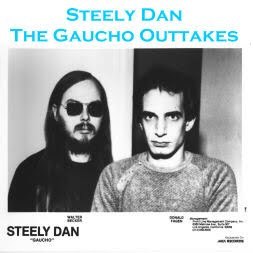
I need this book, and not just because of the hilarious cover photo taken from what I'm guessing was promo photos shot around Gaucho's release. Dudes seriously look like a couple of L.A. serial killers from the '70s. Still, it pales in comparison to the terrifying masterpiece that is the photo on the cover of one of the Gaucho boots:
They look like the living embodiment of a speedball.
I wasn't sure what to expect from a Steely Dan book, considering how much time and energy Becker and Fagen spent either avoiding the press or actively misleading them. And, compared to other rock bios out there, this is relatively tame. There was more time spent on session musicians' thoughts than any interpersonal drama, but that makes sense for the Dan. If you're looking for a salacious tell-all, look elsewhere. But if you are looking for a good overview of Becker and Fagen's career, this is as good place as any to turn.
A solid third of the book seems like tacked on bonus material. I liked reading about the formation up to Donald Fagen's first album, but everything after that seems far less consequential in terms of the band's long-term impact. We didn't need a run-down of every single track list from solo and "reunion" albums after 1990, nor analysis of your dates. I got tired of reading this one, but I did finish it.
This definitive biography of Steely Dan makes it clear that both Donald Fagen & Walter Becker were curmudgeonly when they were teenagers, & not much in their personalities changed after that. Judging by the way they approached recording they also probably suffered from obsessive compulsive disorder. None of which prevented them from creating some of the most wonderful music to have emerged during the 1970s. I was first gifted their music (I had heard Do It Again, Bodhisattva, Reelin' In The Years & Rikki Don't Lose that Number on the radio) with Pretzel Logic on my birthday in 1974. I subsequently acquired every Steely Dan album from their first period on vinyl & then in the CD box set. I also bought their 2 final albums, recorded many years later, but neither contains any track that even approaches their earlier work. But Fagen's 1st solo album, The Nightfly, is one of my all-time faves. And their solo work is also covered in this book, in meticulous detail. What is most intriguing is that neither Fagen nor Becker always played on Steely Dan tracks, because they felt top session players would give them a better result. They were at times more like conductors working with an orchestra, except that these conductors also wrote the symphonies. They are not easy characters to like but their dedication to perfecting the sounds they heard in their heads is admirable. I, for one, am glad that they went to such trouble.
I have two personal connections to Steely Dan, one amusing the other caustic. A late friend and comrade of mine from New York City went to school at Bard College with Fagen and Becker in the late Sixties. He moved into radical politics while the boys took up jazz-rock fusion. Another female friend from UCLA graduate school told me, "these guys gave up touring because no one could stand them and they barely could stand each other". Be that as it may, Fagen and Becker were the perfect musical chroniclers of the Seventies. Starting with CAN'T BUY A THRILL from 1972 and finishing appropriately in 1980 with TANGO, the Bard twosome told literate, ultra-hip tales of Sixties casualties and Seventies burnouts. Fagen, Steely's ace songwriter, channeled Kerouac by way of Lou Reed to compose his lapidary and perplexing lyrics. The bad luck victim of "Do It Again", kept lover of "Dirty Work", the college tale of "My Old School" ("tried to warn you about Chino and Daddy G", a reference to G. Gordon Liddy, who once carried out a drug-bust at Bard) and the pathetic junkie "Kid Charlemagne", are just a few of the fictional characters Fagen conjured and Becker scored. This biography is short on show biz gossip, although Becker's horrific and gargantuan drug habit, which eventually dismantled the band, cannot be overlooked. Brian Sweet's ode of love to S.D. is a must for die-hard fans and a fine introduction for the kids born after 1980 to look up their albums.
Actually more like 4.75 stars. Brian Sweet has taken on the arguous task of writing an all encompassing book about Steely Dan. Given Fagen and Becker's disdain for the press and their penchant for misdirection, this was a tall order. Part biography, part sessionography, it is a fairly deep dive into the making of the Dan's records--something I'm fascinated with, though I know it's not for everyone. This is certainly not freshman level Steely Dan. The book reinforces the notion that Fagen and Becker curmudgeons--albeit hilarious ones--that can be difficult and even downright icy in their relationships with colleagues. Beware getting to know your heroes, as it goes. Mr. Sweet's book does a nice job shedding light on the contributions of both men--what each brings to the table. For instance, Becker's lyrical contributions were somewhat surprising as Fagen has done the bulk of the singing. This version is updated to include the unfortunate passing of Walter Becker and the unfortunate legal wrangling that has ensued.
They were first appreciated in Britain and Brian Sweet can tell you why, along with way more technical recording information than any normal person could hope to understand. Though a devoted fan, Sweet received zero cooperation from Donald Fagen and Walter Becker in writing this book. Nevertheless, they encouraged the author to keep up his research, tracking down every possible interview the group participated in over the course of their decades together. There is minimal information about the personal lives of Fagen and Becker, who wished to be remembered only by their recorded albums. A useful index of times, places, and clues to secret meanings of their enigmatic songs, it will take a more serious biographer to show how this pair of mis-fits transmuted the debris of daily life into musical perfection.
This is such a great book. I think it's well balanced, Sweet will call SD out from time to time in the book and hold no punches, but he rewards them when they deserve rewarding as well. I think I'm going to shoot a video of "Steely Dan Lore" here in a few days. There are a lot of things people say in memes, short videos, and such about SD that this guy doesn't even mention or outright writes it up very differently than the historical rumors. Chevy Chase being in the original SD band is one, but before it was named SD (this is an over generalization, but you get the idea). The book never even mentions Chase, and I think this is legitimate. There are plenty of things like this I would like to point out.
I am a fan of Steely Dan, and this book really opened up my understanding of these two men and their music. From my listening, I heard the jazz influences and appreciated the new rock-and-rock sound they brought to us. And now where it all came from . . .
The author, Brian Sweet, is the editor and publisher of Metal Leg, the UK based Steely Dan fanzine. I was super impressed with his depth of knowledge - not just about the band but also about the development of records and music sessions. Impressive!
So, if you are a fan and want to enjoy this music in a new and richer fashion, you should read this book!
If your a Steely Fan, as I am, then this book is worth some of your time. If your not & want to know about them then it is certainly a worthwhile & rewarding read.
If you have either never heard of them or have never taken some time out to give them a go then can I recommend listening to three of their albums. There were an album act, after all, not a singles one. The three are: Aja, The Royal Scam & Pretzel Logic.
If you like a good tune & music that is put together with the connoisseur in mind then your in for a treat.
3 stars b/c it was written very well (highly researched & detailed), but it was not my style. If you’re looking for a biography focused specifically on the careers of Fagen & Becker, it’s fantastic. Personally, I prefer biographies that dive into the personal life/lives of a musician(s) and seeing how that impacts their career(s). I had to start skimming for the last 100+ pages of the book in order to push through to the end - again, just not my style.
Well researched and written although the lack of interviews with Don and Walter mean everything is second or third hand. Not the author’s fault but I couldn’t help thinking it was second best. No chance of getting an interview with Walter now. RIP.
The history of the group is comprehensive. The tone changes markedly in the final chapters which are written more through the lens of a critic than biographer with many instances of the author giving his (largely negative) opinions on later albums, song choices, cover art, set lists, etc.
A very detailed and comprehensive bio of this stellar band. I’m amazed that the author was able to acquire this much information about a duo that rarely gave interviews. It’s got a ton of detail but if you love this band, you’ll be fascinated.
A great deal of detailed information but very little analysis. What contribution did Steely Dan make to our musical heritage? The book needed a conclusion.
fair enough to Brian Sweet, and there’s plenty of detail, but just entirely absent any basic narrative flair or ability to order research. I feel like I know the order in which events happened, and that’s it.
Sinds mijn 14e al fan van deze band, dus was dit een must read voor mij. Hun hele discografie en wat persoonlijke informatie wordt hier uitvoerig besproken.