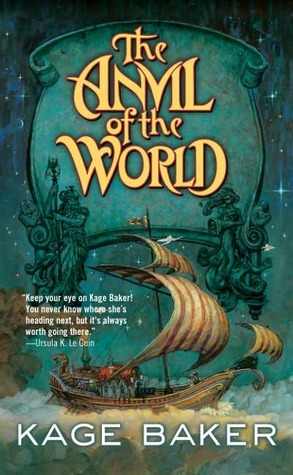
Kage Baker's stories and novels of the mysterious organization that controls time travel, The Company, have made her famous in SF. So has her talent for clever dialogue, and pointed social commentary with a light touch.
The Anvil of the World is her first fantasy novel, a journey across a fantastic landscape filled with bizarre creatures, human and otherwise. It is the tale of Smith, of the large extended family of Smiths, of the Children of the Sun. They are a race given to blood feuds, and Smith was formerly an extremely successful assassin. Now he has wearied of his work and is trying to retire in another country, to live an honest life in obscurity in spite of all those who have sworn to kill him.
His problems begin when he agrees to be the master of a caravan from the inland city of Troon to the seaside city of Salesh. The caravan is dogged with murder, magic, and the brooding image of the Master of the Mountain, a powerful demon, looking down from his mountain kingdom upon the greenlands and the travelers passing below. In Salesh, Smith becomes an innkeeper, but on the journey he befriended the young Lord Ermenwyr, a decadent demonic half-breed. Each time Ermenwyr turns up, he brings new trouble with him.
The outgrowth of stories Baker has been writing since childhood, as engaging as Tolkien and yet nothing like him, Smith's adventure is certainly the only fantasy on record with a white-uniformed nurse, gourmet cuisine, one hundred and forty-four glass butterflies, and a steamboat. This is a book filled with intrigue, romance, sudden violence, and moments of emotional impact, a cast of charming characters, and echoes of the fantasy tradition from Lord Dunsany and Fritz Leiber to Jack Vance and Roger Zelazny.
Born June 10, 1952, in Hollywood, California, and grew up there and in Pismo Beach, present home. Spent 12 years in assorted navy blue uniforms obtaining a good parochial school education and numerous emotional scars. Rapier wit developed as defense mechanism to deflect rage of larger and more powerful children who took offense at abrasive, condescending and arrogant personality in a sickly eight-year-old. Family: 2 parents, 6 siblings, 4 nieces, 2 nephews. Husbands: 0. Children: 0.
Prior occupations: graphic artist and mural painter, several lower clerical positions which could in no way be construed as a career, and (over a period of years for the Living History Centre) playwright, bit player, director, teacher of Elizabethan English for the stage, stage manager and educational program assistant coordinator. Presently reengaged in the above-listed capacities for the LHC's triumphant reincarnation, AS YOU LIKE IT PRODUCTIONS.
20 years of total immersion research in Elizabethan as well as other historical periods has paid off handsomely in a working knowledge of period speech and details.
In spare time (ha) reads: any old sea stories by Marryat, the Aubrey-Maturin novels by Patrick O'Brien, the Hornblower books, ANYTHING by Robert Louis Stevenson, Raymond Chandler, Thorne Smith, Herman Melville (except Pierre, or the Ambiguities, which stinks) Somerset Maugham, George MacDonald Frasier.
Now happily settled in beautiful Pismo Beach, Clam Capital of the World, in charming seaside flat which is unfortunately not haunted by ghost of dashing sea captain. Avid gardener, birdwatcher, spinster aunt and Jethro Tull fan.
2nd read 11/14/08: Very fun book to read. The subversive humorous touches and surprises are very enjoyable.
I highly recommend that you read this book's prequel "The House of the Stag" first. If you do, this book will make a lot more sense and the humor and allusions will be richer (more obvious).
Note: The House of the Stag was published in 2008 but it is about Lord Ermenwyr's parents and sets up "the world" of this book so many things will be much more clear to you. The House of the Stag is more of a novel. The Anvil of the World is more like stories about those characters set in that world.
3rd read: 6/29/11 I do so love this book! I am enjoying Kage Baker's books even more (if possible) as I'm re-reading this time around. Her light and surprisingly wise touch with Fantasy (as well as SF) is a treat for the discerning reader. The books are simple on the surface, but there's a lot of wisdom deep down. (Kind of like Pratchett's Discworld series, imo.) And I like the way she plays with the standard tropes.
7/24/16 Reread once again. Once again, I love this book. It is such a joy to read. Along with Diana Wynne Jones, and Terry Pratchett, if I could resurrect any authors, Kage Baker would definitely be one of my top choices. Her books give me so much enjoyment. Now, I'm off to reread The House of the Stag...with a side trip into The Company The Graveyard Game first.
The Anvil of the World is not quite a novel, but rather three novellas, printed chronologically and linked by their cast of characters. I have a minor quibble with Tor in this matter, because the entire volume is divided only by line breaks, with a page break and a graphic of two swords crossing to indicate the start of the next novella, which made finding my page after I had set the book down rather difficult. (I don't use bookmarks.) It also made it less clear that that was to be the structure. If you go into reading this volume expecting a novel, it will seem extremely choppy, so be warned.
That said, the first novella takes the form of a traveller's tale and an adventure story; it serves as a wonderful introduction to the characters and the world. In it we meet Smith, who has just accepted the role of Caravan Master for his cousin; we meet his caravan Culinary Artist, Mrs. Smith; we meet his subordinates, both the muscle-bound keymen (one of whom is also named Smith) and very young girl runner; and we meet his passengers, a family named Smith, a courier named Parradan Smith, a Yendri (a green-skinned forest-dwelling race) with his nose stuck up in the air, and Lord Ermenwyr and his (extremely attractive) nurse. Despite what the dust jacket says, none of these Smiths are related; they are all indeed Children of the Sun (humans) but none have ever met before and some (including our Caravan Master) are using Smith as an alias. ("Lovely impersonal name, Smith. Rather fond of it myself," says Mrs. Smith to Smith the Caravan Master after he refused to give her his first name.) Needless to say, Smith's first Caravan does not go well; they are attacked repeatedly, and not all of his passengers will arrive with him in Salesh-by-the-Sea, not least because few of them are who they seem.
What is so delightful about this first novella is the world we get to see through it. There has been a trend the past few decades towards more and more realism in fantasy writing -- a trend that has gone so far that books and seminars on fantasy writing always include basic rules for world-building, so that the budding writer doesn't make "mistakes" with geography, language groups, systems of magic, etc. Kage Baker throws that realism out of the window. From the very first page, when she describes how Troon's main event is the Festival of Respirator Masks, she dares us to complain about anachronisms and probability. There is magic aplenty, but no rules are ever laid-out to take its magic away and make it seem like paint-by-numbers; there are technologies side by side that were never seen side by side in our world.
The first novella ends when the caravan reaches Salesh-by-the-Sea; the next picks up several months later, as Smith, Mrs. Smith, his keymen and his runner have given up the caravan life and are now running an inn (already known for its restaurant) in Salesh-by-the-Sea. This second novella has a different structure; Lord Ermenwyr, who is now their patron, arrives to hide out during the Festival, and within hours of his arrival Smith has a dead body on his hands and a grumpy City Warden who has charged Smith with finding the killer by the end of Festival or he won't receive his Safety Certificate. Hilarity ensues, as Smith tries to question his guests and staff in the midst of total debauchery -- the traditional salutation during Festival in Salesh is "Joyous Couplings!" and the traditional costume is a bit of body paint and glitter. I giggled the entire way, enjoyed the revelations about Mrs. Smith's and Burnbright's pasts, and absolutely adored the introduction of Lord Ermenwyr's older brother.
The third novella takes up approximately 9 months after the Festival, but its tone is entirely different from the two novellas that came before, and this abrupt shift in tone is what you must be prepared for. Again Lord Ermenwyr's arrival heralds difficulties for poor Smith and his staff, but this time instead of hilarity we hear grumblings of race riots between the Children of the Sun and the Yendri and the whisper of a Key of Unmaking. The Yendri and the older races (demons, etc.) have always despised the Children of the Sun, for they breed like rabbits (they don't have any conception of birth control) and they decimate the land they settle on like a plague of locusts (they don't have any conception of crop rotation either), and the decision by a real estate company to build a new development on Yendri holy ground is not taken well.
But just as events are coming to a head in Salesh, Lord Ermenwyr abducts Smith for a boat trip to rescue his sister Svnae, of the short story "The Ruby Incomparable" that I loved so dearly in Wizards: Magical Tales from the Masters of Modern Fantasy. The trip does not go as planned, nor is Lord Ermenwyr being entirely honest with Smith; the Master of the Mountain and the Green Saint make an appearance, and even the gods (of both the Children of the Sun and the other races) get involved in what quickly ramps up to an end-of-the-world scenario.
And while that may make the third novella the most seemingly traditional of fantasy plots, the effect is anything but. The forces arrayed on either side of the conflict have very just and valid points, and it is not magic at the center of things but very human decisions. We are told from the first page that the Children of the Sun are "an energetic, sanguine, and mechanically minded people. . . They were consequently given to sins of an ecological nature. . ." Given that, Baker poses the following questions: how much can we blame these "children" for their ignorance, even when the consequences are dire? How much is that blame lessened (if any) if there are other peoples that do know better and, instead of relieving the ignorance they see, they withdraw into themselves or grow violent? It was a difficult story to read at 2am, especially coming on the heels of the delightful farce that was the second novella. It was also quite possibly the best thing by Baker that I have ever read, and I adored Sky Coyote. The Anvil of the World would have been a keeper (in hardcover) for the first two novellas alone; given the third, I have to give it my highest recommendation.
Anvil reads something like a Pratchett novel, if Pterry were a native Californian and had a Vancian knack for lush description. The wide-screen plot and wiseass characters are Baker originals. Not to mention Lord Ermenwyr's verbal-abuse death-duel....
Do give the book a chance to get moving, as the introduction is largely scene-setting, and it's a bit slow-moving. And the episodic, "fix-up" structure has annoyed some readers (not me). Otherwise, it's a near-perfect light fantasy: cinematic, witty, funny, amiable, rambling, baroque, romantic, and fun. If you've liked earlier Kage Baker books, what are you waiting for? And if you haven't tried her yet, Anvil would be a fine place to start -- especially if you prefer fantasy to SF.
2021 reread notes: as good as I recalled. Highly recommended. I now own a like-new hc copy (from a Catholic school in Ontario, of all places), and expect to reread it again down the line.
Author's note: "The author would be remiss in not thanking the shades of Thorne Smith, Fritz Leiber, L. Sprague De Camp and Noel Coward for their inspiration; but primarily this world owes its existence to stories made up in preliterate childhood, when the author peered at Maxfield Parrish's fantasy illustrations and tried to imagine what they represented..."
I’ve been disappointed with Baker’s work of late (will her Company series never get to the climax? Argh!), and the first two-thirds of this book did little to help. She created a rich, detailed, and varied world to play in, peopled with the highly-capitalist, pagan Children of the Sun (complete with fertility festivals and the ritual saying, “Joyous couplings!’), the vegan, holier-than-thou Yendri, and assorted demons, gods and saints. The first two adventures are nothing special, although they’re amusing and involve novel twists to classic fantasy tropes. And then, in the third and last adventure, Lord Ermenwyr gets his ex-assassin, now-hotelier friend Smith into trouble *again*, but this time the consequences are incredible. Suddenly throwaway details like parentage and gardening assume huge importance. Genocide is contemplated. Armies are gathered, and religious sects revealed. The Anvil of the World is not an excellent novel; the first part is too pedestrian for that. But the finale is so excellent, so poignant and well-written, that it saves the initial hundred pages from inconsequence and turns them into a necessary prelude to a fantastic climax.
I've hit the "Kage Baker" section of my book shelf tonight, so I'm just going to sing her praises as I add her books to this catalog.
Basically Anvil of the World is great because it contains everything that's wonderful about Baker: she's funny, highly imaginative, a clear writer who can break out the style when need be (as in the case of Anvil of the World, where she goes a little bit old school fantasy in her tone), and, most importantly, she can write a novel with a moral message while at the same time being highly unsentimental and not at all preachy (looking at you Mr. China Mieville with your Un-Lon-Dun of anvilocity).
I know the word "moral" might make you flinch, it would make ME flinch if someone else said it, but I can't think of a better way of describing it where the author is using the world of the book to parallel our world in such a way that the reader can learn a message about how one might want to behave in our world from reading about the other. PHEW!
Genuinely funny fantasy is hard to find (although stupid humor masquerading as fantasy is not), and this book succeeds marvelously.
It reminded me quite a lot of ‘Thieves' World' – which means, I suppose, that I should say it reminded me of Fritz Leiber's Lankhmar, but I guess that places me in my cultural era! However, I found this book to be both wittier and more enjoyable.
It's made up of three linked novellas, following an ex-mercenary named Smith. In the first story, Smith, having left his previous employment after deciding he doesn't enjoy killing people, appeals to his cousin for a new job, and is placed as "caravan master," in charge of safely transporting a load of goods and passengers to Salesh-by-the-Sea. Unfortunately, the goods are exceedingly fragile, the passengers are difficult, and the road is plagued by bandits, demons, and more...
The second tale picks up after the caravan trip. Having overcome the difficulties of caravanning, Smith has settled down and, with the help of the caravan's cook, Mrs. Smith (no relation; it's a very common name), opened a popular hotel in Salesh. The story opens at the outset of the annual fertility festival – which is basically one big orgy. However, members of the hospitality industry don't get to have much fun at such times – especially when a celebrity journalist turns up dead in one of the hotel rooms. The health inspector charges Smith with solving the crime before festival's end – or he'll lose his license.
In the last installment, we get down to the familiar saving-the-world theme. The Children of the Sun have plans to develop a native Yendri holy spot and build a Planned Community. From this seemingly small conflict, the threat of an all-out race war quickly emerges. And if anyone gets their hands on the legendary Key of Unmaking, all could be lost...
Smith is a rather taciturn, enigmatic character – but the people who surround him are memorable, colorful types, who both fit into the archetypes of fantasy, but are original enough to feel fresh and unique – the matronly cooking-contest winner Mrs. Smith, who hides a wild past... Lord Ermenwyr, the spoiled, part-demon teenager with way too much power, money and drugs than is good for him, his voluptuous demon nursemaid, Balnshik, the athletic young courier Burnbright, and the sensitive, ecologically minded Yendri Willowspear...etc. There's also plenty of action, with ambushes, duels, assassinations, lots and lots of poisoned darts, sorcery and more. Oh, and did I mention it's all very funny?
It doesn't end on a cliffhanger - but there's definitely plenty of room for more tales of Smith and his compatriots...
I took the book for my daughter. I usually used to read books first before I let her read them. It became a habit for a while. I remember I liked this book when I read it. My daughter liked it too.
Stuff I Read - The Anvil of the World by Kage Baker Review
I've been meaning to read Kage Baker for a while now, and this seems just the place to start. While wandering the library a bit drunk (and with a cheese in my pocket) with my wife, she actually picked this one up (while I picked up a different book). But in my cunning I employed the old "wait until she's done reading it and then read it" tactic and waited until she was done reading it, then read it. It worked brilliantly. What I found was a funny and surprisingly brutal critique of society, told earnestly and yet with a shining beam of optimism that I like, that almost Star-Trek-ly promises that while humans might be kind of terrible, we can and should be less so.
And there's a lot to like about this book. It really is wickedly funny, and the writer has the banter down to a fine art, especially whenever half (or quarter) demon Lord Ermenwyr shows up. It is quite hilarious that the Children of the Sun (the humans, basically) are the technologically advanced race and yet the most backwards and destructive. It's easy to see the commentary when contrasted with both the demons and the Yendri, who are appalled at how the Children of the Sun treat the world as if they are its only inhabitants. From the comments about the whales to birth control to pollution to medicine, it all touches brutally and yet just subtly enough to not come off as just sneering. And there is a point to it all.
Perhaps most appropriate to sum things up on how the book treats its themes is a story that one of the Yendri tells in the last of the three sections, when explaining a Yendri joke about a woman who asks a monk for wisdom. It's all about misunderstandings, about wisdom, and about use. It's about relations between the Children of the Sun and the Yendri. As the character, who has been trying to teach the Children of the Sun how to meditate and find peace, comes to learn that what he should be doing to help them is not caring about their souls, but teaching them the worth of crop rotation. It's perhaps doesn't come across in my summary, but it's what starts to wrap up all the themes in the book as things approach the climax.
This is a book told in three distinct parts, after all. The first is a sort of travel adventure, with things constantly going wrong. The second is something of a murder mystery. And the third is more of a political story. They all weave together, though, all get to the ending and then pay off in a big way for the main character, Smith. And that ending, after everything that has been shown about how wasteful, violent, and destructive the Children of the Sun are, promises that they also have more to them, that they have a potential to be good, to escape the cycle. It ends with a note of optimism, which was great, because it made everything make sense, was emotional and powerful and still funny and serious at the same time.
And it was a great story in a great setting. I wonder what will happen from this point, if the focus would still be on Smith or would shift, or is the story is done entirely. But it all worked, and left me smiling, left me wanting more, which is always a good thing. It was a joy to read, and so I'm going to give it nine comedic phallus clowns out of ten.
3.5 stars. A work of fantasy from Kage Baker, who was best known for her science fiction series about The Company. The book seems to consist of three novelettes, but they are contiguous stories and they fit together smoothly. This is quirky and amusing, and has a very slight steampunkish feel since the technology tends towards clockwork and steam power. There are also demons who have magical powers, so this is mostly fantasy.
The first story is lighthearted to the point of frivolousness, and it was my favorite. Our protagonist has fled from some vaguely described trouble, taken the name Smith, and accepted a job from his cousin: he’s to escort a caravan traveling through territory that turns out to be more hostile than expected. The passengers and crew are a motley group consisting of an amusingly high number of people also named Smith.
The second story is nearly as much fun. It’s a murder mystery based in a resort hotel that Smith and company are managing, during a city-wide festival celebrating sexual intercourse.
The last story becomes more serious, and as usual Baker takes things in the direction I’d least like to go. I enjoy her small-scope stuff more than her grand schemes. However, the last story has one of the funniest scenes in the book - when Smith wakes up in the hold of the ship.
Overall it’s a fun read, and I look forward to reading the other books set in this world.
Honestly, this was so much better than I thought it would be. I’m still thinking about it days later, and I think it put me into a reading slump because I don’t want to read anything else unless it’s as good as this was.
It all begins when a world-weary assassin decides to subtly leave the life. He takes on the alias Smith and becomes a caravan master, where he is responsible for a colorful cast of characters. There’s the athletic courier Burnbright, the sensitive healer Willowspear, the enigmatic and slightly dangerous old lady Mrs. Smith, the whiny but captivating Lord Ermenwyr, and many more. Unbeknownst to him, Smith himself becomes the taciturn and deadpan nucleus in the whirlwind of their insanity. His odd friendship with the eccentric Ermenwyr doesn’t leave much hope for a quiet life, but instead promises an outburst of rollicking adventures.
Bizarre, inventive, cinematic, intelligent, and remarkably funny, here’s a taste of fantasy that’s classic but underrated. Through duels, assassinations, ambushes, and romance, Kage Baker throws in all the typical fantasy fare, but this is anything but traditional. The style is unique in that the story is separated into three novellas that flow together into a solid story. The deceptively quirky beginning rockets towards an incredible finale, where hilarity transforms into race riots and the possible genocide of an entire species. It definitely has something to say about ignorance and living harmoniously with people that are different from you.
And this is a minor thing, but I particularly enjoyed the way she avoided curse words. For example, after something bad happens: “Smith said something unprintable.”
It was just so clever and fresh and I loved Smith and Mrs. Smith and Ermenwyr and all his crazy siblings. I read this as part of my 2019 NY resolution to read more classic fantasy, but again, this is so tragically underrated. It’s one of the best I’ve read so far. Fantasy fans won’t want to miss this arresting traveler’s tale.
I had mixed feelings about this book. On the one hand the story was usually interesting, the characters were pretty unique, and the book made me chuckle quite a bit. On the other hand, sometimes I thought the story dragged and sometimes it crossed slightly over the line from funny into ridiculous.
This is a fantasy set in a world in which three different species live. You have the Children of the Sun, of which our main character is a member. These are essentially humans, the most numerous species populating the world, and it seems like half of them are named “Smith”. The book is written in the third person perspective, but we follow the main character the entire time. Not surprisingly, the main character goes by the name of Smith.
Another species is the Yendri, who aren’t elves exactly, but they certainly have a lot of similarities with your typical fantasy elf. The Children of the Sun and the Yendri do not get along well, and there is racist behavior on both sides. The Children of the Sun’s behavior toward the Yendri shows some similarities with the way early American immigrants treated the Native Americans. There is some overt social commentary in the book, such as the aforementioned Native American issues as well as pollution. However, it was kept to a reasonable minimum so it didn’t really annoy me.
Lastly, there are the demons, not to be confused with demons as they're depicted in real-life Western religions. These demons have some magical abilities and they aren’t particularly evil, although their personalities vary greatly so some are better than others. One of them crosses paths with Smith, who unwittingly helps him out with a problem, which results in the demon constantly showing back up whenever he needs help with something. This inevitably results in more troubles for Smith. A demon was usually to blame when the story crossed over the line between funny and ridiculous.
This book actually felt more like three separate stories, each closely related and following right after the other chronologically, but with distinct plots. However, there weren’t any indicators of this within the book. Actually, there weren’t even any chapter breaks. Perhaps this is unique to the e-book version I have. I believe I downloaded it free from Tor several years ago when they were promoting their new-at-the-time newsletter.
The ending didn’t particularly thrill me. It wasn’t horrible, but it was a little weird. This book does stand very well on its own, though. I was on the fence about whether or not I liked this book well enough that I wanted to read the next book in the series, which I understand is actually a prequel. I had to read the synopsis and a few reviews to make up my mind, but I decided to give it a try.
During my regular trawl through the Kindle Store, the sequels to this book popped up. After buying them, I thought that I might as well buy this as well so that I could re-read it in preparation for the sequels.
I must have read this book when it first came out, and it remains the only Kage Baker book that I've read to date, despite buying the entire Company series as those books came out - go figure.
It's still as gloriously deadpan as I remembered, made up of three segments featuring the eponymous Smith and his journey from former assassin on the run, to saviour of his people, the Children of the Sun.
I made some notes that I need to copy into this review at some point, but for now if you have any love for fantasy with a slightly more modern bent whilst avoiding grimdark, then you should pick up this book.
The funniest, most intelligent fantasy I've read in ages! I'd love to meet Lord Ermenwyr sometime. (This is also an absolutely excellent book to read aloud with a lover before bed. Not because it's necessarily erotic--it's not, though there are some deliciously sexy characters--but because it's just so wittily written that it'd a delight to share.)
It's a shame Kage Baker is no longer with us. Her The Anvil of the World spoofs elements of hackneyed fantasy (it starts with a caravan, for Heaven's sake) with wonderful dialogue and a culture with some very Pratchett-like elements. A great quick read.
This is not really a novel but three interconnected novellas. I think I liked the middle bit best where it's essentially a murder mystery. The overall tone is light and quirky, there are some bits that I found funny though I'm kind of guessing this is meant to be more funny than I found it. The setting has some imaginative aspects. I found the whole thing mildly entertaining, emotionally unengaging, and the characters rather lightly drawn.
I'd had rather high hopes for this and although I mostly liked it I'm also a tad disappointed. Still, I'll probably read the next published book in this series which apparently actually takes place earlier.
Strange book set in a high fantasy world. You are tossing into the world without any back story or map, but somehow it works. The story is told in three novellas. Compelling and fun. I loved the hits on our modern world about climate control. Race issues and life in here already.
This book read almost like a collection of three short stories. Each of them was just as good as the other. There's a sweet, funny, sometimes sad quality to the book. It was absolutely fantastic and I can't wait to see what happens next!
My first non-Company novel by Kage Baker. Turned out to be almost three stories in one. The first third was one of those "fantastic journey" segments, replete with conflicts among the denizens of Baker's world: humans, elvish types (the Yendril) and demons (who come in all guises). The hero, Smith, seems an unwitting and sometime unwilling participant in all the goings on while leading a caravan from the mountains to the sea.
In the second segment, demonic happenings occur in something of a murder mystery interlude. The low point of the book, for my money.
The final segment reveals the true nature of Smith and why he has been involved in so much for so long in the tale. The book title finally comes into play as the place where "the key of unmaking" is forged. All that has taken place thus far comes to the fore and results in a satisfying conclusion.
Much different from the Company tales (except for Baker's ever present and keen sense of humor), I found it enjoyable nonetheless. A good fantasy read in contrast to the usual time travel and immortality themes in her other works.
I read book #2 in the series, thought it was not bad, then tried this one. This type of book is what I would call light comedic fantasy. Like a situation comedy but in fantasy books.
Spoilers ahead: It follows an ex-assassin named Smith who gets a job as caravan master from his cousin. That's the first part. His caravan suffers several mishaps (attacks and assassinations) but gets to the seaside town. Due to a huge problem with some merchandise he was carrying (broken art eggs), he and all of his caravan drivers and cook decide to set up shop opening a hotel in the seaside town. That's part 2. That's also where I decided to dnf.
The writing was easy to read and follow and the plot was mildly entertaining/funny but the writing wasn't tight enough, not focused enough for me to continue. I just didn't care enough about the characters to want to continue no matter how wacky the situation was. And that describes middling level authors.
The Anvil of the World narrates the adventures of a man named simply Smith, who takes on a job as caravan master after giving up his old job of assassin. On the way from the inland city of Troon to the coastal city of Salesh, he meets a number of bizarre people, from the caravan's cook, Mrs. Smith (no relation) to the demonic half-breed Lord Ermenwyr. When the party reaches Salesh, the story really gets started - up until then, it's a little slow - and turns into a truly rousing adventure told with wit and style. The Fatally Verbal Abuse duel between Lord Ermenwyr and the sorcerer who's after him is almost worth the price of admission by itself, but there's plenty more to like.
It's been out for several years and I'd given up hope of another book, but Baker's The House of the Stag, out in September, is set in the same world.
I really feel like this book deserves better than three stars, but it's not QUITE a four-star book, mostly because it really doesn't quite hang together as a novel. It's more like three interconnected novellas. I really enjoyed it, though -- Kage Baker may be the first author I've encountered who comes anywhere close to Terry Pratchett's masterful combination of cynicism, sentimentality, and humor. Yet the book does not feel like a direct attempt to copy or riff on Terry Pratchett, except in a "respectful homage" kind of way (rather than a "Pterry can do it, why can't I?" kind of way). Curious to find out if the rest of Baker's stuff is anything like this!
Comedy with a high body count. It really is pretty funny until the last part when it becomes not funny at all--but that part grew organically out of the rest, so it didn't seem like an arbitrary thing. Still, I gather from reviews that she does that in the sequels too. I kind of wish she'd stuck with the tongue in cheek tone; will probably go on to the others, but with somewhat lower expectations. The two "Smith"s make a great lead couple, and the supporting cast is full of surprises too. Better yet (and more rarely), though the story reads like three or so separate novelettes, they all hang together nicely.
This novel reads more like 3 related short stories featuring the same lead cast. While at the start, it seemed like just loads of zany humor, eventually everything starts to tie together and we start to see some stark realities: overpopulation, ecological destruction, racial tensions, etc.
Here's a favorite line of mine that encapsulates the sort of humor found in this novel:
"He said that any son of his ought to be able to make mincemeat of a third-rate philtermonger like Blichbiss, and it was high time I learned to stand on my own and be a man, et cetera et cetera ad infinitum, and I said, 'I hate you, Daddy,' and ran like hell. And here I am."
I loved this book. It was political and amusing, intelligent and surprising, while remaining consistent with ye olde generic devices of fantasy. I appreciated the characters and the not-so-subtle references to our own societal failings and concerns. I adored the funny demons, and I was so relieved to read a fantasy where good and evil weren't simple divisions but rather social demarcations that depended upon perspective and experience. Well done!
An ex-assassin agrees to lead a caravan on a dangerous journey from Troon to Salesh, with the strange Lord Ermenwyr and his nurse as two of the passengers. It was idealistic and a little preachy (about discrimination against the "Greenies" by the Children of the Sun), but it's Kage Baker, who is always a lot of fun. And it's full of sly humor and what are almost slapstick episodes. Very enjoyable.
The Anvil of the World and The House of the Stag create the mythology which was referred to in The Bird of the River. The three books together form one of the most unique, enthralling, absolutely engrossing trilogies I've ever read. Why hadn't anyone ever told me about these books?
Maybe I was just not in the mood for a fantasy book, but I put this one down after just a couple of chapters. I simply couldn't bring myself to care about the story or the characters. It's all meant to be clever, funny, and tongue-in-cheek, but it just has no depth whatsoever, in my opinion. Pass.