
Jump to ratings and reviews
Rate this book

Emblem of Faith Untouched: A Short Life of Thomas Cranmer

Rate this book
 Relates one of the most remarkable lives in the tumultuous English Reformation

Thomas Cranmer (1489–1556) was the first Anglican Archbishop of Canterbury, the author of the Book of Common Prayer, and a central figure in the English Protestant Reformation. Few theologians have led such an eventful life: Cranmer helped Henry VIII break with the pope, pressed his vision of the Reformation through the reign of Edward VI, was forced to recant under Queen Mary, and then dramatically withdrew his recantations before being burned alive.

This lively biography by Leslie Williams narrates Cranmer's life from the beginning, through his education and history with the monarchy, to his ecclesiastical trials and eventual martyrdom. Williams portrays Cranmer's ongoing struggle to reconcile his two central loyalties—allegiance to the crown and fidelity to the Reformation faith—as she tells his fascinating life story.

208 pages, Paperback

Published September 22, 2016

14 people are currently reading
64 people want to read

About the author

Leslie Winfield Williams

5 books5 followers
Leslie Williams is an English professor, writer, and three-time Fellow of Yale Divinity School.

Ratings & Reviews

What do you think?
Rate this book

Friends & Following

Create a free account to discover what your friends think of this book!

Community Reviews

5 stars
24 (31%)
4 stars
44 (57%)
3 stars
8 (10%)
2 stars
0 (0%)
1 star
0 (0%)
Displaying 1 - 19 of 19 reviews
Profile Image for Adam Shields.
1,867 reviews122 followers
March 7, 2022
Summary: A brief biography of the compiler of the original Book of Common Prayer and the first Protestant head of the Church of England.

I am a low church evangelical by history, but very few things have been as important in my faith development over the past 15 years as the Book of Common Prayer. As I have said before, my theology has become more in line with traditional Episcopal/Anglican theology and away from my Baptist heritage (episcopal ecclesiology, openness to infant baptism, more sacramental in theological orientation, etc.), even though I think I will likely remain non-denominational in my actual church membership.


While I am a fan of the Eerdman's Library of Religious Biography series and picked Emblem of Faith Untouched in part because of that, I started reading because I am trying to work through ideas of how we should think of flawed Christian "heroes." Thomas Cranmer was certainly flawed while being a very devoted Christian. He was a younger son of a minor noble and, as was common, went into the church and academy. He was very slow in school, taking roughly twice as long to get his bachelor's degree as usual. But he continued and became the rough equivalent of a professor before dropping out of the academy (which required celibacy and singleness) to get married. But his wife died, and he returned to the academy, albeit with some controversy.


While staying with some friends during a period of plague when people were avoiding larger cities, he walked through how he would approach Henry VIII's desire for a divorce theologically instead of through the ecclesiastical courts. In other words, Cranmer thought what was more important was whether the divorce was right according to scripture rather than whether the ecclesiastical courts agreed. Based on recounting that conversation, Cranmer was summoned to Henry and led a committee to investigate the marriage and reasons for divorce theologically and build support for divorce politically and geopolitically.


One part of Henry's divorce from Catherine that I had not understood with my previous reading was that Henry was betrothed to Cathrine when he was 13. Cathrine had already been married to Henry's brother, but Arthur died just a couple of months after the wedding, while Arthur was only 15. The marriage between Catherine,  the youngest child of the Spanish king and queen Ferdinand and Isabella, and Arthur, and then Henry was for geopolitical reasons, not love. According to Emblem of Faith Untouched, Henry's confessor was convinced, and convinced Henry very early in their marriage, that Henry marrying Catherine was violating Christian ethics and that their marriage would be cursed because she had been married to his brother first. The first four pregnancies of Catherine and Henry ended in either miscarriage, stillbirth, or early death of the child. Only the fifth resulted in Mary, who was the only child of that marriage, to live to adulthood.


While there are some theoretical arguments justifying Henry's divorce of Catherine, later divorces were even less justified. Henry had affairs throughout his marriages, and it had to have been clear to Cranmer that regardless of Cranmer's theological support of the divorce of Catherine, there was no theological support of mistresses and continued divorce and remarriage. Part of Cranmer's commitment was the divine right of kings and the positional authority of the king as an ecclesiological leader, not just a political one. In addition to this, Cranmer eventually was convinced by his interaction with German Protestants that the Pope's authority was geographically and theologically limited and that local countries should have primary political and ecclesiastical control of their territory. Practically, this meant that for Cranmer, there was almost nothing that would be inappropriate (sinful) for Henry to do if Henry wanted it. While Cranmer was the Bishop of Canterbury, Henry took many income-producing properties from the church and exchanged them with other properties so that the church was left with less and the crown with more. Cranmer rarely pushed back against these exchanges.


While Cranmer was acting as the King's ambassador and traveling throughout Europe on a variety of business for Henry, he married the daughter of a German Protestant. At the time, Cranmer was not ordained and did not have a church position. But Henry drew him back to England and appointed him as Archbishop of Canterbury, which required both ordination and celibacy, and Cranmer was married. So he came back took the position, and his wife remained in Germany until later when Cranmer reformed the rules to allow for married clergy.


I am not going to spend a lot of time on his history, other than to note that when Henry died, and eventually Mary rose to the throne and started a bloody persecution of Protestants, Cranmer was eventually arrested and spent years in prison before being executed. During that time in prison, Cranmer was very clearly tortured and wrote or had written for him at least eight confessions. Some were mild confessions, and some were more extensive confessions repudiating his Protestant beliefs. Nearly all of them are tainted by torture and threats. But at his execution, he renounced all prior confessions.


Two quotes I thought were worth sharing here. First, in 1534 Cranmer ordered all pastors to stop preaching on several subjects while a theological consensus was built. He prioritized slow change that was more broad-based.


That summer of 1534, Cranmer issued a proclamation ordering silence from the pulpit on the subjects of masses for the dead, prayers to saints, pilgrimages, and the celibacy of the clergy. Most likely, Henry had not made up his mind on these topics, and wanted the space to figure out what to do. Cranmer, who had been swayed by the reforms he’d seen in Germany, took a slow but steady, drip-by-drip approach to reforming the English church under an absolute monarch. He realized that any reformation could take place only in subtle moves. Without creating a splash, he took every opportunity to license men with the same inclinations, promoting like-minded reformers to the bishop’s bench.

Second, as I have hinted already, Cranmer struggled with what it meant to follow Christ as king and Henry as king. He had an influential dream that illustrated this.


This dream represented the hub of his dilemma: Was service to Christ incompatible with service to the supreme head of the Church in England? Which king would win his soul? The horror in the dream was that both kings rejected him. Silent, Henry excluded him from his court, condemning him to death, while Christ turned away and closed the gate of heaven. “Cranmer, shut off from both life and the afterlife, could turn only to the mouth of hell.”

I do not, in the end, really have a better model for how to think about our Christian "heroes" of the past after reading this, but I do think that at least part of the answer is that we should better understand both the good and bad of those that have come before us. We need to see and discuss where people were right and wrong and where there is more ambiguity. Two, I think there really should be some limitations to how we honor people of the past. I heard someone say this past week, "well maybe we should stop naming buildings after people," and in many ways, I think that may be right. No one is worthy of honor in all areas of life, even if they do individual things that are worth honoring. My classic reflection on this is AW Tozer's wife, who, after she was widowed and remarried, said, "Aiden loved Jesus, but [my new husband] loves me," is a very classic illustration. She was not saying that AW Tozer was not a good Christian or hadn't done many good things. But she was illustrating the limitations of his honor. He should be honored for the way he brought people to Christ, but he was still a lousy husband and father. And we need to be able to see the whole person because we are all flawed and limited creatures.
59 reviews
November 5, 2021
This is one of the best biographies I've ever read. Thomas Cranmer lived such an interesting life and carried a lot of the weight of the English Reformation on his shoulders. Trying to balance his obligations as an Reformation Archbishop and as an advisor to monarchs was a challenge to say the least and he was quite successful at it...at least until what Queen Mary did to him. A truly blessed martyr indeed.
Profile Image for Zach Waldis.
248 reviews9 followers
February 13, 2018
This is one of those books you read at just the right time. Cranmer was a saint of sorts, and his grace, humility, and integrity during the reign of multiple regicidal monarchs stand out as a true faith worth living and emulating, as the book says. Williams just sticks with the historical narrative and not the scholarly conversation, and the result is a powerful and moving portrait of a giant of the faith.
11 reviews
August 26, 2023
While I would give Williams’ book four stars, I need to recommend Cranmer’s story as five stars. Williams does a wonderful job in her biography and I would highly commend it. The “weaknesses” of her book may simply be results of her project: a short, readable biography of this English reformer. And I’m that sense, she has accomplished her task. Cranmer is a dynamically complex figure, and I think her book (or perhaps a narrative of his life) would be improved with a more rounded historical discussion of the man. Nonetheless, she does him great honor in writing this book. Would highly commend!
Profile Image for Stella Etienne.
30 reviews2 followers
August 21, 2024
Very good book discussing the character of Cranmer and his role in facilitating the reformation in England in the court of King Henry VIII, Cromwell, later King Edward and finally falling at the hand of Queen Mary of Scots. The author does a good job at showing the volatile era of reformation between Catholic players in government vs. the reformers. Cranmer’s famous common book of prayer was the result of his character, decades of planning and political meandering during intense political and religious climate of 15th century England.
Profile Image for Ryan Williams.
27 reviews2 followers
June 12, 2024
Great short biography on Thomas Cranmer. Funny how after suggesting to his friends that King Henry consult the religious scholars instead of the pope, he went home having no idea he had just accidentally created the Protestant Anglican Church.

Would definitely recommend if you want to understand the origins of the Anglican/episcopal church but, like me, don’t want to dive into the 700+ page McCullough biography on Cranmer yet.
67 reviews
February 22, 2021
If you are looking to sink in deeply to the life and theology of Thomas Cranmer, Diarmaid MacCulloch biography is the go-to book. But if you would like a good, short, yet detailed, journey through Cranmer's life and theology, this is an excellent place to start. In fact, I might recommend reading this before reading MacCulloch's books as a helpful primer.
Profile Image for Michael Dennis.
76 reviews7 followers
September 21, 2017
A short history of Thomas Cranmer, a figure that hovers in the background of many of the Tudor histories that I've read.

The book itself wasn't bad, but there were two oddities:

1. The word choices by the author were jarring. Perhaps she was attempting to give a popular history vs. a heavily cited scholarly work. No problem. But phrases like "a cheesy attempt", "a squirrelly technique", "the scuttlebutt was that...", and "eating away at him like ants on a carcass" were just weirdly off-putting.

2. I listened to the audiobook version. The narrator was very stilted and was obviously not a practiced professional, sometimes adding a strange lilting, questioning tone to declarative sentences.

Cranmer is an interesting person, caught between his own conscience and temperament, the tumultuous times of the reformation, and two very strong monarchs (Henry VIII and Mary I).
Profile Image for Edmund Roughpuppy.
111 reviews8 followers
September 12, 2025
description

ALMIGHTIE and everlasting God, whiche doest governe all thynges in heaven and earthe: mercifully heare the supplicacions of thy people, and graunt us thy peace all the dayes of our life.

Rough times for poetry
16th century England was an extremely dangerous place and time to be trapped in. The structure of belief and authority, which had governed the population for centuries, cracked, then crumbled. The king was a ravenous monster, his ministers a nest of vipers. Saying the wrong thing, about events on earth or in heaven, often resulted in death by fire.

Our hero, Thomas Cranmer was stuck in this merciless arena, the whole of his life. He attempted to serve his God and his king. He attempted to make sense of a splintering faith. This one gentle man was no match for the gigantic destruction underway, but somehow he managed to leave us some of the most beautiful poetry in English, before being burned at the stake. Leslie Williams serves us his remarkable life, in its complexity, and with affection.

Protestants wanted to end the Catholic church’s secrecy, locking up the Bible and all Christian doctrine in the Latin language, unintelligible to common people. This meant, in England, translating everything into English. Catholics and protestants argued over the propriety of this enterprise, but even today, few people notice how the style of the translation influenced future Christians.

The team of writers who produced the King James Bible—after Cranmer’s time—wrote an English book of great beauty, shaping British and American culture for centuries to come. Even the most implausible tales in the Old Testament are rendered with such majesty, we almost forget their mythic absurdity. I can’t read Latin or Hebrew, but it’s hard to imagine either measuring up.

Thomas gave the English church a liturgical calendar, daily prayers, and funeral rites—written in prose that still echoes in modern ears.

Earth to earth, ashes to ashes, dust to dust; in sure and certain hope of the Resurrection...What the heart loves, the will chooses and the mind justifies. O God, from whom all holy desires, all good counsels, and all just works do proceed; Give unto thy servants that peace which the world cannot give.

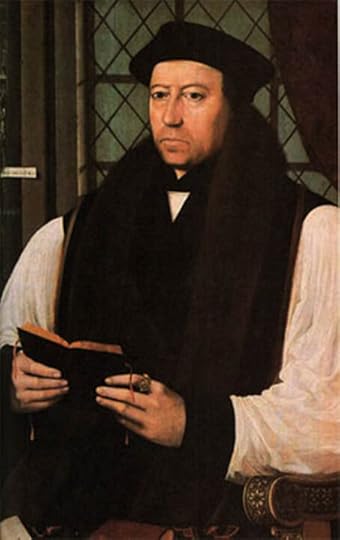
Leslie shares Cranmer’s quirks, his personality. He wasn’t as dour as his portraits.

It took Cranmer eight years to finish his Bachelor of Arts degree [from Jesus College, Cambridge]. . . Cranmer was a plodding scholar by all accounts. Some biographers claim that his deliberation and slow methods reveal a mediocre mind, but others claim that his study habits prove the opposite. The final assessment of his mind’s development lies in the quality of texts he wrote later. For example, the precise and poetic brilliance of the Book of Common Prayer reveals a careful, deliberate reader taking time to absorb and assimilate an array of different ideas along with the wide spectrum of available and stimulating thought—as well as the ability to select le mot juste for clarity and beauty.

description

Eventually, religious and political hysteria caught up with gentle Thomas. This day was surely among the most shameful in English history, and I wonder if the American founders remembered it, when they wrote separation of church and state into their constitution.

[Catholic Queen Mary commanded Thomas Cranmer’s execution for heresy. She ordered Catholic theologian John Cole to preach a sermon before the execution.]
The last part of the sermon Cole addressed to the archbishop. He encouraged Cranmer to take his death well, remembering the thief on the cross next to Christ, to whom Jesus said, “This day thou shalt be with me in paradise.” Cole quoted Paul, arming Cranmer against the terror of the fire by saying that the Lord wouldn’t tempt him beyond his strength. He then gave several examples of martyrs to whom God made the flame seem like a pleasant dew, assuring Cranmer that God, if Cranmer would just call in him, would abate the fury of the flame or give him the strength to stand it.
Cole concluded, pounding home Roman Catholic beliefs. In a final irony, Cole promised Cranmer that he and all the priests present would say dirges, masses and funerals for him—one of the primary idolatries Cranmer had worked so hard to eliminate.
Profile Image for Alan.
93 reviews
January 18, 2024
A most interesting read! Thomas Cramner was a key figure in the reign of Henry VIII as a close advisor and as Archbishop of Canterbury. The reader learns much about the history of this tumultuous period as politics heavily intermingled with religion. Cranmer skilfully avoided death for many years but was finally burned at the stake during Mary 1st’s reign. He was respected by many, including Henry VIII, for his Christian character. Despite political decisions that were made that were not in line with his strong biblical beliefs, he was a strong supporter of the reformation. Highly recommended!
Profile Image for Robert D. Cornwall.
Author 37 books125 followers
March 10, 2018
It has been awhile since I spent much time looking at Cranmer's life and work. This is a brief but thoughtful biography of one of the more enigmatic Reformers. He is known for his strong support of Henry VIII and then martyrdom under Mary Tudor. He is also known for his authorship of the Book of Common Prayer -- 159 and 1552.

This book covers the majority of the bases though not in depth. But for an introduction to Cranmer, this is a great option.
Profile Image for Anson Cassel Mills.
669 reviews18 followers
November 9, 2024
Though Leslie Miller Williams (1951-2020) held a PhD in English literature, she was also a childhood athlete and, late in life, an artist. This sympathetic, but not uncritical, biography of Thomas Cranmer reflects her own well-grounded personality in its short, down-to-earth summary of the flawed reformer’s life. My only criticism is that some descriptions are overly colloquial, perhaps too much so for the book to continue to be read into the next generation.
Profile Image for Justin.
12 reviews
July 13, 2022
Maintains many typically missing details that paint a fuller picture of Cranmer's life, as well as the intrigues of court and his would-be detractors. Clarifies details about Cranmer's theological and liturgical reformations which are not favourable to Anglo-Catholic revisionism. Robustly informative. Much easier to digest than MacCulloch's biography of Thomas Cranmer ("A Life").
25 reviews1 follower
April 18, 2021
Awesome history

Very helpful to understand the history of Henry and the reformation. And to see that the reformation thought took some time to develop in Cranmer’s life.
Profile Image for Daniel Sell.
41 reviews
May 28, 2021
Highly recommend. Thomas Cranmer was a reformer and a Christian martyr.
Profile Image for Josh.
613 reviews1 follower
August 16, 2016
Leslie Williams's short biography of Thomas Cranmer is a fascinating book about a fascinating character in church history and in English history. Since it is a brief biography (about 150 pages), the pace is rapid. While the pace guarantees that "tedious" could never be used to describe the work, details and minutia do not receive the fine-tooth treatment that many would desire.

Williams guides the reader from Cranmer's birth to his infamous death. Cranmer lived in a time of tumult, and he experience much of this himself. Williams's volume describes a flawed and fallen man with whom God was able to do much. Crooked sticks and straight lines immediately come to mind when thinking of Cranmer, and Williams does a superb job of neither vilifying or exalting this man of history as his story is explored.

I received an ARC from the publisher.
Displaying 1 - 19 of 19 reviews

Can't find what you're looking for?

Get help and learn more about the design.