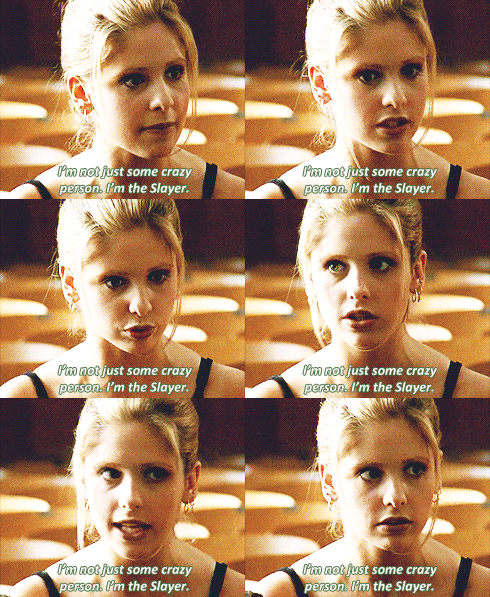
"In every generation there is a Chosen One. She alone will stand against the vampires, the demons, and the forces of darkness. She is the Slayer." Buffy the Vampire Slayer ran for seven seasons, from 1997 to 2003, and in that time it revolutionized American TV. It was a television series that single-handedly reinvented the high school genre, splicing it with action, comedy, and the supernatural to captivate its core teenage audience while providing enough formal experimentation, existential reflection, and, above all, pitch-perfect writing and acting to extend the show's appeal to viewers of all ages.
Anne Billson unravels Buffy's magic, examining her antecedents and influences and exploring how, in a broadcasting environment inimical to long-running series, the show's creators were able to push the envelope and create a fully realized mythology in which fantasy elements are underpinned by emotional honesty. Buffy the Vampire Slayer is a superheroine for our times. Not only that, but she's funny as well. Television will never be the same again.
ANNE BILLSON is a film critic, novelist, photographer, style icon, wicked spinster, evil feminist, and international cat-sitter who has lived in London, Tokyo, Paris and Croydon, and now lives in Belgium. She likes frites, beer and chocolate.
Her books include SUCKERS (an upwardly mobile vampire novel), STIFF LIPS (a Notting Hill ghost story), THE EX (a supernatural detective story) and THE COMING THING (Rosemary's Baby meets Bridget Jones) as well as several works of non-fiction, including BILLSON FILM DATABASE, BREAST MAN: A CONVERSATION WITH RUSS MEYER, and monographs on the films THE THING and LET THE RIGHT ONE IN.
Her latest book is CATS ON FILM, the definitive work of feline film scholarship.
She sometimes writes about film for the Guardian, and is currently working on a screenplay and a sequel to her vampire novel, SUCKERS. She has three blogs: multiglom.com (the Billson Blog), catsonfilm.net (a blog about cats in the cinema), and lempiredeslumieres.com (photographs of Belgian beer, bars and sunsets).
Buffy is shocked to find that Dawn, her annoying little sister is, in fact, a mystical and non-corporeal Key sent to her in human form by an order of monks as a desperate ploy to stop it falling into the hands of this season’s Big Bad. This turns out to be an incredibly ancient god called Glorificus whose human form switches between Glory, a spoilt Californian Valley Girl type, and Ben, a sympathetic intern at the hospital where Joyce, Buffy’s mother, is being treated for a brain tumour. Buffy finds she’s no match for Glory, but feels attracted to Ben… Dawn, who has been programmed with a full complement of memories about life with Buffy and Joyce, is as shocked as everyone else to find she is not human. … Spike (a vampire) has a vivid erotic dream about Buffy… and forces Warren, a geek with advanced technological capabilities, to build him a robot Buffy lookalike, henceforth known as the Buffybot.
Glory drains Tara’s brain and leaves her a drooling idiot… The Scoobies (friends of Buffy) realising they are helpless against such a powerful entity, flee into the desert where they are attacked by the Knights of the Byzantium, who want to destroy Dawn before Glory can use her blood to open a portal between dimensions, thus bringing about the End of the World.
I’m thinking that the above could be the most bonkers plot of a mainstream tv show ever. More bonkers than Doctor Who, and that’s very bonkers. I’m also wondering why they didn’t put the Buffybot into full production immediately, it seems a no brainer. But I couldn’t find one for sale anywhere.
So it seems the plot logic of this show was of the free-floating kind and the fans couldn’t have cared less. They just went with it. I should learn to be more lighthearted. Away with leaden causality and verisimilitude! Let me channel my inner Slayer.
The BFI (British Film Institute) usually produce concise and intellectually terrifying critical monographs about Das Cabinet des Dr Caligari, or La Dolce Vita, or Vertigo, but this charming gallop through the Buffyverse is just pure fandoration, which is a word I just made up. Anne Billson’s book is a love letter to both Buffy and her younger self.
More books on film and tv should be like this one.
I went into the University of Leicester library one day, and found that there are a number of academic books on my favourite TV show/the best show ever. Buffy the Vampire Slayer.
I decided to start with this one, since it's quite short, and is dubbed "a critical reading of the series", which I took to mean it was basically going to be a short guide/vague critical analysis.
The introduction was quite interesting, giving a brief history of feminine heroes and protagonists (or lack thereof). Then what follows is a chapter per season, in which the author spends aarguably too much time simply recapping, and then picks up on one prevalent theme in the season, and expands on it a little. And I do mean a little.
The thing is, the book is only 140 pages. There are seven seasons to cover, and for some reason she felt it necessary to recap every season, and okay she dose quite a good job of succinctly covering all bases, but she still pinpoints a lot of the story arcs (and, particularly in later seasons, different characters have various story arcs). That basically leaves her usually about 8-ish pages per season to really analyse something. And since she chose quite vague themes, it's not really as indepth as I would have liked.
I also didn't really like her incredibly biased criticism of Tara and Dawn. Okay, Dawn, I've heard all the criticism before and I don't agree with it, but I guess I can see why you think she's whiny (because she is, but that's cos SHE IS ENTITLED TO BE). but Tara... there just felt like a lot of unnecessary criticism that was just 'she's a boring character'. And I thought that was weird enough, until we get to season 7 and we find that the author liked Kennedy. I mean, who is this person?
Overall, it's an okay book. I'm glad I chose it to start off my Buffy Academia reading list, cos it was a nice way to introduce myself back into Sunnydale, I just do wish some of the analysis had been a little deeper.
Not only is this book a sorry excuse for “criticism,” the author has god awful opinions. I was expecting a lot more analysis of recurring themes, motifs, and character development but any exploration of these ideas are barely touched on after lengthy recaps of the show by season. The first two chapters aren’t even about Buffy the Vampire Slayer, but rather describe the television and movie scenes of the second half of the twentieth century as lacking in strong female characters that kick ass and also are pretty, and the history of vampire films as well. This scene setting would have been better if condensed into one chapter perhaps.
It’s kind of hard to believe that the author even likes Buffy the Vampire Slayers as much as she says she does. She’s quick to describe her negative feelings about Sarah Michelle Gellar’s “weak chin” (meaning that she didn’t think she was obviously pretty enough to be her ideal girl-power hero), Willow’s long-winded remarks being “on the bearable side of annoying,” her over-the-top hatred of Dawn, and how Tara has a “deadening effect” and is “off-puttingly New Agey” and boring. A considerable amount of text is dedicated to criticizing the appearances of the characters. Besides the weird remarks about physical appearances, just complaining about characterization doesn’t really count as criticism in my opinion. Also, half of the writing in this book seems to be references to other shows of the era that don’t have anything to do with Buffy and are hardly part of the cultural canon anymore (the book was first published in 2005 so I tried to look past its outdatedness since a lot of new media has been created in 15 years). Maybe if you share the same opinions as the author you’ll get more out of this book than I did. I love Buffy and was excited to read this but it was a major letdown.
I expected this to be more of an analysis but it was mostly just a recap of each season with some of the writer’s opinions tossed in there (not very good opinions either) For a woman searching for female representation and power, this writer seemed like too much of a misogynistic cynic for my taste.
A breezy guide to the series, not as academic or objective as you would expect from something published by the BFI. The author's petty attitute towards Dawn and Tara are irksome, not least because the issues with Xander's behaviour are left unexamined (and age the book quite a bit). Of most value at the beginning, where the author provides a personal survey of Buffy's antecedents in film and television, and makes a convincing case for the show's novelty in the 1990s.
A decent introduction and overview of the series and Buffy studies. If you're just getting into the criticism of Buffy then this might be a nice place to start. I like the brief overview of female heroines on film and TV to help show where Buffy Summers joins the pack. Billson adequately highlights broad themes and how Buffy subverts, mixes, and otherwise plays with multiple genres to create something altogether new. This doesn't mean Buffy is perfect or easy to compartmentalize - it has its faults and moments of weakness.
Where Billson's book falls short for me is in her rather flimsy criticism of some of the "weaker" supporting characters. Billson basically doesn't like Riley, Tara and Dawn. She then verbally abuses them for being not to her taste and considers it criticism. It's not. Calling someone boring or dumb doesn't count as analytical criticism of the kind I expect from a book of this nature. I expect such benign criticism from aintitcoolnews, not from a BFI book.
Billson also spends a little more time summarizing each season than I thought necessary. An introductory text like this is most likely to be read by people who already have watched and know the storyline and just want a light dose of criticism to supplement their own thoughts. Still, her criticism is pretty good. Billson's examination of season one nicely shows how economical and well executed season one is and how it stands on its own quite well. I liked this part because the most general criticism I hear from people discovering the show now is that season one is more something you get through before getting to the real good stuff than a season to be taken seriously. The show remains remarkably loyal to that first season throughout its run and people would be well served by watching that season with as much generosity as they give to the other seasons.
Overall, this is a flawed but nice book. It's a really fast read and has moments of good, perceptive criticism. The supplemental section of websites and other Buffy studies texts is also useful.
This is one of a series from the British Film Institute, providing 'critical readings' of TV series. The series follows similar and generally excellent guides to important movies.
Unfortunately, the editorial guidelines have encourage the authors to see these series in the context of their 'personal response', a dangerous licence to self-indulgence especially as the film-related booklets benefited from offering in-depth research on their subjects, albeit from different perspectives, without constant use of the 'I' word.
Anne Billson is not too bad in her judgements. Given the iconic status of Buffy in promoting contemporary 'girl power', it is useful to have a woman outline her responses to the series as it unfolded. She can be tiresome every now and then (especially in her opinionated position on one or two of the supporting cast) but it usually reads right if unimaginatively.
Unfortunately, given the amount of space devoted to recapping the series Season by Season and reminding us of key moments and personalities, the 'experiential' aspect of the book crowds out the information that we might have had on its cultural context and the broader public response.
For Buffy fans, it is a good value 'aide memoire' with a useful selection of websites at the back but, in the end, it is not much more than that.
This was quite fun. A proper film and TV critic looking at Buffy in detail. There was a bit of tongue-in-cheekness and a lot of love for the series, even when being critical. Of course I want to rewatch it all again now.
I decided to read this while I was on a massive read/re-read of the Buffy/Angel/Spike graphic novels. I found Billson to be both entertaining and insightful, and personally interesting.
A book that I would recommend to both fan and non-fan, based on its insight and perspective.