

What do you think?

Monkey Girl: Evolution, Education, Religion, and the Battle for America's Soul – A Dramatic True Story of the Dover Intelligent Design Trial
What should we teach our children about where we come from?
Is evolution a lie or good science?
Is it incompatible with faith?
Have scientists really detected evidence of a creator in nature? From bestselling, Pulitzer Prize-winning author Edward Humes comes a dramatic story of faith, science, and courage unlike any since the famous Scopes Monkey Trial. Monkey Girl takes you behind the scenes of the recent war on evolution in Dover, Pennsylvania, when the town's school board decision to confront the controversy head-on thrust its students, then the entire community, onto the front lines of America's culture wars. Told from the perspectives of all sides of the battle, it is a riveting true story about an epic court case on the teaching of "intelligent design," and what happens when science and religion collide.
Is evolution a lie or good science?
Is it incompatible with faith?
Have scientists really detected evidence of a creator in nature? From bestselling, Pulitzer Prize-winning author Edward Humes comes a dramatic story of faith, science, and courage unlike any since the famous Scopes Monkey Trial. Monkey Girl takes you behind the scenes of the recent war on evolution in Dover, Pennsylvania, when the town's school board decision to confront the controversy head-on thrust its students, then the entire community, onto the front lines of America's culture wars. Told from the perspectives of all sides of the battle, it is a riveting true story about an epic court case on the teaching of "intelligent design," and what happens when science and religion collide.
400 pages, Paperback
First published February 1, 2007
About the author
Edward Humes
22 books287 followersEdward Humes is a Southern California author, journalist and writing teacher whose most recent nonfiction book is “The Forever Witness.” His next book, “Total Garbage: How to Fix Our Waste and Heal Our World,” will be published in time for Earth Day 2024. He shares his home office with a pair of rescued racing greyhounds, Valiant and Dottie.
Ratings & Reviews
Friends & Following
Create a free account to discover what your friends think of this book!
Community Reviews
Displaying 1 - 30 of 135 reviews

November 3, 2012
The preacher gazes at the sea of faces turned up at him as he holds aloft a well-worn copy of the Bible, waving it at a packed church the size of a concert hall.
"I look forward to the day when every teacher is teaching out of this book," he shouts, and he is answered by a loud chorus of hallelujahs. "And there will be no separation of church and state . . . We will live in a theocracy. And what a glorious day that will be!"
Yikes!
It all started as an obscure dispute over science textbooks. A group of evolution-doubting school board members wanted teachers to use Of Pandas & People: The Central Question of Biological Origins, a "science" book that makes it clear that man was created as he is , and Darwin's theory of "from goo to you" is a fairy tale. Despite vocal objections, the measure passed, and a lawsuit was filed against the board by a group of parents who felt that the action was inherently religious, not scientific in nature. What followed was a media circus, complete with clowns, and, of course, monkeys.
Even though the Supreme Court banned "creation science" from public schools in 1987, certain factions have not given up on the idea of a challenge, mainly by using the new term - "intelligent design."
You can either read the book or Google to learn the outcome. Just know that the judge who heard the case received death threats . . . and not from the godless evolutionists.
Now listen to this sad violin music - http://www.youtube.com/watch?v=QuNhTL... - while I pontificate:
In last week's election, Rep. Paul C. Broun, a Republican from Georgia ran unopposed. Broun has called evolution and the Big Bang Theory "lies straight from the pit of hell." In a pro-science protest, 4000 voters wrote in the name of Charles Darwin. Broun also believes the earth is 9,000 years old. He currently serves on the House Science Committee alongside Rep. Todd "Legitimate Rape" Akin.
Yeah. That's where we're at right now.
The "Young Earth" people are not giving up. And they are procreating at alarming rates. As their numbers swell, and their children become politically active, look for this controversy to be repeated. It pains me to say this, but one of these days . . . they just might win.
"I look forward to the day when every teacher is teaching out of this book," he shouts, and he is answered by a loud chorus of hallelujahs. "And there will be no separation of church and state . . . We will live in a theocracy. And what a glorious day that will be!"
Yikes!
It all started as an obscure dispute over science textbooks. A group of evolution-doubting school board members wanted teachers to use Of Pandas & People: The Central Question of Biological Origins, a "science" book that makes it clear that man was created as he is , and Darwin's theory of "from goo to you" is a fairy tale. Despite vocal objections, the measure passed, and a lawsuit was filed against the board by a group of parents who felt that the action was inherently religious, not scientific in nature. What followed was a media circus, complete with clowns, and, of course, monkeys.
Even though the Supreme Court banned "creation science" from public schools in 1987, certain factions have not given up on the idea of a challenge, mainly by using the new term - "intelligent design."
You can either read the book or Google to learn the outcome. Just know that the judge who heard the case received death threats . . . and not from the godless evolutionists.
Now listen to this sad violin music - http://www.youtube.com/watch?v=QuNhTL... - while I pontificate:
In last week's election, Rep. Paul C. Broun, a Republican from Georgia ran unopposed. Broun has called evolution and the Big Bang Theory "lies straight from the pit of hell." In a pro-science protest, 4000 voters wrote in the name of Charles Darwin. Broun also believes the earth is 9,000 years old. He currently serves on the House Science Committee alongside Rep. Todd "Legitimate Rape" Akin.
Yeah. That's where we're at right now.
The "Young Earth" people are not giving up. And they are procreating at alarming rates. As their numbers swell, and their children become politically active, look for this controversy to be repeated. It pains me to say this, but one of these days . . . they just might win.

February 3, 2014
The argument between creationists and evolutionists was in the news recently after the debate between Bill Nye “The Science Guy” and Ken Ham, the Australian who runs the Creation Museum. The dispute is nothing new, though. Creationists and evolutionists have been butting heads since Darwin’s day. Ken Ham’s organization Answers in Genesis represents the more extreme end of the spectrum, the “young earth” creationists who believe that the earth is only 6,000 years old and that dinosaurs and people lived at the same time.

Dinosaur and human living in harmony at the Creation Museum.
This argument grows particularly heated when it involves the public school system. Since the Scopes Monkey Trial in 1925, school boards across the country have debated first whether or not they should allow the teaching of evolution, and more recently whether or not they should allow the teaching of creationism and/or intelligent design. A recent story in Slate reported that thousands of schools are allowed to teach creationism in science classes, in spite of Supreme Court decisions like Edwards v. Aguillard in 1987 that ruled that creationism could not be taught if it was advancing a particular religion.
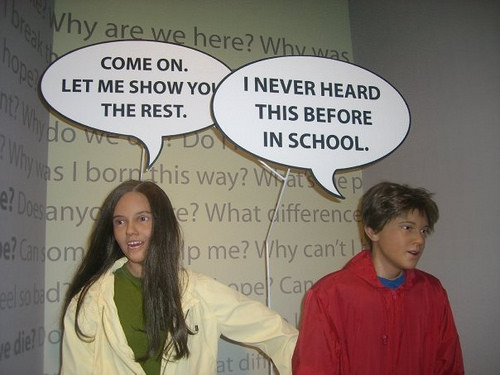
There may be reasons you never learned this in school (Creation Museum).
In Monkey Girl, Edward Humes recounts the 2005 court battle over teaching intelligent design in the Dover Area School District in Dover, Pennsylvania. Two young earth creationists on the school board led the push to add intelligent design to the science curriculum. Intelligent design (ID) argues that certain biological features (like bacterial flagella and the coagulation cascade) are too complex to be explained by evolution alone, and must have required a “designer.” Mainstream science finds nothing “scientific” about this concept, viewing it as a Trojan horse to get re-branded creationism into schools, but the defendants in the case insisted that the goal of including ID in the science curriculum was to improve science education and had nothing to do with religion.
Previous actions by board members made this a difficult argument to defend. When discussing including ID in science classes, one member said, “Two thousand years ago, someone died on a cross. Can we have the courage to stand up for him?” (Prologue, Monkey Girl). With statements like those, it was hard to argue that religious belief was not involved.
Humes does a good job of summarizing the case, with a helpful discussion of the historical background. Unfortunately he gets bogged down in details in telling Dover’s story. It’s as if he wants to give a narrative with the dramatic impact of William Jennings Bryan and Clarence Darrow facing off in the Scopes Trial, but the personalities here don’t have that larger-than-life flair. They are, for the most part, ordinary people with unwavering world views. That setting has a certain innate drama, but it doesn’t warrant the minute-by-minute treatment Humes gives it.
There is also an odd shift in tone throughout the book. Humes starts with a highly journalistic approach, presenting the facts and people on both sides in as fair a manner as possible. As the story progresses, though, it’s as if he loses patience, getting increasingly snarky. His Epilogue rambles strangely about right-wing pundit Ann Coulter. While there is no doubt that she is a good example of an anti-science demagogue, the rant is a bit off-topic for the book.
Monkey Girl is a good treatment of an important and still relevant topic, the inclusion of religion in science education in the public schools. It would have been a better book, though, without the excessive detail and the pretense of courtroom drama.
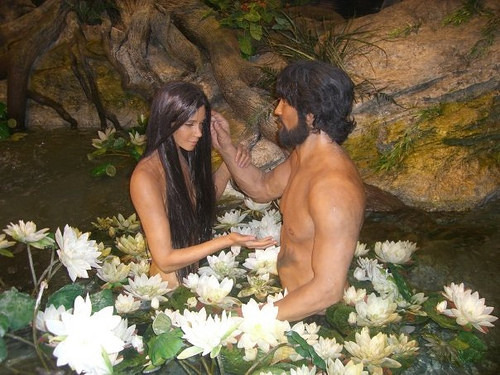
Better days in the Garden of Eden at the Creation Museum.
Dinosaur and human living in harmony at the Creation Museum.
This argument grows particularly heated when it involves the public school system. Since the Scopes Monkey Trial in 1925, school boards across the country have debated first whether or not they should allow the teaching of evolution, and more recently whether or not they should allow the teaching of creationism and/or intelligent design. A recent story in Slate reported that thousands of schools are allowed to teach creationism in science classes, in spite of Supreme Court decisions like Edwards v. Aguillard in 1987 that ruled that creationism could not be taught if it was advancing a particular religion.
There may be reasons you never learned this in school (Creation Museum).
In Monkey Girl, Edward Humes recounts the 2005 court battle over teaching intelligent design in the Dover Area School District in Dover, Pennsylvania. Two young earth creationists on the school board led the push to add intelligent design to the science curriculum. Intelligent design (ID) argues that certain biological features (like bacterial flagella and the coagulation cascade) are too complex to be explained by evolution alone, and must have required a “designer.” Mainstream science finds nothing “scientific” about this concept, viewing it as a Trojan horse to get re-branded creationism into schools, but the defendants in the case insisted that the goal of including ID in the science curriculum was to improve science education and had nothing to do with religion.
Previous actions by board members made this a difficult argument to defend. When discussing including ID in science classes, one member said, “Two thousand years ago, someone died on a cross. Can we have the courage to stand up for him?” (Prologue, Monkey Girl). With statements like those, it was hard to argue that religious belief was not involved.
Humes does a good job of summarizing the case, with a helpful discussion of the historical background. Unfortunately he gets bogged down in details in telling Dover’s story. It’s as if he wants to give a narrative with the dramatic impact of William Jennings Bryan and Clarence Darrow facing off in the Scopes Trial, but the personalities here don’t have that larger-than-life flair. They are, for the most part, ordinary people with unwavering world views. That setting has a certain innate drama, but it doesn’t warrant the minute-by-minute treatment Humes gives it.
There is also an odd shift in tone throughout the book. Humes starts with a highly journalistic approach, presenting the facts and people on both sides in as fair a manner as possible. As the story progresses, though, it’s as if he loses patience, getting increasingly snarky. His Epilogue rambles strangely about right-wing pundit Ann Coulter. While there is no doubt that she is a good example of an anti-science demagogue, the rant is a bit off-topic for the book.
Monkey Girl is a good treatment of an important and still relevant topic, the inclusion of religion in science education in the public schools. It would have been a better book, though, without the excessive detail and the pretense of courtroom drama.
Better days in the Garden of Eden at the Creation Museum.

November 1, 2018
This is a polarizing book – you will likely be on one side or the other.
A school-board in Dover, Pennsylvania elected to teach creationism/intelligent design along with Darwinian evolution in the science curriculum. Their argument was that evolution was “just a theory” that they felt had gaps in it. Creationism and/or Intelligent Design filled those gaps by postulating a “design maker”. Also there were those on the school board who simply felt that Darwin’s teaching conflicted with their literalist interpretation of the Bible. Darwinism and evolution would encourage their children to become atheistic and un-Christian. In a nutshell they felt that evolution conflicted with their view of Christianity.
Many in the Dover community, like science teachers and parents, disagreed with introducing Creationism/Intelligent Design into the science curriculum. They correctly said that science is rational and Creationism/Intelligent Design is irrational and introduces a supernatural explanation into the science course. So this came to be settled by a court case in the state of Pennsylvania well described by the author.
After the trial the judge ruled in favour of the plaintiffs and Creationism/Intelligent Design was removed from the science curriculum. But the polarity continues. The judge who took the decision had his life threatened. In the initial school-board meetings one parent complained that the Creationism/Intelligent Design quorum were Talibanizing the school with their religious ideology.
I simply cannot understand people, like those in Dover, who interpret the Bible literally. The Bible is not a science book, but they are treating it as such, referring to Genesis, Noah’s Ark as truth. They believe the earth to be 5,000 years old. When people believe that the Bible instead of a multitude of geology books explains the different eras of life on earth this is indicative of a vast cultural and educational gap between those who believe fantasy and those who believe truth. It is a clash of modernity and an ancient medieval view of religion.
All this is not helping science in the U.S. It is anti-science. It is part of a culture war in the United States between those with a “liberal education” and the “fundamentalist mindset” This book was published over 10 years ago, so I do not know the extent to which the anti-science agenda has grown and how much it has suppressed real science education.
Page 148 (my book)
In August 1999, the state of Kansas decided that the Niobrara Chalk [a geologic formation] and its fossils simply did not exist – at least, not as the vast majority of scientists and a beloved museum conceived of them. In that year the state’s independent, elected board of education adopted science teaching standards that conspicuously omitted most references to evolution or other principles of cosmology, biology, and geology that might contradict creationist views or suggested the earth might be older than 10,000 years.
A school-board in Dover, Pennsylvania elected to teach creationism/intelligent design along with Darwinian evolution in the science curriculum. Their argument was that evolution was “just a theory” that they felt had gaps in it. Creationism and/or Intelligent Design filled those gaps by postulating a “design maker”. Also there were those on the school board who simply felt that Darwin’s teaching conflicted with their literalist interpretation of the Bible. Darwinism and evolution would encourage their children to become atheistic and un-Christian. In a nutshell they felt that evolution conflicted with their view of Christianity.
Many in the Dover community, like science teachers and parents, disagreed with introducing Creationism/Intelligent Design into the science curriculum. They correctly said that science is rational and Creationism/Intelligent Design is irrational and introduces a supernatural explanation into the science course. So this came to be settled by a court case in the state of Pennsylvania well described by the author.
After the trial the judge ruled in favour of the plaintiffs and Creationism/Intelligent Design was removed from the science curriculum. But the polarity continues. The judge who took the decision had his life threatened. In the initial school-board meetings one parent complained that the Creationism/Intelligent Design quorum were Talibanizing the school with their religious ideology.
I simply cannot understand people, like those in Dover, who interpret the Bible literally. The Bible is not a science book, but they are treating it as such, referring to Genesis, Noah’s Ark as truth. They believe the earth to be 5,000 years old. When people believe that the Bible instead of a multitude of geology books explains the different eras of life on earth this is indicative of a vast cultural and educational gap between those who believe fantasy and those who believe truth. It is a clash of modernity and an ancient medieval view of religion.
All this is not helping science in the U.S. It is anti-science. It is part of a culture war in the United States between those with a “liberal education” and the “fundamentalist mindset” This book was published over 10 years ago, so I do not know the extent to which the anti-science agenda has grown and how much it has suppressed real science education.
Page 148 (my book)
In August 1999, the state of Kansas decided that the Niobrara Chalk [a geologic formation] and its fossils simply did not exist – at least, not as the vast majority of scientists and a beloved museum conceived of them. In that year the state’s independent, elected board of education adopted science teaching standards that conspicuously omitted most references to evolution or other principles of cosmology, biology, and geology that might contradict creationist views or suggested the earth might be older than 10,000 years.

June 19, 2009
So far this is one of the most frustrating books I've ever read. Frustrating not in the sense that the writing is bad or the story indecipherable, but frustrating in that it contains a cast of characters (creationists and intelligent design proponents) who I constantly want to yell at. Their ignorance and desire to impose their moral beliefs is both frightening and frustrating. Other than that, this is a fine book, which I haven't been able to put down since starting earlier this week.

May 5, 2007
"In the time of Galileo it was argued that the texts, 'And the sun stood still ... and hasted not to go down about a whole day' (Joshua x. 13) and 'He laid the foundations of the earth, that it should not move at any time' (Psalm cv. 5) were an adequate refutation of the Copernican theory."
Alan Turing, 1950
This is one of the latest episodes of the struggle between those who feel that Science describes nature pretty well and those who believe that anything other than a strict literal interpretation of the Bible deserves a trip to hell. I think that those who ridicule the scientific method and mock Darwin's work while refusing to read it, do not deserve to benefit from the fruits of science (such as a computer and the internet), much less influence science curriculum in public schools.
I still remember how Math and Science were emphasized if only to remind us that we needed to compete with the Soviets. Until reading this book, I assumed that all but the most extreme religious fundamentalists were fine with this truce-for many years public school biology books limited discussion to a small description of evolution as "changes over time" in high school biology. I was wrong.
While the book mostly focuses on the Dover trial, Humes also takes us to the nearly parallel trial in Kansas, the controversy in the Grand Canyon Giftshop (where Creationists have had some success in censoring information about the geological age of the national monument), and the pseudo-scientific think-tank which excludes any science in conflict with Christian Scripture. I couldn't be certain, but they probably conveniently ignore the scripture at the top of the page regarding the sun going around a stationary earth.
The Dover Trial is full of drama and bad debate, A Scopes Monkey Trial for the 21st century, or Inherit the Wind, Redux. Humes shows in the Dover case how Creationism in public schools, having been defeated in courts during the late 20th century under the Separation of Church and State clause of the First Amendment, evolved (pun intended) into the virtually identical Intelligent Design movement, to Dover, Pennsylvania among other places. Some of the most shocking moments of the trial feature the ironic displays of dishonesty which ultimately brought down the school board members who were trying to bring religion into the local biology classrooms, and had designs on bringing it into the history and government classes as well.
The Dover case pitted one kind of Christians against another. Those who favored the separation of Church and State were attacked as “not Christian enough”, in a great example of how the separation of these two functions protects freedom of religion. Another surprising turn of events showed how the presiding judge, a Bush-supporting Republican was branded as a liberal judicial activist for defending the constitution.
Regarding extreme religious views which by definition do not tolerate any opposing views, what are the limits of tolerance in society? The Framers of the Constitution were historically not far away from centuries of religious wars in Europe which constantly threw governments into turmoil. They saw the value of the separation of church and state to both. Back in those days religious persecution meant death.
This latest version of the old Darwin-vs.-God controversy is the product of the removal of Critical Thinking skills from the mainstream public school curriculum, and the lack of a Cold War Era push towards developments in Math & Science, supported by all but the most outspoken of Bible literalists, who constantly attempt to couch the debate as "God vs. Darwin", when in fact, most religions don't require people to choose between the two. Young-Earthers might benefit from not ignoring the history of the Catholic Church's censorship of Copernicus and Gallileo centuries ago, and ask themselves why the Pope doesn't have a big problem with Darwin's theories today.
Alan Turing, 1950
This is one of the latest episodes of the struggle between those who feel that Science describes nature pretty well and those who believe that anything other than a strict literal interpretation of the Bible deserves a trip to hell. I think that those who ridicule the scientific method and mock Darwin's work while refusing to read it, do not deserve to benefit from the fruits of science (such as a computer and the internet), much less influence science curriculum in public schools.
I still remember how Math and Science were emphasized if only to remind us that we needed to compete with the Soviets. Until reading this book, I assumed that all but the most extreme religious fundamentalists were fine with this truce-for many years public school biology books limited discussion to a small description of evolution as "changes over time" in high school biology. I was wrong.
While the book mostly focuses on the Dover trial, Humes also takes us to the nearly parallel trial in Kansas, the controversy in the Grand Canyon Giftshop (where Creationists have had some success in censoring information about the geological age of the national monument), and the pseudo-scientific think-tank which excludes any science in conflict with Christian Scripture. I couldn't be certain, but they probably conveniently ignore the scripture at the top of the page regarding the sun going around a stationary earth.
The Dover Trial is full of drama and bad debate, A Scopes Monkey Trial for the 21st century, or Inherit the Wind, Redux. Humes shows in the Dover case how Creationism in public schools, having been defeated in courts during the late 20th century under the Separation of Church and State clause of the First Amendment, evolved (pun intended) into the virtually identical Intelligent Design movement, to Dover, Pennsylvania among other places. Some of the most shocking moments of the trial feature the ironic displays of dishonesty which ultimately brought down the school board members who were trying to bring religion into the local biology classrooms, and had designs on bringing it into the history and government classes as well.
The Dover case pitted one kind of Christians against another. Those who favored the separation of Church and State were attacked as “not Christian enough”, in a great example of how the separation of these two functions protects freedom of religion. Another surprising turn of events showed how the presiding judge, a Bush-supporting Republican was branded as a liberal judicial activist for defending the constitution.
Regarding extreme religious views which by definition do not tolerate any opposing views, what are the limits of tolerance in society? The Framers of the Constitution were historically not far away from centuries of religious wars in Europe which constantly threw governments into turmoil. They saw the value of the separation of church and state to both. Back in those days religious persecution meant death.
This latest version of the old Darwin-vs.-God controversy is the product of the removal of Critical Thinking skills from the mainstream public school curriculum, and the lack of a Cold War Era push towards developments in Math & Science, supported by all but the most outspoken of Bible literalists, who constantly attempt to couch the debate as "God vs. Darwin", when in fact, most religions don't require people to choose between the two. Young-Earthers might benefit from not ignoring the history of the Catholic Church's censorship of Copernicus and Gallileo centuries ago, and ask themselves why the Pope doesn't have a big problem with Darwin's theories today.

November 3, 2007
This was a well-written and enthralling read, although the topic it covers is frustrating on so many levels to me. Several times I wanted to pull my hair out, reading about the ignorance and closed-mindedness that would cause people to try to force an untested new "science" on their children, without any real knowledge themselves of the evolutionary theory they reject, or for that matter, the intelligent design theory they're trying to push. It's especially upsetting to me as a Christian to see so many of my fellow travelers equate evolution with atheism without even bothering to try to understand it. This book completely explodes many of the myths that surround ID, and it does so in a lucid fashion that makes for compelling reading even for non-scientists who have never considered the issue before. It's a must-read for anyone who mistakenly believes that ID or creationism has a leg to stand on when it comes to scientific credibility, or who thinks that a Christian can't accept evolution as God's means of creation.

December 25, 2012
An infuriating cautionary tale about what happens when religious fundamentalists attempt to subvert the Constitution in the service of forcing their misguided beliefs on the general population but also a spectacularly satisfying revenge story where these same fundamentalists find themselves outclassed, outmatched and outthought in a small town Pennsylvania courtroom. Although the book makes you want to pull your hair out in frustration at both the willful ignorance and unapologetic disingenuousness of the Dover, Pennsylvania school board in its unconstitutional and anti-education attempt to enforce teaching biblical creationism (misleadingly labeled intelligent design) in public school classrooms, it also makes you want to stand up in cheer as superior scientific thinkers and lawyers expose the attempt for what it really is: utter bullshit.
Throughout the book, Humes does a great job of characterizing all of the players on each side of the case, and, even though he clearly is biased toward logic and reason, he does attempt to paint as sympathetic a portrait of the Dover school board as is possible. In the process of covering the Kitzmiller v. Dover case, he digs deeply into the issue and presents a meticulous history of creationist assaults on the Constitution in the years between the Scopes Monkey Trial and the Kitzmiller--a history of underhanded, deliberate conspiracies to knowingly violate the law in order to force a Supreme Court showdown. It's unconscionable, which makes it so satisfying when this latest attempt is destroyed in such a public and unequivocal way. I promise it's a thorough and thoroughly enjoyable smackdown.
Although the book ends on a high note where facts, science and data triumph over superstition and small mindedness, Humes includes a grim epilogue reminding us that these attempts are far from over and that the religious right have no qualms about continuing to sabotage and fight against a modernizing culture that is increasingly leaving them behind and making them irrelevant. As such, the Kitzmiller victory is more of a call to arms than a call for celebration. The book itself is essential reading on the case itself and on its larger implications.
Throughout the book, Humes does a great job of characterizing all of the players on each side of the case, and, even though he clearly is biased toward logic and reason, he does attempt to paint as sympathetic a portrait of the Dover school board as is possible. In the process of covering the Kitzmiller v. Dover case, he digs deeply into the issue and presents a meticulous history of creationist assaults on the Constitution in the years between the Scopes Monkey Trial and the Kitzmiller--a history of underhanded, deliberate conspiracies to knowingly violate the law in order to force a Supreme Court showdown. It's unconscionable, which makes it so satisfying when this latest attempt is destroyed in such a public and unequivocal way. I promise it's a thorough and thoroughly enjoyable smackdown.
Although the book ends on a high note where facts, science and data triumph over superstition and small mindedness, Humes includes a grim epilogue reminding us that these attempts are far from over and that the religious right have no qualms about continuing to sabotage and fight against a modernizing culture that is increasingly leaving them behind and making them irrelevant. As such, the Kitzmiller victory is more of a call to arms than a call for celebration. The book itself is essential reading on the case itself and on its larger implications.

September 4, 2015
This. Was. Hard. To. Read.
And I don't think I'm a complete idiot. I agree with every reviewer who stated that the author included too much (and varied) information about evolution, Christianity, legal battles in other states, etc. This was more of an exhaustive list of the current state of intelligent design being taught in the classroom than it was a story about the legal case in Dover, PA.
I will elect to read the Devil in Dover to see if it sheds different light on the specific case there. I also found many sources in Monkey Girl that would be interesting to pursue, including Michael Behe's Darwin's Black Box, among others.
And I don't think I'm a complete idiot. I agree with every reviewer who stated that the author included too much (and varied) information about evolution, Christianity, legal battles in other states, etc. This was more of an exhaustive list of the current state of intelligent design being taught in the classroom than it was a story about the legal case in Dover, PA.
I will elect to read the Devil in Dover to see if it sheds different light on the specific case there. I also found many sources in Monkey Girl that would be interesting to pursue, including Michael Behe's Darwin's Black Box, among others.

December 20, 2009
I found this book to be good in the I-want-to-pull-my-hair-out, oh-why-are-people-so-stupid kind of way. Humes writes a thorough and well explained book about the battle between evolution and creationism (or intelligent design) and schools in Dover, Pennsylvania. He includes various other cases and situations regarding this battle as well, dating back more than eighty years ago (rather ridiculous that this country is STILL battling evolution after that length of time). Aside from the battle detailed within I also found errors an editor should have spotted and fixed prior to publication, such as "problems arises" and including important words like "not" when you meant the opposite. I found it very distracting.
Growing up in a family which allowed you to decide on religion without pressure I became rather curious as to what the appeal was for others, why were they so "faithful"? Even at a young age I decided after curiosity led me to explore religion, that it was simply not for me. So I grew up happy with my dinosaur and other species books and eventually went to college and majored in biology. Of my classes, some of my favorites were based on evolution so I had a strong understanding of the field when I began this book. But even in college I still wondered what was the great appeal of religion? I did not get it. I eventually attended numerous religious events with religious friends of different denominations of various faiths, dated a guy who went to church weekly and read parts of the Bible. So I can, unlike many who blindly follow any belief, religious or not, say with conviction that I am one of those hated atheists of which the pro-creation/ID individuals in the book throw like a curse word to those who dare dispute them. So while after Humes book I see all of the pieces of the ID/creation point of view, I still do not understand how one can proceed in life this way. Most of the individuals who battled against evolution did not even understand it (and some did not even understand their own position clearly). Why oh why are we letting the Ann Coulters of the world influence so many minds?
I think I need a nice long nap and some ibuprofen after this book. Just read the actual trial information Humes includes and you will be astounded as to why anyone would think they even had a chance against evolution. These were the most entertaining of all the chapters and the decision by Judge Jones was thorough and thankfully rational. The poor man received death threats for simply upholding one of the most basic tenets of the USA, separation of church and SCIENCE (or state).
One of the sections which had the greatest impression on me was regarding those who believe in evolution broken down into such things as what part of the country they live, their level of education, sex or religious background (chapter 2). During the discussion of those Humes writes of a young man who worries about what evolution could cause. He states: "I'm really afraid to learn too much about evolution, because it might make me doubt my religion. And then where would I be? What would I tell my family?" This young man stated this at a conference with other people of faith who disagreed with evolution as well (although most could not explain the theory to you). So what I take from this, and the fact that people agreed rather than spoke against this individual, is that his faith is not solid enough to even simply LEARN about evolution? And others who heard this were not appalled by his lack of conviction? What kind of faith is that? If I believe in something I am not afraid to learn about the other side, this is simply ignorance. And I must say, if anything, the battle between evolution and creationism does seem to come down to simply that.
Overall though, evolution is an absolutely fascinating subject and more data to back it up is found everyday it seems. Is science my religion as some creationists try to state about people who agree with evolution? Nah, but it sure is fun. But that may be because I was brainwashed by going to college (did you know college did that?). Ignorance IS bliss! Oh and atheists aren’t the work of Satan or at least I haven’t found my mark yet, where is it usually located? ;)
Growing up in a family which allowed you to decide on religion without pressure I became rather curious as to what the appeal was for others, why were they so "faithful"? Even at a young age I decided after curiosity led me to explore religion, that it was simply not for me. So I grew up happy with my dinosaur and other species books and eventually went to college and majored in biology. Of my classes, some of my favorites were based on evolution so I had a strong understanding of the field when I began this book. But even in college I still wondered what was the great appeal of religion? I did not get it. I eventually attended numerous religious events with religious friends of different denominations of various faiths, dated a guy who went to church weekly and read parts of the Bible. So I can, unlike many who blindly follow any belief, religious or not, say with conviction that I am one of those hated atheists of which the pro-creation/ID individuals in the book throw like a curse word to those who dare dispute them. So while after Humes book I see all of the pieces of the ID/creation point of view, I still do not understand how one can proceed in life this way. Most of the individuals who battled against evolution did not even understand it (and some did not even understand their own position clearly). Why oh why are we letting the Ann Coulters of the world influence so many minds?
I think I need a nice long nap and some ibuprofen after this book. Just read the actual trial information Humes includes and you will be astounded as to why anyone would think they even had a chance against evolution. These were the most entertaining of all the chapters and the decision by Judge Jones was thorough and thankfully rational. The poor man received death threats for simply upholding one of the most basic tenets of the USA, separation of church and SCIENCE (or state).
One of the sections which had the greatest impression on me was regarding those who believe in evolution broken down into such things as what part of the country they live, their level of education, sex or religious background (chapter 2). During the discussion of those Humes writes of a young man who worries about what evolution could cause. He states: "I'm really afraid to learn too much about evolution, because it might make me doubt my religion. And then where would I be? What would I tell my family?" This young man stated this at a conference with other people of faith who disagreed with evolution as well (although most could not explain the theory to you). So what I take from this, and the fact that people agreed rather than spoke against this individual, is that his faith is not solid enough to even simply LEARN about evolution? And others who heard this were not appalled by his lack of conviction? What kind of faith is that? If I believe in something I am not afraid to learn about the other side, this is simply ignorance. And I must say, if anything, the battle between evolution and creationism does seem to come down to simply that.
Overall though, evolution is an absolutely fascinating subject and more data to back it up is found everyday it seems. Is science my religion as some creationists try to state about people who agree with evolution? Nah, but it sure is fun. But that may be because I was brainwashed by going to college (did you know college did that?). Ignorance IS bliss! Oh and atheists aren’t the work of Satan or at least I haven’t found my mark yet, where is it usually located? ;)

August 1, 2008
The full title here is Monkey Girl: Evolution, Education, Religion, and the Battle for America's Soul by Edward Humes. There are surprisingly few monkeys or girls in this book, but it does tell the story of the lawsuit between the Dover, Pennsylvania school board and parents who didn't like the idea of religion under the thin guise of intelligent design (ID) being taught in their public schools.
One reason I picked up this book was that while I had soaked up some of the ID controversy through various other media, my knowledge pretty much stopped at "Dem Kansas people sure are dum, hur, hur, hur." The Pennsylvania suit actually went to trial first, and was more influential from a legal standpoint. Basically, here's what happened: a few very vocal and influential members of the Dover school board decided they wanted to reintroduce religion to public schools, and that the godless and anti-religious (to their view) science of evolution needed to go. The best way to do this was to start with a small wedge like creationism --the view that the Old Testament stories of creation should be taken literally-- and then widen the entrance until happy children everywhere are thumping Bibles during recess and that Goldstein kid just stands in the corner looking REALLY uncomfortable. Later, when they actually started getting legal council about how teaching religion in publicly funded schools is kinda sorta totally illegal and unconstitutional, the school board changed their tune slightly from promoting creationism to backing intelligent design as an alternative to evolution. ID posits that the universe in general and mankind in specific are too complex to happen by chance or evolution, and that they had to be designed by someone. They don’t come out and say that that “someone” is G-O-D, but that’s pretty much where everyone’s guesses start and end.
So this is what the school board did, even as their science teachers and a few dissenting board members yelled themselves hoarse in protest. And then some concerned parents --many of them Christians themselves-- said “oh no you di’ent!” and sued the board for violating their children’s constitutional rights. Because ID was still basically religion in the classroom. The school board and their council said “Nuh-uh! Is not!” and the judge had to take it from there.
As far as the book itself, Humes does a really good job of presenting the issues and the case surrounding this lawsuit. It’s clear that he’s on the side of the evolutionists, but it’s also clear from his account how the intelligent design proponents were using ID as a means of bringing religion into schools and had no interest in its scientific merits, which is convenient seeing as it has few. Humes tells the story of this conflict through its players, taking you meticulously through how each step was made and each decision was arrived at, from the beginning of the school board’s decision through the verdict of the resulting trial and its aftermath. The author is exceedingly detailed and specific, but at the same time he keeps the narrative moving forward and keeps things interesting enough so that I wanted to keep reading. Like any good story teller, he lets the characters in the drama shine and tells the tale through them.
Another great thing about Monkey Girl is that it’s fairly educational. I already knew the basics of evolution (animals differ, some of those differences are beneficial, those possessing such benefits proliferate, etc.), but Humes goes beyond the basics, both in his recounting of the trial testimonies and his own asides. After closing the book, I felt that I not only had a better grasp on the historic lawsuit and verdict, but also the issues and science surrounding it. Plus I was entertained, so what’s not to like?
One reason I picked up this book was that while I had soaked up some of the ID controversy through various other media, my knowledge pretty much stopped at "Dem Kansas people sure are dum, hur, hur, hur." The Pennsylvania suit actually went to trial first, and was more influential from a legal standpoint. Basically, here's what happened: a few very vocal and influential members of the Dover school board decided they wanted to reintroduce religion to public schools, and that the godless and anti-religious (to their view) science of evolution needed to go. The best way to do this was to start with a small wedge like creationism --the view that the Old Testament stories of creation should be taken literally-- and then widen the entrance until happy children everywhere are thumping Bibles during recess and that Goldstein kid just stands in the corner looking REALLY uncomfortable. Later, when they actually started getting legal council about how teaching religion in publicly funded schools is kinda sorta totally illegal and unconstitutional, the school board changed their tune slightly from promoting creationism to backing intelligent design as an alternative to evolution. ID posits that the universe in general and mankind in specific are too complex to happen by chance or evolution, and that they had to be designed by someone. They don’t come out and say that that “someone” is G-O-D, but that’s pretty much where everyone’s guesses start and end.
So this is what the school board did, even as their science teachers and a few dissenting board members yelled themselves hoarse in protest. And then some concerned parents --many of them Christians themselves-- said “oh no you di’ent!” and sued the board for violating their children’s constitutional rights. Because ID was still basically religion in the classroom. The school board and their council said “Nuh-uh! Is not!” and the judge had to take it from there.
As far as the book itself, Humes does a really good job of presenting the issues and the case surrounding this lawsuit. It’s clear that he’s on the side of the evolutionists, but it’s also clear from his account how the intelligent design proponents were using ID as a means of bringing religion into schools and had no interest in its scientific merits, which is convenient seeing as it has few. Humes tells the story of this conflict through its players, taking you meticulously through how each step was made and each decision was arrived at, from the beginning of the school board’s decision through the verdict of the resulting trial and its aftermath. The author is exceedingly detailed and specific, but at the same time he keeps the narrative moving forward and keeps things interesting enough so that I wanted to keep reading. Like any good story teller, he lets the characters in the drama shine and tells the tale through them.
Another great thing about Monkey Girl is that it’s fairly educational. I already knew the basics of evolution (animals differ, some of those differences are beneficial, those possessing such benefits proliferate, etc.), but Humes goes beyond the basics, both in his recounting of the trial testimonies and his own asides. After closing the book, I felt that I not only had a better grasp on the historic lawsuit and verdict, but also the issues and science surrounding it. Plus I was entertained, so what’s not to like?

April 11, 2015
Firstly I have to say that I found this book both so rivetting and so engaging that I swept through it in about half the time I normally require for a book of this size, a rate more typical of my reading fifteen years ago. The Dover trial was, I think history will judge, an epochal legal event. Lest this seem an exaggeration, I would point out that the judgement has not and probably will never be appealed, that it establishes the creationist play of its generation as unconstitutional, and that Judge Jones's verdict appears to be so sound, and so well reasoned, that it will probably influence legislatures beyond the shores of the USA for decades. It is a little-known fact that courts in some English-speaking countries can be "influenced" by precedents set in other jurisdictions, and this may well be the kind of judgement that will do just that.
It was not a happy read, I have to admit. The title comes from the plaint of one of the daughters of a plaintiff in the case who did not want to be called "Monkey Girl" at school because her mother was prepared to recognise reality. Reality-denial in the English-speaking world is at epidemic levels, and its tactics are nasty. Monkey dances in front of the houses of the plaintiffs are the least of it. Jones himself, a registered Republican and a Bush appointee, received death threats once his verdict was delivered and has been condemned by fellow Republicans such as the vile Coulter for being a liberal fifth-columnist affiliated to al-Qa'eda on the basis of his verdict. Or something similarly counter-rational. The absurd Pat Robertson, in a triumphant irony, condemned the good people of Dover who had just fought off a claim that Intelligent Design is not a religious concept as being atheists for having opposed it. Have these people no self-knowlegde?
At any rate, all this and more is in the book. The accounts of the cross-examinations, in particular, are masterly - not so technical that they drag the way the forty days and forty nights of the trial must have dragged on Dover's trudging exiles, but not so sensationalised that you do not see the significance. Michael Behe, whom I am almost inclined cheekily to name as the hero of this story, famously ended up in a lasting mental image as the man walled in by the peer-reviewed scientific papers he had claimed did not to his knowledge exist. William Dembski almost pips him to the post by insisting on his own counsel, an almost unheard-of demand for a well-paid expert witness, and thus splitting the defence team. Buckingham of the Dover school board almost deserves pity, had he not apparently perjured himself, as it emerges that he was badly addicted to pain medication at the time he undertook these catastrophically ill-advised measures.
Dover now has its peace again. The press-pack departed, the culprits safely ejected from their elected seats and the science teachers back at the helm of the science curriculum. America at the same time has a historic and beautifully-reasoned judgement that will hopefully serve it well. Still the battle against creationism must go on, and against ignorance. That is where this book shines, as it casts the light of facts upon this shabby interlude and its gratifying denouement. Anyone who wants to understand this trial and the judgement of the excellent Judge Jones, a Republican that liberals can look up to, should read this account.
It was not a happy read, I have to admit. The title comes from the plaint of one of the daughters of a plaintiff in the case who did not want to be called "Monkey Girl" at school because her mother was prepared to recognise reality. Reality-denial in the English-speaking world is at epidemic levels, and its tactics are nasty. Monkey dances in front of the houses of the plaintiffs are the least of it. Jones himself, a registered Republican and a Bush appointee, received death threats once his verdict was delivered and has been condemned by fellow Republicans such as the vile Coulter for being a liberal fifth-columnist affiliated to al-Qa'eda on the basis of his verdict. Or something similarly counter-rational. The absurd Pat Robertson, in a triumphant irony, condemned the good people of Dover who had just fought off a claim that Intelligent Design is not a religious concept as being atheists for having opposed it. Have these people no self-knowlegde?
At any rate, all this and more is in the book. The accounts of the cross-examinations, in particular, are masterly - not so technical that they drag the way the forty days and forty nights of the trial must have dragged on Dover's trudging exiles, but not so sensationalised that you do not see the significance. Michael Behe, whom I am almost inclined cheekily to name as the hero of this story, famously ended up in a lasting mental image as the man walled in by the peer-reviewed scientific papers he had claimed did not to his knowledge exist. William Dembski almost pips him to the post by insisting on his own counsel, an almost unheard-of demand for a well-paid expert witness, and thus splitting the defence team. Buckingham of the Dover school board almost deserves pity, had he not apparently perjured himself, as it emerges that he was badly addicted to pain medication at the time he undertook these catastrophically ill-advised measures.
Dover now has its peace again. The press-pack departed, the culprits safely ejected from their elected seats and the science teachers back at the helm of the science curriculum. America at the same time has a historic and beautifully-reasoned judgement that will hopefully serve it well. Still the battle against creationism must go on, and against ignorance. That is where this book shines, as it casts the light of facts upon this shabby interlude and its gratifying denouement. Anyone who wants to understand this trial and the judgement of the excellent Judge Jones, a Republican that liberals can look up to, should read this account.

March 23, 2014
I'm about halfway through this book. I'm annoyed because it spends too much time exploring the history of evolutionary science and the creation/evolution controversy. I'm hopeful now that it will focus on the situation in Dover and start bringing in other stuff with which I am already very familiar.
Later: This book is at its best when it focuses on the events in Dover. Someone who is unfamiliar with the Creation/Evolution battle would probably find all of it very interesting-- it is told in an entertaining style and breaks down hard concepts into easily understandable bites. Because I am already familiar with this battle, I found the detours into the Scopes trial, the Kansas State Board of Education and the story of Darwin to be an unnecessary distraction. Of course the book would only have been about 1/3 as long if it hadn't ventured into the other stories.
This book should be required reading for anyone who is interested in the education of our students. One hopes that the people who are elected to School Boards have at least a modicum of advanced education themselves but this book shows that some people who are elected to the boards are more motivated by political agendas than actually providing the best education possible for their students. What is especially appalling was the very little interest or knowledge the Dover School Board had about science, evolution or Intelligent Design. The School Board allowed itself to be led by a zealot and the entire community was split as a result.
Later: This book is at its best when it focuses on the events in Dover. Someone who is unfamiliar with the Creation/Evolution battle would probably find all of it very interesting-- it is told in an entertaining style and breaks down hard concepts into easily understandable bites. Because I am already familiar with this battle, I found the detours into the Scopes trial, the Kansas State Board of Education and the story of Darwin to be an unnecessary distraction. Of course the book would only have been about 1/3 as long if it hadn't ventured into the other stories.
This book should be required reading for anyone who is interested in the education of our students. One hopes that the people who are elected to School Boards have at least a modicum of advanced education themselves but this book shows that some people who are elected to the boards are more motivated by political agendas than actually providing the best education possible for their students. What is especially appalling was the very little interest or knowledge the Dover School Board had about science, evolution or Intelligent Design. The School Board allowed itself to be led by a zealot and the entire community was split as a result.

September 20, 2015
It's amazing to think that the Scopes "monkey trial" took place in 1925, and nothing has essentially changed in some parts of the U.S. The book relates the story of the Dover, Pennsylvania, school district, as it takes yet another stand against evolution in 2004. The story reveals much ignorance and bullying from a fundamentalist Christian sect that wants to reintroduce creationism into the school's science curriculum under the guise of "intelligent design," which its proponents insist is nothing at all like creationism. The science teachers are appalled. One of the leaders of the group says that his daughter didn't descend from no monkey, a sentiment that the author says Darwin would have agreed with.
It's another repeat of the heresy that started with Galileo, when he said the earth revolved around the sun, and not vice-versa. This version plays out with much bitterness and arguments from ignorance. The book encompasses the ultimate court case that decided in favor of the "Darwinists," as the fundamentalists called them. It's fascinating and horrifying at the same time to see that the nation is still retrying the Scopes trial in 2004.
A great book. I would highly recommend it.
It's another repeat of the heresy that started with Galileo, when he said the earth revolved around the sun, and not vice-versa. This version plays out with much bitterness and arguments from ignorance. The book encompasses the ultimate court case that decided in favor of the "Darwinists," as the fundamentalists called them. It's fascinating and horrifying at the same time to see that the nation is still retrying the Scopes trial in 2004.
A great book. I would highly recommend it.
March 21, 2007
This book reads more like a mystery novel than a non-fiction book. Even thogh the outcome is known in the Dover evolution trial, the author so immerses you in the people, the town, the issues, the science and the court proceeding than one has a hard time to lay it down.
Intelligent Design comes off as nothing more than the old creation science trying to pass itself off as a scientific alternative to evolution again. And most of the members of the Dover schoolboard seemed to know as little about Intelligent Design as about evolution.
An excellent read
Intelligent Design comes off as nothing more than the old creation science trying to pass itself off as a scientific alternative to evolution again. And most of the members of the Dover schoolboard seemed to know as little about Intelligent Design as about evolution.
An excellent read

January 11, 2012
In Defense of Reason: Why Intelligent Design Deserved Its Dover, PA Defeat
On December 20, 2005 Federal Judge John E. Jones, a Republican jurist appointed by President George W. Bush rendered this decision:
"The proper application of both the endorsement and Lemon tests to the facts of this case makes it abundantly clear that the Board's ID Policy violates the Establishment Clause. In making this determination, we have addressed the seminal question of whether ID is science. We have concluded that it is not, and moreover that ID cannot uncouple itself from its creationist, and thus religious, antecedents.
Both Defendants and many of the leading proponents of ID make a bedrock assumption which is utterly false. Their presupposition is that evolutionary theory is antithetical to a belief in the existence of a supreme being and to religion in general. Repeatedly in this trial, Plaintiffs' scientific experts testified that the theory of evolution represents good science, is overwhelmingly accepted by the scientific community, and that it in no way conflicts with, nor does it deny, the existence of a divine creator.
To be sure, Darwin's theory of evolution is imperfect. However, the fact that a scientific theory cannot yet render an explanation on every point should not be used as a pretext to thrust an untestable alternative hypothesis grounded in religion into the science classroom or to misrepresent well-established scientific propositions.
The citizens of the Dover area were poorly served by the members of the Board who voted for the ID Policy. It is ironic that several of these individuals, who so staunchly and proudly touted their religious convictions in public, would time and again lie to cover their tracks and disguise the real purpose behind the ID Policy.
With that said, we do not question that many of the leading advocates of ID have bona fide and deeply held beliefs which drive their scholarly endeavors. Nor do we controvert that ID should continue to be studied, debated, and discussed. As stated, our conclusion today is that it is unconstitutional to teach ID as an alternative to evolution in a public school science classroom.
Those who disagree with our holding will likely mark it as the product of an activist judge. If so, they will have erred as this is manifestly not an activist Court. Rather, this case came to us as the result of the activism of an ill-informed faction on a school board, aided by a national public interest law firm eager to find a constitutional test case on ID, who in combination drove the Board to adopt an imprudent and ultimately unconstitutional policy. The breathtaking inanity of the Board's decision is evident when considered against the factual backdrop which has now been fully revealed through this trial. The students, parents, and teachers of the Dover Area School District deserved better than to be dragged into this legal maelstrom, with its resulting utter waste of monetary and personal resources."
Nearly two years have elapsed since Judge Jones issued this historic verdict. A decision, which was, without question, a staggering blow to both the Discovery Institute's Intelligent Design advocates, and to many others, who, regrettably, still harbor ample, rather disingenuous, pretensions to asserting the scientific validity of an idea that was soundly rejected once before, in the late 18th and early 19th centuries, and deserves its widespread current repudiation by modern scientists, especially from those who are professional evolutionary biologists (If you don't believe my claims, then please read the many ludicrous, often hysterical, comments posted by Intelligent Design advocates (who truly deserve British paleontologist Richard Fortey's perjorative nickname, IDiot) and other creationists at the Amazon.com product page for Dr. Michael Behe's "The Edge of Evolution: The Search for the Limits to Darwinism", often relying upon vituperative attacks on supporters of evolution, and in, general, of reason itself.). However, the conservative Discovery Institute, and its fellow intellectual travelers in the Intelligent Design and creationist movements are in a total state of denial, still refusing to admit their devastating debacle at the hands of a Republican Federal jurist. It is important then, that Pulitzer Prize-winning journalist Edward Humes has written his book, "Monkey Girl: Evolution, Education, Religion, and the Battle for America's Soul", and that it is published now, when its contents not only defend Judge Jones' truly landmark, historic decision, but also emphasize the great moral failings of those who profess their devout Christian religious faith, by words and deeds that are quite contrary to the Ten Commandments, who remain fanatically determined to seeing their narrow, tormented version of a Christian origin myth taught alongside genuine science in North American science classrooms and elsewhere around the globe.
Humes' elegant book is much more than a splendid journalistic recounting of the 2005 Kitzmiller vs. Dover Area School District trial. It's a terse history of the evolution vs. creation wars that have been waged in American courts and school district meetings since the legendary Scopes "Monkey Trial" trial that pitted distinguished lawyers Clarence Darrow and William Jennings Bryan against each other in an epic test of wills in Dayton, Tennessee in the summer of 1925; incidentally the only time where creationists won a legal battle, thanks to the pro-creationist sympathies of the presiding judge in that case. It's a succinct summary of modern evolutionary biology too, in which Humes correctly observes that "Darwin's Theory of Evolution" (More accurately, the Darwin/Wallace Theory of Evolution via Natural Selection) is but one component of the current evolutionary theory that has successfully explained - and made successful testable predictions too - of every branch of the biological sciences, from microbiology to cellular and developmental biology to paleobiology to population genetics, and last, but not least, systematics and ecology. It is also an accurate depiction of Intelligent Design too, elucidating its major concepts such as "Irreducible Complexity", and persuasively demonstrating why Intelligent Design isn't science. Humes observes correctly that current evolutionary theory is imperfect, but then he demolishes the "gaps in the theory" charge that's a constant rhetorical refrain stated all too often by Intelligent Design advocates and other creationists, by observing that other sciences, like modern Physics have gaps too, and that, of all the sciences, evolutionary biology has been the one that has been most often tested - and supported - by the existing scientific evidence.
Those in search of the human dimensions of this tale may be surprised that Humes has - and I think wisely too - given it substantially lesser weight, especially in his coverage of the trial's daily proceedings. Instead, he has opted to give a concise, but still, definitive exploration of the very issues stated by Judge Jones in the conclusion of his December 20, 2005 decision with regards to the religious origins of Intelligent Design and the scientific validity of evolution. For example, he gives a fascinating glimpse into the history of the Discovery Institute; especially of its origins and of its infamous "Wedge Strategy" document, which, in a concise, rather revealing, excerpt at the end of his book, demonstrates the Discovery Institute's overtly religious rationale for promoting Intelligent Design. He also stresses the Fundamentalist Protestant Christian religious ties to Intelligent Design that have been stated by Discovery Institute Senior Fellows Stephen Meyer, William Dembski, Philip Johnson, and others, in documents furnished as evidence for the Kitzmiller vs. Dover Area School District trial, but also in remarks made elsewhere.
However, "Monkey Girl" doesn't entirely forsake the human dimensions of its saga. Humes, an excellent investigative journalist - whose previous books include those devoted to criminal cases - traces the Dover Area School District's sordid descent into an abyss of reason, as it lied, distorted - and otherwise, deceived - parents, Dover High School's science teachers, and, last, but not least, the local general public by its gradual adoption of a creationist curriculum for Dover High School biology classes during the summer and fall of 2004. He offers an unflattering portrayal of an arrogant, self-righteous school district board that refused to listen to its teachers, and to its parents - who were greatly concerned about injecting religious dogma (Intelligent Design) into science classrooms - and, most importantly, to its lawyers who had grave doubts about the legal implications of the board's decisions. And he demonstrates how this predominantly "Christian" board stubbornly persisted in advancing its dubious creationist agenda, as evidenced by lying under oath twice in court, both in early January and in the fall of 2005.
Those who are the true heroes of this saga are an extraordinary cast of characters, beginning with lead plaintiff attorneys Eric Rothschild and Steve Harvey of the prominent law firm Pepper Hamilton, and Witold "Vic" Walczak, the legal director of the Pennsylvania branch of the American Civil Liberties Union (ACLU). These three lawyers were quite effective in their questioning, and especially cross-examination, of witnesses; for example, Rothschild forced Lehigh University biochemist Michael Behe to admit under oath, that under Behe's unique, expansive definition of science (which takes into account science's role in exploring supernatural phenomena), one could conclude that astrology is as much a science as astrophysics and chemistry. Equally effective were the expert witnesses for the plaintiffs, beginning with Brown University cell biologist Kenneth R. Miller and concluding with University of California, Berkeley vertebrate paleobiologist Kevin Padian, though Humes suggests that the most effective witness was philosopher of science Barbara Forrest demonstrating that the Intelligent Design "textbook" "Of Pandas and People" had "evolved" from an unpublished version promoting "creation science" (Thanks to the "smoking gun" evidence unearthed by National Center for Science Education information specialist Nick Matzke.). Last, but not least, Humes offers both compelling portraits and trial testimony of the plaintiffs, beginning with single mother Tammy Kitzmiller, who recognized, in the compelling words of another plaintiff, Fred Callahan, that the Dover Area School District board's attempt to insert Intelligent Design into Dover High School's science classroom was "thinly veiled religion.... [and] a violation of the First Amendment".
Humes recognizes that Judge Jones' decision was both a victory for science and a "failure" in the ongoing culture wars, "the battle for America's soul". It was a victory for science since it demonstrated evolution's validity as science, while proving that Intelligent Design is as yet an unproven, untested hypothesis which fails to meet every criteria established by mainstream science, and should, in Nick Matzke's own words, "take the only legitimate route to academic respectability - winning the scientific battle, in the scientific community" (A sentiment recently echoed by distinguished evolutionary biologist Richard Dawkins in his review, published in the July 1, 2007 issue of The New York Times Book Review, of Dr. Michael Behe's latest book, challenging Behe to submit his ideas for publication in such prominent peer-reviewed scientific journals such as The Journal of Theoretical Biology and The American Naturalist.). Jones' decision is a "failure" since it has only reinforced a widespread popular belief that, somehow, science is against both "God and faith" especially from those who strongly disagree with the validity of the Establishment Clause in the First Amendment of our Bill of Rights, arguing that ours is a Christian nation established by the Founding Fathers (An assertion that Humes correctly rejects, by quoting from the 1796 Treaty of Tripoli, "...the Government of the United States of America is not, in any sense, founded on the Christian religion..."; a treaty signed by then U. S. President John Adams, one of the framers, along with Benjamin Franklin, and especially, Thomas Jefferson, of the Declaration of Independence.). It is also a failure since the Discovery Institute and others have continued to wage war upon both mainstream science and the teaching of evolution in American science classrooms, of which Professor Behe's latest book is indeed the latest example. And yet, ending on a more optimistic note, Humes' superb "Monkey Girl" is a brilliant, elegant example of investigative journalism at its best, the definitive examination of the Kitzmiller vs. Dover Area School District trial and of the ongoing, still unresolved, culture wars that spawned it.
(Reposted from my 2007 Amazon review)
On December 20, 2005 Federal Judge John E. Jones, a Republican jurist appointed by President George W. Bush rendered this decision:
"The proper application of both the endorsement and Lemon tests to the facts of this case makes it abundantly clear that the Board's ID Policy violates the Establishment Clause. In making this determination, we have addressed the seminal question of whether ID is science. We have concluded that it is not, and moreover that ID cannot uncouple itself from its creationist, and thus religious, antecedents.
Both Defendants and many of the leading proponents of ID make a bedrock assumption which is utterly false. Their presupposition is that evolutionary theory is antithetical to a belief in the existence of a supreme being and to religion in general. Repeatedly in this trial, Plaintiffs' scientific experts testified that the theory of evolution represents good science, is overwhelmingly accepted by the scientific community, and that it in no way conflicts with, nor does it deny, the existence of a divine creator.
To be sure, Darwin's theory of evolution is imperfect. However, the fact that a scientific theory cannot yet render an explanation on every point should not be used as a pretext to thrust an untestable alternative hypothesis grounded in religion into the science classroom or to misrepresent well-established scientific propositions.
The citizens of the Dover area were poorly served by the members of the Board who voted for the ID Policy. It is ironic that several of these individuals, who so staunchly and proudly touted their religious convictions in public, would time and again lie to cover their tracks and disguise the real purpose behind the ID Policy.
With that said, we do not question that many of the leading advocates of ID have bona fide and deeply held beliefs which drive their scholarly endeavors. Nor do we controvert that ID should continue to be studied, debated, and discussed. As stated, our conclusion today is that it is unconstitutional to teach ID as an alternative to evolution in a public school science classroom.
Those who disagree with our holding will likely mark it as the product of an activist judge. If so, they will have erred as this is manifestly not an activist Court. Rather, this case came to us as the result of the activism of an ill-informed faction on a school board, aided by a national public interest law firm eager to find a constitutional test case on ID, who in combination drove the Board to adopt an imprudent and ultimately unconstitutional policy. The breathtaking inanity of the Board's decision is evident when considered against the factual backdrop which has now been fully revealed through this trial. The students, parents, and teachers of the Dover Area School District deserved better than to be dragged into this legal maelstrom, with its resulting utter waste of monetary and personal resources."
Nearly two years have elapsed since Judge Jones issued this historic verdict. A decision, which was, without question, a staggering blow to both the Discovery Institute's Intelligent Design advocates, and to many others, who, regrettably, still harbor ample, rather disingenuous, pretensions to asserting the scientific validity of an idea that was soundly rejected once before, in the late 18th and early 19th centuries, and deserves its widespread current repudiation by modern scientists, especially from those who are professional evolutionary biologists (If you don't believe my claims, then please read the many ludicrous, often hysterical, comments posted by Intelligent Design advocates (who truly deserve British paleontologist Richard Fortey's perjorative nickname, IDiot) and other creationists at the Amazon.com product page for Dr. Michael Behe's "The Edge of Evolution: The Search for the Limits to Darwinism", often relying upon vituperative attacks on supporters of evolution, and in, general, of reason itself.). However, the conservative Discovery Institute, and its fellow intellectual travelers in the Intelligent Design and creationist movements are in a total state of denial, still refusing to admit their devastating debacle at the hands of a Republican Federal jurist. It is important then, that Pulitzer Prize-winning journalist Edward Humes has written his book, "Monkey Girl: Evolution, Education, Religion, and the Battle for America's Soul", and that it is published now, when its contents not only defend Judge Jones' truly landmark, historic decision, but also emphasize the great moral failings of those who profess their devout Christian religious faith, by words and deeds that are quite contrary to the Ten Commandments, who remain fanatically determined to seeing their narrow, tormented version of a Christian origin myth taught alongside genuine science in North American science classrooms and elsewhere around the globe.
Humes' elegant book is much more than a splendid journalistic recounting of the 2005 Kitzmiller vs. Dover Area School District trial. It's a terse history of the evolution vs. creation wars that have been waged in American courts and school district meetings since the legendary Scopes "Monkey Trial" trial that pitted distinguished lawyers Clarence Darrow and William Jennings Bryan against each other in an epic test of wills in Dayton, Tennessee in the summer of 1925; incidentally the only time where creationists won a legal battle, thanks to the pro-creationist sympathies of the presiding judge in that case. It's a succinct summary of modern evolutionary biology too, in which Humes correctly observes that "Darwin's Theory of Evolution" (More accurately, the Darwin/Wallace Theory of Evolution via Natural Selection) is but one component of the current evolutionary theory that has successfully explained - and made successful testable predictions too - of every branch of the biological sciences, from microbiology to cellular and developmental biology to paleobiology to population genetics, and last, but not least, systematics and ecology. It is also an accurate depiction of Intelligent Design too, elucidating its major concepts such as "Irreducible Complexity", and persuasively demonstrating why Intelligent Design isn't science. Humes observes correctly that current evolutionary theory is imperfect, but then he demolishes the "gaps in the theory" charge that's a constant rhetorical refrain stated all too often by Intelligent Design advocates and other creationists, by observing that other sciences, like modern Physics have gaps too, and that, of all the sciences, evolutionary biology has been the one that has been most often tested - and supported - by the existing scientific evidence.
Those in search of the human dimensions of this tale may be surprised that Humes has - and I think wisely too - given it substantially lesser weight, especially in his coverage of the trial's daily proceedings. Instead, he has opted to give a concise, but still, definitive exploration of the very issues stated by Judge Jones in the conclusion of his December 20, 2005 decision with regards to the religious origins of Intelligent Design and the scientific validity of evolution. For example, he gives a fascinating glimpse into the history of the Discovery Institute; especially of its origins and of its infamous "Wedge Strategy" document, which, in a concise, rather revealing, excerpt at the end of his book, demonstrates the Discovery Institute's overtly religious rationale for promoting Intelligent Design. He also stresses the Fundamentalist Protestant Christian religious ties to Intelligent Design that have been stated by Discovery Institute Senior Fellows Stephen Meyer, William Dembski, Philip Johnson, and others, in documents furnished as evidence for the Kitzmiller vs. Dover Area School District trial, but also in remarks made elsewhere.
However, "Monkey Girl" doesn't entirely forsake the human dimensions of its saga. Humes, an excellent investigative journalist - whose previous books include those devoted to criminal cases - traces the Dover Area School District's sordid descent into an abyss of reason, as it lied, distorted - and otherwise, deceived - parents, Dover High School's science teachers, and, last, but not least, the local general public by its gradual adoption of a creationist curriculum for Dover High School biology classes during the summer and fall of 2004. He offers an unflattering portrayal of an arrogant, self-righteous school district board that refused to listen to its teachers, and to its parents - who were greatly concerned about injecting religious dogma (Intelligent Design) into science classrooms - and, most importantly, to its lawyers who had grave doubts about the legal implications of the board's decisions. And he demonstrates how this predominantly "Christian" board stubbornly persisted in advancing its dubious creationist agenda, as evidenced by lying under oath twice in court, both in early January and in the fall of 2005.
Those who are the true heroes of this saga are an extraordinary cast of characters, beginning with lead plaintiff attorneys Eric Rothschild and Steve Harvey of the prominent law firm Pepper Hamilton, and Witold "Vic" Walczak, the legal director of the Pennsylvania branch of the American Civil Liberties Union (ACLU). These three lawyers were quite effective in their questioning, and especially cross-examination, of witnesses; for example, Rothschild forced Lehigh University biochemist Michael Behe to admit under oath, that under Behe's unique, expansive definition of science (which takes into account science's role in exploring supernatural phenomena), one could conclude that astrology is as much a science as astrophysics and chemistry. Equally effective were the expert witnesses for the plaintiffs, beginning with Brown University cell biologist Kenneth R. Miller and concluding with University of California, Berkeley vertebrate paleobiologist Kevin Padian, though Humes suggests that the most effective witness was philosopher of science Barbara Forrest demonstrating that the Intelligent Design "textbook" "Of Pandas and People" had "evolved" from an unpublished version promoting "creation science" (Thanks to the "smoking gun" evidence unearthed by National Center for Science Education information specialist Nick Matzke.). Last, but not least, Humes offers both compelling portraits and trial testimony of the plaintiffs, beginning with single mother Tammy Kitzmiller, who recognized, in the compelling words of another plaintiff, Fred Callahan, that the Dover Area School District board's attempt to insert Intelligent Design into Dover High School's science classroom was "thinly veiled religion.... [and] a violation of the First Amendment".
Humes recognizes that Judge Jones' decision was both a victory for science and a "failure" in the ongoing culture wars, "the battle for America's soul". It was a victory for science since it demonstrated evolution's validity as science, while proving that Intelligent Design is as yet an unproven, untested hypothesis which fails to meet every criteria established by mainstream science, and should, in Nick Matzke's own words, "take the only legitimate route to academic respectability - winning the scientific battle, in the scientific community" (A sentiment recently echoed by distinguished evolutionary biologist Richard Dawkins in his review, published in the July 1, 2007 issue of The New York Times Book Review, of Dr. Michael Behe's latest book, challenging Behe to submit his ideas for publication in such prominent peer-reviewed scientific journals such as The Journal of Theoretical Biology and The American Naturalist.). Jones' decision is a "failure" since it has only reinforced a widespread popular belief that, somehow, science is against both "God and faith" especially from those who strongly disagree with the validity of the Establishment Clause in the First Amendment of our Bill of Rights, arguing that ours is a Christian nation established by the Founding Fathers (An assertion that Humes correctly rejects, by quoting from the 1796 Treaty of Tripoli, "...the Government of the United States of America is not, in any sense, founded on the Christian religion..."; a treaty signed by then U. S. President John Adams, one of the framers, along with Benjamin Franklin, and especially, Thomas Jefferson, of the Declaration of Independence.). It is also a failure since the Discovery Institute and others have continued to wage war upon both mainstream science and the teaching of evolution in American science classrooms, of which Professor Behe's latest book is indeed the latest example. And yet, ending on a more optimistic note, Humes' superb "Monkey Girl" is a brilliant, elegant example of investigative journalism at its best, the definitive examination of the Kitzmiller vs. Dover Area School District trial and of the ongoing, still unresolved, culture wars that spawned it.
(Reposted from my 2007 Amazon review)

February 6, 2025
This is the worst book to ever hit the face of this planet. The whole thing lacks structure so bad it’s actually insanely painful. The author jumps between like 17 state cases in one chapter which makes it almost impossible to keep up and understand what’s going on. There is so many different men mentioned in each chapter it’s hard to keep track of who is who and what side they are all on in the lawsuit. There’s also barely any women mentioned and the men annoyed me so bad. This book pissed me offffffffff!!!!! It could’ve been written sooo much better. Let’s all pray I get an A on the essay about it tho🙏🏻

June 24, 2008
Skeptic-in-Chief, Michael Shermer, has described Pulitizer Prize winner Edward Humes' book, Monkey Girl as "the definitive history" of the Kitzmiller trial and a "must-read for anyone who cares about science, education, and liberty." That would seem to exclude the Dover Board of Education that voted to include intelligent design as part of the high school biology curriculum, and a large segment of the American public.
Humes provides a reporter's eye view of the infamous trial, giving a nearly perfect description of the motivations and personalities of those on both sides of the fence in Dover, as well as a cogent description of the history of the creationism vs. evolution controversy and why it engenders such passionate and bitter feelings.
While Monkey Girl reads pretty much as a reporter's account of the trial could be expected to, still it's not hard to discern which side of the debate Humes comes down on. It's obvious that he agrees with Judge John Jones III that the decision of the Dover board was an act of "breath-taking inanity." Ostensibly, that's because the board was warned by its own attorney that putting ID into science classes would get it sued, and would not pass constitutional muster. This unwise act was compounded by the decision of several board members to lie egregriously about their motivations. Several denied ever having discussed creationism in connection with their meetings, despite the fact that their were multiple newspaper articles and at least one television clip showing that that's exactly what they did.
But beyond this, by his lucid summary of the scientific evidence at the trial, Humes exposes the shortcomings of ID, including its failure to produce any persuasive evidence that it has a scientific basis, and could or should be regarded as a scientific, rather than a religious, idea. Does this make Humes something more than a merely objective reporter? The answer to that question may provide a sort of litmus test as to which side of the debate you come down on.
Humes describes a lecture by Kent Hovind, a bombastic, but wildly popular critic of evolution, now imprisioned after being convicted of tax fraud, as "his usual mix of cornpone humor and utterly incorrect science." And he takes Ann Coulter to task for her many inaccuracies, lies and ludicrous errors in her book, Godless. But you have to love a book that first points out that Coulter confuses tautology with circular reasoning, and then explains the difference this way: "Here's a true tautology: Ann Coulter gets so many things wrong because she gets so few things right."
Particularly engrossing is Humes' description of the cross-examination of Michael Behe, the district's major scientific expert at trial, and one of the big guns in the ID movement. While Humes perhaps betrays his admiration and approval of the cross-examination, it nonetheless was widely regarded as devastating and will no doubt go down as a classic cross-examination. Judge Jones called it the "most effective cross-examination he had ever witnesses in his quarter century of legal practice."
Humes describes how Behe's mood on cross-examination shifted from chipper and ebullient as it had been on direct, to evasive, trapped and flustered. He details how Behe testified that ID was "testable in a laboratory," but went on to admit that although there was an experiment with bacteria that could be performed which could falsify or prove his theory of irreducible complexity and intelligent design, he had not performed it because to do so would "not be fruitful." He recounts how Behe wrote that ID focuses on proposed mechanisms for how complex biological structures arose, but was unable to identify any such mechanisms, how Behe testified that his definition of science, which is broad enough to encompass ID, and is broader than the one accepted by the scientific establishment, would also encompass astrology as science.
Although Humes shows that the proponents of ID were simply outgunned at trial, scientifically, legally and logically, still he shows that the proponents of evolution are not winning in the public consciouness or in the public schools, with a majority of Americans believing that creationism is true, and distrustful, if not downright hostile, to evolution, and many school districts either not teaching evolution, or giving it short shrift as "too controversial." It really doesn't matter what carbon dating, DNA, and the fossil record show about the age of the earth and the common ancestry of life on earth. Or that many scientists and religious leaders, includding the Pope, have said that evolution is not inconsistent with belief in a divine creator. For many people, evolution is atheism, and does not belong in public schools, period.
At the end of his book, Humes quotes a Dover High student: "People are going to believe whatever they want when it comes to Darwin and God and coming from monkeys. That's why they call it belief. Facts have nothing to do with it. So why get all upset about it?'
There's a certain sadness and truth, as well as a certain naivete about that statement. The Dover case, and the continuing bitter strugges in America over "cultural" issues show just why people do get upset about their beliefs. Humes' book shows why this bitter struggle is not likely to end with the Dover decision.
Humes provides a reporter's eye view of the infamous trial, giving a nearly perfect description of the motivations and personalities of those on both sides of the fence in Dover, as well as a cogent description of the history of the creationism vs. evolution controversy and why it engenders such passionate and bitter feelings.
While Monkey Girl reads pretty much as a reporter's account of the trial could be expected to, still it's not hard to discern which side of the debate Humes comes down on. It's obvious that he agrees with Judge John Jones III that the decision of the Dover board was an act of "breath-taking inanity." Ostensibly, that's because the board was warned by its own attorney that putting ID into science classes would get it sued, and would not pass constitutional muster. This unwise act was compounded by the decision of several board members to lie egregriously about their motivations. Several denied ever having discussed creationism in connection with their meetings, despite the fact that their were multiple newspaper articles and at least one television clip showing that that's exactly what they did.
But beyond this, by his lucid summary of the scientific evidence at the trial, Humes exposes the shortcomings of ID, including its failure to produce any persuasive evidence that it has a scientific basis, and could or should be regarded as a scientific, rather than a religious, idea. Does this make Humes something more than a merely objective reporter? The answer to that question may provide a sort of litmus test as to which side of the debate you come down on.
Humes describes a lecture by Kent Hovind, a bombastic, but wildly popular critic of evolution, now imprisioned after being convicted of tax fraud, as "his usual mix of cornpone humor and utterly incorrect science." And he takes Ann Coulter to task for her many inaccuracies, lies and ludicrous errors in her book, Godless. But you have to love a book that first points out that Coulter confuses tautology with circular reasoning, and then explains the difference this way: "Here's a true tautology: Ann Coulter gets so many things wrong because she gets so few things right."
Particularly engrossing is Humes' description of the cross-examination of Michael Behe, the district's major scientific expert at trial, and one of the big guns in the ID movement. While Humes perhaps betrays his admiration and approval of the cross-examination, it nonetheless was widely regarded as devastating and will no doubt go down as a classic cross-examination. Judge Jones called it the "most effective cross-examination he had ever witnesses in his quarter century of legal practice."
Humes describes how Behe's mood on cross-examination shifted from chipper and ebullient as it had been on direct, to evasive, trapped and flustered. He details how Behe testified that ID was "testable in a laboratory," but went on to admit that although there was an experiment with bacteria that could be performed which could falsify or prove his theory of irreducible complexity and intelligent design, he had not performed it because to do so would "not be fruitful." He recounts how Behe wrote that ID focuses on proposed mechanisms for how complex biological structures arose, but was unable to identify any such mechanisms, how Behe testified that his definition of science, which is broad enough to encompass ID, and is broader than the one accepted by the scientific establishment, would also encompass astrology as science.
Although Humes shows that the proponents of ID were simply outgunned at trial, scientifically, legally and logically, still he shows that the proponents of evolution are not winning in the public consciouness or in the public schools, with a majority of Americans believing that creationism is true, and distrustful, if not downright hostile, to evolution, and many school districts either not teaching evolution, or giving it short shrift as "too controversial." It really doesn't matter what carbon dating, DNA, and the fossil record show about the age of the earth and the common ancestry of life on earth. Or that many scientists and religious leaders, includding the Pope, have said that evolution is not inconsistent with belief in a divine creator. For many people, evolution is atheism, and does not belong in public schools, period.
At the end of his book, Humes quotes a Dover High student: "People are going to believe whatever they want when it comes to Darwin and God and coming from monkeys. That's why they call it belief. Facts have nothing to do with it. So why get all upset about it?'
There's a certain sadness and truth, as well as a certain naivete about that statement. The Dover case, and the continuing bitter strugges in America over "cultural" issues show just why people do get upset about their beliefs. Humes' book shows why this bitter struggle is not likely to end with the Dover decision.

August 10, 2019
Fine account of a landmark case
The "Monkey Girl" in the title is one of the victims of the gross ignorance enacted by the Dover (Pennsylvania) Board of Education in 2005 as its majority members tried to slip creationism into the science classroom. She was a student who was made fun of because her parents accepted the empirical truth of biological evolution. It's an apt title for this very readable account of the Kitzmiller v. Dover "second Scopes trial" that ended in a victory for proponents of evolution. It's appropriate because ad hominem attacks, non sequiturs, and outright stupidity are characteristic of the style practiced by the parents of children who call others "monkeys."
Edward Humes made his reputation as a true crime writer. He has now branched out into other fields, and I am very glad he has. He brings rare reportorial skills and great energy to any subject or event he writes about. He writes clearly and without any phony humbug, and he does his research. And he is admirably fair.
However, it's hard to say just how "fair" this account may seem to those who believe in Intelligent Design or creationism or, for that matter, in the literal interpretation of the Bible. The plain fact is that ID is not science, and a literal interpretation of much of the Bible is blatantly false in a scientific sense. Furthermore, although it is difficult to say nice things about True Believers in this sorry context, amazingly enough Humes does just that. Even though the real instigator of this embarrassment to the Dover school district, onetime Board President Bill Buckingham, revealed himself as someone who would (and did) lie under oath, who is grossly ignorant about matters of science and faith, who doesn't play fair and bullies people--Humes nonetheless describes him in a way that elicits sympathy for him.
One does not however feel sympathy for the Discovery Institute with its Intelligent Design Trojan horse "wedge strategy" with which it hopes to replace science in the classroom and ultimately, as Humes has it, win America's soul. Such people are playing for power. They want control. They want to replace the scientific method with appeals to authority for whom they hope to speak. They want to put God in charge so that they, as those who are in a position to speak for God, have the power and the authority. They are like Pat Robertson and his ilk who believe that any lie (and ID is a lie) is okay if it is done in the name of God.
Humes not only covers the Dover trial in depth but he gives the historical context in which it occurred as well as information about previous trials covering similar circumstances, including the famous Scopes trial and the precedent setting Edwards case from 1987 in which the Court ruled that creationism is religion and cannot be taught in the public schools. This is the case that got the Discovery Institute and others to come up with ID to further their anti-evolution agenda. Intelligent Design has been described as creationism in a tux. The conservative and Republican Judge John E. Jones III who presided over and ruled in the Dover case decided that ID was simply creationism (no tux), and that is basically why the Dover Board lost the case.
Humes makes not only the principals in the case come to life as he describes their actions, but he also makes crystal clear the legal and scientific arguments, which to the uninformed may be difficult to follow. This is a good book for people who are not experts who want to know what happened in Dover but also want to understand the issues involved.
Curiously enough Humes' epilogue contains a devastating mini-review of Ann Coulter's book "Godless." Humes waded through it (something I would not take the time to do) probably because one of the intellectual leaders of the ID movement, William Dembski, helped her with the science. Humes quotes a three-sentence passage from Coulter in which he identifies "five lies and one ludicrous error." (p. 346) In doing so Humes makes what I think is an important point that clarifies a lot of what this struggle is about. He writes:
"Perhaps the most outrageous lie contained in this three-sentence passage is Coulter's claim that liberals think evolution disproves God. In truth, the exact opposite is true: It is conservatives who think this way. Religious conservatives, not liberals, have tried to ban evolution from the public schools for decades because it contradicts their literal reading of the Bible." (p. 347)
Scientists in general and especially evolutionary biologists in particular know that evolution says exactly nothing about the existence or non-existence of God.
It is an irony of the times in which we live that those who most strenuously claim to be Christians are the ones who tell the biggest lies and tell them most often.
--Dennis Littrell, author of the mystery novel, “Teddy and Teri”
The "Monkey Girl" in the title is one of the victims of the gross ignorance enacted by the Dover (Pennsylvania) Board of Education in 2005 as its majority members tried to slip creationism into the science classroom. She was a student who was made fun of because her parents accepted the empirical truth of biological evolution. It's an apt title for this very readable account of the Kitzmiller v. Dover "second Scopes trial" that ended in a victory for proponents of evolution. It's appropriate because ad hominem attacks, non sequiturs, and outright stupidity are characteristic of the style practiced by the parents of children who call others "monkeys."
Edward Humes made his reputation as a true crime writer. He has now branched out into other fields, and I am very glad he has. He brings rare reportorial skills and great energy to any subject or event he writes about. He writes clearly and without any phony humbug, and he does his research. And he is admirably fair.
However, it's hard to say just how "fair" this account may seem to those who believe in Intelligent Design or creationism or, for that matter, in the literal interpretation of the Bible. The plain fact is that ID is not science, and a literal interpretation of much of the Bible is blatantly false in a scientific sense. Furthermore, although it is difficult to say nice things about True Believers in this sorry context, amazingly enough Humes does just that. Even though the real instigator of this embarrassment to the Dover school district, onetime Board President Bill Buckingham, revealed himself as someone who would (and did) lie under oath, who is grossly ignorant about matters of science and faith, who doesn't play fair and bullies people--Humes nonetheless describes him in a way that elicits sympathy for him.
One does not however feel sympathy for the Discovery Institute with its Intelligent Design Trojan horse "wedge strategy" with which it hopes to replace science in the classroom and ultimately, as Humes has it, win America's soul. Such people are playing for power. They want control. They want to replace the scientific method with appeals to authority for whom they hope to speak. They want to put God in charge so that they, as those who are in a position to speak for God, have the power and the authority. They are like Pat Robertson and his ilk who believe that any lie (and ID is a lie) is okay if it is done in the name of God.
Humes not only covers the Dover trial in depth but he gives the historical context in which it occurred as well as information about previous trials covering similar circumstances, including the famous Scopes trial and the precedent setting Edwards case from 1987 in which the Court ruled that creationism is religion and cannot be taught in the public schools. This is the case that got the Discovery Institute and others to come up with ID to further their anti-evolution agenda. Intelligent Design has been described as creationism in a tux. The conservative and Republican Judge John E. Jones III who presided over and ruled in the Dover case decided that ID was simply creationism (no tux), and that is basically why the Dover Board lost the case.
Humes makes not only the principals in the case come to life as he describes their actions, but he also makes crystal clear the legal and scientific arguments, which to the uninformed may be difficult to follow. This is a good book for people who are not experts who want to know what happened in Dover but also want to understand the issues involved.
Curiously enough Humes' epilogue contains a devastating mini-review of Ann Coulter's book "Godless." Humes waded through it (something I would not take the time to do) probably because one of the intellectual leaders of the ID movement, William Dembski, helped her with the science. Humes quotes a three-sentence passage from Coulter in which he identifies "five lies and one ludicrous error." (p. 346) In doing so Humes makes what I think is an important point that clarifies a lot of what this struggle is about. He writes:
"Perhaps the most outrageous lie contained in this three-sentence passage is Coulter's claim that liberals think evolution disproves God. In truth, the exact opposite is true: It is conservatives who think this way. Religious conservatives, not liberals, have tried to ban evolution from the public schools for decades because it contradicts their literal reading of the Bible." (p. 347)
Scientists in general and especially evolutionary biologists in particular know that evolution says exactly nothing about the existence or non-existence of God.
It is an irony of the times in which we live that those who most strenuously claim to be Christians are the ones who tell the biggest lies and tell them most often.
--Dennis Littrell, author of the mystery novel, “Teddy and Teri”

January 2, 2010
Monkey Girl / 978-0-06-088548-9
When all 350 pages of "Monkey Girl" arrived in the mail, I looked at this very large book a little dubiously. Although I was very interested in the Dover court trial, it seemed unlikely that my interest would be maintained through the entirety of such a large tome.
"Monkey Girl" is far from being the dry scholarly tome I had envisioned, however. Author Humes sustains the reader's interest so well, and brings the controversy around the Dover trial so brilliantly to life, that the entire book is as entertaining as it is informative. "Monkey Girl" begins with the initial stages of the Dover controversy, heightening the religious 'crusade' aspects of polarized board members who seemed more interested in 'outing' their science teachers as inferior (in their mind) Christians and people, rather than in educating their students.
As Humes builds up to the highly anticipated trial, and makes the case for Intelligent Design as a mere palette swap of Creation Science, and explains why evolution is such a robust and healthy theory, it is astonishing to see how much detail is included in this book. Fascinating material is given with regards to such topics as pseudogenes and fused chromosomes, and in such an accessible manner that readers of any levels will be able to understand. If anything, this accessibility of the material serves to underscore just how unnecessary this trial and 'controversy' were, and it is truly frustrating to hear the school board members readily admit in court that they had been totally unwilling to listen to any of the science teachers, and - indeed - refused to research either evolution OR intelligent design prior to forcing it into the classroom. One cannot help but feel that if people focused less on partisan politics and more on looking at the facts and weighing the options, our children would be better served.
"Monkey Girl" contains so many interesting gems of information (for instance, that the initial push to teach evolution in the classrooms came not from 'godless liberals', but from Republicans during the space race and communism scares - a time when we recognized that sub-standard schools did not benefit our country as a whole), that even those who are not directly interested in the Dover trial and controversy will still find interesting reading material here. If nothing else, "Monkey Girl" is a good example of how a good trial, with a good judge, really ought to unfold - it is clear that Judge John Jones was initially 'expected' to rule along party and partisan lines, and it is refreshing to see this unfairly cynical assumption turned on its head. Humes gives careful evidence that Judge Jones listened carefully and with an open mind to the evidence on trial before him, and that he sought to provide a ruling both fair and factual.
~ Ana Mardoll
When all 350 pages of "Monkey Girl" arrived in the mail, I looked at this very large book a little dubiously. Although I was very interested in the Dover court trial, it seemed unlikely that my interest would be maintained through the entirety of such a large tome.
"Monkey Girl" is far from being the dry scholarly tome I had envisioned, however. Author Humes sustains the reader's interest so well, and brings the controversy around the Dover trial so brilliantly to life, that the entire book is as entertaining as it is informative. "Monkey Girl" begins with the initial stages of the Dover controversy, heightening the religious 'crusade' aspects of polarized board members who seemed more interested in 'outing' their science teachers as inferior (in their mind) Christians and people, rather than in educating their students.
As Humes builds up to the highly anticipated trial, and makes the case for Intelligent Design as a mere palette swap of Creation Science, and explains why evolution is such a robust and healthy theory, it is astonishing to see how much detail is included in this book. Fascinating material is given with regards to such topics as pseudogenes and fused chromosomes, and in such an accessible manner that readers of any levels will be able to understand. If anything, this accessibility of the material serves to underscore just how unnecessary this trial and 'controversy' were, and it is truly frustrating to hear the school board members readily admit in court that they had been totally unwilling to listen to any of the science teachers, and - indeed - refused to research either evolution OR intelligent design prior to forcing it into the classroom. One cannot help but feel that if people focused less on partisan politics and more on looking at the facts and weighing the options, our children would be better served.
"Monkey Girl" contains so many interesting gems of information (for instance, that the initial push to teach evolution in the classrooms came not from 'godless liberals', but from Republicans during the space race and communism scares - a time when we recognized that sub-standard schools did not benefit our country as a whole), that even those who are not directly interested in the Dover trial and controversy will still find interesting reading material here. If nothing else, "Monkey Girl" is a good example of how a good trial, with a good judge, really ought to unfold - it is clear that Judge John Jones was initially 'expected' to rule along party and partisan lines, and it is refreshing to see this unfairly cynical assumption turned on its head. Humes gives careful evidence that Judge Jones listened carefully and with an open mind to the evidence on trial before him, and that he sought to provide a ruling both fair and factual.
~ Ana Mardoll

March 5, 2014
In all likelihood, this book is not going to surprise any of its readers.
Some will be proponents of secular education, those who maintain that science must be allowed to do science and that religion be kept private, a subject of discussion best suited to areas other than classes devoted to studies of naturalistic observation. They will perhaps be surprised at just how prevalent the attempts at encroachment by the creationist camp are, but they will also be familiar with the tired, uninformed argumentation employed by those who see God's hand in everything great and small.
Some will be members of this or that school of faith, desperate to reconcile a worldview based on belief with the findings of the many disciplines that rely on observation and evidence as the exclusive determinants of how we understand the world. They will perhaps be surprised at the manner in which intelligent design is so completely rejected by scientists worldwide, as well as at how this belief doesn't itself qualify as a scientific theory, while evolution does.
It's difficult to quickly and effectively convey to a mass of people, many of whom are raised to be suspicious of education and the educated, just how much we understand of the world thanks to decades, sometimes centuries, of evidence, experimentation, and observation in the many fields under the common umbrella of "science." These thousands of papers, books, experiments, lectures, and the rest are, by their nature, more difficult to condense into digestible knowledge for the people. Much simpler to base one's thoughts off of a single book, thousands of years old and rife with scientific inaccuracy, which claims itself to be the truth and the word.
For all of this, it's important to read this book for the following reasons.
For those who understand evolution (to whatever extent), as well as the many theories and disciplines that back it up, this book is an illuminating look into the state of America as it relates to and understands science. It's a grim picture, but the end of the book does offer hope that things can get better.
For those who do not, this book offers clear refutation of most of the arguments against evolution. Evolution, as much as anything can be in science, is indeed a fact. It is not incompatible with faith. There is no reason why a creator could or would not employ such a simple, yet effective, tool with which to develop their creation. More important than that, it helps to explain what evolution really is, just how many fields back it up, and how fighting for it to be removed from school curricula is not only bad science, but damaging to society.
Well worth reading.
Some will be proponents of secular education, those who maintain that science must be allowed to do science and that religion be kept private, a subject of discussion best suited to areas other than classes devoted to studies of naturalistic observation. They will perhaps be surprised at just how prevalent the attempts at encroachment by the creationist camp are, but they will also be familiar with the tired, uninformed argumentation employed by those who see God's hand in everything great and small.
Some will be members of this or that school of faith, desperate to reconcile a worldview based on belief with the findings of the many disciplines that rely on observation and evidence as the exclusive determinants of how we understand the world. They will perhaps be surprised at the manner in which intelligent design is so completely rejected by scientists worldwide, as well as at how this belief doesn't itself qualify as a scientific theory, while evolution does.
It's difficult to quickly and effectively convey to a mass of people, many of whom are raised to be suspicious of education and the educated, just how much we understand of the world thanks to decades, sometimes centuries, of evidence, experimentation, and observation in the many fields under the common umbrella of "science." These thousands of papers, books, experiments, lectures, and the rest are, by their nature, more difficult to condense into digestible knowledge for the people. Much simpler to base one's thoughts off of a single book, thousands of years old and rife with scientific inaccuracy, which claims itself to be the truth and the word.
For all of this, it's important to read this book for the following reasons.
For those who understand evolution (to whatever extent), as well as the many theories and disciplines that back it up, this book is an illuminating look into the state of America as it relates to and understands science. It's a grim picture, but the end of the book does offer hope that things can get better.
For those who do not, this book offers clear refutation of most of the arguments against evolution. Evolution, as much as anything can be in science, is indeed a fact. It is not incompatible with faith. There is no reason why a creator could or would not employ such a simple, yet effective, tool with which to develop their creation. More important than that, it helps to explain what evolution really is, just how many fields back it up, and how fighting for it to be removed from school curricula is not only bad science, but damaging to society.
Well worth reading.

May 10, 2013
Mr. Humes gives a straightforward account of the debate between intelligent design and science in an easy-to-read, entertaining manner. It will be an excellent read for thoughtful people on both sides of the controversy.
I read Forty Days and Forty Nights by Matthew Chapman and felt I wanted more detail. I got it here. There was the history of the creationist and intelligent design movements and their promulgators, and the stories of previous lawsuits, including Scopes. There was savvy analysis of the legal and scientific aspects of the controversy (and the religious aspects, too, at least from a more moderate perspective). The book was clear, concise, and sharp. The author anticipated and answered all of my questions. He cut out the editorializing and cutesy, sympathetic descriptions of characters. As in science and the law, he let the facts speak for themselves.
The book wasn't exhaustively detailed, but if I want more, the deposition and trial transcripts and documents are available on the net at NCSE and TalkOrigins, among others.
I am disappointed (but not surprised) that the opposition continues its attempts to chip away at our First Amendment rights in spite of its devastating defeat in Kitzmiller. Well, to tell the truth, I was surprised because before I read this book I thought there could be "teachable moments" where you could explain to the creationists what the separation of church and state really means … well, now I know that some do know but don't care (it's end times for them, after all, and souls are at stake), and others neither know nor care.
Every day I interact with people who demonstrate a profound lack of interest and curiosity about anything that matters and a propensity to believe practically anything. They don't think, and, more importantly, they don't read. I'm wondering if poor reading skills are contributing more to ignorance and a lack of critical thinking skills in the United States today than poor science skills. After all, without reading comprehension, how can you learn about science or anything else that matters? I get the feeling those Dover school board members never read anything. And they seem to be representative of today's American citizens. Breathtaking inanity, indeed.
But I am sure the author did not intend that we give up hope, so I will assume that reachable and teachable anti-evolutionists do exist. Eight or more years of damage done by ultraconservative administrations will take some time to undo. Thank you, Edward Humes, for this admirable step in the right direction.
I read Forty Days and Forty Nights by Matthew Chapman and felt I wanted more detail. I got it here. There was the history of the creationist and intelligent design movements and their promulgators, and the stories of previous lawsuits, including Scopes. There was savvy analysis of the legal and scientific aspects of the controversy (and the religious aspects, too, at least from a more moderate perspective). The book was clear, concise, and sharp. The author anticipated and answered all of my questions. He cut out the editorializing and cutesy, sympathetic descriptions of characters. As in science and the law, he let the facts speak for themselves.
The book wasn't exhaustively detailed, but if I want more, the deposition and trial transcripts and documents are available on the net at NCSE and TalkOrigins, among others.
I am disappointed (but not surprised) that the opposition continues its attempts to chip away at our First Amendment rights in spite of its devastating defeat in Kitzmiller. Well, to tell the truth, I was surprised because before I read this book I thought there could be "teachable moments" where you could explain to the creationists what the separation of church and state really means … well, now I know that some do know but don't care (it's end times for them, after all, and souls are at stake), and others neither know nor care.
Every day I interact with people who demonstrate a profound lack of interest and curiosity about anything that matters and a propensity to believe practically anything. They don't think, and, more importantly, they don't read. I'm wondering if poor reading skills are contributing more to ignorance and a lack of critical thinking skills in the United States today than poor science skills. After all, without reading comprehension, how can you learn about science or anything else that matters? I get the feeling those Dover school board members never read anything. And they seem to be representative of today's American citizens. Breathtaking inanity, indeed.
But I am sure the author did not intend that we give up hope, so I will assume that reachable and teachable anti-evolutionists do exist. Eight or more years of damage done by ultraconservative administrations will take some time to undo. Thank you, Edward Humes, for this admirable step in the right direction.

July 31, 2012
This book offers a riveting and wrenching account of the 2005 trial resulting from the Dover School District's decision to teach intelligent design. I say "wrenching" because, while the book covers a familiar culture wars narrative of religion vs. science, several themes are shown with striking clarity.
First, the deep gulf between scientists and biblical literalists; where scientists see questions of faith (which deal with the supernatural realm) as apart from questions of science (which deal with the natural world), biblical literalists see science as atheism and thus deeply threatening to their worldview. Hence, it must be defeated. Second, the eerie similarities between the tactics used by creationists and biblical literalists to defeat evolution, and the tactics used by climate change deniers to undermine environmental protection: both rely on an intellectually dishonest approach of creating a "controversy" within the scientific community (where there is none) and then forcing teachers, journalists, and politicians to give "both sides" equal weight in the name of fairness.
Third, the dogged refusal of so many foot soldiers in the creationist movement to actually try and understand evolutionary theory specifically or the scientific method generally. Fourth, and related, the extent to which the fear of controversy over science and evolution has already led biology textbook authors and biology K-12 teachers to self-censor themselves by simply skipping units in evolution. Finally, the ongoing insistence of evangelicals that we are a "Christian nation"; their refusal to admit that religious diversity exists in America; and their illogical insistence that removing religion from the public sphere constitutes a war on Christianity (rather than the creation of an even playing field for people of all faith traditions).
This book offers one explanation for why America lags in innovation and achievement. Huge swaths of the American public choose to remain ignorant, and are encouraged by their religious leaders to remain ignorant, about basic facts relating to history, law, and science. (Four stars rather than five stars because the narrative is repetitive in some places, and occasionally jumps around.)
First, the deep gulf between scientists and biblical literalists; where scientists see questions of faith (which deal with the supernatural realm) as apart from questions of science (which deal with the natural world), biblical literalists see science as atheism and thus deeply threatening to their worldview. Hence, it must be defeated. Second, the eerie similarities between the tactics used by creationists and biblical literalists to defeat evolution, and the tactics used by climate change deniers to undermine environmental protection: both rely on an intellectually dishonest approach of creating a "controversy" within the scientific community (where there is none) and then forcing teachers, journalists, and politicians to give "both sides" equal weight in the name of fairness.
Third, the dogged refusal of so many foot soldiers in the creationist movement to actually try and understand evolutionary theory specifically or the scientific method generally. Fourth, and related, the extent to which the fear of controversy over science and evolution has already led biology textbook authors and biology K-12 teachers to self-censor themselves by simply skipping units in evolution. Finally, the ongoing insistence of evangelicals that we are a "Christian nation"; their refusal to admit that religious diversity exists in America; and their illogical insistence that removing religion from the public sphere constitutes a war on Christianity (rather than the creation of an even playing field for people of all faith traditions).
This book offers one explanation for why America lags in innovation and achievement. Huge swaths of the American public choose to remain ignorant, and are encouraged by their religious leaders to remain ignorant, about basic facts relating to history, law, and science. (Four stars rather than five stars because the narrative is repetitive in some places, and occasionally jumps around.)

August 25, 2008
An excellent journalistic look at the religious mentality in America...although the same mentality is very much alive elsewhere. The author tries his best to be balanced, and he manages to remain disinterested (not to be confused with uninterested) about as much as humanly possible. However, probably due to the fact that he's writing about some really ignorant and hard-headed people, in the end one gets the feeling that he's on the side of the Darwinists. What I got out of this book is not that Intelligent Design is necessarily wrong, but that most religious people just don't "get it" when it comes to this topic. A lot of the antics that some religious organizations are involved in, including outright deception and misinformation, are downright shameful. Due to this, it's rather clear that if religious people want to have their beliefs respected, they're going to have to recognize that they stand outside the realm of science. Indeed, an Intelligent Designer is still the most coherent explanation for the formation of the universe and everything in it, but the arguments for this need to reformulated since religious people have performed embarrassingly poorly in what they've done so far. That's one reason why scientists have circled the wagons and refused to take "Creationists" seriously. Overall, this is a great book about a fascinating trial that everyone interested in this topic should read.

August 16, 2008
I liked this book for two things: the simple, fascinating explanations of the many scientific experiments that prove evolution and the day to day account of the Dover, PA version of the Scopes Monkey Trial. Where the book went wrong was when the author tried to bite off more than he could chew - delving into the history of the evolution/creationism debate or inexplicably spending a few chapters of the book in Kansas, superficially tackling the debate the School Board there was having before returning to Dover. So, this book is ultimately a bit long and a bit meandering, but if you're willing to get through those parts there is a lot to benefit you. In particular, I thought the analysis of the judge's decisions was on point and thoughtful, and the presentation of the science was clear and intriguing. I found myself weeks later describing some of the experiments to my family, to great interest. I also thought the author made an impressive attempt to treat both sides with some humanity and fairness.

July 30, 2010
Monkey Girl is about evolution, but mostly it is about the people involved in the Dover, Pennsylvania case. Edward Humes does a good job of explaining all of the different people involved in the case and how it came about. He does pick a side however: he clearly believes that evolution should be taught in American schools.
Several of the people involved in the case were described as stereotypical villains, and this dismissal distracted from the original story. Humes does describe the other side a little-by explaining their movement, their museum, and then discrediting them. Where Humes shines in his historical background. He explains the former cases against evolution, and I was fascinated when he explained the irony of several key finds near Dover itself.
Monkey Girl does an excellent job of describing the machine that drives this movement, getting behind the money that drives both sides.
Several of the people involved in the case were described as stereotypical villains, and this dismissal distracted from the original story. Humes does describe the other side a little-by explaining their movement, their museum, and then discrediting them. Where Humes shines in his historical background. He explains the former cases against evolution, and I was fascinated when he explained the irony of several key finds near Dover itself.
Monkey Girl does an excellent job of describing the machine that drives this movement, getting behind the money that drives both sides.

March 18, 2022
Dover was a pivotal case for science education in the United States. Humes examines the history of science legislation and the politics that evolved with it while crafting a wonderful work detailing the facts and opinions and personalities that shaped this case. From the school board meeting that kicked it all off to the judge’s opinion that closed the Finally door on intelligent design in science class rooms. Humes immerses the reader into the atmosphere of the evolution debate as a whole, exploring themes like, what is science vs religion, what are facts vs opinions and how we can know the difference. And not to be over looked, how larger than life personalities drove the narratives of this discussion on both sides.

October 18, 2021
This book is great and reading it 14 years after publication really shows how the roots of critical race theory scaremongering, anti-mask mandates, and anti-science Republicans operate and how they have only become more radicalized. This book predates President Obama and Tr*mp, but you can see the roots of death panels and "alternative facts". For a book on Intelligent Design v. Evolution it acts as a fossil that shows the evolution of the conservative movement to even more extreme positions. For a group that wore shirts to Tr*mp rallies saying "facts don't care about your feelings", the book is more evidence that their true slogan is "my feelings don't care about facts".

December 22, 2014
Definitely a compelling read about the Dover PA court case dealing with the conflict of teaching evolution versus intelligent design. And I mean: Intelligent design as creationism in disguise. I was raised in the Catholic faith and still believed the Christian perspective compatible with evolution/Darwinism until this book opened my eyes. Definitely thought provoking.
March 1, 2017
A masterpiece of reporting, a takedown of pseudoscience that is high-level science and legal writing, too. This transcends everything written on the topic of creation science-slash-intelligent design by showing that ID is not just junk science - it's junk religion.

September 22, 2024
It takes Monkey Girl a little while to get going, several early chapters lingering on the history of evolution and its conflict with creationism, essentially following the path all the way from Darwin to a 21st century Pennsylvania high school. But by the end it turns into something of a romp as the intelligent design proponents (nee cdesign proponentsists) flounder pathetically in the courtroom, outmatched in every sense. This might seem to be a bit of an anticlimax of sorts, as the outcome never seems remotely in question (even if you're unaware of this decades-old trial). But the creationists' case is so weak, their lawyers so ill-prepared, their witnesses so inept, that the final chapters slide right past anticlimax and almost into comedy. For someone opposed to teaching creationism in schools, it's endlessly satisfying to watch the ID movement so thoroughly dismantled. If you're a creationist, I guess don't read this book; it will be a bad time.
Displaying 1 - 30 of 135 reviews