

What do you think?

Breath by Breath: Liberating Practice of Insight Meditation
Freedom from suffering is not only possible, but the means for achieving it are completely within our grasp—literally as near to us as our own breath. This is the 2,500-year-old good news contained in the Anapanasati Sutra, the Buddha's own teaching on cultivating both tranquility and deep insight through the full awareness of breathing. In this book, Larry Rosenberg brings this timeless meditation method to life for people today, using the insights gained from his many years of practice and teaching. With wisdom, compassion, and humor he shows how the practice of breath awareness is quietly, profoundly transformative—and also supremely practical: if you're breathing, you've already got everything you need to start.
215 pages, Hardcover
First published March 17, 1998
Ratings & Reviews
Friends & Following
Create a free account to discover what your friends think of this book!
Community Reviews
Displaying 1 - 30 of 65 reviews

April 7, 2009
So far, the most helpful idea of this witty meditation book is his description of the mind.... it's like a dog chasing a plastic bone over and over. Our minds keep going after the same worries or different worries with the same, non-nutritive, repetitive result. Mediation is a way to quiet the wayward puppies of our mind for just a moment, and watch those fleeting worries pass by, unchased, with the same result.
Thankfully, he says it a lot better. It is a very enjoyable book.
Thankfully, he says it a lot better. It is a very enjoyable book.

March 9, 2024
Two years into practice and reaping plenty of benefits from daily breathwork, I began to wonder "Now what?" and then I found this book.
4.5 stars. Sometimes a little over-the-top with the emotional appeals, but this is a very clear walkthrough of a simple (though not easy) sixteen stage practice. Thanks to this additional framework, lately when I follow the breath it's not so much in circles.
4.5 stars. Sometimes a little over-the-top with the emotional appeals, but this is a very clear walkthrough of a simple (though not easy) sixteen stage practice. Thanks to this additional framework, lately when I follow the breath it's not so much in circles.

June 11, 2016
Simply the best book I’ve come across on breath meditation. It really gets into the nitty-gritty questions that Westerners have with “just” sitting there. He sprinkles in anecdotes from his experiences that keep the narrative moving; these are generally enlightening and often funny, as when he’s bitten by a mosquito during a meditation session where the participants aren’t allowed to move lest a monk beat them with the “stick of compassion.” And then there’s a chapter about how to incorporate everything you’ve just learned into a typically hectic life. Grade: A

October 28, 2021
This is one of the best books on breath work I have read to date and the author’s teachings on the Anapanasati Sutra were very accessible. I found having read this, my understanding of Thich Nhat Hahn’s teachings deepened as well. Highly recommend this for someone who is looking to understand what meditation and breath work (and by work, I don’t mean labor) are all about or for someone like myself, seeking to deepen their understanding and practice.
April 24, 2025
This book provides what I find to be a potentially really useful framework for progressing my meditation practice. However, I wasn’t particularly keen on the style of writing. I cannot put my finger in what exactly but it struggled to keep my attention.
March 3, 2020
I've read, perhaps, 60-70 books related to "meditation" and watched many more youtube videos. I'm practicing samatha/vipassana myself and have been meditating for about four years now - every single day. In "Breath by Breath," Larry suggests that we - as he does - follow and use the Anapanasati Sutta contemplations as a framework for our practice and that by doing so, we can "launch the process of liberation," without having to be too concerned with a lot of other Buddhist teachings (i.e. the Four Foundations of Mindfulness, The Seven Factors of Awakening, all the fetters and hindrances, etc.). In other words, we can check off a lot of "boxes" by being guided by the Anapanasati Sutta because these contemplations encompass so much of Buddha's teachings. Larry's descriptive, personal experiences and insight have provided very valuable guideposts for my own practice. I highly recommend this book.

September 3, 2007
This is mostly an analysis of the Anapanasati Sutra by a local teacher from the Cambridge Insight Meditation Center. It's clear, readable and interesting. He does pepper it a bit with personal stories - I had to laugh at the one about a 3 month meditation retreat in Thailand that culminated in a week without sleeping. It made me think that some people will turn just about anything into an extreme sport. His chapter on daily practice for laypeople was more useful and I did like the book. (April 29, 2007)

January 19, 2014
Recommend this book to practitioners who desire to learn the benefits of living in the present moment. It is a wonderful guide to following the breath and finding inner peace.
The books speaks to me in different ways each time I read it. I will re-read this book forever.
The books speaks to me in different ways each time I read it. I will re-read this book forever.

August 31, 2014
This is another one that I wish there was a 10 star rating system (or half stars). I give it 4.5 starts with the caveat that it takes a lot to get me to give 5 stars.
This book is a great companion as you start exploring the Anapanasati Sutta.
This book is a great companion as you start exploring the Anapanasati Sutta.

May 9, 2021
Books about meditation and Buddhism are always hard to review. How many words can you spend on insights that are beyond language? This is always the challenge of writing about insights and awakening. Nevertheless Rosenberg has a clear and concrete guide to insight meditation.
For those familiar with this practice, there may not be a lot that is new, but it is a comprehensive and clear guide to the practice. It is firmly rooted in its Buddhist origins, so while it is not at all necessary to be a practicing Buddhist to practice insight meditation, Rosenberg uses reference points from Buddhist teachings. Therefore, it is a book for all practitioners, but those without a fundamental knowledge of Buddhist history may find themselves initially lost.
Highly recommended for anyone who wants to deepen their connection with their practice and themselves.
For those familiar with this practice, there may not be a lot that is new, but it is a comprehensive and clear guide to the practice. It is firmly rooted in its Buddhist origins, so while it is not at all necessary to be a practicing Buddhist to practice insight meditation, Rosenberg uses reference points from Buddhist teachings. Therefore, it is a book for all practitioners, but those without a fundamental knowledge of Buddhist history may find themselves initially lost.
Highly recommended for anyone who wants to deepen their connection with their practice and themselves.

November 25, 2022
A practical and personal narrative-driven book that focuses on the breath. A reaffirmation of the necessity of consistency and the importance of mindfulness as a part of daily life. Larry Rosenberg is encouraging and practical.
Of particular use was the emphasis on the many ways that our attention can wander and how we can recenter the present moment.
Of particular use was the emphasis on the many ways that our attention can wander and how we can recenter the present moment.

January 16, 2023
One trains oneself 😌

January 5, 2026
It's not a problem unless you make it into one.

May 31, 2026
Extremely encouraging and inspiring. For me this book had a way of soothing and scolding which produced the desired result of continuous contentment. It mellowed me out nicely.

June 7, 2026
Based around the Anapanasati Sutra - the mindfulness of breathing attributed to Buddha - I found this book has brought together a lot of what I had learned in meditation apps and given me a direction to take it. Written in a very accessible and conversational way, the author guides the reader through each stage of meditation - awareness, the body, feelings, letting go, tranquility, silence, and bringing what you learn into day to day life.

June 1, 2022
Beautiful book!

June 1, 2026
Sam Harris has described Breath by Breath: The Liberating Practice of Insight Meditation by Larry Rosenberg as one of the best practical guides to meditation available in English — and in my review of Harris's own
Waking Up: A Guide to Spirituality Without Religion
, I described how that book changed my meditation practice and my clinical work as a therapist. Breath by Breath is the natural companion to Harris's book: where Waking Up makes the philosophical and neuroscientific case for secular meditation, Rosenberg's book is the instruction manual — patient, detailed, grounded in decades of practice, and completely accessible to readers who have no interest in religious belief.
What Vipassana Is
The word vipassana comes from Pali, the canonical language of Theravada Buddhism, and translates roughly as "insight," "clear seeing," or "to see things as they truly are." It is a form of meditation distinct from concentration practice — the kind of meditation in which you try to hold the mind on a single object for extended periods. Vipassana uses the breath as an initial anchor, but its deeper aim is not concentration for its own sake. It is the cultivation of a quality of awareness that can observe the contents of consciousness — thoughts, feelings, sensations, mental states — with clarity and without grasping. You are not trying to stop thinking. You are trying to see thinking as it actually is: impermanent, arising and passing, not you.
Rosenberg's book is a systematic guide to the practice described in the Anapanasati Sutra, the Buddha's discourse on mindfulness of breathing, which is reproduced in full as an appendix. The sutra outlines sixteen steps, organized into four groups of four — what Rosenberg calls the four tetrads — that correspond to the four foundations of mindfulness: body, feelings, mind, and wisdom. Rosenberg works through each group in careful, practical detail.
The Structure of the Book
The book's chapter structure follows the four tetrads directly. Chapter 1, Breathing with the Body, covers the foundational practice: finding a stable posture, establishing attention on the breath, learning the difference between directed attention and effortful concentration. The breath is always available. It is always in the present moment. This is why it works as an anchor — you cannot breathe in the past or the future.
Chapter 2, Breathing with Feelings, addresses what Buddhism calls vedana — the felt quality of experience, the pleasant, unpleasant, or neutral tone that accompanies every perception. Rosenberg's definition is broader than the everyday meaning of "feelings":
This is one of the most practically useful reframings in the book. We tend to think of feelings as emotional states — happiness, grief, anger. Vedana is more fundamental than that: it is the bare quality of attraction, aversion, or neutrality that precedes emotion and largely drives our reactions before we have had time to think. Learning to observe vedana without immediately acting on it is one of the central skills of Vipassana practice, and one with obvious clinical applications for anyone working with anxiety, addiction, or impulse control.
The chapter also contains the line that is, for me, the philosophical heart of the entire book:
Chapter 3, Breathing with the Mind, moves into the observation of mental states themselves — whether the mind is contracted or expansive, distracted or concentrated, agitated or calm. This is the territory Harris covers in Waking Up when he discusses the constructed nature of the self: the realization, available through sustained attention, that the sense of being a fixed, continuous "I" located somewhere behind the eyes is itself an arising phenomenon — something the mind does, not something the mind is.
Chapter 4, Breathing with Wisdom, introduces the three marks of existence — anicca (impermanence), dukkha (unsatisfactoriness), and anatta (non-self) — not as abstract doctrines but as observable facts about experience. You do not have to believe in impermanence. You can watch it directly: every breath, every sensation, every thought arises and passes. The practice is to observe this so consistently that the truth of impermanence is no longer an intellectual position but a lived reality.
Chapter 5, The Condensed Method, is where the book becomes most accessible for busy practitioners. Rosenberg quotes Ajahn Buddhadasa's elegant reduction of all sixteen steps to just two:
This is the practice in its simplest form. Settle. See clearly. Repeat.
Chapter 6, Breathing with Daily Life, addresses the question that practical meditators always face: what happens when you get off the cushion? Rosenberg argues that formal sitting practice is the laboratory, but the real experiment is the rest of your life. The quality of attention you cultivate in formal practice gradually — very gradually — begins to infect your ordinary waking hours. You notice the vedana before you react. You catch the arising of an old habitual response before it has fully formed. This is slow work. Rosenberg is honest about that.
Chapter 7, Breathing into Silence, points toward the deeper possibilities of sustained practice — what the tradition calls samadhi, states of deep stillness and absorption that most beginning meditators will not encounter for a long time, if ever. Rosenberg discusses them without mystification and without false promises.
The Psychological and Clinical Dimensions
I want to speak specifically to mental health clinicians who may read this review, because the therapeutic applications of Vipassana practice are substantial and underutilized in Western clinical settings.
The practice of observing vedana — the felt quality of experience before emotion fully forms — is essentially the experiential dimension of what Dialectical Behavior Therapy calls radical acceptance and what CBT calls cognitive defusion. Learning to observe a feeling without immediately being that feeling is the core skill. Vipassana gives you a method for developing it that is older than any Western therapy and considerably more thorough.
The observation of impermanence has direct clinical relevance for depression and anxiety. Depression involves a cognitive style in which the present negative state feels permanent and total — "this is how things are and always will be." Vipassana practice, sustained over time, undermines this cognitive style at its root, not by arguing against it but by providing direct, repeated experiential evidence that every state — including the worst — arises and passes. Anxiety involves attachment to the future — a mental grasping at outcomes not yet determined. The practice of returning, again and again, to the present breath is a direct counter-training to this habit.
The concept of anatta — non-self — is the most difficult and the most therapeutically powerful. The clinical implications of even partially realizing that the self is a construction rather than a fixed entity are significant: reduced defensiveness, reduced rumination, increased psychological flexibility. This is not a mystical claim. It is the experiential ground of what modern psychology calls defusion in ACT (Acceptance and Commitment Therapy) and decentering in MBSR (Mindfulness-Based Stress Reduction).
Conclusion
Breath by Breath is the best traditional guide to Vipassana meditation I have read — more practical than many, more philosophically honest than most, and written by a teacher who brings both rigorous training in the Theravada tradition and the perspective of a Westerner who came to the practice as an adult. It does not require you to become a Buddhist. It does not require you to believe anything. It requires only that you sit down, pay attention to your breath, and see what is actually happening in your own mind.
That turns out to be considerably more difficult and considerably more rewarding than it sounds.
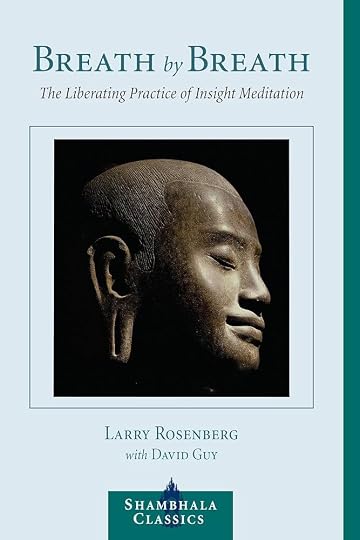
[Image: Book Cover]
Citations:
Rosenberg, L., & Guy, D. (2004). Breath by breath: The liberating practice of insight meditation (Kindle Edition). Shambhala. https://www.amazon.com (Original work published 1998).
Rosenberg, L., & Guy, D. (2014). Breath by breath: The liberating practice of insight meditation (Audiobook; E. Ballerini, Narr.). Audible Studios. https://www.audible.com/pd/Breath-By-... (Original work published 1998).
SoBrief. (n.d.). Breath by breath: Summary, audio, quotes, FAQ. https://sobrief.com/books/breath-by-b...
Title: Breath by Breath: The Liberating Practice of Insight Meditation
Author(s): Larry Rosenberg with David Guy
Year: 1998
Genre: Nonfiction — Eastern Philosophy & Meditation
Page count: 244 pages
Date(s) read: 5/28/26–6/1/26
Book 108 in 2026
What Vipassana Is
The word vipassana comes from Pali, the canonical language of Theravada Buddhism, and translates roughly as "insight," "clear seeing," or "to see things as they truly are." It is a form of meditation distinct from concentration practice — the kind of meditation in which you try to hold the mind on a single object for extended periods. Vipassana uses the breath as an initial anchor, but its deeper aim is not concentration for its own sake. It is the cultivation of a quality of awareness that can observe the contents of consciousness — thoughts, feelings, sensations, mental states — with clarity and without grasping. You are not trying to stop thinking. You are trying to see thinking as it actually is: impermanent, arising and passing, not you.
Rosenberg's book is a systematic guide to the practice described in the Anapanasati Sutra, the Buddha's discourse on mindfulness of breathing, which is reproduced in full as an appendix. The sutra outlines sixteen steps, organized into four groups of four — what Rosenberg calls the four tetrads — that correspond to the four foundations of mindfulness: body, feelings, mind, and wisdom. Rosenberg works through each group in careful, practical detail.
The Structure of the Book
The book's chapter structure follows the four tetrads directly. Chapter 1, Breathing with the Body, covers the foundational practice: finding a stable posture, establishing attention on the breath, learning the difference between directed attention and effortful concentration. The breath is always available. It is always in the present moment. This is why it works as an anchor — you cannot breathe in the past or the future.
Chapter 2, Breathing with Feelings, addresses what Buddhism calls vedana — the felt quality of experience, the pleasant, unpleasant, or neutral tone that accompanies every perception. Rosenberg's definition is broader than the everyday meaning of "feelings":
"The term feelings — sometimes called sensations — refers to everything that comes in through the sense doors, including the mind." (p. 58)
This is one of the most practically useful reframings in the book. We tend to think of feelings as emotional states — happiness, grief, anger. Vedana is more fundamental than that: it is the bare quality of attraction, aversion, or neutrality that precedes emotion and largely drives our reactions before we have had time to think. Learning to observe vedana without immediately acting on it is one of the central skills of Vipassana practice, and one with obvious clinical applications for anyone working with anxiety, addiction, or impulse control.
The chapter also contains the line that is, for me, the philosophical heart of the entire book:
"All the Buddha's teachings, it has been said, can be reduced to one: Under no circumstances attach to anything as me or mine." (p. 54)
Chapter 3, Breathing with the Mind, moves into the observation of mental states themselves — whether the mind is contracted or expansive, distracted or concentrated, agitated or calm. This is the territory Harris covers in Waking Up when he discusses the constructed nature of the self: the realization, available through sustained attention, that the sense of being a fixed, continuous "I" located somewhere behind the eyes is itself an arising phenomenon — something the mind does, not something the mind is.
Chapter 4, Breathing with Wisdom, introduces the three marks of existence — anicca (impermanence), dukkha (unsatisfactoriness), and anatta (non-self) — not as abstract doctrines but as observable facts about experience. You do not have to believe in impermanence. You can watch it directly: every breath, every sensation, every thought arises and passes. The practice is to observe this so consistently that the truth of impermanence is no longer an intellectual position but a lived reality.
Chapter 5, The Condensed Method, is where the book becomes most accessible for busy practitioners. Rosenberg quotes Ajahn Buddhadasa's elegant reduction of all sixteen steps to just two:
"1. Practice with the breathing until a certain level of concentration and calm is achieved. 2. Open the awareness to whatever arises in the mind-body process and see that it is all impermanent, unsatisfactory, and lacking an essential self." (p. 150)
This is the practice in its simplest form. Settle. See clearly. Repeat.
Chapter 6, Breathing with Daily Life, addresses the question that practical meditators always face: what happens when you get off the cushion? Rosenberg argues that formal sitting practice is the laboratory, but the real experiment is the rest of your life. The quality of attention you cultivate in formal practice gradually — very gradually — begins to infect your ordinary waking hours. You notice the vedana before you react. You catch the arising of an old habitual response before it has fully formed. This is slow work. Rosenberg is honest about that.
Chapter 7, Breathing into Silence, points toward the deeper possibilities of sustained practice — what the tradition calls samadhi, states of deep stillness and absorption that most beginning meditators will not encounter for a long time, if ever. Rosenberg discusses them without mystification and without false promises.
The Psychological and Clinical Dimensions
I want to speak specifically to mental health clinicians who may read this review, because the therapeutic applications of Vipassana practice are substantial and underutilized in Western clinical settings.
The practice of observing vedana — the felt quality of experience before emotion fully forms — is essentially the experiential dimension of what Dialectical Behavior Therapy calls radical acceptance and what CBT calls cognitive defusion. Learning to observe a feeling without immediately being that feeling is the core skill. Vipassana gives you a method for developing it that is older than any Western therapy and considerably more thorough.
The observation of impermanence has direct clinical relevance for depression and anxiety. Depression involves a cognitive style in which the present negative state feels permanent and total — "this is how things are and always will be." Vipassana practice, sustained over time, undermines this cognitive style at its root, not by arguing against it but by providing direct, repeated experiential evidence that every state — including the worst — arises and passes. Anxiety involves attachment to the future — a mental grasping at outcomes not yet determined. The practice of returning, again and again, to the present breath is a direct counter-training to this habit.
The concept of anatta — non-self — is the most difficult and the most therapeutically powerful. The clinical implications of even partially realizing that the self is a construction rather than a fixed entity are significant: reduced defensiveness, reduced rumination, increased psychological flexibility. This is not a mystical claim. It is the experiential ground of what modern psychology calls defusion in ACT (Acceptance and Commitment Therapy) and decentering in MBSR (Mindfulness-Based Stress Reduction).
Conclusion
Breath by Breath is the best traditional guide to Vipassana meditation I have read — more practical than many, more philosophically honest than most, and written by a teacher who brings both rigorous training in the Theravada tradition and the perspective of a Westerner who came to the practice as an adult. It does not require you to become a Buddhist. It does not require you to believe anything. It requires only that you sit down, pay attention to your breath, and see what is actually happening in your own mind.
That turns out to be considerably more difficult and considerably more rewarding than it sounds.
[Image: Book Cover]
Citations:
Rosenberg, L., & Guy, D. (2004). Breath by breath: The liberating practice of insight meditation (Kindle Edition). Shambhala. https://www.amazon.com (Original work published 1998).
Rosenberg, L., & Guy, D. (2014). Breath by breath: The liberating practice of insight meditation (Audiobook; E. Ballerini, Narr.). Audible Studios. https://www.audible.com/pd/Breath-By-... (Original work published 1998).
SoBrief. (n.d.). Breath by breath: Summary, audio, quotes, FAQ. https://sobrief.com/books/breath-by-b...
Title: Breath by Breath: The Liberating Practice of Insight Meditation
Author(s): Larry Rosenberg with David Guy
Year: 1998
Genre: Nonfiction — Eastern Philosophy & Meditation
Page count: 244 pages
Date(s) read: 5/28/26–6/1/26
Book 108 in 2026

November 11, 2015
I absolutely adored this book and will be reading everything I can get my hands on by Larry Rosenberg. I enjoyed that he comes from a background like mine (highly intellectual, academic, secular); I felt that helped him speak about Buddhist practices in language that felt more natural to me than many other books, even ones I've liked.
Breath by Breath is a commentary on the Anapanasati sutra: the sutra I studies with my meditation group on breathing. Rosenberg helped my understanding of Vipassana meditation more than any other author we read, especially how to do open awareness meditation. I really learned a lot from this book about what breathing meditation can do for me and how it supports wisdom meditation.
Breath by Breath is a commentary on the Anapanasati sutra: the sutra I studies with my meditation group on breathing. Rosenberg helped my understanding of Vipassana meditation more than any other author we read, especially how to do open awareness meditation. I really learned a lot from this book about what breathing meditation can do for me and how it supports wisdom meditation.
August 29, 2011
Read this in conjunction with The Meditative Path and these two books really complimented each other. This book follows the Anapanasati Sutra. The author has wonderful quotes scattered throughout. For example, "Most of the time that people get discouraged with practice, they do it to themselves. They've heard time and time again that the practice is being nobody and going nowhere, then they sit down and try to be somebody getting somewhere." The author does a good job of explaining the origin of the Pali words and scatters personal anecdotes throughout as well.
August 27, 2018
"Breath by Breath: The Liberating Practice of Insight Meditation" is the discussion of the teachings contained in the Anapanasati Sutra, an ancient Buddhist Text, which outlines the basic tenets of Buddhism that the "self" is a delusion, is at the heart of suffering and that one's breathing is an escape to that suffering leading to one's insight and liberation. I would highly recommend this book.

September 29, 2017
Breath by Breath is a very clear, insightful commentary on the Buddha's sutra on breathing and meditation. In my opinion its more of a reference book and one to be read over and over to reaffirm the integrity of your meditation practice. This is a classic and will bring insight for all those that pick it up n
January 16, 2008
oh so great! i recommend this book to any and everyone. it will make you so aware of self... well as much as a book can... that you'll be ready to do a vipassana retreat right then. which i haven't done, by the way.

March 1, 2009
"One trains oneself. . . " For anyone who really is attempting to learn mindfulness, this is a must read. Its one that I will return to time and time again as my meditation practice becomes an increasingly practical art.
January 2, 2010
I highly recommend this book to anyone looking for a clear, straightforward guide to meditation to develop insight and to work towards enlightenment. Rosenberg stress a path aht is practical and grounded in living everyday life.
November 16, 2014
One of the most impactful books I've read on my Buddhist path, Rosenberg brings personal stories to the ancient text and makes it relevant to modern life. I return to it again and again. I have it in both paper and digital versions so I have ready access to it wherever I am.
March 22, 2011
Very readable introduction to insight meditation

February 15, 2016
I've probably read this at least 2x before, but suddenly this sutra seemed to unlock all kinds of mysteries for me - it's all about the breath....
Read
August 26, 2016If you read only one book on mindfulness meditation, read this one. I can't recommend it too highly.
October 20, 2016
Not too many new ideas here. I was hoping for more exercises, instead this is filled mostly with advice on how to approach meditating that is repeated in most Buddhist books.

June 8, 2025
Definitely the most technical book on meditation I've read so far in terms of level of detail, and I think it was the best way for me to grasp the practice of "Insight Meditation”. I was quite intrigued as I'd heard it was a 16-step process, but the author did a great job of breaking it down and showing how each step kind of naturally leads into the next. This serves as a handbook to insight meditation; I would only recommend it to folks who already have some sort of meditation practice and are curious to see what other kinds are out there. It can be more intense, requires more commitment, and I don't think any lay meditator *needs* this to find peace or anything, but I found it a quite fulfilling process, and will continue working to integrate this into my life as the journey has just begun! I was pretty diligent about practicing each step (called contemplations) as it came up, doing 2 one day, the first 3 the next, the first 5 the next, etc, and I found it a great way to absorb the info.
There were plenty of fun and interesting more philosophical insights, but the author also did a good job of bringing the focus back to practical application throughout, staying true to the basis of insight meditation (which I've now learned) boils down to seeing more and thinking less.
One downside though is as much as I'd say the author is a good teacher, he suffers a bit from taking some of the basics for granted and doesn't know what it's like to be a beginner anymore. For example he mentions how if someone is new they should "start small" (which I agree with), "just doing 15 or 20 minutes on their first session", which is insane and is a recipe for driving people crazy--two to five minutes serves as a much better intro. This is just one example of the kind of thing where it's too hardcore from the get-go, but if you're able to recognize these bits and scale them down, everything can be iterated on and this tendency doesn't get in the way as much.
There were plenty of fun and interesting more philosophical insights, but the author also did a good job of bringing the focus back to practical application throughout, staying true to the basis of insight meditation (which I've now learned) boils down to seeing more and thinking less.
One downside though is as much as I'd say the author is a good teacher, he suffers a bit from taking some of the basics for granted and doesn't know what it's like to be a beginner anymore. For example he mentions how if someone is new they should "start small" (which I agree with), "just doing 15 or 20 minutes on their first session", which is insane and is a recipe for driving people crazy--two to five minutes serves as a much better intro. This is just one example of the kind of thing where it's too hardcore from the get-go, but if you're able to recognize these bits and scale them down, everything can be iterated on and this tendency doesn't get in the way as much.
Displaying 1 - 30 of 65 reviews