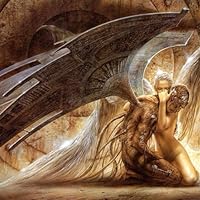
Set over two hundred years from now, in a world very much like Imperial Rome, this is the story of General Peter Black, the last decent man, as told through the eyes of his devoted (and illegitimate) daughter, Justa.
Raised on battlefields, more comfortable in the company of hard men of war than with women or other children, Justa must keep the truth of her birth hidden. Her father regards her as an embarrassment, a reminder of his one and only indiscretion. Yet she is a remarkable woman, one whose keen mind wins her an education at the feet of Emperor Mathias the Glistening himself.
All his life, General Black served the noble emperor, and, out of loyalty to the father, continues to serve his son after Mathias's death, even as the son's reign degenerates into an insane tyranny worthy of Nero or Caligula. As the rule of the empire passes from father to son with disastrous results, a strange metal plague begins slowly destroying the empire's technology, plunging the realm into chaos and the world into war. Amid the destruction and upheaval, General Black must decide whether to turn his back on the men and institutions who never loved him nearly as much as he did them, or whether to save his most trusted ally and adviser, his best friend and only real family.
The Martian General's Daughter is a gripping tale of a world at war; of cunning strategies and vile politics; of bravery, foolishness, and excess. It is at once a stirring military adventure, a cautionary tale of repeating history, a cutting satire, and a heartbreaking examination of the joys and pain inherent in the love between a father and child. Judson's previous novel was selected in multiple best-of-the-year lists. With The Martian General's Daughter, he offers another must-read epic destined to take its place in the canon of science fiction, and sure to appeal to readers of everything from Orson Scott Card to Walter M. Miller, Jr.
In the late 23rd century, the Pan-Polarian Empire reigns supreme. Covering most of the northern hemisphere of Earth, with colonies on Mars and the moons of Jupiter, the Empire knows no rivals and fears no enemies, until a mysterious metal-corroding plague begins to destroy the empire’s technology. As territories fall and borders shrink, the great Emperor Mathias the Glistening also succumbs to the plague, and the empire passes to his son, Luke Anthony--whose disastrous rule is anything but benevolent. In the years of disasters, violence, debauchery, and corruption that follow, one man, hopelessly kind, decent, and honorable, is loyal enough to serve the son as faithfully as he served the father: General Peter Justice Black, the last good man. This is his story, as told by his illegitimate daughter, Justa.
I’ve noticed, lately, that there are a lot of stories out there about the daughters of interesting people. There is a book about the bonesetter’s daughter, the abortionist’s daughter, the memory keeper’s daughter, the King of Elfland, the optimist, the heretic, the Iron Dragon. Damien Rice has a song called “The Blower’s Daughter.” I’m not going to talk about The Doctor’s Daughter. And so on. As I quickly discovered, the list is larger than I thought. Presidents’ daughters are popular; ex-Governors’ daughters, less so. But the way the trend was going, it was probably inevitable we would get a book about the Martian General’s Daughter. Next up: daughters of asteroid miners, Jovian cruise ship captains, xenobiologists, and galactic-scale feng shui enthusiasts; see also The Comet Harvester’s Daughter, The Hoovooloo’s Daughter, etc.
(Naturally, the story here wasn’t about the girl; rather, the focus was on her father, the Martian General. I suspect this is true of most, if not all, books about That Interesting Person’s Daughter, but I’m not sure I’m willing to test that theory. Judson’s always worth it, though.)
On its own, The Martian General’s Daughter is a moving story about the end of an empire, but it suffers slightly from following on the heels of Judson’s last book, Fitzpatrick's War. At nearly 500 pages, Fitzpatrick's War was a hefty and well-told future history about the rise and fall of a conqueror; at half the length, The Martian General's Daughter feels rather weak in comparison. The world of the Pan-Polarian Empire doesn't quite distinguish itself from Fitzpatrick's Yukon--it's not set in the same future earth, and it isn't a sequel or a prequel, but, when compared to FW, there's a feeling that it should be: or, more to the point, Judson should have either written The Martian General as a sequel/prequel/interquel to Fitzpatrick's War, or made more changes to make this novel stand stronger on its own.
I'm reluctant to give such harsh criticism to this novel, but it couldn't be avoided. The Martian General's Daughter is still a good story and a stern warning about the dangers of repeating history; unfortunately, it's overshadowed by its predecessor.
Still looking forward to The Comet Harvester's Daughter. Anyone?
What is America? This may seem like a strange question to ask after reading a book titled The Martian General’s Daughter. But it is the most important question that we who live in the lands today known as the United States of America must answer. Are we an empire, or a nation? If empire, can we avoid the fate Rudyard Kipling accurately foresaw for the Anglo-Saxons? “Far-called, our navies melt away / On dune and headland sinks the fire / Lo, all our pomp of yesterday / Is one with Nineveh and Tyre!” If nation, can we retrench, shedding the burdensome trappings of empire and regaining our nation, without a descent into chaos? And, whichever we choose, is America, golden America, fated merely to evanesce?
Theodore Judson wrote what may be my favorite work of modern fiction, Fitzpatrick’s War, a retelling of the story of Alexander the Great, set mostly in the twenty-seventh century A.D. Judson seems fascinated by what makes empires rise and fall, and whether this cycle can be escaped; that is the theme both of Fitzpatrick’s War and of this book. Fitzpatrick’s War, published in 2004, has proven eerily prescient, speaking of the chaos of North America in the 2020s and 2030s, and the rebuilding of a new society from the ashes of the old. As does no other book, it haunts me. Unfortunately, it is out of print and extremely expensive, as are many used books today (including this book, though it is available as an e-book, unlike Fitzpatrick’s War). I am, you will be glad to hear, working diligently to try to restore both to print.
The Martian General’s Daughter is shorter and more modest in its sweep than Fitzpatrick’s War. Despite the title, the plot has very little to do with Mars, and it is not really a work of science fiction. Rather, it is a recasting of the failing Roman Empire, compressing its last few hundred years into a few decades, fractally reflected through a retelling of the actual Year of the Five Emperors, A.D. 193. To be sure, the year here is 2293, not 193, and many different aspects of the later Empire are woven throughout, but all that is really incidental to the overall thrust of Judson’s work.
The book does begin on Mars, where Peter Black, the titular general, an aged straight-arrow military man who has served the Pan-Polarian Empire his entire life, rising in the ranks from non-commissioned officer, is overseeing a mining station on Mars. The Empire consists of all of North America, along with much of the rest of the globe north of the fiftieth parallel, and was apparently the result of some major catastrophe in earlier centuries, although the details are never specified. Technology is advanced—the Pan-Polarians have not only space flight, but beam weapons and atomic-repulsion armor. The Empire’s capital is Mexico City (now called Garden City), and while its soldiers fight wars on the borders against the Persians and the Chinese, the decayed ruling classes cluster at the imperial center, extracting what they can as things fall apart.
For falling apart they are, terminally in 2293, and rapidly in the decade prior covered by the book in flashbacks. Politically, the empire is a chaotic mass of scheming, competing interests. The emperor around whom the book centers, dead by 2293, is an analog of Commodus, one Luke Anthony (although he demands he be called “The Concerned One”). His father, Mathias the Glistening, a worthy philosopher-king, an analog of Marcus Aurelius, knew his son to be insane but nonetheless imposed his rule. Black avoids both politics and, when possible, Garden City, where his wife and two sons, with whom he has a cool relationship, live as part of the upper crust as a result of his being favored by successive emperors, who see in him a reliable, predictable tool. He prefers the frontier, where he is assisted by his amanuensis and only counsellor, his young bastard daughter, Justa, who narrates the book (and is, naturally, the titular daughter). And aside from politics, the Empire is physically falling apart, even faster than politically. Mars is soon left behind, as all the men there flee or die, suffering the same fate as the other extraplanetary outposts of mankind, on Mercury, in the Asteroid Belt, and on the moons of Jupiter and Saturn. The high works of the Pan-Polarians are consumed by the “nanomachine plague,” a weapon hatched in a Chinese laboratory, which destroys electrically-energized metal, and is the immediate cause of the collapse.
Black is a man who wants nothing more than to die in harness. He has no interest in power, yet for years he is repeatedly recalled to Garden City to either wait or serve, until assigned again to the marches. He serves Luke Anthony even though he knows that the Emperor is a very bad man, a very bad emperor, and could turn on him at any time. The Emperor’s last chamberlain is Cleander, who aims to replace the Emperor and who tries to recruit Black to help him overthrow Luke Anthony. Black refuses, preventing Cleander from killing the Emperor even when he has descended into total madness and secluded himself deep inside the palace, ignoring the world outside. Black represents the last of Pan-Polarian virtue, a combination of humility and power, rare even at the beginning of empires, and a certain sign of final disintegration when it disappears completely. Cleander exclaims that he cannot understand why Black defends the insane and erratic Emperor, and Black responds. “ ‘I understand Mathias lifted me from the ranks,’ said Father. ‘He made me a man my family could be proud to claim. He would want me to serve his son.’ ‘Mathias the Glistening is very dead,’ said Cleander. ‘We owe the dead as much as the living,’ said Father. ‘Perhaps more. We are everything they have left.’ ”
Even in a time of decay, however, it is such men who appeal, both to the masses, who seek a restoration to better times, and to the elites, who hope to manipulate such men to their own advantage. It is the latter who drive the action of this book, which opens with a letter from a man who is father-in-law to Black’s sons, in Garden City, a “fuel factor”—a middleman who has become enormously rich by corruptly selling desperately-needed fuels to the Empire. In other words, he is a commodities speculator. (I imagine most or all of the characters in this book are based on actual Romans, though my history knowledge is not detailed enough to match them all.) The letter announces that, after the rapid death of the two emperors who reign after Luke Anthony is finally assassinated, Black has been elected the new emperor by the joint unanimous acclamation of the soldiery and the people, and should return from the Amur River, in Siberia, the easternmost border of the Empire, to claim his uncontested throne. (Spoilers ahead.)
The fuel factor lies. In reality, as always in such situations, other men also desire ultimate power. The second major contender is a Turk in service of the Empire, Abdul Selin, whose power base is his extended family and the military forces they collectively control. The Pan-Polarians conquered the Turks some 150 years before, and made them satraps of North Africa; we will return to the dilution of Pan-Polarian blood as proximate cause of the Empire’s failure. Justa relates Black’s return to Earth, accompanied by his loyal men, as the nanomachines consume the mining transport pressed into service as an orbital shuttle, forcing Black and his men into escape pods, while “courageous Captain Mbasa rode the ore barge until it exploded like a supernova in the cloudless sky and was strewn across the mountains of southwestern Asia.” He makes his headquarters in Armenia, near Lake Van, and collects an army from among the Eastern forces, all of which he had earlier commanded. (It is no doubt not a coincidence that all of the Asian locations in which action takes place in this book were sites of significant events two-and-a-half thousand years before.)
Selin seizes Garden City and North America, killing many of the elites (including Black’s legitimate family). He crosses the Atlantic, defeats a third pretender in Europe, overruns Istanbul (which apparently had not been given back its correct name), and moves toward western Anatolia, where he expects to defeat Black with his larger army. But through superior tactics and luck, Black unexpectedly defeats Selin’s army near Nicaea, in Bithynia (where Pliny the Younger was governor, once upon a time). Selin barely escapes and flees back to North America, and for a moment, Black contemplates that he really could be Emperor.
But even in the few months since Black returned to Earth, the technology collapse has accelerated. Flying machines, satellite communication, and advanced weapons have all failed. Selin travels back to North America by sail. Black realizes that Selin will rule North America for a time, but not for long, and his reach will not extend outside that continent, because it is no longer physically possible. Therefore, he hatches a new plan, for himself and his polyglot army, few of whom are full-blooded Pan-Polarian, and many of whom have never seen North America and do not speak its languages. “I propose we cross into Europe and begin the world anew. That land was the home to many of your ancestors. The new diseases have depopulated many areas and left the land open for settlement by new pioneers. . . . In Europe, you will be build a new nation and I will grow old. The Empire will pass away, and in a thousand years your descendants will read of it in a language that does not yet exist, and they will wander if these things really were. And even if they think the story of our age is no more real than the tales of Camelot and Troy, those in ages hence will know who among us were villains and those who were loyal to the things they held dear.”
Justa and her father settle in Amsterdam, once again becoming relevant in an age of trade conducted by wind-driven ship. Within a few years, the Empire collapses wholly, under even worse and less competent emperors, analogs of men such as Heliogabalus. The last emperor “had reigned for only two years when the people native to the capital and to Mexico itself sacked the city and renamed it Mexico City.” North America fragments into statelets and anarchy. In her new home, Justa marries a local man, and her father dies peacefully in their garden. The book ends thirty years later, in 2323, with Justa pouring coffee for a Spanish trader, and musing to him about her already semi-legendary father. “General Black was a mixture of good and bad, as all men are. In him the good far outweighed the bad. He was also the last of his kind.”
The Pan-Polarian Empire dies because it has reached its natural end. This is no surprise, of course—every empire that has ever existed has died. For that matter, every polity before those extant at this moment has died, and if it is not conquered from outside, every polity dies in a way similar to the death of an empire, through internal decay followed by dissolution. There is no didacticism in this book, but what Judson portrays with his vivid story is an empire dying for three reasons—the end of virtue, especially of the ruling class; fragility resulting from complexity; and the collapse of Pan-Polarian vigor and will under the pressure of alien migrants, who erode the bonds of trust that characterized the empire at its height. The same three failures characterize every empire at the end. True, each dies a little bit differently and for somewhat varied ancillary reasons. Did the Roman Empire fragment, in part, because its city residents were poisoned by lead water pipes? Perhaps, but the essential causes are always these three, and incidentals are, well, incidentals.
As to the first, this is obvious and does not need further discussion. All history points to the erosion of virtue, meaning adherence to the moral beliefs and hard, self-limiting practices beneficial to the collective that always characterize the early period of any successful society or empire, as the primary internal destructor of nations, civilizations, and empires. Renewal of that virtue, at least without upheaval that makes the polity unrecognizable, has never happened. And the primary driver of failing virtue is wealth, with the caveat that it is rarely when the peak of wealth is reached that an empire crumbles, despite the corrosive effect on virtue. Rather, it is the falling backward, the shrinking of the pie (and the inevitable plugging of the holes with debt and a devalued currency), that accelerates fragmentation.
As to the second, it is well covered by Joseph Tainter in his famous The Collapse of Complex Societies. Complexity, requiring ever-more-baroque and expensive repair to maintain, always results in fragility. Complex societies are less resilient societies. Worse, this effect is today (and in this book) exacerbated by complexity’s handmaiden, technology. High technology, a new thing on the Earth, both gives and takes away. It allows accomplishment and ease, but it also heightens complexity. Moreover, the higher it is, the more likely that catastrophic acceleration of an empire’s end will result from engineered weapons, such as Judson’s nanomachine plague. I have long said that technology will accelerate our own collapse—as we fall, the ground will come up much faster than it did for the Romans. What took their empire hundreds of years will likely take us only a handful, something Judson deftly portrays.
I see no way to avoid this problem; it is what it is. We cannot turn off technology, or the drive to master and extend it. It also seems very likely that technology always exacerbates the decline of virtue, by atomizing society. It is even possible, counterintuitively, that technology may make any future successful polity or empire impossible, by layering the defects of liquid modernity over everyone everywhere, preventing any accumulation of a critical mass of men and women who can form a new virtuous, high-trust society. Along the same lines, The Martian General’s Daughter also implicitly illustrates another concern of mine—that any future society, if our civilizations fall entirely, will forever be unable to reach the heights we reached, much less advance beyond, because we have already stripped from the globe’s surface all sources of energy, as well as metals and minerals, which can be extracted without already having advanced technology. Any successors rebuilding, if they fall low enough first, will likely be unable to make forward progress; think of nineteenth-century America, but forever limited to wood and coal.
As to the third, a constant theme throughout the book, again showing Judson’s prescience, is the effect of mass immigration on the Empire, leading to ethnic dilution of the Pan-Polarians. The feet of clay of all empires has always been such dilution; the Carthaginians, for example, were ultimately defeated by the Romans because they did not breed natives and therefore turned to massive use of unreliable mercenaries. Justa herself more than once remarks on her own swarthiness compared to that of her father, the result of her nameless mother being Syrian. Black’s army is composed of aliens or half-bloods, speaking many different languages. This seems to be the typical end point of decaying empires; it was true not only in Rome, but among the Habsburgs, and it is increasingly true in the American military, though hard statistics are impossible to obtain. But, for example, videos circulate of American enlisted men speaking Mandarin to each other, and the Regime has openly floated the idea of granting rapid citizenship to any alien who will serve the American Empire, given that Americans, for very good reason, have less and less interest in joining the military.
However, the question of mass immigration and empire is much broader than what types of men compose an empire’s military. All of the Pan-Polarian Empire, at least the cities, is overrun with migrants, mostly living off the dole or earning money through small trade and the market in vice. Their presence erodes and ultimately destroys all social cohesion. “Every day on the streets there was some sort of native holiday; there were long processions and the din of trumpets and drums. No one, however, could explain to Father what was being celebrated.” When the crisis comes, the Pan-Polarians, from the highest citizen to the lowest, have nothing left in the tank. They cannot act together, and so they all fall together.
We, of course, face all three of these problems. There is little more to say on the first two, so let’s focus on the third. A few weeks ago, the political class of our nation was roiled by arguments centered around the migrants who have similarly flooded America for decades, with vast increases over the past four years. In the past, such arguments have been confined to the Right ghetto, and have had no impact whatsoever on national policy. But in these strange new days, as Donald Trump takes office, having in large part won because of American opposition to this migration, the argument immediately involved the highest levels of power.
Some maintain that America should welcome migrants, the more the better. Their core argument is that . . . [Review completes as first comment.]
The bones of The History of the Decline and Fall of the Roman Empire peek out everywhere, except that Judson compresses events going from the late afternoon of the glory of the Empire to its horrifying collapse, and turns up to eleven the corruption and imperial excesses. As a result the gripping, up-past-bedtime conclusion is a bit too extreme and unbelievable, though some Roman historical accounts may well correct my impressions.
The rot at the core of the Pan-Polarian Empire--the corruption of officials and sheer insanity of its emperor--is paralleled by its technological collapse, which is both an interesting combination and a dangerous game. As the Empire diminishes its technological reach diminishes as well, so energy weapons and holograms and other 23rd century concepts dwindle to 19th century sailing ships and projectile weaponry. It's never clear how the citizenry copes with the direct loss, and I kept wondering about the loss of mechanized agriculture. The conjured images, however, are exceedingly powerful.
The story is narrated by General Peter Black's illegitimate daughter Justa, who acts as his unofficial aide-de-camp. Despite her narration and the book title, events are more focused on her father, whose stolid simplicity and unwavering loyalty navigates him through the collapse of empire. While it never feels like _her_ story particularly, the distance of the narrator from events allows her to make piercing observations and witticisms that would be entirely out of character for her father. This wry wit buoys what could easily become a dry recitation of events, and excuses her detailed narration of scenes where she was not actually present.
The writing was passive, list-like and often an info-dump. After finishing two chapters, I felt nothing for the book or characters besides a desire to put it down, despite the markings of an intriguing plot. It reads, to me, like the outline of a novel.
I may try this again some other time - If I force myself further into it, the plot might grip me for the ride. But it is the kind of thing I’ll need to set aside a day to read - because one I have to put it down, there is no great want to pick it back up. It is unfortunate, as I see a lot of potential here.
Unfortunately I was sorely disappointed in Judson's The Martian General's Daughter. Despite this theoretically being a novel about the fall of an empire, whereas Fitzpatrick's War was supposedly about the rise of an empire, this short novel actually seems like nothing more than leftover material from his first book, despite there not being any allusion to this being the same empire as was founded in the first book.
I was somewhat glad to see a female persona in this novel, something that was lacking in Fitzpatrick's War, but there wasn't anything particularly contributed by the narrator that couldn't have been said or done by a male heir - though I suppose a general's son would have had more pressure to join the army, rather than being an unpaid advisor in that army. This unpaid advisor status was a further detriment to the story though, in that the narrator wasn't actually present at a number of the personal meetings described in the book, and rather than being made into an interesting portion of the story, was simply glossed over. The other characters - bland and uninteresting - seemed to have been recycled from Judson's earlier work, with even the general being such a boring, uninteresting character that it was difficult for me to see why the narrator, who was a potentially interesting person, felt any affection for him whatsoever.
The plot honestly felt like some sort of extenuation or cast-offs from Fitzpatrick's War - mad emperor, failing technology, poorly choreographed wars and logistics, and the narrator and her family merely trying to make it through. Nothing new was advanced, nothing interesting really ventured, other than a poorly-explained decision about how the empire deserved a madman as emperor, to ruin it completely, with no thought to the terror it would cause the numberless innocents caught in the resulting bloody implosion.
Thematically I think the author's opinions as expressed in his body of work to date - that empire is inevitable if unchecked, that empire creates monstrosities, and that empire is the only choice in the event of a technological catastrophe - were interesting in Fitzpatrick's War, but belabored and fatuous in The Martian General's Daughter.
Overall, the novel feels more like a scam than an honest literary attempt, in that the author seems to be recycling characters, plot and materials from his first novel, and in the fact that Mars and the narrator's gender have so little to do with the rest of the novel - nothing momentous even occurs during their brief stay on Mars - as to make it seem like those portions of it were added or reworked just to give this boring peice of work an interesting, eye-catching title. I really wanted to enjoy and like this next effort of the author's, based on what I had seen in his initial foray, but unfortunately had quite the opposite reaction.
This book had a lot more depth than you might first realize. First the title, Mars, the god of war, us the general's guiding light...even though it is never mentioned in the novel. Duty, Honor, Loyalty are all that are important to the general and has daughter. The book also shows how a good man fairs in a bad political system. You could almost imagine the Gladiator's General Maximus being in the same position as Peter Black; A great military leader, at home on the frontier keeping the borders safe, honorable to a fault but completely out of his league when dealing with the politics of the empire. Finally, at the beginning the old emperor explains to the general's daughter why he has chosen his corrupt son to replace him on the throne...because the empire deserves such a fate. It makes me wonder if old Marcus Aurelius thought the same thing of his empire and his son Commodus.
Good story...I look forward to reading more of Theodore Judson's books
This entire review has been hidden because of spoilers.
It was on a 50 cent rack at a book store. I got because its supposed to be a book of "strategies, and vile politics". "a stirring military adventure". At least according to the back of the book cover.
( off topic: why do we buy a book based on what the publisher says on the back cover page? Its almost as bad as buying a book for its cover! Lol)
anyway, it's short enough that I read it in one sitting. It was ok. As bit of strategy, a bit of vile politics. a George Martin book it was not.
It was an average steampunk/sci-fi/alt- history/war story about a girl and her dad.
If you see it on a rack somewhere it's only worth the $1-2 if you can't find something you want.
Despite a promising premiere in "Fitzpatrick's War" which turned the life of Alexander the Great into a charmingly bitter MilSF satire, this thinner adaptation of the "Time of the Five Emperors" lacks the richness in realization and exploitation of genre convention. It drags in places and tends to go for perversity for the sake of perversity. Most problematically, Judson struggles to develop a female voice that isn't stilted and stale, and fails.
Take "The Fall of the Roman Empire" and transplant it to about 270 years into the future and you have The Martian General's Daughter. Justa is the illegitimate daughter of General Peter Justice Black, a low-born veteran soldier, who holds onto ideals of duty and honour in a time when no-one else has any comprehension what these words mean. The book is written from her viewpoint, which is mostly as passive observer. Decades (centuries) of war and environmental damage has seen the rise of the Pan-Polarian empire, based in Mexico and encompassing most of North America. However, a "metal plague" (a nano-virus which prevents electrical machinery from working) is killing all technology and so, as the book progresses, mankind slips from high-tech (people with cyber-enhancements) into a medieval world. The story is simple; the old, kindly emperor dies and his son, Luke Anthony, becomes emperor. Luke is essentially Caligula and reigns with all the insanity and bloodshed that entails. The empire falls further and further into ruin. Lots of political scheming ensues. Mars barely features at all in the book. There are a couple of nice bits to the book, such as the explosion of new religions (my favourite being Elvis worship) and warped version of old religions. But overall, the book is highly predictable if you know your Roman history.
Wanted to check this out after I enjoyed Judson's prior work, Fitzpatrick's War. I enjoyed this - even though it's a lesser effort to FW, which is borderline lost media. (This isn't much better off in terms of legal availability, have fun with the ebay auctions.) It's a more direct allegorical tale than Fitzpatrick's War, a future space sci-fi America collapsing like the Roman Empire of the time of Marcus Aurelius and Commodus.
Justa, the protagonist, sadly doesn't have much agency or things to do as Robert Bruce in FW, who was at the center of everything going on or was directly impacted by it. There's a lot of 'I heard this happened to my father' or 'I heard that happened', and relatively little Justa does herself.
The book's depictions of a decaying empire are unflinching, grotesque, and honestly more than a little funny - it's not a bad book by any means, and a pretty easy read if you can find it. Is there better out there? Sure, but this is a great time too. I laughed out loud a lot while reading it, was disturbed a lot while reading it. 9/10, A-.
I read this years ago, then found it in the bottom of a box during a move. Which is unfortunate, as it was originally borrowed. Whoops, i'll have to return it eventually, I guess.
Theodore Judson writes science fiction that's also about the fall of Ancient Rome somehow, and he does an excellent job of it. The prose is compelling, the characters sketched simply but clearly, and The Martian General's Daughter makes for a quick, but compelling read. I loved this the first time I read it, and am very pleased to learn it's held up so well. Glad to have stumbled back on this, I'd heartily recommend it to anyone...
While I would not rate this one as high as his previous work, Fitzpatrick's War, it was a fairly decent read provided your tastes run to political science fiction.
S.M. Stirling writes that it is a "A witty, learned, amusing, and sometimes moving retelling of ancient truths ...". The only part of this I question is amusing. I found this to be a thinking persons read and not very amusing at all, though there were a few humorous scenes. This was a sad tale, as the back cover blurb will tell you, of the slow decline and collapse of empire (ala the Fall of the Roman Empire) and the latter years of a trusted old war horse, General Peter Justice Black, as told by his (illegitimate) daughter.
I had seriously considered stopping mid-book as it was very painful to watch Gen. Black, already in his middle to later years, slowly fall from prominence. Circumstances, or perhaps Lady Luck, saw fit to preserve this most honorable and dedicated defender of the empire from some of the worst pitfalls that eventually destroy an emperor and successive wanna-be's. Really, despite some of his attitudes I fell in love with Gen. Black who held on to his honor and sense of decency through some very horrific events and excesses.
I am happy that I did hang on and finish the novel as the final chapters resolved most everything quite nicely and left one with a feeling of hopelessness as yet another in a long line of empires collapses, and hope as the common folk move forward with their daily lives despite the political upheavals surrounding them.
Again, if you enjoy heavily political science fiction, this will be a welcome addition to your library - especially if you loved Fitzpatrick's War.
Again, Judson’s story takes place in futuristic Victorian age and focuses on the Pan-Polarian Empire. Not as good as Fitzpatrick’s War but it follows the same story of empire and how it corrupts those involved in it. More work could have been put into some of the other characters (Justa and General Peter Black are well done though), especially Luke Anthony, the Caligula-like emperor, who you only ever see the sadistic side of. Not as well developed as Isaac Fitzpatrick, the crazed emperor from Judson’s other book, who could incur the reader’s disgust and sympathy at the same time. General Black on the other hand is an interesting look into how easily a man could be devoted and loyal to even the most despicable of people. The way the stoyr ends also provides a similar and interesting critique on how certain people like Black and Anthony are portrayed in history, which to me only seems so true. Despite the book’s shortcomings, Judson is a great author and does a good job at developing an alternative universe. I wouldn’t be surprised if in twenty years people associate him with other authors like Sterling, Heinlein, Asimov, and Bova.
I had issues with awkward sentences. There were many run-on sentences and long sentences that made you lose your train of thought. Some information came so late in the book and at times there was information overkill. I hated the jumping around of the places as I felt things/setting wasn't fully established to the reader. Lucky, the condition of the world and the reason behind it is, just not all the locations. Maybe it is the jumping from past to present that is so confusing. I also wished that the characters were consistent. Golden, for example, is made out as a sneaky, brown nosing, con-man who is somewhat educated or at least well spoken. When we meet him we get it hammered into us that he is fat and he ends up being a pervy fat, old man who acts nothing like the letters and such.
Other characters progressed well, though. The ending was the best thing about this and not because it ended but because the last 70 or so pages were actually paced well and had good character development.
If it wasn't for the messed up sentences...2 stars it is.
I'm not sure what's up with Theodore Judson. I read Fitzgerald's War (or was it Fitzpatrick's?)and while I like the writing, the protagonist was a pathetic, naive dolt. And a whoop ass war hero. I wrote in a prior review that Judson adapt Machiavelli's advice. A protagonist can be loved or hated, but he can not be despised.
He doesn't make that mistake here, although the protagonist(s) are no one's definition of a hero. The Martian General (who's not really from Mars) is approaching senility, the story is told second person by the titular daughter.
It's another story of a falling empire in the future with low technology. FW had a lame reason, MGD had a better one. But still, wtf? Why this theme? I'm willing to give Judson another chance, because he's a fantastic writer. He needs to branch out quickly, though.
Although the title gives you the impression that most of this book is about the daughter, it's more about her fascination for and personal envelopment by her father. A man who is entirely alone as he both a man of war, faith, and honor. The adjective "martian" has less to do with the general's eventual position before seeking the title of emporer, and more to do with the alienation and sense of "other" that embodies the man.
As a Christian, the author portrayed an interesting speculation on the nature of the faith in the future. It speculated on Christianity's competition with new religions, mass persecution at the hands of "more rational individuals", and eventual survival all happening in the next 300 years.
Not as fun or original feeling as his "Fitzpatrick's War", but a similar feel of historical accounts looking backwards and forwards at events of imagined future history. Similar to the declining eras of Rome, a Marcus Aurelius-like Emperor of a transcontinental empire fails to appoint a proper successor and the last honorable General tries to be obedient and salvage what he can of the Empire at the same time. All sorts of thoughts on language, philosophy, warfare, technology & culture inform the action and leave one wistful and doubting ideas like progress, honor, etc. Nano technologies and biological warfare destroy anything we might consider modern technology like metals, computers, electricity and the Emperors "fiddle while Rome burns," or as Judson has them act, "fly kites".
I would have given this book four stars but for the ending. The ending seemed a bit glossed over and incongruent with the rest of the story. I didn't think final chapter was bad on its own but it just fit with the feel of the rest of the narrative. I think it could have been done better. I still enjoyed this book. I would it rate this 3.5 stars if I could.
Judson has followed up 'Fizpatrick's War' with another alternate future story about empire. The book actually feels a bit like a prequel to his previous effort. The Martian Generals daughter is a story about the end of an empire, in the case the 'Pan-Polarian' rather than Fitzpatricks Yukons. While Fitz was a take on Alexander the great this is the story of Romes dissolution.
I enjoyed it, although not nearly as much. It really suffers a bit from 'more of the same' syndrome in some ways. I would recommend it to fans of empire stories but really I would continue to recommend Fitzpatrick's War instead.
Told from the point of view of the titular daughter, this book regales the final death throws of an empire bloated with decadence and corruption. The main character, the general, is perhaps the last honest man, a true believer of the empire and all its ideals. Although set in the future, technology doesn't play a roll in the telling. Or rather, this book could have taken place while Nero fiddled and Rome burned.
For a second time, Judson has written a very engaging sci/fi book that is a thinly veiled allegory for the fall of the Roman empire. Fitzpatrick's War is vastly superior, but this book is not without its charms.
Like Judson's previous effort Fitzpatrick's War, this is a "future history" of a technologically-regressed Earth. It's well-written and has an interesting setting, but the story lacks a certain "oomph" that would make it a page turner and a 5-star effort.