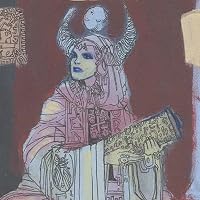
Evangeline Walton’s The Song of Rhiannon is based on the third branch of the ancient Welsh mythological cycle, the Mabinogion. The novel was first published in 1972 as number 51 in the Ballantine Adult Fantasy Series edited by Lin Carter, with fantastic wraparound cover art by David Johnston. Before I read Carter’s introduction, I had been under the impression that Walton had completed novels based on all four branches of the Mabinogion in the 1930s, with only one of them actually published at the time—The Virgin and the Swine (1936), later reprinted as The Island of the Mighty in the Ballantine series in 1970. However, Carter’s comments suggest that Walton finished writing at least The Song of Rhiannon as late as the early 1970s, encouraged by Carter himself.
Of the three volumes I have read so far, The Song of Rhiannon is the weakest. Both The Prince of Annwn and The Children of Llyr are far stronger as coherent narratives. The Song of Rhiannon does meander toward a satisfactory conclusion, but its sections fit together somewhat incongruously. Perhaps the third branch of the Mabinogion is itself structurally disconnected. Walton does explain in a postscript how she altered the original tale, though perhaps she could only change so much without compromising its integrity as a retelling of the old legends.
It is interesting to consider Walton’s tetralogy as occupying a middle ground between mythology and the modern fantasy genre. These books are clearly not a simple recasting of the old legends in contemporary language—Walton reshapes them in accordance with her own literary aims. Having now read three of the volumes, I am not entirely sure whether I like this technique. I would have preferred either a faithful recounting of the Mabinogion or a wholly original fantasy inspired by it. Walton’s series seems to fall somewhere between the two. Perhaps reading The Island of the Mighty will help clarify my opinion.
The Song of Rhiannon begins with Mannawyddan and Pryderi returning to the Island of the Mighty (i.e., Britain) after the disastrous war in Ireland recounted in The Children of Llyr. They settle in Dyved with Rhiannon—Pryderi’s mother and formerly Pwyll’s wife —and Kigva, Pryderi’s wife. The story centers on these four characters. It was particularly enjoyable to read more about Mannawyddan, the good and wise son of Llyr, who also played a major role in The Children of Llyr.
Pryderi, the young and inexperienced king of Dyved, precipitates the group’s adventures through his impulsive and ill-considered decisions. Monsters, magic, and strange events abound throughout the book, though—as mentioned—it reads more like a sequence of loosely connected episodes than a unified narrative. Walton’s prose is strong, though occasionally uneven.
I’m glad to be reading these novels to gain a better sense of the old Welsh legends. I’m curious to see how the narrative develops in the fourth and final volume, The Island of the Mighty.