

What do you think?

Mr. Matisse and His Cutouts
Mr. Matisse is a painter with "the sun in his tummy." His colors make everyone happy. But one day he becomes ill and has to have a major operation. When he wakes up in a white hospital room, he misses his colors. 'Bring my brushes! Bring my paint!' But the sheets are not smooth and taut like canvas. And the walls and ceiling are too far away. What will he do now?
32 pages, Hardcover
First published January 1, 2014
Ratings & Reviews
Friends & Following
Create a free account to discover what your friends think of this book!
Community Reviews
Displaying 1 - 30 of 34 reviews

September 19, 2016
The joy of drawing ‘paper jokes’ with scissors
’I am creating directly with colour. It’s what I’ve been striving for all my life.’
Mr. Matisse and His Cut-Outs is a charming picture book created by the Dutch writer and illustrator Annemarie Van Haeringen, commissioned by the Stedelijk Museum Amsterdam, in relation to the 2015 exhibition The Oasis of Matisse.
The original Dutch title refers to the monumental mural that was at the heart of the exhibition, The parakeet and the Mermaid, a gouache on paper, cut and pasted, dating from 1952. Matisse, unable to leave the house because of his health, called this work ‘a little garden around me where I can walk’.

The cut-outs represent the final stage of Matisse’s creative life, a radical new method of making art by cutting shapes out of painted paper and arranging them into vivacious decorative compositions by pinning them to the walls. Although Van Haeringen only tells part of the story on the origins of Matisse’s use of the cut-out technique, relating it solely to his illness, her little book offers a great starting point to bring the great artist to the attention of the young (7-12); it could also stimulate adults to consider Matisse’s art and life more closely. Initially, like many traditional painters, Matisse used paper cut-outs to plot the design of works in other materials, using textile patterns inspired by the weaving traditions of his birthplace. In the late 1930s, he used cut-out slips of paper as aide-memoirs and tools in the composition of his paintings and projects to conceptualize them.

More than just associating Matisse’s cut-out murals with his then limited physical abilities, the simplicity of the flowing shapes illustrates his assiduous search for the ultimate purity of form and the bare essence of beauty. Starting with a with a swallow to cover a stain on the wall, and a fish, Matisse eventually became inspired by his travel memories - having visited Tahiti 15 years ago. The beauty of the lagoons, the brilliant tropical colours and the traditional Tahitian fabrics provided him with abundant imagery consisting of pomegranates, algea, seaweed, leaves, coral, birds and women - like in the two large silk-screen pieces made on sand-colored linen, Oceania, the Sky and Oceania, the Sea.
While most of his French contemporaries put away the cut-outs collages as ‘paper jokes’, or even ‘the pictorial maunderings of second childhood’ of an old man, Matisse’s friend and perpetual rival Picasso was moved by the beauty of this soaring period in Matisse’s art. It were Picasso’s words which inspired Van Haeringen to write Matisse had the sun in his tummy: ‘In the end, everything depends on one's self, on a fire in the belly with a thousand rays. Nothing else counts. That is why, for example, Matisse is Matisse. He's got the sun in his gut.’
Visiting the Matisse exhibition and another one on the late work of Rembrandt with our children in Amsterdam in 2015, I expected them to rave on the brightness and playfulness of Matisse’s paintings and colourful cut-outs. To my astonishment, I was wrong - it proved quite a challenge to enthuse them. They both preferred Rembrandt and uttered ‘I could do that. It’s so simple!’ about Matisse. Finding out he needed assistants to help him create his work in this last phase, they were shocked he didn’t entirely ‘create’ his art himself. Matisse, confined to his bed or a wheelchair after surgery, was fully transparent on the help of his assistants who meticulously followed his instructions on the arrangement of the cut-outs, climbing up and down the ladder to pin them to the walls of his studio, directing them to rotate and position the slices of paper. As there is no accounting for tastes, we ended up in discussing another topic instead, the role of assistants and apprentices in art, even more pertinent now the children were so much more in awe for Rembrandt’s paintings – like Rubens well-known for his large workshop and many pupils.

With this vivid and spirited story about Matisse’s cut-outs and his unyielding impetus to create beauty and colour regardless of his physical impediments, this picture book reminded me of the endearing portraits of his three grandchildren Matisse drew from his bed on the ceiling with a fishing rod in 1950. The drawing can be seen in the gorgeous museum dedicated to Matisse in his place of birth Le Cateau-Cambrésis – definitely vaut le voyage, whatever Le Guide Vert says – bumptious as ever on modern art.

My honest thanks goes to Netgalley, the publisher North South Books and Annemarie Van Haeringen for the ARC.
’I am creating directly with colour. It’s what I’ve been striving for all my life.’
Mr. Matisse and His Cut-Outs is a charming picture book created by the Dutch writer and illustrator Annemarie Van Haeringen, commissioned by the Stedelijk Museum Amsterdam, in relation to the 2015 exhibition The Oasis of Matisse.
The original Dutch title refers to the monumental mural that was at the heart of the exhibition, The parakeet and the Mermaid, a gouache on paper, cut and pasted, dating from 1952. Matisse, unable to leave the house because of his health, called this work ‘a little garden around me where I can walk’.
The cut-outs represent the final stage of Matisse’s creative life, a radical new method of making art by cutting shapes out of painted paper and arranging them into vivacious decorative compositions by pinning them to the walls. Although Van Haeringen only tells part of the story on the origins of Matisse’s use of the cut-out technique, relating it solely to his illness, her little book offers a great starting point to bring the great artist to the attention of the young (7-12); it could also stimulate adults to consider Matisse’s art and life more closely. Initially, like many traditional painters, Matisse used paper cut-outs to plot the design of works in other materials, using textile patterns inspired by the weaving traditions of his birthplace. In the late 1930s, he used cut-out slips of paper as aide-memoirs and tools in the composition of his paintings and projects to conceptualize them.
More than just associating Matisse’s cut-out murals with his then limited physical abilities, the simplicity of the flowing shapes illustrates his assiduous search for the ultimate purity of form and the bare essence of beauty. Starting with a with a swallow to cover a stain on the wall, and a fish, Matisse eventually became inspired by his travel memories - having visited Tahiti 15 years ago. The beauty of the lagoons, the brilliant tropical colours and the traditional Tahitian fabrics provided him with abundant imagery consisting of pomegranates, algea, seaweed, leaves, coral, birds and women - like in the two large silk-screen pieces made on sand-colored linen, Oceania, the Sky and Oceania, the Sea.
While most of his French contemporaries put away the cut-outs collages as ‘paper jokes’, or even ‘the pictorial maunderings of second childhood’ of an old man, Matisse’s friend and perpetual rival Picasso was moved by the beauty of this soaring period in Matisse’s art. It were Picasso’s words which inspired Van Haeringen to write Matisse had the sun in his tummy: ‘In the end, everything depends on one's self, on a fire in the belly with a thousand rays. Nothing else counts. That is why, for example, Matisse is Matisse. He's got the sun in his gut.’
Visiting the Matisse exhibition and another one on the late work of Rembrandt with our children in Amsterdam in 2015, I expected them to rave on the brightness and playfulness of Matisse’s paintings and colourful cut-outs. To my astonishment, I was wrong - it proved quite a challenge to enthuse them. They both preferred Rembrandt and uttered ‘I could do that. It’s so simple!’ about Matisse. Finding out he needed assistants to help him create his work in this last phase, they were shocked he didn’t entirely ‘create’ his art himself. Matisse, confined to his bed or a wheelchair after surgery, was fully transparent on the help of his assistants who meticulously followed his instructions on the arrangement of the cut-outs, climbing up and down the ladder to pin them to the walls of his studio, directing them to rotate and position the slices of paper. As there is no accounting for tastes, we ended up in discussing another topic instead, the role of assistants and apprentices in art, even more pertinent now the children were so much more in awe for Rembrandt’s paintings – like Rubens well-known for his large workshop and many pupils.
With this vivid and spirited story about Matisse’s cut-outs and his unyielding impetus to create beauty and colour regardless of his physical impediments, this picture book reminded me of the endearing portraits of his three grandchildren Matisse drew from his bed on the ceiling with a fishing rod in 1950. The drawing can be seen in the gorgeous museum dedicated to Matisse in his place of birth Le Cateau-Cambrésis – definitely vaut le voyage, whatever Le Guide Vert says – bumptious as ever on modern art.
My honest thanks goes to Netgalley, the publisher North South Books and Annemarie Van Haeringen for the ARC.

November 30, 2018
I read this because of Ilse's typically wonderful review, so I won't add much to what she says, and you can see some of the book there. But the point of this picture book, which is mainly for children, maybe ages 4-8 (and their parents, and anyone who loves art), is that Matisse was sick and wanted more color in his life, so even confined to a wheelchair, he transformed his environment with color and shapes and light.
Early on we learn that one of the best colorists in the history of art had the "sun in his soul," but later he gets "sick in the stomach," which for adults means abdominal cancer. Recovering, he saw white walls, white sheets, essentially blank pages all around him, so he decided to cut out and color wild shapes and paste them on the walls. Annemarie van Haeringen splashes the pages in the manner of Matisse; her point of the book for children's to try to be positive and create when you are in a low period, but really, this approach represented a remarkable new art form.
Here is a MOMA link about Matisse's cut-out process:
https://www.moma.org/interactives/exh...
Early on we learn that one of the best colorists in the history of art had the "sun in his soul," but later he gets "sick in the stomach," which for adults means abdominal cancer. Recovering, he saw white walls, white sheets, essentially blank pages all around him, so he decided to cut out and color wild shapes and paste them on the walls. Annemarie van Haeringen splashes the pages in the manner of Matisse; her point of the book for children's to try to be positive and create when you are in a low period, but really, this approach represented a remarkable new art form.
Here is a MOMA link about Matisse's cut-out process:
https://www.moma.org/interactives/exh...

June 18, 2016
What a wonderful book for children with artistic interests (and their adults). It deserves to be read with parents and by adults too. The underlying story presents Matisse having to go to the hospital due to stomach problems (not specifically outlined for children readers). He has surgery and then is confined to bed, unable to use the paints and brushes that he so loves. So what does he do? He invents a new form of expression for his art -- cut out shapes of varying forms and colors.
This book is a riot of color and shape and demonstrates how one can make the use of one's skills even when other abilities may be limited. It also shows how art can be a collaborative effort. I've always enjoyed Matisse's colorful art cutouts and now that I know their history, I believe I love them even more.
Definitely recommended
A copy of this book was provided by the publisher through NetGalley in return for an honest review.
This book is a riot of color and shape and demonstrates how one can make the use of one's skills even when other abilities may be limited. It also shows how art can be a collaborative effort. I've always enjoyed Matisse's colorful art cutouts and now that I know their history, I believe I love them even more.
Definitely recommended
A copy of this book was provided by the publisher through NetGalley in return for an honest review.

March 15, 2026
Dutch illustrator and author Annemarie Van Haeringen shows with her 2014 picture book De parkiet, de zeemeermin en de slak (and which is titled as Mr. Matisse and His Cutouts in Jan Michael's 2016 English language translation, with the Dutch title referring to a monumental mural of a parakeet, a mermaid and a snail that was the pièce de resistance of a 1952 Matisse exhibition) how when French artist Henri Matisse because of serious illness (because of an abdominal cancer that nearly cost him his life) was no longer physically able paint and sculpt using traditional methods, he then created colourful paper cutouts (basically a combination of sculpture and painting) and which allowed Matisse to still and constantly do art in spite of serious physical mobility challenges.
Now in Mr. Matisse and His Cutouts Van Haeringen (and of course by extension the translator as well) imagines that Henri Matisse discovers the process of creating cutouts in his hospital bed after serious and debilitating abdominal surgery (and yes, both my inner child and even more so adult I do find the presented text for Mr. Matisse and His Cutouts just a wee bit simplistic, not overly so, but I guess that we both do kind of want a bit more textual meat so to speak, and indeed, even in a picture book aimed at and conceptualised for children).
However and this having been said, Annemarie van Haeringen's illustrations for Mr. Matisse and His Cutouts, they are so spectacular, they are so aesthetically wonderful that the verbal basicness can easily and totally be mostly forgiven, with van Haeringen using delicately nuanced colour, brilliant hues as well as monochrome to skilfully depict and mirror what is being textually presented regarding Henri Matisse's cancer struggles, regarding his pain both emotional and physical at not longer being able to do art the traditional way and of course also Matisse's joyful triumph with the bright and vividly hued paper cutouts (and with van Haeringen's pen and ink and watercolour artwork depicting Matisse's famous red studio, his hospital room and the transformation of the hospital room into a garden of colourful and visually delightful, art and totally, utterly life as well as joy affirming paper cutouts).
And just to say in conclusion that while Annemarie van Haeringen paying visual tribute to Henri Matisse by incorporating elements of his style (vivid colours and shapes) into her illustrations for Mr. Matisse and His Cutouts is aesthetically delightful and that the brief biographical note is appreciated, it definitely is kind of annoying that no examples of Henri Matisse's actual artwork is included and featured in Mr. Matisse and His Cutouts (and that my four star rating is therefore nicely solid but is also rather generous of me).
Now in Mr. Matisse and His Cutouts Van Haeringen (and of course by extension the translator as well) imagines that Henri Matisse discovers the process of creating cutouts in his hospital bed after serious and debilitating abdominal surgery (and yes, both my inner child and even more so adult I do find the presented text for Mr. Matisse and His Cutouts just a wee bit simplistic, not overly so, but I guess that we both do kind of want a bit more textual meat so to speak, and indeed, even in a picture book aimed at and conceptualised for children).
However and this having been said, Annemarie van Haeringen's illustrations for Mr. Matisse and His Cutouts, they are so spectacular, they are so aesthetically wonderful that the verbal basicness can easily and totally be mostly forgiven, with van Haeringen using delicately nuanced colour, brilliant hues as well as monochrome to skilfully depict and mirror what is being textually presented regarding Henri Matisse's cancer struggles, regarding his pain both emotional and physical at not longer being able to do art the traditional way and of course also Matisse's joyful triumph with the bright and vividly hued paper cutouts (and with van Haeringen's pen and ink and watercolour artwork depicting Matisse's famous red studio, his hospital room and the transformation of the hospital room into a garden of colourful and visually delightful, art and totally, utterly life as well as joy affirming paper cutouts).
And just to say in conclusion that while Annemarie van Haeringen paying visual tribute to Henri Matisse by incorporating elements of his style (vivid colours and shapes) into her illustrations for Mr. Matisse and His Cutouts is aesthetically delightful and that the brief biographical note is appreciated, it definitely is kind of annoying that no examples of Henri Matisse's actual artwork is included and featured in Mr. Matisse and His Cutouts (and that my four star rating is therefore nicely solid but is also rather generous of me).

August 13, 2016
This is a fun children's book about Matisse and how he started making collages while he was in the hospital. The illustration are charming and the biography at the end, following the story, is short but comprehensive. I found the handling of his illness as the sun in his tummy a bit confusing, but overall charming for fans of the artist.
Copy provided by publisher and NetGalley
Copy provided by publisher and NetGalley

June 22, 2016
'Mr. Matisse and His Cutouts' by Annmarie van Haeringen is a about a specific time in the aging painter's life, and it presents a rather nice lesson on thinking differently about the things we like to do when we can not longer do them.
We are introduced to Henri Matisse as an artist who has the "sun in his tummy" with the beautful way he used colors in his paintings. In the book, this is explained as going to the hospital for some "stomach problems" which is a good way of telling childres that in the latter years of his life, Henri Matisse was diagnosed with abdominal cancer and that left him bed and chairbound. Since he could no longer paint the same way, he came up with another way of bringing color to the world with his cutouts.
The illustrations don't attempt to reproduce Matisse's art, but the colors are vibrant and the lesson about thinking differently about how to do things is clear. It's a well written and colorful picture book for children.
I received a review copy of this ebook from Nort South Books Inc. and NetGalley in exchange for an honest review. Thank you for allowing me to review this ebook.
We are introduced to Henri Matisse as an artist who has the "sun in his tummy" with the beautful way he used colors in his paintings. In the book, this is explained as going to the hospital for some "stomach problems" which is a good way of telling childres that in the latter years of his life, Henri Matisse was diagnosed with abdominal cancer and that left him bed and chairbound. Since he could no longer paint the same way, he came up with another way of bringing color to the world with his cutouts.
The illustrations don't attempt to reproduce Matisse's art, but the colors are vibrant and the lesson about thinking differently about how to do things is clear. It's a well written and colorful picture book for children.
I received a review copy of this ebook from Nort South Books Inc. and NetGalley in exchange for an honest review. Thank you for allowing me to review this ebook.

September 3, 2016
A few years ago, I had the opportunity to visit the Matisse museum in Nice where they have loads of his cutouts on display. I think if I were taking a child there this would be an excellent introduction to Matisse's art. The book is colorful and gives some background information on Matisse and his life. But if I weren't either taking a child to an art exhibit or teaching them about art in some way, then I don't know that this would be interesting subject matter for them.

June 15, 2016
"I'm creating directly with color.
It's what I've been striving for all my life."
Mr. Matisse and His Cutouts is a children's nonfiction picture book. After a severe illness, renowned artist Henri Matisse is bedridden in a bare, white room. Despite his pain, he still has the insatiable need to create and fill the walls with color. Since painting is difficult, he begins creating art by cutting shapes out of paper and arranging the shapes into stunning compositions, with the help of an assistant. When he is able to return home, he continues to create using the cutout method. (I found this informative article about the process at The Museum of Modern Art's website.)
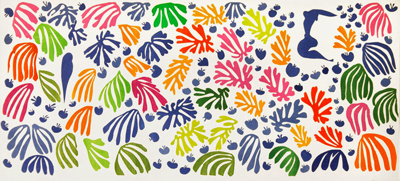
(The Parakeet and the Mermaid. 1952)
The illustrations fit the subject perfectly. Sometimes the shapes swirl around the pages, mimicking the movement in Matisse's artwork. The illustrator uses the vibrant colors of Matisse's color palette. At the end, there are a few paragraphs of biographical information.
What struck me most about the story was Matisse's instinctive need to create and how he kept creating despite his physical challenges. When his illness made it difficult to paint, he didn't give up; he devised a new way to create. I recommend this book, especially for children who enjoy making artwork. It would be so fun to create cutout collages with your child when you finish reading!
He couldn't sleep, and he wouldn't take a sleeping pill.
"I might lose all the beautiful images if I did."
_____________________________
Thank you to North South Books Inc. & NetGalley for a copy of this book in exchange for an honest review. This does not affect my opinion of the book or the content of my review. Publication Date: September 1, 2016
It's what I've been striving for all my life."
Mr. Matisse and His Cutouts is a children's nonfiction picture book. After a severe illness, renowned artist Henri Matisse is bedridden in a bare, white room. Despite his pain, he still has the insatiable need to create and fill the walls with color. Since painting is difficult, he begins creating art by cutting shapes out of paper and arranging the shapes into stunning compositions, with the help of an assistant. When he is able to return home, he continues to create using the cutout method. (I found this informative article about the process at The Museum of Modern Art's website.)
(The Parakeet and the Mermaid. 1952)
The illustrations fit the subject perfectly. Sometimes the shapes swirl around the pages, mimicking the movement in Matisse's artwork. The illustrator uses the vibrant colors of Matisse's color palette. At the end, there are a few paragraphs of biographical information.
What struck me most about the story was Matisse's instinctive need to create and how he kept creating despite his physical challenges. When his illness made it difficult to paint, he didn't give up; he devised a new way to create. I recommend this book, especially for children who enjoy making artwork. It would be so fun to create cutout collages with your child when you finish reading!
He couldn't sleep, and he wouldn't take a sleeping pill.
"I might lose all the beautiful images if I did."
_____________________________
Thank you to North South Books Inc. & NetGalley for a copy of this book in exchange for an honest review. This does not affect my opinion of the book or the content of my review. Publication Date: September 1, 2016

June 21, 2016
I knew about Matisse's large, colourful beautiful paintings, I was not aware of his paper cutout collage type works.
"Mr. Matisse and His Cutouts" is a children's nonfiction picture book. After a severe illness where he has abdominal surgery and ends up in a bare, white hospital room, artist Henri Matisse needs colour. Despite his pain, he still needs to create and fill the walls with color. He tries to paint but for various reasons that does not work, so he he begins creating art by cutting shapes out of paper and arranging the shapes on the walls and ceilings of his room, with the help of an assistant. When he is able to return home, he continues to create using the cutout method to create various works.
"I'm creating directly with color. It's what I've been striving for all my life."
He couldn't sleep, and he wouldn't take a sleeping pill. "I might lose all the beautiful images if I did."
The language and illustrations in this book are creative, artistic and use the colours that Matisse so loved. This is a wonderful book when looking at various types of art, the history of art, creativity, perseverence and more. Parents and teachers could read this book with children, then create cutout masterpieces.
There was a short biography at the end of the book to give a little more information. I learned more about this artist from reading this short book. It would be a great addition to a school library.
I received a copy of this book from Netgalley in exchange for an honest review.
"Mr. Matisse and His Cutouts" is a children's nonfiction picture book. After a severe illness where he has abdominal surgery and ends up in a bare, white hospital room, artist Henri Matisse needs colour. Despite his pain, he still needs to create and fill the walls with color. He tries to paint but for various reasons that does not work, so he he begins creating art by cutting shapes out of paper and arranging the shapes on the walls and ceilings of his room, with the help of an assistant. When he is able to return home, he continues to create using the cutout method to create various works.
"I'm creating directly with color. It's what I've been striving for all my life."
He couldn't sleep, and he wouldn't take a sleeping pill. "I might lose all the beautiful images if I did."
The language and illustrations in this book are creative, artistic and use the colours that Matisse so loved. This is a wonderful book when looking at various types of art, the history of art, creativity, perseverence and more. Parents and teachers could read this book with children, then create cutout masterpieces.
There was a short biography at the end of the book to give a little more information. I learned more about this artist from reading this short book. It would be a great addition to a school library.
I received a copy of this book from Netgalley in exchange for an honest review.
June 18, 2016
This book taught me something I did not know: why Henri Matisse started making art from paper cutouts. Matisse became ill and was stuck in a boring, white hospital room -- yet he was used to a world filled with color. He did not let circumstances stand in his way, but rather he found a way through those circumstances to satisfy his artistic soul.
The illustrations of the portion of the book with the cutouts are vivid and bright. I do wish there were examples of the collages that Matisse made later after this period of inspiration in the hospital. Children reading the book would enjoy seeing the art that was created, and it would be helpful to see how the ideas he had when he was stuck in the hospital led to wonderful artistic compositions later on.
Overall, this was a quick, enjoyable, and informative book. My students have limited exposure to art, and I constantly try to find ways to give them ways of learning about and experiencing art. This book would fit nicely with other books about art in the classroom.
I received my ARC from NetGalley.
The illustrations of the portion of the book with the cutouts are vivid and bright. I do wish there were examples of the collages that Matisse made later after this period of inspiration in the hospital. Children reading the book would enjoy seeing the art that was created, and it would be helpful to see how the ideas he had when he was stuck in the hospital led to wonderful artistic compositions later on.
Overall, this was a quick, enjoyable, and informative book. My students have limited exposure to art, and I constantly try to find ways to give them ways of learning about and experiencing art. This book would fit nicely with other books about art in the classroom.
I received my ARC from NetGalley.

August 22, 2016
This book is elegant, artistic, and inspiring. That being said, I probably won't be ordering a copy for the library, because I'm not sure that it will have a wide enough appeal.
The artwork is lovely, and Matisse's passion for art is evident and contagious. There's a confusing bit about his abdominal cancer being caused by the sun leaving his belly, but perhaps it's easier to understand than explaining all of the details of his illness.
I would recommend this book for one-on-one reading with children interested in art, or even for children whose loved one is facing a serious illness. It may help them understand how the individual may not be able to do all of the exact things they used to do, but they still have the same passions and can find other ways to fulfill them.
As an adult, I enjoyed the book, and am feeling a bit more inclined to appreciate beauty around me, and to try to contribute to it.
Thanks to Netgalley for making this book available in exchange for an honest review.
The artwork is lovely, and Matisse's passion for art is evident and contagious. There's a confusing bit about his abdominal cancer being caused by the sun leaving his belly, but perhaps it's easier to understand than explaining all of the details of his illness.
I would recommend this book for one-on-one reading with children interested in art, or even for children whose loved one is facing a serious illness. It may help them understand how the individual may not be able to do all of the exact things they used to do, but they still have the same passions and can find other ways to fulfill them.
As an adult, I enjoyed the book, and am feeling a bit more inclined to appreciate beauty around me, and to try to contribute to it.
Thanks to Netgalley for making this book available in exchange for an honest review.

June 16, 2016
This sweet little picture book tells in simple terms why Matisse, who is know for such paintings as this:
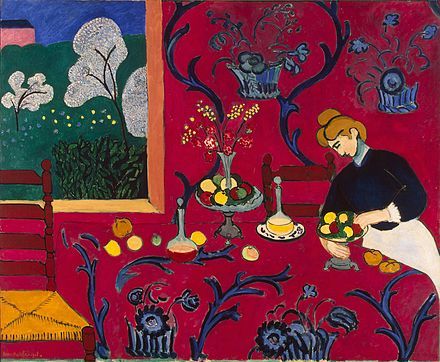
and this:

started creating cut-paper illustrations such as this.

In beautiful watercolor illustrations, the illustrator/author traces how Mattise had stomach cancer, and so couldn't stand up to do his paintings, but still wanted to create beauty in the world.
Delightful, and colorful. Great way to teach about famous painters, and art.
Thanks to NetGalley and NorthSouth for providing this book for an honest review.
and this:
started creating cut-paper illustrations such as this.
In beautiful watercolor illustrations, the illustrator/author traces how Mattise had stomach cancer, and so couldn't stand up to do his paintings, but still wanted to create beauty in the world.
Delightful, and colorful. Great way to teach about famous painters, and art.
Thanks to NetGalley and NorthSouth for providing this book for an honest review.

July 25, 2016
A wonderful introduction for youngsters to this artist,
Illustrations are true to Matisse's style - bold, clear lines show his work, and muted, slightly messy, subdued colors represent his life.
The narrative text is simple but full of details. Interesting that the author used the word, "But" to begin a number of sentences. This would be great to use with youngsters (and adults!) who make excuses to help them see that there are ways to overcome or work around or through the daily challenges we all face.
I wonder why the author used 'Mr.' in the title...
This is a much better intro to Matisse than "The Iridescence of Birds: A Book About Henri Matisse"
by Patricia MacLachlan but as a teacher or librarian, I would use both in a purposeful lesson about art or the genre of biographies.
Illustrations are true to Matisse's style - bold, clear lines show his work, and muted, slightly messy, subdued colors represent his life.
The narrative text is simple but full of details. Interesting that the author used the word, "But" to begin a number of sentences. This would be great to use with youngsters (and adults!) who make excuses to help them see that there are ways to overcome or work around or through the daily challenges we all face.
I wonder why the author used 'Mr.' in the title...
This is a much better intro to Matisse than "The Iridescence of Birds: A Book About Henri Matisse"
by Patricia MacLachlan but as a teacher or librarian, I would use both in a purposeful lesson about art or the genre of biographies.

June 27, 2016
I received this book in exchange for an honest review.
There are very few things I love more than children's books about art and artists. They were my favorites as a child and they're still my favorites now. I can't wait for my children to read this one! It's adorable, colorful, and tells a lovely story about a wonderful artist. Hooray!
There are very few things I love more than children's books about art and artists. They were my favorites as a child and they're still my favorites now. I can't wait for my children to read this one! It's adorable, colorful, and tells a lovely story about a wonderful artist. Hooray!
July 7, 2016
This book is a terrific introduction to Matisse. I think that this book will spark questions, discussions and potential creative endeavors on the part of the children who read it. I do agree with another reviewer that I would have liked to have seen more examples of his art, but again, this could just add another opportunity for further exploration.

April 12, 2015
Mijn recensie van 'De parkiet, de zeemeermin en de slak' verscheen op Cutting Edge
http://www.cuttingedge.be/boekenstrip...
http://www.cuttingedge.be/boekenstrip...
October 29, 2016
Beautiful!

June 16, 2020
Note: I received a digital review copy of this book from the publisher through NetGalley.

October 28, 2017
First published in Holland, this book captures the visual energy of Matisse's cutouts and color. It is also helpful in positioning the artist and his style in his later-life circumstances (when artists are stereotypically supposed to be over the hill), demonstrating how he applied his skill and vision to the form that emerged from his circumstances, not just the pure work of his imagination. The book can also serve as a jumping-off point for an art exercise with color, scissors, and paper.

July 9, 2020
A really fun read about how Henri Matisse started in paper cutouts: he got sick, had surgery and couldn't paint! So he started paper cutouts and attached them all over the walls!! I love his work and these illustrations were so fun, we used this and 3 other books for a summer art project inspired by him
July 30, 2017
This is a very pretty book and an excellent introduction to Matisse and his work for children. The focus on illness, while important historically, feels a bit out of place in this context.
September 27, 2019
K-3, great with paired activity

June 16, 2020
This book is absolutely beautiful. I now know a part of Matisse's life I didn't know. I have seen the cutouts at the Modern Art Museum in DC. They are beautiful. Definitely worth seeing.

Read
June 30, 2018HCPL Juv Nonfiction 759.4 Hae
Mr. Matisse is a painter with "the sun in his tummy." His colors make everyone happy. But one day he becomes ill and has to have a major operation. When he wakes up in a white hospital room, he misses his colors. 'Bring my brushes! Bring my paint!' But the sheets are not smooth and taut like canvas. And the walls and ceiling are too far away. What will he do now?
Personal note: This could be used for the MFAH art camp.
Mr. Matisse is a painter with "the sun in his tummy." His colors make everyone happy. But one day he becomes ill and has to have a major operation. When he wakes up in a white hospital room, he misses his colors. 'Bring my brushes! Bring my paint!' But the sheets are not smooth and taut like canvas. And the walls and ceiling are too far away. What will he do now?
Personal note: This could be used for the MFAH art camp.

March 2, 2017
I found this biography to be a little to simple for anyone I could possibly imagine using it for. It is over the heads of K-2 and way to simple for anyone else. I would have liked to see at least one photograph of his cutwork, but that wasn't there either. It's not a total loss, but not great.

September 23, 2016
Cute introduction to Matisse and his cutouts. I for one was not aware that it started when he was in the hospital recuperating.

July 26, 2016
I put together an artist study unit last year for kindergarten and first grade. It was very difficult to find artist books that were informative, fun and inspiring. This would have been amazing to have back then.
This book focuses on the artist Matisse and tell a wonderful story in a manner that will keep kids and adults entertained. The e book copy has issues with formatting (like most picture books in ebook format) but it was still coherent and fun. I loved this and I will be grabbing the physical copy when it comes out and recommending it to my local library!
This book focuses on the artist Matisse and tell a wonderful story in a manner that will keep kids and adults entertained. The e book copy has issues with formatting (like most picture books in ebook format) but it was still coherent and fun. I loved this and I will be grabbing the physical copy when it comes out and recommending it to my local library!

June 22, 2016
I liked this biography about Henri Matisse that is clearly meant for little kids. The only thing I didn't like was I felt like it was pandering to the little kids by saying he had a tummy ache and had to go to the hospital for an operation. I wish there was a way to tell kids about his abdominal issues without using such vague terms.

June 28, 2016
This book can be easily used for teaching children about the works and life of Matisse. I've found the illustrations more inspired than the text though. Wish there were more images and even some useful exercises for the children that could help more familiarity with the artist and his work.
Disclaimer: Book offered by the publisher via NetGalley.com
Disclaimer: Book offered by the publisher via NetGalley.com

September 1, 2016
Matisse, a painter, gets a stomach illness and has to have an operation. While recuperating, he discovers he is unable to paint. He begins to make cutouts and have people pin them to the wall. In the months it takes him to heal, he makes his room a paradise.
Beautifully illustrated picture book. For ages 4 through 8.
Beautifully illustrated picture book. For ages 4 through 8.
Displaying 1 - 30 of 34 reviews