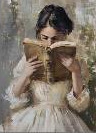
VERSION: Retold Beaumont. ADAPTATION: 1 star ARTWORK: 3 stars. BEAUTY: Redhead. BEAST: Lion and ram mix. CURSE: "A wicked fairy" did it, the reason is implied. THE Rs: Warped. KEY ELEMENT CHANGED: The sisters are vilified, the role of the fairy is enlarged, and the relationship between Beauty and Beast has problematic elements not present in the fairy tale. FAVOURITE SCENE:
Two things to sum up my feelings on this book: one, it's a great pity that Michael Hague's art is paired up with such a poor retelling of the tale, and two, this is a dream come true for those with a unicorn fetish.
The book, which is a retelling of Beaumont with a bit from Villeneuve (the dream of Beast sequence) and not an adaptation, has problems from the very beginning, when Deborah Apy, the adapter, wastes paper on a useless detour about the sisters talking nonsense about dresses and social class and dissing Beauty behind her back. They're far worse in this version than in the original, and Apy doesn't avoid any chance she has to vilify them even more. They are given names here, too, which makes me notice a curious trend for naming the sisters in the versions where they're made to be eviler than they should be. And also, another curiosity: in this version, their father is upset at how cruel and spoiled they are, but he claims he can do nothing. Well, he could start by not spoiling them rotten and giving them everything they ask even when there's no money for it.
The unicorns don't bother me, I neither like nor dislike them, but in fairness it's rather excessive. They're mentioned six times in the text, and depicted in the illustrations as well. The maiden and unicorn medieval trope doesn't belong in B&B, so why include it here? To please the artist? Not a good choice, because it's a forced and artificial inclusion.
But the most troubling change is the one made to Beauty and Beast's relationship. For one, Beauty is terribly repulsed by Beast for too long, she actually feels "shock and repulsion" at his proposal of marriage, and when he asks her if she finds him ugly, she bluntly tells him that "Yes, that is true." None of the kindness and tact of the tale's Beauty is found here. And it's not just outwardly, because inwardly, she thinks "how terrible must it be for him to be so very ugly." Rather looks-fixated, this girl.
And here's one of two lines that troubled me because of what they imply:
Still, as she returned to her room, she could not help but be thankful that the Beast apparently did not intend to press himself on her often.
I hope I'm not reading too much into this line, but honest to goodness it does read as if Beauty expected Beast to demand sex from her. She thinks the above line after he's asked her to marry him and on her way to her bedroom, so the implication is clear to me. Furthermore, Beast does become creepy and actually INVADES her bedroom in a later scene. One night, Beauty opens her window and looks into the palace grounds, seeing nothing, but she hears noises that appear to be of Beast hunting. She doesn't make the connection, but when she falls asleep, Beast enters her bedroom whilst Beauty sleeps, shuts the window and then goes to stand by her bed, looking at her longingly "for hours," with "blood dripping from his hands."
So yeah, the rape subtext is heavy and clear enough.
I almost stopped reading there. This is crossing a line I'm not willing to forgive. B&B has its issues, but one thing it doesn't have is a stalker and rapey Beast. No amount of good art is going to salvage such a book for me.
Beauty and Beast have so little interaction, too, before she suddenly goes from "dreading his arrival" and "struggling with her repugnance for him" to eagerly "anticipate Beast's visits with pleasure." Why does it happen? Because. The plot says it must happen, so it happens. And Beauty gets so many dreams with the fairy (and the stupid unicorn) that literally tell her what's happening, but she is still too dumb to notice even when the prince appears in the dream to basically tell her she's cruel and should look past appearances. For all the time spent on useless wanderings that could've been invested in developing their relationship, have them engage in conversations and get to know each other like in the tale, this book wastes 80 pages in pure chaff.
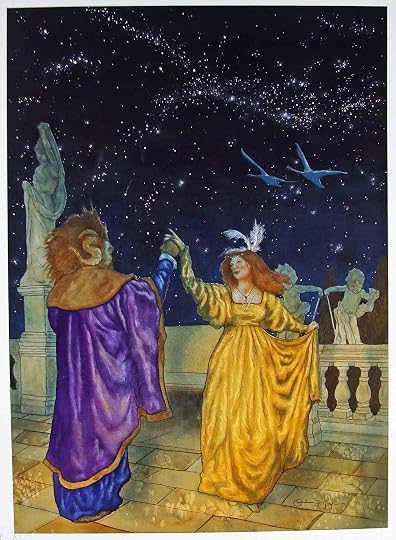
And as I said before, not even Michael Hague's great art suffices to save this for me. Perhaps the one salvageable thing is that this book is the only one where there's a dance scene between Beauty and Beast, which Disney copied. Look at the illustration I included above, even the colour arrangement was copied by Disney: blue for Beast, yellow for Beauty. And this is a book from 1980, so long before Disney.
I wish I remembered the Cocteau film better, because this reminded me of it, minus many visual details. Lot of focus in the nastiness of the sisters and the whininessangst emotions of the Beast. Quite heavy on the Stockholm Syndrome.
Lovely although not particularly moving illustrations by the famed Michael Hague appear in full pages every fourth page or so. This version has a LOT of text -- 45 full pages of writing, not counting the illustrations. I wouldn't try reading this to or with a small child.
Green Tiger Press was a children’s book publisher which created wonderful-to-look-at reading gems during the 1980s. Alas, Simon & Schuster gobbled them up in 1990 and that was that. I feel lucky whenever I can get my hands on a Green Tiger book because of their commitment to turn even basic stories into glorified pages of glory and wonder. This rendition of the old tale is such a book.
The fairytale is adapted by Deborah Apy Kohen and is told with such detail that the reader never loses involvement with the story. We first learn about the patriarch of Beauty’s family and all that he has had to endure. Then the family comes into focus. This is more than just a Disney version, as the evil sisters are fine supporting characters, full of envy and selfishness.
The magic castle of the Beast awes the reader, which means a small child would be enthralled. And when the maned hero/antihero finally emerges, we know there will be a test to see who can prove their worth in a world that rewards greed.
Someone spent a lot of time designing this fantasy. The text is in Palatino Italic, which works well here. Normally, italic fonts drive me crazy but here they work magic, like the Beast himself. The layout is simple with two pages of text accompanied by a full-page color plate (!) mounted to every third page. And since the illustrations are by Michael Hague, the reader is treated to a world of magic. The textured paper is a lovely champagne color wrapped in between a terracotta softcover binding. All in all, a lovely presentation. I’m not sure it should ever touch a child’s hand because of the potential damage, but an adult reading this to a child while showing the artwork would open up a world of astonishment to a young tyke.
Originally published in 1980 by the Green Tiger Press - a small, independent publisher based in Seattle, WA, that produced beautifully illustrated fairy-tales, and other children's books - and then reprinted in this 1983 edition by Holt, Rinehart and Winston, Deborah Apy's retelling of the classic French story of Beauty and the Beast is based upon the version first recorded by Mme. le Prince de Beaumont in 1756, and accompanied by the artwork of Michael Hague. Text-heavy for a picture-book (one might almost say it was more of an illustrated chapter-book, with the occasional full-page illustration), the tale will be engrossing for older readers interested in the genre, but undoubtedly beyond the younger children who are normally considered the target audience for picture-books.
I enjoyed this version, which I have owned for some years, but never seem to have gotten around to, although I did find myself wondering, as I read through, just how faithful it was to the le Prince de Beaumont version. It's been a few years since I read Zipes' translation (which is probably the best available in English), but I don't recall there being any unicorns in the fairy-tale, not even in the dreams sent by the good fairy watching over Beauty during her stay in the Beast's palace. Then again, Michael Hague is known for his depiction of unicorns (as well as teddy-bears, oddly enough), so perhaps Apy deliberately inserted them into her story, in order to provide him the opportunity to include them in his paintings? I think I will have to reread the original again, sometime soon, to make sure!
In any case, I appreciated the artwork in this Beauty and the Beast, although I didn't (as is usual with Hague's work) love it. I grew up on his version of The Wizard of Oz, and can never really dislike his work, as a consequence, but it is never exactly what I want, either. His Beauty simply doesn't appeal to me, and his Beast is an odd mix of lion and ram. On the other hand, the scene where Beauty and her father open the chest and are surrounded by butterflies (in the original? or not?) is irresistibly magical, as is the scene in which the winged fairy floats outside Beauty's curtained bed. All in all, this is a retelling with both narrative and artistic appeal, despite being somewhat uneven, and although it will never be one of my favorites (for that, see: Max Eilenberg and Angela Barrett's Beauty and the Beast, or Nancy Willard and Barry Moser's version), I do recommend it to readers interested in exploring diverse interpretations of this classic tale.
The illustrations are lovely. I have no idea why the Unicorn is there. At least the prince didn't do anything to deserve being cursed. Unfortunately Apy makes very weird choices narratively. I think she was trying to draw on the Cocteau version but made the scenes weirder and more troubling. For instance, the Beast watches Beauty sleep while blood drips off his hands for hours. Why? Probably because the Cocteau version had a similar scene but Beauty was awake and told him he was out of line. The names for the sisters were also similar to the Cocteau version. While the sisters aren't amazing in the original version they aren't nearly as horrible as in this version. Or it could be drawing on the 1979 horror fantasy version called Panna a Netvor. But we can't know for sure because she doesn't say exactly what her influences are. I can only say that some of her weirder and more sinister additions seem to be drawing on film adaptations. Though it could also be drawing on some of the Beauty and the Beast type stories which are not from France and have weirder elements to them.
More an illustrated fairy tale than a picture book. The retelling by Apy follows the classic story fairly closely but I can't really recall a unicorn being in the original. Beauty's brothers are mentioned near the beginning but don't feature much in the story nor are they depicted in the artwork.
The illustrations are typical Michael Hague. Lush & detailed and often featuring fairies, goblins and of course unicorns. I was happy to see Beauty riding side saddle on the journey to the Beast's castle.
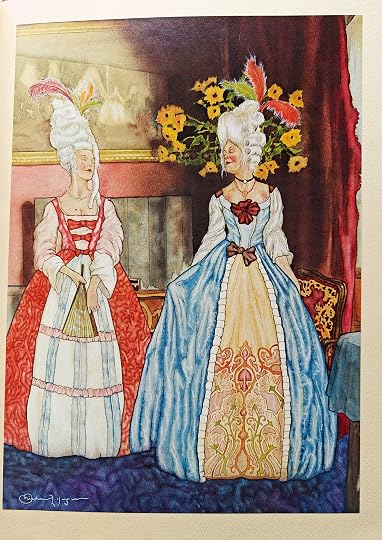
The sisters and the merchant seem to be in 18thc attire but Beauty is mostly shown in earlier, more renaissance styles. Beast is rather leonine- almost looking like the cowardly lion except that he has long curling horns.
I'm not really big on the good fairy or fairy godmother aspect that is an important part of this retelling. Guess I prefer my Beauty to figure things out on her own rather than having some magical guardian hit her over the head with prophetic dreams.
The illustrations are richly detailed, but lack some quality that give them grace and life. However, the text is more worthy of attention than many fairy tale picture books, and includes some oft' ignored details in the story.
This is my favorite non-Disney version of Beauty and the Beast. There are so many elements in this tale that are not in any other. From how Belle discovers what is happening, to how the Beast is portrayed, it reminds me a lot of the old Faerie Tale Theater episode of this story.
The tone is very atmospheric and mysterious. As the story unfolds you meet a wide variety of magical characters, and learn things just as Belle does.
The illustrations are amazing as well, as is everything Michael Hague does. Absolutely beautiful. A wonderful version of a favorite tale.
There are some nice ideas presented that are unique to this adaptation of the Beauty and the Beast fairy tale, which made me interested in this version (there’s a unicorn; I almost put the book back, before I saw the full page illustration on one of the pages).
There are a lot of nice things about this version of Beauty and the Beast. Deborah Apy's retelling of the fairy tale doesn't stray far from its source material, and Michael Hague's illustrations are very well done in a style that hearkens back to the Golden Age of children's picture books.
The reason I didn't rate this any higher is that it would seem the appeal of this version may be somewhat limited (notwithstanding, the book was created in 1980). The book is text-heavy, and the formal composition of the illustrations suggests it may not be well-suited for younger children. I think older readers would probably be inclined to read the tale without the illustrations or choose another version.
Such a beautiful telling of the story. Some versions can get a bit creepy, but this version was truly a sweeping fairy tale. It also focused on love rather than passion, which I think is important when this story is told. And the beast was not a horrible, angry person; he was more mournful and sad, which made Beauty's growing affection for him seem less Stockholm-syndrome-esque. It let me forget the Disney version and just soak into a lovely world for a few minutes.
This sumptuously illustrated picture book takes the familiar tale and embellishes it, drawing us into the background and personae surrounding the titular characters. Beauty’s sisters actually get monikers, Jeanette and Adelle. (However, the three sons of the merchant remain nameless, a curious omission.)
The story progresses with enough detail to make you understand the merchant’s circumstances, his love for his children and his determination to see them well taken care of, even to the point of argument and negotiation when one of his lost ships comes back to port. We see the struggle he has to keep Beauty out of the Beast’s clutches and her equal resolve to stay as the Beast’s captive in her father’s stead.
The story contains unexpected changes: a chest filled with butterflies, swans incongruously sporting parts from other animals and a hall filled with exotic birds, e.g. The one omission that provoked me was the final revelation of the prince. While the book contains lavish pictures, the prince doesn’t get a corresponding image. Instead, the reader is treated to a stunning, lovely image of a unicorn. It’s incredibly lovely with its overlong fetlocks and a flowing beard. But it’s an unsatisfying substitution.
This picture book is an excellent treasure with truly magnificent and detailed images accompanying the text. Children who like adaptations of this French conte will find this very enjoyable.